135
HEIDL: Learning Linguistic Expressions with Deep Learning
and Human-in-the-Loop
Yiwei Yang1, Eser Kandogan2, Yunyao Li2, Walter S. Lasecki1, Prithviraj Sen2 1Computer Science and Engineering, University of Michigan - Ann Arbor
2IBM Research - Almaden, San Jose, CA
{yanyiwei, wlasecki}@umich.edu,{eser, yunyaoli, senp}@us.ibm.com
Abstract
While the role of humans is increasingly rec-ognized in machine learning community, rep-resentation of and interaction with models in current human-in-the-loop machine learning (HITL-ML) approaches are too low-level and far-removed from human’s conceptual models. We demonstrate HEIDL, a prototype HITL-ML system that exposes the machine-learned model through high-level, explainable linguis-tic expressions formed of predicates represent-ing semantic structure of text. In HEIDL, human’s role is elevated from simply eval-uating model predictions to interpreting and even updating the model logicdirectlyby en-abling interaction with rule predicates them-selves. Raising the currency of interaction to such semantic levels calls for new interac-tion paradigms between humans and machines that result in improved productivity for text analytics model development process. More-over, by involving humans in the process, the human-machine co-created models generalize better to unseen data as domain experts are able to instill their expertise by extrapolating from what has been learned by automated al-gorithms from few labelled data.
1 Introduction
Machine learning (ML) is an inherently iterative process where humans, ML experts, play a cen-tral role. Experts decide which features to include, hyperparameters to tune, metrics to evaluate, and whether the desired level of quality has been at-tained, failing which they iterate all over. Tradi-tionally, to understand a predictive model one usu-ally begins by examining the model’s predictions with little understanding of the inner workings of the learned, black-box model. More transparent representations of predictive models, such as first-order logic (a dialect with human-interpretable se-mantics), allows understanding the inner
work-ings of the learned model, but traditional tech-niques (Muggleton,1996) to learning these are too brittle for real-world data, as they fail to learn any-thing unless there exists a logic program that can perfectly separate the data according to its labels. Deep learning has been used to successfully learn rule-based predictive models (Cohen et al.,2017;
Yang et al.,2017;Evans and Grefenstette, 2018) from data with noisy labels. Besides interpretabil-ity and explainabilinterpretabil-ity, other advantages of learn-ing a logical model include the promise of im-proved generalization to unseen data due to the strong inductive bias provided by the predicates employed (Evans and Grefenstette,2018).
Human-in-the-loop machine learning (HITL-ML) approaches aim to provide humans with the ability to interact with the model that goes be-yond simply examining model predictions. Hu-mans need to be able to interpret, explain, and rea-son about models throughout the model develop-ment cycle, especially in domains where labeled training data is too limited to learn a model that generalizes well to unseen data, we need to be able to interpret and examine machine learning mod-els. The above-mentioned works that utilize deep learning to learn a logical theory raise new oppor-tunities and challenges since their precise syntax is more readily interpretable by humans that allows for new ways for humans to interact with machine learned models at levels that go far beyond just in-specting predictions.
with deep learning for text analytics, inspect them, show their inner workings by exposing how they operate on examples, and even breaking them apart into their constituent predicates and adding new ones to create new expressions in the process. HEIDL enables domain experts to instill their ex-pertise into a machine-learned model thus result-ing in a co-created one that has superior general-ization performance than what is achievable by hu-mans or machine learning optimization algorithms alone while incurring a fraction of human labor thus increasing the productivity of the overall text analytics model development process.
To evaluate HEIDL’s efficacy, we conducted a user study where IBM’s data scientists used HEIDL to improve linguistic expressions for clas-sifying sentences extracted from real-world, le-gal contracts. Since contracts may be proprietary, the initial learned linguistic expressions fed as in-put to HEIDL were trained on IBM procurement contracts while the test set consisted of non-IBM procurement contract sentences. Within30 min-utes, each data scientist produced linguistic ex-pressions with training set precision, recall up-wards of75%representing a significant reduction in model development time since trawling through
> 28,000training sentences to construct linguis-tic expressions from scratch would require multi-ple weeks of effort. In terms of prediction quality, while a black-box long short-term memory net-work trained by replacing tokens with GloVe em-beddings (Pennington et al.,2014) produces44%
F1 on held out non-IBM procurement contract sentences, the linguistic expressions modified by data scientists via HEIDL produces55%F1 trans-lating to a 25% improvement in out-of-domain generalization performance. We emphasize that HEIDL is not specific to the task described here and may be useful for learning linguistic expres-sions for any classification task. Moreover, the main ideas embodied in HEIDL may be helpful for building tools to learn explainable models for applications beyond classification.
2 Related Work
Human computation integrates human effort into computational processes to complete tasks that cannot yet be done by computer. Prior work has focused on using crowdsourcing to facilitate and scale human computation. For instance, crowd-powered systems have been developed to
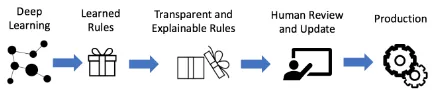
sup-Figure 1: Overview of our approach
port continuous conversations (Lasecki et al.), edit rules governing UI behaviors described in natu-ral language (Lee et al.), support natural language editing of papers (Bernstein et al.), and create novel stories (Kim et al.). There is also work on evaluating task design tradeoffs on crowdsourced text annotations(Snow et al.) and (Jiang et al.). Our approach draws on human computation by leveraging domain experts to create a more gen-eralizable model even when data is scarce.
Prior work in HITL-ML has focused on elicit-ing knowledge from people to create more power-ful models. For example, research has introduced ways to solicit examples from people for labels to strengthen the training data, e.g., through active learning (Settles and Craven) queries that select the most informative item from an oracle to re-duce labeling effort. In SEER (Hanafi et al.,2017), people select few examples for the system to learn information extraction rules. In AnchorViz (Chen et al.), people explore semantically related exam-ples to find feature blinded items. Other work has focused on interactive clustering where people guide the model by changing the clusters (Smith et al.) and providing keywords (Sherkat et al.), and on eliciting feedback from experts to select relevant features (Micallef et al.). We also elicit user input to improve a model, but our approach presents understandable output, allowing users to directly modify it by selecting trusted rules.
3 Approach
Fig.1 shows an overview of our approach where we begin by learning linguistic expressions from labeled data using deep learning followed by us-ing our system to explain said expressions to do-main experts so they can verify and modify these. We briefly explain how to derive predicates from semantic linguistic structures, then describe how deep learning is used to construct linguistic ex-pressions before describing our system.
3.1 Semantic Linguistic Structure (SLS)
[image:2.595.307.525.65.110.2]pro-Figure 2: UI allows users (1) to get an overview of linguistic expressions (2) filter by precision, recall, and F1, (3) rank, (4,5) filter by predicates, (6) remove expressions by predicate, (7) examine metrics and (8) examples for each expression, (9) monitor overall progress as users add and remove expressions to their collection, and (10) provide a ‘playground’ allowing users to examine and modify expressions.
cessing techniques such as semantic role labeling and syntactic parsing. It captures “who is doing what to whom, when, where and how” described in a sentence as depicted by the following example (simplified for readability).
John
| {z } agent
bought
| {z } action
daisy
| {z } theme
for Mary
| {z } beneficiary
yesterday
| {z } context:temporal
.
SLSs may be used as predicates to form linguistic expressions. For sentence classification, we ex-tract SLSs using SystemT’s (Krishnamurthy et al.,
2009) semantic role labeler including but not lim-ited to actions/verbs and various arguments of the action such as agent (doer of the action), ob-ject of the action and manner in which it is per-formed. From these, we construct: 1) predicates that test properties of the action such as tense, as-pect, mood, modalclass, voice and polarity, and 2) predicates generated by looking up the extracted verb (bases), agents, objects etc. in dictionaries. For the user study task, we have access to a multi-tude of hand-crafted dictionaries that contain sur-face forms for verb (bases), objects, themes etc. We emphasize that HEIDL is not specific to a par-ticular set of predicates and can work with any set of predicates that allow us to learn initial, high quality linguistic expressions. Just like many other text analytics applications, and particularly for the domain of legal contracts, dictionary match predi-cates offer one way to achieve this.
3.2 Deep Learning Linguistic Expressions
As mentioned in Section 1, recent works use neural networks to learn a logical theory. Two powerful and extremely general formulations that can learn from noisy labeled data virtually any kind of logic program, including linguistic ex-pressions for classification, are TensorLog ( Co-hen et al., 2017) and ∂ILP (Evans and Grefen-stette,2018). Describing the accompanying learn-ing algorithms is out of scope for this demo pro-posal but we describe the weighted rules model representation to ground our system and better describe the input to HEIDL. Given predicates
P = {pred1, . . .predm} and binary class labeled data D = {(x1, y1), . . .(xn, yn)} such that each labelyi ∈ {0,1} andxi denotes a sentence, the
weighted rules model associates a non-negative weight with each rule or linguistic expression1:
w1 : `(x)←pred11(x)∧. . .pred1k1(x)
.. .
wN : `(x)←predN1 (x)∧. . .predNkN(x)
Intuitively, if sentencexsatisfies a linguistic ex-pression thenxinherits the corresponding weight; the higher the weight the greater the chance of the sentence being assigned the label, i.e. `(x)
1
[image:3.595.104.491.61.276.2]is true. While learning a model based on logic provides strong inductive bias that can help reg-ularize the learned model and better generalize to unseen data, due to limited labeled data in many real-world applications (e.g., enterprise settings where privacy and proprietary ownership restricts the size of the training set) the risk of overfitting is not completely eliminated. Moreover, the pres-ence of weights can hamper explainability since humans are much better at interpreting logical ex-pressions. Our goal is to take a weighted rules model such as described above and modify it to a fully explainable, more generalizable model that consists of a set of linguistic expressions follow-ing simple yet powerful disjunctive semantics, in other words, sentencexis assigned the label ifany
of the expressions hold true for it, which is where HEIDL comes into the picture.
3.3 User Experience
Unlike classical HITL-ML, our approach allows people to interact with machine-learned linguistic expressions and facilitate co-operative model de-velopment. There are two primary challenges: (1) present users with a quick overview of learned ex-pressions; enable them to organize, order, and nav-igate expressions effectively, (2) help understand each expression’s semantics and quality through examples and statistics; deepen understanding by providing a ‘playground’ to verify and modify ex-pressions while examining impact (see Fig.2). Be-low we describe some of the user experience fea-tures in more detail to address these challenges.
3.3.1 Overview, Rank, Filter
Initially, the system presents all machine-learned linguistic expressions along with their precision, recall, and F1 measures (relevant for classification tasks). Users can rank and filter to organize the ex-pressions to process them. Ranking allows users to quickly see the expressions with high performance on training data and is especially useful when the list of expressions is large. Filtering allows users to narrow down to a small set of similar expres-sions without being overwhelmed. Users can fil-ter expressions by setting a minimum threshold on multiple performance measures. Users can also filter expressions by their constituent predi-cates. Filtering by predicate is useful when the users reckon an expression potentially generaliz-able, and would like to see similar expressions that share common predicates.
3.3.2 Linguistic Expression Selection
The end goal of the system is to create a col-lection of trusted linguistic expressions. To do so, after evaluating an expression, users would add it to the ‘approved’ or ‘disapproved’ collec-tion. When an expression is approved, the com-bined performance of all approved expressions is recomputed. This helps users to keep track of their overall progress. To help users assess expres-sions, HEIDL provides a random sample of up to 4 true positive and 4 false positive matching ex-ample sentences. Each exex-ample is decorated with annotations highlighting the constituent predicates that form part of the expression when the cursor hovers on it (Fig.2).
While HEIDL shows the performance of each linguistic expression individually, they may be misleading as the sentences retrieved by the ex-pression may be already covered by other expres-sions that have already been approved. HEIDL provides a ‘look ahead’ feature to see the potential ‘delta’ effect of adding the expression to the ap-proved collection so users can see if approving the expression would be beneficial, in which case they can take a closer look by reading its associated ex-amples, or examine it in ‘Playground’ mode.
3.3.3 Playground
HEIDL provides a Playground mode that allows users to inspect and modify linguistic expressions by adding or dropping predicates, and examine the effects. While playing with expressions, users can also examine the ‘delta’ examples. If a predicate is dropped, then the expression becomes more gen-eral, thus retrieving more sentences than it pre-viously did. Conversely, if a predicate is added fewer sentences are retrieved and HEIDL shows examples of the difference. This is beneficial be-cause it allows users to see the effect of individual predicates. Adding new predicates is especially useful if experts have a sense for which predicates are potentially good. Performance measures and examples are updated accordingly, helping users decide whether or not to keep the modification.
4 Salient Results from a User Study
scientists. The task was to label sentences with
Communicationwhich implies some form of com-munication between the two parties involved in the contract. The training data consists of28,174 sen-tences extracted from149IBM procurement con-tracts and the held out, test data consists of 1259
sentences extracted from 11 non-IBM procure-ment contracts. The initial set of 188 weighted linguistic expressions learned using deep learning performed at67%F1 (the harmonic mean of pre-cision and recall) on the test set. Note that, as mentioned in Section3.2, weights can lead to lack of explainability. Thus the data scientist’s task is to use HEIDL to generate from this initial set of linguistic expressions, a smaller set expressed in pure first-order logic that achieves maximal per-formance on the out-of-domain test set. For each data scientist, we initialize HEIDL with the initial linguistic expressions, the training set sentences, and the corresponding predicates and dictionaries. Our baseline is a well established sentence clas-sification neural network, based on bi-directional long short-term memory (LSTM). More precisely, the LSTM replaces the tokens in the input sentence with their corresponding 300-dimensional GloVe embedding, computes an intermediate hidden state which are then max-pooled, fed into a fully con-nected layer and ReLU activation before passing it through sigmoid activation to get a probability of predicting the label. To improve training of the LSTM, we employed a variety of dropout regular-izations: variational dropout after the embedding lookup layer, weight dropout in the LSTM layer, and dropout in the fully connected layer.
Each user took roughly 30 minutes to build a model that performed to their satisfaction on the training set (recall that, data scientists did not have access to the held out test set) which is far less effort than what would be required if writing lin-guistic expressions from scratch (by our estimates, person-weeks to cover the close30,000sentences in the training set). Moreover, users selected fewer expressions compared to deep learning’s weighted rules (5-8 vs. 188) indicating that HEIDL helps learn parsimonious models thus aiding explain-ability. Most importantly, HEIDL improves gen-eralization. We did a post-hoc analysis, measur-ing F1 for all combinations of sets of rules learned by the 4 participants. We report the averages and standard deviations respectively for teams sizes: 1: .32(SD=.17), 2: .46(SD=.1), 3: .52(SD=.06),
and 4: .55(SD=0), showing that F1 increases with team size. On average, teams of 3 produced a F1 of .52 on the test set, as compared to .44 pro-duced by the LSTM, which lacks explainability. We can potentially create a model with less hu-man effort if high expertise exists (i.e., one of our participants subsumed the others in all combina-tions), if we can determine expertise beforehand. We also chose the top-K best rules from the initial set of linguistic expressions (where K was deter-mined by optimizing over the training set) which produced .41 on the test set. These results indi-cate that using HEIDL, data scientists can instill their domain expertise into learned linguistic ex-pressions and achieve superior out-of-domain gen-eralization than using supervised learning alone while incurring far less human effort than writing rules from scratch.
5 Demo Overview
BesidesCommunication, other useful labels for la-beling sentences in legal contracts includeTerm & Termination (sentences that state contract termi-nation clauses) andPayment Terms(sentences that mention payments). The demo will provide an op-portunity for attendees to use HEIDL to solve such classification tasks by developing binary classi-fiers in the form of linguistic expressions. Atten-dees will be able to access the 28,000 sentences extracted from IBM procurement contracts and ex-plore the initial188linguistic expressions learned using deep learning formed out of183predicates along with their associated dictionaries to get a feel for what it takes for a data scientist to develop linguistic expressions for such a challenging real-world domain. In our experience, the first good linguistic expressions usually takes a few seconds of exploration to identify using HEIDL’s ranking and filtering features. For example, consider the line:Notices may betransmitted electronically
video (https://youtu.be/kicfGDMKu-w) shows HEIDL in action.
6 Conclusion
Our taxonomy contains many more labels rele-vant to the contracts domain, each requiring de-velopment of linguistic expressions. Testimonies from data scientists confirm that for all labeling tasks, HEIDL was extremely useful. HEIDL is not specifically designed to work with a specific set of predicates nor with rules learned solely using deep learning. As long as the text analytics clas-sification task provides a set of dictionary match-ing predicates from which a learner can produce accurate initial linguistic expressions, HEIDL can help domain experts instill further domain exper-tise into them. Even if the domain expert does not modify the linguistic expressions, tools such as HEIDL provide a useful control point that al-lows humans to verify the model before deploying it which should prove useful in enterprise settings. HEIDL’s rule-centric interface provides an inter-esting counter-point to other HITL-ML methods such as active learning and SEER which are more example-centric. HEIDL is meant to improve pro-ductivity of domain experts and while we hope to perform further evaluations in future (on other tasks e.g., sentiment labeling), initial results have yielded promising results.
References
Michael S. Bernstein, Greg Little, Robert C. Miller, Bj¨orn Hartmann, Mark S. Ackerman, David R. Karger, David Crowell, and Katrina Panovich. Soy-lent: A word processor with a crowd inside. In
UIST.
Nan-Chen Chen, Jina Suh, Johan Verwey, Gon-zalo Ramos, Steven Drucker, and Patrice Simard. Anchorviz: Facilitating classifier error discovery through interactive semantic data exploration. In
IUI.
William W. Cohen, Fan Yang, and Kathryn Rivard Mazaitis. 2017. Tensorlog: Deep learning meets probabilistic dbs. CoRR.
Richard Evans and Edward Grefenstette. 2018. Learn-ing explanatory rules from noisy data. JAIR.
Maeda F. Hanafi, Azza Abouzied, Laura Chiticariu, and Yunyao Li. 2017. Synthesizing extraction rules from user examples with seer. InSIGMOD.
Youxuan Jiang, Catherine Finegan-Dollak, Jonathan K Kummerfeld, and Walter Lasecki. Effective crowd-sourcing for a new type of summarization task. In
NAACL.
Joy Kim, Justin Cheng, and Michael S. Bernstein. Ensemble: Exploring complementary strengths of leaders and crowds in creative collaboration. In
CSCW.
Rajasekar Krishnamurthy, Yunyao Li, Sriram Ragha-van, Frederick Reiss, Shivakumar Vaithyanathan, and Huaiyu Zhu. 2009. SystemT: A System for Declarative Information Extraction. SIGMOD Record.
Walter S. Lasecki, Rachel Wesley, Jeffrey Nichols, Anand Kulkarni, James F. Allen, and Jeffrey P. Bigham. Chorus: A crowd-powered conversational assistant. InUIST.
Sang Won Lee, Yujin Zhang, Isabelle Wong, Yiwei Yang, Stephanie D. O’Keefe, and Walter S. Lasecki. Sketchexpress: Remixing animations for more ef-fective crowd-powered prototyping of interactive in-terfaces. InUIST.
Luana Micallef, Iiris Sundin, Pekka Marttinen, Muhammad Ammad-ud din, Tomi Peltola, Marta Soare, Giulio Jacucci, and Samuel Kaski. Interac-tive elicitation of knowledge on feature relevance improves predictions in small data sets. InIUI.
Stephen Muggleton. 1996. Learning from positive data. InWorshop on ILP.
Jeffrey Pennington, Richard Socher, and Christopher D Manning. 2014. Glove: Global vectors for word representation. InEMNLP.
Matthew Richardson and Pedro Domingos. 2006. Markov logic networks.Machine Learning.
Burr Settles and Mark Craven. An analysis of active learning strategies for sequence labeling tasks. In
EMNLP.
Ehsan Sherkat, Seyednaser Nourashrafeddin, Evange-los E. Milios, and Rosane Minghim. Interactive document clustering revisited: A visual analytics ap-proach. InIUI.
Alison Smith, Varun Kumar, Jordan Boyd-Graber, Kevin Seppi, and Leah Findlater. Closing the loop: User-centered design and evaluation of a human-in-the-loop topic modeling system. InIUI.
Rion Snow, Brendan O’Connor, Daniel Jurafsky, and Andrew Y. Ng. Cheap and fast—but is it good?: Evaluating non-expert annotations for natural lan-guage tasks. InEMNLP.