Multi-representation Ensembles and Delayed SGD Updates
Improve Syntax-based NMT
Danielle Saunders† and Felix Stahlberg† and Adri`a de Gispert‡† and Bill Byrne‡†
†Department of Engineering, University of Cambridge, UK
‡SDL Research, Cambridge, UK
Abstract
We explore strategies for incorporat-ing target syntax into Neural Ma-chine Translation. We specifically focus on syntax in ensembles con-taining multiple sentence representa-tions. We formulate beam search over such ensembles using WFSTs, and de-scribe a delayed SGD update train-ing procedure that is especially effec-tive for long representations like lin-earized syntax. Our approach gives state-of-the-art performance on a dif-ficult Japanese-English task.
1
Introduction
Ensembles of multiple NMT models consis-tently and significantly improve over single models (Garmash and Monz,2016). Previous work has observed that NMT models trained to generate target syntax can exhibit improved sentence structure (Aharoni and Goldberg, 2017;Eriguchi et al., 2017) relative to those trained on plain-text, while plain-text mod-els produce shorter sequences and so may en-code lexical information more easily (Nadejde et al., 2017). We hypothesize that an NMT ensemble would be strengthened if its compo-nent models were complementary in this way.
However, ensembling often requires compo-nent models to make predictions relating to the same output sequence position at each time step. Models producing different sen-tence representations are necessarily synchro-nized to enable this. We propose an approach to decoding ensembles of models generating different representations, focusing on models generating syntax.
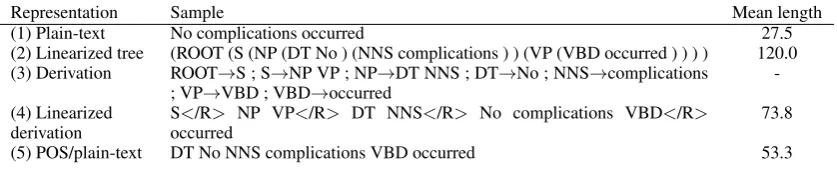
As part of our investigation we suggest strategies for practical NMT with very long target sequences. These long sequences may arise through the use of linearized con-stituency trees and can be much longer than their plain byte pair encoded (BPE) equiv-alent representations (Table 1). Long se-quences make training more difficult (Bah-danau et al., 2015), which we address with an adjusted training procedure for the Trans-former architecture (Vaswani et al.,2017), us-ing delayed SGD updates which accumulate gradients over multiple batches. We also sug-gest a syntax representation which results in much shorter sequences.
1.1 Related Work
but omit POS tags to reduce sequence length. They demonstrate improved target language reordering when producing syntax. Eriguchi et al. (2017) combine recurrent neural net-work grammar (RNNG) models (Dyer et al., 2016) with attention-based models to produce well-formed dependency trees. Wu et al. (2017) similarly produce both words and arc-standard algorithm actions (Nivre,2004).
Previous approaches to ensembling diverse models focus on model inputs. Hokamp (2017) shows improvements in the quality es-timation task using ensembles of NMT mod-els with multiple input representations which share an output representation. Garmash and Monz (2016) show translation improvements with multi-source-language NMT ensembles.
2
Ensembles of Syntax Models
We wish to ensemble using models which generate linearized constituency trees but these representations can be very long and difficult to model. We therefore propose a derivation-based representation which is much more compact than a linearized parse tree (examples in Table 1). Our linearized derivation representation ((4) in Table1) con-sists of the derivation’s right-hand side tokens with an end-of-rule marker,</R>, marking the last non-terminal in each rule. The original tree can be directly reproduced from the se-quence, so that structure information is main-tained. We map words to subwords as de-scribed in Section3.
2.1 Delayed SGD Update Training for Long Sequences
We suggest a training strategy for the Trans-former model (Vaswani et al., 2017) which gives improved performance for long se-quences, like syntax representations, without
requiring additional GPU memory. The Ten-sor2Tensor framework (Vaswani et al.,2018) defines batch size as the number of tokens per batch, so batches will contain fewer sequences if their average length increases. During NMT training, by default, the gradients used to up-date model parameters are calculated over in-dividual batches. A possible consequence is that batches containing fewer sequences per update may have ‘noisier’ estimated gradients than batches with more sequences.
Previous research has used very large batches to improve training convergence while requiring fewer model updates (Smith et al., 2017; Neishi et al., 2017). However, with such large batches the model size may exceed available GPU memory. Training on multiple GPUs is one way to increase the amount of data used to estimate gradients, but it requires significant resources. Our strategy avoids this problem by using delayed SGD up-dates. We accumulate gradients over a fixed number of batches before using the accumu-lated gradients to update the model1. This lets us effectively use very large batch sizes with-out requiring multiple GPUs.
2.2 Ensembling Representations
Table 1 shows several different representa-tions of the same hypothesis. To formulate an ensembling decoder over pairs of these representations, we assume we have a trans-ducerT that maps from one representation to the other representation. The complexity of the transduction depends on the representa-tions. Mapping from word to BPE represen-tations is straightforward, and mapping from (linearized) syntax to plain-text simply deletes non-terminals. LetPbe the paths inTleading from the start state to any final state. A path
Representation Sample Mean length
(1) Plain-text No complications occurred 27.5
(2) Linearized tree (ROOT (S (NP (DT No ) (NNS complications ) ) (VP (VBD occurred ) ) ) ) 120.0 (3) Derivation ROOT→S ; S→NP VP ; NP→DT NNS ; DT→No ; NNS→complications
; VP→VBD ; VBD→occurred
-(4) Linearized derivation
S</R> NP VP</R> DT NNS</R> No complications VBD</R>
occurred
73.8
[image:3.595.90.509.99.184.2](5) POS/plain-text DT No NNS complications VBD occurred 53.3
Table 1: Examples for proposed representations. Lengths are for the first 1M WAT English training sentences with BPE subwords (Sennrich et al.,2016).
Figure 1: Transducer mapping internal to external representations. A partial hypothesis might beo(xy2)in the external representation andi(xy1y2)in the internal representation.
p∈ Pmaps aninternal representationi(p)to anexternal representationo(p).
The ensembling decoder produces exter-nal representations. Two NMT systems are trained, one for each representation, giving modelsPi andPo. An ideal equal-weight en-sembling ofPiandPoyields
p∗= argmax
p∈P
Pi(i(p))Po(o(p)) (1)
witho(p∗)as the external representation of the translation.
In practice, beam decoding is performed in the external representation, i.e. over projec-tions of paths inP 2. Leth = h
1. . . hj be a partial hypothesis in the output representation. The set of partial paths yieldinghare:
M(h) = (2)
{(x, y)|xyz∈ P, o(x) =h<j, o(xy) =h}
2See thetokenizationwrappers inhttps:// github.com/ucam-smt/sgnmt
Herezis the path suffix. The ensembled score ofhis then:
P(hj|h<j) =Po(hj|h<j)× (3)
max (x,y)∈M(h)Pi
(i(y)|i(x))
[image:3.595.162.456.230.339.2]Reference low - energy electron microscope ( LEEM ) and photoelectron microscope ( PEEM ) were attracted attention as new surface electron microscope .
Plain BPE low energy electron microscope ( LEEM ) and photoelectron microscope ( PEEM ) are noticed as new surface electron microscope .
Linearized derivation
low-energy electron microscopy ( LEEM ) and photoelectron microscopy ( PEEM ) are attract-ing attention as new surface electron microscopes .
Table 2: Sample generated translations from individual models
3
Experiments
We first explore the effect of our delayed SGD update training scheme on single models, con-trasting updates every batch with accumulated updates every 8 batches. To compare target representations we train Transformer models with target representations (1), (2), (4) and (5) shown in Table1, using delayed SGD updates every 8 batches. We decode with individ-ual models and two-model ensembles, com-paring results for single-representation and representation ensembles. Each multi-representation ensemble consists of the plain BPE model and one other individual model.
All Transformer architectures are Ten-sor2Tensor’s base Transformer model (Vaswani et al., 2018) with a batch size of 4096. In all cases we decode using SGNMT (Stahlberg et al., 2017) with beam size 4, using the average of the final 20 checkpoints. For comparison with earlier target syntax work, we also train two RNN attention-based seq2seq models (Bahdanau et al.,2015) with normal SGD to produce plain BPE sequences and linearized derivations. For these models we use embedding size 400, a single BiLSTM layer of size 750, and batch size 80.
We report all experiments for Japanese-English, using the first 1M training sen-tences of the Japanese-English ASPEC data (Nakazawa et al.,2016). All models use plain BPE Japanese source sentences. English con-stituency trees are obtained using CKYlark (Oda et al., 2015), with words replaced by BPE subwords. We train separate Japanese
(lowercased) and English (cased) BPE vocab-ularies on the plain-text, with 30K merges each. Non-terminals are included as separate tokens. The linearized derivation uses addi-tional tokens for non-terminals with</R>.
3.1 Results and Discussion
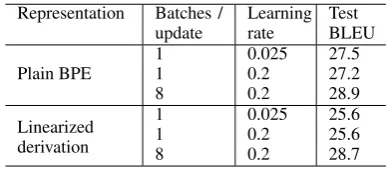
Our first results in Table 3 show that large batch training can significantly improve the performance of single Transformers, partic-ularly when trained to produce longer se-quences. Accumulating the gradient over 8 batches of size 4096 gives a 3 BLEU improve-ment for the linear derivation model. It has been suggested that decaying the learning rate can have a similar effect to large batch train-ing (Smith et al.,2017), but reducing the ini-tial learning rate by a factor of 8 alone did not give the same improvements.
Representation Batches / update
Learning rate
Test BLEU
Plain BPE
1 0.025 27.5
1 0.2 27.2
8 0.2 28.9
Linearized derivation
1 0.025 25.6
1 0.2 25.6
[image:4.595.308.503.491.576.2]8 0.2 28.7
Table 3: Single Transformers trained to con-vergence on 1M WAT Ja-En, batch size 4096
Architecture Representation Dev BLEU
Test BLEU Seq2seq
(8-model ensemble)
Best WAT17 result (Morishita et al.,
2017)
- 28.4
Seq2seq Plain BPE 21.6 21.2
Linearized derivation 21.9 21.2
Transformer
Plain BPE 28.0 28.9
Linearized tree 28.2 28.4
Linearized derivation 28.5 28.7
[image:5.595.88.293.99.212.2]POS/BPE 28.5 29.1
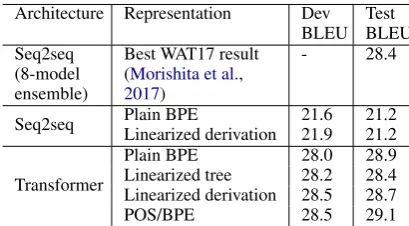
Table 4: Single models on Ja-En. Previous evaluation result included for comparison.
External representation
Internal representation
Test BLEU
Plain BPE Plain BPE 29.2
Linearized derivation Linearized derivation 28.8
Linearized tree Plain BPE 28.9
Plain BPE Linearized derivation 28.8
Linearized derivation Plain BPE 29.4†
POS/BPE Plain BPE 29.3†
Plain BPE POS/BPE 29.4†
Table 5: Ja-En Transformer ensembles: † marks significant improvement on plain BPE baseline shown in Table 4 (p < 0.05 using bootstrap resampling (Koehn et al.,2007)).
3indicates that large batch training is instru-mental in this.
We find that RNN-based syntax models can equal plain BPE models as in Aharoni and Goldberg (2017); Eriguchi et al. (2017) use syntax for a 1 BLEU improvement on this dataset, but over a much lower baseline. Our plain BPE Transformer outperforms all syn-tax models except POS/BPE. More compact syntax representations perform better, with POS/BPE outperforming linearized deriva-tions, which outperform linearized trees.
Ensembles of two identical models trained with different seeds only slightly improve over the single model (Table5). However, an ensemble of models producing plain BPE and linearized derivations improves by 0.5 BLEU over the plain BPE baseline.
By ensembling syntax and plain-text we hope to benefit from their complementary strengths. To highlight these, we examine hy-potheses generated by the plain BPE and lin-earized derivation models. We find that the syntax model is often more grammatical, even when the plain BPE model may share more vocabulary with the reference (Table2).
In ensembling plain-text with a syntax ex-ternal representation we observed that in a small proportion of cases non-terminals were over-generated, due to the mismatch in tar-get sequence lengths. Our solution was to pe-nalise scores of non-terminals under the syn-tax model by a constant factor.
It is also possible to constrain decoding of linearized trees and derivations to well-formed outputs. However, we found that this gives little improvement in BLEU over uncon-strained decoding although it remains an inter-esting line of research.
4
Conclusions
We report strong performance with individual models that meets or improves over the re-cent best WAT Ja-En ensemble results. We train these models using a delayed SGD up-date training procedure that is especially ef-fective for the long representations that arise from including target language syntactic in-formation in the output. We further improve on the individual results via a decoding strat-egy allowing ensembling of models produc-ing different output representations, such as subword units and syntax. We propose these techniques as practical approaches to includ-ing target syntax in NMT.
Acknowledgments
References
Roee Aharoni and Yoav Goldberg. 2017.Towards string-to-tree neural machine translation. In Proceedings of the 55th Annual Meeting of the Association for Computational Linguistics (Vol-ume 2: Short Papers), volume 2, pages 132– 140.
Dzmitry Bahdanau, Kyunghyun Cho, and Yoshua Bengio. 2015. Neural machine translation by jointly learning to align and translate. InICLR.
Chris Dyer, Adhiguna Kuncoro, Miguel Balles-teros, and Noah A Smith. 2016. Recurrent
neural network grammars. In Proceedings of
NAACL-HLT, pages 199–209.
Akiko Eriguchi, Yoshimasa Tsuruoka, and Kyunghyun Cho. 2017. Learning to parse and translate improves neural machine translation. In Proceedings of the 55th Annual Meeting of the Association for Computational Linguistics (Volume 2: Short Papers), volume 2, pages 72–78.
Ekaterina Garmash and Christof Monz. 2016. En-semble learning for multi-source neural
ma-chine translation. In Proceedings of
COL-ING 2016, the 26th International Conference on Computational Linguistics: Technical Pa-pers, pages 1409–1418.
Chris Hokamp. 2017.Ensembling factored neural machine translation models for automatic post-editing and quality estimation. InProceedings of the Second Conference on Machine Transla-tion, pages 647–654.
Philipp Koehn, Hieu Hoang, Alexandra Birch, Chris Callison-Burch, Marcello Federico, Nicola Bertoldi, Brooke Cowan, Wade Shen, Christine Moran, Richard Zens, et al. 2007. Moses: Open source toolkit for statistical machine translation. InProceedings of the 45th annual meeting of the ACL on interactive poster and demonstration sessions, pages 177–180. Association for Computational Linguistics.
Makoto Morishita, Jun Suzuki, and Masaaki Na-gata. 2017. NTT neural machine translation
systems at WAT 2017. In Proceedings of the
4th Workshop on Asian Translation (WAT2017), pages 89–94.
Maria Nadejde, Siva Reddy, Rico Sennrich, Tomasz Dwojak, Marcin Junczys-Dowmunt, Philipp Koehn, and Alexandra Birch. 2017.
Predicting target language CCG supertags
im-proves neural machine translation. In
Pro-ceedings of the Second Conference on Machine Translation, pages 68–79.
Toshiaki Nakazawa, Manabu Yaguchi, Kiyotaka Uchimoto, Masao Utiyama, Eiichiro Sumita, Sadao Kurohashi, and Hitoshi Isahara. 2016. ASPEC: Asian scientific paper excerpt corpus. InProceedings of the Ninth International Con-ference on Language Resources and Evaluation (LREC), pages 2204–2208. European Language Resources Association (ELRA).
Masato Neishi, Jin Sakuma, Satoshi Tohda, Shonosuke Ishiwatari, Naoki Yoshinaga, and Masashi Toyoda. 2017. A bag of useful tricks for practical neural machine translation: Em-bedding layer initialization and large batch size. In Proceedings of the 4th Workshop on Asian Translation (WAT2017), pages 99–109.
Joakim Nivre. 2004. Incrementality in
determin-istic dependency parsing. In Proceedings of
the Workshop on Incremental Parsing: Bring-ing EngineerBring-ing and Cognition Together, pages 50–57. Association for Computational Linguis-tics.
Yusuke Oda, Graham Neubig, Sakriani Sakti, Tomoki Toda, and Satoshi Nakamura. 2015.
Ckylark: A more robust PCFG-LA parser. In
Proceedings of the 2015 Conference of the North American Chapter of the Association for Computational Linguistics: Demonstrations, pages 41–45.
Rico Sennrich, Barry Haddow, and Alexandra Birch. 2016.Neural machine translation of rare
words with subword units. In Proceedings of
the 54th Annual Meeting of the Association for Computational Linguistics (Volume 1: Long Pa-pers), volume 1, pages 1715–1725.
Samuel L Smith, Pieter-Jan Kindermans, and Quoc V Le. 2017. Don’t decay the learning rate, increase the batch size. arXiv preprint arXiv:1711.00489.
models and search strategies. InProceedings of the 2017 Conference on Empirical Methods in Natural Language Processing: System Demon-strations, pages 25–30.
Ashish Vaswani, Samy Bengio, Eugene Brevdo, Francois Chollet, Aidan N. Gomez, Stephan Gouws, Llion Jones, Łukasz Kaiser, Nal Kalchbrenner, Niki Parmar, Ryan Sepassi, Noam Shazeer, and Jakob Uszkoreit. 2018.
Tensor2tensor for neural machine translation.
CoRR, abs/1803.07416.
Ashish Vaswani, Noam Shazeer, Niki Parmar, Jakob Uszkoreit, Llion Jones, Aidan N Gomez, Łukasz Kaiser, and Illia Polosukhin. 2017. At-tention is all you need. InAdvances in Neural Information Processing Systems, pages 6000– 6010.