Emotion Detection in Code-switching Texts via Bilingual and Sentimental
Information
Zhongqing Wang†‡, Sophia Yat Mei Lee‡, Shoushan Li†∗, and Guodong Zhou† †Natural Language Processing Lab, Soochow University, China
‡Department of Chinese and Bilingual Studies, The Hong Kong Polytechnic University
{wangzq.antony, sophiaym}@gmail.com, {lishoushan, gdzhou}@suda.edu.cn
Abstract
Code-switching is commonly used in the free-form text environment, such as so-cial media, and it is espeso-cially favored in emotion expressions. Emotions in code-switching texts differ from monolingual texts in that they can be expressed in ei-ther monolingual or bilingual forms. In this paper, we first utilize two kinds of knowledge, i.e. bilingual and sentimen-talinformation to bridge the gap between different languages. Moreover, we use a term-document bipartite graph to incor-porate both bilingual and sentimental in-formation, and propose a label propaga-tion based approach to learn and predic-t in predic-the biparpredic-tipredic-te graph. Empirical spredic-tud- stud-ies demonstrate the effectiveness of our proposed approach in detecting emotion in code-switching texts.
1 Introduction
With the rapid development of Web 2.0, emotion analysis in social media has become of great val-ue to market predictions and analysis (Liu et al., 2013; Lee et al., 2014). Previous researches on emotion analysis have mainly focused on emo-tion expressions in monolingual texts (Chen et al., 2010; Lee et al., 2013a). However, in informal settings such as micro-blogs, emotions are often expressed by a mixture of different natural lan-guages. Such a mixture of language is called coswitching. Specifically, coswitching text is de-fined as text that contains more than one language (code). It is a common phenomenon in multilin-gual communities (Auer, 1999; Adel et al., 2013). For instance, [E1-E3] are three examples of code-switching emotional posts containing both
Chi-*Corresponding author
nese and English words. [E1] expresses the hap-pinessemotion through English, and theanger e-motion in [E2] is expressed through both Chinese and English, while thefearemotion in [E3] is ex-pressed through a mixed English-Chinese phrase (holdØ4).
[E1]·‚®²ghighå5
(We are already getting hyper our-selves.)
[E2] • ˜é{Ò´/Oœv kk5 §Ø O â´1n ö0"shit!
(A quote, to my great disgust, is ”There’s no staking claims in a relation-ship based on who got there first - the one who isn.t loved is the true third party.”Shit!)
[E3] ùo‡y-:{" " "¶
‚holdØØØ444Bœœœ
(The so-called ”highlighting”...wecan’t hold it anymore.)
It is more difficult to detect emotions in codswitching texts than in monolingual ones since e-motions in code-switching posts can be expressed through one or two languages. Hence, traditional automatic emotion detection methods which sim-ply consider monolingual texts (Liu et al., 2013; Lee et al., 2013a) would not be readily applicable. The key issue of emotion detection in code-switching texts is to deal with the emotions ex-pressed through different languages. Thus bridg-ing the gap between different languages becomes essential for emotion detection in code-switching texts. A straightforward approach to handle this issue is to translate texts from one language into another. Since Chinese is the dominant language in our data set, a word-by-word statistical machine translation strategy (Zhao et al., 2009) is adopt-ed to translate English words into Chinese. Ad-ditionally, as text from micro-blogs is informal,
synonym dictionary and PMI similar based word correlation (Turney, 2002) are used to enhance the language model for machine translation.
In spite of the English-to-Chinese translation, many English and Chinese words are still uncon-nected. Hence, we use sentiment analysis strategy (Turney, 2002; Li et al., 2013) to extract the po-larity of both Chinese and English texts, and then connect words of similar polarity.
Moreover, for propagating label information be-tween the bilingual texts from training data to test data, we use a term-document bipartite graph to incorporate both bilingual and sentimental in-formation and propose a label propagation (Zhu and Ghahramani, 2002) based approach to learn and predict in the graph. Specially, the label information between Chinese and English texts would be propagated through the bipartite graph by word-document relations, bilingual informa-tion, and sentiment information. Evaluation of the data set indicates the importance of the task and the effectiveness of our proposed approach.
2 Related Work
Emotion analysis has been a hot research topic in NLP in the last decade. One main group of relat-ed studies on this task is about emotion resource construction (Xu et al., 2010; Volkova et al., 2012; Lee et al., 2014). Moreover, emotion classification is one of the most important tasks in emotion anal-ysis, while emotion classification aims to classify text into multiple emotion categories (Chen et al., 2010; Liu et al., 2013). Despite a growing body of research on emotion analysis, little has been done on the analysis of emotion in code-switching due to the complexities of processing two languages at the same time.
Besides, although several research studies have focused on analyzing bilingual (Wan, 2009; Lu et al., 2011; Tang et al., 2014) and code-switching texts (Li and Fung, 2012; Ling et al., 2013; Lig-nos and Marcus, 2013), none of them has studied the multilingual code-switching issues in emotion detection. This research area is especially crucial when public emotions are mostly expressed in the free-form text on the Internet.
3 Data Collection
We collect our data set from Weibo.com, one of the most popular SNS websites in China. We use encoding code for each character in the post to
i-dentify the code-switching posts. After removing posts containing noise and advertisements, we ex-tract 4,195 code-switching posts from the dataset for emotion annotation. Five basic emotions are annotated, namelyhappiness,sadness,fear,anger
and surprise (Lee et al., 2013b). After the an-notation process, results show 2,312 posts which include emotions. Moreover, 81.4% of emotion-al posts are expressed through Chinese. Although there are a few words of English in each post (an average of 3 words per post), 43.5% of emotion posts are caused by English. This statistic indi-cates that English is of vital importance to emotion expression even in code-switching contexts domi-nated by Chinese.
[image:2.595.314.524.347.487.2]The corpora is annotated by two annotators and the inter-annotator agreement calculation shows that the agreement of our annotation is 0.692 in Cohen’s Kappa coefficient, which indicates that the quality of the annotation is guaranteed.
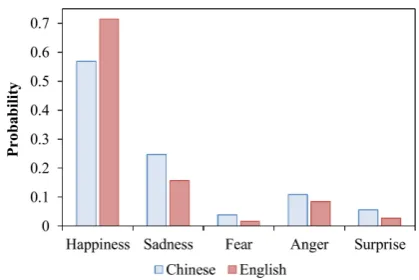
Figure 1: Distribution of Emotions and Languages
The joint distribution between emotions and caused languages is illustrated in Figure 1. The
Y-axis of the figure presents the conditional prob-ability of a post expressing the emotionei given thatlj is the caused language,p(ei|lj).
It is suggested in Figure 2 that: 1)happiness oc-curs more frequently than other emotions; 2) peo-ple would like to use English text to express the
happinessemotion much more than thesadness e-motion; 3) the distribution of emotions expressed through Chinese and English text are similar.
4 Emotion Detection via Bilingual and Sentiment Information
re-search. We systematically explore both the bilin-gual and sentimental information to detect emo-tions in code-switching posts. Moreover, we use a term-document bipartite graph to incorporate these two kinds of information, and propose a La-bel Propagation (LP) based approach to learn and predict emotion in code-switching texts. In the fol-lowing subsections, we will discuss these issues one by one.
4.1 Bilingual Information
For using bilingual information, a word-by-word statistical machine translation strategy is adopt-ed to translate words from English into Chinese. For better clarity, a word-based decoding, which adopts a log-linear framework as in (Och and Ney, 2002) with translation model and language model being the only features, is used:
P(c|e) = exp [ P2
i=1λihi(c, e)] P
cexp [P2i=1λihi(c, e)] (1)
where
h1(c, e) = log(pγ(c|e)) (2) is the translation model, which is converted from the bilingual lexicon1, and
h2(c, e) = log(pθLM(c)pθSY N(c)pθP MI(c)) (3)
is the language model, andpθLM(c)is the bigram
language model which is trained from a large s-caleWeibodata set2. As text in micro-blogs is
in-formal, synonym dictionary3and PMI based word
correlation are used to enhance the language mod-el for machine translation. pθSY N(c) denotes the
synonym similarity between translated words and the contexts. This is necessary since the sense of translated words and the contexts are expected to be similar; and pθP MI(c) presents the PMI
simi-larity between translated words and the contexts, while the PMI score is calculated by the individ-ual and co-occurred hit count between translated words and contexts from the search engine4
(Tur-ney, 2002). This is to ensure that the translated words are highly associated with the contexts.
1MDBG CC-CEDICTis adopted as the bilingual lexicon: http://www.mdbg.net/chindict/chindict.php?page=cedict
2The large-scaleWeibodata set contains 2,716,197 posts in total.
3TongYiCiLinis adopted as the Chinese synonym dictio-nary: http://www.ltp-cloud.com/
4We use BING.com as the search engine for PMI: http://www.bing.com/
The candidate target sentences made up of a se-quence of the optional target words are ranked by the language model. The output will be generat-ed only if it reaches the maximum probability as follows (Brown et al., 1990; Zhao et al., 2009):
c=argmaxYp(wc) (4)
4.2 Sentimental Information
Sentimental information is very useful in emotion detection (Gao et al., 2013). In this paper, we ex-tract polarity from both Chinese and English texts to ensure text of similar polarity will be connected. In this paper, both Chinese5 and English6
sen-timental lexicons are employed to identify can-didate opinion expressions by searching the oc-currences of negative and positive expressions in text, and predict the polarity of both Chinese and English texts through the word-counting approach (Turney, 2002).
4.3 LP-based Emotion Detection
For the knowledge of bilingual and sentimental in-formation to be well incorporated, we use a term-document bipartite graph to incorporate the in-formation, and propose a label propagation based approach to learn and predict emotion in code-switching texts.
The input of the LP algorithm is a graph de-scribing the relationship between each sample pair in the labeled and test data (Sindhwani and Melville, 2008; Li et al., 2013). In a bipartite graph, the nodes consist of two parts: documents and all terms extracted from the documents. An undirected edge(di, wk) exists if and only if the
documentdicontains the termwk.
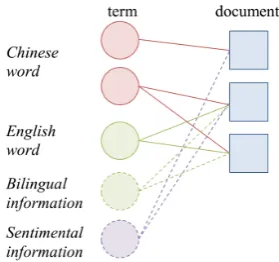
Note that, there are four kinds of terms on the graph, i.e., Chinese words, English words, trans-lated Chinese words (bilingual information), and sentimental features. Although Chinese words and English words cannot be connected directly, the label information between Chinese and English words would be propagated through the bipartite graph by word-document relations, bilingual in-formation, and sentiment information. The exam-ple of the bipartite graph is illustrated on the Fig-ure 2.
5DUTIR Sentiment Lexicon is adopt-ed as the Chinese sentiment lexicon: http://ir.dlut.edu.cn/EmotionOntologyDownload.aspx
Figure 2: Example of the bipartite graph
When all terms are taken into consideration, we get the transition probability from di to dj as in (5):
tij =X k
xik P
kxik · xjk P
kxjk (5)
wherexik is the frequency of termwkin
docu-mentdi.
After building the document-document trans-fer matrix through the bipartite graph, we use la-bel propagation algorithm (Zhu and Ghahramani, 2002; Zhou and Kong, 2009) to learn and predict emotions in the graph, in which the probabilities of the labeled data are clamped in each loop using their initial ones and act as a force to propagate their labels to the test data.
5 Experiments
In this section, we first introduce the experimental settings, and then evaluate the performance of our proposed approach for detecting emotions in code-switching texts.
5.1 Experimental Settings
As described in Section 3, the data are collected fromWeibo.com. We randomly select half of the annotated posts as the training data and another half as the test data. FNLP7 is used for Chinese
word segmentation.
5.2 Experimental Results
Our first group of experiments is to investigate whether our proposed label propagation model with both bilingual and sentimental information can improve emotion detection in code-switching texts. Figure 3 shows the experimental results of different models, whereMEis the basic Maximum
7FNLP (FudanNLP), https://github.com/xpqiu/fnlp/
Entropy (ME) classification model8 in which all
Chinese and English words of each post function as a feature,ME-CNandME-ENin which only the Chinese or English text of each post function as features, andBLP-BS, our proposed LP-based ap-proach which incorporates both bilingual and sen-timental information. We adopt F1-Measure (F1.) to measure the performance of each model in the respective emotions.
From Figure 3, we find that the results of ME-CNandME-EN are instable. It indicates that on-ly considering one kind of language text is not very effective for predicting emotions in code-switching texts. Moreover, as Chinese and English texts are taken into account collectively with both bilingual and sentimental information, our pro-posed BLP-BS model is significantly better than basic approaches on all the emotions.
Figure 3: Results of emotion detection
We then analyze the influence of different fac-tors in our proposed approach with average F1-Measure of the five emotions with the results il-lustrated in Table 1. In the table, Basic SMT
refers to using basic word-by-word statistical ma-chine translation to help the detection process; En-hanced SMT refers to using both synonyms and word correlation to enhance the machine transla-tion process; Sentimentrefers to using sentimen-tal information to help the detection process; ME-BS refers to using the maximum entropy model with both bilingual and sentimental information, andBLPrefers to the label propagation model in which all of the words in Chinese and English text function as a feature.
From Table 1, it is observed that: 1) senti-mental information (Sentiment) are effective for predicting emotion in both ME-based and BLP
[image:4.595.309.525.322.453.2]Method Average F1.
ME 0.354
+Basic SMT 0.354 +Enhanced SMT 0.382 +Sentiment 0.369
ME-BS 0.383
BLP 0.385
+Enhanced SMT 0.392 +Sentiment 0.406
[image:5.595.91.274.61.200.2]BLP-BS 0.412
Table 1: Results of influence on different factors
based models; 2)Enhanced SMT outperforms Ba-sic SMT, which proves the effectiveness of our en-hanced approaches for statistical machine transla-tion; and 3) our proposed approach (BLP-BS) out-performs the other approaches. This indicates the complementarity of bilingual and sentimental in-formation on the bipartite graph based label prop-agation model.
6 Conclusion
In this study, we address a novel task, namely e-motion detection in code-switching texts. First, we collect and extract the code-switching post-s from Weibo.com, which are annotated with e-motions. Then, we use both SMT-based bilin-gual information and sentimental information to bridge the gap between different languages in code-switching texts. Finally, we propose a bi-partite graph based label propagation model to effectively incorporate both bilingual and senti-mental information for detecting emotion in code-switching texts. Empirical studies demonstrate that our model significantly outperforms several strong baselines.
Our current work assumes the independence of emotions and caused languages. In future work, we would like to explore the relation among tions and caused languages for detecting the emo-tion and caused languages collectively.
Acknowledgments
Prof. Deyi Xiong contributed valuable insights and wise counsel on machine translation. Our col-league, Helena Yan Ping Lau, did excellent work on corpus analysis for probing and understanding the problem, and helped us review the paper, of-fering valuable feedback and helpful leads.
We thank our anonymous reviewers for prudent advice.
The work is funded by an Early Career Scheme (ECS) sponsored by the Research Grants Council of Hong Kong (No. PolyU 5593/13H), and sup-ported by the National Natural Science Founda-tion of China (No. 61273320, and No. 61375073) and the Key Project of the National Natural Sci-ence Foundation of China (No. 61331011).
References
Adel H., N. Vu, and T. Schultz. 2013. Combination of Recurrent Neural Networks and Factored Language Models for Code-Switching Language Modeling. In
Proceedings of ACL-13.
Auer P. 1999.Code-Switching in Conversation. Rout-ledge.
Brown P., J. Cocke, S. Pietra, V. Pietra, F. Jelinek, J. Lafferty, R. Mercer, and P. Roossin. 1990. A Sta-tistical Approach to Machine Translation. Computa-tional Linguistics, 16(2):79-85.
Chen Y., S. Lee, S. Li, and C. Huang. 2010. Emotion Cause Detection with Linguistic Constructions. In
Proceeding of COLING-10.
Gao W., S. Li, S. Lee, G. Zhou, and C. Huang. 2013. Joint Learning on Sentiment and Emotion Classifi-cation. InProceedings of CIKM-13.
Lee S., H. Zhang, and C. Huang. 2013a. An Event-Based Emotion Corpus. In Proceedings of CLSW 2013.
Lee S., Y. Chen, C. Huang, and S. Li. 2013b. Detect-ing Emotion Causes with a LDetect-inguistic Rule-Based Approach.Computational Intelligence, 29(3), 390-416.
Lee S., S. Li, and C. Huang. 2014. Annotating Events in an Emotion Corpus. InProceedings of LREC-14. Li Y., and P. Fung. 2012. Code-switch Language Mod-el with Inversion Constraints for Mixed Language Speech Recognition. InProceedings of COLING-12. Li S., Y. Xue, Z. Wang, and G. Zhou. 2013. Ac-tive Learning for Cross-domain Sentiment Classifi-cation. InProceeding of IJCAI-2013.
Ling W., G. Xiang, C. Dyer, A. Black, and I. Trancoso. 2013. Microblogs as Parallel Corpora. In Proceed-ings of ACL-13.
Lignos C., and M. Marcus. 2013. Toward Web-scale Analysis of Codeswitching. In Proceedings of An-nual Meeting of the Linguistic Society of America. Liu H., S. Li, G. Zhou, C. Huang, and P. Li. 2013. Joint
Lu B., C. Tan, C. Cardie and B. Tsou. 2011. Joint Bilin-gual Sentiment Classification with Unlabeled Paral-lel Corpora. InProceedings of ACL-2011.
Och F., and H. Ney. 2002. Discriminative Training and Maximum Entropy Models for Statistical Machine Translation. InProceedings of ACL-02.
Quan C., and F. Ren. 2009. Construction of a Blog E-motion Corpus for Chinese EE-motional Expression Analysis. InProceedings of EMNLP-09.
Sindhwani V. and P. Melville. 2008. Document-Word Co-Regularization for Semi-supervised Sentimen-t Analysis. InProceedings of ICDM-08.
Tang X., X. Wan, and X. Zhang. 2014. Cross-Language Context-aware Citation Recommendation in Scien-tific Articles. InProceedings of SIGIR-14.
Turney P. 2002. Thumbs up or Thumbs down? Seman-tic Orientation Applied to Unsupervised Classifica-tion of comments. InProceedings of ACL-02. Volkova S., W. Dolan, and T. Wilson. 2012. CLex: A
Lexicon for Exploring Color, Concept and Emotion Associations in Language. InProceedings of EACL-12.
Xu G., X. Meng, and H. Wang. 2010. Build Chinese Emotion Lexicons Using A Graph-based Algorithm and Multiple Resources. InProceeding of COLING-10.
Wan X. 2009. Co-Training for Cross-Lingual Sentiment Classification. In Proceedings of ACL/IJCNLP-09.
Zhao H., Y. Song, C. Kit, and G. Zhou. 2009. Cross Language Dependency Parsing using a Bilingual Lexicon. InProceedings of ACL-09.
Zhou G. and K. Fang. 2009. Global Learning of Noun Phrase Anaphoricity in Coreference Resolution via Label Propagation. InProceedings of EMNLP-2009. Zhu X. and Z. Ghahramani. 2002. Learning from La-beled and UnlaLa-beled Data with Label Propagation.
CMU CALD Technical Report.