Proceedings of the 55th Annual Meeting of the Association for Computational Linguistics, pages 158–167 Proceedings of the 55th Annual Meeting of the Association for Computational Linguistics, pages 158–167
Program Induction by Rationale Generation:
Learning to Solve and Explain Algebraic Word Problems
Wang Ling♠ Dani Yogatama♠ Chris Dyer♠ Phil Blunsom♠♦
♠DeepMind ♦University of Oxford
{lingwang,dyogatama,cdyer,pblunsom}@google.com
Abstract
Solving algebraic word problems re-quires executing a series of arithmetic operations—a program—to obtain a final answer. However, since programs can be arbitrarily complicated, inducing them directly from question-answer pairs is a formidable challenge. To make this task more feasible, we solve these problems by generating answer rationales, sequences of natural language and human-readable mathematical expressions that derive the final answer through a series of small steps. Although rationales do not explic-itly specify programs, they provide a scaf-folding for their structure via intermedi-ate milestones. To evaluintermedi-ate our approach, we have created a new 100,000-sample dataset of questions, answers and ratio-nales. Experimental results show that in-direct supervision of program learning via answer rationales is a promising strategy for inducing arithmetic programs.
1 Introduction
Behaving intelligently often requires mathemat-ical reasoning. Shopkeepers calculate change, tax, and sale prices; agriculturists calculate the proper amounts of fertilizers, pesticides, and wa-ter for their crops; and managers analyze produc-tivity. Even determining whether you have enough money to pay for a list of items requires applying addition, multiplication, and comparison. Solv-ing these tasks is challengSolv-ing as it involves rec-ognizing how goals, entities, and quantities in the real-world map onto a mathematical formaliza-tion, computing the soluformaliza-tion, and mapping the so-lution back onto the world. As a proxy for the richness of the real world, a series of papers have
used natural language specifications of algebraic word problems, and solved these by either learn-ing to fill in templates that can be solved with equation solvers (Hosseini et al.,2014;Kushman et al., 2014) or inferring and modeling operation sequences (programs) that lead to the final an-swer (Roy and Roth,2015).
In this paper, we learn to solve algebraic word problems by inducing and modeling programs that generate not only the answer, but ananswer ratio-nale, a natural language explanation interspersed with algebraic expressions justifying the overall solution. Such rationales are what examiners re-quire from students in order to demonstrate un-derstanding of the problem solution; they play the very same role in our task. Not only do natural language rationales enhance model interpretabil-ity, but they provide a coarse guide to the structure of the arithmetic programs that must be executed. In fact the learner we propose (which relies on a heuristic search; §4) fails to solve this task with-out modeling the rationales—the search space is too unconstrained.
This work is thus related to models that can explain or rationalize their decisions (Hendricks et al.,2016;Harrison et al.,2017). However, the use of rationales in this work is quite different from the role they play in most prior work, where interpretation models are trained to generate plau-sible sounding (but not necessarily accurate) post-hoc descriptions of the decision making process they used. In this work, the rationale is generated as a latent variable that gives rise to the answer—it is thus a more faithful representation of the steps used in computing the answer.
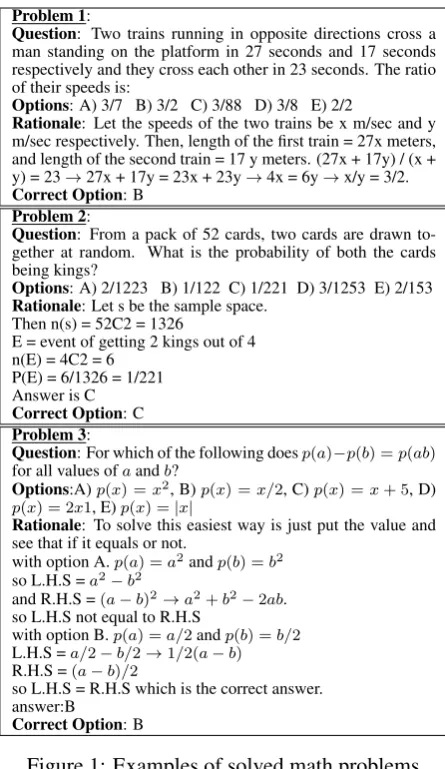
This paper makes three contributions. First, we have created a new dataset with more than 100,000 algebraic word problems that includes both an-swers and natural language answer rationales (§2). Figure1 illustrates three representative instances
Problem 1:
Question: Two trains running in opposite directions cross a man standing on the platform in 27 seconds and 17 seconds respectively and they cross each other in 23 seconds. The ratio of their speeds is:
Options: A) 3/7 B) 3/2 C) 3/88 D) 3/8 E) 2/2
Rationale: Let the speeds of the two trains be x m/sec and y m/sec respectively. Then, length of the first train = 27x meters, and length of the second train = 17 y meters. (27x + 17y) / (x + y) = 23→27x + 17y = 23x + 23y→4x = 6y→x/y = 3/2. Correct Option: B
Problem 2:
Question: From a pack of 52 cards, two cards are drawn to-gether at random. What is the probability of both the cards being kings?
Options: A) 2/1223 B) 1/122 C) 1/221 D) 3/1253 E) 2/153 Rationale: Let s be the sample space.
Then n(s) = 52C2 = 1326
E = event of getting 2 kings out of 4 n(E) = 4C2 = 6
P(E) = 6/1326 = 1/221 Answer is C
Correct Option: C Problem 3:
Question: For which of the following doesp(a)−p(b) =p(ab) for all values ofaandb?
Options:A)p(x) =x2, B)p(x) =x/2, C)p(x) =x+ 5, D)
p(x) = 2x1, E)p(x) =|x|
Rationale: To solve this easiest way is just put the value and see that if it equals or not.
with option A.p(a) =a2andp(b) =b2
so L.H.S =a2−b2
and R.H.S =(a−b)2→a2+b2−2ab.
so L.H.S not equal to R.H.S
with option B.p(a) =a/2andp(b) =b/2 L.H.S =a/2−b/2→1/2(a−b) R.H.S =(a−b)/2
so L.H.S = R.H.S which is the correct answer. answer:B
[image:2.595.68.291.59.444.2]Correct Option: B
Figure 1: Examples of solved math problems.
from the dataset. Second, we propose a sequence to sequence model that generates a sequence of in-structions that, when executed, generates the ra-tionale; only after this is the answer chosen (§3). Since the target program is not given in the train-ing data (most obviously, its specific form will de-pend on the operations that are supported by the program interpreter); the third contribution is thus a technique for inferring programs that generate a rationale and, ultimately, the answer. Even con-strained by a text rationale, the search space of possible programs is quite large, and we employ a heuristic search to find plausible next steps to guide the search for programs (§4). Empirically, we are able to show that state-of-the-art sequence to sequence models are unable to perform above chance on this task, but that our model doubles the accuracy of the baseline (§6).
2 Dataset
We built a dataset with 100,000 problems with the annotations shown in Figure1. Each question is decomposed in four parts, two inputs and two out-puts: the description of the problem, which we will denote as thequestion, and the possible (mul-tiple choice) answer options, denoted asoptions. Our goal is to generate the description of the ratio-nale used to reach the correct answer, denoted as
rationaleand thecorrect optionlabel. Problem 1 illustrates an example of an algebra problem, which must be translated into an expression (i.e.,
(27x+ 17y)/(x+y) = 23) and then the desired quantity(x/y)solved for. Problem 2 is an
exam-ple that could be solved by multi-step arithmetic operations proposed in (Roy and Roth,2015). Fi-nally, Problem 3 describes a problem that is solved by testing each of the options, which has not been addressed in the past.
2.1 Construction
We first collect a set of 34,202 seed problems that consist of multiple option math questions covering a broad range of topics and difficulty levels. Ex-amples of exams with such problems include the GMAT (Graduate Management Admission Test) and GRE (General Test). Many websites contain example math questions in such exams, where the answer is supported by a rationale.
Next, we turned to crowdsourcing to generate new questions. We create a task where users are presented with a set of 5 questions from our seed dataset. Then, we ask the Turker to choose one of the questions and write a similar question. We also force the answers and rationale to differ from the original question in order to avoid paraphrases of the original question. Once again, we manually check a subset of the jobs for each Turker for qual-ity control. The type of questions generated us-ing this method vary. Some turkers propose small changes in the values of the questions (e.g., chang-ing the equality p(a)p(b) = p(ab) in Problem 3
Question Rationale
Training Examples 100,949
Dev Examples 250
Test Examples 250
Numeric Average LengthVocab Size 21,0099.6 14,74516.6 Non-Numeric Average LengthVocab Size 17,84967.8 25,03489.1
[image:3.595.71.300.61.170.2]All Average LengthVocab Size 38,85877.4 39,779105.7
Table 1: Descriptive statistics of our dataset.
define in the instructions that this is not allowed, as it will generate multiple copies of the same prob-lem in the dataset if two or more Turkers copy from the same resource. These Turkers can be de-tected by checking the nearest neighbours within the collected datasets as problems obtained from online resources are frequently submitted by more than one Turker. Using this method, we obtained 70,318 additional questions.
2.2 Statistics
Descriptive statistics of the dataset is shown in Figure1. In total, we collected 104,519 problems (34,202 seed problems and 70,318 crowdsourced problems). We removed 500 problems as heldout set (250 for development and 250 for testing). As replicas of the heldout problems may be present in the training set, these were removed manually by listing for each heldout instance the closest prob-lems in the training set in terms of character-based Levenstein distance. After filtering, 100,949 prob-lems remained in the training set.
We also show the average number of tokens (to-tal number of tokens in the question, options and rationale) and the vocabulary size of the questions and rationales. Finally, we provide the same statis-tics exclusively for tokens that are numeric values and tokens that are not.
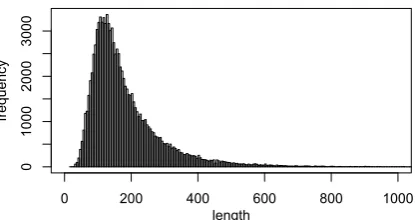
Figure 2 shows the distribution of examples based on the total number of tokens. We can see that most examples consist of 30 to 500 tokens, but there are also extremely long examples with more than 1000 tokens in our dataset.
3 Model
Generating rationales for math problems is chal-lenging as it requires models that learn to per-form math operations at a finer granularity as each step within the solution must be explained. For instance, in Problem 1, the equation (27x +
0 200 400 600 800 1000
0
1000
2000
3000
fre
qu
en
cy
[image:3.595.311.519.67.177.2]length
Figure 2: Distribution of examples per length.
17y)/(x + y) = 23 must be solved to obtain
the answer. In previous work (Kushman et al.,
2014), this could be done by feeding the equation into an expression solver to obtain x/y = 3/2. However, this would skip the intermediate steps
27x+ 17y= 23x+ 23yand4x= 6y, which must
also be generated in our problem. We propose a model that jointly learns to generate the text in the rationale, and to perform the math operations re-quired to solve the problem. This is done by gener-ating a program, containing both instructions that generate output and instructions that simply gener-ate intermedigener-ate values used by following instruc-tions.
3.1 Problem Definition
In traditional sequence to sequence mod-els (Sutskever et al., 2014; Bahdanau et al.,
2014), the goal is to predict the output sequence y = y1, . . . , y|y| from the input sequence
x=x1, . . . , x|x|, with lengths|y|and|x|.
i x z v r 1 From Id(“Let”) Let y1
2 a Id(“s”) s y2
3 pack Id(“be”) be y3
4 of Id(“the”) the y4
5 52 Id(“sample”) sample y5
6 cards Id(“space”) space y6
7 , Id(“.”) . y7
8 two Id(“\n”) \n y8
9 cards Id(“Then”) Then y9
10 are Id(“n”) n y10
11 drawn Id(“(”) ( y11
12 together Id(“s”) s y12
13 at Id(“)”) ) y13
14 random Id(“=”) = y14
15 . Str to Float(x5) 52 m1
16 What Float to Str(m1) 52 y15
17 is Id(“C”) C y16
18 the Id(“2”) 2 y17
19 probability Id(“=”) = y18
20 of Str to Float(y17) 2 m2
21 both Choose(m1,m2) 1326 m3
22 cards Float to Str(m3) 1326 y19
23 being Id(“E”) E y20
24 kings Id(“=”) = y21
25 ? Id(“event”) event y22
26 <O> Id(“of”) of y23
27 A) Id(“getting”) getting y24
28 2/1223 Id(“2”) 2 y25
29 <O> Id(“kings”) kings y26
30 B) Id(“out”) out y27
31 1/122 Id(“of”) of y28
. . . .
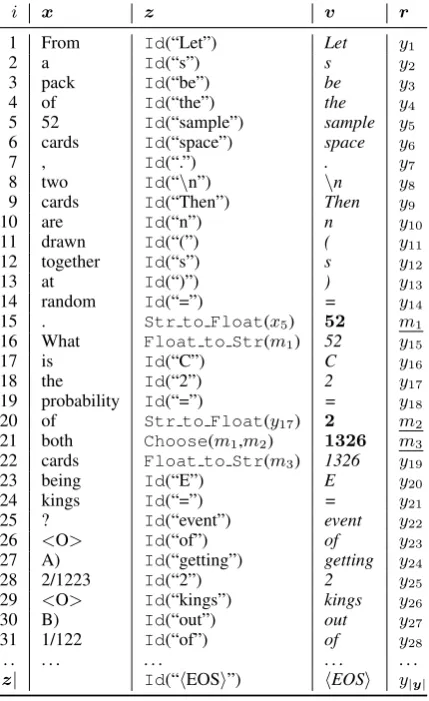
[image:4.595.74.290.62.414.2]|z| Id(“hEOSi”) hEOSi y|y| Table 2: Example of a programzthat would gen-erate the output y. In v, italics indicates string types;boldindicates float types. Refer to§3.3for description of variable names.
3.2 Generating Programs to Generate Rationales
We wish to generate a latent sequence ofprogram instructions, z = z1, . . . , z|z|, with length |z|,
that will generateywhen executed.
We expresszas a program that can accessx,y, and the memory bufferm. Upon finishing execu-tion we expect that the sequence of output tokens to be placed in the output vectory.
Table2illustrates an example of a sequence of instructions that would generate an excerpt from Problem 2, where columnsx,z,v, andrdenote the input sequence, the instruction sequence (pro-gram), the values of executing the instruction, and where each valuevi is written (i.e., either to the
output or to the memory). In this example, instruc-tions from indexes 1 to 14 simply fill each position with the observed outputy1, . . . , y14with a string, where theIdoperation simply returns its
parame-ter without applying any operation. As such, run-ning this operation is analogous to generating a word by sampling from a softmax over a vocabu-lary. However, instructionz15reads the input word x5, 52, and applies the operationStr to Float, which converts the word 52 into a floating point number, and the same is done for instructionz20, which reads a previously generated output word y17. Unlike, instructions z1, . . . , z14, these op-erations write to the external memory m, which stores intermediate values. A more sophisticated instruction—which shows some of the power of our model—is z21 = Choose(m1, m2) → m3 which evaluates m1
m2
and stores the result inm3. This process repeats until the model generates the end-of-sentence symbol. The last token of the pro-gram as said previously must generate the correct option value, from “A” to “E”.
By training a model to generate instructions that can manipulate existing tokens, the model ben-efits from the additional expressiveness needed to solve math problems within the generation process. In total we define 22 different oper-ations, 13 of which are frequently used opera-tions when solving math problems. These are:
Id, Add, Subtract, Multiply, Divide,
Power,Log,Sqrt,Sine,Cosine,Tangent,
Factorial, and Choose (number of
combi-nations). We also provide 2 operations to con-vert betweenRadians andDegrees, as these are needed for the sine, cosine and tangent opera-tions. There are 6 operations that convert floating point numbers into strings and vice-versa. These include theStr to FloatandFloat to Str
[image:4.595.74.289.65.416.2]hi
softmax
oi
ri
softmax
ri
qi,j=1
softmax
qij
softmax copy input
aij
qi,j+1
copy output
hi+1
j < argc(oi)?
vi
[image:5.595.78.290.71.203.2]execute
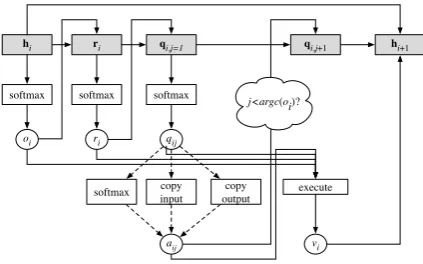
Figure 3: Illustration of the generation process of a single instruction tuple at timestampi.
3.3 Generating and Executing Instructions
In our model, programs consist of sequences of instructions, z. We turn now to how we model each zi, conditional on the text program
specifi-cation, and the program’s history. The instruction ziis a tuple consisting of an operation (oi), an
or-dered sequence of its arguments (ai), and a
deci-sion about where its results will be placed (ri)(is
it appended in the outputyor in a memory buffer m?), and the result of applying the operation to its arguments (vi). That is,zi= (oi, ri,ai, vi).
Formally, oi is an element of the pre-specified
set of operations O, which contains, for example
add, div, Str to Float, etc. The number of
arguments required byoiis given byargc(oi), e.g., argc(add) = 2 andargc(log) = 1. The
argu-ments are ai = ai,1, . . . , ai,argc(oi). An
instruc-tion will generate a return valueviupon execution,
which will either be placed in the outputyor hid-den. This decision is controlled byri. We define
the instruction probability as:
p(oi,ai, ri,vi|z<i,x,y,m) =
p(oi |z<i,x)×p(ri |z<i,x, oi)×
argcY(oi)
j=1
p(ai,j |z<i,x, oi,m,y)×
[vi=apply(oi,a)],
where[p]evaluates to 1 ifpis true and 0 otherwise, and apply(f,x)evaluates the operationf with ar-guments x. Note that the apply function is not learned, but pre-defined.
The network used to generate an instruction at a given timestampiis illustrated in Figure3. We first use the recurrent state hi to generate p(oi |
z<i,x) = softmax
o∈O (hi), using a softmax over the
set of available operationsO.
In order to predict ri, we generate a new
hid-den stateri, which is a function of the current
pro-gram context hi, and an embedding of the
cur-rent predicted operation, oi. As the output can
either be placed in the memory mor the output y, we compute the probabilityp(ri = OUTPUT |
z<i,x, oi) = σ(ri·wr +br), whereσ is the
lo-gistic sigmoid function. If ri = OUTPUT, vi is
appended to the outputy; otherwise it is appended to the memorym.
Once we generate ri, we must predict ai, the argc(oi)-length sequence of arguments that
oper-ation oi requires. The jth argument ai,j can be
either generated from a softmax over the vocab-ulary, copied from the input vector x, or copied from previously generated values in the output y or memory m. This decision is modeled us-ing a latent predictor network (Ling et al.,2016), where the control over which method used to gen-erate ai,j is governed by a latent variable qi,j ∈ {SOFTMAX,COPY-INPUT,COPY-OUTPUT}. Sim-ilar to when predicting ri, in order to make this
choice, we also generate a new hidden state for each argument slot j, denoted by qi,j with an
LSTM, feeding the previous argument in at each time step, and initializing it withriand by reading
the predicted value of the outputri.
• Ifqi,j = SOFTMAX, ai,j is generated by
sam-pling from a softmax over the vocabularyY,
p(ai,j |qi,j =SOFTMAX) = softmax ai,j∈Y
(qi,j).
This corresponds to a case where a string is used as argument (e.g.y1=“Let”).
• Ifqi,j =COPY-INPUT,ai,j is obtained by
copy-ing an element from the input vector with a pointer network (Vinyals et al.,2015) over input wordsx1, . . . , x|x|, represented by their encoder
LSTM stateu1, . . . ,u|x|. As such, we compute
the probability distribution over input words as:
p(ai,j |qi,j =COPY-INPUT) = (1) softmax
ai,j∈x1,...,x|x|
f(uai,j,qi,j)
Function f computes the affinity of each to-kenxai,j and the current output contextqi,j. A
common implementation off, which we follow, is to apply a linear projection from [uai,j;qi,j]
into a fixed size vector (where[u;v]is vector
concatenation), followed by atanhand a linear
• Ifqi,j =COPY-OUTPUT, the model copies from
either the outputy or the memory m. This is equivalent to finding the instruction zi, where
the value was generated. Once again, we de-fine a pointer network that points to the output instructions and define the distribution over pre-viously generated instructions as:
p(ai,j |qi,j =COPY-OUTPUT) = softmax
ai,j∈z1,...,zi−1
f(hai,j,qi,j)
Here, the affinity is computed using the decoder statehai,j and the current stateqi,j.
Finally, we embed the argument ai,j1 and the
stateqi,j to generate the next state qi,j+1. Once
all arguments for oi are generated, the operation
is executed to obtainvi. Then, the embedding of
vi, the final state of the instructionqi,|ai| and the
previous statehi are used to generate the state at
the next timestamphi+1.
4 Inducing Programs while Learning
The set of instructionszthat will generateyis un-observed. Thus, givenxwe optimize the marginal probability function:
p(y|x) = X
z∈Z
p(y|z)p(z|x) = X
z∈Z(y)
p(z|x),
where p(y | z) is the Kronecker delta function
δe(z),y, which is 1 if the execution ofz, denoted as
e(z), generates yand 0 otherwise. Thus, we can redefinep(y|x), the marginal over all programsZ,
as a marginal over programs that would generate y, defined as Z(y). As marginalizing over z ∈
Z(y)is intractable, we approximate the marginal
by generating samples from our model. Denote the set of samples that are generated byZˆ(y). We
maximizePz∈Zˆ(y)p(z|x).
However, generating programs that generate y is not trivial, as randomly sampling from the RNN distribution over instructions at each timestamp is unlikely to generate a sequencez ∈ Z(y).
This is analogous to the question answering work inLiang et al.(2016), where the query that
1The embeddings of a given argumenta
i,jand the return
valueviare obtained with a lookup table embedding and two
flags indicating whether it is a string and whether it is a float. Furthermore, if the the value is a float we also add its numeric value as a feature.
generates the correct answer must be found dur-ing inference, and traindur-ing proved to be difficult without supervision. InRoy and Roth(2015) this problem is also addressed by adding prior knowl-edge to constrain the exponential space.
In our work, we leverage the fact that we are generating rationales, where there is a sense of progression within the rationale. That is, we as-sume that the rationale solves the problem step by step. For instance, in Problem 2, the rationale first describes the number of combinations of two cards in a deck of 52 cards, then describes the number of combinations of two kings, and finally com-putes the probability of drawing two kings. Thus, while generating the final answer without the ra-tionale requires a long sequence of latent instruc-tions, generating each of the tokens of the rationale requires far less operations.
More formally, given the sequencez1, . . . , zi−1 generated so far, and the possible values for zi
given by the network, denotedZi, we wish to filter Zi toZi(yk), which denotes a set of possible
op-tions that contain at least one path capable of gen-erating the next token at indexk. Finding the set Zi(yk)is achieved by testing all combinations of
instructions that are possible with at most one level of indirection, and keeping those that can generate yk. This means that the model can only
gener-ate one intermedigener-ate value in memory (not includ-ing the operations that convert strinclud-ings into floatinclud-ing point values and vice-versa).
Decoding. During decoding we find the most likely sequence of instructions z givenx, which can be performed with a stack-based decoder. However, it is important to refer that each gen-erated instructionzi = (oi, ri, ai,1, . . . , ai,|ai|, vi)
must be executed to obtainvi. To avoid generating
unexecutable code—e.g., log(0)—each hypothesis instruction is executed and removed if an error oc-curs. Finally, once the “hEORi” tag is generated, we only allow instructions that would generate one of the option “A” to “E” to be generated, which guarantees that one of the options is chosen.
5 Staged Back-propagation
As it is shown in Figure2, math rationales with more than 200 tokens are not uncommon, and with additional intermediate instructions, the sizezcan easily exceed 400. This poses a practical challenge for training the model.
for each instruction zi, the model needs to
com-pute the probability distribution between all the at-tendable unitscconditioned on the previous state
hi−1. For the attention model and input copy
mechanisms,c= x0,i−1 and for the output copy
mechanism c = z. These operations generally involve an exponential number of matrix multi-plications as the size of c andz grows. For in-stance, during the computation of the probabilities for the input copy mechanism in Equation1, the affinity functionf between the current context q and a given inputukis generally implemented by
projecting u and q into a single vector followed by a non-linearity, which is projected into a sin-gle affinity value. Thus, for each possible input u, 3 matrix multiplications must be performed. Furthermore, for RNN unrolling, parameters and intermediate outputs for these operations must be replicated for each timestamp. Thus, aszbecomes larger the attention and copy mechanisms quickly become a memory bottleneck as the computation graph becomes too large to fit on the GPU. In con-trast, the sequence-to-sequence model proposed in (Sutskever et al.,2014), does not suffer from these issues as each timestamp is dependent only on the previous statehi−1.
To deal with this, we use a training method we callstaged back-propagationwhich saves mem-ory by considering slices ofK tokens inz, rather than the full sequence. That is, to train on a mini-batch where|z|= 300withK = 100, we would
actually train on 3 mini-batches, where the first batch would optimize for the firstz1:100, the sec-ond for z101:200 and the third for z201:300. The advantage of this method is that memory intensive operations, such as attention and the copy mecha-nism, only need to be unrolled forKsteps, andK can be adjusted so that the computation graph fits in memory.
However, unlike truncated back-propagation for language modeling, where context outside the scope of K is ignored, sequence-to-sequence models require global context. Thus, the sequence of stateshis still built for the whole sequence z. Afterwards, we obtain a slice hj:j+K, and
com-pute the attention vector.2 Finally, the prediction
of the instruction is conditioned on the LSTM state and the attention vector.
2This modeling strategy is sometimes known as late
fu-sion, as the attention vector is not used for state propagation, it is incorporated “later”.
6 Experiments
We apply our model to the task of generating ratio-nales for solutions to math problems, evaluating it on both the quality of the rationale and the ability of the model to obtain correct answers.
6.1 Baselines
As the baseline we use the attention-based se-quence to sese-quence model proposed byBahdanau et al.(2014), and proposed augmentations, allow-ing it to copy from the input (Ling et al.,2016) and from the output (Merity et al.,2016).
6.2 Hyperparameters
We used a two-layer LSTM with a hidden size of H = 200, and word embeddings with size 200.
The number of levels that the graphGis expanded during sampling D is set to 5. Decoding is per-formed with a beam of 200. As for the vocabulary of the softmax and embeddings, we keep the most frequent 20,000 word types, and replace the rest of the words with an unknown token. During train-ing, the model only learns to predict a word as an unknown token, when there is no other alternative to generate the word.
6.3 Evaluation Metrics
The evaluation of the rationales is performed with average sentence level perplexity and BLEU-4 (Papineni et al., 2002). When a model cannot generate a token for perplexity computation, we predict unknown token. This benefits the baselines as they are less expressive. As the perplexity of our model is dependent on the latent program that is generated, we force decode our model to gener-ate the rationale, while maximizing the probability of the program. This is analogous to the method used to obtain sample programs described in Sec-tion4, but we choose the most likely instructions at each timestamp instead of sampling. Finally, the correctness of the answer is evaluated by com-puting the percentage of the questions, where the chosen option matches the correct one.
6.4 Results
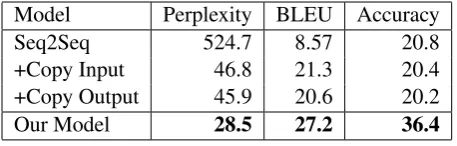
The test set results, evaluated on perplexity, BLEU, and accuracy, are presented in Table3.
Model Perplexity BLEU Accuracy
Seq2Seq 524.7 8.57 20.8
+Copy Input 46.8 21.3 20.4
+Copy Output 45.9 20.6 20.2
[image:8.595.71.300.62.135.2]Our Model 28.5 27.2 36.4
Table 3: Results over the test set measured in Per-plexity, BLEU and Accuracy.
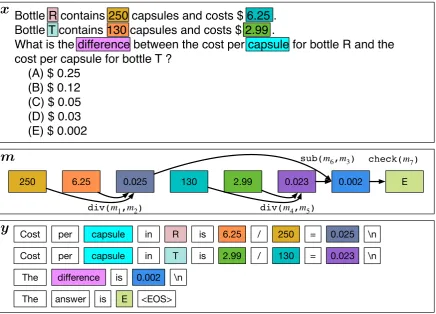
sparse. Adding an input copy mechanism greatly improves the perplexity as it allows the genera-tion process to use values that were mengenera-tioned in the question. The output copying mechanism improves perplexity slightly over the input copy mechanism, as many values are repeated after their first occurrence. For instance, in Problem 2, the value “1326” is used twice, so even though the model cannot generate it easily in the first occur-rence, the second one can simply be generated by copying the first one. We can observe that our model yields significant improvements over the baselines, demonstrating that the ability to gener-ate new values by algebraic manipulation is essen-tial in this task. An example of a program that is inferred is shown in Figure 4. The graph was gen-erated by finding the most likely programz that generatesy. Each node isolates a value inx,m, ory, where arrows indicate an operation executed with the outgoing nodes as arguments and incom-ing node as the return of the operation. For sim-plicity, operations that copy or convert values (e.g. from string to float) were not included, but nodes that were copied/converted share the same color. Examples of tokens where our model can obtain the perplexity reduction are the values “0.025”, “0.023”, “0.002” and finally the answer “E” , as these cannot be copied from the input or output.
BLEU. We observe that the regular sequence to sequence model achieves a low BLEU score. In fact, due to the high perplexities the model gener-ates very short rationales, which frequently consist of segments similar to “Answer should be D”, as most rationales end with similar statements. By applying the copy mechanism the BLEU score improves substantially, as the model can define the variables that are used in the rationale. In-terestingly, the output copy mechanism adds no further improvement in the perplexity evaluation. This is because during decoding all values that can be copied from the output are values that could
have been generated by the model either from the softmax or the input copy mechanism. As such, adding an output copying mechanism adds little to the expressiveness of the model during decoding.
Finally, our model can achieve the highest BLEU score as it has the mechanism to generate the intermediate and final values in the rationale.
Accuracy. In terms of accuracy, we see that all baseline models obtain values close to chance (20%), indicating that they are completely unable to solve the problem. In contrast, we see that our model can solve problems at a rate that is signifi-cantly higher than chance, demonstrating the value of our program-driven approach, and its ability to learn to generate programs.
In general, the problems we solve correctly cor-respond to simple problems that can be solved in one or two operations. Examples include ques-tions such as “Billy cut up each cake into 10 slices, and ended up with 120 slices altogether. How many cakes did she cut up? A) 9 B) 7 C) 12 D) 14 E) 16”, which can be solved in a single step. In this case, our model predicts “120 / 10 = 12 cakes. Answer is C” as the rationale, which is reasonable.
6.5 Discussion.
While we show that our model can outperform the models built up to date, generating complex ratio-nales as those shown in Figure1correctly is still an unsolved problem, as each additional step adds complexity to the problem both during inference and decoding. Yet, this is the first result showing that it is possible to solve math problems in such a manner, and we believe this modeling approach and dataset will drive work on this problem.
7 Related Work
Extensive efforts have been made in the domain of math problem solving (Hosseini et al., 2014;
Kushman et al.,2014;Roy and Roth,2015), which aim at obtaining the correct answer to a given math problem. Other work has focused on learning to map math expressions into formal languages (Roy et al.,2016). We aim to generate natural language rationales, where the bindings between variables and the problem solving approach are mixed into a single generative model that attempts to solve the problem while explaining the approach taken.
Bottle R contains 250 capsules and costs $ 6.25 .
Bottle T contains 130 capsules and costs $ 2.99 .
What is the difference between the cost per capsule for bottle R and the
cost per capsule for bottle T ?
(A) $ 0.25
(B) $ 0.12
(C) $ 0.05
(D) $ 0.03
(E) $ 0.002
Cost per capsule in R is 6.25 / 250 = 0.025
Cost per capsule in T is 2.99 / 130 = 0.023
The difference is 0.002
The answer is E
250 6.25 0.025 130 2.99 0.023 0.002 E
div(m1,m2) div(m4,m5)
sub(m6,m3) check(m7)
\n
\n
\n
<EOS>
[image:9.595.85.522.65.379.2]y
m
x
Figure 4: Illustration of the most likely latent program inferred by our algorithm to explain a held-out question-rationale pair.
Bahdanau et al., 2014; Kalchbrenner and Blun-som,2013), and inherits ideas from the extensive literature on semantic parsing (Jones et al.,2012;
Berant et al., 2013; Andreas et al., 2013; Quirk et al.,2015;Liang et al.,2016;Neelakantan et al.,
2016) and program generation (Reed and de Fre-itas,2016;Graves et al.,2016), namely, the usage of an external memory, the application of differ-ent operators over values in the memory and the copying of stored values into the output sequence. Providing textual explanations for classification decisions has begun to receive attention, as part of increased interest in creating models whose deci-sions can be interpreted. Lei et al.(2016), jointly modeled both a classification decision, and the se-lection of the most relevant subsection of a docu-ment for making the classification decision. Hen-dricks et al. (2016) generate textual explanations for visual classification problems, but in contrast to our model, they first generate an answer, and then, conditional on the answer, generate an ex-planation. This effectively creates a post-hoc jus-tification for a classification decision rather than a program for deducing an answer. These papers,
like ours, have jointly modeled rationales and an-swer predictions; however, we are the first to use rationales to guide program induction.
8 Conclusion
In this work, we addressed the problem of generat-ing rationales for math problems, where the task is to not only obtain the correct answer of the prob-lem, but also generate a description of the method used to solve the problem. To this end, we collect 100,000 question and rationale pairs, and propose a model that can generate natural language and perform arithmetic operations in the same decod-ing process. Experiments show that our method outperforms existing neural models, in both the fluency of the rationales that are generated and the ability to solve the problem.
References
Jacob Andreas, Andreas Vlachos, and Stephen Clark. 2013. Semantic parsing as machine translation. In Proc. of ACL.
Ben-gio. 2014. Neural machine translation by jointly
learning to align and translate. arXiv1409.0473.
Jonathan Berant, Andrew Chou, Roy Frostig, and Percy Liang. 2013. Semantic parsing on freebase from
question-answer pairs. InProc. of EMNLP.
Alex Graves, Greg Wayne, Malcolm Reynolds, Tim Harley, Ivo Danihelka, Agnieszka Grabska-Barwiska, Sergio Gmez Colmenarejo, Edward Grefenstette, Tiago Ramalho, John Agapiou, Adri Puigdomnech Badia, Karl Moritz Hermann, Yori Zwols, Georg Ostrovski, Adam Cain, Helen King, Christopher Summerfield, Phil Blunsom, Koray Kavukcuoglu, and Demis Hassabis. 2016. Hybrid computing using a neural network with
dynamic external memory. Nature538(7626):471–
476.
Brent Harrison, Upol Ehsan, and Mark O. Riedl. 2017. Rationalization: A neural machine translation ap-proach to generating natural language explanations.
CoRRabs/1702.07826.
Lisa Anne Hendricks, Zeynep Akata, Marcus Rohrbach, Jeff Donahue, Bernt Schiele, and Trevor Darrell. 2016. Generating visual explanations. In Proc. ECCV.
Mohammad Javad Hosseini, Hannaneh Hajishirzi, Oren Etzioni, and Nate Kushman. 2014. Learning to solve arithmetic word problems with verb
catego-rization. InProc. of EMNLP.
Bevan Keeley Jones, Mark Johnson, and Sharon Gold-water. 2012. Semantic parsing with bayesian tree
transducers. InProc. of ACL.
Nal Kalchbrenner and Phil Blunsom. 2013. Recurrent
continuous translation models. InProc. of EMNLP.
Nate Kushman, Yoav Artzi, Luke Zettlemoyer, and Regina Barzilay. 2014. Learning to automatically
solve algebra word problems. InProc. of ACL.
Tao Lei, Regina Barzilay, and Tommi Jaakkola. 2016.
Rationalizing neural predictions. In Proc. of
EMNLP.
Chen Liang, Jonathan Berant, Quoc Le, Kenneth D. Forbus, and Ni Lao. 2016. Neural symbolic ma-chines: Learning semantic parsers on freebase with
weak supervision. arXiv1611.00020.
Wang Ling, Edward Grefenstette, Karl Moritz Her-mann, Tom´as Kocisk´y, Andrew Senior, Fumin Wang, and Phil Blunsom. 2016. Latent predictor
networks for code generation. InProc. of ACL.
Stephen Merity, Caiming Xiong, James Bradbury, and
Richard Socher. 2016. Pointer sentinel mixture
models. arXiv1609.07843.
Arvind Neelakantan, Quoc V. Le, and Ilya Sutskever. 2016. Neural programmer: Inducing latent
pro-grams with gradient descent. InProc. ICLR.
Kishore Papineni, Salim Roukos, Todd Ward, and Wei-Jing Zhu. 2002. Bleu: A method for automatic
eval-uation of machine translation. InProc. of ACL.
Chris Quirk, Raymond Mooney, and Michel Galley. 2015. Language to code: Learning semantic parsers
for if-this-then-that recipes. InProc. of ACL.
Scott E. Reed and Nando de Freitas. 2016. Neural
programmer-interpreters. InProc. of ICLR.
Subhro Roy and Dan Roth. 2015. Solving general
arithmetic word problems. InProc. of EMNLP.
Subhro Roy, Shyam Upadhyay, and Dan Roth. 2016. Equation parsing: Mapping sentences to grounded
equations. InProc. of EMNLP.
Ilya Sutskever, Oriol Vinyals, and Quoc V. Le. 2014. Sequence to sequence learning with neural
net-works. arXiv1409.3215.
Oriol Vinyals, Meire Fortunato, and Navdeep Jaitly.