120
Anonymized BERT: An Augmentation Approach
to the Gendered Pronoun Resolution Challenge
Bo Liu S&P Global New York, NY
Abstract
We present our 7th place solution1to the Gen-dered Pronoun Resolution challenge, which uses BERT without fine-tuning and a novel augmentation strategy designed for contextual embedding token-level tasks. Our method anonymizes the referent by replacing candi-date names with a set of common place-holder names. Besides the usual benefits of effectively increasing training data size, this approach diversifies idiosyncratic information embedded in names. Using same set of com-mon first names can also help the model rec-ognize names better, shorten token length, and remove gender and regional biases associated with names. The system scored 0.1947 log loss in stage 2, where the augmentation con-tributed to an improvements of 0.04. Post-competition analysis shows that, when using different embedding layers, the system scores 0.1799 which would be third place.
1 Introduction
Gender bias has been an important topic in nat-ural language processing in recent years (Boluk-basi et al., 2016;Reddy and Knight, 2016; Chi-appa and Gillam, 2018; Madaan et al., 2018). GAP (Gendered Ambiguous Pronouns) dataset is a gender balanced labeled corpus of 8,908 am-biguous pronoun-name pairs sampled from En-glish Wikipedia, built and released by Webster et al.(2018) to challenge the community for gen-der unbiased pronoun resolution systems.
In the Gendered Pronoun Resolution challenge which is based on GAP dataset, we designed a unique augmentation strategy for token-level con-textual embedding models and applied it to fea-ture based BERT (Devlin et al., 2019) approach for a 7th place finish. BERT is a large bidirec-tional transformer trained with masked language
1The code is available at https://github.com/boliu61/gendered-pronoun-resolution
model, which is fine-tuned to state-of-the-art re-sults on a variety of NLP benchmark tasks. Four version of BERT model weights were released in October 2018, following a family of NLP transfer learning models in the same year, ELMo (Peters et al.,2018), ULMFit (Howard and Ruder,2018) and OpenAI GPT (Radford et al.,2018).
Although augmentation has been shown to be very effective in deep learning (Xie et al.,2019), most NLP augmentation methods are on document or sentence level, such as synonym replacement (Zhang et al.,2015), data noising (Xie et al.,2017) and back-translation (Yu et al., 2018). For token level tasks like pronoun resolution, only the name and pronoun embeddings are in the model input. Even though altering whole document also affect these embeddings, direct change to the names has much bigger impact to the model.
The main idea of our augmentation is to re-place each name in the name-pronoun pair by a set of common placeholder names, in order to (1) diversify the idiosyncratic information embed-ded in individual names and leave only the con-textual information and (2) remove any gender or region related bias in names. In other words, toanonymize the names and make BERT extract name-independent features purely about context. With the same set of common first names from the training corpus as the placeholders, the model can recognize candidate names more easily and em-bed contextual information more compactly into single tokens. This technique could also be used in other token level tasks to anonymize people or entity names.
2 Model
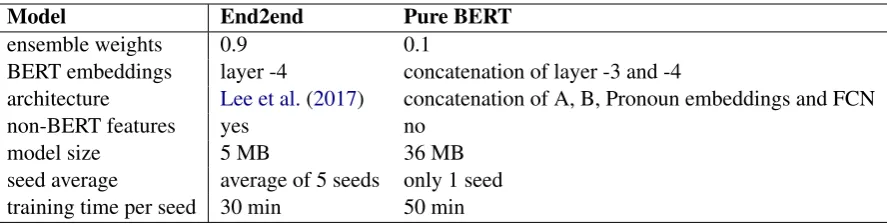
End2end model: This model uses the scor-ing architecture proposed in Lee et al. (2017), but with BERT embeddings. Since candidate names A and B are already given in this task, the model doesn’t have mention scores, only an-tecedent scores, which is a concatenation of BERT embeddings of the name (A or B); BERT embed-dings of the pronoun; their element-wise similar-ity (between A/B and P); and non-BERT features such as distance between the name and the pro-noun, whether the name is in the URL and lin-guistic features (syntactic distances and parts of sentence etc).
Pure BERT model: The input of this model is only the concatenated BERT embeddings of name A, name B and the pronoun, which are fed into two fully connected hidden layers of dimensions 512 and 32 before the softmax output layer.
2.1 Augmentation
Our augmentation strategy works this way: for each sample, replace all the occurrences of names A and B by 4 sets of placeholder names during both training and inference unless certain condi-tions are met. In training, it will make the epoch size 5 times as big. In inference, the model will make 5 predictions for each sample which are to be ensembled—this is also known as TTA (test time augmentation).
The 4 sets of placeholder names are
F: Alice, Kate,M: John, Michael
F: Elizabeth, Mary,M: James, Henry
F: Kate, Elizabeth,M: Michael, James
F: Mary, Alice,M: Henry, John
The names were chosen from most common names in stage 1 data. For each sample, use the male pair if the pronoun is masculine (“he”, “him”, or “his”) and female pair otherwise.
We have experimented with fewer or more sets of placeholder names, and alternative name choices which are more “modern” (common names in GAP are mostly old fashioned, as many articles are about historical figures), but none worked better than the original set of names we initially chose.
The conditions for not applying augmentation are:
1. If the placeholder name already appear in original document. e.g. in the following doc-ument, do not apply the augmentation sets that have “Alice” as a placeholder name,
Alicewent to live with Nick’s sister Kathy, who desperately tried to ...
2. If A or B is full name (first and last name), but the first name or last name appear alone elsewhere in the document. e.g. If we re-place “Candace Parker” (name B) by “Kate” in the following sentence, the model would not known “Kate” and “Parker” are the same person
... the Shock’s Plenette Pierson made a hard box-out on Candace Parker , causing both players to become entangled and fall over. As Parkertried to stand up, ...
3. If the name has more than two words, such as “Elizabeth Frances Zane” or “Jose de Vene-cia Jr”, We don’t replace it because it would be difficult to implement rule 2.
4. If one of name A or B is a substring of the other, e.g. name A is “Erin Fray” and name B is “Erin”. These are likely tagging errors.
In stage 1 data, for each set of placeholder names there are 8%, 2%, 1% and 1% data that met these conditions respectively and 88% was augmented. Note that the first 8% are different for each set of placeholder names—only the 4% cor-responding to conditions 2-4 wasn’t augmented at all.
3 Experiments
We used the official GAP dataset to build the sys-tem. There are 2000 data in both test and devel-opment sets and 454 in validation set. We used all of test and development plus 400 random rows in validation set (4400 in total) to train the system and left 54 as a sanity check to test the inference pipeline. The gender is nearly equally distributed in the training data with 2195 male and 2205 fe-male examples.
prevent cheating. The gender distribution is again almost equal with 383 female and 377 male exam-ples.
The meta information for both End2end and Pure Bert model is shown in Table 1. For each model, we trained two versions, one based on BERT Large Uncased, the other based on BERT Large Cased. For the competition, we used layer -4 (fourth to last hidden layer) embeddings for the End2end model and a concatenation of lay-ers -3 and -4 for the Pure BERT model. As will be shown in the results section, we re-trained the models after the competition with layers -5 and -6 and achieved better results.
Pre-processing: As reported in the competition discussion forum, there are some clear label mis-takes in GAP dataset. We identified 159 misla-bels (74 development, 68 test, 17 validation) to the best of our ability by going through all the exam-ples with a log loss of 1 or larger. We trained the system using corrected labels but report all results evaluated with original labels.
Post-processing: The problem with using clean labels to train and dirty labels to evaluate is that, loss will be huge for very confident predictions if the label is wrong (i.e. when the predicted probability for the wrong-label class is very small). We solved this problem by clipping predicted probabilities smaller than a threshold 0.005, which was tuned with cross validation. The idea is similar to label smoothing (Szegedy et al., 2016) and confidence penalty (Pereyra et al., 2017)
All the training was done in Google Colab with a single GPU. We used 5-fold cross validation for stage 1 results, and 5-fold average for stage 2 test results. End2end model was trained 5 times us-ing different seeds with each seed takus-ing about 30 minutes; Pure BERT model was trained only once which took about 50 minutes.
Each team is allowed two submissions for this shared task. Above described is our submission A. Submission B is the same except that (1) it was trained on GAP test and validation sets only (2454 training samples instead of 4400), and (2) it didn’t use the linguistic features. Submission B has worse results than A in both stage 1 and stage 2 as expected.
4 Results and discussion
4.1 Augmentation results
In Table2, we show the contribution of augmen-tation to the End2end model. In both uncased and cased versions and their ensemble, stage 1 log loss improved by about 0.01 when augmentation is added in training but not inference. And an-other massive 0.05 and 0.04 improvement for the uncased and cased version respectively is achieved when TTA is used. For the ensemble, augmenta-tion improved the score from 0.3470 to 0.3052.
The reason that this augmentation method worked so well can be explained in number of ways.
1. BERT contextual embeddings of a name con-tain information of both the context and the name itself. Only the contextual information is relevant for coreference resolution—whether the name is Alice or Betty or Claire does not matter at all. By replacing all names by the same set of place-holders, only the useful contextual information re-mains for the model to learn.
2. By using the same set of names in both training and inference, the noise from individual names are further reduced, i.e., the model will likely know they are names when it sees the same placeholder names during inference. This is even more so for foreign (non Western) names, as there are some articles in GAP about foreign figures. Without augmentation, it’s less likely that BERT model trained on English corpus can recognize, for example, a lowered cased (Romanized) Chi-nese name as a name.
3. For gender-neutral names (including certain foreign names) and males with a typically femi-nine name or females with a typically masculine name, the model can much easily resolve the gen-der after augmentation.
4. When a long name or uncommon name is tokenized into multiple word-piece tokens, we use the average embeddings of all these tokens. Since all the placeholder names are common first names thus tokenized into single token, the syntactic in-formation may be embedded better into a single vector than the average of a few.
5. TTA will generate four additional predictions for each sample. Ensemble of them and the un-augmented one gives an extra boost.
Model End2end Pure BERT
ensemble weights 0.9 0.1
BERT embeddings layer -4 concatenation of layer -3 and -4
architecture Lee et al.(2017) concatenation of A, B, Pronoun embeddings and FCN
non-BERT features yes no
model size 5 MB 36 MB
[image:4.595.78.522.61.173.2]seed average average of 5 seeds only 1 seed training time per seed 30 min 50 min
Table 1: Meta information of two models.
model uncased cased ensemble
no augmentation 0.3878 0.3771 0.3470
augmentation only in training 0.3796 0.3671 0.3355
augmentation in both training and inference 0.3308 0.3308 0.3052
Table 2: Stage 1 results improvements in End2end model due to augmentation
order of the 4 augmentations’ scores varies de-pending on the model (not reported due to space limit), but they all always outperform the one with-out augmentation. In other words, given a trained model, the prediction on any of four augmented version is better than prediction on original data.
4.2 Overall results
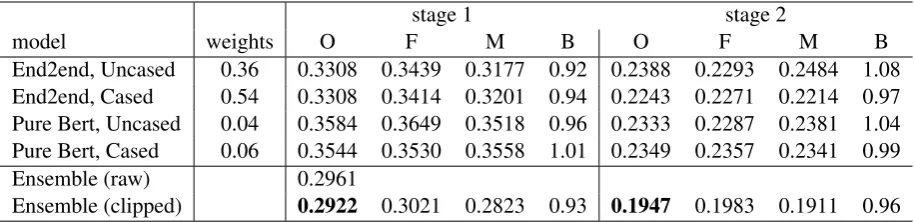
In Table3, we report the log loss scores of single models and the ensemble. For stage 1, we use the 5-fold cross validation scores, trained with cleaned labels and evaluated using original labels. We also tuned the ensemble weights based on scores with cleaned labels (not shown).
During the competition, we experimented with BERT embedding layers -1 to -4 by trying dif-ferent combinations of layers and their sum and concatenation and settled on layer -4 for End2end model and concatenation of -3 and -4 for Pure BERT model. After the competition ended, we re-alized lower layers work better on this task. So we re-trained the models using layer -5 for End2end model and layer -5 and -6 for Pure BERT model.
The results are significantly better across the board, as shown in Table 4. In fact, the stage 2 score 0.1799 is good enough for third place on the leaderboard. The ensemble weights were tuned on stage 1 data using clean labels as before.
After the competition, we also calculated the gender breakdown for all single and ensemble models based on the gender of the pronoun, re-ported also in Table3and4. During the
competi-tion, we trained the system and tuned the ensem-ble weights solely based on overall score. As a re-sult, it exhibits some degree of gender bias in both stages, similar toWebster et al.(2018) and the sys-tems cited therein. The final ensemble’s bias is 0.93 in stage 1 and 0.96 in stage 2, with bias rep-resented by the ratio of masculine and feminine scores.
Interestingly, the 4 single models demonstrate different level of bias, ranging from 0.91 to 1.03 in stage 1, and from 0.85 to 1.09 in stage 2. The larger variance is due to the much smaller stage 2 test size. Had the evaluation metrics been different than the overall log loss, we could have addressed it by assigning different weights to each single model. For instance, if systems were judged by the worse of feminine and masculine scores (to penalize heavily biased systems), we would have tuned the weights differently, sacrificing some overall score for a more balanced perfor-mance. For example, with ensemble weights [0.18, 0.42, 0.12, 0.28] and clipping threshold of 0.006, the overall score and gender bias of our post-competition system would be 0.2855 and 0.97 in stage 1 instead of the original version with better overall (0.2846) and a larger bias (0.93), as shown in the last row of Table4. On stage 2 data, the bias became slightly worse to 0.96 from 0.97. But since the stage 1 dataset is about six times as large as stage 2, the latter version is still the more gender unbiased system considering both sets.
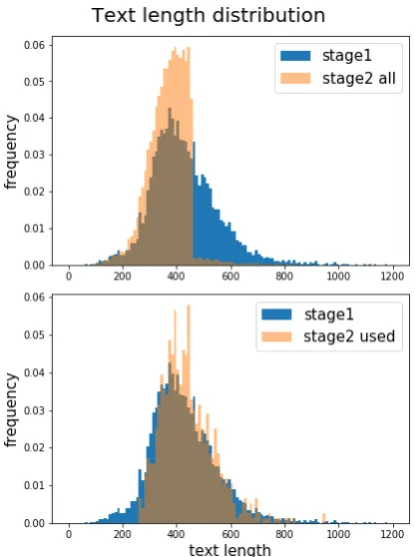
discrepancy between the document styles of two stages. There are many more shorter documents in stage 2, as shown in the top plot of Figure1. In many of the shorter documents, the pronoun refers to name A, which is the page entity. The aver-age predicted probabilities of the three classes A, B and Neither are 0.61, 0.35 and 0.05, compared with 0.44, 0.46 and 0.10 in stage 1.
However, as revealed by the stage 2 solution, 94% of the stage 2 data are unlabeled, which was probably generated differently (e.g. most unla-beled data have length smaller than 455). The length distribution of the 760 “real” labeled data used for scoring is very close to stage 1, as shown in the bottom plot of Figure1. So is the predicted probability distribution (0.45, 0.46, 0.09). Then what could explain the 0.1 log loss difference be-tween the two stage 2? We boostrapped 760 sam-ples from stage 1 predictions for 10,000 times, the simulated stage 2 score is smaller than actual stage 2 score for only once (0.01%). So the discrepancy is not solely due to variance from smaller sample size in stage 2.
Our best educated guess is cleaner labels: our stage 1 score evaluated using clean labels is 0.1993, which is much closer to stage 2 score. The organizer likely spent more effort quality-checking the smaller stage 2 labels. Obviously, different pre-processing criteria during data prepa-ration could also have made stage 2 data inherently easier to resolve.
5 Conclusion
We presented a simple yet effective augmenta-tion strategy that helped us finishing 7th place in the Gendered Pronoun Resolution challenge without fine-tuning. We reasoned how this tech-nique helped the model achieving higher scores by anonymizing idiosyncrasy in individual names while also handling gender and other biases to some degree. We demonstrated how the sys-tem could be altered slightly to (1) get a better score good for 3rd place by only changing BERT embedding layers or (2) become more gender-unbiased by using different ensemble weights.
[image:5.595.312.520.63.342.2]Even though our solution only used feature-based approach, we expect this augmentation method to work as well with fine-tune BERT ap-proach, which could potentially further improve the score.
Figure 1: Comparisons of document length distribu-tions of two stages. Top: all 12359 documents in stage 2. Bottom: the 760 “real” documents used for scoring in stage 2.
References
Tolga Bolukbasi, Kai-Wei Chang, James Y Zou, Venkatesh Saligrama, and Adam T Kalai. 2016. Man is to computer programmer as woman is to homemaker? debiasing word embeddings. In
Ad-vances in neural information processing systems,
pages 4349–4357.
Silvia Chiappa and Thomas PS Gillam. 2018. Path-specific counterfactual fairness. arXiv preprint
arXiv:1802.08139.
Jacob Devlin, Ming-Wei Chang, Kenton Lee, and Kristina Toutanova. 2019. Bert: Pre-training of deep bidirectional transformers for language
understand-ing.NAACL.
Jeremy Howard and Sebastian Ruder. 2018. Univer-sal language model fine-tuning for text classifica-tion. The 56th Annual Meeting of the Association for Computational Linguistics (ACL).
Kenton Lee, Luheng He, Mike Lewis, and Luke Zettle-moyer. 2017. End-to-end neural coreference reso-lution. InProceedings of the 2017 Conference on Empirical Methods in Natural Language Process-ing, pages 188–197.
stage 1 stage 2
model weights O F M B O F M B
End2end, Uncased 0.36 0.3308 0.3439 0.3177 0.92 0.2388 0.2293 0.2484 1.08 End2end, Cased 0.54 0.3308 0.3414 0.3201 0.94 0.2243 0.2271 0.2214 0.97 Pure Bert, Uncased 0.04 0.3584 0.3649 0.3518 0.96 0.2333 0.2287 0.2381 1.04 Pure Bert, Cased 0.06 0.3544 0.3530 0.3558 1.01 0.2349 0.2357 0.2341 0.99
Ensemble (raw) 0.2961
Ensemble (clipped) 0.2922 0.3021 0.2823 0.93 0.1947 0.1983 0.1911 0.96
Table 3: Log loss scores of single models and the ensemble for both stages,competition version, withOverall,
Feminine,Masculine andBias (M/F). Stage 2 results were evaluated after competition ended using the solution provided by Kaggle, except the final score 0.1947 (in bold), which placed 7th in the competition.
stage 1 stage 2
model weights O F M B O F M B
End2end, Uncased 0.36 0.3244 0.3402 0.3086 0.91 0.1901 0.1820 0.1984 1.09 End2end, Cased 0.44 0.3239 0.3345 0.3133 0.94 0.1871 0.2017 0.1723 0.85 Pure Bert, Uncased 0.08 0.3486 0.3593 0.3378 0.94 0.2269 0.2322 0.2215 0.95 Pure Bert, Cased 0.12 0.3492 0.3446 0.3539 1.03 0.2158 0.2145 0.2171 1.01
Ensemble (raw) 0.2875
Ensemble (clipped) 0.2846 0.2947 0.2744 0.93 0.1799 0.1829 0.1769 0.97
[image:6.595.72.530.63.174.2]More unbiased version 0.2855 0.2929 0.2780 0.97 0.1817 0.1858 0.1776 0.96
Table 4: Log loss scores of single models and the ensemble for both stages, post-competition version, with
Overall,Feminine,Masculine andBias (M/F). Stage 2 results were evaluated after competition ended using the solution provided by Kaggle. The stage 2 final score 0.1799 would rank third place on the leaderboard. Last row is a more gender-unbiased version with different ensemble weights.
man bookers prize winning fiction. arXiv preprint
arXiv:1807.10615.
Gabriel Pereyra, George Tucker, Jan Chorowski, Łukasz Kaiser, and Geoffrey Hinton. 2017. Regular-izing neural networks by penalRegular-izing confident output distributions. arXiv preprint arXiv:1701.06548.
Matthew Peters, Mark Neumann, Mohit Iyyer, Matt Gardner, Christopher Clark, Kenton Lee, and Luke Zettlemoyer. 2018. Deep contextualized word rep-resentations. In Proceedings of the 2018 Confer-ence of the North American Chapter of the Associ-ation for ComputAssoci-ational Linguistics: Human
Lan-guage Technologies, Volume 1 (Long Papers), pages
2227–2237.
Alec Radford, Karthik Narasimhan, Tim Salimans, and Ilya Sutskever. 2018. Improving language under-standing by generative pre-training.
Sravana Reddy and Kevin Knight. 2016. Obfuscating gender in social media writing. InProceedings of the First Workshop on NLP and Computational So-cial Science, pages 17–26.
Christian Szegedy, Vincent Vanhoucke, Sergey Ioffe, Jon Shlens, and Zbigniew Wojna. 2016. Rethink-ing the inception architecture for computer vision.
InProceedings of the IEEE conference on computer
vision and pattern recognition, pages 2818–2826.
Kellie Webster, Marta Recasens, Vera Axelrod, and Ja-son Baldridge. 2018. Mind the gap: A balanced cor-pus of gendered ambiguous pronouns. In Transac-tions of the ACL, page to appear.
Qizhe Xie, Zihang Dai, Eduard Hovy, Minh-Thang Lu-ong, and Quoc V Le. 2019. Unsupervised data aug-mentation.arXiv preprint arXiv:1904.12848.
Ziang Xie, Sida I Wang, Jiwei Li, Daniel L´evy, Aiming Nie, Dan Jurafsky, and Andrew Y Ng. 2017. Data noising as smoothing in neural network language models. Fifth International Conference on Learning Representations (ICLR).
Adams Wei Yu, David Dohan, Minh-Thang Luong, Rui Zhao, Kai Chen, Mohammad Norouzi, and Quoc V Le. 2018. Qanet: Combining local convolution with global self-attention for reading comprehen-sion. Sixth International Conference on Learning Representations (ICLR).