5867
Using Human Attention to Extract Keyphrase from Microblog Post
Yingyi Zhang Chengzhi Zhang∗
Nanjing University of Science and Technology
{yingyizhang, zhangcz}@njust.edu.cn
Abstract
This paper studies automatic keyphrase ex-traction on social media. Previous works have achieved promising results on it, but they neglect human reading behavior during keyphrase annotating. The human attention is a crucial element of human reading behavior. It reveals the relevance of words to the main topics of the target text. Thus, this paper aims to integrate human attention into keyphrase extraction models. First, human attention is represented by the reading duration estimated from eye-tracking corpus. Then, we merge human attention with neural network models by an attention mechanism. In addition, we also integrate human attention into unsuper-vised models. To the best of our knowledge, we are the first to utilize human attention on keyphrase extraction tasks. The experimental results show that our models have significant improvements on two Twitter datasets.
1 Introduction
Rapidly growth of user-generated content on so-cial media has far outpaced human beings’ read-ing and understandread-ing capacity. Keyphrase ex-traction is one of the technologies that can or-ganize this massive content. A keyphrase con-sists of one or more salient words, which repre-sents the main topics of a document. It has a se-ries of downstream applications, e.g., text summa-rization (Zhao et al., 2011a) and information re-trieval (Choi et al.,2012).
Generally, corpus with human annotated keyphrases are needed to train models in su-pervised keyphrase extraction frameworks. The premise for annotators to annotate keyphrases is to read the corresponding content. Intuitively, features estimated from human reading behavior can be leveraged to assist keyphrase extraction.
*Corresponding Author.
Previous studies on keyphrase extraction have ignored these features (Zhang et al.,2016,2018). Thus, this paper aims to integrate the reading behavior into keyphrase extraction frameworks.
When human reading, they do not pay the same attention to all words (Carpenter and Just,1983). The reading time of per-word is the indicative of textual (as well as lexical, syntactic and seman-tic) processing (Demberg and Keller,2008), which reflects human attention on various content. To obtain human attention during reading, this paper estimates eye fixation duration from eye-tracking corpus inspired byCarpenter and Just(1983) and Barrett et al.(2018). The modern-day eye track-ing equipment resulttrack-ing in a very rich and detailed dataset (Cop et al.,2017). Thus, we utilize open-source eye-tracking corpora and do not require eye-tracking information of the target datasets.
To integrate human attention into keyphrase ex-traction models, this paper constructs a neural net-work model with attention mechanism. Attention mechanism is a neural module designed to imi-tate human visual attention when they reading and looking (Bahdanau et al., 2014). To regularize the predicted value of attention mechanism, hu-man attention estimated from eye-tracking corpus is leveraged as the ground truth of it. Quantitative and qualitative analyses demonstrate that our mod-els yield a better performance than state-of-the-art models. In addition, we prove that human atten-tion is also effective on unsupervised keyphrase extraction models. We are, to the best of our knowledge, the first to integrate human attention into keyphrase extraction tasks.
2 Related Work
Twitter and Sina Weibo. Previous studies ex-tract keyphrases using traditional supervised al-gorithms (Marujo et al., 2015), which depending on a large set of manually selected features. To overcome this drawback, neural network models, which can learn features from training corpus au-tomatically, are proposed and are proven effec-tive in keyphrase extraction. For instance, Zhang et al. (2016) propose a neural network model to extract keyphrases from Tweets. This model ex-tracts keyphrases from Tweets directly, which suf-fers from the severe data sparsity problem. Ex-ternal knowledge is utilized to alleviate this prob-lem. Zhang et al. (2018) encode conversation context consisting of Tweet reply in neural mod-els. This model yields a better performance than Zhang et al.(2016) , which prove the effectiveness of external knowledge. Thus, this paper is in the line of integrating external knowledge into neural network models. In this paper, we explore the idea of using human attention estimated from available eye-tracking corpus to assist keyphrase extraction. The open source eye-tracking corpus of natural reading include the Dundee corpus (Ekbal et al., 2007) and GECO (Cop et al.,2017). The features of eye tracking corpus include first fixation dura-tion (FFD), total reading time (TRT), go-past time (GPT) , et al. TRT is a feature that has been ap-plied to various natural language processing tasks, such as multi word expressions prediction (Roha-nian et al.,2017) and sentiment analysis (Barrett et al., 2018). Thus, we select the TRT feature to represent the human attention. Since the GECO corpus is open sourced and is in English, we esti-mate the TRT feature from it.
3 Keyphrase Extraction Framework
Formally, given a target microblog postxi
formu-lated as word sequence< xi,1, xi,2,· · ·, xi,|xi| >,
where |xi| denotes the length of xi, we aim to
produce a tag sequence< yi,1, yi,2,· · ·, yi,|xi| >,
where yi,w indicates whether xi,w is part of a
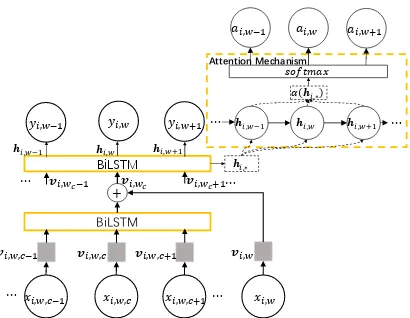
keyphrase. As shown in Figure 1, our models use the character-level word embedding proposed byJebbara and Cimiano(2017), but we ignore this part of our architecture in the equations below:
yi,w =σ(Wytanh(Weyhi,w+bey)+by) (1)
wherehi,wis the representation ofxi,wafter
pass-ing through the Bi-directional LSTM (BiLSTM) layer, Wy and by are parameters of the function
𝑥𝑖,𝑤,𝑐−1 𝑥𝑖,𝑤,𝑐 𝑥𝑖,𝑤,𝑐+1 𝑥𝑖,𝑤
BiLSTM
𝒗𝑖,𝑤,𝑐−1 𝒗𝑖,𝑤,𝑐 𝒗𝑖,𝑤,𝑐+1 𝒗𝑖,𝑤 +
⋯ ⋯
Attention Mechanism
𝒗𝑖,𝑤𝑐
BiLSTM
⋯
⋯ 𝒉𝑖,𝑤−1 𝒉𝑖,𝑤 𝒉𝑖,𝑤+1
𝛼(𝒉𝑖,∗)
⋯
𝑠𝑜𝑓𝑡𝑚𝑎𝑥
𝒉𝑖,𝑤+1
𝑎𝑖,𝑤−1 𝑎𝑖,𝑤 𝑎𝑖,𝑤+1
⋯
𝒉𝑖,𝑤
𝒉𝑖,𝑤−1
𝑦𝑖,𝑤+1 𝑦𝑖,𝑤
𝑦𝑖,𝑤−1
𝒉𝑖,∗
[image:2.595.315.520.61.220.2]𝒗𝑖,𝑤𝑐+1 𝒗𝑖,𝑤𝑐−1
Figure 1: The framework of neural network keyphrase extraction with human attention.
σ(·) to be learned. W
e
y andbey are parameters of the functiontanh(·) to be learned,σ(·)is a non-liner function. In detail,yi,w has five possible
val-ues followingZhang et al.(2016):
y{Single, Begin, M iddle, End, N ot} (2)
where Single represents that xi,w is a one-word
keyword. Begin, Middle and End represent that
xi,wis the first word, the middle word and the last
word of a keyphrase, respectively. Not represents thatxi,wis not a keyword or part of a keyphrase.
From the hidden states, we directly predict word level raw attention scoresai,w:
ai,w =Waei,w+ba (3)
ei,w=tanh(Wehi,w+be) (4)
where We and be are parameters of function
tanh(·). Then, we normalize these predictions to attention weightsagi,w:
g ai,w =
ai,w
P
kai,k
(5)
where k is the length ofxi. Inspired by Barrett
et al. (2018), we combine above mentioned two objections: word-level and attention-level. The word-level is to minimize the squared error be-tween outputsyi,w and true word labelsyˆi,w.
Lword=
X
i
X
w
(yi,w−yˆi,w)2 (6)
weights ai,w and real human attention ˆai,w
esti-mated from eye-tracking corpus.
Latt =
X
i
X
w
(ai,w−ˆai,w)2 (7)
When combined,λwordandλatt(between 0 and 1)
are utilized to trade off loss functions at the word-level and attention-word-level, respectively.
L=λwordLword+λattLatt (8)
In addition to above mentioned single layer mod-els, we also use joint-layer BiLSTM proposed by Zhang et al.(2016). As a multi-task learner, joint-layer BiLSTM tackles two tasks with two types of outputs, yi,w1 and yi,w2 . yi,w1 has a binary tagset, which indicates whether the wordxi,wis part of a
keyphrase or not. y2i,wemploys the 5-value tagset defined in Equation2. There is an attention mod-ule upon each BiLSTM layer with a corresponding prediction. The loss changes with the number of layers in models. Theout represents the number of layers in the model.
L=
out
X
i=1
λiwordLiword+
out
X
i=1
λiattLiatt (9)
4 Experiment Settings
4.1 Twitter Dataset
Our experiments are conducted on two datasets, i.e., Daily-Life dataset and Election-Trec dataset.
Daily-Life This is collected from January of 2018 to April of 2018 using Twitter’s steaming API with a set of daily life keywords.
Election-Trec This is constructed based on opensource dataset TREC2011 track1 and Elec-tion corpus (Zeng et al.,2018)2.
For keyphrase annotation, we follow Zhang et al. (2016) to use microblog hashtags as gold-standard keyphrases and filtered all microblog posts by two rules: first, there is only one hash tag per post; second, the hashtag is inside a post. Then, we removed all the ‘#’ before keyphrase ex-traction. For both Twitter datasets, we randomly sample 0.8, 0.1 and 0.1 for training, development and testing. We preprocessed both Twitter datasets
1
https://trec.nist.gov/data/tweets/
2http://www.ccs.neu.edu/home/luwang/datasets/micro
blog conversation.zip
Dataset # of
annot. msgs
mesgs length
Vocab Cover
Election-Trec
Train 24,210 19.94 36,018 7.7
Vali 3,027 20.00 9,909 17.8
Test 3,027 19.71 9,973 17.9
Daily-Life
Train 12,827 28.92 40,628 7.0
Vali 1,610 28.77 9,964 17.4
Test 1,610 29.75 10,355 17.5
Table 1: Statistics of two datasets. Train, Dev, and Test denotes training, development, and test set, respec-tively. # of annot. Msgs: number of target post with keyphrase annotation. mesgs length: average count of words in the target post. Vocab: vocabulary size. Cover: The percent (%) of words existing in GECO.
with Twitter NLP tool3for tokenization. After fil-tering and preprocessing, Daily-Life dataset and Election-Trec dataset contains 16,047 Tweets and 30,264 Tweets, respectively. Table 1 shows the statistic information of two Twitter datasets
Since there are no spaces between words in hashtags, we use some strategies to segment hashtags. There are two kinds of hashtags in the datasets. One is the ‘multi-word’ that con-tains both capitals and lowercases, the other are the ‘single-word’ in all lowercases or capi-tals. If a hashtag is a ‘multi-word’, we segment hashtags with two patterns, first is (capital) ∗ (lowercase)+, which represents one capital fol-lowed by one or more lowercases, second is
(capital)+, which represents one or more capi-tals. When doing hashtag segmentation, the first pattern is utilized firstly and then the second pat-tern is applied. Meanwhile, we do not do any pre-processing if a hashtag is a ‘single-word’.
4.2 Eye-tracking Corpus
This paper estimates human attention from GECO corpus (Cop et al.,2017), which is based on nor-mal reading. In GECO, participants read a part of the novel ‘The Mysterious Affair at Styles’ by Agatha Christie. Six males and seven females whose native language is English participated in and read a total of 5,031 sentences. There are var-ious features in GECO, including First Fixation Duration (FFD) and Total Reading Time (TRT). In this paper, we merely use the TRT feature, which represents total human attention on words during reading. This feature is also used byCarpenter and Just(1983) andBarrett et al.(2018). We then
vide TRT values by the number of participants to get an average TRT (ATRT).
Human attention correlates with word fre-quency (Rayner and Duffy,1988). Thus, ATRT is normalized by the word frequency of the British National Corpus (BNC)4. Before normalizing, BNC is log-transformed per million and inversed (INV-BNC), such that rare words get a high value. ATRT and INV-BNC are min-max-normalized to a value in the range 0-1. ATRT is multiplied with INV-BNC to get normalized ATRT (N-ATRT). Af-ter preprocessing, there are 5,012 unique words in the dataset. In addition, words that are not in-cluded in the GECO corpus, which do not have a corresponding N-ATRT value, are given the mean value of N-ATRT. Table1shows the percentage of words that can be found in GECO corpus.
4.3 Implementation Details
In the training phrase, we choose BiL-STM (Graves and Schmidhuber, 2005) with 300 dimensions. For single layer models, λword
andλatt are set to 0.7 and 0.3, respectively. For
joint layer models, λ1word, λ1att, λ2word and λ2att
are set to 0.4, 0.2, 0.2 and 0.2, respectively. Parameters are set under the best performance. The epoch is set to 5. We initialize target post by embeddings pre-trained on 99M tweets with 27B tokens and 4.6M words in the vocabulary.
4.4 Baseline Models
We compare our models with CRF (Zhang et al., 2008) and two kinds of neural network models: one kind is the neural network model without at-tention mechanism (BiLSTM model), the other is the neural network model with attention mecha-nism but is not modified by human attention (A-BiLSTM model). Similar as HA-(A-BiLSTM pro-posed by this paper, BiLSTM models and A-BiLSTM models employ the single layer pattern and the joint layer pattern. The parameter setting of the joint layer pattern is same withZhang et al. (2016). We compare the performance of models with the P, R and F1 evaluation metrics.
BiLSTM model This model is merely
con-structed by the character-level word embedding and the BiLSTM layer.
A-BiLSTM model This model is constructed by the character-level word embedding,
BiL-4http://www.natcorp.ox.ac.uk/
Daily-Life Election-Trec
Baseline
CRF 64.07 58.34
BiLSTM(Single) 70.37±1.30 66.42±0.97
A-BiLSTM(Single) 70.49±0.50 66.70±0.81
BiLSTM(Joint) 72.48±0.47 67.74±0.47
A-BiLSTM(Joint) 73.23±1.06 69.69±0.37
Our model
HA-BiLSTM(Single) 71.28±0.33 67.57±0.28
[image:4.595.313.520.59.165.2]HA-BiLSTM(Joint) 74.35±0.17 70.74±0.38
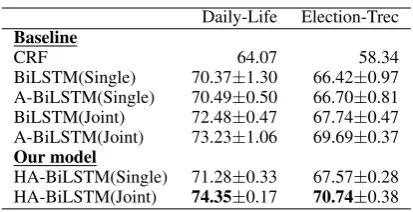
Table 2: Comparisons of the average F1 scores (%) and their standard deviations (%) over the results of mod-els on two datasets with 5 sets of parameters for ran-dom initialization. BiLSTM (Single) is the BiLSTM model with a single layer pattern. BiLSTM (Joint) is the BiLSTM model with a joint layer model. A-BiLSTM (Single) is the A-A-BiLSTM model with a sin-gle layer pattern. A-BiLSTM (Joint) is the A-BiLSTM model with a joint layer pattern. HA-BiLSTM (Single) is the HA-BiLSTM model with a single layer pattern. HA-BiLSTM (Joint) is the HA-BiLSTM model with a joint layer pattern.
STM layer and attention mechanism. Different with HBiLSTM, the attention mechanism in A-BiLSTM is not modified by human attention.
5 Result
5.1 Overall Comparisons
Human attention estimated from eye-tracking corpus is helpful in improving the performance of neural network keyphrase extraction. As shown in Table2, all the F1 values of models with human attention are higher than those of baseline models. In this paper, human attention is repre-sented by the total reading time of per-word esti-mated from eye-tracking corpus. Thus, it indicates that the attempt of integrating human reading be-havior information into neural network is feasible.
The open-source eye-tracking corpus can im-prove the performance of models on datasets in different genres. Although the genre of the GECO eye-tracking corpus is fiction, which is dif-ferent with the genre of the target dataset (Mi-croblog), it has the ability to improve the perfor-mance of keyphrase extraction on target datasets.
5.2 Qualitative Analysis
Target Post what would ahillary clinton
supreme court look like?
Gold-standard hillary clinton
Models
A-BiLSTM (Single) hillary clinton; court
[image:5.595.310.519.60.165.2]HA-BiLSTM (Single) hillary clinton
Table 3: The example that the hashtag in the target post is ‘hillary clinton’.
Target Post I nominate MEN for a shorty
award in entertainment be-cause she never fails to write awesome smileys! xd URL
Gold-standard entertainment
Models
A-BiLSTM (Single) NULL
HA-BiLSTM (Single) entertainment
Table 4: The example that the hashtag in the target post is ‘entertainment’.
(Single) and HA-BiLSTM (Single). Interestingly, the A-BiLSTM extracts two phrases ‘hillary clin-ton’ and ‘court’. It may due to that the attention weight of ‘court’ is the biggest among all words in the target post in A-BiLSTM. The HA-BiLSTM identifies the correct keyphrase. In this model, the attention weight of ‘court’ is the 6th biggest among all words in the target post. The reason of this phenomenon is that the ‘court’ has a low N-ATRT value (0.024). Using the N-ATRT value of ‘court’ can modify the attention weight of ‘court’. In Table 4, the keyphrase of the target post should be ‘entertainment’. As shown in Table4, the A-BiLSTM model do not extract any phrase, while the HA-BiLSTM model extract the cor-rect keyphrase. It may due to that the attention weight of ‘entertainment’ in A-BiLSTM is the 13th biggest among all the words in the target post, while it is the third biggest in HA-BiLSTM, which is due to the high N-ATRT value (0.147) of ‘enter-tainment’ in GECO eye-tracking dataset modify-ing the correspondmodify-ing attention weight.
5.3 Analysis on Unsupervised Models
In this section, we explore the idea of using hu-man attention on TextRank (Mihalcea and Tarau, 2004), which is an unsupervised keyphrase extrac-tion algorithm. As defined in Secextrac-tion 3, a Tweet
xi consist of words xi,1, xi,2,· · ·, xi,n. If xi,m
is appeared within the window of xi,j, there is
an edge e(xi,m, xi,j) between these two words.
Based on the graph composited by word vertices and edges, the importance of each word vertices can be calculated. In TextRank, the value of xi,j
Num Daily-Life Election-Trec
P R F1 P R F1
TextRank
2 1.7 3.5 2.3 4.0 8.0 5.4
5 2.8 8.6 4.3 4.6 15.3 7.1
10 2.9 8.6 4.3 4.7 15.8 7.2
HATR
2 2.7 5.5 3.6 6.4 12.9 8.6
5 4.0 12.1 6.0 7.3 24.4 11.3
[image:5.595.77.287.62.124.2]10 4.0 12.1 6.0 7.4 24.9 11.4
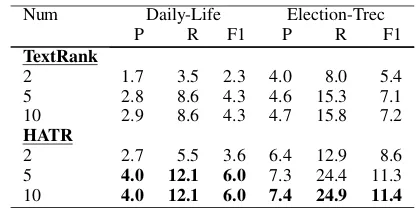
Table 5: The P, R, F1 scores (%) of TextRank and Tex-tRank with human attention (HATR) models on two datasets. N um represents the number of top-Num phrases that are chose to be candidate words.
ande(xi,m, xi,j)are initialized unprivileged.
In our models, we utilize human attention to normalize the initialized value of xi,j and
e(xi,m, xi,j). The initialized value of xi,j
de-pends on the N-ATRT value of itself. The initial-ized value ofe(xi,m, xi,j)depends on the N-ATRT
value ofxi,m andxi,j. After extracting candidate
words by HATR, we generate keyphrases by com-bining candidate words if words are connected to-gether in target posts.
As shown in Table5,all the P, R and F1 values of HATR are higher than those of TextRank.These observations indicate that integrating human at-tention during reading into TextRank is feasible. Moreover, more candidate keyphrases yield better keyphrase extraction performance.
6 Conclusion
In this paper, we consolidate the neural network keyphrase extraction algorithm with human atten-tion represented by total reading time (TRT) esti-mated from GECO eye-tracking corpus. The pro-posed models yield a better performance on two Twitter datasets. Moreover, human attention is also effective on unsupervised models.
In the future, first, we try to utilize more eye-tracking corpus and estimate more features of reading behavior. Then, we will attempt to ana-lyze real human reading behavior on social media and thereby explore more specific human attention features on social media.
Acknowledgments
References
Dzmitry Bahdanau, Kyunghyun Cho, and Yoshua Ben-gio. 2014. Neural machine translation by jointly learning to align and translate. arXiv pre-print, arXiv/1409.0473.
Maria Barrett, Joachim Bingel, Nora Hollenstein, Marek Rei, and Anders Søgaard. 2018. Sequence classification with human attention. InProceedings of the 22nd Conference on Computational Natural Language Learning, CoNLL, pages 302–312.
Abdelghani Bellaachia and Mohammed Al-Dhelaan. 2012. NE-Rank: A Novel Graph-Based Keyphrase Extraction in Twitter. In Proceedings of the IEEE/WIC/ACM International Conferences on Web Intelligence, pages 372–379.
Patricia A Carpenter and Marcel Adam Just. 1983. What your eyes do while your mind is reading. Eye movements in reading: Perceptual and language processes, pages 275–307.
Jaeho Choi, W. Bruce Croft, and Jinyoung Kim. 2012. Quality Models For Microblog Retrieval. In Pro-ceedings of the 21st ACM International Confer-ence on Information and Knowledge Management, CIKM, pages 1834–1838.
Uschi Cop, Nicolas Dirix, Denis Drieghe, and Wouter Duyck. 2017. Presenting geco: An eyetracking cor-pus of monolingual and bilingual sentence reading.
Behavior research methods, 49(2):602–615.
Vera Demberg and Frank Keller. 2008. Data from eye-tracking corpora as evidence for theories of syntactic processing complexity. Cognition, 109(2):193–210.
Asif Ekbal, S Mondal, and Sivaji Bandyopadhyay. 2007. Pos tagging using hmm and rule-based chunking. InProceedings of workshop on shallow parsing in South Asian languages, SPSAL, pages 25–28.
Alex Graves and J¨urgen Schmidhuber. 2005. Frame-wise Phoneme Classification with Bidirectional LSTM and Other Neural Network Architectures.
Neural Networks, 18(5-6):602–610.
Soufian Jebbara and Philipp Cimiano. 2017. Improv-ing opinion-target extraction with character-level word embeddings. InProceedings of the First Work-shop on Subword and Character Level Models in NLP, SCLeM, pages 159–167.
Lu´ıs Marujo, Wang Ling, Isabel Trancoso, Chris Dyer, Alan W. Black, Anatole Gershman, David Martins de Matos, Jo˜ao Paulo da Silva Neto, and Jaime G. Carbonell. 2015. Automatic Keyword Extraction on Twitter. In Proceedings of the 53rd Annual Meet-ing of the Association for Computational LMeet-inguistics and the 7th International Joint Conference on Natu-ral Language Processing of the Asian Federation of Natural Language Processing, ACL, pages 637–643.
Rada Mihalcea and Paul Tarau. 2004. TextRank: Bringing Order into Text. In Proceedings of the 2004 Conference on Empirical Methods in Natural Language Processing , EMNLP, A meeting of SIG-DAT, a Special Interest Group of the ACL, held in conjunction with ACL, pages 404–411.
Keith Rayner and Susan A Duffy. 1988. On-line com-prehension processes and eye movements in reading.
Reading research: Advances in theory and practice, 6:13–66.
Omid Rohanian, Shiva Taslimipoor, Victoria Yaneva, and Le An Ha. 2017. Using gaze data to predict multiword expressions. In Proceedings of the In-ternational Conference Recent Advances in Natural Language Processing, RANLP, pages 601–609.
Xingshan Zeng, Jing Li, Lu Wang, Nicholas Beauchamp, Sarah Shugars, and Kam-Fai Wong. 2018. Microblog conversation recommendation via joint modeling of topics and discourse. In Proceed-ings of the Conference of the North American Chap-ter of the Association for Computational Linguis-tics: Human Language Technologies, NAACL-HLT, pages 375–385.
Chengzhi Zhang, Huilin Wang, Yao Liu, Dan Wu, Yi Liao, and Bo Wang. 2008. Automatic keyword extraction from documents using conditional ran-dom fields. Journal of Computational Information Systems, 4(3):1169–1180.
Qi Zhang, Yang Wang, Yeyun Gong, and Xuanjing Huang. 2016. Keyphrase Extraction Using Deep Recurrent Neural Networks on Twitter. In Proceed-ings of the Conference on Empirical Methods in Nat-ural Language Processing, EMNLP, pages 836–845.
Yingyi Zhang, Jing Li, Yan Song, and Chengzhi Zhang. 2018. Encoding conversation context for neural keyphrase extraction from microblog posts. In Pro-ceedings of the Conference of the North American Chapter of the Association for Computational Lin-guistics: Human Language Technologies, NAACL-HLT, pages 1676–1686.
Hong Zhao, Chen Sheng Bai, and Song Zhu. 2011a. Automatic keyword extraction algorithm and im-plementation. Applied Mechanics and Materials, 44:4041–4049.