646
Evaluating Discourse in Structured Text Representations
Elisa Ferracane1,Greg Durrett2,Junyi Jessy Li1andKatrin Erk1
1Department of Linguistics 2Department of Computer Science
The University of Texas at Austin
[email protected], [email protected] [email protected], [email protected]
Abstract
Discourse structure is integral to understand-ing a text and is helpful in many NLP tasks. Learning latent representations of discourse is an attractive alternative to acquiring expen-sive labeled discourse data. Liu and Lapata
(2018) propose a structured attention mecha-nism for text classification that derives a tree over a text, akin to an RST discourse tree. We examine this model in detail, and evalu-ate on additional discourse-relevant tasks and datasets, in order to assess whether the struc-tured attention improves performance on the end task and whether it captures a text’s dis-course structure. We find the learned latent trees have little to no structure and instead fo-cus on lexical cues; even after obtaining more structured trees with proposed model modi-fications, the trees are still far from captur-ing discourse structure when compared to course dependency trees from an existing dis-course parser. Finally, ablation studies show the structured attention provides little benefit, sometimes even hurting performance.1
1 Introduction
Discourse describes how a document is organized, and how discourse units are rhetorically connected to each other. Taking into account this structure has shown to help many NLP end tasks, including summarization (Hirao et al.,2013;Durrett et al.,
2016), machine translation (Joty et al.,2017), and sentiment analysis (Ji and Smith,2017). However, annotating discourse requires considerable effort by trained experts and may not always yield a structure appropriate for the end task. As a result, having a model induce the discourse structure of a text is an attractive option. Our goal in this paper is to evaluate such an induced structure.
1Code and data available athttps://github.com/
elisaF/structured
Inducing structure has been a recent popular approach in syntax (Yogatama et al.,2017;Choi et al.,2018;Bisk and Tran,2018). Evaluations of these latent trees have shown they are inconsistent, shallower than their explicitly parsed counterparts (Penn Treebank parses) and do not resemble any linguistic syntax theory (Williams et al.,2018).
For discourse,Liu and Lapata(2018) (L&L) in-duce a document-level structure while performing text classification with a structured attention that is constrained to resolve to a non-projective depen-dency tree. We evaluate the document-level struc-ture induced by this model. In order to compare the induced structure to existing linguistically-motivated structures, we choose Rhetorical Struc-ture Theory (RST) (Mann and Thompson,1988), a widely-used framework for discourse structure, because it also produces tree-shaped structures.2 We evaluate on some of the same tasks as L&L, but add two more tasks we theorize to be more discourse-sensitive: text classification of writing quality, and sentence order discrimination (as pro-posed byBarzilay and Lapata(2008)).
Our research uncovers multiple negative results. We find that, contrary to L&L, the structured at-tention does not help performance in most cases; further, the model is not learning discourse. In-stead, the model learns trees with little to no struc-ture heavily influenced by lexical cues to the task. In an effort to induce better trees, we propose sev-eral principled modifications to the model, some of which yield more structured trees. However, even the more structured trees bear little resem-blance to ground truth RST trees.
We conclude the model holds promise, but
re-2
The Penn Discourse Treebank (PDTB; Prasad et al.,
inter-sentence biLSTM structured attention
s1 s2 … st
d1
semantic discourse
e1
d2
e2
dt
et
y max-pooling
document-level
words sentences
class
structured attention +compose structured attention +compose
document
sentence
Compose eʹt
eʹ2
eʹ1
…
[image:2.595.73.290.63.147.2]…
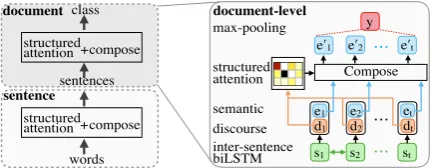
Figure 1: Model of Liu and Lapata (2018) with the document-level portion (right) that composes sentences into a document representation.
quires moving beyond text classification, and in-jecting supervision (as inStrubell et al.(2018)).
Our contributions are (1) comprehensive perfor-mance results on existing and additional tasks and datasets showing document-level structured atten-tion is largely unhelpful, (2) in-depth analyses of induced trees showing they do not represent dis-course, and (3) several principled model changes to produce better structures but that still do not re-semble the structure of discourse.
2 Rhetorical Structure Theory (RST)
In RST, coherent texts consist of minimal units, which are linked to each other, recursively, through rhetorical relations (Mann and Thompson,
1988). Thus, the goal of RST is to describe the rhetorical organization of a text by using a hier-archical tree structure that captures the commu-nicative intent of the writer. An RST discourse tree can further be represented as adiscourse de-pendency tree. We follow the algorithm ofHirao et al. (2013) to create an unlabelled dependency tree based on the nuclearity of the tree.
3 Models
We present two models: one for text classification, and one for sentence ordering. Both are based on the L&L model, with a design change to cause stronger percolation of information up the tree (we also experiment without this change).
Text classificationThe left-hand side of Figure1
presents an overview of the model: the model op-erates first at the sentence-level to create sentence representations, and then at the document-level to create a document representation from the previ-ously created sentence representations. In more detail, the model composes GloVe embeddings (Pennington et al.,2014) into a sentence represen-tation using structured attention (from which a tree can be derived), then sentence representations into a single document representation for class
predic-tion. At both sentence and document level, each object (word or sentence, respectively) attends to other objects that could be its parent in the tree. Since the sentence and document-level parts of the model are identical, we focus on the document level (Figure 1, right), which is of interest to us for evaluating discourse effects.
Sentence representations s1, . . . , st are fed to
a bidirectional LSTM, and the hidden representa-tions [h1, . . . , ht] consist of a semantic part (et)
and a structure part (dt): [et,dt] = ht. Unnor-malized scoresfij representing potentials between
parentiand childjare calculated using a bilinear function over the structure vector:
tp = tanh(Wpdi); tc= tanh(Wcdj) (1)
fij =tTpWatc (2)
The matrix-tree theorem allows us to compute marginal probabilitiesaij of dependency arcs
un-der the distribution over non-projective depen-dency trees induced by fij (details in Koo et al.
(2007)). This computation is fully differentiable, allowing it to be treated as another neural network layer in the model. We importantly note the model only uses the marginals. We can post-hoc use the Chu-Liu-Edmonds algorithm to retrieve the highest-scoring tree underf, which we callfbest
(Chu and Liu,1965;Edmonds,1967).
The semantic vectors of sentenceseare then up-dated using this attention. Here we diverge from the L&L model: in their implementation,3 each node is updated based on a weighted sum over its parentsin the tree (their paper states both parents and children).4 We instead inform each node by a sum over its children, more in line with past work where information more intuitively perco-lates from children to parents and not the other way (Ji and Smith,2017) (we also run experiments without this design change). We calculate the con-text for all possible children of that sentence as:
ci= n X
k=1
aikek (3)
whereaikis the probability thatkis the child ofi,
andekis the semantic vector of the child.
The children vectors are then passed through a non-linear function, resulting in the updated se-mantic vectore0ifor parent nodei.
e0i= tanh(Wr[ei, ci]) (4)
3
https://github.com/nlpyang/structured
4We found similar results for using both parents and
Yelp Debates WQ WQTC WSJSO
L&L(orig) 68.51|68.27(0.19) 81.82|79.48 (2.90) 84.14|82.69(1.36) 80.73|79.63 (1.03) 96.17|95.29(0.84) L&L(ours) 68.51|68.23(0.23) 78.88|77.81 (1.80) 84.14|82.70(1.36) 82.49|81.11(0.95) 95.57|94.76(1.11)
−doc attn 68.34|68.13(0.17) 82.89|81.42(1.08) 83.75|82.80(0.94) 80.60|79.25 (0.94) 95.57|95.11(0.42)
−both attn 68.19|68.05 (0.13) 79.95|77.34 (1.79) 84.27|83.16(1.25) 77.58|76.16 (1.25) 95.23|94.68(0.37)
L&L(reported) 68.6 76.5 - -
-Table 1: Max| mean (standard deviation) accuracy on the test set averaged across four training runs with different initialization weights. Bolded numbers are within 1 standard deviation of the best performing model. L&L(orig) uses the original L&L code; L&L(ours) includes the design change and bug fix. L&L(reported) lists results re-ported by L&L on a single training run.
Finally, a max pooling layer overe0ifollowed by a linear layer produces the predicted document class
y. The model is trained with cross entropy loss. Additionally, the released L&L implementation has a bug where attention scores and marginals are not masked correctly in the matrix-tree computa-tion, which we correct.
Sentence order discrimination This model is
identical, except for task-specific changes. The goal of this synthetic task, proposed by Barzilay and Lapata(2008), is to capture discourse coher-ence. A negative class is created by generating random permutations of a text’s original sentence ordering (the positive class). A coherence score is produced for each positive and negative example, with the intuition that the originally ordered text will be more coherent than the jumbled version. Because we compare two examples at a time (orig-inal and permuted order), we modify the model to handle paired inputs and replace cross-entropy loss with a max-margin ranking loss.
4 Experiments
We evaluate the model on four text classification tasks and one sentence order discrimination task.
4.1 Datasets
Details and statistics are included in AppendixA.5
Yelp (in L&L, 5-way classification) comprises customer reviews from the Yelp Dataset Challenge (collected by Tang et al.(2015)). Each review is labeled with a 1 to 5 rating (least to most positive).
Debates (in L&L, binary classification) are tran-scribed debates on Congressional bills from the U.S. House of Representatives (compiled by
Thomas et al.(2006), preprocessed byYogatama
5
Of the document-level datasets used in L&L (SNLI was sentence-level), we omit IMDB and Czech Movies be-cause on IMDB their model did not outperform prior work, and Czech (a language with freer word order than English) highlighted the non-projectivity of their sentence-level trees, which is not the focus of our work.
and Smith(2014)). Each speech is labeled with 1 or 0 indicating whether the speaker voted in favor of or against the bill.
Writing quality (WQ)(not in L&L, binary
clas-sification) contains science articles from the New York Times (extracted from Louis and Nenkova
(2013)). Each article is labeled as either ‘very good’ or ‘typical’ to describe its writing quality. While both classes contain well-written text,Louis and Nenkova(2013) find features associated with discourse including sentiment, readability, along with PDTB-style discourse relations are helpful in distinguishing between the two classes.
Writing quality with topic control (WQTC)
(not in L&L, binary classification) is similar to WQ, but controlled for topic using a topic simi-larity list included with the WQ source corpus.6
Wall Street Journal Sentence Order (WSJSO)
(not in L&L, sentence order discrimination) is the WSJ portion of PTB (Marcus et al.,1993).
4.2 Settings
For each experiment, we train the model four times varying only the random seed for weight initializations. The model is trained for a fixed amount of time, and the model from the timestep with highest development performance is chosen. We report accuracies on the test set, and tree anal-yses on the development set. Our implementation is built on the L&L released implementation, with changes as noted in Section3. Preprocessing and training details are in AppendixA.
4.3 Results
We report accuracy (as in prior work) in Table1, and perform two ablations: removing the struc-tured attention at the document level, and remov-ing it at both document and sentence levels. Addi-tionally, we run experiments on the original code
6An analysis in section4.3shows the WQ-trained model
[image:3.595.73.526.63.135.2]Yelp Debates WQ WQTC WSJSO
[image:4.595.78.289.454.497.2]tree height 2.049 2.751 2.909 4.035 2.288 prop. of leaf nodes 0.825 0.849 0.958 0.931 0.892 norm. arc length 0.433 0.397 0.420 0.396 0.426 % vacuous trees 73% 38% 42% 14% 100%
Table 2: Statistics for learned trees averaged across four runs (similar results without the design change or bug fix are in the Appendix Table6). See Table4for gold statistics on WQTC.
withoutthe design change or bug fix to confirm our findings are similar (see L&L(orig) in Table1).
Document-level structured attention does not
help. Structured attention at the sentence level
helps performance for all except WQ, where no form of attention helps. However, structured atten-tion at the document level yields mostly negative results, in contrast to the improvements reported in L&L. In Yelp, WSJSO, and WQ, there is no differ-ence. In Debates, the attention hurts performance. Only in WQTC does the structured attention pro-vide a benefit. While a single training run could produce the improvements seen in L&L, the re-sults across four runs depict a more accurate pic-ture. When inducing structures, it is particularly important to repeat experiments as the structures can be highly inconsistent due to the noise caused by random initialization (Williams et al.,2018).
1 2 3 4 5 6 7 8 9 10 11 12 13 14 15 16 17 ROOT
(1)madam speaker, i rise in opposition to h.r. 3283 on both process and policy grounds.. . . (17)look beyond the majority’s smoke and mirrors, and vote against this ill-timed and ill-conceived legislation.
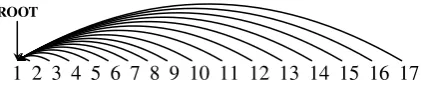
Figure 2: Learned dependency tree from Debates.
Trees do not learn discourse. Although
docu-ment level structured attention provides little ben-efit in performance, we probe whether the model could still be learning some discourse. We visu-ally inspect the learnedfbest trees and in Table2
we report statistics on them (see Appendix Table
6for similar results with the original code). The visual inspection (Figure2) reveals shallow trees (also reported in L&L), but furthermore the trees have little to no structure.7 We observe an interesting pattern where the model picks one of the first two or last two sentences as the root, and
7While shallow trees are expected in PDTB-style
dis-course, even these trees would exhibit meaningful structure between adjacent sentences, which is entirely absent here.
Yelp uuu, sterne, star, rating, deduct, 0, edit, un-derwhelmed, update, allgemein
Debates oppose, republican, majority, thank, gentle-man, leadership, california, measure, presi-dent, vote
WQ valley, mp3, firm, capital, universal, ven-ture, silicon, analyst, capitalist, street
Table 3: Top 10 words most associated with the root sentence (measured with PPMI).
all other sentences are children of that node. We label these trees as ‘vacuous’ and the strength of this pattern is reflected in the tree statistics (Table
2). The height of trees is small, showing the trees are shallow. The proportion of leaf nodes is high, that is, most nodes have no children. Finally, the normalized arc length is high, where nodes that are halfway into the document still connect to the root. We further probe the root sentence, as the model places so much attention on it. We hypothesize the root sentence has strong lexical cues for the task, suggesting the model is instead attending to particular words. In Yelp, reviewers often start or end with a sentiment-laden sentence summarizing their rating. In Debates, speakers begin or end their speech by stating their stance on the bill. In WQ and WQTC, the interpretation of the root is less clear. In WSJSO, we find the root is always the first sentence of the correctly ordered docu-ment, which is reasonable and commonly attested in a discourse tree, but the remainder of the vacu-ous tree is entirely implausible.
To confirm our suspicion that the root sentence is lexically marked, we measure the association between words appearing in the root sentence and those elsewhere by calculating their positive point-wise mutual information scores (Table3).
In Yelp, we find root words often express sen-timent and explicitly mention the number of stars given (‘sterne’ in German, or ‘uuu’ as coined by a particularly prolific Yelper), which are clear indi-cators of the rating label. For Debates, words ex-press speaker opinion, politeness and stance which are strong markers for the binary voting label. The list for WQ revolves around tech, suggesting the model is learning topics instead of writing quality. Thus, in WQTC we control for topics.
5 Learning better structure
Acc height leaf arc vacuous
Full 81.11 4.035 0.931 0.396 14%
-biLSTM 77.80 11.51 0.769 0.353 4% -biLSTM, +w 75.57 7.364 0.856 0.359 3% -biLSTM, +p 77.11 10.430 0.790 0.349 3% -biLSTM, +4p 81.71 9.588 0.811 0.353 3%
[image:5.595.73.299.63.145.2]parsed RST - 25.084 0.567 0.063 0%
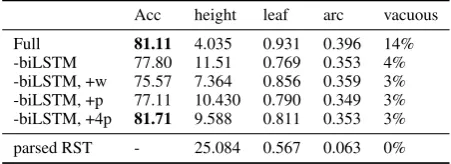
Table 4: Mean test accuracy and tree statistics on the WQTC dev set (averaged across four runs). -biLSTM removes the document-level biLSTM, +w uses the weighted sum, +p performs 1 extra percolation, and +4p does 4 levels of percolation. The last row are (‘gold’) parsed RST discourse dependency trees.
learns vacuous trees less frequently, we focus on this task. We experiment with three modifica-tions. First, we remove the document-level biL-STM since it performs a level of composition that might prevent the attention from learning the true structure. Second, we note equation 3 captures possible children only at one level of the tree, but not possible subtrees. We thus perform an addi-tional level of percolation over the marginals to in-corporate the children’s children of the tree. That is, after equation4, we calculate:
c0i = n X
k=1
aike0i; e00i = tanh(Wr[e0i, c0i]) (5)
Third, the max-pooling layer gives the model a way of aggregating over sentences while ignoring the learned structure. Instead, we propose a sum that is weighted by the probability of a given sen-tence being the root, i.e., using the learned root attention scoreari:yi =Pni=1arie00i.
We include ablations of these modifications and additionally derive RST discourse dependency trees,8 collapsing intrasentential nodes, as an ap-proximation to the ground truth.
The results (Table 4) show that simply remov-ing the biLSTM produces trees with more struc-ture (deeper trees, fewer leaf nodes, shorter arc lengths, and less vacuous trees), confirming our in-tuition that it was doing the work for the structured attention. However, it also results in lower per-formance. Changing the pooling layer from max to weighted sum both hurts performance and re-sults in shallower trees (though still deeper than Full), which we attribute to this layer still being a pooling function. Introducing an extra level of tree percolation yields better trees but also a drop in performance. Finally, using 4 levels of
percola-8We use the RST parser inFeng and Hirst(2014) and
fol-lowHirao et al.(2013) to derive discourse dependency trees.
tion both reaches the accuracy of Full and retains the more structured trees.9 We hypothesize accu-racy doesn’t surpass Full because this change also introduces extra parameters for the model to learn. While our results are a step in the right direc-tion, the structures are decidedly not discourse when compared to the parsed RST dependency trees, which are far deeper with far fewer leaf nodes, shorter arcs and no vacuous trees. Impor-tantly, the tree statistics show the structures do not follow the typical right-branching structure in news: the trees are shallow, nodes often connect to the root instead of a more immediate parent, and the vast majority of nodes have no children. In work concurrent to ours,Liu et al.(2019) pro-poses a new iterative algorithm for the structured attention (in the same spirit as our extra percola-tions) and applies it to a transformer-based sum-marization model. However, even these induced trees are not comparable to RST discourse trees. The induced trees are multi-rooted by design (each root is a summary sentence) which is unusual for RST;10their reported tree height and edge agree-ment with RST trees are low.
6 Conclusion
In this paper, we evaluate structured attention in document representations as a proxy for discourse structure. We first find structured attention at the document level is largely unhelpful, and second it instead captures lexical cues resulting in vacu-ous trees with little structure. We propose several principled changes to induce better structures with comparable performance. Nevertheless, calculat-ing statistics on these trees and comparcalculat-ing them to parsed RST trees shows they still contain no meaningful discourse structure. We theorize some amount of supervision, such as using ground-truth discourse trees, is needed for guiding and con-straining the tree induction.
Acknowledgments
We thank the reviewers for insightful feedback. We acknowledge the Texas Advanced Computing Center for grid resources. The first author was supported by the NSF Graduate Research Fellow-ship Program under Grant No. 2017247409.
9
More than 4 levels caused training to become unstable.
10Less than 25% of trees in the RST Discourse Treebank
References
Regina Barzilay and Mirella Lapata. 2008. Model-ing Local Coherence - An Entity-Based Approach.
Computational Linguistics, 34(1):1–34.
Yonatan Bisk and Ke Tran. 2018. Inducing grammars with and for neural machine translation. In Proceed-ings of the 2nd Workshop on Neural Machine Trans-lation and Generation, pages 25–35. Association for Computational Linguistics.
Lynn Carlson, Daniel Marcu, and Mary Ellen
Okurovsky. 2001. Building a discourse-tagged cor-pus in the framework of rhetorical structure theory. InProceedings of the Second SIGdial Workshop on Discourse and Dialogue, pages 1–10. Association for Computational Linguistics.
Jihun Choi, Kang Min Yoo, and Sang-goo Lee. 2018. Learning to compose task-specific tree structures. In Proceedings of the 2018 Association for the Ad-vancement of Artificial Intelligence (AAAI).
Y.J. Chu and T.H. Liu. 1965. On the shortest arbores-cence of a directed graph. Science Sinica, 14:1396– 1400.
Greg Durrett, Taylor Berg-Kirkpatrick, and Dan Klein. 2016. Learning-based single-document summariza-tion with compression and anaphoricity constraints. In Proceedings of the 54th Annual Meeting of the Association for Computational Linguistics (Volume 1: Long Papers), pages 1998–2008. Association for Computational Linguistics.
Jack Edmonds. 1967. Optimum branchings. Journal of Research of the National Bureau of Standards, 71:233–240.
Vanessa Wei Feng and Graeme Hirst. 2014. A linear-time bottom-up discourse parser with constraints and post-editing. InProceedings of the 52nd Annual Meeting of the Association for Computational Lin-guistics (Volume 1: Long Papers), pages 511–521. Association for Computational Linguistics.
Tsutomu Hirao, Yasuhisa Yoshida, Masaaki Nishino,
Norihito Yasuda, and Masaaki Nagata. 2013.
Single-document summarization as a tree knapsack problem. InProceedings of the 2013 Conference on Empirical Methods in Natural Language Process-ing, pages 1515–1520.
Yangfeng Ji and Noah A. Smith. 2017. Neural Dis-course Structure for Text Categorization. In Pro-ceedings of the 55th Annual Meeting of the Associa-tion for ComputaAssocia-tional Linguistics (Volume 1: Long Papers), pages 996–1005. Association for Computa-tional Linguistics.
Shafiq Joty, Francisco Guzm´an, Llu´ıs M`arquez, and Preslav Nakov. 2017. Discourse structure in ma-chine translation evaluation. Computational Lin-guistics, 43(4):683–722.
Terry Koo, Amir Globerson, Xavier Carreras, and Michael Collins. 2007. Structured prediction mod-els via the matrix-tree theorem. In Proceedings of the 2007 Joint Conference on Empirical Methods in Natural Language Processing and Computational Natural Language Learning (EMNLP-CoNLL).
Alex Lascarides and Nicholas Asher. 2008. Segmented discourse representation theory: Dynamic semantics with discourse structure. In Computing meaning, pages 87–124. Springer.
Yang Liu and Mirella Lapata. 2018. ”Learning Struc-tured Text Representations”.Transactions of the As-sociation for Computational Linguistics, 6:63–75.
Yang Liu, Ivan Titov, and Mirella Lapata. 2019.Single document summarization as tree induction. In Pro-ceedings of the 2019 Conference of the North Amer-ican Chapter of the Association for Computational Linguistics: Human Language Technologies, Vol-ume 1 (Long and Short Papers), pages 1745–1755, Minneapolis, Minnesota. Association for Computa-tional Linguistics.
Annie Louis and Ani Nenkova. 2013. What Makes Writing Great? First Experiments on Article Qual-ity Prediction in the Science Journalism Domain.
TACL.
William C Mann and Sandra A Thompson. 1988. Rhetorical structure theory: Toward a functional the-ory of text organization. Text-Interdisciplinary Jour-nal for the Study of Discourse, 8(3):243–281.
Mitchell P Marcus, Mary Ann Marcinkiewicz, and Beatrice Santorini. 1993. Building a large annotated corpus of English: The Penn Treebank. Computa-tional linguistics, 19(2):313–330.
Jeffrey Pennington, Richard Socher, and Christopher Manning. 2014. Glove: Global vectors for word representation. In Proceedings of the 2014 Con-ference on Empirical Methods in Natural Language Processing (EMNLP), pages 1532–1543. Associa-tion for ComputaAssocia-tional Linguistics.
Rashmi Prasad, Nikhil Dinesh, Alan Lee, Eleni Milt-sakaki, Livio Robaldo, Aravind K Joshi, and Bon-nie L Webber. 2008. The Penn Discourse TreeBank 2.0. InLREC.
Evan Sandhaus. 2008. The New York Times annotated corpus. Linguistic Data Consortium, Philadelphia, 6(12):e26752.
Emma Strubell, Patrick Verga, Daniel Andor,
David Weiss, and Andrew McCallum. 2018.
Duyu Tang, Bing Qin, and Ting Liu. 2015. ”Learning Semantic Representations of Users and Products for Document Level Sentiment Classification”. In Pro-ceedings of the 53rd Annual Meeting of the Associ-ation for ComputAssoci-ational Linguistics and the 7th In-ternational Joint Conference on Natural Language Processing (Volume 1: Long Papers), pages 1014– 1023. Association for Computational Linguistics.
Matt Thomas, Bo Pang, and Lillian Lee. 2006. ”Get out the vote: Determining support or opposition from Congressional floor-debate transcripts”. In
Proceedings of the 2006 Conference on Empirical Methods in Natural Language Processing, pages 327–335. Association for Computational Linguis-tics.
Adina Williams, Andrew Drozdov, and Samuel R. Bowman. 2018. Do latent tree learning models iden-tify meaningful structure in sentences? Transac-tions of the Association for Computational Linguis-tics, 6:253–267.
Dani Yogatama, Phil Blunsom, Chris Dyer, Edward Grefenstette, and Wang Ling. 2017. Learning to compose words into sentences with reinforcement learning.ICLR.
Dani Yogatama and Noah A. Smith. 2014. ”Linguis-tic Structured Sparsity in Text Categorization”. In
Proceedings of the 52nd Annual Meeting of the As-sociation for Computational Linguistics (Volume 1: Long Papers), pages 786–796. Association for Com-putational Linguistics.
A Appendices
Datasets Statistics for the datasets are listed in
Table5.
For WQ, the very good class was created by
Louis and Nenkova(2013) using as a seed the 63 articles in the New York Times corpus (Sandhaus,
2008) deemed to be high-quality writing by a team of expert journalists. The class was then expanded by adding all other science articles in the NYT cor-pus that were written by the seed authors (4,253 articles). For the typical class, science articles by all other authors were included (19,520). Because the data is very imbalanced, we undersample the typical class to be the same size as the very good. We split this data into 80/10/10 for training, devel-opment and test, with both classes equally repre-sented in each partition.
For WQTC, the original dataset authors provide a list of the 10 most topically similar articles for each article.11 We make use of this list to explicitly sample topically similar documents.
11
http://www.cis.upenn.edu/˜nlp/ corpora/scinewscorpus.html
Preprocessing For Debates and Yelp, we follow
the same preprocessing steps as in L&L, but do not set a minimum frequency threshold when creating the word embeddings. For our three datasets, sen-tences are split and tokenized using Stanford Core NLP.
Training For all models, we use the Adagrad
optimizer with a learning rate of 0.05. For WQ, WQTC, and WSJSO, gradient clipping is per-formed using the global norm with a ratio of 1.0. The batch size is 32 for all models except WSJSO uses 16. All models are trained for a maximum of 8 hours on a GeForce GTX 1080 Ti card.
Results Because our results hinge on multiple
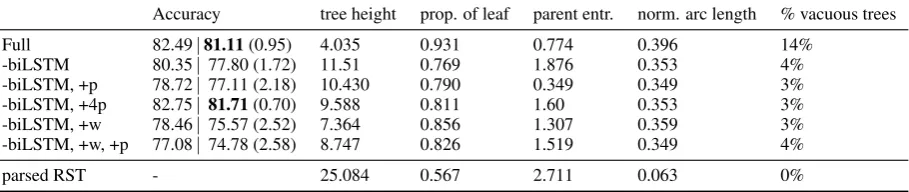
runs of experiments each initialized with different random weights, we include here more detailed versions of our results to more accurately illustrate their variability. Table6supplements Table2with tree statistics from L&L(orig), the modelwithout the design change or bug fix, to illustrate the de-rived trees on this model are similar. Finally, Table
Number of documents
Dataset Classes Total Train Dev Test Vocab.
Yelp 5 333K 266,522 33,333 33,317 53K
Debates 2 1.5K 1,050 102 374 21K
WQ 2 7.7K 6,195 775 763 150K
WQTC 2 7.8K 6,241 777 794 131K
[image:8.595.139.460.117.200.2]WSJSO - 2.4K 1,950 (35,165) 247 (4,392) 241 (4,383) 49K
Table 5: Statistics for the datasets used in the text classification and discrimination tasks (calculated after prepro-cessing). For WSJSO, the number of generated pairs are in parentheses.
Yelp Debates WQ WQTC WSJSO
tree height 2.049 (2.248) 2.751 (2.444) 2.909 (2.300) 4.035 (2.468) 2.288 (2.368) prop. of leaf nodes 0.825 (0.801) 0.849 (0.869) 0.958 (0.971) 0.931 (0.966) 0.892 (0.888) norm. arc length 0.433 (0.468) 0.397 (0.377) 0.420 (0.377) 0.396 (0.391) 0.426 (0.374) % vacuous trees 73% (68%) 38% (40%) 42% (28%) 14% (21%) 100% (56%)
Table 6: Statistics for the learned trees averaged across four runs on the L&L(ours) model with comparisons (in parentheses) to results using the original L&L code without the design change or bug fix.
Accuracy tree height prop. of leaf parent entr. norm. arc length % vacuous trees
Full 82.49|81.11(0.95) 4.035 0.931 0.774 0.396 14%
-biLSTM 80.35| 77.80 (1.72) 11.51 0.769 1.876 0.353 4%
-biLSTM, +p 78.72| 77.11 (2.18) 10.430 0.790 0.349 0.349 3%
-biLSTM, +4p 82.75| 81.71(0.70) 9.588 0.811 1.60 0.353 3%
-biLSTM, +w 78.46| 75.57 (2.52) 7.364 0.856 1.307 0.359 3%
-biLSTM, +w, +p 77.08| 74.78 (2.58) 8.747 0.826 1.519 0.349 4%
[image:8.595.77.532.554.650.2]parsed RST - 25.084 0.567 2.711 0.063 0%