IOT & Cloud Computing - The Platform and
Services being enabled for Companies
Anurag Mehta1, Abrar Dalal2 1, 2
MBA-IT , Symbiosis International Deemed University, (India)
Abstract: Cloud computing and Internet of Things (IoT) are two very different technologies that are both already part of the various industries. Their support and use are expected to be more and more common, making them important peripheral of the Future Internet. In this paper, we'll focus our attention on the integration of Cloud and IoT, specifically the services, which is what we call the Cloud IoT archetype.[3] These Cloud IOT services are the most important notions of Future Internet for providing a common global IT Platform to combine seamless networks and networked things. Cloud Computing in IoT provides beckoned solution for processing huge data streams and computations while facing the challenges of everything that will be connected with seamless networks in the future. The research below has showcased some manufacturing organizations who are using IoT Platforms & Services integrated with Cloud services for ease of their workflow in the field of production.
Keywords: AWS (Amazon FreeRTOS), Microsoft Azure (Azure IoT Hub), GCP (GCP IoT Edge)
I. INTRODUCTION
Cloud computing and IoT are tightly coupled.[4][5] The growth of IoT and the rapid development of associated technologies create a widespread connection of “things.” This has led to the production of large amounts of data, which needs to be stored, processed and accessed. Cloud computing as a paradigm for big data storage and analytics. While IoT is exciting on its own, the real innovation will come from combining it with cloud computing. [6] The combination of cloud computing and IoT will enable new monitoring services and powerful processing of sensory data streams. For example, sensory data can be uploaded and stored with cloud computing, later to be used intelligently for smart monitoring and actuation with other smart devices. Ultimately, the goal is to be able to transform data to insight and drive productive, cost-effective action from those insights. The cloud effectively serves as the brain to improved decision-making and optimized internet-based interactions. [6] With the trend going on in ubiquitous computing, everything is going to be connected to the Internet and its data will be used for various progressive purposes, creating not only information from it, but also, knowledge and even wisdom. Internet of Things (IoT) becoming so pervasive that it is becoming important to integrate it with cloud computing because of the amount of data IoT's could generate and their requirement to have the privilege of virtual resources utilization and storage capacity, but also, to make it possible to create more usefulness from the data generated by IoT's and develop smart applications for the users. IoT's and cloud computing integration is not that simple and bears some key hurdles considering implementation within industries. Those key issues have been highlighted in this paper.
II. RELATED LITERATURE
In real time while scheduling the applications for processing received from the smart devices using cloud computing technology, scheduling algorithms are followed. Some of the Load Balancing algorithms have been examined in detail, like one of them being implemented on checkpoint based [13]. The cloud services were ranked based on the checkpoint based load balancing considering the client's prerequisites and keeping up the QoS. But the ranking of services cannot be applied to all the type of devices as each device has a different configuration in real world. The authors in [14] have examined on how cloud computing applications have broadened their services in mix with portable and quick moving correspondence media know as cloud computing.
A. Purpose
Main Characteristic features of IoT and Cloud integration are :-
1) The cloud computing of IoT is an on-demand self-service, meaning it’s there when you need it. Cloud computing is a web-based service that can be accessed without any special assistance or permission from other people; however, you need at minimum some sort of internet access.[1][3][4]
3) Cloud computing allows for resource pooling, meaning information can be shared with those who know where and how (have permission) to access the resource, anytime and anywhere. This lends to broader collaboration or closer connections with other users. From an IoT perspective, just as we can easily assign an IP address to every "thing" on the planet, we can share the "address" of the cloud-based protected and stored information with others and pool resources.[5][6]
4) Cloud computing features rapid elasticity, meaning users can readily scale the service to their needs. You can easily and quickly edit your software setup, add or remove users, increase storage space, etc. This characteristic will further empower IoT by providing elastic computing power, storage and networking.[1][2]
5) The cloud computing of IoT is a measured service, meaning you get what you pay for. Providers can easily measure usage statistics such as storage, processing, bandwidth and active user accounts inside your cloud instance. This pay per use (PPU) model means your costs scale with your usage. In IoT terms, it's comparable to the ever-growing network of physical objects that feature an IP address for internet connectivity, and the communication that occurs between these objects and other internet-enabled devices and systems; just like your cloud service, the service rates for that IoT infrastructure may also scale with use.[2][3][5]
III. METHODOLOGY
We noticed from the responses we received from various organizations about using/not using of IoT’s Cloud Services; following pointers are now listed from our observation: -
A. Expensive
B. Security Concerns
C. Lack of Resources/Expertise
D. Limited Control
E. Extensibility not feasible
F. Integration
G. Managing Multi-Cloud Environments
Included in our research are frameworks that are focused upon as the dominant objection of disparate Cloud Services-
1) Azure IoT Hub –We Use Azure IoT Hub to securely connect, monitor and manage billions of devices to develop Internet of Things (IoT) applications. IoT Hub is an open and elastic cloud platform as a service that help in supporting of open-source SDKs and multiple protocols. But upon observation, we got to know that the service (Azure IoT Hub) is not that price effective for an organizational aspect (Not Cost Efficient to deploy). This acts as a hurdle to not use the service. The following chart shows the same:
[Source: https://azure.microsoft.com/en-in/pricing/details/iot-hub/ Azure IoT Hub pricing]
3) AWS IoT 1-Click is a service that permits easy devices to trigger AWS Lambda functions which will execute associate action. AWS IoT 1-Click supported devices modify you to simply perform actions like notifying technical support, trailing assets, and replenishing merchandise or services.[4] AWS IoT 1-Click supported devices area unit prepared to be used right out of the box and eliminate the necessity for writing your own computer code or configuring them for secure property. AWS IoT 1-Click supported devices is simply managed. Access to different AWS services, like DynamoDB or CloudWatch is controlled through IAM roles. This prevents unneeded information exposure to sure Lambda functions and lowers the attack surface of the microservice within the event of a security breach. Lambda functions area unit transient, so they have to persist their state somewhere. Available choices embody victimization DynamoDB or RDS tables, that need mounted payments per month. Lambda functions write their logs to CloudWatch, that presently is that the solely tool to troubleshoot and monitor your functions. [6]
4) Amazon FreeRTOS Amazon FreeRTOS is associate degree OS for microcontrollers that creates tiny, low-power edge devices straightforward to program, deploy, secure, connect, and manage. Amazon FreeRTOS extends the FreeRTOS kernel, a preferred open supply OS for microcontrollers, with software package libraries that build it straightforward to firmly connect your tiny, low-power devices to AWS cloud services like AWS IoT Core or to additional powerful edge devices running AWS IoT Greengrass. [5] Microcontrollers, that sometimes run a time period software system while not the intrinsic practicality to attach to native networks or the cloud, can now utilize the rich connectivity features of AWS by employing the Amazon FreeRTOS. As we see with various organizations, disparate cloud services are needed for necessities of the organization, one of them being managing of multi-cloud environments. For instance, Azure IoT Hub securely connects, monitors and manages all the connected devices within an organization, and an organization requires a medium for notification to various modules within an organization (e.g. technical team) therefore they require AWS IoT 1-Click. Now monitoring them and making them work with each other efficiently boasts a challenge towards the respective organization.
[Source : https://www.allaboutcircuits.com: Amazon FreeRTOS: An Embedded OS for IoT Devices] This is An Example of how Amazon FreeRTOS is an operating system for microcontrollers
IV. ANALYSIS
The Following survey was conducted by us on IOT & Cloud Platforms/Services. The results are accordingly mentioned.
A. Cloud – IOT Based Services’ Aspects
Fig 1
[image:4.612.112.494.123.353.2]1) Observation: Upon observation from the survey thus conducted, we noticed that quite a few companies were not readily aware of the extensive benefits of cloud within their organization (cause of them being either using a local service.
Fig. 2
2) Observation: Upon observation we found out that amongst the various cloud services being used within the organization, On-Premise as well as Public Cloud came out to be the most widely operated-upon service. On-On-Premise Cloud Service usage was the most noticed as data security will always be paramount.
78% 22%
Do you use Cloud Services by any means in your
organization?
Yes No
26%
30% 16%
24%
4%
What type of Cloud Services does your organization operates upon?
[image:4.612.100.513.415.680.2]Fig 3. IOT Devices used within various organizations
3) Observation: Consideration of this aspect, we saw that Smart Locks came out to be the most extensively utilized framework within, as the accessibility aspect as well as the convenience it provides to the organization’s members
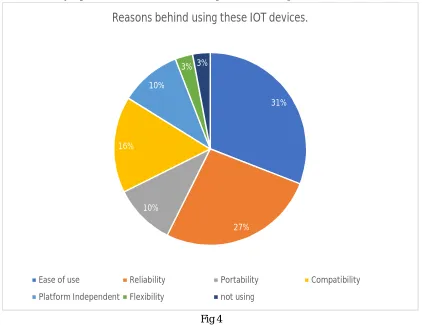
Fig 4
4) Observation: The fault tolerance aspect is quite reliable cause of the ease of use phenomenon amongst various IOT devices as well as the cloud services.
30%
30% 26%
14%
Choose from the mentioned options about various IOT devices that
are being frequently used in your organization.
Smart Assistant Smart Locks Smart Lights None
31%
27% 10%
16% 10%
3% 3%
Reasons behind using these IOT devices.
Ease of use Reliability Portability Compatibility
[image:5.612.95.517.370.695.2]Fig 5
5) Observation: Amazon FreeRTOS being the base for microcontrollers, and microcontrollers themselves being the future of IOT & Cloud, their mass usage in the industry is quite inevitable.
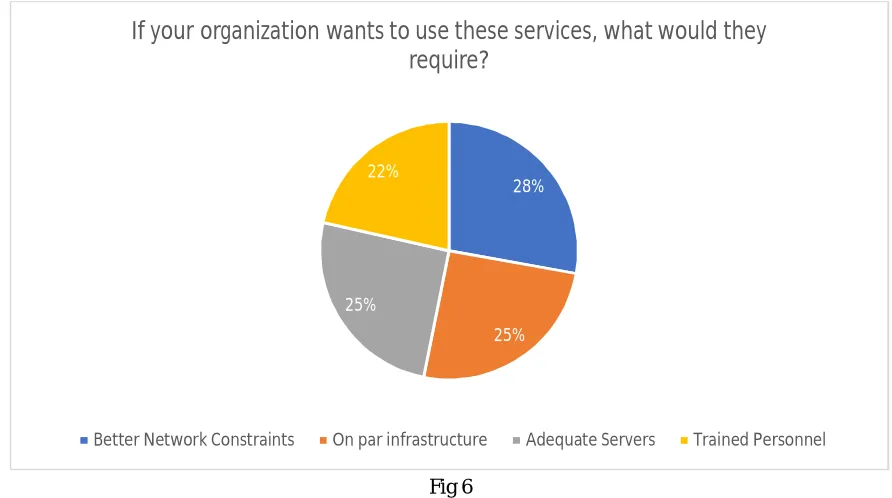
Fig 6
6) Observation : For some of the organizations that were mentioned in the questionnaire about not being using the cloud services, the top reason were due to on par infrastructure as well as inadequate servers. This was noticed because the H/W requirements for some of the equipments being unable to cope up with the required industry standards, also the lack of appropriate servers contributes towards network constraints.
12%
19%
19% 12%
14% 4%
12%
4% 4%
Which of the following IOT or Cloud-based IOT services does your
company use?
AWS IOT 1-click Amazon FreeRTOS Azure Iot Hub
Azure Iot Central GCP-Cloud IotCore GCP - Cloud IOT Edge
IBM Cloud Amdocs Cloud Service none
28%
25% 25%
22%
If your organization wants to use these services, what would they
require?
[image:6.612.91.530.69.383.2] [image:6.612.81.527.417.666.2]V. CONCLUSION
The cloud computing technology will distribute huge chunks of information within the distributed ADPS. Through deploying cosmically of cloud computing server, we are able to transfer the work. The cloud computing technology gives speedy data handling and assist decision support functions for the networking architecture. This will shorten the time cost bring by redundant data and concerned data of unexpected events, shorten the time of developing them requires programs and reduce the loss of life and property caused by unexpected events. These will work with help of stable internet connection. The other challenges include requirement for more distributed processing and storage of the massive data as well as cloud functionalities. Since clouds are decentralized (and infrastructure-less), processing capabilities and data positioned closer to users and migration of servers to follow mobile users are fields that requires further research. Cloud will empower IoT by providing elastic computing power, storage and networking. The massive data generated from IoT can be analyzed in the cloud with big data solutions to gain insights and patterns of usage and behavior of machines and humans. This business intelligence in turn will allows to predict forthcoming growth in data demand and deploy additional resources accordingly.
REFERENCES
[1] Sherin C Abraham, ‘Internet of Things (IoT) with Cloud Computing and Machine-to-Machine
[2] (M2M) Communication’, International Journal of Emerging Trends in Science and Technology, IJETST- Vol. 03, Issue 09, Pages 4654-4661, 2016 [3] S.K. Dhurandher, S. Misra, M.S. Obaidat, V. Basal, P. Singh and V. Punia,’An Energy-Efficient On Demand Routing algorithm for Mobile Ad-Hoc
Networks’, 15 th International conference on Electronics, Circuits and Systems, pp. 958-9618, 2008.
[4] AlGabri Malek, Chunlin LI, Z. Yang, Naji Hasan.A.H and X.Zhang ,’ Improved the Energy of Ad hoc On- Demand Distance Vector Routing Protocol’, International Conference on Future Computer Supported Education, Published by Elsevier, IERI, pp. 355-361, 2012.
[5] Shilpa jain and Sourabh jain ,’Energy Efficient Maximum Lifetime Ad-Hoc Routing (EEMLAR)’, international Journal of Computer Networks and Wireless Communications, Vol.2, Issue 4, pp. 450-455, 2012.
[6] Nobuo Ezaki, Marius Bulacu Lambert , Schomaker , “Text Detection from Natural Scene Images: Towards a System for Visually Impaired Persons” , Proc. of 17th Int. Conf. on Pattern Recognition (ICPR), IEEE Computer Society, pp. 683-686, vol. II, 2004