R E G U L A R A R T I C L E
Open Access
Online social networks and offline protest
Zachary C Steinert-Threlkeld
1*, Delia Mocanu
2, Alessandro Vespignani
2and James Fowler
1,3*Correspondence:
1Department of Political Science,
University of California - San Diego, 9500 Gilman Drive #0521, San Diego, CA 92093, USA Full list of author information is available at the end of the article
Abstract
Large-scale protests occur frequently and sometimes overthrow entire political systems. Meanwhile, online social networks have become an increasingly common component of people’s lives. We present a large-scale longitudinal study that connects online social media behaviors to offline protest. Using almost 14 million geolocated tweets and data on protests from 16 countries during the Arab Spring, we show that increased coordination of messages on Twitter using specific hashtags is associated with increased protests the following day. The results also show that traditional actors like the media and elites are not driving the results. These results indicate social media activity correlates with subsequent large-scale decentralized coordination of protests, with important implications for the future balance of power between citizens and their states.
Keywords: social media; Twitter; protests; Arab Spring; collective action
1 Introduction
In the last two decades, large-scale protests have increased in frequency; these protests often lead to mass casualties, change countries’ political systems, and sometimes lead to war, as is the case in Iran in or Libya and Syria in . Here we present results from a large-scale longitudinal study that connects these two worlds, showing that coordination on social networks correlates with protest offline. Online social networks have become an increasingly common component of people’s lives and are used to predict box office returns [], stock market fluctuations [], social collective phenomena [–], and even private traits such as sexual orientation and political ideology []. They can also be har-nessed for crowd sourced searching [] and get-out-the-vote campaigns []. Using . million geolocated tweets and machine-coded data on protests from countries during the Arab Spring, we show that coordination of messages on Twitter is associated with increased protests the following day. The large-scale, systematic study we present here provides extensive evidence that social media may help decentralized groups coordinate online to organize protests offline. These results suggest that individuals in a wide range of countries use social media to organize large-scale protests and not only at the height of protest events; coordination is a perpetual, systematic activity. The results therefore extends existing work which focuses on protest events in one country [–].
The Arab Spring protests started in Tunisia on December th, , and eventually led to the resignation of that country’s president on January th, . They spread to neighboring countries over the following weeks, inspiring massive turnout in Egypt that caused President Hosni Mubarak to resign on February th, . In the aftermath, many
other countries experienced protest, with some, such as Libya and Syria, quickly turning into civil wars.
Accounts of the Arab Spring have frequently credited Twitter, Facebook, and other social network sites with helping the protests self-organize []. Indeed, there are many reasons to expect that social media did play a role. When deciding whether or not to protest, in-dividuals have to estimate the risk of arrest or violent state repression, and they have to weigh that cost against the potential benefits of any change in policy that may result. They are primarily interested in how many other individuals are going to protest and whether those participants are first-time protesters or not []. Protestingen massedecreases the chance an individual will personally experience state violence and increases the probabil-ity of achieving policy change. Individuals wanting to protest are therefore strongly incen-tivized to coordinate their protest action with others.
2 Data
Social media can make it easier to protest because it lowers the barriers required to coor-dinate, making it easier to know if others will protest and whether or not they are habitual protesters. Joining a social media platform requires many fewer resources than establish-ing a newspaper, runnestablish-ing a television station, or openestablish-ing a civil society organization [], meaning many more people can produce information seen by others. For example, tweets can be composed and read using a basic mobile phone, and blogs only require access to an internet connection. Social media also facilitates connections between people who other-wise would not come into contact [], greatly increasing the number of people that know about an event. While governments can also use social media to monitor and repress their citizens [, ], the lower barriers to entry and broadcast-like features of social media give individuals more power to coordinate than they have without online social networks.
Here, we quantitatively test the hypothesis that social media usage correlates with sub-sequent protests, using longitudinal data from the Arab Spring. Though individuals use many online networks to organize protest, we focus on the social media site Twitter for three reasons. First, it has become a tool for citizens to gather and disseminate information in information-scarce environments such as authoritarian regimes. It therefore is a critical component of many protest movements, starting with the Iran election protests and continuing through the Ukraine civil war. Second, it provides some of the best temporal resolution of any data source. It is therefore one of the few sources available to researchers interested in quickly-changing processes such as protests. Third, state actors belatedly re-alized the power of social media, making social media an attractive tool for anyone seeking independent information; the content contained in social media therefore more closely re-flected the offline world than did official news sources [].
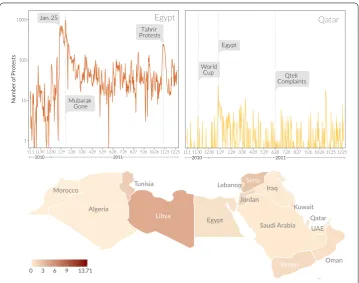
Figure 1 Protests during the Arab Spring.Daily protests during the Arab Spring in a high-protest country (Egypt, upper left) and a low-protest country (Qatar, upper right) as measured in the Global Dataset on Events, Location, and Tone from November 1st, 2010 to December 31st, 2011. The lower panel shows variation in the average number of protests by country over this period; Bahrain has the highest average number of protests.
To measure social media behavior over the same period, we collected almost million geolocated tweets that originated in these countries []. Unlike previous studies [, ], we did not select tweets based on protest-related topic words. This gives us a representa-tive sample of online conversations that includes tweets that were not about protests or surrounding events in these countries (see the Supplementary Materials for a discussion of the advantages of this approach). Our inferences therefore do not risk being caused by selecting on the dependent variable. Overall, .% of tweets in our sample have GPS coordinates, the rest have a user reported location.
We identified topics using hashtags, self-categorized topic words preceded by the # sign. Hashtags associate the message that contains them with a larger discourse. For example, the tweet ‘You guys! We’re about to head to a meeting point in front of Marie Louis store in batal ahmed street #jan’ contains the ‘#jan’ hashtag, a common hashtag used to talk about protests in Egypt, since January th was the first day of major protests in that country. Anyone can search Twitter for a hashtag, and Twitter will return all tweets con-taining that hashtag; one can also click a hashtag seen in a tweet and instantaneously see the tweets using that hashtag. One does not need an account with Twitter to see tweets or hashtags.
is what we call coordination. We call this coordination because individuals are more likely to protest when they know many others will protest, and using a few hashtags repeatedly signals that there exists a latent demand for protest []. As the communication about upcoming protest occupies more of a country’s total communication, individuals should have higher confidence that others will protest.
We measure the extent of this coordination with the Gini coefficient, which indicates the amount of inequality in a distribution. This coefficient ranges from a value of , which indicates complete equality (no coordination: all hashtags are used the same number of times), to , which indicates complete inequality (perfect coordination: everyone uses a single hashtag and no other hashtags are used). A high hashtag Gini coefficient therefore means that individuals are coordinating on the event that that hashtag represents. We do not use the percent of tweets containing a hashtag because that measure is agnostic to the hasthag(s) used in a tweet, so a day with a high percentage of hashtagged tweets may have little coordination. We also do not use an information entropy measure because low entropy could correspond to a day where all hashtags are the same or a day where no hashtags are used; this point is explored more in the Supplementary Materials.
The measure of coordination captures when people on Twitter coordinate protests. Fig-ure shows how the coordination measFig-ure changes over time in Egypt and Qatar as well as the average level of coordination in the countries. The correspondence between co-ordination and events is noticeable, and countries with more protest also had higher
erage levels of coordination. Egypt’s average level of coordination is ., Syria’s .. At the other extreme, Kuwait’s level of coordination is ., Oman’s .; the lowest income Gini is Sweden’s, at ..
3 Results
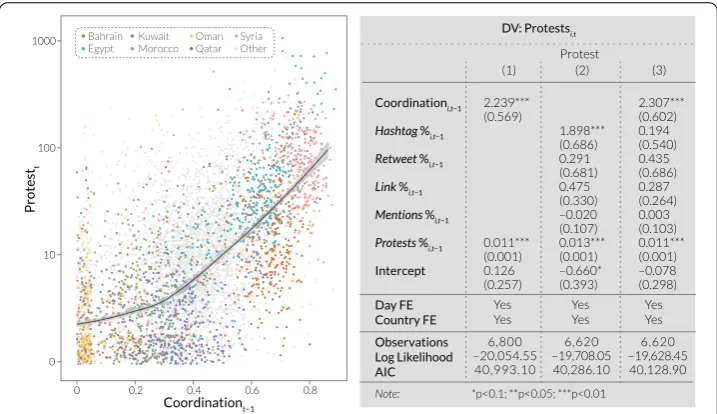
Figure reveals a robust statistical relationship between yesterday’s level of coordination and today’s number of protests. To reach this conclusion, we use a negative binomial re-gression model where the dependent variable is the count of protests at timetand the primary independent variables is the coordination at timet– . The coordination mea-sure has ap-value less than . (coefficient of . and standard error of .), and a one standard deviation increase in the coordination measure is associated with a .% increase in the number of protests on the following day. Figure also shows that the result holds when a number of potential other methods of coordination are modeled. The per-cent of tweets that contain a hashtag indicates the extent to which people are contributing to a tagged conversation, in some cases about protests. When a high percent of tweets are retweeted, a smaller number of original tweets drive the conversation. The percent of tweets that contain links indicates that more people are referencing an important blog or news item. And the percent of tweets that mention other users indicates that more direct communication is happening between people on Twitter. Retweets and hashtags are especially conducive to spreading information that may have a coordinating effect. None of these measures correlate as strongly with protests on the following day as coor-dination, and none of them are significantly associated with protests after controlling for coordination. A more detailed presentation of the model and controls is reported in the Supplementary Materials.
We also show in the Supplementary Materials that these results are robust to model type (linear vs. negative binomial regression), protest data source (a handcoded dataset and a different machine-coded one deliver the same results), and serial correlation in er-rors (multiple tests suggest that including a lagged dependent variable is sufficient to deal with the problem, and including several extra lags does not change the results). All mod-els account for unobserved between-country differences with country fixed effects (ac-counting for stable characteristics like country size and political history), and they control for unobserved sources of variation over time with day fixed effects (helping to control for day-of-week variation in Twitter activity or special events like Ramadan that affect all countries in the study). Moreover, a model that drops high protest days also shows a sig-nificant relationship, suggesting that the association is not driven by a few large events. Finally, to ensure that the results are not driven by individuals trying to draw international attention to the protests [], we drop all English tweets; the results remain the same.
An important question about the potential effect of social media coordination is its source - is it decentralized or does it come from traditional sources like news media and political activists? In the Supplementary Materials, we add to our models a number of measures of Twitter activity from these traditional sources [], including the percent of tweets on a given day that were sent by media organizations, media personalities, digital activists, and the top % most active Twitter users. However, these models with controls continue to show a similar association with hashtag coordination, with an effect for media organizations and no effect for digital activists. Coordination therefore appears to come through decentralized activity of many individuals, not the frequent tweeting of a few spe-cialized actors.
Figure shows the prevalence of the hashtags in Bahrain, Egypt, Morocco, and Qatar most often used for coordination during the study period. They were chosen by observing the most common hashtag in a country on a given day, counting how many times that hashtag was the most common during the study period, and keeping the most common. In Egypt, three features stand out. First, there is little coordination on any one hashtag before January th. The hashtag ‘#egypt’ is barely used, the first appearance of ‘#jan’ is not until January th (and then accounts for only .% of tweets), and ‘#tahrir’ does not appear until January th (and it does not appear in large numbers until just before the resignation of Mubarak). Second, which hashtag is most prevalent depends on the type of upcoming event. During the days of initial protest, ‘#jan’ dominates, as this was the focal date for the protests. Though the largest protests while Mubarak was in power took place in Tahrir Square, they were contentious, which is why more general hashtags such as ‘#jan’ and ‘#egypt’ dominate. Moreover, ‘#jan’ consistently declines in usage after the days of protest. By the middle of March, it will never be the most common of the three hashtags again, and it ceases to correlate with the other two. Third, overall levels of coordination decrease after the first days. They first decrease sharply after President Mubarak’s resignation, and their average prevalence gradually continues to decline. ‘#tahrir’ might be an exception, as it is used much more narrowly to coordinate specific, Tahrir Square-centric events, but the frequency of its usage declines as well.
Figure 4 Most popular hashtags in 4 countries.Most frequent Twitter hashtags during the Arab Spring in Egypt (upper left), Bahrain (upper right), Morocco (lower left), and Qatar (lower right). Each panel shows the percent of a day’s tweets which contain at least one of the hashtags indicated in that country’s legend. Hashtags were chosen by determining which were most often the most common hashtag on a given day across all days in the period of study and tracking the 4 most common overall.
discuss events concerning the Pearl Roundabout, the main focus of protestor activity in Bahrain. #lulu is not in our dataset before February th, and its use varies over time in more specific patterns than #Bahrain. Finally, note the focus on events in Egypt at the end of the Egyptian protests and starting again in mid-October.
Morocco experienced much less protest, as shown in Figure , and Figure shows they also experienced less coordination. The initial protests in Morocco occurred on February th, when coordination peaked, but otherwise the level of coordination is not on the same scale seen in more contentious countries. Note also that Moroccans did not appear to take as much interest in events occurring elsewhere in the Middle East and North Africa, sug-gesting that they may have felt less affinity towards protestors in other countries. Similarly, Qatar exhibits low levels of coordination and no attempts at organizing protests. The day with the highest level of hashtag coordination is December nd, , when Qatar learned it was chosen to host the World Cup. However, people in Qatar paid close attention to the events in #Libya, the third most common hashtag (and, not shown, hashtags about the Egypt protests ranked th and th).
4 Discussion
following day. Past work suggests that individuals are more likely to protest when their close friends or neighbors are protesting [] and when they have prior experience with protest [], but the results here suggest that weak ties can also facilitate mobilization []. They do so by exposing individuals to information about participation from outside of their local, strong-tie social network, allowing those who are on the fence about protesting to approximate how widespread, and therefore safe, the protests are. In this sense, social media helps people not only to learn about protests, but also to see that others are learning about them, aiding in coordination [].
These results do not mean that there will always exist a relationship between coordi-nation and subsequent events. For example, in democracies, where the cost of protesting is lower, individuals may not need to coordinate with each other to protest. Or in coun-tries with free media, coordinating may be more likely to come from media sources than individuals. Future work should investigate these boundaries.
A growing literature suggests that new technology lowers violence [] and decreases a state’s control of information []. But as states learn how to control information and communication technology [], they have also learned how to use it to track individual participants in protest [] and activities the state has defined to be illegal []. By mak-ing coordination visible to a broad audience, activists can facilitate protest, but they also make their coordination visible to the state, enabling targeted repression. Thus, online social networks may help individuals protest, but they also help states repress protesting individuals. Future research should try to discern which of these effects prevails.
Additional material
Additional file 1: Supplementary Materials(pdf )
Competing interests
The authors declare that they have no competing financial interests.
Authors’ contributions
AV and DM collected the Twitter data; ZST collected the data on protests. DM and ZST cleaned the Twitter data. All authors contributed to model design and testing. ZST drafted the initial report, and all authors edited it. ZST and AV created the figures.
Author details
1Department of Political Science, University of California - San Diego, 9500 Gilman Drive #0521, San Diego, CA 92093, USA. 2Laboratory for the Modeling of Biological and Socio-technical Systems, Northeastern University, Boston, MA 02115, USA. 3Department of Medicine, University of California - San Diego, 9500 Gilman Drive #0521, San Diego, CA 92093, USA.
Acknowledgements
AV acknowledges the support by the Intelligence Advanced Research Projects Activity (IARPA) via Department of Interior National Business Center (DoI/NBC) contract number D12PC00285. The views and conclusions contained herein are those of the authors and should not be interpreted as necessarily representing the official policies or endorsements, either expressed or implied, of IARPA, DoI/NBE, or the United States Government. The funders had no role in study design, data collection and analysis, decision to publish, or preparation of the manuscript.
Received: 20 August 2015 Accepted: 28 October 2015
References
1. Asur S, Huberman BA (2010) Predicting the future with social media. In: 2010 IEEE/WIC/ACM international conference on web intelligence and intelligent agent technology, pp 492-499
2. Curme C, Preis T, Stanley HE, Moat HS (2014) Quantifying the semantics of search behavior before stock market moves. Proc Natl Acad Sci USA 111:11600-11605
4. Ramakrishnan N, Butler P, Muthiah S, Self N, Khandpur R, Saraf P, Wang W, Cadena J, Vullikanti A, Korkmaz G, Kuhlman C, Marathe A, Zhao L, Hua T, Chen F, Lu CT, Huang B, Srinivasan A, Trinh K, Getoor L, Katz G, Doyle A, Ackermann C, Zavorin I, Ford J, Summers K, Fayed Y, Arredondo J, Gupta D, Mares D (2014) “Beating the news” with EMBERS: forecasting civil unrest using open source indicators. In: Proceedings of the 20th ACM SIGKDD international conference on knowledge discovery and data mining. KDD ’14. ACM, New York, pp 1799-1808.
doi:10.1145/2623330.2623373
5. Boecking B, Hall M, Schneider J (2015) Event prediction with learning algorithms - a study of events surrounding the Egyptian revolution of 2011 on the basis of micro blog data. Policy Internet 7:159-184
6. Kosinski M, Stillwell D, Graepel T (2013) Private traits and attributes are predictable from digital records of human behavior. Proc Natl Acad Sci USA 110:5802-5805
7. Pickard G, Pan W, Rahwan I, Cebrian M, Crane R, Madan A, Pentland A (2011) Time-critical social mobilization. Science 334:509-512
8. Bond RM, Fariss CJ, Jones JJ, Kramer ADI, Marlow C, Settle JE, Fowler JH (2012) A 61-million-person experiment in social influence and political mobilization. Nature 489:295-298
9. Conover MD, Ferrara E, Menczer F, Flammini A (2013) The digital evolution of occupy Wall Street. PLoS ONE 8:e64679 10. Alvarez R, Garcia D, Moreno Y, Schweitzer F (2015) Sentiment cascades in the 15M movement. EPJ Data Sci 4:6.
http://www.epjdatascience.com/content/4/1/6
11. Budak C, Watts D (2015) Dissecting the spirit of Gezi: influence vs. selection in the occupy Gezi movement. Sociol Sci 2:370-397. https://www.sociologicalscience.com/articles-v2-18-370
12. Gruzd A, Tsyganova K (2015) Information wars and online activism during the 2013/2014 crisis in Ukraine: examining the social structures of pro- and anti-Maidan groups. Policy Internet 7:121-158. http://doi.wiley.com/10.1002/poi3.91 13. Pollock J (2011) Streetbook: how Egyptians and Tunisian youth hacked the Arab Spring. MIT Technol Rev: 70 14. Lohmann S (1994) The dynamics of informational cascades: the Monday demonstrations in Leipzig, East Germany,
1989-91. World Polit 47:42-101
15. Edmond C (2013) Information manipulation, coordination, and regime change. Rev Econ Stud 80:1422-1458 16. Granovetter M (1973) The strength of weak ties. Am J Sociol 78:1360-1380
17. Egorov G, Guriev S, Sonin K (2009) Why resource-poor dictators allow freer media: a theory and evidence from panel data. Am Polit Sci Rev 103:645-668
18. Bassiouni MC, Rodley N, Al-Awadhi B, Kirsch P, Arsanjani MH (2011) Report of the Bahrain Independent Commission of Inquiry. Technical report, Bahrain Independent Commission of Inquiry, Manama, Bahrain
19. Hamdy N, Gomaa EH (2012) Framing the Egyptian uprising in Arabic language newspapers and social media. J Commun 62:195-211
20. Leetaru K, Schrodt P (2013) GDELT: Global Data of Events, Language, and Tone, 1979-2012 21. Ward MD, Beger A, Cutler J, Dorff C, Radford B (2013) Comparing GDELT and ICEWS event data
22. Mocanu D, Baronchelli A, Perra N, Vespignani A, Goncalves B, Zhang Q (2013) The Twitter of Babel: mapping world languages through microblogging platforms. PLoS ONE 8:e61981
23. Aday S, Freelon D, Farrell H, Lynch M, Sides J (2012) New media and conflict after the Arab Spring. Technical report, United States Institute of Peace, Washington
24. Bruns A, Highfield T, Burgess J (2013) The Arab Spring and social media audiences: English and Arabic Twitter users and their networks. Am Behav Sci 57:871-898
25. Lehmann J, Gonçalves B, Ramasco JJ, Cattuto C (2012) Dynamical classes of collective attention in Twitter. In: Proceedings of the 21st international conference on world wide web - WWW ’12, pp 251-260
26. Romero DM, Meeder B, Kleinberg J (2011) Differences in the mechanics of information diffusion across topics: idioms, political hashtags, and complex contagion on Twitter. In: International world wide web conference, pp 695-704 27. Lotan G, Ananny M, Gaffney D, Boyd D, Pearce I, Graeff E (2011) The revolutions were tweeted: information flows
during the 2011 Tunisian and Egyptian revolutions web. Int J Commun 5:1375-1406
28. Gould RV (1991) Multiple networks and mobilization in the Paris Commune, 1871. Am Sociol Rev 56:716-729 29. McAdam D (1986) Recruitment to high-risk activism: the case of freedom summer. Am J Sociol 92:64-90 30. Chwe MS-Y (2000) Communication and coordination in social networks. Rev Econ Stud 67:1-16
31. Pierskalla JH, Hollenbach FM (2013) Technology and collective action: the effect of cell phone coverage on political violence in Africa. Am Polit Sci Rev 107:207-224
32. Kalathil S, Boas TC (2003) Open networks, closed regimes: the impact of the Internet on authoritarian rule. Carnegie Endowment for International Peace, Washington