597
©IJRASET: All Rights are Reserved
Design & Development of an Integrated Controller
for Improving Energy Efficiency of Welding
Machine
Bindu Tomer1, R. P. Sharma2 1, 2
Departmentof Mechanical Engineering, YIT, Jaipur, Rajasthan, India
Abstract: Arc welding is an extremely important and necessary industrial and construction process. This work aims at reduction in energy consumption of idling welding transformer and control of welding power and quality by employing PWM technique also real time monitoring and control of welding transformer parameters using MATLAB is desired. Welding is a non-continuous process and employed in mechanical and civil construction process, the idling time of welding transformer is relatively high and thus automatic switching techniques are required to reduce no load losses of welding transformer also welding quality monitoring is provided by using image processing technique. Thus a comprehensive computer controlled, energy saving, welding setup is proposed & presented by implementation of hardware prototype interfaced with MATLAB.
Keywords: Welding Transformer, Data logging and control, MATLAB, Welding electrode, sensing, PWM control technique
I. INTRODUCTION
This method is employed for fuse 2 metal pieces so that joint is made on its periphery. "The two-piece assembly takes place when heat or pressure is exerted to themselves and with or without addition of metal to form a bond. Welding Process has been utilized in industries i.e. railways & fabrication. This process consumes more power (kilowatts). When welding is not done by welder, than heavy power wastage occur in form of no load losses which can be reduced by using designing circuit and this will not influence welding performance of the equipment, by reducing the no load loss in welding transformer we can very effectively reduce the overall cost of machine. In proposed work, a welding system has been designed that employs multiple secondary windings, one primary welding& other Aux secondary winding, that enable tip to base contact detection with low power transformer & thus allows Main Welding Transformer to be turned off when not operating & thus saving on no load loss of Main Transformer. In addition, image processing is also used for quality inspection of weld surface. Proposed work also includes PWM which improves the quality of weld.
II. LITERATURE SURVEY
Radiographic films are used in for detection of continuity of structure of weld which requires labors for interpretation. Author has presented a paper for determination of weld defects by employing image processing. Hardware and software system automatically transforms the radiographic films into digital images, after that examines and compares with the digitalized radiographic images database. Author proposed this methodology for developing professional system for moderately replacing labors part in image analysis, quality and efficiency in welding manufacturing technology(1).
Electric arc welding is one which utilizes electricity to produce heat to join two metals. Safety is main criterion during every welding operation. Welding process is very hazardous. It needs safety of body parts and also weld area. In this process, ultraviolet, infrared radiation, dust & fumes are produced which is very harmful for any exposed human being. This research contains overview of hazards and harmful effects on health and safety precautions during welding. The content is adapted from numerous research papers. This paper involves the people which can affect by electric welding. (2).
Demands are increasing on companies day by day for high quality and consistent products. Main challenge is to maintain quality and consistency of product in manufacturing process. The main aim is quality management of products in manufacturing process for obtaining objective, automatic inspection and analysis technique must be used. (3).
This paper is focused on development of multi DOF welding robots. It is a mechatronics system which integrates mechanics, electronics, sensors, computer hardware and software, control, artificial intelligence and many other advanced technologies.Multi Degree of freedom robot has been utilized in industries like spot welding etc. (4).
598
©IJRASET: All Rights are Reserved
less than 6 Degree of freedom. Redundancy problem will emerge when there is no issue of joint limitations and collision. The main objective of this paper is reduction in energy consumption by using optimal redundancy approach for 6 DOF welding robot. (5). The objective of this paper to discuss the advancement in orbital welding. This paper draws special attention to problem faced during orbital welding and its solutions. This process is used to weld pipes/tubes. Author also discussed history of orbital welding, basic concepts of orbital welding and problem faced during welding process. The solution of the problem faced during this welding process are also suggested in this paper. (6).
This paper draws special attention on advancement of robotic functioning and its utilization with various metals joining application. Robots are extensively used in industries to minimize the involvement of human in production and automating the process. For this scenario, robots are programmed to perform critical operations such as welding and material handling. (7).
JFE Group presented a paper to produce light weight car body. So as to accomplish this, steel ought to have high tensile strength and great weld ability. Thick plates are used in order to manufacture container ship, cylinder vessel etc. This paper summaries of latest development in welding. (8).
III. METHODOLOGY
[image:2.612.102.506.237.481.2]A. System Architecture
Fig 1.1: System architecture
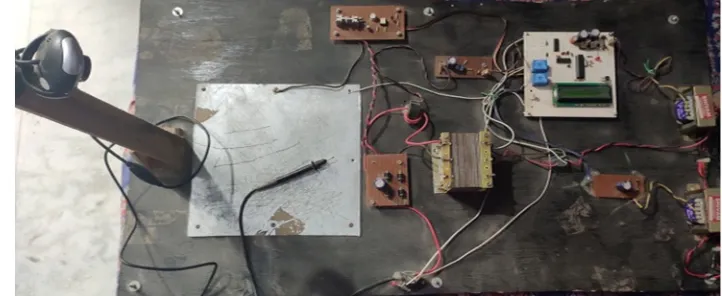
System architecture is design according to save energy and quality management show in above figure. Main transformer supply to welding electrode, microcontroller control input/output according to given instruction. A relay connected to welding transformer input side which is cut power supply when electrode is not in used. A temperature sensor is connected to welding transformer to detect transformer temperature and a camera connect to microcontroller which capture welding joints image and check quality of joint. Welding electrode connected to microcontroller through sensing circuit.
[image:2.612.86.447.573.721.2]599
©IJRASET: All Rights are Reserved
IV. RESULT
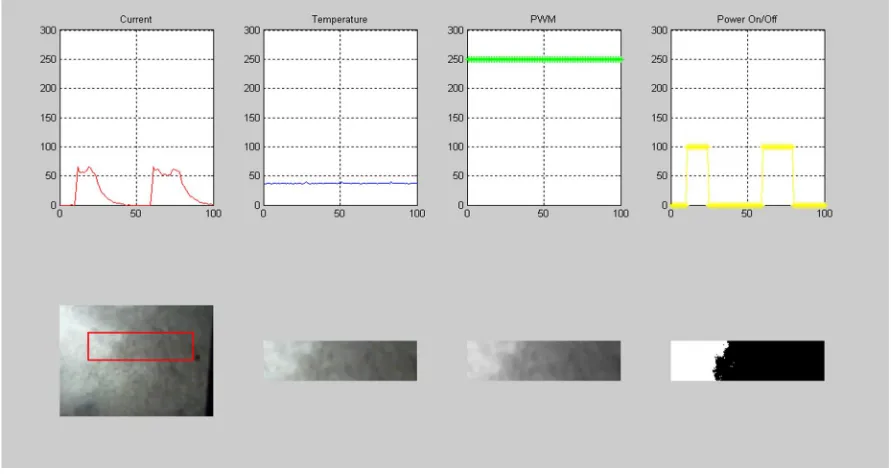
Table 2 shows that different parameters are calculated at 100% duty. The current, power, time is measured by using MATLAB Program from PLOT. Figure shows graph of current, power on/off, PWM and Temperature v/s time.
Switching time at PWM 100%
S.No. Time (sec)
Power ON/OFF
Current Current cut
off time at
1 0 0 0 10th sec
2 11 1 60 26th sec
3 27 0 0 60th sec
4 61 1 60 80th sec
5 81 0 0 100sec
Table1: Time of current, power on/off
[image:3.612.89.535.299.536.2]Time column show time in seconds when welding started and current cutoff time column show welding was done. Power ON/OFF column present power turns ON or OFF. Zero(0) represent power is off and one (1) represent power is ON and image is captured using camera and image quality has been checked by MATLAB Program.
Fig 1.3: Weld parameters at PWM 250
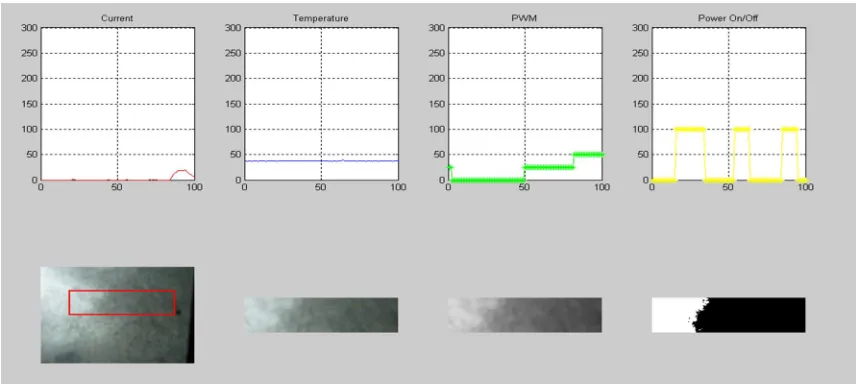
Different parameters calculated on different duty cycle and images & plots of parameters are given below.Time is representing welding start and close timing. Welding power is represent power is ON or OFF at pulse width. All tables which is shown below represent welding parameters at different PWM.
S.No. Time(sec) PWM Welding
Power ON/OFF
Current
1 0 0 0 0
2 16 0 1 5
3 50 25 0 0
4 55 25 1 2
5 80 50 0 0
6 85 50 1 22
600
[image:4.612.91.519.76.268.2]©IJRASET: All Rights are Reserved
Fig 1.4: weld parameters at PWM 0-50
Image quality is also checked by using MATLAB Program which is tabulated below:
[image:4.612.114.506.319.708.2]
Table 3: Image quality table by using MATLAB Program
S.No. Image name Observed result Actual result Image
1 1.jpg Good welding
joint
Good welding joint
2 2.jpg Poor Poor
3 3.jpg Poor Poor
4 4.jpg Good Poor
5 5.jpg Poor Poor
6 6.jpg Poor Poor
601
©IJRASET: All Rights are Reserved
V. CONCLUSION
This work introduces a unique welding machine no load power saving techniques using electronic switching and sensing techniques. No load reduction is achieved by switching off primary circuit of welding transformer when not in use, & sensing of welding electrode & job contact by switching secondary on a low voltage load current loop ,& once contact is detected , secondary is shifted to welding transformer & power to primary winding is automatically turned on by the embedded controller. During the welding process, current flowing through the secondary is monitored using CT current transformer to reset a threshold timer for primary cutoff,& when no activity is detected for preset threshold time, primary is turned off & secondary again shifted to low voltage low current loop. Also an innovative combination of the system with real time monitoring & control using MATLAB data acquisition is provided in conjunction with PWM to control welding power & quality. Also integrated is an image processing based welding quality monitoring implemented by using real time video & MATLAB. Thus a next generation connected energy efficient welding setup & demonstrated. The proposal is validated by the result is 64%. No load power saving is achieved, & power control by PWM is achieved in real time as observed in result. Also welding quality analysis by MATLAB image processing concurs with human observation by 85.71% concurrence.
VI. FUTURE SCOPE
The proposed system has been able to provide a highly efficient & quality controlled welding machine with real time monitoring & welding quality analysis system is a promising. The proposed system is a promising technique; all brief significant improvements are sought in proved of undergoing industrialization. Prim improvements sought are integration of the proposed system with inverter type welding machines & those with controlled rectifiers. Also apart from welding transformer temperature & secondary current, other important parameters such as OC (open circuit) secondary voltage, input power factor, input total harmonic distortion may be monitored& logged in real time. Also, integration of machine learning & artificial intelligence in image processing based welding quality analysis is designed for increasing analysis accuracy & prediction of various outcomes.
REFERENCES
[1] Ngon Dang Thien*, Cuong Le Chi, Ha Nguyen Ngoc “An Approach to the Automatic Detection of Weld Defects in Radiography Films Using Digital Image Processing” International Conference on System Science and Engineering,2017.
[2] Christopher T. Mgonja “The effects of arc welding hazards to welders and people surrounding the welding area” IJEIT,2017.
[3] Muhammed Raazick1Noorshan1, Rashid K1, Rumaisa C M1 Sanmishal P K1 “Defect Reduction in an Arc Welding Process Using Cause and Effect Diagram” IJEIT, 2016.
[4] Yuan Jing,Wang Rui,Jiang Li “Research on Neural Network PID Adaptive Control with Industrial Welding Robot in Multi-degree of Freedom”IEEE 2016. [5] Ngoc Chi Nam Doan, Pey Yuen Tao “Optimal Redundancy Resolution for Robotic Arc Welding Using Modified Particle Swarm Optimization” IEEE 2016. [6] Omkar JoshiP1P, Dr. ArunkumarP2 “Overview of Orbital Welding Technology” IJISET,2015.
[7] V.V.Ruiwale, A.A.Kadam, S.M.Kulkarni, M.S.Jadhao “A Review on Recent Trends in Robotic Welding” International Journal of Engineering Science and Innovative Technology (IJESIT),2015.