The Problem with Kappa
David M W Powers
Centre for Knowledge & Interaction Technology, CSEM
Flinders University
[email protected]
Abstract
It is becoming clear that traditional evaluation measures used in Computational Linguistics (including Error Rates, Accuracy, Recall, Precision and F-measure) are of limited value for unbiased evaluation of systems, and are not meaningful for comparison of algorithms unless both the dataset and algorithm parameters are strictly controlled for skew (Prevalence and Bias). The use of techniques originally designed for other purposes, in particular Receiver Operating Characteristics Area Under Curve, plus variants of Kappa, have been proposed to fill the void.
This paper aims to clear up some of the confusion relating to evaluation, by demonstrating that the usefulness of each evaluation method is highly dependent on the assumptions made about the distributions of the dataset and the underlying populations. The behaviour of a number of evaluation measures is compared under common assumptions.
Deploying a system in a context which has the opposite skew from its validation set can be expected to approximately negate Fleiss Kappa and halve Cohen Kappa but leave Powers Kappa unchanged. For most performance
evaluation purposes, the latter is thus most appropriate, whilst for comparison of behaviour, Matthews Correlation is recommended.
Introduction
Research in Computational Linguistics usually requires some form of quantitative evaluation. A number of traditional measures borrowed from Information Retrieval (Manning & Schütze, 1999) are in common use but there has been considerable critical evaluation of these measures themselves over the last decade or so (Entwisle & Powers, 1998, Flach, 2003, Ben-David. 2008).
Receiver Operating Analysis (ROC) has been advocated as an alternative by many, and in particular has been used by Fürnkranz and Flach (2005), Ben-David (2008) and Powers (2008) to better understand both learning algorithms relationship and the between the various measures, and the inherent biases that make many of them suspect. One of the key advantages of ROC is that it provides a clear indication of chance level performance as well as a less well known indication of the relative cost weighting of positive and negative cases for each possible system or parameterization represented.
intersections of ROC curves are both prima facie evidence that fusion of the parameterized classifiers will be useful (cf. Provost and Facett, 2001; Flach and Wu, 2005).
AUK stands for Area under Kappa, and represents a step in the advocacy of Kappa (Ben-David, 2008ab) as an alternative to the traditional measures and ROC AUC. Powers (2003,2007) has also proposed a Kappa-like measure (Informedness) and analysed it in terms of ROC, and there are many more, Warrens (2010) analyzing the relationships between some of the others.
Systems like RapidMiner (2011) and Weka (Witten and Frank, 2005) provide almost all of the measures we have considered, and many more besides. This encourages the use of multiple measures, and indeed it is now becoming routine to display tables of multiple results for each system, and this is in particular true for the frameworks of some of the challenges and competitions brought to the communities (e.g. 2nd i2b2 Challenge in NLP for Clinical Data, 2011; 2nd Pascal Challenge on HTC, 2011)).
This use of multiple statistics is no doubt in response to the criticism levelled at the evaluation mechanisms used in earlier generations of competitions and the above mentioned critiques, but the proliferation of alternate measures in some ways merely compounds the problem. Researchers have the temptation of choosing those that favour their system as they face the dilemma of what to do about competing (and often disagreeing) evaluation measures that they do not completely understand. These systems and competitions also exhibit another issue, the tendency to macro-averages over multiple classes, even of measures that are not denominated in class (e.g. that are proportions of predicted labels rather than real classes, as with Precision).
This paper is directed at better understanding some of these new and old measures as well as providing recommendations as to which measures are appropriate in which circumstances.
What’s in a Kappa?
In this paper we focus on the Kappa family of measures, as well as some closely related statistics named for other letters of the Greek alphabet, and some measures that we will show behave as Kappa measures although they were not originally defined as such. These include Informedness, Gini Coefficient and single point
ROC AUC, which are in fact all equivalent to DeltaP’ in the dichotomous case, which we deal with first, and to the other Kappas when the marginal prevalences (or biases) match.
1.1
Two classes and non-negative Kappa. Kappa was originally proposed (Cohen, 1960) to compare human ratings in a binary, or dichotomous, classification task. Cohen (1960) recognized that Rand Accuracy did not take chance into account and therefore proposed to subtract off the chance level of Accuracy and then renormalize to the form of a probability: K(Acc) = [Acc – E(Acc)] / [1 – E(Acc)] (1)This leaves the question of how to estimate the expected Accuracy, E(Acc). Cohen (1960) made the assumption that raters would have different distributions that could be estimated as the products of the corresponding marginal coefficients of the contingency table:
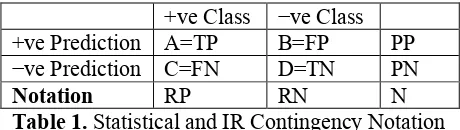
+ve Class −ve Class
+ve Prediction A=TP B=FP PP
−ve Prediction C=FN D=TN PN
[image:2.595.299.529.335.400.2]Notation RP RN N
Table 1. Statistical and IR Contingency Notation In order to discuss this further it is important to discuss our notational conventions, and it is noted that in statistics, the letters A-D (upper case or lower case) are conventionally used to label the cells, and their sums may be used to label the marginal cells. However in the literature on ROC analysis, which we follow here, it is usual to talk about true and false positives (that is positive predictions that are correct or incorrect), and conversely true and false negatives. Often upper case is used to indicate counts in the contingency table, which sum to the number of instances, N. In this case lower case letters are used to indicate probabilities, which means that the corresponding upper case values in the contingency table are all divided by N, and n=1.
Statistics relative to (the total numbers of items in) the real classes are called Rates and have the number (or proportion) of Real Positives (RP) or Real Negatives (RN) in the denominator. In this notation, we have Recall = TPR = TP/RP.
The accuracy of all our predictions, positive or negative, is given by Rand Accuracy = (TF+TN)/N = tf+tn, and this is what is meant in general by the unadorned term Accuracy, or the abbreviation Acc.
Rand Accuracy is the weighted average of Precision and Inverse Precision (probability that negative predictions are correctly labeled), where
the weighting is made according to the number of predictions made for the corresponding labels. Rand Accuracy is also the weighted average of Recall and Inverse Recall (probability that negative instances are correctly predicted), where the weighting is made according to the number of instances in the corresponding classes.
The marginal probabilities rp and pp are also known as Prevalence (the class prevalence of positive instances) and Bias (the label bias to positive predictions), and the corresponding probabilities of negative classes and labels are the Inverse Prevalence and Inverse Bias respectively. In the ROC literature, the ratios of negative to positive classes is often referred to as the class ratio or skew. We can similarly also refer to a label ratio, prediction ratio or prediction skew. Note that optimal performance can only be achieved if class skew = label skew.
The Expected True Positives and Expected True Negatives for Cohen Kappa, as well as Chi-squared significance, are estimated as the product of Bias and Prevalence, and the product of Inverse Bias and Inverse Prevalence, resp., where traditional uses of Kappa for agreement of human raters, the contingency table represents one rater as providing the classification to be predicted by the other rater. Cohen assumes that their distribution of ratings are independent, as reflected both by the margins and the contingencies: ETP = RP*PP; ETN = RN*NN. This gives us E(Acc) = (ETP+ETN)/N=etp+etn.
By contrast the two rater two class form of Fleiss (1981) Kappa, also known as Scott Pi, assumes that both raters are labeling independently using the same distribution, and that the margins reflect this potential variation. The expected number of positives is thus effectively estimated as the average of the two raters’ counts, so that EP = (RP+PP)/2, and EN = (RN+PN)/2, ETP = EP2 and ETN = EN2.
1.2
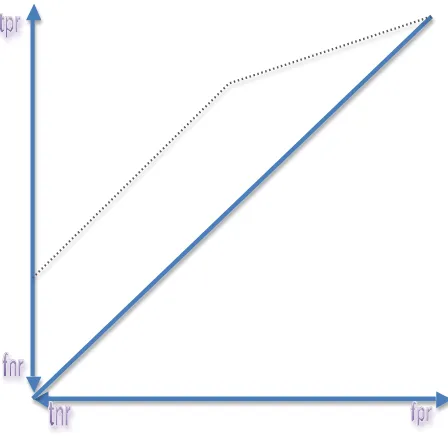
Inverting KappaThe definition of Kappa in Eqn (1) can be seen to be applicable to arbitrary definitions of Expected Accuracy, and in order to discover how other measures relate to the family of Kappa measures it is useful to invert Kappa to discover the implicit definition of Expected Accuracy that allows a measure to be interpreted as a form of Kappa. We simply make E(Acc) the subject by multiplying out Eqn (1) to a common denominator and associating factors of E(Acc): Figure 1. Illustration of ROC Analysis. The
solid diagonal represents chance performance for different rates of guessing positive or negative labels. The dotted line represent the convex hull enclosing the results of different systems, thresholds or parameters tested. The (0,0) and (1,1) points represent guessing always negative and always positive and are always nominal systems in a ROC curve. The points along any straight line segment of a convex hull are achievable by probabilistic interpolation of the systems at each end, the gradient represents the cost ratio and all points along the segment, including the endpoints have the same effective cost benefit. AUC is the area under the curve joining the systems with straight edges and AUCH is the area under the convex hull where points within it are ignored. The height above the chance line of any point represents DeltaP’, the Gini Coefficient and also the Dichotomous Informedness of the corresponding system, and also corresponds to twice the area of the triangle between it and the chance line, and thus 2AUC-1 where AUC is calculated on this single point curve (not shown) joining it to (0,0) and (1,1). The (1,0) point represents perfect performance with 100% True Positive Rate and 0% False Negative Rate.
[image:3.595.64.288.72.294.2]K(Acc) = [Acc – E(Acc)] / [1 – E(Acc)] (1) E(Acc) = [Acc – K(Acc)] / [1 – K(Acc)] (2) Note that for a given value of Acc the function connecting E(Acc) and K(Acc) is its own inverse:
E(Acc) = fAcc(K(Acc)) (3)
K(Acc) = fAcc(E(Acc)) (4)
For the future we will tend to drop the Acc argument or subscript when it is clear, and we will also subscript E and K with the name or initial of the corresponding definition of Expectation and thus Kappa (viz. Fleiss and Cohen so far).
Note that given Acc and E(Acc) are in the range of 0..1 as probabilities, Kappa is also restricted to this range, and takes the form of a probability.
1.3
Multiclass multirater KappaFleiss (1981) and others sought to generalize the Cohen (1960) definition of Kappa to handle both multiple class (not just positive/negative) and multiple raters (not just two – one of which we have called real and the other prediction). Fleiss in fact generalized Scott’s (1955) Pi in both senses, not Cohen Kappa. The Fleiss Kappa is not formulated as we have done here for exposition, but in terms of pairings (agreements) amongst the raters, who are each assumed to have rated the same number of items, N, but not necessarily all. Krippendorf’s (1970, 1978) effectively generalizes further by dealing with arbitrary numbers of raters assessing different numbers of items.
Light (1971) and Hubert (1977) successfully generalized Cohen Kappa. Another approach to estimating E(Acc) was taken by Bennett et al (1955) which basically assumed all classes were equilikely (effectively what use of Accuracy, F-Measure etc. do, although they don’t subtract off the chance component).
The Bennett Kappa was generalized by Randolph (2005), but as our starting point is that we need to take the actual margins into account, we do not pursue these further. However, Warrens (2010a) shows that, under certain conditions, Fleiss Kappa is a lower bound of both the Hubert generalization of Cohen Kappa and the Randolph generalization of Bennet Kappa, which is itself correspondingly an upper bound of both the Hubert and the Light generalizations of Cohen Kappa. Unfortunately the conditions are that there is some agreement between the class and label skews (viz. the
prevalence and bias of each class/label). Our focus in this paper is the behaviour of the various Kappa measures as we move from strongly matched to strongly mismatched biases.
Cohen (1968) also introduced a weighted variant of Kappa. We have also discussed cost weighting in the context of ROC, and Hand (2009) seeks to improve on ROC AUC by introducing a beta distribution as an estimated cost profile, but we will not discuss them further here as we are more interested in the effectiveness of the classifer overall rather than matching a particular cost profile, and are skeptical about any generic cost distribution. In particular the beta distribution gives priority to central tendency rather than boundary conditions, but boundary conditions are frequently encountered in optimization. Similarly Kaymak et al.’s (2010) proposal to replace AUC by AUK corresponds to a Cohen Kappa reweighting of ROC that eliminates many of its useful properties, without any expectation that the measure, as an integration across a surrogate cost distribution, has any validity for system selection. Introducing alternative weights is also allowed in the definition of F-Measure, although in practice this is almost invariably employed as the equally weighted harmonic mean of Recall and Precision. Introducing additional weight or distribution parameters, just multiplies the confusion as to which measure to believe.
Powers (2003) derived a further multiclass Kappa-like measure from first principles, dubbing it Informedness, based on an analogy of Bookmaker associating costs/payoffs based on the odds. This is then proven to measure the proportion of time (or probability) a decision is informed versus random, based on the same assumptions re expectation as Cohen Kappa, and we will thus call it Powers Kappa, and derive an formulation of the corresponding expectation.
Powers’ ‘Informedness’ suggests that human association is in some sense optimal. Powers (2007) also introduces a dual of Informedness that he names Markedness, and shows that the geometric mean of Informedness and Markedness is Matthews Correlation, the nominal analog of Pearson Correlation.
Powers’ Informedness is in fact a variant of Kappa with some similarities to Cohen Kappa, but also some advantages over both Cohen and Fleiss Kappa due to its asymmetric relation with Recall, in the dichotomous form of Powers (2007), Informedness = Recall + InverseRecall – 1 = (Recall – Bias) / (1 – Prevalence).
If we think of Kappa as assessing the relationship between two raters, Powers’ statistic is not evenhanded and the Informedness and Markedness duals measure the two directions of prediction, normalizing Recall and Precision. In fact, the relationship with Correlation allows these to be interpreted as regression coefficients for the prediction function and its inverse.
1.4
Kappa vs CorrelationIt is often asked why we don’t just use Correlation to measure. In fact, Castellan (1996) uses Tetrachoric Correlation, another generalization of Pearson Correlation that assumes that the two class variables are given by underlying normal distributions. Uebersax (1987), Hutchison (1993) and Bonnet and Price (2005) each compare Kappa and Correlation and conclude that there does not seem to be any situation where Kappa would be preferable to Correlation. However all the Kappa and Correlation variants considered were symmetric, and it is thus interesting to consider the separate regression coefficients underlying it that represent the Powers Kappa duals of Informedness and Markedness, which have the advantage of separating out the influences of Prevalence and Bias (which then allows macro-averaging, which is not admissable for any symmetric form of Correlation or Kappa, as we will discuss shortly). Powers (2007) regards Matthews Correlation as an appropriate measure for symmetric situations (like rater agreement) and generalizes the relationships between Correlation and Significance to the Markedness and Informedness Measures. The differences between Informedness and Markedness, which relate to mismatches in Prevalence and Bias, mean that the pair of numbers provides further information about the nature of the relationship between the two classifications or raters, whilst
the ability to take the geometric mean (of macro-averaged) Informedness and Markedness means that a single Correlation can be provided when appropriate.
Our aim now is therefore to characterize Informedness (and hence as its dual Markedness) as a Kappa measure in relation to the families of Kappa measures represented by Cohen and Fleiss Kappa in the dichotomous case. Note that Warrens (2011) shows that a linearly weighted versions of Cohen’s (1968) Kappa is in fact a weighted average of dichotomous Kappas. Similarly Powers (2003) shows that his Kappa (Informedness) has this property. Thus it is appropriate to consider the dichotomous case, and from this we can generalize as required.
1.5
Kappa vs DeterminantWarrens (2010c) discusses another commonly used measure, the Odds Ratio ad/bc (in Epidemiology rather than Computer Science or Computational Linguistics). Closely related to this is the Determinant of the Contingency Matrix dtp = ad-bc = etp-etn (in the Chi-Sqr, Cohen and Powers sense based on independent marginal probabilities). Both show whether the odds favour positives over negatives more for the first rater (real) than the second (predicted) – for the ratio it is if it is greater than one, for the difference it is if it is greater than 0. Note that taking logs of all coefficients would maintain the same relationship and that the difference of the logs corresponds to the log of the ratio, mapping into the information domain.
Warrens (2010c) further shows (in cost-weighted form) that Cohen Kappa is given by the following (in the notation of this paper, but preferring the notations Prevalence and Inverse Prevalence to rp and rn for clarity):
KC = dtp/[(Prev*IBias+Bias*IPrev)/2]. (5) Based on the previous characterization of Fleiss Kappa, we can further characterize it by KF = dtp/[(Prev+Bias)*(IBias+IPrev)/4]. (6)
Powers (2007) also showed corresponding formulations for Bookmaker Informedness (B, or Powers Kappa = KP), Markedness and Matthews Correlation:
B = dtp/[(Prev*IPrev)]. (7)
M = dtp/[(Bias*IBias)]. (8)
Cohen Kappa, the arithmetic means of Bias and Prevalence clear in Fleiss Kappa, and the geometric means of Bias and Prevalence in the Matthews Correlation. Further the independence of Bias is apparent for Powers Kappa in the Informedness form, and independence of Prevalence is clear in the Markedness direction.
Note that the names Powers uses suggest that we are measuring something about the information conveyed by the prediction about the class in the case of Informedness, and the information conveyed to the predictor by the class state in the case of Markedness. To the extent that Prevalence and Bias can be controlled independently, Informedness and Markedness are independent and Correlation represents the joint probability of information being passed in both directions! Powers (2007) further proposes using log formulations of these measures to take them into the information domain, as well as relating them to mutual information, G-squared and chi-squared significance.
1.6
Kappa vs ConcordanceThe pairwise approach used by Fleiss Kappa and its relatives does not assume raters use a common distribution, but does assume they are using the same set, and number of categories. When undertaking comparison of unconstrained ratings or unsupervised learning, this constraint is removed and we need to use a measure of concordance to compare clusterings against each other or against a Gold Standard. Some of the concordance measures use operators in probability space and relate closely to the techniques here, whilst others operate in information space. See Pfitzner et al. (2009) for reviews of clustering comparison/concordance.
A complete coverage of evaluation would also cover significance and the multiple testing problem, but we will confine our focus in this paper to the issue of choice of Kappa or Correlation statistic, as well as addressing some issues relating to the use of macro-averaging. In this paper we are regarding the choice of Bias as under the control of the experimenter, as we have a focus on learned or hand crafted computational linguistics systems. In fact, when we are using bootstrapping techniques or dealing with multiple real samples or different subjects or ecosystems, Prevalence may also vary. Thus the simple marginal assumptions of Cohen or Powers statistics are the appropriate ones.
1.7
AveragingWe now consider the issue of dealing with multiple measures and results of multiple classifiers by averaging. We first consider averages of some of the individual measures we have seen. The averages need not be arithmetic means, or may represent means over the Prevalences and Biases.
We will be punctuating our theoretical discussions and explanations with empirical demonstrations where we use 1:1 and 4:1 prevalence versus matching and mismatching bias to generate the chance level contingency based on marginal independence. We then mix in a proportion of informed decisions, with the remaining decisions made by chance.
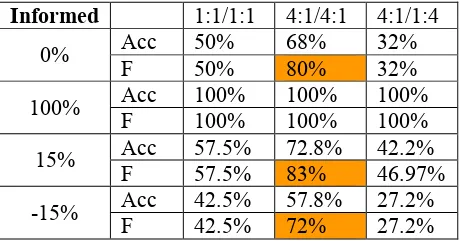
Table 2 compares Accuracy and F-Measure for an informed decision percentage of 0, 100, 15 and -15. Note that Powers Kappa or ‘Informedness’ purports to recover this proportion or probability.
F-Measure is one of the most common measures in Computational Linguistics and Information Retrieval, being a Harmonic Mean of Recall and Precision, which in the common unweighted form also is interpretable with respect to a mean of Prevalence and Bias:
F = tp / [(Prev+Bias)/2] (10)
Note that like Recall and Precision, F-Measure ignores totally cell D corresponding to tn. This is an issue when Prevalence and Bias are uneven or mismatched. In Information Retrieval, it is often justified on the basis that the number of irrelevant documents is large and not precisely known, but in fact this is due to lack of knowledge of the number of relevant documents, which affects Recall. In fact if tn is large with respect to both rp and pp, and thus with respect to components tp, fp and fn, then both tn/pn and tn/rn approach 0 as tn increases without bound.
As discussed earlier, Rand Accuracy is a prevalence (real class) weighted average of Precision and Inverse Precision, as well as a bias (prediction label) weighted average of Recall and Inverse Precision. It reflects the D (tn) cell unlike F, and while it does not remove the effect of chance it does not have the positive bias of F.
Acc = tp + fp (11)
Informed 1:1/1:1 4:1/4:1 4:1/1:4
Acc 50% 68% 32%
0%
F 50% 80% 32%
Acc 100% 100% 100%
100%
F 100% 100% 100%
Acc 57.5% 72.8% 42.2%
15%
F 57.5% 83% 46.97%
Acc 42.5% 57.8% 27.2%
-15%
[image:7.595.67.297.71.193.2]F 42.5% 72% 27.2%
Table 2. Accuracy and F-Measure for different mixes of prevalence and bias skew (odds ratio shown) as well as different proportions of correct
(informed) answers versus guessing – negative proportions imply that the informed decisions are
deliberately made incorrectly (oracle tells me what to do and I do the opposite).
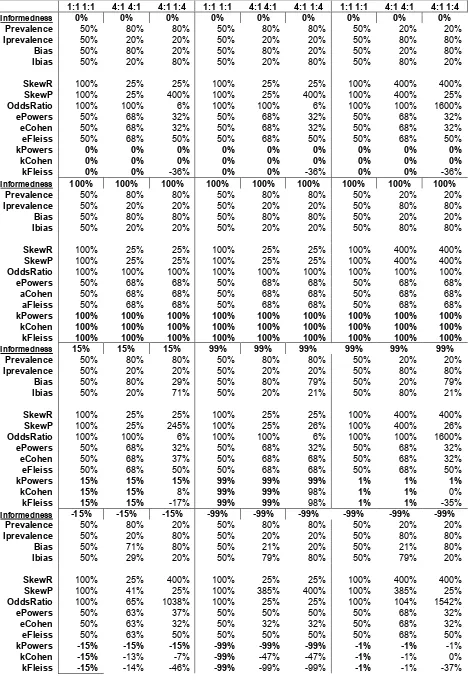
From Table 2 we note that the first set of statistics notes the chance level varies from the 50% expected for Bias=Prevalence=50%. This is in fact the E(Acc) used in calculating Cohen Kappa. Where Prevalences and Biases are equal and balanced, all common statistics agree – Recall = Precision = Accuracy = F, and they are interpretable with respect to this 50% chance level. All the Kappas will also agree, as the different averages of the identical prevalences and biases all come down to 50% as well. So subtracting 50% from 57.5% and normalizing (dividing) by the average effective prevalence of 50%, we return 15% informed decisions in all cases (as seen in detail in Table 3).
However, F-measure gives an inflated estimate when it focus on the more prevalent positive class, with corresponding bias in the chance component.
Worse still is the strength of the Acc and F scores under conditions of matched bias and prevalence when the deviation from chance is -15% - that is making the wrong decision -15% of the time and guessing the rest of the time. In academic terms, if we bump these rates up to ±25% F-factor gives a High Distinction for guessing 75% of the time and putting the right answer for the other 25%, a Distinction for 100% guessing, and a Credit for guessing 75% of the time and putting a wrong answer for the other 25%! In fact, the Powers Kappa corresponds to the methodology of multiple choice marking, where for questions with k+1 choices, a right answer gets 1 mark, and a wrong answer gets -1/
k so that guessing achieves an expected mark of 0. Cohen Kappa achieves a very similar result for unbiased guessing strategies.
We now turn to macro-averaging across multiple classifiers or raters. The Area Under the Curve measures are all of this form, whether we are talking about ROC, Kappa, Recall-Precision curves or whatever. The controversy over these averages, and macro-averaging in general, relates to one of two issues: 1. The averages are not in general over the appropriate units or denominators of the individual statistics; or 2. The averages are over a classifier determined cost function rather than an externally or standardly defined cost function. AUK and H-Measure seek to address these issues as discussed earlier. In fact they both boil down to averaging with an inappropriate distribution of weights.
Commonly macro-averaging averages across classes as average statistics derived for each class weighted by the cardinality of the class (viz. prevalence). In our review above, we cited four examples, but we will refer only to WEKA (Witten et al., 2005) here as a commonly used system and associated text book that employs and advocates macro-averaging. WEKA averages over tpr, fpr, Recall (yes redundantly), Precision, F-Factor and ROC AUC. Only the average over tpr=Recall is actually meaningful, because only it has the number of members of the class, or its prevalence, as its denominator. Precision needs to be macro-averaged over the number of predictions for each class, in which case it is equivalent to micro-averaging.
Other micro-averaged statistics are also shown, including Kappa (with the expectation determined from ZeroR – predicting the majority class, leading to a Cohen-like Kappa).
AUC will be pointwise for classifiers that don’t provide any probabilistic information associated with label prediction, and thus don’t allow varying a threshold for additional points on the ROC or other threshold curves. In the case where multiple threshold points are available, ROC AUC cannot be interpreted as having any relevance to any particular classifier, but is an average over a range of classifiers. Even then it is not so meaningful as AUCH, which should be used as classifiers on the convex hull are usually available. The AUCH measure will then dominate any individual classifiers, as if the convex hull is not the same as the single classifier it must include points that are above the classifier curve and thus its enclosed area totally includes the area that is enclosed by the individual classifier.
by the size of the positive class, is not meaningful as effectively shown by Powers (2003) for the special case of the single point curve given its equivalence to Powers Kappa.
In fact Markedness does admit averaging over classes, whilst Informedness requires averaging over predicted labels, as does Precision. The other Kappa and Correlations are more complex (note the demoninators in Eqns 5-9) and how they might be meaningfully macro-averaged is an open question. However, microaveraging can always be done quickly and easily by simply summing all the contingency tables (the true contingency tables are tables of counts, not probabilities, as shown in Table 1).
Macroaveraging should never be done except for the special cases of Recall and Markedness when it is equivalent to micro-average, which is only slightly more expensive/complicated to do.
Comparison of Kappas
We now turn to explore the different definitions of Kappas, using the same approach employed with Accuracy and F-Factor in Table 1: We will consider 0%, 100%, 15% and -15% informed decisions, with random decisions modelled on the basis of independent Bias and Prevalence.
This clearly biases against the Fleiss family of Kappas, which is entirely appropriate. As pointed out by Entwisle & Powers (1998) the practice of deliberately skewing bias to achieve better statistics is to be deprecated – they used the real-life example of a CL researcher choosing to say water was always a noun because it was a noun more often than not. With Cohen or Powers’ measures, any actual power of the system to determine PoS, however weak, would be reflected in an improvement in the scores versus any random choice, whatever the distribution. Recall that choosing one answer all the time corresponds to the extreme points of the chance line in the ROC curve.
Studies like Fitzgibbon et al (2007) and Leibbrandt and Powers (2012) show divergences amongst the conventional and debiased measures, but it is tricky to prove which is better.
Kappa in the Limit
It is however straightforward to derive limits for the various Kappas and Expectations under extreme and central conditions of bias and prevalence, including both match and mismatch. The 36 theoretical results match the mixture model results in Table 3, however, due to space constraints, formal treatment will be limited to
two of the more complex cases that both relate to Fleiss Kappa with its mismatch to the marginal independence assumptions we prefer. These will provide informedness of probability B plus a remaining proportion 1-B of random responses exhibiting extreme bias versus both neutral and contrary prevalence. Note that we consider only |B|<1 as all Kappas give Acc=1 and thus K=1 for B=1, and only Powers Kappa is designed to work for B<1, giving K= -1 for B= -1.
Recall that the general calculation of Expected Accuracy is
E(Acc) = etp+etn (11)
For Fleiss Kappa we must calculate the expected values of the correct contingencies as discussed previously with expected probabilities ep = (rp+pp)/2 & en = (rn+pn)/2 (12) etp = ep2 & etn = en2 (13) We first consider cases where prevalence is extreme and the chance component exhibits inverse bias. We thus consider limits as rp0, rn1, pp1-B, pnB. This gives us (assuming |B|<1)
EF(Acc) = (1/4+B2/4+B/2)2+(1/4+B2/4-B/2)2 = (1+B2)/2 (14) KF(Acc) = (1-B)2/[B2-2] (15) We second consider cases where the prevalence is balanced and chance extreme, with rp0.5, rn0.5, pp1-B, pnB, giving
EF(Acc) = 1/2 + (B-1/2)2/2 = 5/
8 + B(B-1)/2 (16)
KF(Acc)=[(B-1/2)-(B-1/2)2/2]/[1/2-(B-1/2)2/2] (17) =[B-5/
8+B(B-1)/2]/[1-(5/8+B(B-1)/2)
Conclusions
The asymmetric Powers Informedness gives the clearest measure of the predictive value of a system, while the Matthews Correlation (as geometric mean with the Powers Markedness dual) is appropriate for comparing equally valid classifications or ratings into an agreed number of classes. Concordance measures should be used if number of classes is not agreed or specified.
1:1 1:1 4:1 4:1 4:1 1:4 1:1 1:1 4:1 4:1 4:1 1:4 1:1 1:1 4:1 4:1 4:1 1:4
Informedness 0% 0% 0% 0% 0% 0% 0% 0% 0%
Prevalence 50% 80% 80% 50% 80% 80% 50% 20% 20%
Iprevalence 50% 20% 20% 50% 20% 20% 50% 80% 80%
Bias 50% 80% 20% 50% 80% 20% 50% 20% 80%
Ibias 50% 20% 80% 50% 20% 80% 50% 80% 20%
SkewR 100% 25% 25% 100% 25% 25% 100% 400% 400%
SkewP 100% 25% 400% 100% 25% 400% 100% 400% 25%
OddsRatio 100% 100% 6% 100% 100% 6% 100% 100% 1600%
ePowers 50% 68% 32% 50% 68% 32% 50% 68% 32%
eCohen 50% 68% 32% 50% 68% 32% 50% 68% 32%
eFleiss 50% 68% 50% 50% 68% 50% 50% 68% 50%
kPowers 0% 0% 0% 0% 0% 0% 0% 0% 0%
kCohen 0% 0% 0% 0% 0% 0% 0% 0% 0%
kFleiss 0% 0% -36% 0% 0% -36% 0% 0% -36%
Informedness 100% 100% 100% 100% 100% 100% 100% 100% 100%
Prevalence 50% 80% 80% 50% 80% 80% 50% 20% 20%
Iprevalence 50% 20% 20% 50% 20% 20% 50% 80% 80%
Bias 50% 80% 80% 50% 80% 80% 50% 20% 20%
Ibias 50% 20% 20% 50% 20% 20% 50% 80% 80%
SkewR 100% 25% 25% 100% 25% 25% 100% 400% 400%
SkewP 100% 25% 25% 100% 25% 25% 100% 400% 400%
OddsRatio 100% 100% 100% 100% 100% 100% 100% 100% 100%
ePowers 50% 68% 68% 50% 68% 68% 50% 68% 68%
aCohen 50% 68% 68% 50% 68% 68% 50% 68% 68%
aFleiss 50% 68% 68% 50% 68% 68% 50% 68% 68%
kPowers 100% 100% 100% 100% 100% 100% 100% 100% 100% kCohen 100% 100% 100% 100% 100% 100% 100% 100% 100% kFleiss 100% 100% 100% 100% 100% 100% 100% 100% 100%
Informedness 15% 15% 15% 99% 99% 99% 99% 99% 99%
Prevalence 50% 80% 80% 50% 80% 80% 50% 20% 20%
Iprevalence 50% 20% 20% 50% 20% 20% 50% 80% 80%
Bias 50% 80% 29% 50% 80% 79% 50% 20% 79%
Ibias 50% 20% 71% 50% 20% 21% 50% 80% 21%
SkewR 100% 25% 25% 100% 25% 25% 100% 400% 400%
SkewP 100% 25% 245% 100% 25% 26% 100% 400% 26%
OddsRatio 100% 100% 6% 100% 100% 6% 100% 100% 1600%
ePowers 50% 68% 32% 50% 68% 32% 50% 68% 32%
eCohen 50% 68% 37% 50% 68% 68% 50% 68% 32%
eFleiss 50% 68% 50% 50% 68% 68% 50% 68% 50%
kPowers 15% 15% 15% 99% 99% 99% 1% 1% 1%
kCohen 15% 15% 8% 99% 99% 98% 1% 1% 0%
kFleiss 15% 15% -17% 99% 99% 98% 1% 1% -35%
Informedness -15% -15% -15% -99% -99% -99% -99% -99% -99%
Prevalence 50% 80% 20% 50% 80% 80% 50% 20% 20%
Iprevalence 50% 20% 80% 50% 20% 20% 50% 80% 80%
Bias 50% 71% 80% 50% 21% 20% 50% 21% 80%
Ibias 50% 29% 20% 50% 79% 80% 50% 79% 20%
SkewR 100% 25% 400% 100% 25% 25% 100% 400% 400%
SkewP 100% 41% 25% 100% 385% 400% 100% 385% 25%
OddsRatio 100% 65% 1038% 100% 25% 25% 100% 104% 1542%
ePowers 50% 63% 37% 50% 50% 50% 50% 68% 32%
eCohen 50% 63% 32% 50% 32% 32% 50% 68% 32%
eFleiss 50% 63% 50% 50% 50% 50% 50% 68% 50%
kPowers -15% -15% -15% -99% -99% -99% -1% -1% -1%
kCohen -15% -13% -7% -99% -47% -47% -1% -1% 0%
[image:9.595.64.533.61.746.2]kFleiss -15% -14% -46% -99% -99% -99% -1% -1% -37%
References
2nd i2b2 Workshop on Challenges in Natural Language Processing for Clinical Data (2008).
http://gnode1.mib.man.ac.uk/awards.html
(accessed 4 November 2011)
2nd Pascal Challenge on Hierarchical Text Classification http://lshtc.iit.demokritos.gr/node/48
(accessed 4 November 2011)
N. Ailon. and M. Mohri (2010) Preference-based learning to rank. Machine Learning 80:189-211. A. Ben-David. (2008a). About the relationship
between ROC curves and Cohen’s kappa. Engineering Applications of AI, 21:874–882, 2008. A. Ben-David (2008b). Comparison of classification
accuracy using Cohen’s Weighted Kappa, Expert Systems with Applications 34 (2008) 825–832 Y. Benjamini and Y. Hochberg (1995). "Controlling
the false discovery rate: a practical and powerful approach to multiple testing". Journal of the Royal Statistical Society. Series B (Methodological) 57 (1), 289–300.
D. G. Bonett & R.M. Price, (2005). Inferential Methods for the Tetrachoric Correlation Coefficient, Journal of Educational and Behavioral Statistics 30:2, 213-225
J. Carletta (1996). Assessing agreement on classification tasks: the kappa statistic. Computational Linguistics 22(2):249-254
N. J. Castellan, (1966). On the estimation of the tetrachoric correlation coefficient. Psychometrika, 31(1), 67-73.
J. Cohen (1960). A coefficient of agreement for nominal scales. Educational and Psychological Measurement, 1960:37-46.
J. Cohen (1968). Weighted kappa: Nominal scale agreement with provision for scaled disagreement or partial credit. Psychological Bulletin 70:213-20. B. Di Eugenio and M. Glass (2004), The Kappa
Statistic: A Second Look., Computational Linguistics 30:1 95-101.
J. Entwisle and D. M. W. Powers (1998). "The Present Use of Statistics in the Evaluation of NLP Parsers", pp215-224, NeMLaP3/CoNLL98 Joint Conference, Sydney, January 1998
Sean Fitzgibbon, David M. W. Powers, Kenneth Pope, and C. Richard Clark (2007). Removal of EEG noise and artefact using blind source separation. Journal of Clinical Neurophysiology 24(3):232-243, June 2007
P. A. Flach (2003). The Geometry of ROC Space: Understanding Machine Learning Metrics through ROC Isometrics, Proceedings of the Twentieth International Conference on Machine Learning (ICML-2003), Washington DC, 2003, pp. 226-233. J. L. Fleiss (1981). Statistical methods for rates and
proportions (2nd ed.). New York: Wiley.
A. Fraser & D. Marcu (2007). Measuring Word Alignment Quality for Statistical Machine Translation, Computational Linguistics 33(3):293-303.
J. Fürnkranz & P. A. Flach (2005). ROC ’n’ Rule Learning – Towards a Better Understanding of Covering Algorithms, Machine Learning 58(1):39-77.
D. J. Hand (2009). Measuring classifier performance: a coherent alternative to the area under the ROC curve. Machine Learning 77:103-123.
T. P. Hutchinson (1993). Focus on Psychometrics. Kappa muddles together two sources of disagreement: tetrachoric correlation is preferable. Research in Nursing & Health 16(4):313-6, 1993 Aug.
U. Kaymak, A. Ben-David and R. Potharst (2010), AUK: a sinple alternative to the AUC, Technical Report, Erasmus Research Institute of Management, Erasmus School of Economics, Rotterdam NL.
K. Krippendorff (1970). Estimating the reliability, systematic error, and random error of interval data. Educational and Psychological Measurement, 30 (1),61-70.
K. Krippendorff (1978). Reliability of binary attribute data. Biometrics, 34 (1), 142-144.
J. Lafferty, A. McCallum. & F. Pereira. (2001). Conditional Random Fields: Probabilistic Models for Segmenting and Labeling Sequence Data. Proceedings of the 18th International Conference on Machine Learning (ICML-2001), San Francisco, CA: Morgan Kaufmann, pp. 282-289. R. Leibbrandt & D. M. W. Powers, Robust Induction
R. Lowry (1999). Concepts and Applications of Inferential Statistics. (Published on the web as http:// faculty.vassar.edu/lowry/webtext.html.) C. D. Manning, and H. Schütze (1999). Foundations
of Statistical Natural Language Processing. MIT Press, Cambridge, MA.
J. H McDonald, (2007). The Handbook of Biological Statistics. (Course handbook web published as http: //udel.edu/~mcdonald/statpermissions.html) J.C. Nunnally and Bernstein, I.H. (1994).
Psychometric Theory (Third ed.). McGraw-Hill. K. Pearson and D. Heron (1912). On Theories of
Association. J. Royal Stat. Soc. LXXV:579-652 P. Perruchet and R. Peereman (2004). The
exploitation of distributional information in syllable processing, J. Neurolinguistics 17:97−119. D. Pfitzner, R. E. Leibbrandt and D. M. W. Powers
(2009). Characterization and evaluation of similarity measures for pairs of clusterings, Knowledge and Information Systems, 19:3, 361-394 D. M. W. Powers (2003), Recall and Precision versus the Bookmaker, Proceedings of the International Conference on Cognitive Science (ICSC-2003), Sydney Australia, 2003, pp. 529-534. (See http:// david.wardpowers.info/BM/index.htm.)
D. M. W. Powers (2008), Evaluation Evaluation, The 18th European Conference on Artificial Intelligence (ECAI’08)
D. M W Powers, (2007/2011) Evaluation: From Precision, Recall and F-Factor to ROC, Informedness, Markedness & Correlation, School of Informatics and Engineering, Flinders University, Adelaide, Australia, TR SIE-07-001, Journal of Machine Learning Technologies 2:1 37-63. https://dl-web.dropbox.com/get/Public/201101-Evaluation_JMLT_Postprint-Colour.pdf?w=abcda988 D. M. W. Powers, 2012. The Problem of Area Under
the Curve. International Conference on Information Science and Technology, ICIST2012, in press. D. M. W. Powers and A. Atyabi, 2012. The Problem
of Cross-Validation: Averaging and Bias, Repetition and Significance, SCET2012, in press. F. Provost and T. Fawcett. Robust classification for
imprecise environments. Machine Learning, 44:203–231, 2001.
RapidMiner (2011). http://rapid-i.com (accessed 4 November 2011).
L. H. Reeker, (2000), Theoretic Constructs and Measurement of Performance and Intelligence in Intelligent Systems, PerMIS 2000. (See http://www.isd.mel.nist.gov/research_areas/ research_engineering/PerMIS_Workshop/ accessed 22 December 2007.)
W. A. Scott (1955). Reliability of content analysis: The case of nominal scale coding. Public Opinion Quarterly, 19, 321-325.
D. R. Shanks (1995). Is human learning rational? Quarterly Journal of Experimental Psychology, 48A, 257-279.
T. Sellke, Bayarri, M.J. and Berger, J. (2001), Calibration of P-values for testing precise null hypotheses, American Statistician 55, 62-71. (See http:// www.stat.duke.edu/%7Eberger/papers.html#p-value accessed 22 December 2007.)
P. J. Smith, Rae, DS, Manderscheid, RW and Silbergeld, S. (1981). Approximating the moments and distribution of the likelihood ratio statistic for multinomial goodness of fit. Journal of the American Statistical Association 76:375,737-740. R. R. Sokal, Rohlf FJ (1995) Biometry: The principles
and practice of statistics in biological research, 3rd ed New York: WH Freeman and Company. J. Uebersax (1987). Diversity of decision-making
models and the measurement of interrater agreement. Psychological Bulletin 101, 140−146. J. Uebersax (2009) http://ourworld.compuserve.com/
homepages/jsuebersax/agree.htm accessed 24 February 2011.
M. J. Warrens (2010a), Inequalities between multi-rater kappas. Advances in Data Analysis and Classification 4:271-286.
M. J. Warrens (2010b). A formal proof of a paradox associated with Cohen’s kappa. Journal of Classificaiton 27:322-332.
M. J. Warrens (2010c). A Kraemer-type rescaling that transforms the Odds Ratio into the Weighted Kappa Coefficient. Psychometrika 75:2 328-330. M. J. Warrens (2011). Cohen’s linearly wieghted
Kappa is a weighted average of 2x2 Kappas. Psychometrika 76:3, 471-486.
D. A. Williams (1976). Improved Likelihood Ratio Tests for Complete Contingency Tables, Biometrika 63:33-37.