A T r a i n a b l e M e s s a g e U n d e r s t a n d i n g S y s t e m *
Amit Bagga
Joyce Yue Chai
Department of Computer Science
Box 90129, Duke University
Durham, NC 27708-0129
Internet: {amit, chai}Qcs.duke.edu
1 Introduction and
Background
The Message Understanding Conferences (MUCs) have given a great impetus to research in informa- tion extraction (IE). The systems which have par- ticipated in the MUCs have been quite successful at extracting information from the domains that they have been trained on (MUC-4, 1992), (MUC- 5, 1993), (MUC-6, 1995). The precision and recall statistics were around 60% and 50% respectively for MUC-6. However, these systems are domain depen- dent and customizing them to a new domain is a long and tedious process. For example, porting BBN's PLUM system from the Joint Ventures (MUC-5) do- main to the Microelectronics (MUC-5) domain took approximately 3 person weeks (Weischedel, 1993). Moreover, training and adapting these systems to a particular domain is done by a group of compu- tational linguists. These linguists determine all the ways in which the target information is expressed in a given corpus and then think of all the plausible variants of these ways, so that appropriate regular patterns can be written.The explosion in the amount of free text mate- rial on the Internet, and the use of this information by people from all walks of life, has made the is- sue of generalized information extraction a central one in Natural Language Processing. Many sys- tems, including ones from NYU (Grishman, 1995), BBN (Weischedel, 1995), SRI (Appelt, 1995), SRA (Krupka, 1995), M I T R E (Aberdeen, 1995), and the University of Massachusetts (Fisher, 1995), have taken steps to make the process of customizing a system for a particular domain an easy one. Appelt et al. write, "If information extraction systems are going to be used in a wide variety of applications, it will ultimately be necessary for the end users to be able to customize the systems themselves in a relatively short time." (Appelt, 1995)
We have built a system that attempts to provide
Supported by Fellowships from IBM Corporation.
any user with the ability to efficiently create and customize, for his or her own application, an infor- mation extraction system with competitive precision and recall statistics. This paper will present the the- ory of the system and some details of an implemen- tation. It will also describe a test of the system in which a 3 hour training session produced precision and recall statistics in the 60% levels and above.
2 System Architecture
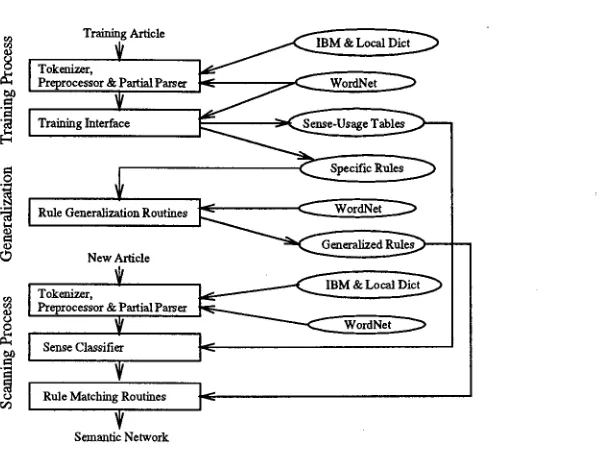
As illustrated in Figure 1, there are three main stages in the running of the system: the Training Process, Rule Generalization, and the Scanning Pro- cess. During the Training Process, the user, with the help of a graphical user interface (GUI), takes a few prototypical articles from the domain that the sys- tem is being trained on, and creates rules (patterns) for the target information contained in the train- ing articles. These rules are specific to the training articles and they are generalized so that they can be run on other articles from the domain. The Rule Generalization routines, with the help of WordNet 1, generalize the specific rules generated by the Train- ing Process. The system can now be run on a large number of articles from the domain (Scanning Pro- cess). The output of the Scanning Process, for each article, is a semantic network (Quillian, 1968) for that article which can then be used by a Postpro- cessor to fill templates, answer queries, or generate abstracts.
2.1 T o o l s U s e d B y t h e S y s t e m
2.1.1 I B M a n d L o c a l D i c t i o n a r i e s
The system uses IBM's LanguageWare English Dictionary, IBM's Computing Terms Dictionary, and a local dictionary of our choice. The IBM dictio-
l WordNet is an on-line lexical reference system de- veloped by George Miller and his group at Princeton University.
Bagga ~ Chai 1 Trainable Message Understanding
Amit Bagga and Joyce Yue Chai (1997) A Trainable Message U n d e r s t a n d i n g S y s t e m . CoNLL97: Computational Natural Language Learning, ACL pp 1-8.
@ 1997 Association for Computational Linguistics
d~ [ Tokenizer,
Preprocessor &~/PartialParse~ ~ /
"~
~
~ e - O s a g e T ~
==-
'~ [ Training Interface
[ Rule GeneralizationRoutines ~
~ W o r ~ e t ~
New ,Article
Preprocessor & PartialParser
8
~ I sense Classifier
I <
~ [ Rule Matching Rout/nes
[q=
Semantic
NetworkFigure 1: The Architecture
naries contain about 150,000 words while the local dictionary contains about 100 words.
2.1.2 G a z e t t e e r
The system also uses a gazetteer consisting of ap- proximately 250 names of cities, states, and coun- tries.
2.1.3 W o r d N e t
The system also uses WordNet (Miller, 1990). WordNet is an on-line lexical reference system in which English nouns, verbs, and adjectives are orga- nized into synonym sets
(synsets),
each representing one underlying lexical concept (meaning or sense). Different relations link these synsets. WordNet con- tains approximately 95,600 word forms organized into some 70,100 synsets (Miller, 1990).Consider the following example from (Miller, 1990): the synsets
{board, plank}
and{board, com-
mittee}
each serve as unambiguous designators oftwo different meanings (or senses) of the noun
board.
Also associated with each synset is a short English description (gloss) of the meaning expressed by the synset. So the synset
{board}
(a person's meals, provided regularly for money), consisting only of the nounboard
itself, can be distinguished from the other senses by the gloss associated with it.In addition, WordNet attempts to organize differ- ent senses of a word based on the frequency of usage of the senses. For example, a listing of all the syn- onyms of
board
yields 8 different synsets, each des- ignating a different sense of the noun. The most commonly used sense (Sense 1) is{board, plank}
while the least commonly used sense (Sense 8) is
{board}
(a flat portable surface (usually rectangu-lar) designed for board games).
An important relationship present in WordNet, that is used extensively by our system, is the hy- p o n y m y / h y p e r n y m y (the subset/superset, or the ISA) relationship. A concept represented by the synset {x, xl, . . . } is said to be a h y p o n y m of the concept represented by the synset {y, yl, . . - } if native speakers of English accept sentences con- structed for such frames as
An x is a (kind of) y.
If this holds then we can also say t h a t {y, Yl, --. } is a h y p e r n y m of {x, Xl, . . . }. For example,{maple}
is a hyponym of
{tree},
and{tree}
is a h y p o n y m of{plant}.
Hyponymy is transitive and asymmetrical,and it generates a hierarchical semantic structure in which a hyponym is said to be below its superordi- nate.
More details about WordNet can be found in (Miller, 1990a).
2.2 T h e T o k e n i z e r
The Tokenizer accepts ASCII characters as input and produces a stream of tokens (words) as output. It also determines sentence boundaries.
2.3 T h e P r e p r o c e s s o r
The Preprocessor accepts the tokens produced by the Tokenizer as input and produces a "word" stack as output. While creating the "word" stack, the pre- processor, using finite-state rules, tries to identify some important entities, like names of companies, proper names, etc., contained in the article. Groups
[image:2.596.187.495.93.319.2]of words t h a t comprise these entities are collected together and p u t in one slot in the "word" stack. T h e y are considered as one item for all future pro- cessing.
T h e Preprocessor identifies the following entities:
• cities, states, and countries
• n a m e s of companies
• software packages
• e-mail and Web addresses
• file and directory names
• dates, times, dollar amounts, telephone num- bers, and Zip codes
• proper names.
2 . 4 P a r t i a l P a r s e r
T h e Partial Parser accepts the word stack produced by the Preprocessor as input and produces a se- quence of non-overlapping phrases as output. These phrases are stored in a phrase stack. T h e headword of each phrase is also identified and stored on the phrase stack. T h e parser recognizes noun groups, verb groups and preposition groups.
T h e Partial Parser is a finite-state parser and is largely borrowed f r o m SRI's FASTUS system (Hobbs, 1993). T h e parser uses 14 finite-state rules to identify the noun groups, 7 rules to identify the verb groups, and one rule to identify the preposition groups. T h e last words of each group are identified as their headwords.
T h e o u t p u t of the parser, the phrase stack, is used by b o t h the Training and the Scanning processes.
2.5 T h e T r a i n i n g I n t e r f a c e
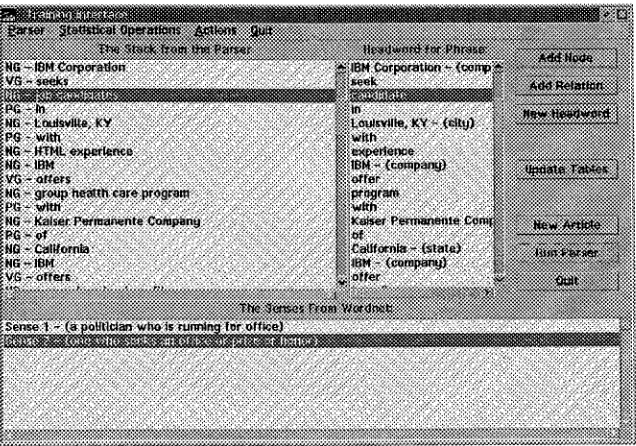
There are two parts to the Training Process: identi- fication of the (WordNet) sense usage of headwords of interest, and the building of specific rules. Train- ing is done by a user with the help of a graphical user Training Interface. Figure 2 shows a snapshot of the Training Interface. T h e Training Interface takes as input the phrase stack produced by the Par- tial Parser. Sense usage tables, and a collection of specific rules are built as a result of the Training Process.
2.5.1 I d e n t i f i c a t i o n o f S e n s e U s a g e
T h e Training Process yields a collection of training-article-specific rules which are then gener- alized by the Rule Generalization routines. These generalization routines m a k e use of the WordNet h y p e r n y m relationship by replacing the headwords
present in a rule with one of its m o r e general super- ordinates in the WordNet hierarchy. For this to be done, the Rule Generalization routines m u s t know the sense (concept) of usage of the headword in the article it appears in, because the W o r d N e t hierarchy is sense dependent. Moreover, training articles often contain headwords t h a t are not used in their m o s t frequent sense. For example, in a d o m a i n which ad- vertises j o b openings, the noun
opening
will m o s t likely be used as an " o p p o r t u n i t y for e m p l o y m e n t or promotion" (Sense 4), rather t h a n the m o s t com- m o n l y occuring sense: "an open or e m p t y space in or between things" (Sense 1). Therefore, for each of the headwords of interest, the user, based on the gloss associated with the senses provided by Word- Net, has to decide which sense is being used in the article. If the user does not train on a particular headword, then, by default, it is assumed to have been used in its m o s t c o m m o n l y occuring sense.T h e system, for each headword appearing in the article, keeps a count of the frequency of occurrence of the senses associated with it. All this information is stored in the form of a table (Sense-Usage Table) which is later used by the Scanning Process. During the Scanning Process, the system does not have the help of the user to determine w h a t sense of a partic- ular headword is being used. Neither can the s y s t e m simply assume the m o s t c o m m o n l y occuring sense. Therefore, the Sense Classifier determines the senses of the headwords of the phrases based on the Sense- Usage Table built during the Training Process. T h e sense identified by the Sense Classifier is then used for all future processing.
2.5.2 B u i l d i n g t h e S p e c i f i c R u l e s
T h e user builds the collection of rules by actually building semantic networks for the training articles using the Training Interface. Specifically, the user scans the phrase stack one entry at a t i m e and se- lects phrases t h a t he or she feels should be trans- lated to the o u t p u t semantic network. T h e n the selected phrases are translated to nodes or tran- sitions of the network using G U I provided opera- tions. There are two operations used to build the semantic network: the A D D . N O D E operation and the A D D . R E L A T I O N operation.
T h e ADD_NODE operation allows the user to add a node to the semantic network while the A D D _ R E L A T I O N operation allows the user to add a transition between two nodes. For the A D D _ R E L A T I O N operation, if either (or both) of the two nodes do not exist, the A D D _ N O D E op- eration is a u t o m a t i c a l l y invoked and the node is added to the network. Since the A D D . R E L A T I O N
Figure 2: Snapshot of the Training Interface
operation subsumes the A D D . N O D E operation, we only consider the ADD_RELATION operation. T h e system automatically creates and saves an ADDA:~ELATION rule for each ADD_RELATION operation performed by the user during training.
T h e user executes an ADD_RELATION operation by identifying the two objects (nodes) and the rela- tionship (transition) between them. For example, consider the phrase stack of the sentence "IBM Cor- poration seeks job candidates in Louisville, KY with H T M L experience." as shown in Figure 2. Suppose the user executes an A D D . R E L A T I O N operation by identifying IBM Corporation, and job candidates as the two nodes, and seeks as the transition connecting the nodes. T h e rule corresponding to this operation is shown in Figure 3. T h e left hand side (LHS) of the rule specifies the conditions t h a t need to be satisfied for the RHS to be executed. For each rule, there are three conditions in the LHS. Each condition is a 4-tuple consisting of the following fields: the head- word of the phrase, the type of phrase, the WordNet sense number identified by the user (default is 1), the headword "type" identified by the Preprocessor (de- fault is "other_type"). T h e three conditions present in the LHS of the rule need not appear contiguously in a sentence of the article.
Training a 3000 byte article (approximately 1 page) takes approximately 10 minutes. T h e num- ber of articles t h a t the system must be trained on depends on the domain and the user's expectations of precision and recall. T h e more you train the sys- tem, the b e t t e r the precision and recall. We are
currently working on the problem of trying to pre- dict the right number of articles on which the system must be trained, for a particular domain, to obtain target recall and precision statistics.
3 G e n e r a l i z a t i o n
Rules created as a result of the Training Process are very specific and can only be applied to exactly the same patterns as the ones present during the train- ing. In order to make the specific rules applicable to a large number of unseen articles in the domain, a comprehensive generalization mechanism is neces- sary. We are not only interested in the generalization itself, but also in the strategy to control the degree of generalization for various applications in different domains.
3.1 D e g r e e o f G e n e r a l i z a t i o n
The hierarchical organization of WordNet (Miller, 1990) provides the possibility of a u t o m a t i c rule gen- eralization of the rules. Philip Resnik has done some work earlier in using the hierarchical struc- ture of WordNet (Resnik, 1995a) (Resnik, 19955). With the large a m o u n t of information on seman- tic classification and t a x o n o m y provided in Word- Net, m a n y ways of incorporating WordNet's seman- tic features with generalization are foreseeable. Al- though, at this stage, we only concentrate on the H y p e r n y m / H y p o n y m feature.
~.From the training process, the specific rules con- tain three entities on the LHS as shown in Fig- ure 3. Each entity is a quadruple, in the form of
[image:4.596.148.466.103.326.2][IBM Corporation, NG, 1,company], [seek, VG, 1, other_type], [candidate, NG, 2, other_type] ADD..NODE(IBM Corporation), ADD_NODE(candidate),
ADD__RELATION(seek, IBM Corporation, candidate)
Figure 3: A Sample Rule
(Wl, el, Sl, tl), (W2, e2, 82, t2),(~3, c3, 83, $3)
ADD_NODE(wx), ADD_NODE(w3), ADD_RELATION(w2, wl, w3)
Figure 4: An Abstract Specific Rule
sp = (w,e,s,t),
where w is the headword of thetrained phrase, c is the part of the speech of the word, s is the sense number representing the mean- ing of w, t is the semantic type identified by the pre- processor for w. An abstract specifi c rule is shown in Figure 4.
For each
sp =
(w, e, s, t), if w exists in WordNet, then there is a corresponding synset in WordNet. The hyponym/hypernym hierarchical structure pro- vides a way of locating the superordinate conceptsof
sp.
By following additional hypernyms, we willget more and more generalized concepts and eventu-
ally reach the most general concept, such as
{person,
human being,...}.
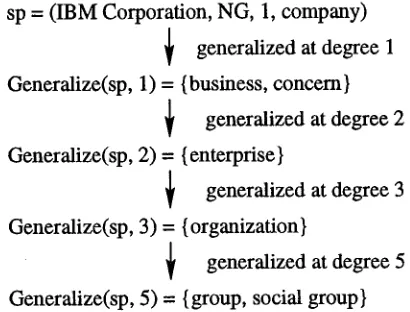
Based on this scenario, for eachconcept, different degrees of generalization can be achieved by adjusting the distance between this con- cept and the most general concept in the WordNet hierarchy. The function to accomplish this task is
Generalize(sp, h),
which returns a synset list h levelsabove the specific concept represented by
sp
in thehierarchy. An example is shown in Figure 5.
sp = (IBM Corporation, NG, 1, company)
generalized at degree 1
Generalize(sp, 1) = {business, concem}
generalized at degree 2
Generalize(sp, 2) = { enterprise}
generalized at degree 3
Generalize(sp, 3) = {organization}
generalized at degree 5
Generalize(sp, 5) = {group, social group}
Figure 5: Degrees of Generalization for a Specific Concept
3.2 G e n e r a l i z e d R u l e s
The process of generalizing rules consists of replacing each
sp = (w, e, s, t)
in the specific rules by a more general superordinate synset from its hypernym treein WordNet by performing the
Generalize(sp, h)
function. The degree of generalization for rules
varies with the variation of h in
Generalize(sp, h).
For example, Figure 6 shows the rule in Figure 3 generalized to two different degrees.
Figure 7 shows an abstract generalized rule. The C symbol signifies the subsumption relationship. Therefore, a C b signifies that a is subsumed by b, or, in WordNet terms, concept b is a superordinate concept of concept a. The generalized rule states that the RHS of the rule gets executed if
all
of the following conditions hold:• A sentence contains three phrases (not neces- sarily contiguous) with headwords W1, W2, and
w3.
• The quadruples corresponding to these head- words are
( W1, C1, S1, T1) , ( W2 , C2, $2,T2),
and(W3, C3, $3, T3).
• The synsets, in WordNet, corresponding to the
quadruples, are subsumed by
Generalize(spl,
hi), Generalize(sp2, h2),
andGeneralize(sp3,
h3)
respectively.4
S c a n n i n g N e w A r t i c l e s
The goal of generalizing the rules is to generate se- mantic networks for unseen articles. The semantic networks are built with the help of the ADD.NODE and the ADD.RELATION operations present in the RHS of the rules. The Scanning Process consists of the following steps:
• Parse the unseen article and segment it into phrases belonging to one of NG, VG, or PG
(c,).
• Identify the headword (Wi) for each phrase.
[image:5.596.67.272.537.693.2][{enterprise}], [seek, VG, 1, other_type], [{applicant}] > ADD..NODE({enterprise}), ADD_NODE({applicant}), ADD.RELATION(seek, {enterprise}, {applicant})
[{organization}], [seek, VG, 1, other_type], [{person}] > ADD_NODE({organization}), ADD..NODE({person}), ADD.RELATION(seek, {organization}, {person})
Figure 6: Specific Rule in General Forms
(Wl,
C1, S1,T1)
(.~Generalize(spl,
hi), (W2, C2, $2, T2) CGeneralize(sp2,
h2),(W3,
C3, $3,
T3) CGeneralize(sp3,
h3)> ADD_NODE(W1), ADD_NODE(W3), ADD_RELATION(W2,W1, W3)
Figure 7: Generalized Rule
• Use the Preprocessor to identify the type (Ti)
for each headword.
Use the Sense Classifier (as described in Sec- tion 2.5.1 to assign the appropriate sense (Si) to each headword.
Each phrase can now be uniquely represented by (W~, C~, Si, 7~). Match (14~, Ci, Si, 7~) with the LHS of a generalized rule.
If the three entities
[Generalize(spi,
hi)] sub-sume three phrases [(W~,
C~, S~,
7~)], within asingle sentence in the article, the rule is fired and the RHS of the rule executed.
If we train on
IBM Corporation seeks job candi-
dates
and generate the rule as in Figure 3, Table 1lists some sentences that can be processed as the degree of generalization.
100 95 90 85 80 75 70 65 60 55 50 40 30 20 10 0
! i ! i i
8 train-arts - - . i = . - i . - Z . - . - S Z L . . . ~ . . . 16 train-arts . . .
-- ... --... ...
I ! I I I 1 2 3 4 5
degree of generalization
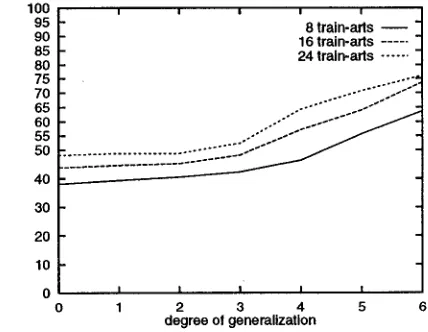
Figure 8: Precision vs. Degree of Generalization
100 95 90 85 80 75 70 65 60 55 50 40 30 20 10 0
i i i i i
8 t r a i n - a r t s - - "
1 6 t r a i n - a r t s . . . 2 4 t r a l n - a r l s . . .
i. I !
o 1 5
I ! I 2 3 4 degree ol generalization
Figure 9: Recall vs. Degree of Generalization
5 E x p e r i m e n t s
We designed an experiment to investigate how train- ing and the generalization strategy affect meaning extraction. We trained our system on three sets of
articles from the
triangle.jobs
USENET newsgroup,with emphasis on the following seven facts:
• Company Name. Examples: IBM, Metro Infor- mation Services, DCR Inc.
• Position/Title. Examples: programmer, finan- cial analyst, software engineer.
• Experience/Skill. Example: 5 years experience in Oracle.
• Location. Examples: Winston-Salem, North Carolina.
• Benefit. Examples: company matching funds, comprehensive health plan.
[image:6.596.324.538.308.474.2] [image:6.596.74.297.554.718.2]degree Noun Phrase Verb Phrase Noun Phrase 0 G T E (any company) seeks, looks for, searches job candidates 1 Auction Agency (any business) seeks, looks for, searches bidder 2 Motor Factory (any enterprise) seeks, looks for, searches engineers 3 Police (any organization) seeks, looks for, searches the fugitive (any person) 4 Biology Lab (any group) seeks, looks for, searches missing frog (any life form)
Table 1: Sample Sentences that Can Be Processed in the Scanning Part
• Salary. Examples: $32/hr, 60K.
• Contact Info. Examples: Fax is 919-660-6519, email address.
The first training set contained 8 articles; the second set contained 16 articles including the first set; and the third set contained 24 articles includ- ing those in the first two sets. For rules from each training set, seven levels of generalization were per- formed. Based on the generalized rules at each level, the system was run on 80 unseen articles from the same newsgroup to test its performance on the ex- traction of the seven facts.
The evaluation process consisted of the following step: first, each unseen article was studied to see how m a n y facts of interest were present in the ar- ticle; second, the semantic transitions produced by the system were examined to see if they correctly caught any facts of interest. The precision and recall curves with respect to the degree of generalization are shown in Figures 8 and 9 respectively.
In the precision vs. degree of generalization graph (Figure 8), precision decreases from 96.1% to 68.4% for the first training set as the degree of generaliza- tion increases from 0 to 6. The first set of eight train- ing articles has better performance on precision. The fact t h a t precision decreases with increased numbers of training articles seems to be counter intuitive ini- tially. But, as the number of training articles in- crease, the the number of rules increase; which in- creases the chance t h a t some piece of irrelevant infor- mation m a y trigger one of the rules, thereby decreas- i n g the precision. In the recall vs. degree of gener- alization graph (Figure 9), for the third training set of 24 articles, recall increases from 48.2% to 76.1% as generalization degree increases. As expected, the third training set out-performed the other two train- ing sets on recall.
In Figure 9, there is a j u m p in recall as we go from generalization degree 3 to generalization degree 4. This gives rise to the following important question: W h y does a certain degree of generalization have a big impact on extracting a fact(s)? Moreover, with the increase in the degree of generalization, preci-
sion tends to fall while recall tends to increase. The question t h a t arises here is: W h a t degree of general- ization gives us the best compromise between preci- sion and recall? We are currently conducting further research t h a t will help us answer such questions.
6
C o n c l u s i o n
This paper describes a trainable system for mean- ing extraction. The critical parts in the system are the preprocessor, the partial parser, the training in- terface, the rule interpreter, the rule generalization routines, and the rule matching routines.
Our system allows a person to train a small num- ber of texts from a particular domain, to get the desired information from a larger corpus of texts. The training effort is reduced to a few hours and the person training the system need not be a linguist or domain expert.
7
Acknowledgment
We wish to thank Jerry Hobbs of SRI for providing us with the finite-state rules for the parser.
We also wish to thank our advisor Dr. Alan W. Biermann for all his help, advise, and support.
R e f e r e n c e s
Aberdeen, John, et al. 1995. MITRE: Description of
the
ALEMBIC
System Used for MUC-6,Pro-
ceedings of the Sixth Message Understanding
Conference (MUC-6),
pp. 141-155, November1995.
Appelt, Douglas E., et al. 1995. SRI International: Description of the FASTUS System Used for MUC-6,
Proceedings of the Sixth Message Un-
derstanding Conference (MUC-6),
pp. 237-248, November 1995.
Fisher, David, et al. 1995. Description of the UMass System as Used for MUC-6,
Proceedings of
the Sixth Message Understanding Conference
(MUC-6),
pp. 127-140, November 1995. [image:7.596.66.508.104.182.2]Grishman, Ralph. 1995. The NYU System for
MUC-6 or Where's the Syntax?
Proceedings
of the Sixth Message Understanding Confer-
ence (MUC-6),
pp. 167-175, November 1995.Hobbs, J., et al. 1995. FASTUS: A system for Ex-
tracting Information from Text,
Human Lan-
guage Technology,
pp. 133-137, 1993.Krupka, George R. 1995. Description of the SRA
System as Used for MUC-6,
Proceedings of
the Sixth Message Understanding Conference
(MUC-6),
pp. 221-235, November 1995.Miller, G.A. 1990. Introduction to WordNet: An
On-Line Lexical Database.
WordNet Manuals,
pp. 10-32, August 1993.
Miller, G.A., et al. 1990a.
Five Papers on Word-
Net,
Cognitive Science Laboratory, PrincetonUniversity, No. 43, July 1990.
Proceedings of the Fourth Message Understanding
Conference (MUC-4),
June 1992, San Mateo:Morgan Kaufmann.
Proceedings of the Fifth Message Understanding
Conference (MUC-5),
August 1993, San Ma-teo: Morgan Kaufmann.
Proceedings of the Sixth Message Understanding
Conference (MUC-6),
November 1995, SanFrancisco: Morgan Kaufmann.
Quillian, M. Ross. 1968 Semantic Memory, In
Semantic Information Processing,
M. Minsky(ed.). Cambridge, Massachusetts: MIT Press, 1968, pp. 216-270.
Resnik, Philip. 1995a Using Information Content to Evaluate Semantic Similarity in a Taxonomy,
Proceedings of IJCAI-95,
1995.Resnik, Philip. 1995b Disambiguating Noun Group-
ings With Respect to WordNet Senses,
Third
Workshop on Very Large Corpora,
1995.Weischedel, R., et al. 1993. BBN: Description of the
PLUM System as Used for MUC-5,
Proceed-
ings of the Fifth Message Understanding Con-
ference (MUC-5),
pp. 93-107, August 1993.Weischedel, Ralph. 1995. BBN: Description of the
PLUM System as Used for MUC-6,