988
Graph Pattern Entity Ranking Model
for Knowledge Graph Completion
Takuma Ebisu1,2 and Ryutaro Ichise2,1,3
1SOKENDAI, Chiyoda-ku, Tokyo, Japan
2National Institute of Informatics, Chiyoda-ku, Tokyo, Japan
3National Institute of Advamced Industrial Science and Technology, Koto-ku, Tokyo, Japan
{takuma,ichise}@nii.ac.jp
Abstract
Knowledge graphs have evolved rapidly in recent years and their usefulness has been demonstrated in many artificial intelligence tasks. However, knowledge graphs often have
lots of missing facts. To solve this
prob-lem, many knowledge graph embedding mod-els have been developed to populate knowl-edge graphs and these have shown outstand-ing performance. However, knowledge graph embedding models are so-called black boxes, and the user does not know how the informa-tion in a knowledge graph is processed and the models can be difficult to interpret. In this pa-per, we utilize graph patterns in a knowledge graph to overcome such problems. Our pro-posed model, thegraph pattern entity ranking model(GRank), constructs an entity ranking system for each graph pattern and evaluates them using a ranking measure. By doing so, we can find graph patterns which are useful for predicting facts. Then, we perform link prediction tasks on standard datasets to eval-uate our GRank method. We show that our proach outperforms other state-of-the-art ap-proaches such as ComplEx and TorusE for
standard metrics such as HITS@n and MRR.
Moreover, our model is easily interpretable be-cause the output facts are described by graph patterns.
1 Introduction
Knowledge graphs can be used to describe real-world relations as facts in a form that a computer can easily process and has been used for many
ar-tificial intelligence tasks (Hakimov et al., 2012;
Daiber et al., 2013; Bordes et al., 2014). In a knowledge graph, a fact is represented by a
la-beled and directed edge, called a triple (h,r,t),
where h and t are entity nodes and r is a
rela-tion label of an edge from h to t. Knowledge
graphs such as YAGO (Suchanek et al., 2007),
DBpedia (Auer et al., 2007), and Freebase (
Bol-lacker et al., 2008) have developed rapidly in re-cent years and are used for many artificial intel-ligence tasks such as question answering, content tagging, fact-checking, and knowledge inference. Although some knowledge graphs already contain millions of entities and billions of facts, they might still be incomplete and some facts may be missing. Hence, we need to develop a system that can pre-dict missing facts to complete knowledge graphs automatically.
Many kinds of models for link prediction
have been developed to estimate unknown facts. Knowledge graph embedding models, which are the most widely used approach in this field, map entities and relations in a knowledge graph onto a vector space and obtain the latent underlying fea-tures. However, these models are generally diffi-cult to interpret, as we do not know how informa-tion is processed in the models and the predicted facts are output without explanation.
In this paper, we construct statistical models
based ongraph pattern matching. These models
are not only easy to interpret compared to knowl-edge graph embedding models but also outperform state-of-the-art models for link prediction.
Our main contributions in this paper are as fol-lows:
• Defining graph pattern association rules
(GPARs) for a knowledge graph.
• Introducing a graph pattern probability
model(GPro) and discussing its flaws.
• Proposing a novel model, the graph pattern
entity ranking model (GRank), which uses graph patterns to rank entities.
• Proposing distributed rankings to address the
• Evaluating the proposed models through link
prediction tasks for standard datasets: It
is shown that our model outperforms most state-of-the-art knowledge graph embedding
models for the HITS@nand MRR metrics.
The remainder of this paper is organized as
fol-lows. In Section 2, we discuss related work on
link prediction. In Section3, we define the terms
and notation used in this paper. In Section 4, we
define standard confidences for GPARs and
dis-cuss their problems. In Section5, we propose the
GRank model to deal with these problems. In
Sec-tion6, we present an experimental study in which
we compare our models with baseline results for
benchmark datasets. In Section 7, we conclude
this paper.
2 Related Work
We categorize related work for link prediction into two groups: work on knowledge graph embedding models (which are latent feature models) and work on observed feature models.
2.1 Knowledge Graph Embedding Models
Recently, knowledge graph embedding models have yielded great results in link prediction tasks. Knowledge graph embeddings models em-bed entities and relations on a continuous space and can be roughly classified into three types: translation-based models, bilinear models, and neural network-based models.
The first translation-based model was the
TransE (Bordes et al.,2013) model, which gained
attention because of its effectiveness and
simplic-ity. TransE employs the principleh+r= t, where
h,r and t are the embeddings of h,r and t,
re-spectively. While this principle efficiently cap-tures first-order rules, the TransE approach still has some problems. The conflict between princi-ple and regularization is one of these problems and
the TorusE (Ebisu and Ichise,2018) model was
re-cently proposed to solve this problem by embed-ding entities and relations on a torus manifold.
RESCAL (Nickel et al.,2011) was the first
bi-linear model, where each relation is represented by
a square matrix and the score of the triple (h,r,t) is
calculated by a bilinear map which corresponds to
the matrix of the relationr and whose arguments
arehandt. Hence, RESCAL represents the most
general form of a bilinear model. Extensions of
RESCAL have been proposed by restricting
bilin-ear functions, for example, DistMult (Yang et al.,
2015) and ComplEx (Trouillon et al., 2016)
re-strict the matrices representing the relations to di-agonal matrices.
Neural network-based models have layers and an activation function like a neural network. The
Neural Tensor Network (NTN) (Socher et al.,
2013) has a standard linear neural network
struc-ture and a bilinear tensor strucstruc-ture, and can be considered as a generalization of RESCAL, where the weight of the network is trained for each
re-lation. Graph Convolutional Networks (GCNs)
(Duvenaud et al., 2015; Defferrard et al., 2016;
Kipf and Welling, 2017) exploit the convolution operator to capture local information for a graph, however these models are for undirected graphs.
Relational GCNs (Schlichtkrull et al., 2017) and
ConvE (Dettmers et al.,2018) are generalizations
of GCNs for knowledge graphs.
Knowledge graph embedding is the standard ap-proach for link prediction. However, it suffers from low interpretability, resulting in triples which are predicted without any clear reason.
2.2 Observed Feature Models
The main advantage of observed feature mod-els over knowledge graph embedding modmod-els is their interpretability. Additionally, Toutanova et
al. (2015) proposed a relatively simple logistic
re-gression model, the Node+LinkFeat model, which utilizes only one-hop information in a knowledge graph and demonstrated that it performs far bet-ter for link prediction on standard datasets than most existing knowledge graph embedding
mod-els. However, it has also been shown that the
Node+LinkFeat model cannot deal with a low-redundancy dataset because the model uses infor-mation which is too local. On the other hand, it has shown that a logistic regression model, the PRA
model (Lao and Cohen, 2010; Lao et al., 2011),
which utilizes multi-hop information do not have
sufficient accuracy (Liu et al., 2016). This
sug-gests logistic regression does not have enough power to deal with deep information. These stud-ies have motivated research toward developing a more efficient model utilizing deeper information.
We begin by discussing GPARs, which were
proposed recently byFan et al. (2015), and have
Team A U.K.
located_in
p1 p2 p3 p4 p5
member_of
pm
manager_of
U.K. France
nationality
Team B Germany
located_in
p'1 p'2 p'3 p'4 p'5
member_of
p'm
manager_of
U.K. Germany
nationality
Italy
Team C
p''1 p''2 p''3 p''4 p''5
member_of
p''m
manager_of
Germany Italy France
[image:3.595.77.501.69.196.2]nationality
Figure 1: GraphGexof sports teams.
located_in
x y
located_in ,
manager_of
x z y
nationality
��, ,
member_of
x z nationality y
[image:3.595.75.501.73.323.2]��, ,
Figure 2: Graph patterns onGex.
because graph patterns can capture deeper infor-mation lying in a knowledge graph and a GPAR explicitly describe the process of prediction.
How-ever, the definition of GPARs byFan et al.cannot
be applied to a knowledge graph becauseFan et al.
assumes a different structure for a social network graph than a knowledge graph. In the following section, we define GPARs for a knowledge graph.
3 Preliminaries
In this section, we introduce the definitions and notation required to discuss GPAR-based models.
3.1 Graph Pattern Association Rules on Knowledge Graphs
We modify GPARs for application to a
knowl-edge graph following the definitions ofFan et al.
(2015).
Knowledge Graph: Agraphis defined asG=
{(h,r,t)} ⊂ E×R×E, where E denotes a set of
entities and Rdenotes a set of relations. An
ele-ment (h,r,t) ofGis called a triple and represents
the directed relationrbetweenhandt.
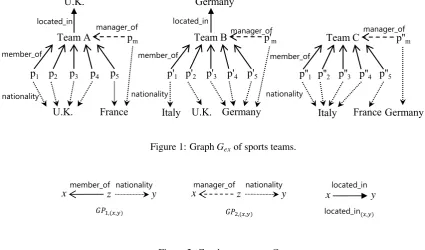
An example graph Gex is shown in Figure 1,
wherepirepresents a person, Teams “A”, “B”, and
“C” represent sports teams, and countries are
enti-ties in Eex with labeled arrows between two
enti-ties representing directed relations inRex.
Graph Pattern: A graph pattern on G is a
graphGP(x,y) ={(zi,r,zj)} ⊂VGP×R×VGP, where
VGPdenotes a set of variables,xandyare two
des-ignated variables, andR is the set of relations of
G. We supposeVGPhas no redundancy, in other
words,∀z∈VGP,∃(zi,r,zj)∈GP(x,y),z= zi∨z=
zj.
Some examples of graph patterns
on Gex are shown in Figure 2, where
GP1,(x,y) = {(z,member of,x),(z,nationality,y)},
GP2,(x,y) = {(z,manager of,x),(z,nationality,y)}, and located in(x,y) = {(x,located in,y)}. Our focus in this paper is on finding useful graph patterns for link prediction.
Graph Pattern Matching Function: A match-ing functionofGP(x,y) on (h,t) ∈ E×E is an
in-jective function m : VGP → E that satisfies the
following conditions: m(x) = h, m(y) = t, and
for all (zi,r,zj) ∈ GP(x,y), (m(zi),r,m(zj)) ∈ G.
M(GP(x,y),(h,t)) denotes the set of all matching
functions of GP(x,y) on (h,t). We say GP(x,y)
matches (h,t) if there is at least one matching
func-tion ofGP(x,y)on (h,t) (i.e.M(GP(x,y),(h,t)),∅).
For example, m : VGP1,(x,y) → Eex (m(x) =
Team A,m(z) = p1,m(y) = U.K.) is a matching
function ofGP1,(x,y)on (Team A,U.K.).
GPAR: A graph pattern association rule
(GPAR) ARis defined asGP(x,y) ⇒ r(x,y), where
GP(x,y) and r(x,y) are graph patterns and r(x,y) =
{(x,r,y)}.
For example, a GPAR AR1 = P1,(x,y) ⇒
matching function ofGP1,(x,y) on (h,t), then it is likely that there is also a matching function of located in(x,y) on (h,t), i.e. (h,located in,t) is a fact.
3.2 Reconstruction of Knowledge Graph to Queries
Our task is the link prediction of a knowledge
graph, i.e. to predict the missing entity of aquery,
which is formally defined as follows:
Query: Aqueryis a triple which is missing an entity: (h,r,?) or (?,r,t).
We divide a knowledge graphGinto queries and
answers to use as training data for our model. Let
Qr,head (Qr,tail) denote the set of training queries
missing a head (tail) entity for a relationrobtained
fromG; thenQr,head(Qr,tail) is defined as follows:
Qr,head={(?,r,t)|(h,r,t)∈G},
Qr,tail ={(h,r,?)|(h,r,t)∈G}
In this case, the answers of training queries are de-fined as follows:
a(?,r,t)={h|(h,r,t)∈G},
a(h,r,?)={t|(h,r,t)∈G}
A knowledge graph usually contains only positive
triples. Hence, we adopt thepartial completeness
assumption(PCA) (Gal´arraga et al., 2013,2015) to generate negative answers.
Partial Completeness Assumption: if (h,r,t)
is inG, then
∀t′ ∈E,((h,r,t′)<G⇒(h,r,t′) is negative) (1)
∀h′ ∈E,((h′,r,t)<G⇒(h′,r,t) is negative) (2)
The standard PCA definition consists only of Equation (1), but we add Equation (2) because we
also need to allow negative answers for Qr,head.
Under PCA, negative answers for each question are defined as follows:
n(?,r,t)= E\a(?,r,t), n(h,r,?) =E\a(h,r,?)
4 Standard Confidence and Problems
4.1 AMIE with GPARs
An association rule is essentially a binary clas-sifier, i.e. the antecedent of an association rule matches or does not match, and an association rule is thus evaluated. Following this idea, we suggest
the most straightforward way to define the
confi-dence, which indicates the reliability of an asso-ciation rule, is the conditional probability, which is the probability of the consequent given the an-tecedent for a GPAR. The conditional probability
Prtail(r(x,y)|GP(x,y)) of a GPARGP(x,y) ⇒r(x,y)to predict a tail is defined as follows:
conftail(GP(x,y)⇒r(x,y))=Prtail(r(x,y)|GP(x,y))= P
(h,r,?)∈Qr,tail|{t∈a(h,r,?)| M(GP(x,y),(h,t)),∅}| P
(h,r,?)∈Qr,tail|{t
′∈E| M(GP
(x,y),(h,t′)),∅}|
For each query, the candidate entities found by the graph pattern are counted for the denomina-tor while only correct entities are counted for the numerator. This confidence is used to evaluate GPARs only to answer queries with a missing tail
becauseQrtailand its answers are used to define it.
Interestingly, GPARs with this confidence are
equivalent to AMIE (Gal´arraga et al.,2013,2015),
which was proposed to find horn clauses for a knowledge graph, although AMIE was proposed before the appearance of GPARs. However, AMIE originally has only one confidence value for a GPAR because AMIE is not designed for link pre-diction. Hence, we introduce the following alter-native definition for the confidence value to an-swer a query missing a head entity.
4.2 Standard Link Prediction Model and Problems
We define another confidence to deal with a query with a missing head entity as follows:
confhead(GP(x,y)⇒r(x,y))=Prhead(r(x,y)|GP(x,y))= P
(?,r,t)∈Qr,head|{h∈a(?,r,t)| M(GP(x,y),(h,t)),∅}| P
(?,r,t)∈Qr,head|{h
′ ∈E |M(GP
(x,y),(h′,t)),∅}|
Additionally, we restrict matching functions to
in-jective functions as defined in Section3.1, which
is different from AMIE, because the restriction avoids redundant matching functions which map multiple variables to the same entity and gives a good bias for real-world knowledge. For
exam-ple, an GPAR GP3,(x,y) ⇒ sibling of(x,y), where
GP3,(x,y) = {(z,parent of,x),(y,child of,z)}, is
helpful to predict siblings. However, let p
rep-resent a person,GP3,(x,y) matches (p,p) although
p is not a sibling of p. The above restriction
omits such concerns. For another example, a
Gex in Figure 1 should not be considered
help-ful because m(x) = m(z2) holds for a matching
functionmof the antecedent pattern and as a
re-sult, the GPAR is almost tautological. We consider
two confidence values for GPARs, con ftail and
con fhead, referred to as the graph pattern
proba-bility model(GPro).
However, GPro cannot deal with queries where counting the number of matching functions is cru-cial. An example where the number of
match-ing functions is important is shown in Figure 1.
InGex, the country that Team C is located in is
missing. One might guess that Team C is
lo-cated in Italy because most of the Team C play-ers have Italian nationality and the nationality of a player often matches the country that the team is located in. However, GPro underestimates the GPAR AR1,(x,y) = GP1,(x,y) ⇒ located in(x,y),
which is equivalent to one’s guessing process:
conftail(AR1,(x,y))=2/5, whileconftail(AR2,(x,y))= 1/2, where AR2,(x,y) = GP2,(x,y) ⇒located in(x,y).
Hence, GPro judges AR2,(x,y) is more useful than
AR1,(x,y), and as a result, GPro predicts Team C is
located in Germany rather than Italy.
This problem is caused by considering a GPAR
as a binary classifier, i.e. the matching
num-ber is not taken into account. For example, if
we apply AR1,(x,y) = P1,(x,y) ⇒ located in(x,y) to
a query (Team A,located in,?) in the traditional
way (as a binary classifier), the output will contain two entities with equal weighting, the U.K. and
France, because P1,(x,y) matches (Team A,U.K.)
and (Team A,France). Then, one of the output
en-tities is correct and the other is incorrect. This is
the reason whyAR1,(x,y)is underestimated.
To deal with this problem, in this paper, we consider a GPAR as an entity ranking system by counting the number of matching functions of the antecedent graph pattern rather than considering as a binary classifier.
5 GPAR as Entity Ranking System and Evaluation Metrics
As well as considering a GPAR as a binary clas-sifier, we consider it as an entity ranking system. Entities are ranked according to a score, based on their number of matching functions.
Moreover, we introduce the distributed
rank-ingsfor entities, which are proposed to deal with
situations where multiple entities have the same score. Then, we define the evaluation metrics for
the distributed rankings to evaluate GPARs for link prediction.
These approaches overcome the problems
shown in Section4.2.
5.1 GPAR as Entity Ranking System
We consider a GPAR as a ranking system in this section to rank queries for which counting the number of matching functions of the antecedent
is helpful, as shown in Section4.2.
First, we define a scoring function whose
argu-ments are a graph patternGP(x,y)and a pair of
enti-ties (h,t). The scoring function returns the number
of matching functions of a pattern on a pair, which is formally defined as follows:
score(GP(x,y),(h,t))=|M(GP(x,y),(h,t))|
Given a pattern GP(x,y) and a query (h,r,?), we
can obtain the score(GP(x,y),(h,t′)) for each
can-didate tail entity t′. Then we obtain the
rank-ings of the tail entities in descending order of the scores. The head entity rankings for a query
(?,r,t) are also obtained in this way. This
rank-ing method gives us new perspective when we ap-ply GPARs to answer a query. For example, if
we apply AR1,(x,y) = P1,(x,y) ⇒ located in(x,y) to
a query (Team A,located in,?) the U.K. will be
ranked first and France second. In this situation,
we can say that AR1,(x,y) works because the
cor-rect entity ranks higher than the wrong entity. We can basically evaluate a GPAR as an entity ranking system by evaluating output rankings by an eval-uation metric for an ranking system such as the
mean average precision. However, often multiple entities have the same score and traditional met-rics cannot deal with the situation. To deal with this problem, we propose a new concept, called
distributed rankings, and the corresponding met-rics in the following sections.
5.2 Distributed Rankings
We propose distributed rankings where each entity can distribute over multiple ranks and each rank can have multiple entities, to deal with situations where multiple entities have the same score.
Traditional rankings of entities are represented
by a matrixRank = (ranki,j) ∈ {0,1}n×n, wheren
is the number of entities, and for each column and row there is one 1 element. In this matrix, columns represent entities and rows represent ranks. For
rank i. On the other hand, distributed rankings
of entities are represented by a matrix dRank =
(dranki,j) ∈ [0,1]n×n, where the summation of a
column or a row is equal to 1. Different from tra-ditional rankings, the value of each element is con-tinuous and multiple elements can be greater than
0 in a column or a row. For example,ranki,j =0.5
means that half of the entity jhas ranki. Note that
a traditional ranking matrix is a distributed ranking matrix.
Given a pattern GP(x,y) and a query (h,r,?),
We obtain distributed rankings of entities,
dRANK(GP(x,y),(h,r,?)), according to their
scores as follows. Let a be the number of
en-tities whose scores are greater than the entity
represented by j and let b be the number of
entities whose scores are the same as the entity
represented by j. Then, dranki,j, an element of
dRANK(GP(x,y),(h,r,?)), is determined to be 1/b
fora+1≦i≦a+band 0 otherwise. Distributed
rankings of head entities for a query (?,r,t) are
obtained in the same way, and we refer to them as
dRANK(GP(x,y),(?,r,t)). Unlike traditional rank-ings, distributed rankings are uniquely determined from the scores of entities.
Traditional rankings can be evaluated by met-rics such as the average precision or the cumula-tive gain. However, distributed rankings cannot be evaluated by these metrics. Hence, we require a different evaluation metric for distributed rank-ings.
5.3 Evaluation of GPARs as Entity Ranking System
We use a GPAR to obtain distributed entity
rank-ings as shown in Section5.1. In this section, we
define a metric to evaluate distributed rankings of
entities by generalizing the average precision to
evaluate a GPAR.
For a pattern GP(x,y) and a training query
(h,r,?), the distributed precision at k, dPrek, of
dRANK(GP(x,y),(h,r,?)) is defined as follows:
dPrek(GP(x,y),(h,r,?))
=
Pk i=1
P
tj∈a(h,r,?)dranki,j
k
wheretjis an entity represented by janddranki,j
is an element ofdRANK(GP(x,y),(h,r,?)). The
el-ements related with correct entities ranked higher
or equal tokare summed up as the traditional
pre-cision atk.
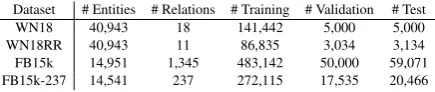
[image:6.595.312.530.63.109.2]Dataset # Entities # Relations # Training # Validation # Test WN18 40,943 18 141,442 5,000 5,000 WN18RR 40,943 11 86,835 3,034 3,134 FB15k 14,951 1,345 483,142 50,000 59,071 FB15k-237 14,541 237 272,115 17,535 20,466
Table 1: Statistics of benchmark datasets. The numbers of entities, relations, training triples, validation triples, and test triples are shown.
Then, thedistributed average precision,dAP, is
defined for a patternGP(x,y) and a training query
(h,r,?) as follows:
dAP(GP(x,y),(h,r,?))
=
P
tj∈a(h,r,?) Pn
k=1dPrek(GP(x,y),(h,r,?)))×drankk,j |a(h,r,?)|
where tj is an entity represented by j, dranki,j
is an element of dRANK(GP(x,y),(h,r,?)), and n
is the number of entities. The numerator of the average precision for traditional rankings is the
summation of the precision at k for relevant
en-tities. However, a relevant entity represented by
jis distributed over multiple ranks indRANK so
that the precision at k multiplied by drankk,j is
summed over k where a relevant entity j is
dis-tributed. dAP(GP(x,y),(?,r,t)) for a training query
with a missing head can be defined in the same
way. Thedistributed mean average precisionfor a
GPARGP(x,y)⇒r(x,y)is defined as follows:
dMAPhead(GP(x,y) ⇒r(x,y))
=
X
(?,r,t)∈Qr,head
dAP(GP(x,y),(?,r,t)) |Qr,head|
dMAPtail(GP(x,y)⇒r(x,y))
=
X
(h,r,?)∈Qr,tail
dAP(GP(x,y),(h,r,?)) |Qr,tail|
We also define dMAP with for the “filtered” (
Bor-des et al.,2013) rankings which are obtained from original rankings by eliminating entities whose corresponding triples (except the target triple) were included in the training dataset. ”Filtered” dMAP (fdMAP) is the mean of the dAP of ”fil-tered” rankings for each answer of queries.
We refer to GPARs considered as entity rank-ing systems with these dMAPs or fdMAPs as the
WN18 FB15k WN18RR FB15k-237
MRR HITS@ MRR HITS@ MRR HITS@ MRR HITS@
Model 1 3 10 1 3 10 1 3 10 1 3 10
TransE 0.397 0.040 0.745 0.923 0.414 0.247 0.534 0.688 0.182 0.027 0.295 0.444 0.257 0.174 0.284 0.420 TorusE 0.947 0.943 0.950 0.954 0.733 0.674 0.771 0.832 – – – – – – – – RESCAL 0.890 0.842 0.904 0.928 0.354 0.235 0.409 0.587 – – – – – – – – DistMult 0.822 0.728 0.914 0.936 0.654 0.546 0.733 0.824 0.43 0.39 0.44 0.49 0.241 0.155 0.263 0.419 ComplEx 0.941 0.936 0.945 0.947 0.692 0.599 0.759 0.840 0.44 0.41 0.46 0.51 0.240 0.152 0.263 0.419 R-GCN 0.814 0.686 0.928 0.955 0.651 0.541 0.736 0.825 – – – – 0.248 0.153 0.258 0.417 ConvE 0.942 0.935 0.947 0.955 0.745 0.670 0.801 0.873 0.46 0.39 0.43 0.48 0.316 0.239 0.350 0.491
PRA 0.458 0.422 – 0.481 0.336 0.303 – 0.392 – – – – – – – – Node+LinkFeat 0.940 – – 0.943 0.822 – – 0.870 – – – – 0.272 – – 0.414
[image:7.595.81.517.61.200.2]GPro 0.950 0.946 0.954 0.959 0.793 0.759 0.810 0.858 0.467 0.430 0.485 0.543 0.229 0.163 0.250 0.360 GRank (dMAP) 0.950 0.946 0.953 0.957 0.841 0.814 0.855 0.890 0.466 0.434 0.480 0.530 0.312 0.233 0.340 0.473 GRank(fdMAP) 0.950 0.946 0.954 0.958 0.842 0.816 0.856 0.891 0.470 0.437 0.482 0.539 0.322 0.239 0.352 0.489
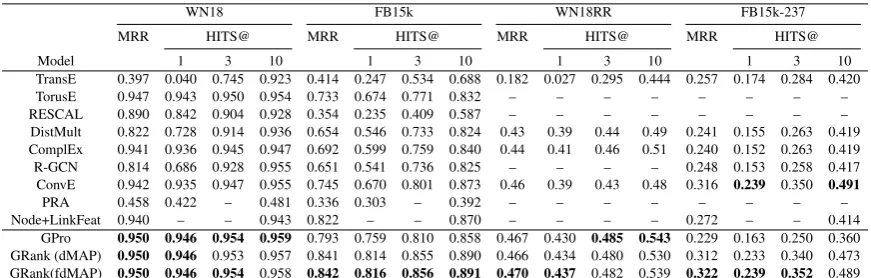
Table 2: Mean Reciprocal Rank (MRR) and HITS@nscores obtained for the link prediction tasks on the WN18,
FB15k, WN18RR, and FB15k-237 datasets. The highest result for each column is shown in bold. The results of
TransE and TorusE were reported byEbisu and Ichise(2018), the results of RESCAL were reported by Nickel
et al.(2016), the results of DistMult and ComplEx were reported byTrouillon et al.(2016), the results of R-GCN and ConvE were reported byDettmers et al.(2018), the results of PRA were reported byLiu et al.(2016), and the
results of Node+LinkFeat were reported byToutanova and Chen(2015).
shown in Section 4.2, unlike GPro. For
exam-ple, dMAPtail(AR1,(x,y)) = 1, is the maximum
value, while dMAPtail(AR2,(x,y)) = 1/2 in
Fig-ure 1. Hence, GRank can answer the query
(Team C,located in,?) by applyingAR1,(x,y).
6 Experiments
Our proposed models, GPro (Section 4.2) and
GRank (Section5), are evaluated through link
pre-diction tasks and compared with other state-of-the-art link prediction models.
6.1 Datasets
Experiments were conducted on four benchmark
datasets: WN18, FB15k (Bordes et al., 2013),
WN18RR (Dettmers et al., 2018), and
FB15k-237 (Toutanova and Chen,2015) (details of these
datasets are provided in Table1). These datasets
have been widely used in previous studies for eval-uating model performance in link prediction tasks. WN18 and FB15k were extracted from the real
knowledge graphs WordNet (Miller, 1995) and
Freebase (Bollacker et al., 2008), respectively.
WordNet is a well-known human-curated lexical database, and hence, WN18 is an easy benchmark of link prediction because it is well constructed and there are few missing or wrong facts. There-fore, link prediction models should perform well on WN18. Freebase is a huge knowledge graph of general facts and there are many missing facts. It is known that WN18 and FB15k have redun-dancy in the form of reverse relations. For this rea-son, when WN18RR and FB15k-237 are extracted
from WN18 and FB15k, the inverse relations of other relations are removed.
6.2 Evaluation Protocol
We conducted the link prediction task
follow-ing the same approach reported in (Bordes et al.,
2013) to evaluate our models qualitatively and
quantitatively. For each test triple (ht,rt,tt) in a
dataset, two queries, (ht,rt,?) and (?,rt,tt), were
constructed in the same way as in Section 3.2.
Then, we obtained the rankings of entities for each query from each model as outlined in the follow-ing paragraphs. The rankfollow-ings were ”filtered” by eliminating entities whose corresponding triples (except the target test triple) were included in the training, validation, or test dataset. The ob-tained rankings were scored by their mean
recip-rocal rank (MRR) and HITS@n, where MRR is
the mean of the inverse of the ranks of
correspond-ing entities and HITS@nis the proportion of test
queries whose corresponding entities are ranked in
the topnof the obtained rankings.
Next, we describe how to obtain rankings from models. We restricted antecedent graph patterns of
GPARs toconnected andclosed(Gal´arraga et al.,
2013,2015) patterns whose size|GP(x,y)|was less
than or equal toL to restrict the search space. A
connected and closed patterns is a pattern
connect-ingx andywithout branches, as shown in Figure
2. Lwas chosen for each model among{1,2,3}by
anIntel Xeon Gold 6154(3.00 GHz, 18 cores). We now explain how we obtained the rankings for queries with missing heads. For each relation
r, we chose the top 1,000 GPARs in descending
order of the standard confidence, the dMAP, or
the fdMAP to predict the heads. Let GPi,(x,y) ⇒
r(x,y) be the obtained GPAR, wherei denotes the
rank. We defined the ordering for two entities
for query (?,rt,tt) as follows: for entities e1 and
e2, we define e1 > e2 if there existsi′ for which
score(GPi,(x,y),(e1,tt)) = score(GPi,(x,y),(e2,tt))
for i > i′ and score(GPi′,(x,y),(e1,tt)) > score(GPi′,(x,y),(e2,tt)). We obtained the entity
rankings with this ordering for each query. Rank-ings for queries with missing tails were obtained in the same way.
6.3 Results
The results of the link prediction tasks for our proposed models, GPro, GRank with dMAP, and
GRank with fdMAP, are shown in Tables2, where
the results reported in previous studies are in-cluded for comparison.
In Table 2, the first seven models are
knowl-edge graph embedding models and the following two models are observed feature models. Table
2 shows the effectiveness of the Node+LinkFeat
model (Toutanova and Chen,2015), although this
model is very simple (high MRRs imply that the model also has high HITS@1s or HITS@3s). The Node+LinkFeat model performed well on WN18 and FB15k because these datasets often contain the reverse relations of other relations. In other words, it shows that knowledge graph embedding models failed to capture this
redun-dancy. On the other hand, our proposed
mod-els, GPro and GRank, generally yield better re-sults than the knowledge graph embedding models and results which are better than or comparable to Node+LinkFeat, which means that our models can also handle such redundancy. In particular, GRank with dMAP and fdMAP yielded the best results on FB15k. This indicates that taking the multiplicity of matchings and deeper information into account is important for knowledge graphs such as Free-Base that contain miscellaneous relations and are not well curated like WordNet. As a result, GRank performed well.
Table 2 also shows GPro and GRank yield
better results for the WN18RR dataset than the other models. For FB15k-237, the performance
of Node+LinkFeat is comparable with most of the other more sophisticated knowledge graph mod-els and GPro does not yield good results because FB15k-237 has less redundancy. GRank also per-forms better than the most other models for the FB15k-237 dataset for the same reason as the FB15k dataset. However, our models do not uti-lize the information related to the co-occurrence of entities and relations in triples (node
fea-tures (Toutanova and Chen,2015)), while ConvE,
Node+LinkFeat, and other models do. We also limited the size and the shapes of graph patterns because of the calculation time; we will address these and improve our models further in our future work.
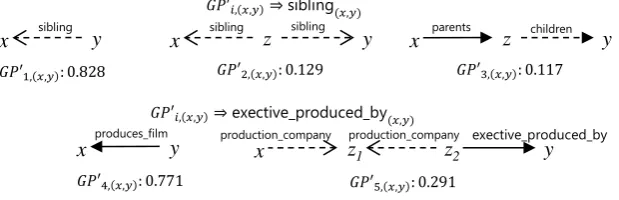
Quality of Obtained Paths The examples of antecedent patterns ranked high by GRank with
dMAPtail for FB15k are shown in Figure 3. The
patterns shown for predicting thesiblingrelation
are all correct as the antecedents of GPARs;
how-ever, the MAP of GP′2,(x,y) and GP′3,(x,y) are low.
The reason for this is thatGP′2,(x,y)works when an
individual has more than two siblings. The MAP
ofGP′3,(x,y)is low because individual’s parents are
often missing in FB15k. However, they are still ranked higher than other patterns.
The produces film relation is the inverse
re-lation of the exective produced by relation in
FB15k. Such patterns are very helpful when
performing link prediction tasks, and GRank is
able to find them. However, the MAP is not
as high because of missing facts. GRank is
able to use majority rules such as GP′5,(x,y) ⇒
film produced by(x,y) instead in such cases. This rule can be interpreted as stating that a particular film was likely to have been produced by a person who produced many films in the same production company.
Output triples of GRank (and GPAR-based models) are described by antecedent patterns unlike knowledge graph embedding models as shown here.
7 Conclusions
In this paper, we first defined GPARs for a knowl-edge graph and the standard confidence measures of GPARs for link prediction. Then, we pointed out the problems with the standard confidence measures and we introduced a new perspective using GPARs to rank entities to overcome these
rank-sibling
x y
��′�, , ⇒sibling ,
��′, , : .
sibling
x z
��′, , : .
y
sibling parents
x z
��′, , : .
y
children
produces_film
x y
��′�, , ⇒exective_produced_by ,
��′, , : .
production_company
x z1
��′, , : .
z2 exective_produced_byy
[image:9.595.144.454.69.169.2]production_company
Figure 3: Examples of antecedent patterns fordMAPtail which were given high ranks by GRank for the FB15k
dataset.
ings for situations where multiple entities have the same scores and defined metrics for them. This idea led us to propose the GRank model. GRank is easy to interpret because outputs are described by GPARs, unlike knowledge graph embedding mod-els, and so efficient that it outperformed the state-of-the-art knowledge graph embedding models in link prediction tasks.
In future work, we will extend GRank to use more complex patterns. We considered only an-tecedent graph patterns whose sizes were less than or equal to 3.If we allow antecedent graph patterns to have larger sizes, then we may find more useful GPARs. We also restricted graph patterns to con-tain only variables and not constants. Hence, we did not use all of the available information con-tained in the knowledge graph. We believe that using such complex graph patterns will improve GRank further.
Acknowledgements
This work was partially supported by the New En-ergy and Industrial Technology Development Or-ganization (NEDO).
We would like to thank Patrik Schneider for helpful writing advice.
References
S¨oren Auer, Christian Bizer, Georgi Kobilarov, Jens Lehmann, Richard Cyganiak, and Zachary G. Ives. 2007. DBpedia: A nucleus for a web of open data. In The Semantic Web, 6th International Semantic Web Conference, 2nd Asian Semantic Web Confer-ence, pages 722–735.
Kurt Bollacker, Colin Evans, Praveen Paritosh, Tim Sturge, and Jamie Taylor. 2008. Freebase: A collab-oratively created graph database for structuring
hu-man knowledge. In Proceedings of the 2008 ACM
SIGMOD International Conference on Management of Data, pages 1247–1250.
Antoine Bordes, Sumit Chopra, and Jason Weston. 2014. Question answering with subgraph
embed-dings. In Proceedings of the 2014 Conference on
Empirical Methods in Natural Language Processing (EMNLP), pages 615–620.
Antoine Bordes, Nicolas Usunier, Alberto Garc´ıa-Dur´an, Jason Weston, and Oksana Yakhnenko. 2013. Translating embeddings for modeling
multi-relational data. InAdvances in Neural Information
Processing Systems, pages 2787–2795.
Joachim Daiber, Max Jakob, Chris Hokamp, and Pablo N. Mendes. 2013. Improving efficiency and accuracy in multilingual entity extraction. In Pro-ceedings of the 9th International Conference on Se-mantic Systems, pages 121–124.
Micha¨el Defferrard, Xavier Bresson, and Pierre Van-dergheynst. 2016. Convolutional neural networks on graphs with fast localized spectral filtering. In Advances in Neural Information Processing Systems 29, pages 3844–3852.
Tim Dettmers, Pasquale Minervini, Pontus Stenetorp,
and Sebastian Riedel. 2018. Convolutional 2d
knowledge graph embeddings. In Proceedings of
the Thirtieth AAAI Conference on Artificial Intelli-gence.
David K Duvenaud, Dougal Maclaurin, Jorge Ipar-raguirre, Rafael Bombarell, Timothy Hirzel, Alan Aspuru-Guzik, and Ryan P Adams. 2015. Convolu-tional networks on graphs for learning molecular
fin-gerprints. In Advances in Neural Information
Pro-cessing Systems 28, pages 2224–2232.
Takuma Ebisu and Ryutaro Ichise. 2018. Toruse:
Knowledge graph embedding on a lie group. In
Pro-ceedings of the Thirtieth AAAI Conference on Artifi-cial Intelligence.
Wenfei Fan, Xin Wang, Yinghui Wu, and Jingbo Xu.
2015. Association rules with graph patterns. VLDB
Luis Gal´arraga, Christina Teflioudi, Katja Hose, and Fabian M. Suchanek. 2015. Fast rule mining in
on-tological knowledge bases with AMIE+. VLDB J.,
24(6):707–730.
Luis Antonio Gal´arraga, Christina Teflioudi, Katja Hose, and Fabian M. Suchanek. 2013. AMIE: as-sociation rule mining under incomplete evidence in
ontological knowledge bases. In22nd International
World Wide Web Conference, pages 413–422.
Sherzod Hakimov, Salih Atilay Oto, and Erdogan Dogdu. 2012. Named entity recognition and disam-biguation using linked data and graph-based central-ity scoring. InProceedings of the 4th International Workshop on Semantic Web Information
Manage-ment, SWIM ’12, pages 1–7.
Thomas N. Kipf and Max Welling. 2017.
Semi-supervised classification with graph convolutional networks. InProceedings of the Fifth International Conference on Learning Representations.
Ni Lao and William W. Cohen. 2010. Relational
re-trieval using a combination of path-constrained
ran-dom walks.Machine Learning, 81(1):53–67.
Ni Lao, Tom M. Mitchell, and William W. Cohen.
2011. Random walk inference and learning in A
large scale knowledge base. InProceedings of the
2011 Conference on Empirical Methods in Natural Language Processing, pages 529–539.
Qiao Liu, Liuyi Jiang, Minghao Han, Yao Liu, and
Zhiguang Qin. 2016. Hierarchical random walk
in-ference in knowledge graphs. InProceedings of the 39th International ACM SIGIR Conference on Re-search and Development in Information Retrieval, pages 445–454.
George A. Miller. 1995. Wordnet: A lexical database
for English.Commun. ACM, 38(11):39–41.
Maximilian Nickel, Lorenzo Rosasco, and Tomaso A. Poggio. 2016. Holographic embeddings of
knowl-edge graphs. InProceedings of the Thirtieth AAAI
Conference on Artificial Intelligence, pages 1955– 1961.
Maximilian Nickel, Volker Tresp, and Hans-Peter
Kriegel. 2011. A three-way model for collective
learning on multi-relational data. In Proceedings
of the 28th International Conference on Machine Learning, pages 809–816.
Michael Sejr Schlichtkrull, Thomas N. Kipf, Peter Bloem, Rianne van den Berg, Ivan Titov, and Max
Welling. 2017. Modeling relational data with graph
convolutional networks.CoRR, abs/1703.06103.
Richard Socher, Danqi Chen, Christopher D. Manning,
and Andrew Y. Ng. 2013. Reasoning with
neu-ral tensor networks for knowledge base completion. InAdvances in Neural Information Processing Sys-tems, pages 926–934.
Fabian M. Suchanek, Gjergji Kasneci, and Gerhard Weikum. 2007. Yago: a core of semantic knowl-edge. InProceedings of the 16th International Con-ference on World Wide Web, pages 697–706.
Kristina Toutanova and Danqi Chen. 2015. Observed versus latent features for knowledge base and text
inference. InProceedings of the 3rd Workshop on
Continuous Vector Space Models and Their Compo-sitionality.
Th´eo Trouillon, Johannes Welbl, Sebastian Riedel, ´Eric Gaussier, and Guillaume Bouchard. 2016. Complex
embeddings for simple link prediction. In
Proceed-ings of the 33rd International Conference on Ma-chine Learning, pages 2071–2080.
Bishan Yang, Wen-tau Yih, Xiaodong He, Jianfeng Gao, and Li Deng. 2015. Embedding entities and relations for learning and inference in knowledge
bases. In Proceedings of the Third International