Proceedings of the 2019 Conference on Empirical Methods in Natural Language Processing
4249
Learning Latent Parameters without Human Response Patterns:
Item Response Theory with Artificial Crowds
John P. Lalor1∗, Hao Wu2, Hong Yu1,3,4
1College of Information and Computer Sciences, UMass Amherst
2Department of Psychology and Human Development, Vanderbilt University 3Department of Computer Science, UMass Lowell
4Center for Healthcare Organization & Implementation Research, Bedford VA
[email protected], [email protected], [email protected]
Abstract
Incorporating Item Response Theory (IRT) into NLP tasks can provide valuable informa-tion about model performance and behavior. Traditionally, IRT models are learned using hu-man response pattern (RP) data, presenting a significant bottleneck for large data sets like those required for training deep neural net-works (DNNs). In this work we propose learn-ing IRT models uslearn-ing RPs generated from arti-ficial crowds of DNN models. We demonstrate the effectiveness of learning IRT models using DNN-generated data through quantitative and qualitative analyses for two NLP tasks. Param-eters learned from human and machine RPs for natural language inference and sentiment analysis exhibit medium to large positive cor-relations. We demonstrate a use-case for la-tent difficulty item parameters, namely train-ing set filtertrain-ing, and show that ustrain-ing difficulty to sample training data outperforms baseline methods. Finally, we highlight cases where hu-man expectation about item difficulty does not match difficulty as estimated from the machine RPs.
1 Introduction
What is the most difficult example in the Stanford Natural Language Inference (SNLI) data set (Bow-man et al., 2015) or in the Stanford Sentiment Tree-bank (SSTB) (Socher et al., 2013)? A priorithe answer is not clear. How does one quantify the difficulty of an example and does it pertain to a specific model, or more generally?
There has been much recent work trying to as-sess the quality of data sets used for NLP tasks, (e.g. Lalor et al., 2016; Sakaguchi and Van Durme,
∗
Current affiliation: Mendoza College of Business, Uni-versity of Notre Dame
2018; Kaushik and Lipton, 2018). In particular, a common finding is that different examples within the same class have very different qualities such as difficulty, and these differences affect models’ performance. For example, one study found that a subset of reading comprehension questions were so difficult as to be unanswerable (Kaushik and Lipton, 2018). In another work, the difficulty of specific items was found to be a significant pre-dictor of whether a model would classify the item correctly (Lalor et al., 2018).
While a number of methods exist for estimating difficulty, in this work we focus on Item Response Theory (IRT) (Baker, 2001; Baker and Kim, 2004), a widely used method in psychometrics. IRT mod-els fit parameters of data points (called “items”) such as difficulty based on a large number of an-notations (“response patterns” or RPs), typically gathered from a human population (“subjects”). It has been shown to be an effective way to evaluate and analyze NLP models with respect to human populations (Lalor et al., 2016, 2018).
is much cheaper compared to employing human annotators.
We demonstrate that learned parameters from IRT models fit with artificial crowd data are posi-tively correlated with parameters learned with hu-man data for small data sets. We then use varia-tional inference (VI) methods (Jordan et al., 1999; Hoffman et al., 2013) to fit a large-scale IRT model. Using VI allows us to scale IRT models to deep-learning-sized data sets. Finally, we show why learning such models is useful by demonstrating how learned difficulties can improve training set subsampling.
Our contributions are as follows: (1) We show that IRT models can be fit using machine RPs by comparing item parameters learned from human and from machine RPs for two NLP tasks; (2) we show that RPs from more complex models lead to higher correlations between parameters from human and machine RPs; (3) we demonstrate a use-case for latent difficulty item parameters, namely training set filtering, and show that using difficulty to sample training data outperforms baseline meth-ods; (4) we provide a qualitative analysis of items with the largest human-machine disagreement in terms of difficulty to highlight cases where human intuition is inconsistent with model behavior.
These results provide a direct comparison be-tween humans and machine learning models in terms of identifying easy and difficult items. They also provide a foundation for large-scale IRT mod-els to be fit by using ensembles of machine learning models to obtain RPs instead of humans, greatly reducing the cost of data-collection.1
2 Fitting Item Response Theory Models
2.1 Traditional Item Response Theory
Here we briefly describe IRT and the specific model under consideration, the Rasch model (also known as the one-parameter logistic or 1PL model) (Rasch, 1960).
We refer the reader to (Baker, 2001; Baker and Kim, 2004) for additional details on IRT, and to (Martınez-Plumed et al., 2016; Lalor et al., 2016, 2018) for more details on previous applications of IRT to machine learning.
IRT models are designed to estimate latent abil-ity parameters (θ) of subjects and latent item pa-rameters such as difficulty of items (b). For a 1PL
1Code for IRT model fitting is available athttps://
github.com/jplalor/py-irt.
model, the probability that subjectjwill answer itemicorrectly is a function of the subject’s latent abilityθjand the item’s latent difficultybi:
p(yij = 1|θj, bi) =
1
1 +e−(θj−bi) (1)
The probability that subjectj will answer itemi
incorrectly is:
p(yij = 0|θj, bi) = 1−p(yij = 1|θj, bi) (2)
The likelihood of a data set of RPsY fromJ sub-jects to a set ofI items is:
p(Y|θ, b) = J Y
j=1
I Y
i=1
p(Yij =yij|θj, bi) (3)
For the 1PL model, the difficulty parameter rep-resents the ability level at which the probability of an individual answering an item correctly is 50%. This occurs when item difficulty is equal to subject ability (θj =bi in Eq. 1).
The item parameters are typically estimated by marginal maximum likelihood (MML) via an Expectation-Maximization (EM) algorithm (Bock and Aitkin, 1981), in which subject parameters are considered random effects θi ∼ N(0, σθ2)
and marginalized out. Once item parameters are learned, subjects’θparameters are scored typically with maximum a posteriori (MAP) estimation. IRT models are usually fitted to RPs of hundreds or thousands of human subjects, who usually answer at most100questions. Therefore the methods for fitting these models have not been scaled to huge data sets and large numbers of subjects (e.g. tens of thousands of machine learning models).
2.2 IRT with Variational Inference
VI is a model fitting method that approximates an intractable posterior distribution in Bayesian infer-ence by a simpler variational distribution. Prior work has compared VI methods with traditional IRT methods (Natesan et al., 2016) and found it effective, but was primarily concerned with fitting IRT models for human-scale data.
Bayesian methods in IRT assume that the indi-vidualθandbparameters in Eq. (2) both follow Gaussian prior distributions and make inference through the resultant joint posterior distribution
π(θ, b|Y). As this posterior is usually intractable, VI approximates it by the variational distribution:
q(θ, b) = J Y
j=1
πjθ(θj) I Y
i=1
Whereπjθ()andπib()denotes different Gaussian densities for different parameters whose means and variances are determined by minimizing the KL-Divergence betweenq(θ, b)andπ(θ, b|Y).
The choice of priors in Bayesian IRT can vary. Prior work has shown that vague and hierarchical priors are both effective (Natesan et al., 2016). We experiment with both in this work. A vague prior assumesθj ∼N(0,1)andbi ∼N(0,103), where
the large variance indicates a lack of information on the difficulty parameters. A hierarchical Bayesian model assumes
θj |mθ, uθ ∼N(mθ, u−θ1)
bi|mb, ub ∼N(mb, u−b1)
mθ, mb ∼N(0,106)
uθ, ub ∼Γ(1,1)
Our results for these two options were very similar, so we only report those for hierarchical priors.
3 Data and Models
Here we describe the data sets used to conduct our experiments, as well as the DNN model archi-tectures for both generating response patterns and conducting our training set filtering experiment.
SNLI The SNLI data set (Bowman et al., 2015) is a popular data set for the natural language in-ference task. Briefly, each example in the data set consists of two sentences in English: the premise and the hypothesis, and a corresponding label. The correct label is “entailment” if the premise implies the hypothesis, “contradiction” if the premise im-plies that the hypothesis must be false, and “neutral” if the premise implies neither the hypothesis nor its negation. SNLI consists of 550k/10k/10k train-ing/validation/testing examples examples.
SSTB The Stanford Sentiment Treebank (SSTB) (Socher et al., 2013) is a collection of English phrases extracted from movie reviews with fine-grained sentiment annotations (very negative, neg-ative, neutral, positive, very positive). In this work we focus on binary sentiment classification, using the SST-2 split of the data set, where neutral exam-ples have been removed. The data set consists of 67k/873/1.8k training/validation/testing examples.
Human RP Data The human RP data sets for SNLI and SSTB were previously collected from Amazon Mechanical Turk (AMT) workers (Lalor
et al., 2016, 2018). For a randomly selected sample of items from SNLI and SSTB, new labels were gathered from 1000 AMT workers (Turkers). Each Turker labeled each item, so that for each item there were 1000 new labels. For each Turker, a RP was generated by grading the provided labels against the known gold-standard label.
Building an Artificial Crowd As mentioned ear-lier, it is not feasible to have humans provide RPs for data sets used to train DNN models. Can we instead use RPs from DNNs? We trained an en-semble of DNN models with varying amount of training data to simulate an artificial crowd so that enough responses were obtained to fit the IRT mod-els. The goal here is not to build an ensemble of DNNs to surpass current classification state of the art results, but instead to test our hypothesis to de-termine if machine RPs can fit IRT models that can benefit NLP tasks.
Specifically, we trained1000LSTM models for NLI classification using the SNLI data set and1000
LSTM models for binary SA classification using the SSTB data set (Bowman et al., 2015; Socher et al., 2013). The SNLI model consists of two LSTM sequence-embedding models (Hochreiter and Schmidhuber, 1997), one to encode the premise and another to encode the hypothesis. The two sen-tence encodings are then concatenated and passed through three tanh layers. Finally, the output is passed to a softmax classifier layer to output class probabilities. For SSTB, we used a single LSTM model without the concatenation step. The models were implemented in DyNet (Neubig et al., 2017). Models were trained with SGD for 100 epochs with a learning rate of 0.1, and validation set accuracy was used for early stopping.
For each model mi, we randomly sampled a
subset of the task training set,xitrain. We corrupted a random selection of training labels by replacing the gold standard label with an incorrect label. For each model-training set pair, we trained the model, used the held out validation set for early stopping, and wrote the model’s graded (correct/incorrect) outputs to disk as that model’s RP. The set of RPs for all models is our input data for the IRT models.
recur-rent neural network (Munkhdalai and Yu, 2017):
ot=frLST M(xt)
zt=sof tmax(o>t Mt−1)
mr,t =zt>Mt−1
ct=fcM LP(ot, mr,t)
ht=fwLST M(ct)
Mt=Mt−1(1−(zt⊗ek)>)
+ (ht⊗et)(zt⊗ek)>
where frLST M is the read function, fcM LP is the composition function,fwLST M is the write function,
Mtis the external memory at timet, andel∈Rl
andek ∈Rkare vectors of ones.
The goal with the data set restriction and label corruption was to build an ensemble of models with widely varying performance on the SNLI test set. Training with different training set sizes and levels of noise corruption means that certain models will perform very well on the test set (large training sets and low label corruption) while others will perform poorly (small training sets and high label corrup-tion). This way we will get a variety of response patterns to simulate performance on the task across a spectrum of ability levels. While we could have modified the networks in any number of ways (e.g. changing layer sizes, learning rates, etc.), modify-ing the trainmodify-ing data is a straightforward method for generating a variety of response patterns, and has been shown to have an impact on performance in terms of item difficulty (Lalor et al., 2018). Further investigations of network modifications is left for future work.
4 Methods
We conduct the following experiments: (i) a com-parison of IRT parameters learned from human and machine RP data, using existing IRT data sets (Lalor et al., 2016, 2018) as the baseline for com-parison, (ii) a comparison between MML and VI parameter estimates, and (iii) a demonstration of the effectiveness of learned IRT parameters via training data set selection experiments.
4.1 Validating Variational Inference
Before using VI to fit IRT models for DNN data, we must first show that VI produces estimates similar to traditional methods. This was established in prior work on synthetic data (Natesan et al., 2016).
Here we compare them on an existing human data set (Lalor et al., 2016).
A traditional Rasch model was fit with both MML and VI. MML was implemented in the R package mirt (Chalmers et al., 2015) and VI in Pyro (Bingham et al., 2018), a probabilistic pro-gramming language built on PyTorch (Paszke et al., 2017) that implements typical VI model fitting and variance reduction (Kingma and Welling, 2014; Ranganath et al., 2014). We calculate the root mean squared difference (RMSD) between MML and VI estimates for subject and item parameters. Our expectation is that the RMSD will be sufficiently small to confirm that the VI parameters are similar enough to those learned by MML, since we will not be able to use MML when we attempt to scale up to larger data sets.
4.2 Human Machine Correlation
We further compare item difficulty parameters learned from machine RPs to those learned from hu-man RPs. These two sets of parameters cannot be compared directly as they can only be interpreted in reference to their respective subject populations. Instead, we compute the correlation between these two sets of parameters to see whether items that are easy for humans are also easy for machines. We fit two Rasch models, one with existing human RPs (Lalor et al., 2016, 2018). and one with the machine RPs. Both models were fit with MML using the mirt R package (Chalmers et al., 2015). Learned item difficulty parameters were extracted and compared via Spearmanρrank order correla-tions.
4.3 Training Set Subsampling
To demonstrate the usefulness of the learned IRT parameters, we next describe a downstream use case: training set filtering for more efficient learn-ing. Can we maintain model performance by re-moving the easiest and/or hardest items from the training set? Once difficulty parameters for each data set were learned, we trained a new DNN model using only a subset of the original training data. We trained a number of models, each with a different cutoff in terms of training data to observe how gen-eralization was impacted in each case.
We looked at 4 filtering strategies (in each case
d is the item difficulty threshold): (i) absolute value inner (AVI), where all training items with
|bi| < d were retained, (ii) absolute value outer
(a) NLI (b) SA
Figure 1: Comparison of learned item difficulty parameters for human (x-axis) and machine data (y-axis) for NLI (Fig. 1a) and SA (Fig. 1b). Spearmanρ(NLI):0.409(LSTM) and0.496(NSE). Spearmanρ(SA):0.332(LSTM) and0.392(NSE).
were retained, (iii) an upper bound (UB), where items withbi < dwere retained, and (iv) a lower
bound (LB), where items with bi > d were
re-tained. These methods were compared against two baselines that consider the percentage of models that label an item correctly (0 ≤ pc ≤ 1) as an inexpensive proxy for difficulty: (i) percent-correct upper bound (PCUB), where items withpci < d
were retained, and (ii) percent-correct lower bound (PCLB), where items withpci > dwere retained.
Setting an upper bound on difficulty (UB) is similar to setting a lower bound on percent correct (PCLB) (i.e., we are excluding the hardest items from train-ing). Similarly, setting a lower bound on difficulty (LB) is analogous to setting an upper bound on percent correct (PCUB) in that they both exclude the easiest items from training.
Each of the filtering strategies have arguments in favor of their potential effectiveness. AVI includes “average” items in terms of training examples, none that are too easy or too difficulty. AVO is the oppo-site, where only the easiest and most difficult ex-amples are retained, so that the extremes for each class can be learned. UB ensures that those ex-amples that are too difficult are not included, and LB ensures that the examples that are too easy are not included so that the model doesn’t spend time learning very easy examples.
5 Results
5.1 Human Machine Model Correlations
We first look at the results of our human-machine model comparison (Figures 1a and 1b). As an upper bound for correlations, we split the human annotation data in half for both SNLI and SSTB,
fit two IRT Rasch models, and calculated the corre-lation between the learned parameters. Spearman
ρvalues were 0.992 and 0.987 for SNLI and SSTB items, respectively.
For both SNLI and SSTB, we find a positive cor-relation between the item difficulties of IRT models fit using human and machine RPs. In addition, the more complex NSE model has consistently a higher correlation with the human-learned difficulty pa-rameters than the LSTM model. This suggests that creating more complex DNN architectures has bear-ing on how the model identifies difficult items with regards to human expectations.
The correlation is not perfect, and we would argue that this is an expected and encouraging re-sult. A close to perfect correlation would indicate that the DNN models and the human population agree closely on the difficulty ranking for the data sets and would be an incredible finding and evi-dence for the argument that DNN models encode human knowledge well, at least with respect to the difficulty of specific items. This of course is not true, and the positive but not perfect correla-tion coefficients indicate this as such. That said, it is encouraging that the positive correlation ex-ists. One would expect that training ensembles of more sophisticated NLP models such as BERT (De-vlin et al., 2018) would further increase correlation scores.
5.2 Learning IRT Models with VI
Our next goal was to determine if VI could be used to fit IRT models and confirm prior work to that effect (Natesan et al., 2016). The RMSDs between MML and VI estimates were0.158and
Figure 2: Test set accuracy by filtering strategy for NLI (left) and SA (right) plotted against percentage of training data retained. In both tasks filtering using the AVI strategy is most efficient in terms of high accuracy for small training set sizes.
parameters. Learned parameters are very similar between the two methods, which is to be expected. This echos the results of prior work showing that VI is a good alternative to traditional MML methods for learning IRT models (Natesan et al., 2016). This result holds not only with synthetic data, as was used in the prior work, but also with human data collected for the development of an actual IRT test (Lalor et al., 2016).
5.3 Data Filtering
[image:6.595.332.500.302.475.2]Finally we consider training new DNN models on the filtered training data sets, restricted according to latent difficulty and the strategies described above (Figure 2). The horizontal dotted lines in each plot represent the test set accuracy for a model trained with the full training data set. For both SNLI and SSTB, the AVI strategy of selecting “average” ex-amples leads to very good test set accuracy scores with less than 25% of the original training data. This shows that the strategy of selecting training data in terms of average difficulty, and gradually adding easier and harder examples at the same time provides examples that allows trained models to generalize well. For both tasks, there is a large number of examples that are very easy in terms of latent difficulty (Figure 3). Sampling with AVI avoids selecting too many examples that are too easy and instead selects examples that are of aver-age difficulty for the task, which may be better for learning. In both cases LB and PCUB are the least effective strategies, indicating that it is not enough to only include the most difficult examples.
The plots show that PCUB and LB provide very
Figure 3: Density plot of learned difficulties for SNLI and SSTB data sets.
similar results, as do PCLB and UB, which is to be expected. Difficulty parameters learned from IRT are very similar to metrics such as percent correct, but as the plots show are not exactly the same. Differences in RPs (i.e. which specific items were answered correctly/incorrectly) have an effect on item difficulty that is not captured by calculating percent correct.
It is worth noting here that the filtering strategy we used did not take class labels into considera-tion.2 The only determining factor as to whether a training item was included was the learned diffi-culty parameterbi, which led to class imbalances
in the training set. This imbalance, however did
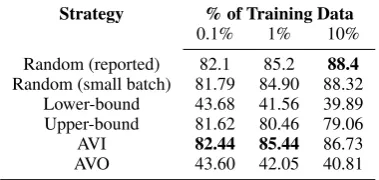
Strategy % of Training Data 0.1% 1% 10%
Random (reported) 82.1 85.2 88.4 Random (small batch) 81.79 84.90 88.32
[image:7.595.87.277.64.154.2]Lower-bound 43.68 41.56 39.89 Upper-bound 81.62 80.46 79.06 AVI 82.44 85.44 86.73 AVO 43.60 42.05 40.81
Table 1: Dev accuracy results for MT-DNN model with different training set sampling strategies.
not seem to have a significant negative effect in terms of performance. More advanced sampling strategies that maintain training set distribution or sample data using a Bayesian approach are left for future work.
As an additional experiment, we used the learned difficulty parameters to compare data sampling strategies for a state-of-the-art NLI model, MT-DNN (Liu et al., 2019). We sampled training data for SNLI at several intervals (0.1%, 1%, 10%) and trained the MT-DNN model with the sampled data. We trained each model, as well as the random sam-ple baseline, using the publicly available MT-DNN code.3 Results are reported in Table 1. Note that we report two random baselines: (i) those reported in the original work, which were obtained by training the MT-DNN model with a batch size of 32. Due to GPU resource constraints we had to train each MT-DNN model with a batch size of 8, and therefore report our reproduced random baseline results that we obtained as well (“Random (small batch)”). For very small samples of data, the AVI strategy outper-forms random sampling and all other methods as well. As more data is sampled, the random models perform better. This indicates that a more advanced sampling strategy that starts with AVI then incorpo-rates outliers (very easy/hard examples) at certain thresholds may improve learning as well.
6 Analysis
Qualitative Evaluation of Difficulty Table 2 shows examples of premise-hypothesis sentence pairs from SNLI with the learned difficulty parame-ter from the machine RP IRT model. The easy sen-tence pairs for each class seem to be very obvious, whereas the most difficult examples are difficult due to ambiguity. For example, the hardest con-tradiction example could be classified as neutral instead of contradiction. It could be the case that
3https://github.com/namisan/mt-dnn
the man is sweeping while on vacation, though it isn’t likely. The hypothesis doesn’t directly contra-dict the premise like the easy example does (cats instead of dogs, sleeping instead of playing).
Analysis of Differences An interesting question comes up as a result of the less-than-perfect corre-lation scores (§5.1): Where are the differences? To examine these more closely we identified those ex-amples from the data sets where the rank order was most different between the human- and machine-response pattern models (Table 3). That is, we calculated the absolute difference in ranking be-tween the human model and the DNN model, and selected those where that value was highest. The average absolute difference in ranking was around 40 for the SNLI task and around 30 for SSTB, for both the LSTM and NSE ensembles.
We can see interesting patterns in the discrepan-cies. For SNLI, the easiest sentence pair for the LSTM model (which is also very easy for the NSE model) is one of the hardest for humans (Table 3, row 1). Upon inspection of the gathered labels, the high difficulty comes from the fact that there were many Turkers who labeled the data as neutral and also many who labeled it as contradiction.
On the other hand, an example that is easy for humans but difficult for the DNN models (Table 2, row 2) requires more abstract thinking than the earlier example. The humans are able to infer that because the girl is unwrapping an item, she will discover what is under the wrapping paper when the unwrapping is complete. The models find this pair to be one of the most difficult in the data set.
For SSTB, we see similar patterns (Table 3, rows 3-4). For humans, one of the easiest review snip-pets is clearly positive (row 3), mainly because we know who Anthony Hopkins is and know how to rate his quality as an actor. However for the DNN models, the text itself does not have a lot of pos-itive or negative signal and therefore the item is considered very difficult. On the other hand, the last example is very difficult for humans (row 4), possibly due to the relatively neutral text. However, for the DNN models certain terms such as “stultify-ingly contrived” may signal a more negative review and lead to the item being easier.
Premise Hypothesis Label Difficulty
Two men and a woman are inspecting the front tire of a bicycle.
There are a group of people near a bike.
Entailment -3.7
A girl in a newspaper hat with a bow is unwrapping an item.
The girl is going to find out what is under the wrapping paper.
Entailment 3.1
Two dogs playing in snow. A cat sleeps on floor Contradiction -4.0 Man sweeping trash outside a large statue. A man is on vacation. Contradiction 3.8
[image:8.595.80.523.63.175.2]People sitting in chairs with a row flags hanging over them. A family reunion for Fourth of July Neutral -3.6 A group of dancers are performing. The audience is silent. Neutral 3.8
Table 2: The easiest and hardest items judged by machine responses for each class in the SNLI test data set.
Task Label Item Text Difficulty ranking
Humans LSTM NSE
SNLI Contradiction P:Two dogs playing in snow.
H:A cat sleeps on floor
168 1 5
Entailment P:A girl in a newspaper hat with a bow is unwrapping an item.
H:The girl is going to find out what is under the wrapping paper.
55 172 176
SSTB Positive Only two words will tell you what you know when deciding to see it: Anthony. Hopkins.
9 103 110
Negative ...are of course stultifyingly contrived and too stylized by half. Still, it gets the job done–a sleepy afternoon rental.
128 46 41
Table 3: Examples from the SNLI and SSTB data sets where the ranking in terms of difficulty varies widely between human and DNN models. In all cases difficulty is ranked from easy to hard (1=easiest).
provides the labels. Human intuitions or model architecture decisions impact the response patterns collected, which in turn affect the learned param-eters. An investigation into what upstream infor-mation drives downstream effects such as learned difficulty is an interesting and important direction for future work.
7 Related Work
Prior work has considered IRT in the context of evaluating ML models using human (Lalor et al., 2016) and machine-generated (Martınez-Plumed et al., 2016) response patterns. Martınez-Plumed et al. (2016) attempted to fit IRT models using ma-chine generated response patterns on small data sets (i.e. 200-300 items), but obtain results that are difficult to interpret using the existing IRT assump-tions. Lalor et al. (2016) develop new IRT test sets for NLI using human-generated data, and present new ways to interpret and understand model per-formance beyond raw accuracy. Due to the need for human annotations the resulting tests are short (i.e. 124 examples). To the best of our knowledge no one has attempted to fit IRT models using DNN-generated response patterns on large data sets.
There have been a number of studies on model-ing latent traits of data to identify a correct label,
(e.g. Bruce and Wiebe, 1999). There has also been work in modeling individuals to identify poor an-notators (Hovy et al., 2013), but neither jointly model the ability of individuals and data points, nor apply the resulting metrics to interpret DNN models. Other work has modeled the probability a label is correct along with the probability of an annotator to label an item correctly according to the (Dawid and Skene, 1979) model, but do not consider difficulty or discriminatory ability of the data points (Passonneau and Carpenter, 2014). In the above models an annotator’s response depends on an item only through its correct label. IRT as-sumes a more sophisticated response mechanism involving both annotator qualities and item charac-teristics. The DARE model (Bachrach et al., 2012) jointly estimates ability, difficulty and response us-ing probabilistic inference. It was evaluated on an intelligence test of 60 multiple choice questions administered to 120 individuals.
[image:8.595.70.529.209.337.2]internal uncertainty of the model is used as the basis for selecting how training examples are weighted. However, model uncertainty depends upon the orig-inal training data the model was trained on, while here we use an external measure of uncertainty.
Curriculum learning (CL) is a training procedure where models are trained to learn simple concepts before more complex concepts are introduced (Ben-gio et al., 2009). CL training for neural networks can improve generalization and speed up conver-gence. In curriculum learning the difficulty of items is typically assigned based on heuristics of the data (e.g. the number of sides of a shape). IRT models directly estimate difficulty from the responses of human or machine test-takers themselves instead of relying on heuristics. Self-paced learning and the Leitner method use model performance to estimate difficulties, but are restricted to a single model’s performance, not a more global notion of difficulty (Kumar et al., 2010; Amiri et al., 2018).
8 Conclusion
In this work we have described how large-scale IRT models can be trained with DNN response pat-terns using VI. Learning the difficulty parameters of items and the ability parameters of DNN models allows for more nuanced interpretation of model performance and enables us to filter training data so that DNN models can be trained on less data while maintaining generalization as measured by test set performance. IRT models with machine RPs can be fit not only for NLP data sets but also data sets in other machine learning domains such as computer vision (additional results on two computer vision data sets are included in Appendix A).
One limitation of this work is the up-front cost of generating RPs from the DNN ensemble. However, the cost of running a large number of DNN models to generate response pattern data is significantly less than the cost of obtaining those labels from human annotators in two ways. First, the monetary cost of asking thousands of humans to label tens or hundreds of thousands of images or sentence pairs is prohibitive. Second, since the response patterns require that a single individual provide labels for all (or most) of the data set, each individual would need to label a huge number of items. Each indi-vidual would most likely get bored or burned out and the quality of the labels would suffer.
That said, consider for example a large company (or research lab) that runs hundreds or thousands
of experiments each day on some internal data set. Many of the experiments would not lead to signifi-cant improvements in model performance, and the outputs from those experiments would be discarded. With the methods proposed here those outputs can be used to learn the latent parameters of the data to focus in on what exactly is working well and what isn’t with respect to the models being tested and the data used to train them. Using the previously discarded data to learn IRT models and estimate la-tent difficulty and ability parameters can be used to improve a variety of tasks such as model selection, data selection, and curriculum learning strategies.
IRT models assume difficulty is a latent parame-ter of the items and can be estimated from response pattern data. Difficulty is directly linked to subject ability, in contrast to heuristics such as sentence length or word rarity. Certain items may be easy or difficult for a variety of reasons. With the methods presented here, an interesting direction for future work is to further examine why certain examples are more difficult than others.
We have shown that it is possible to fit IRT mod-els using RPs from DNN modmod-els. Prior work relied on human RPs to investigate the impact of difficulty on model performance (Lalor et al., 2018), but it is now possible to conduct similar IRT analyses with machine RPs. This work also opens the pos-sibility of fitting IRT models on much larger data sets. By removing the human bottleneck, we can use ensembles of DNN models to generate RPs for large data sets (e.g. all of SNLI or SSTB instead of a sample). Having difficulty and ability estimates for machine learning data sets and models can lead to very interesting work around such areas as active learning, curriculum learning, and meta learning.
Acknowledgements
References
Hadi Amiri, Timothy Miller, and Guergana Savova. 2018. Spotting spurious data with neural networks. InProceedings of the 2018 Conference of the North American Chapter of the Association for Computa-tional Linguistics: Human Language Technologies, Volume 1 (Long Papers), volume 1, pages 2006– 2016.
Yoram Bachrach, Thore Graepel, Tom Minka, and John Guiver. 2012. How to grade a test without knowing the answers - A bayesian graphical model for adap-tive crowdsourcing and aptitude testing. In Proceed-ings of the 29th International Conference on Ma-chine Learning, ICML 2012, Edinburgh, Scotland, UK, June 26 - July 1, 2012. icml.cc / Omnipress.
Frank B Baker. 2001. The basics of item response the-ory. ERIC.
Frank B. Baker and Seock-Ho Kim. 2004. Item Re-sponse Theory: Parameter Estimation Techniques, Second Edition. CRC Press.
Yoshua Bengio, J´erˆome Louradour, Ronan Collobert, and Jason Weston. 2009. Curriculum learning. In Proceedings of the 26th International Conference on Machine Learning, pages 41–48. ACM.
E. Bingham, J. P. Chen, M. Jankowiak, F. Obermeyer, N. Pradhan, T. Karaletsos, R. Singh, P. Szerlip, P. Horsfall, and N. D. Goodman. 2018. Pyro: Deep Universal Probabilistic Programming. ArXiv e-prints.
R Darrell Bock and Murray Aitkin. 1981. Marginal maximum likelihood estimation of item parameters: Application of an em algorithm. Psychometrika, 46(4):443–459.
Samuel R. Bowman, Gabor Angeli, Christopher Potts, and D. Christopher Manning. 2015. A large an-notated corpus for learning natural language infer-ence. In Proceedings of the 2015 Conference on Empirical Methods in Natural Language Processing, pages 632–642. Association for Computational Lin-guistics.
Rebecca F. Bruce and Janyce M. Wiebe. 1999. Recog-nizing subjectivity: A case study in manual tagging. Nat. Lang. Eng., 5(2):187–205.
Phil Chalmers, Joshua Pritikin, Alexander Robitzsch, and Mateusz Zoltak. 2015. mirt: Multidimensional Item Response Theory.
Haw-Shiuan Chang, Erik Learned-Miller, and Andrew McCallum. 2017. Active bias: Training a more ac-curate neural network by emphasizing high variance samples. In Advances in Neural Information Pro-cessing Systems.
A. Philip Dawid and Allan M. Skene. 1979. Maximum likelihood estimation of observer error-rates using the em algorithm. Journal of the Royal Statistical Society. Series C (Applied Statistics), 28(1):20–28.
Jacob Devlin, Ming-Wei Chang, Kenton Lee, and Kristina Toutanova. 2018. Bert: Pre-training of deep bidirectional transformers for language understand-ing.arXiv preprint arXiv:1810.04805.
S Hochreiter and J Schmidhuber. 1997. Long Short-Term Memory. Neural Computation, 9(8):1735– 1780.
Matthew D Hoffman, David M Blei, Chong Wang, and John Paisley. 2013. Stochastic variational infer-ence. The Journal of Machine Learning Research, 14(1):1303–1347.
Dirk Hovy, Taylor Berg-Kirkpatrick, Ashish Vaswani, and Eduard Hovy. 2013. Learning whom to trust with mace. In Proceedings of the 2013 Confer-ence of the North American Chapter of the Associ-ation for ComputAssoci-ational Linguistics: Human Lan-guage Technologies, pages 1120–1130. Association for Computational Linguistics.
Michael I Jordan, Zoubin Ghahramani, Tommi S Jaakkola, and Lawrence K Saul. 1999. An intro-duction to variational methods for graphical models. Machine learning, 37(2):183–233.
Divyansh Kaushik and Zachary C Lipton. 2018. How much reading does reading comprehension require? a critical investigation of popular benchmarks. In Proceedings of the Conference on Empirical Meth-ods in Natural Language Processing. Conference on Empirical Methods in Natural Language Processing, volume 2018.
Diederik P Kingma and Max Welling. 2014. Auto-encoding variational bayes. InInternational Confer-ence on Learning Representations.
M Pawan Kumar, Benjamin Packer, and Daphne Koller. 2010. Self-paced learning for latent variable models. In Advances in Neural Information Processing Sys-tems, pages 1189–1197.
Brenden M Lake, Ruslan Salakhutdinov, and Joshua B Tenenbaum. 2015. Human-level concept learning through probabilistic program induction. Science, 350(6266):1332–1338.
John P Lalor, Hao Wu, Tsendsuren Munkhdalai, and Hong Yu. 2018. Understanding deep learning perfor-mance through an examination of test set difficulty: A psychometric case study. In Proceedings of the Conference on Empirical Methods in Natural Lan-guage Processing. Conference on Empirical Meth-ods in Natural Language Processing, volume 2018.
Xiaodong Liu, Pengcheng He, Weizhu Chen, and Jian-feng Gao. 2019. Multi-task deep neural networks for natural language understanding. arXiv preprint arXiv:1901.11504.
Fernando Martınez-Plumed, Ricardo BC Prudˆencio, Adolfo Martınez-Us´o, and Jos´e Hern´andez-Orallo. 2016. Making sense of item response theory in ma-chine learning. In Proceedings of 22nd European Conference on Artificial Intelligence (ECAI), Fron-tiers in Artificial Intelligence and Applications, vol-ume 285, pages 1140–1148.
Tsendsuren Munkhdalai and Hong Yu. 2017. Neural semantic encoders.EACL 2017.
Prathiba Natesan, Ratna Nandakumar, Tom Minka, and Jonathan D Rubright. 2016. Bayesian prior choice in irt estimation using mcmc and variational bayes. Frontiers in psychology, 7:1422.
Graham Neubig, Chris Dyer, Yoav Goldberg, Austin Matthews, Waleed Ammar, Antonios Anastasopou-los, Miguel Ballesteros, David Chiang, Daniel Cloth-iaux, Trevor Cohn, Kevin Duh, Manaal Faruqui, Cynthia Gan, Dan Garrette, Yangfeng Ji, Lingpeng Kong, Adhiguna Kuncoro, Gaurav Kumar, Chai-tanya Malaviya, Paul Michel, Yusuke Oda, Matthew Richardson, Naomi Saphra, Swabha Swayamdipta, and Pengcheng Yin. 2017. Dynet: The dy-namic neural network toolkit. arXiv preprint arXiv:1701.03980.
Rebecca J. Passonneau and Bob Carpenter. 2014. The benefits of a model of annotation. Transactions of the Association of Computational Linguistics, 2:311–326.
Adam Paszke, Sam Gross, Soumith Chintala, Gregory Chanan, Edward Yang, Zachary DeVito, Zeming Lin, Alban Desmaison, Luca Antiga, and Adam Lerer. 2017. Automatic differentiation in pytorch.
Rajesh Ranganath, Sean Gerrish, and David Blei. 2014. Black box variational inference. InArtificial Intelli-gence and Statistics, pages 814–822.
Georg Rasch. 1960. Studies in mathematical psychol-ogy: I. probabilistic models for some intelligence and attainment tests.
Keisuke Sakaguchi and Benjamin Van Durme. 2018. Efficient online scalar annotation with bounded sup-port. InProceedings of the 56st Annual Meeting of the Association for Computational Linguistics.
Richard Socher, Alex Perelygin, Jean Wu, Jason Chuang, D. Christopher Manning, Andrew Ng, and Christopher Potts. 2013. Recursive deep models for semantic compositionality over a sentiment tree-bank. In Proceedings of the 2013 Conference on Empirical Methods in Natural Language Processing, pages 1631–1642. Association for Computational Linguistics.
Ian Tenney, Dipanjan Das, and Ellie Pavlick. 2019a. Bert rediscovers the classical nlp pipeline. In Pro-ceedings of the 57th Annual Meeting of the Associa-tion for ComputaAssocia-tional Linguistics.