Neural Machine Translation with Source Dependency Representation
Kehai Chen1∗, Rui Wang2†, Masao Utiyama2, Lemao Liu3,Akihiro Tamura4,Eiichiro Sumita2 andTiejun Zhao1
1Machine Intelligence & Translation Laboratory, Harbin Institute of Technology 2ASTREC, National Institute of Information and Communications Technology (NICT)
3Tencent AI Lab
4Graduate School of Science and Engineering, Ehime University
{khchen and tjzhao}@hit.edu.cn
{wangrui, mutiyama and eiichiro.sumita}@nict.go.jp [email protected] and [email protected]
Abstract
Source dependency information has been successfully introduced into statistical machine translation. However, there are only a few preliminary attempts for Neural Machine Translation (NMT), such as concatenating representations of source word and its dependency label together. In this paper, we propose a novel attentional NMT with source dependency represen-tation to improve translation performance of NMT, especially on long sentences. Empirical results on NIST Chinese-to-English translation task show that our method achieves 1.6 BLEU improvements on average over a strong NMT system.
1 Introduction
Neural Machine Translation (NMT) ( Kalch-brenner and Blunsom, 2013; Bahdanau et al.,
2014; Sutskever et al., 2014) relies heavily on source representations, which encode implicitly semantic information of source words by neural networks (Mikolov et al., 2013a,b). Recently, several research works have been proposed to learn richer source representation, such as multi-source information (Zoph and Knight,2016;Firat et al., 2016), and particularly source syntactic information (Eriguchi et al.,2016;Li et al.,2017;
Huadong et al.,2017;Eriguchi et al., 2017), thus improving the performance of NMT.
In this paper, we enhance source representations by dependency information, which can capture source long-distance dependency constraints for word prediction. Actually, source dependency information has been shown greatly effective in
∗Kehai Chen was an internship research fellow at NICT
when conducting this work.
†Corresponding author.
Statistical Machine Translation (SMT) (Garmash and Monz,2014;Kazemi et al.,2015;Hadiwinoto et al., 2016; Chen et al., 2017; Hadiwinoto and Ng, 2017). In NMT, there has been a quite recent preliminary exploration (Sennrich and Haddow,2016), in which vector representations of source word and its dependency label are simply concatenated as source input, achieving state-of-the-art performance in NMT (Bojar et al.,2016).
In this paper, we propose a novel NMT with source dependency representation to improve translation performance. Compared with the simple approach of vector concatenation, we learn the Source Dependency Representation (SDR) to compute dependency context vectors and alignment matrices in a more sophisticated manner, which has the potential to make full use of source dependency information. To this end, we create a dependency unit for each source word to capture long-distance dependency constraints. Then we design an Encoder with convolutional architecture to jointly learn SDRs (Section3) and source dependency annotations, thus computing dependency context vectors and hidden states by a novel double-context based Decoder for word prediction (Section4). Empirical results on NIST Chinese-to-English translation task show that the proposed approach achieves significant gains over the method bySennrich and Haddow(2016), and thus delivers substantial improvements over the standard attentional NMT (Section5).
2 Background
An NMT model consists of an Encoder process and a Decoder process, and hence it is often called Encoder-Decoder model (Sutskever et al.,
2014; Bahdanau et al., 2014). Typically, each unit of source input xj ∈ (x1, . . . , xJ) is firstly embedded as a vectorVxj, and then represented as
x3
x1
x4
x7 ε
/ / / / /
Convolution layer1
Max-pooling layer 1
Output layer VU2
Input layer
Convolution layer 2
[image:2.595.120.479.64.192.2]Max-pooling layer 2
Figure 1: The CNN architecture for learning SRD.
an annotation vectorhj by
hj =fenc(Vxj, hj−1), (1)
where fenc is a bidirectional Recurrent Neural Network (RNN) (Bahdanau et al., 2014). These annotation vectors H = (h1, . . . , hJ) are used to generate the target word in theDecoder.
An RNNDecoderis used to compute the target wordyiprobability by a softmax layerg:
p(yi|y<i, x) =g(ˆyi−1, si, ci), (2)
whereyˆi−1is the previously emitted word, andsi is an RNN hidden state for the current time step:
si=ϕ(ˆyi−1, si−1, ci), (3)
and the context vector ci is computed as a weighted sum of these source annotationshj:
ci= J
X
j=1
αijhj, (4)
where the normalized alignment weight αij is computed by
αij = PJexp(eij) k=1exp(eik)
, (5)
where eij is an alignment which indicates how well the inputs around position j and the output at the positionimatch:
eij =f(si−1, hj). (6)
wheref is a feedforward neural network.
3 Source Dependency Representation
In order to capture source long-distance depen-dency constraints, we extract a dependepen-dency unit Uj for each source word xj from dependency tree, inspired by a dependency-based bilingual composition sequence for SMT (Chen et al.,
2017). The extracted Uj is defined as the following:
Uj =hP Axj, SIxj, CHxji, (7)
where P Axj, SIxj, CHxj denote the parent,
siblings and children words of source word xj in a dependency tree. Take x2 in Figure 2 as an example, the blue solid box U2 denotes its dependency unit: P Ax2 = hx3i, SIx2 =
hx1, x4, x7iandCHx2=hεi(no child), that is,U2 =hx3, x1, x4, x7, εi.
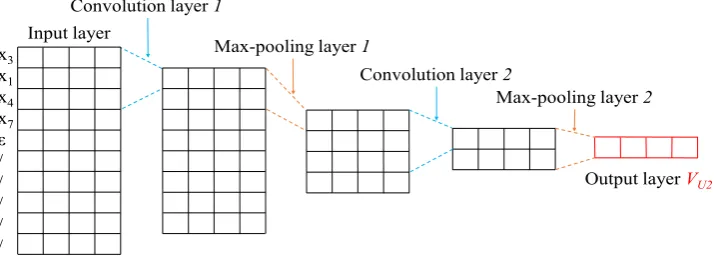
We design a simplified neural network follow-ing Chen et al. (2017)’s Convolutional Neural Network (CNN) method, to learn the SDR for each source dependency unit Uj, as shown in Figure1. Our neural network consists of an input layer, two convolutional layers, two pooling layers and an output layer:
• Input layer: the input layer takes words of a dependency unitUjin the form of embedding vectors n×d, where n is the number of words in a dependency unit andd is vector dimension of each word. In our experiments, we setnto10,1anddis620. For dependency
units shorter than10, we perform “/” padding at the ending ofUj. For example, the padded U2ishx3, x1, x4, x7, ε, /, /, /, /, /i.
1We find that 99% of all the source dependency units
contain no more than10words. So if the length is more than 10, the extra words are abandoned; if the length is less than
• Convolutional layer: the first convolution consists of one3×dconvolution kernels (the stride is 1) to output an (n-2)×d matrix; the second convolution consists of one3×d convolution kernels to output a n−2
2 ×d matrix.
• Max-Pooling layer: the first pooling layer performs row-wise max over the two con-secutive rows to output a n−2
4 ×dmatrix; the second pooling layer performs row-wise max over the two consecutive rows to output a
n−2
8 ×dmatrix.
• Output layer: the output layer performs row-wise average based on the output of the second pooling layer to learn a compact d-dimension vector VUj for Uj. In our
experiment, the output of the output layer is 1×d-dimension vector.
It should be noted that the dependency unit is similar to the source dependency feature of
Sennrich and Haddow (2016) and the SDR is the same to the source-side representation of Chen et al. (2017). In comparison with
Sennrich and Haddow (2016), who concatenate the source dependency labels and word together to enhance the Encoder of NMT, we adapt a separate attention mechanism together with a CNN dependencyEncoder. Compared withChen et al. (2017), which expands the famous neural network joint model (Devlin et al., 2014) with source dependency information to improve the phrase pair translation probability estimation for SMT, we focus on source dependency information to enhance attention probability estimation and to learn corresponding dependency context and RNN hidden state for improving translation.
4 NMT with SDR
In this section, we propose two novel NMT mod-elsSDRNMT-1 andSDRNMT-2, both of which can make use of source dependency information SDR to enhanceEncoderandDecoderof NMT. 4.1 SDRNMT-1
Compared with standard attentional NMT, the
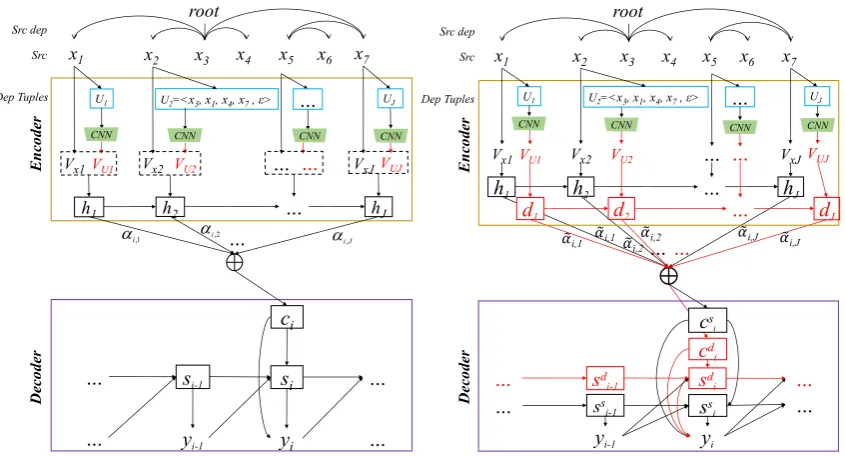
Encoder of SDRNMT-1 model consists of a convolutional architecture and an bidirectional RNN, as shown in Figure 2. Therefore, the proposedEncodercan not only learn composition-al representations for dependency units but composition-also
greatly tackle the sparsity issues associated with large dependency units.
Motivated by (Sennrich and Haddow, 2016), we concatenate the Vxj and VUj as input of the
Encoder, as shown in the black dotted box in Figure 2. Source annotation vectors are learned based on the concatenated representation with dependency information:
hj =fenc(Vxj :VUj, hj−1), (8)
where “:” denotes the operation of vectors concatenation. Finally, these learned annotation vectors are as the input of the standard NMT
Decoderto jointly learn alignment and translation. The only difference between our method and ( Sen-nrich and Haddow, 2016)’s method is that they only use dependency label representation instead ofVUj.
4.2 SDRNMT-2
In SDRNMT-1, a single annotation, learned over concatenating word representation and SDR, is used to compute the context vector and the RNN hidden state for the current time step. To relieve more translation performance for NMT from the SDR, we propose adouble-contextmechanism, as shown in Figure3.
First, the Encoder of SDRNMT-2 consists of two independent annotationshj anddj:
hj =fenc(Vxj, hj−1),
dj =fenc(VUj, dj−1),
(9)
where H = [h1,· · · , hJ] and D = [d1,· · ·, dJ] encode source sequential and long-distance depen-dency information, respectively.
The Decoder learns the corresponding align-ment matrices and context vectors over the H andD, respectively. That is, according to eq.(6), given the previous hidden statess
i−1 andsdi−1, the current alignmentses
i,jandedi,jare computed over source annotation vectorshj anddj, respectively:
es
i,j =f(ssi−1+hj),
edi,j =f(sid−1+dj). (10)
According to eq.(5), we further compute the current alignmentα˜:
˜
αi,j = exp(λe s
i,j+ (1−λ)edi,j)
PJ
j=1exp(λesi,j+ (1−λ)edi,j)
Src dep
Src
U2=<x3, x1, x4, x7, ε>
Dep Tuples U1
E
n
code
r
Vx1VU1
h1
Vx2 VU2 h2
VxJVUJ hJ … … … yi De code r … si … ci yi-1 si-1 … … UJ CNN
CNN CNN CNN
x1 x2 x3 x4 x5 x6 x7
root
…
,1
i i,2 … i J,
Figure 2: SDRNMT-1for thei-th time step.
De code r sd i-1 yi-1 ss i-1 sd i cs i yi cd i ss i
x1 x2 x3 x4 x5 x6 x7 Src dep
Src
root
U2=<x3, x1, x4, x7, ε>
Dep Tuples U1
E
n
code
r
Vx1VU1
h1
Vx2 VU2
h2
VxJVUJ
hJ … … … UJ CNN
CNN CNN CNN
d1 d2 … dJ
… … … … … … …
𝛼i,1 𝛼i,1 𝛼i,2
[image:4.595.90.513.60.288.2]𝛼i,2 𝛼i,J 𝛼i,J
Figure 3: SDRNMT-2for thei-th time step.
where λ is a hyperparameter2 to control the
importance ofHandD. Note that compared with the original alignment model only depending on the sequential annotation vectorsH, the alignment weight α˜i,j jointly compute statistic over source sequential annotation vectors H and dependency annotation vectorsD.
The current context vector cs
i and cdi are compute by eq.(4), respectively:
csi =XJ j=1 ˜
αi,jhj,andcdi = J
X
j=1 ˜
αi,jdj. (12)
The current hidden statess
i andsdi are computed by eq.(3), respectively:
ss
i =ϕ(ssi−1, yi−1, csi), sd
i =ϕ(sdi−1, yi−1, cdi).
(13)
Finally, according to eq.(2), the probabilities for the next target word are computed using two hidden states ss
i and sdi, the previously emitted word yˆi−1, the current sequential context vector cs
i and dependency context vectorcdi:
p(yi|y<i, x, T) =g(ˆyi−1, ssi, sdi, csi, cdi). (14)
5 Experiment
5.1 Setting up
We carry out experiments on Chinese-to-English translation. The training dataset consists of 1.42M 2λcan be tuned according to a subset FBIS of training
data and be set as0.6in the experiments.
sentence pairs extract from LDC corpora.3 We
use the Stanford dependency parser (Chang et al.,
2009) to generate the dependency tree for Chinese. We choose the NIST 2002 (MT02) and the NIST 2003-2008 (MT03-08) datasets as the validation set and test sets, respectively. Case-insensitive4 -gram NIST BLEU score (Papineni et al.,2002) is used as an evaluation metric, andsigntest(Collins et al.,2005) is as statistical significance test.
The baseline systems include the standard Phrase-Based Statistical Machine Translation (PBSMT) implemented in Moses (Koehn et al., 2007) and the standard Attentional NMT (AttNMT) (Bahdanau et al., 2014), where only source word representation is utilized. We also compare with a state-of-the-art syntax enhanced NMT method (Sennrich and Haddow,2016). For a fair comparison, we only utilize dependency information for (Sennrich and Haddow, 2016), called Sennrich-deponly. We try our best to re-implement the baseline methods on Nematus toolkit4(Sennrich et al.,2017).
For all NMT systems, we limit the source and target vocabularies to 30K, and the maximum sentence length is 80. The word embedding dimension is620,5and the hidden layer dimension
3LDC2002E18, LDC2003E07, LDC2003E14, Hansards
portion of LDC2004T07, LDC2004T08, and LDC2005T06.
4https://github.com/EdinburghNLP/nematus 5For SDRNMT-1, the360dimensions are fromV
xj and
System Dev (MT02) MT03 MT04 MT05 MT06 MT08 AVG
PBSMT 33.15 31.02 33.78 30.33 29.62 23.53 29.66
AttNMT 36.31 34.02 37.11 32.86 32.54 25.44 32.40
Sennrich-deponly 36.68 34.51 38.09 33.37 32.96 26.96 32.98
SDRNMT-1 36.88 34.98* 38.14 34.61 33.58 27.06 33.32
[image:5.595.84.510.64.147.2]SDRNMT-2 37.34 35.91** 38.73* 34.18** 33.76** 27.64* 34.04
Table 1: Results on NIST Chinese-to-English Translation Task. “*” indicates statistically significant better than “Sennrich-deponly” atp-value <0.05 and “**” atp-value <0.01. AVG = average BLEU scores for test sets.
is1000, and all the layers use the dropout training technique (Hinton et al., 2012). We shuffle training set before training and the mini-batch size is80. Training is conducted on a single Tesla P100 GPU. All NMT models train for15 epochs using ADADELTA (Zeiler,2012), and the train time is6
days, which is25% slower than the standard NMT. 5.2 Results and Analyses
Table 1 shows the translation performances on test sets measured in BLEU score. The AttNMT significantly outperforms PBSMT by2.74BLEU points on average, indicating that it is a strong baseline NMT system. The baseline Sennrich-deponly improves the performance over the AttNMT by 0.58BLEU points on average. This indicates that the proposed source dependency constraint is beneficial for improving the perfor-mance of NMT.
Moreover, SDRNMT-1gains improvements of
0.92 and0.34 BLEU points on average than the AttNMT and Sennrich-deponly. These show that the proposed SDR can more effectively capture source dependency information than vector con-catenation. Especially, the proposed
SDRNMT-2outperforms the AttNMT and Sennrich-deponly on average by1.64and1.03BLEU points. These verify that the proposed double-context method is effective for word prediction.
5.3 Effect of Translating Long Sentences We follow (Bahdanau et al., 2014) to group sentences of similar lengths all the test sets (MT03-08), for example, “40” indicates that the length of sentences is between 30 and 40,
and compute a BLEU score per group. As
demonstrated in Figure 4, the proposed models outperform other baseline systems, especially in translating long sentences. These results show that the proposed models can effective encode long-distance dependencies to improve translation.
25 30 35
10 20 30 40 50 60 70 80 80+
BL
E
U
SENT LENGTHS
PBSMT AttNMT Sennrich-deponly SDSNMT-1 SDSNMT-2
Figure 4: Translation qualities for different sentence lengths.
6 Conclusion and Future Work
In this paper, we explored the source dependency information to improve the performance of NMT. We proposed a novel attentional NMT with source dependency representation to capture source long-distance dependencies. In the future, we will try to exploit a general framework for utilizing richer syntax knowledge.
Acknowledgments
[image:5.595.309.525.214.364.2]References
Dzmitry Bahdanau, Kyunghyun Cho, and Yoshua
Bengio. 2014. Neural machine translation by
jointly learning to align and translate. CoRR, abs/1409.0473.
Ondˇrej Bojar, Rajen Chatterjee, Christian Feder-mann, Yvette Graham, Barry Haddow, Matthias Huck, Antonio Jimeno Yepes, Philipp Koehn, Varvara Logacheva, Christof Monz, Matteo Negri, Aurelie Neveol, Mariana Neves, Martin Popel, Matt Post, Raphael Rubino, Carolina Scarton, Lucia Specia, Marco Turchi, Karin Verspoor, and
Marcos Zampieri. 2016. Findings of the 2016
conference on machine translation. InProceedings of the First Conference on Machine Translation, pages 131–198, Berlin, Germany. Association for Computational Linguistics.
Pi-Chuan Chang, Huihsin Tseng, Dan Jurafsky, and
Christopher D. Manning. 2009. Discriminative
reordering with Chinese grammatical relations features. InProceedings of the Third Workshop on Syntax and Structure in Statistical Translation at NAACL HLT 2009, pages 51–59, Boulder, Colorado. Association for Computational Linguistics.
Kehai Chen, Tiejun Zhao, Muyun Yang, and Lemao
Liu. 2017. Translation prediction with source
dependency-based context representation. In
Proceedings of the Thirty-First AAAI Conference on Artificial Intelligence, pages 3166–3172, California, USA. AAAI Press.
Michael Collins, Philipp Koehn, and Ivona Kucerova.
2005. Clause restructuring for statistical machine
translation. In Proceedings of the 43rd Annual Meeting of the Association for Computational Linguistics, pages 531–540, Ann Arbor, Michigan. Association for Computational Linguistics.
Jacob Devlin, Rabih Zbib, Zhongqiang Huang, Thomas Lamar, Richard Schwartz, and John Makhoul. 2014.
Fast and robust neural network joint models for statistical machine translation. In Proceedings of the 52nd Annual Meeting of the Association for Computational Linguistics (Volume 1: Long Papers), pages 1370–1380, Baltimore, Maryland. Association for Computational Linguistics.
Akiko Eriguchi, Kazuma Hashimoto, and Yoshimasa
Tsuruoka. 2016. Tree-to-sequence attentional
neural machine translation. In Proceedings of the 54th Annual Meeting of the Association for Computational Linguistics, pages 823–833, Berlin, Germany. Association for Computational Linguis-tics.
Akiko Eriguchi, Yoshimasa Tsuruoka, and Kyunghyun Cho. 2017. Learning to parse and translate improves neural machine translation. In Proceedings of the 55th Annual Meeting of the Association for Computational Linguistics, Vancouver, Canada. Association for Computational Linguistics.
Orhan Firat, Kyunghyun Cho, and Yoshua Bengio.
2016. Multi-way, multilingual neural machine
translation with a shared attention mechanism. In
Proceedings of the 2016 Conference of the North American Chapter of the Association for Computa-tional Linguistics: Human Language Technologies, pages 866–875, San Diego, California. Association for Computational Linguistics.
Ekaterina Garmash and Christof Monz. 2014.
Dependency-based bilingual language models for reordering in statistical machine translation. In
Proceedings of the 2014 Conference on Empirical
Methods in Natural Language Processing,
pages 1689–1700, Doha, Qatar. Association for Computational Linguistics.
Christian Hadiwinoto, Yang Liu, and Hwee Tou Ng.
2016. To swap or not to swap? exploiting
dependency word pairs for reordering in statistical machine translation. InProceedings of the Thirtieth AAAI Conference on Artificial Intelligence, pages 2943–2949, Arizona, USA. AAAI Press.
Christian Hadiwinoto and Hwee Tou Ng. 2017.
A dependency-based neural reordering model for statistical machine translation. In Proceedings of the Thirty-First AAAI Conference on Artificial Intelligence, California, USA. AAAI Press.
Geoffrey E. Hinton, Nitish Srivastava, Alex
Krizhevsky, Ilya Sutskever, and Ruslan
Salakhutdinov. 2012. Improving neural networks
by preventing co-adaptation of feature detectors.
CoRR.
Chen Huadong, Huang Shujian, Chiang David, and
Chen Jiajun. 2017. Improved neural machine
translation with a syntax-aware encoder and de-coder. In Proceedings of the 55th Annual Meeting of the Association for Computational Linguistics, Vancouver, Canada. Association for Computational Linguistics.
Nal Kalchbrenner and Phil Blunsom. 2013. Recurrent
continuous translation models. In Proceedings of the 2013 Conference on Empirical Methods in Natural Language Processing, pages 1700– 1709, Seattle, Washington, USA. Association for Computational Linguistics.
Arefeh Kazemi, Antonio Toral, Andy Way, Amirhas-san Monadjemi, and Mohammadali Nematbakhsh.
2015. Dependency-based reordering model for
constituent pairs in hierarchical smt. InProceedings of the 18th Annual Conference of the European Association for Machine Translation, pages 43– 50, Antalya, Turkey. Association for Computational Linguistics.
Philipp Koehn, Hieu Hoang, Alexandra Birch, Chris Callison-Burch, Marcello Federico, Nicola Bertoldi, Brooke Cowan, Wade Shen, Christine Moran, Richard Zens, Chris Dyer, Ondrej Bojar, Alexandra
source toolkit for statistical machine translation. In Proceedings of the 45th Annual Meeting of the Association for Computational Linguistics Compan-ion Volume Proceedings of the Demo and Poster Sessions, pages 177–180, Prague, Czech Republic. Association for Computational Linguistics.
Junhui Li, Xiong Deyi, Tu Zhaopeng, Zhu Muhua,
and Zhou Guodong. 2017. Modeling source syntax
for neural machine translation. In Proceedings of the 55th Annual Meeting of the Association for Computational Linguistics, Vancouver, Canada. Association for Computational Linguistics.
Tomas Mikolov, Kai Chen, Greg Corrado, and
Jeffrey Dean. 2013a. Efficient estimation of word
representations in vector space. arXiv preprint arXiv:1301.3781.
Tomas Mikolov, Ilya Sutskever, Kai Chen, Greg
Corrado, and Jeffrey Dean. 2013b. Distributed
representations of words and phrases and their compositionality. In Proceedings of the 26th International Conference on Neural Information Processing Systems, pages 3111–3119, USA. Cur-ran Associates Inc.
Kishore Papineni, Salim Roukos, Todd Ward, and
Wei-Jing Zhu. 2002. Bleu: a method for automatic
evaluation of machine translation. InProceedings of 40th Annual Meeting of the Association for Com-putational Linguistics, pages 311–318, Philadelphia, Pennsylvania, USA. Association for Computational Linguistics.
Rico Sennrich, Orhan Firat, Kyunghyun Cho, Alexan-dra Birch, Barry Haddow, Julian Hitschler, Marcin Junczys-Dowmunt, Samuel L¨aubli, Antonio Valerio Miceli Barone, Jozef Mokry, and Maria Nadejde. 2017. Nematus: a toolkit for neural machine transla-tion. InProceedings of the Software Demonstrations of the 15th Conference of the European Chapter of the Association for Computational Linguistics, pages 65–68, Valencia, Spain. Association for Computational Linguistics.
Rico Sennrich and Barry Haddow. 2016. Linguistic
input features improve neural machine translation. InProceedings of the First Conference on Machine Translation, pages 83–91, Berlin, Germany. Associ-ation for ComputAssoci-ational Linguistics.
Ilya Sutskever, Oriol Vinyals, and Quoc V. Le.
2014. Sequence to sequence learning with
neural networks. In Proceedings of the 27th International Conference on Neural Information Processing Systems, pages 3104–3112, Cambridge, MA, USA. MIT Press.
Matthew D. Zeiler. 2012. ADADELTA: an adaptive
learning rate method.CoRR, abs/1212.5701.
Barret Zoph and Kevin Knight. 2016.
Multi-source neural translation. In Proceedings of the 2016 Conference of the North American Chapter