University of Warwick institutional repository: http://go.warwick.ac.uk/wrap
This paper is made available online in accordance with publisher policies. Please scroll down to view the document itself. Please refer to the repository record for this item and our policy information available from the repository home page for further information.
To see the final version of this paper please visit the publisher’s website. Access to the published version may require a subscription.
Author(s): Martina Zellin, Markus Conci, Adrian von Mühlenen and Hermann J. Müller
Article Title: Two (or three) is one too many: testing the flexibility of contextual cueing with multiple target locations
Year of publication: 2011 Link to published article:
http://dx.doi.org/10.3758/s13414-011-0175-x
Two (or three) is one too many:
Testing the flexibility of contextual cueing with multiple target locations
Martina Zellin1, Markus Conci1, Adrian von Mühlenen2, & Hermann J. Müller1
1
Department Psychologie, Ludwig-Maximilians-Universität München, Germany 2
Department of Psychology, University of Warwick, United Kingdom
Running head: Multiple target locations in contextual cueing
word count: 150 (abstract) + 7480 (main text)
Correspondence to: Martina Zellin
Allgemeine und Experimentelle Psychologie Department Psychologie
Ludwig-Maximilians Universität Leopoldstr. 13
D-80802 München Germany
Tel: ++49 (0)89 2180 5325 Fax: ++49 (0)89 2180 5211
Abstract
Visual search for a target object is facilitated when it is repeatedly presented within an invariant context of surrounding items (‘contextual cueing’; Chun & Jiang, 1998). The current study investigated whether such invariant contexts can cue more than one target location. In a series of three experiments, we show that contextual cueing is significantly reduced when invariant contexts are paired with two rather than one possible target location, whereas no contextual cueing occurs with three distinct target locations. Closer data inspection revealed that one ‘dominant’ target always exhibited substantially more contextual cueing than the other ‘minor’ target, which caused negative contextual-cueing effects. However, minor targets could benefit from the invariant context when they were spatially close to the dominant target. In sum, our experiments suggest that contextual cueing can guide visual attention to a
Introduction
Visual scenes typically contain multiple objects of varying complexity that need to be processed selectively in order to achieve behavioral goals. When searching for a specific target object in a given scene, visual selection can be supported by a variety of cues directing attention to relevant, and away from irrelevant, parts of a scene. Thus, for example, search may be guided bottom-up by visual cues that attract attention on the basis of perceptual salience, as well as top-down by a working memory ‘template’ specifying features of the searched-for target (Wolfe & Horowitz, 2004, for review). In addition, selection may be aided by learned contingencies within a given environment. Real-world scenes usually consist of a relatively stable collection of co-occurring objects, permitting search for one object to be facilitated via its associations with other objects (Oliva & Torralba, 2007, for review). For example, visual search for a toaster might be quicker when it is presented in a kitchen rather than a garage scene. Thus, context information can offer valuable cues to the location of a target object (Bar, 2004, for review; Biederman, Mezzanotte, & Rabinowitz, 1982; Hollingworth, 2006).
configurations, suggesting that participants had no explicit memory of the spatial relations between the target location and its invariant context. Contextual cueing was therefore
considered an implicit memory mechanism for spatial context, which facilitates visual search by guiding attention more efficiently (or directly) towards the target location. Guidance by this form of contextual memory may thus provide useful support for attentional orienting in complex environments, as demonstrated in visual search. Such a mechanism should also be flexible and adaptive, to compensate for the variability and possible changes that can occur in the environment. Flexibility could, for instance, mean that one invariant context is associated with multiple target objects. In natural environments, such as a kitchen, search might benefit from the stable kitchen layout not only when it comes to finding the toaster but also when it comes to finding other potentially relevant items such as a coffee machine.
contextual cueing was impaired and did not recover with the repeated presentation of the new target location (Manginelli & Pollmann, 2009). Recently, Makovski and Jiang (2010) further qualified this lack of adaptivity by showing that contextual cueing was transferred to a new target located in close proximity to the original target location. Thus, adaptation of contextual cueing seems to occur only within a fairly limited spatial range.
In sum, while some studies reported evidence for adaptation to multiple target locations in contextual cueing (Chun & Jiang, 1998; Kunar et al., 2005; Conci et al., 2011), others clearly failed to provide evidence of flexible compensation for environmental changes (Chun & Jiang, 1998; Conci et al., 2011; Makovski & Jiang, 2010; Manginelli & Pollmann, 2009), or they reported adaptation to occur only within a limited spatial region (see also Chua & Chun, 2003; Makovski & Jiang, 2010).
repeated target location would further reduce the overall effect, because the contextual-cueing effect would be averaged across one cued and two (or three etc.) uncued target locations.
To determine the degree of adaptivity in contextual learning, three contextual-cueing experiments with multiple target locations were conducted. Contextual-cueing effects were observed with two target locations (Experiments 1 and 2), but the effect was significantly reduced when directly compared to displays with one target location (Experiment 2).
Moreover, no contextual-cueing effect was observed for displays that were paired with three possible target locations (Experiment 3). While, overall, this pattern of results replicated previous studies (see above), additional post-hoc analyses of all three experiments confirmed that one (‘dominant’) target location consistently showed significantly more contextual cueing than the other (‘minor’) locations. Furthermore, proximity between targets enabled
contextual-cueing for two or even all three target locations. Taken together, these findings show that contextual cueing does not integrate multiple target locations evenly; but in fact, the successful predictive association between an invariant context and a target location is limited to only one target location and its immediate surround.
Experiment 1
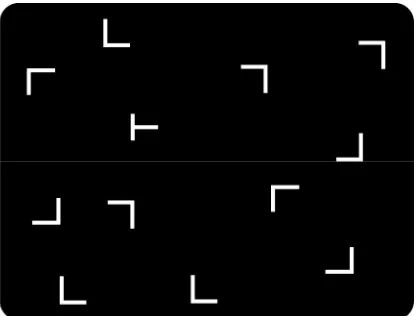
Experiment 1 was designed to replicate the results of Chun and Jiang (1998), who reported that contextual cueing occurred for invariant contexts paired with two possible target locations. Each search display was paired with two distinct target locations (see Figure 1 for an example). To ensure that both target locations could be associated equally well with the invariant (old) context, the two targets were always presented in separate, alternating blocks of trials. This variation was used to avoid primacy of one target over the other owing to the order of presentation. If contextual cueing includes two different target locations, a
Method
Participants
Sixteen participants took part in the experiment (10 women; mean age: 26 years; age range: 22–49 years). All participants had normal or corrected-to-normal visual acuity, and all but one were right-handed. They received either payment (8 €) or one course credit.
Apparatus and Stimuli
Stimulus presentation and response collection was controlled by an IBM-PC compatible computer using Matlab Routines and Psychophysics Toolbox extensions (Brainard, 1997; Pelli, 1997). Stimuli subtended 0.7° x 0.7° of visual angle and were
presented in gray (8.5 cd/m2) against a black background (0.02 cd/m2) on a 17” CRT monitor. Search displays consisted of 12 items, one of which was a T-shaped target rotated randomly by 90° either to the left or the right. The eleven remaining items were L-shaped nontargets rotated randomly in one of the four orthogonal orientations. Search displays were generated by placing the target and nontargets randomly in the cells of a 6 x 8 matrix, with an individual cell size of 2.5° x 2.5°. Nontargets were jittered horizontally and vertically in steps of 0.1°, within a range of ±0.6°. Example search displays are shown in Figure 1. Participants were seated in a dimly lit room with an unrestrained viewing distance of approximately 57 cm from the computer screen.
Trial sequence
right. In case of a response error, a minus sign appeared on the screen for 1000 ms. An inter-stimulus interval of 1000 ms separated one trial from the next.
Design and Procedure
Experiment 1 implemented a 2 x 8 repeated-measures design, with the (within-subject) factors context (old, new) and epoch (1–8). With respect to ‘context’, for old contexts, a set of 12 displays was generated for each participant and repeated throughout the experiment (with an invariant arrangement of nontarget items on every presentation). For new contexts, the configuration of nontarget items was generated randomly on each trial. Each display was paired with two target locations. In order to rule out location probability effects, different sets of target locations were selected for old and new contexts, such that, overall, 48 possible target locations were assigned to the displays. The orientation of the target was random on each trial, whereas those of the nontargets were held constant for old contexts. Figure 1 depicts an example search display with an invariant configuration of nontargets paired with two different target locations. The second factor ‘epoch’ divided the experiment into eight equally sized consecutive bins (each bin consisted of 120 trials), which permitted the examination of possible learning effects over the course of the experiment by using aggregated, more robust values.
*insert Figure 1 about here*
20 times. After each block, participants took a short break and continued with the experiment at their own pace. Overall, participants completed 984 trials.
Recognition test
After the last search trial, an instruction was presented on the screen informing participants about the repetition of some of the search displays throughout the experiment. Participants started the presentation of another 24 trials and decided via mouse button
responses whether a particular display had been shown previously (= old) or not (= new). All displays were presented with target locations corresponding to the odd blocks only (i.e., with targets presented in block 1), as the explicit recognition of a given repeated context would not depend on the location of the target, but rather on the arrangement of the nontargets. The response was non-speeded and no error feedback was given.
Results
Search Task
Individual mean error rates were calculated for each variable combination. The overall error rate was low (2.9 %) and a repeated-measures analysis of variance (ANOVA) with the factors context (old, new) and epoch (1–8) revealed no significant effects (all ps > .1).
Figure 2 shows mean RTs for old and new contexts as a function of epoch. A repeated-measures ANOVA with the factors context (old, new) and epoch (1-8) yielded a significant main effect of context, F(1,15) = 10.36, p < .01, and a marginally significant main effect of epoch, F(1.34,20.13) = 3.27, p = .075. RTs were on average 57 ms faster for old than for new contexts, and they decreased by about 166 ms from the first to the last epoch. The interaction between context and epoch was not significant, F(7,105) = 1.31, p > .2. When target location (target location in odd blocks, target location in even blocks) was entered as a third factor into the analysis, the context x target location interaction did not reach
significance either (p > .3; all other effects were as described above), that is, the magnitude of contextual cueing for the two target locations was not systematically influenced by the order of presentation (similar results were obtained in Experiment 2). An additional analysis performed on individual blocks (rather than epochs) revealed the first significant difference between old and new contexts to occur in block 5, t(15) = -2.86, p = .01, which is comparable to findings of fast contextual learning in previous studies (e.g., Conci et al., 2011) and to all subsequent experiments reported here.
*insert Figure 2 about here*
Recognition Test
Overall, old and new contexts were classified as old and new, respectively, in 51% of all trials. Participants correctly identified old contexts in 45.8% of the trials (hit rate), and their false-alarm rate of reporting new contexts as old (46.9%) was comparable to the hit rate,
t(15) = -0.21, p = .84. This suggests that participants were unaware of the repeated contexts during the experiment.
Discussion
locations. Targets in old-context displays were detected 57 ms faster than targets in new-context displays. Moreover, the recognition test scores suggested that participants learned the associations between the invariant context and the target locations implicitly.
In comparison to Chun and Jiang (1998), who reported only a marginally significant contextual-cueing effect of 35 ms for two target locations, the 57 ms effect observed here was more robust and statistically reliable. This may suggest that both the alternating order of target presentation ─ which would facilitate associating both target locations equally well with the context ─ and the larger number of trials contributed to the formation of stronger context-target associations. However, contextual-cueing for two-target displays was still substantially reduced as compared to similar experiments with only one target location for each display (e.g., Conci & von Mühlenen, 2009, reported contextual-cueing effects greater than 200 ms). This overall reduction in the magnitude of contextual cueing could be the result of multiple-target learning (as suggested by Brady & Chun, 2007). Alternatively, observers may learn only one of two target locations effectively (single-target learning), in which case contextual cueing would be reduced because positive contextual-cueing effects (for one location) would be averaged with near-zero effects (for the other location).
Experiment 2
Method
Apparatus, stimuli, design, and procedure were similar to Experiment 1, except that half of the old and new displays were paired with one target location (baseline) and the other half with two target locations. Overall, 36 target locations were used in Experiment 2. One-target and two-One-target displays were randomly intermixed within blocks (40 in total). Again, two-target displays contained one of two possible target locations in alternating order across blocks, that is each of the two target locations was shown 20 times.
Twenty-one participants took part in the experiment (15 women; mean age: 26.9 years; age range: 19–50 years). All participants had normal-or-corrected to normal visual acuity and were right-handed. They received either payment (8 €) or one course credit.
Results
Search Task
The overall error rate was relatively low (2.1%), and a repeated-measures ANOVA with the factors context (old, new), targets (one, two), and epoch (1–8) only revealed a significant interaction between targets and epoch, F(3.72,74.39) = 3.42, p < .05. Errors increased slightly from epoch one (2.3%) to epoch eight (2.7%) for one-target displays, as compared to a slight decrease in errors (from 2% to 1.5%) for two-target displays.
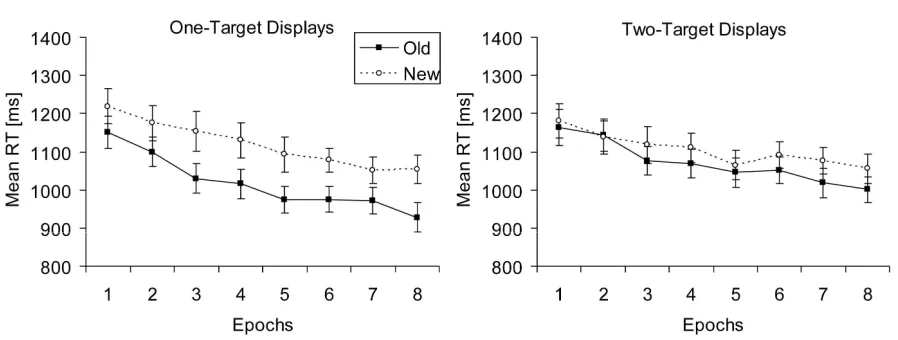
Individual mean RTs were calculated for each variable combination excluding error trials and outliers. Figure 3 shows mean RTs for old and new contexts as a function of epoch, separately for displays paired with one (left panel) and two (right panel) target locations. A repeated-measures ANOVA with the factors context (old, new), targets (one, two), and epoch (1-8) revealed significant main effects of context, F(1,20) = 14.05, p < .01, and epoch,
larger contextual-cueing effects for one-target displays (101 ms) as compared to two-target displays (33 ms). As can be seen in Figure 3 (right panel), contextual cueing for two-target displays only emerged from epoch three onwards, reaching comparable sizes to Experiment 1 in the last two epochs (57 ms and 55 ms, t(20) = -2.22, p = .04, and t(20) = -1.93, p = .07, respectively).
*insert Figure 3 about here*
Recognition Test
Overall accuracy of recognizing old and new contexts was 45.2%. For one-target displays, participants correctly identified old contexts on 56.4% of trials (hit rate), but this did not differ from the false alarm rate of 49.6%, t(20) = 1.21, p = .24. Similarly, the numbers of hits (57.9%) and false alarms (49.6%) were statistically comparable for two-target displays,
t(20) = 1.84, p = .08, suggesting that participants were mostly unable to explicitly discern between old and new contexts.
Analysis by separate target locations
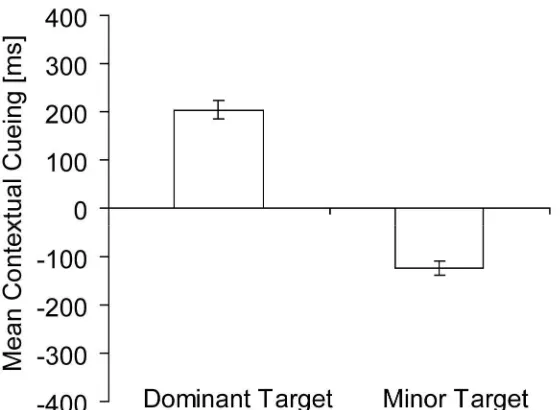
The results of both Experiments 1 and 2 revealed a contextual-cueing effect for displays with two target locations, but the effect was considerably reduced relative to the baseline condition with one target location. To examine whether this reduction was due to learning of only one of the two target locations, the data of all two-target displays from Experiments 1 and 2 were collapsed. For each participant, the mean contextual-cueing effect was computed separately for each display and target location. Subsequently, for each display, the target location with a relatively larger contextual-cueing effect was assigned to a
‘dominant target’ category, while the target location with the smaller contextual-cueing effect was assigned to a ‘minor target’ category. As can be seen from Figure 4, the averaged
minor location, t(36) = 18.16, p = .00). Contextual cueing for both the dominant and minor target location differed reliably from zero, as revealed by one-sample t tests, t(36) = 11.14,
p = .00, and t(36) = -8.09, p = .00, respectively. This pattern of positive and negative cueing effects indicates that only one of two target locations was effectively cued by a repeated context, whereas there were significant costs for the other location.
In order to demonstrate that the difference in contextual cueing between the dominant and minor target locations was not simply an artefact of our sorting procedure, one-target displays (baseline) were also examined for equivalent effects (Experiment 2 only). This was done by applying an analogous sorting procedure as with two-target displays: For each participant, pairs of one-target (baseline) displays were randomly selected (which can be considered equivalent to random pairing of target locations for two-target displays), and for each pair, displays that generated a larger and a smaller contextual-cueing effect were assigned to a ‘dominant’ and a ‘minor’ category, respectively, exactly as in the procedure described above. The resulting mean dominant contextual-cueing effect was large and positive (251 ms), and the mean minor effect negative (-49 ms) (comparison dominant vs. minor cueing effect, t(20) = 12.56, p = .00); note, though, that only the dominant effect differed significantly from zero, t(20) = 9.25, p = .00 (minor, t(20) = -1.85, p = .08). In a subsequent step, dominant and minor contextual cueing in the baseline condition (one-target displays) were compared with contextual cueing of dominant and minor target locations in two-target displays (Experiment 2 only). The results revealed dominant contextual-cueing effects to be comparable between one- and two-target displays (251 ms vs. 205 ms),
contextual cueing was comparable between both types of displays, there were pronounced contextual costs for minor target locations in two-target displays.
*insert Figure 4 about here*
Between-target distance analysis
Additional analyses for all two-target displays were performed on the combined data from Experiments 1 and 2 in order to examine the influence of spatial distance between the dominant and the minor target location (range = 2.5°–20.2° of visual angle) on contextual cueing for the latter location. First, a correlation analysis revealed contextual cueing for the minor target location to decrease with increasing distance from the dominant target location,
r = -.318, p = .00. In a further step, we examined whether spatial distance between the two locations facilitated positive contextual cueing for one target location or for both target locations. Displays were sorted according to whether there was a positive (i.e., above zero) contextual-cueing effect for both target locations (30.5%), or for only one target location (46.5%; or for none of the locations). Note that three observers had to be excluded from this analysis because they did not show contextual cueing for more than one target location. When both target locations were cued, the mean distance between them was significantly smaller than when only one location was cued, 7.4° and 9.7°, respectively (t(33) = 4.27, p = .00). This finding implies that smaller distances facilitated contextual cueing of two target locations more reliably than larger distances. Still, with two cued target locations, the dominant location exhibited more contextual cueing than the minor location, 362 ms and 172 ms, respectively (t(33) = 10.33, p = .00). It should be noted that the numerically large contextual-cueing effects obtained in this (and subsequent) analyses resulted from the procedure of selecting only relatively extreme cases with large contextual-cueing effects (while excluding smaller or negative values).
In agreement with previous studies (e.g., Chun & Jiang, 1998), Experiment 2
demonstrated a contextual-cueing effect for both one-target and two-target displays. But at the same time, contextual cueing was significantly reduced for two-target displays relative to one-target displays (33 ms vs. 101 ms).
According to Brady and Chun (2007), a reduction in contextual cueing for two-target displays originates from the increase in inspection times due to multiple-target learning. However, close scrutiny of the collapsed data from Experiments 1 and 2 rather supports an alternative explanation based on single-target learning. When displays were ranked according to the size of contextual cueing for each target location, only one (the dominant) target
location showed strong contextual cueing comparable to learning with one-target displays. By contrast, the other (minor) target location was associated with contextual costs, and these costs significantly exceeded negative contextual-cueing effects in baseline displays. This pattern of results suggests that contextual cueing is much less flexible than proposed. Rather, a given invariant context can reliably cue search to only one repeated target location, but (mostly) fails to facilitate search for a target presented at a second repeated location (for comparable results, see also Conci et al., 2011; Makovski & Jiang, 2010; Manginelli & Pollmann, 2009). The fact that minor target locations in two-target displays elicited larger contextual costs than any baseline displays indicates that the learned (dominant) target location misdirects spatial-attentional allocation (namely to the dominant location) when the target is actually presented at the other (minor) location.
In addition, contextual cueing decreased for minor target locations with increasing distance from the dominant target location, and reliable (i.e., above-zero) contextual-cueing effects for both target locations were only found when these were (relatively) close to each other (see also Brady & Chun, 2007; Makovski & Jiang, 2010). Nevertheless, even if both targets were cued successfully, one dominant target location could still be identified as
together, this pattern of results demonstrates that contextual cueing is not well adaptive to multiple target locations, as it effectively facilitates guidance to one target location (and its immediate surround) only.
Experiment 3
The results obtained thus far showed that contextual cueing was reduced for two-target relative to one-target displays, and this reduction occurred because only one of two targets was reliably cued. To examine whether single-target learning transfers to multiple, repeated target locations in general, in Experiment 3, half of the search displays were paired with three different target locations, and the other half with one (baseline). We expected to observe contextual cueing for only one out of the three alternative target locations. If reliable contextual cueing only occurs for one out of three target locations, the averaged contextual-cueing benefit for three-target displays should be even more reduced than for two-target displays.
Methods
The methodological details were similar to Experiment 2, except that now half of the old and new displays were paired with three distinct target locations and the other half again with only one target location (baseline). Overall, 48 possible target locations were used in Experiment 3. Three-target displays presented all possible target locations in a systematically alternating order across blocks; i.e., within a sequence of three blocks the three target
Twenty-two participants took part in the experiment (16 women; mean age: 26 years; age range: 18–34 years). All participants had normal-or-corrected to normal visual acuity and were right-handed. They received either payment (8 €) or one course credit.
Results
Search Task
The overall error rate was relatively low (2.4%), and a repeated-measures ANOVA with the factors context (old, new) targets (one, three) and epoch (1-7) revealed no significant effects (ps > .3).
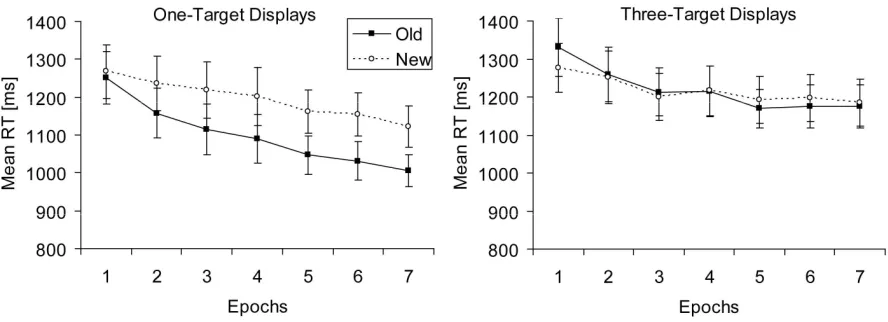
Individual mean RTs were calculated for each variable combination after exclusion of error trials and outliers. Figure 5 depicts the mean RTs for old and new contexts as a function of epoch, separately for one-target (left panel) and three-target displays (right panel). A repeated-measures ANOVA with the factors context (old, new), targets (one, three), and epoch (1–7) yielded significant main effects of context, F(1,21) = 4.57, p < .05, targets,
F(1,21) = 16.35, p < .01, and epoch, F(2.65,55.63) = 14.29, p < .001. RTs were faster for old-as compared to new-context displays (by 46 ms), and for one-target old-as compared to three-target displays (by 71 ms). The main effect of epoch was reflected in a decrease in RTs, by 160 ms, from the first to the last epoch. Furthermore, the targets x context interaction was significant, F(1,21) = 7.52, p < .05, due to a strong contextual-cueing effect for one-target displays (95 ms), but not for three-target displays (-3 ms). The factors context and epoch also interacted significantly, F(2.95,61.93) = 3.64, p < .05, with contextual-cueing effects
increasing from -19 ms in epoch one to 63 ms in epoch seven. The interaction between targets and epoch was significant, F(3.91,82.03) = 3.11, p < .05, with RTs decreasing more across epochs for one-target displays (by 195 ms) than for three-target displays (by 123 ms).
*insert Figure 5 about here*
Overall, the mean accuracy in the recognition test was 55.1%. For one-target displays, participants correctly identified old contexts on 60.6% of trials (hit rate), and this differed significantly from the false-alarm rate of 46.6%, t(21) = 2.59, p = .02, suggesting that
participants were to some extent aware of the repeated contexts. For three-target displays, the rates of hits (53%) and false alarms (46.6%) were comparable and showed no evidence of explicit recognition, t(21) = 1.06, p = .30. To further qualify the explicit recognition performance in one-target displays, we examined whether the participants’ ability to
recognize repeated layouts was related to the size of the contextual-cueing effect. Individual sensitivity scores d’ (z(hits) –z(false alarms)) were computed as a measure of explicit recognition and correlated with the contextual-cueing effect for one-target displays. This analysis produced no evidence of a correlation, r = -.03, p = .89; that is, recognition performance was not systematically related to the size of contextual cueing.
Analysis by separate target locations
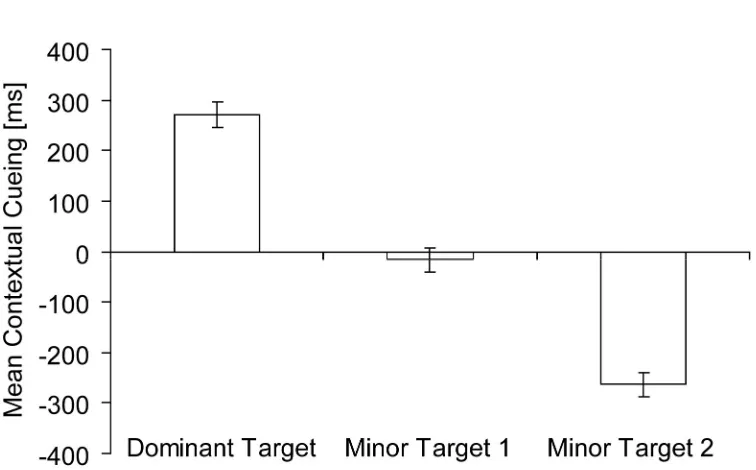
In a subsequent step, contextual cueing for all three-target displays was analyzed separately for the dominant target location and the two minor target locations (see Experiment 2 above for details of the analysis procedure). Figure 6 illustrates that the mean contextual-cueing effect for the dominant target location was significantly larger than for the two minor target locations (271 ms vs. -17 ms vs. -263 ms), t(21) = 11.28, p = .00, and t(21) = 14.64,
p = .00, respectively. Contextual cueing for the minor target locations also differed
significantly from each other, t(21) = 11.62, p = .00. Mean contextual cueing of the dominant target location was significantly larger than zero, t(21) = 8.02, p = .00, but contextual cueing of the minor target locations was equal to or smaller than zero, t(21) = -.61, p = .55, and
t(21) = -9.15, p = .00, respectively.
(one-target displays), analogous to Experiment 2, triplets of one-(one-target displays were randomly selected (for each participant), and then each triplet was sorted by the largest (dominant), the second largest (minor one), and the smallest contextual-cueing effect (minor two) to obtain a baseline ranking for the three-target displays. Not surprisingly, in the baseline, the dominant contextualcueing effect (331 ms) was greater compared to both minor effects (109 ms and -139 ms, respectively; t(21) = 7.73, p = .00, and t(21) = 9.91, p = .00, for the two
comparisons), and the latter also differed reliably from each other, t(21) = 7.70, p = .00. Less trivially, each dominant and minor baseline contextual-cueing effect also differed
significantly from zero, t(21) = 7.5, p = .00, t(21) = 3.2, p = .00, and t(21) = -4.07, p = .00, respectively.
Next, dominant and minor contextual cueing in the baseline was compared to contextual cueing of dominant and minor target locations in three-target displays. As in Experiment 2, dominant contextual cueing was comparable between one-target (331 ms) and three-target displays (271 ms), t(21) = -1.56, p = .13. But contextual cueing of minor target locations (-17 ms vs. -263 ms) was significantly smaller compared to minor contextual-cueing effects in the baseline (109 ms vs. -139 ms), t(21) = -2.82, p = .01, and t(21) = -3.22, p = .00, respectively. In sum, the dominant contextual-cueing effect in the baseline was similar to that for dominant target locations in three-target displays. By contrast, minor target locations in three-target displays showed no contextual-cueing effect or even a contextual cost, whereas minor effects in the baseline still reflected a reliable contextual benefit (at least for the minor-one location). Thus, minor target locations in three-target displays were associated with significant contextual costs beyond the smallest effects in the baseline.
*insert Figure 6 about here*
Again, the influence of spatial distance in three-target displays between dominant and minor target locations (range = 2.5°–21.5° of visual angle) on contextual cueing for the minor target locations was analyzed. Overall, contextual cueing for the minor target locations was reduced with greater distance from the dominant location, r = -.335, p = .00, and r = -.331,
p = .00, respectively (correlations were partially controlled for distance between minor target locations). In a further step, RTs for three-target displays were sorted into three groups, according to whether (above-zero) contextual-cueing effects were obtained for all three target locations (13.6% of the data), for two target locations (30.3%), or for one target location (40.9%; or for none of the target locations). A one-way ANOVA revealed that the mean distance differed significantly between groups, F(3,128) = 6.84, p < .001 (with a significant linear trend, F(1,128) = 11.10, p < .01). Mean distances were 10.7°, 9°, and 7.6° for
contextual cueing of one, two, and three target locations, respectively, suggesting that the integration of multiple target locations into a learned context was only possible with smaller between-target distances. When two target locations were successfully cued, the average effect was 394 ms for the dominant target location and 163 ms for the minor target location (-238 ms for the ‘uncued’ location; all ps< .001). When three target locations exhibited contextual cueing, the average effect was 441 ms for the dominant target location, and 319 ms and 155 ms for the first and the second minor target location, respectively (all ps < .001).
Discussion
that only a single, dominant target location was successfully cued by an invariant context with effects comparable to baseline, one-target displays. By contrast, the two remaining (minor) target locations did not show reliable contextual cueing and were associated with significant contextual costs when compared to the smallest effects in baseline displays. Therefore, the lack of observable contextual cueing for three-target displays can be attributed to single-target learning.
Moreover, as with to two-target displays (Experiment 2), relative proximity between target locations facilitated contextual cueing for minor target locations and enhanced, to a certain extent, contextual cueing of two or even all three target locations by one-and-the-same, invariant context. However, the size of contextual cueing for one or two proximal target locations never reached the same level as that for the dominant target location. This pattern of results again demonstrates that contextual cueing can index only a single target location (and its immediate surround) reliably, but fails to represent multiple target locations within an invariant context.
General Discussion
The repeated presentation of invariant spatial item layouts facilitates visual search by guiding attention more directly to a learned target location. In the current study, invariant contexts were paired with multiple target locations (each presented on different trials) to investigate the adaptive properties of contextual cueing. Altogether, our results revealed that contextual cueing integrated only one target location successfully, but failed to reliably facilitate search for a second or third target location.
showed that this reduction was caused by reliable learning of only one of two target locations (i.e., the dominant target, which was, however, not determined by order of presentation). Search for the remaining minor target locations did not benefit from the invariant context, but rather, in fact, showed contextual costs that were greater than the costs observed for
inefficiently learned baseline displays. Furthermore, when a third target location was paired with a given, invariant context, there was no observable contextual cueing (-3 ms) overall, while there was reliable contextual cueing, of 95 ms, for one-target displays (Experiment 3). Again, closer inspection of the result pattern showed that the substantial reduction was caused by reliable cueing of only one of three target locations. By contrast, search for targets
appearing at minor locations was again characterized by contextual costs that exceeded the costs observed for inefficiently learned baseline displays. However, additional analyses of all three experiments indicated that, in a subset of the repeated displays, larger distances between the dominant and the minor target locations were related to reduced contextual-cueing effects (or, in other words, increased contextual costs) for minor target locations. Conversely,
proximity between target locations seemed to enable contextual cueing of two or even three locations. Nevertheless, the dominant target location still exhibited more contextual cueing than the proximal location(s).
Previous studies already reported that, following the learning of a first target location, the introduction of a second target location disrupted contextual cueing (Conci et al., 2011; Makovski & Jiang, 2010; Manginelli & Pollmann, 2009). These findings implied that the learned association between a given target location and a given invariant context hinders adaptation to a second target location. The current pattern of results replicated these findings even for displays that presented the possible target locations in alternating order (across blocks of trials), which was expected to provide optimal conditions for learning more than one target location. Consequently, changes in the context-target relation cannot be sufficiently adapted to or compensated for in contextual learning.
Nevertheless, within a relatively narrow spatial range, two-target and three-target displays revealed contextual cueing for multiple target locations, but contextual facilitation dissipated as the spatial distances among target locations increased (see also Makovski & Jiang, 2010, for similar findings). This could mean that contextual cueing establishes multiple memory-based associations between an invariant context and proximal target locations. However, the magnitude of contextual cueing still differed between the cued (dominant and minor) target locations, suggesting that contextual cueing of a second or third target was rather a side-effect of contextual cueing of the dominant target. Computational models of contextual cueing (Brady & Chun, 2007) assume that observers build up associations between the target location and the invariant context in repeated visual search. In subsequent search, target locations are cued by a locally activated context, rather than the whole repeated display (see also Geyer, Shi, & Müller, 2010). Thus, a second or third target, located near the
Based on the current results, we assume that observers orient attention primarily to the learned (dominant) target location, and if the target appears at its expected (i.e., learned) location, robust contextual-cueing effects occur. However, if the dominant target is absent, observers need to reorient attention to the unlearned (minor) target, which shows contextual cueing if it is located near the dominant target, but this facilitation dissipates and even turns into considerable costs with growing distances from the dominant location (see also
Manginelli & Pollmann, 2009, who demonstrated comparable results based on eye movement measures).
Interestingly, single-target learning was equally effective even when three different target locations were paired with one-and-the-same invariant context. This demonstrates a remarkable degree of selective and noise-resistant (or interference-free) learning. Evidence for the resistance of contextual cueing to interference was already reported by Jiang and Chun (2001), who found contextual learning for a repeated set of nontargets presented among another set of unpredictably changing items (see also Endo & Takeda, 2005; Olson & Chun, 2002). In addition, effective learning of repeated contexts occurred even when these were intermixed with a large number of novel display layouts on five consecutive days (Jiang, Song, & Rigas, 2005). Furthermore, once contextual cueing was established for a set of old-context displays, the subsequent presentation of noise (i.e., the presentation of new-old-context displays) did no longer affect the learned associations (Junge, Scholl, & Chun, 2007). In general agreement with these findings, in the current study, contextual memory for the learned (dominant) target location was equally strong whether it was associated with its repeated context in 100%, 50%, or only 33% of all cases. Thus, while contextual learning is rather inflexible in adapting to changing environments (e.g., when the target location
But what might be the advantage of optimizing selectivity at the expense of
flexibility? One tentative answer is that contextual learning is, in fact, particularly effective when an invariant context cues only one target region. By contrast, if three (or even more) target locations were learned to be associated with a single invariant context, the context would provide only a vague cue, with a 33% (or smaller) chance of directly guiding attention to the relevant location – thus substantially compromising the benefit of predictive surrounds. Consequently, preserving the functional role of predictability may be more valuable in
repeated visual search than a high degree of flexibility.
Acknowledgements
References
Bar, M. (2004). Visual objects in context. Nature Reviews Neuroscience, 5, 617–629.
Biederman, I., Mezzanotte, R. J., & Rabinowitz, J. C. (1982). Scene perception: detecting and judging objects undergoing relational violations. Cognitive Psychology, 14, 143–177. Brady, T. F., & Chun, M. M. (2007). Spatial constraints on learning in visual search:
modeling contextual cuing. Journal of Experimental Psychology. Human Perception and Performance, 33, 798–815.
Brainard, D. H. (1997). The Psychophysics Toolbox. Spatial Vision, 10, 433–436.
Chua, K.-P., Chun, M.M. (2003). Implicit scene learning is viewpoint dependent. Perception & Psychophysics, 65, 72-80.
Chun, M. M. (2000). Contextual cueing of visual attention. Trends in Cognitive Sciences, 4,
170–178.
Chun, M. M., & Jiang, Y. (1998). Contextual cueing: implicit learning and memory of visual context guides spatial attention. Cognitive Psychology, 36, 28–71.
Conci, M., & von Mühlenen, A. (2009). Region segmentation and contextual cuing in visual search. Attention, Perception & Psychophysics, 71, 1514–1524.
Conci, M., Sun, L., & Müller, H. J. (2011). Contextual remapping in visual search after predictable target-location changes. Psychological Research (Manuscript in press). Endo, N., & Takeda, Y. (2005). Use of spatial context is restricted by relative position in
implicit learning. Psychonomic Bulletin & Review, 12, 880–885.
Fiske, S., & Sanocki, T. (2010). Memory and attentional guidance in contextual cueing.
Journal of Vision, 10, 1302.
Experimental Psychology. Human Perception and Performance, 36,515–532.
Hollingworth, A. (2006). Scene and position specificity in visual memory for objects. Journal of Experimental Psychology. Learning, Memory, and Cognition, 32, 58–69.
Jiang, Y., & Chun, M. M. (2001). Selective attention modulates implicit learning. The Quarterly Journal of Experimental Psychology. A, Human Experimental Psychology, 54,
1105–1124.
Jiang, Y., & Wagner, L. C. (2004). What is learned in spatial contextual cuing—configuration or individual locations? Perception & Psychophysics, 66, 454–463.
Jiang, Y., Song, J.-H., & Rigas, A. (2005). High-capacity spatial contextual memory.
Psychonomic Bulletin & Review, 12, 524–529.
Jungé, J. A., Scholl, B. J., & Chun, M. M. (2007). How is spatial context learning integrated over signal versus noise? A primacy effect in contextual cueing. Visual Cognition, 15, 1– 11.
Kunar, M. A., Michod, K. O., & Wolfe, J. M. (2005). When we use the context in contextual cueing: Evidence from multiple target locations. Journal of Vision, 5, 412.
Makovski, T., & Jiang, Y. V. (2010). Contextual cost: when a visual-search target is not where it should be. Quarterly Journal of Experimental Psychology, 63, 216–225. Manginelli, A. A., & Pollmann, S. (2009). Misleading contextual cues: how do they affect
visual search? Psychological Research, 73, 212–221.
Nabeta, T., Ono, F., & Kawahara, J.-I. (2003). Transfer of spatial context from visual to haptic search. Perception, 32, 1351–1358.
Oliva, A., & Torralba, A. (2007). The role of context in object recognition. Trends in Cognitive Sciences, 11, 520–527.
context. Visual Cognition, 9, 273–302.
Pelli, D. G. (1997). The VideoToolbox software for visual psychophysics: transforming numbers into movies. Spatial Vision, 10, 437–442.
Wolfe, J. M., Klempen, N., & Dahlen, K. (2000). Postattentive vision. Journal of Experimental Psychology. Human Perception and Performance, 26, 693–716. Wolfe, J. M., & Horowitz, T. S. (2004). What attributes guide the deployment of visual
Figure Captions
Figure 1. Example search displays with an old (invariant) context paired with two different target locations.
Figure 2. Mean RTs (in ms, and associated standard error bars) for old and new contexts as a function of epoch (filled and unfilled symbols, respectively) in Experiment 1.
Figure 3. Mean RTs (in ms, and associated standard error bars) for old and new contexts as a function of epoch (filled and unfilled symbols, respectively) in Experiment 2, for displays paired with one (left panel) and displays paired with two target locations (right panel).
Figure 4. Mean contextual cueing (in ms, and associated standard error bars) for dominant and minor target locations (collapsed data for all two-target displays from Experiments 1 and 2).
Figure 5. Mean RTs (in ms, and associated standard error bars) for old and new contexts as a function of epoch (filled and unfilled symbols, respectively) in Experiment 3, for displays paired with one (left panel) and displays paired with three target locations (right panel).