RACE: Large-scale ReAding Comprehension Dataset From Examinations
Guokun Lai⇤and Qizhe Xie⇤and Hanxiao Liu and Yiming Yang and Eduard Hovy {guokun, qzxie, hanxiaol, yiming, hovy}@cs.cmu.edu
Language Technologies Institute Carnegie Mellon University
Pittsburgh, PA 15213
Abstract
We present RACE, a new dataset for benchmark evaluation of methods in the reading comprehension task. Collected from the English exams for middle and high school Chinese students in the age range between 12 to 18, RACE con-sists of near 28,000 passages and near 100,000 questions generated by human experts (English instructors), and cov-ers a variety of topics which are care-fully designed for evaluating the students’ ability in understanding and reasoning. In particular, the proportion of questions that requires reasoning is much larger in RACE than that in other benchmark datasets for reading comprehension, and there is a significant gap between the performance of the state-of-the-art mod-els (43%) and the ceiling human perfor-mance (95%). We hope this new dataset can serve as a valuable resource for re-search and evaluation in machine com-prehension. The dataset is freely
avail-able at http://www.cs.cmu.edu/
˜glai1/data/race/and the code is available at https://github.com/ qizhex/RACE_AR_baselines
1 Introduction
Constructing an intelligence agent capable of un-derstanding text as people is the major challenge of NLP research. With recent advances in deep learning techniques, it seems possible to achieve human-level performance in certain language un-derstanding tasks, and a surge of effort has been devoted to the machine comprehension task where people aim to construct a system with the ability to
⇤
* indicates equal contribution
answer questions related to a document that it has to comprehend (Chen et al.,2016; Kadlec et al.,
and comparison using the same evaluation met-rics. Although efforts have been made with a sim-ilar motivation, including the MCTest dataset cre-ated by (Richardson et al.,2013) (containing 500 passages and 2000 questions) and several others (Pe˜nas et al.,2014;Rodrigo et al.,2015;Khashabi et al.,2016; Shibuki et al.,2014), the usefulness of those datasets is significantly restricted due to their small sizes, especially not suitable for train-ing powerful deep neural networks whose success relies on the availability of relatively large training sets.
Our new dataset, namely RACE, consists of 27,933 passages and 97,687 questions. After read-ing each passage, each student is asked to answer several questions where each question is provided with four candidate answers – only one of them is correct . Unlike existing datasets, both the ques-tions and candidate answers in RACE are not re-stricted to be the text spans in the original passage; instead, they can be described in any words. A sample from our dataset is presented in Table1.
Our latter analysis shows that correctly answer-ing a large portion of questions in RACE requires the ability of reasoning, the most important fea-ture as a machine comprehension dataset (Chen et al.,2016). RACE also offers two important sub-divisions of the reasoning types in its questions, namely passage summarization and attitude anal-ysis, which have not been introduced by the any of the existing large-scale datasets to our knowledge. In addition, compared to other existing datasets where passages are either domain-specific or of a single fixed style (namely news stories for CNN/-Daily Mail, NEWSQA and Who-did-What, fiction stories for Children’s Book Test and Book Test, and Wikipedia articles for SQUAD), passages in RACE almost cover all types of human articles, such as news, stories, ads, biography, philosophy, etc., in a variety of styles. This comprehensiveness of topic/style coverage makes RACE a desirable resource for evaluating the reading comprehension ability of machine learning systems in general.
The advantages of our proposed dataset over ex-isting large datasets in machine reading compre-hension can be summarized as follows:
• All questions and candidate options are gen-erated by human experts, which are intention-ally designed to test human agent’s ability in reading comprehension. This makes RACE a relatively accurate indicator for reflecting the
text comprehension ability of machine learn-ing systems under human judge.
• The questions are substantially more difficult than those in existing datasets, in terms of the large portion of questions involving reason-ing. At the meantime, it is also sufficiently large to support the training of deep learning models.
• Unlike existing large-scale datasets, candi-date options in RACE are human generated sentences which may not appear in the origi-nal passage. This makes the task more chal-lenging and allows a rich type of questions such as passage summarization and attitude analysis.
• Broad coverage in various domains and writ-ing styles: a desirable property for evaluatwrit-ing generic (in contrast to domain/style-specific) comprehension ability of learning models.
2 Related Work
In this section, we briefly outline existing datasets for the machine reading comprehension task, in-cluding their strengths and weaknesses.
2.1 MCTest
MCTest (Richardson et al., 2013) is a popular dataset for question answering in the same for-mat as RACE, where each question is associated with four candidate answers with a single cor-rect answer. Although questions in MCTest are of high-quality ensured by careful examinations through crowdsourcing, it contains only 500 stores and 2000 questions, which substantially restricts its usage in training advanced machine compre-hension models. Moreover, while MCTest is de-signed for 7 years old children, RACE is con-structed for middle and high school students at 12–18 years old hence is more complicated and requires stronger reasoning skills. In other words, RACE can be viewed as a larger and more difficult version of the MCTest dataset.
2.2 Cloze-style datasets
The past few years have witnessed several large-scale cloze-style datasets (Hermann et al., 2015;
Hill et al.,2015;Bajgar et al.,2016;Onishi et al.,
Passage:
In a small village in England about 150 years ago, a mail coach was standing on the street. It didn’t come to that village often. People had to pay a lot to get a letter. The person who sent the letter didn’t have to pay the postage, while the receiver had to. “Here’s a letter for Miss Alice Brown,” said the mailman.
“ I’m Alice Brown,” a girl of about 18 said in a low voice.
Alice looked at the envelope for a minute, and then handed it back to the mailman. “I’m sorry I can’t take it, I don’t have enough money to pay it”, she said.
A gentleman standing around were very sorry for her. Then he came up and paid the postage for her.
When the gentleman gave the letter to her, she said with a smile, “ Thank you very much, This letter is from Tom. I’m going to marry him. He went to London to look for work. I’ve waited a long time for this letter, but now I don’t need it, there is nothing in it.”
“Really? How do you know that?” the gentleman said in surprise.
“He told me that he would put some signs on the envelope. Look, sir, this cross in the corner means that he is well and this circle means he has found work. That’s good news.”
The gentleman was Sir Rowland Hill. He didn’t forgot Alice and her letter.
“The postage to be paid by the receiver has to be changed,” he said to himself and had a good plan.
“The postage has to be much lower, what about a penny? And the person who sends the letter pays the postage. He has to buy a stamp and put it on the envelope.” he said . The government accepted his plan. Then the first stamp was put out in 1840. It was called the “Penny Black”. It had a picture of the Queen on it.
Questions:
1): The first postage stamp was made .
A. in England B. in America C. by Alice D. in 1910 2): The girl handed the letter back to the mailman because .
A. she didn’t know whose letter it was B. she had no money to pay the postage
C. she received the letter but she didn’t want to open it D. she had already known what was written in the letter 3): We can know from Alice’s words that .
A. Tom had told her what the signs meant before leaving B. Alice was clever and could guess the meaning of the signs C. Alice had put the signs on the envelope herself
D. Tom had put the signs as Alice had told him to
4): The idea of using stamps was thought of by . A. the government
B. Sir Rowland Hill C. Alice Brown D. Tom
5): From the passage we know the high postage made . A. people never send each other letters
B. lovers almost lose every touch with each other C. people try their best to avoid paying it D. receivers refuse to pay the coming letters
Answer:ADABC
Table 1: Sample reading comprehension problems from our dataset.
CNN/Daily Mail (Hermann et al., 2015) are the largest machine comprehension datasets with 1.4M questions. However, both require limited reasoning ability (Chen et al.,2016). In fact, the best machine performance obtained by researchers (Chen et al.,2016;Dhingra et al.,2016) is close to human’s performance on CNN/Daily Mail.
Childrens Book Test (CBT) (Hill et al.,2015) and Book Test (BT) (Bajgar et al.,2016) are con-structed in a similar manner. Each passage in CBT consist of20contiguous sentences extracted from children’s books and the next (21st) sentence is used to make the question. The main difference between the two datasets is the size of BT being 60times larger. Machine comprehension models have also matched human performance on CBT (Bajgar et al.,2016).
Who Did What (WDW) (Onishi et al., 2016) is yet another cloze-style dataset constructed from the LDC English Gigaword newswire corpus. The authors generate passages and questions by pick-ing two news articles describpick-ing the same event,
using one as the passage and the other as the ques-tion.
High noise is inevitable in cloze-style datasets due to their automatic generation process, which is reflected in the human performance on these datasets:82%for CBT and84%for WDW.
2.3 Datasets with Span-based Answers In datasets such as SQUAD (Rajpurkar et al.,
Datasets with span-based answers are challeng-ing as the space of possible spans is usually large. However, restricting answers to be text spans in the context passage may be unrealistic and more importantly, may not be intuitive even for humans, indicated by the suffered human performance of 80.3% on SQUAD (or 65% claimed byTrischler et al.(2016)) and 46.5% on NEWSQA. In other words, the format of span-based answers may not necessarily be a good examination of reading com-prehension of machines whose aim is to approach the comprehension ability ofhumans.
2.4 Datasets from Examinations
There have been several datasets extracted from examinations, aiming at evaluating systems un-der the same conditions as how humans are evalu-ated in schools. E.g., the AI2 Elementary School Science Questions dataset (Khashabi et al.,2016) contains 1080 questions for students in elementary schools; NTCIR QA Lab (Shibuki et al., 2014) evaluates systems by the task of solving real-world university entrance exam questions; The Entrance Exams task at CLEF QA Track (Pe˜nas et al.,2014;
Rodrigo et al.,2015) evaluates the system’s read-ing comprehension ability. However, data pro-vided in these existing tasks are far from sufficient for the training of advanced data-driven machine reading models, partially due to the expensive data generation process by human experts.
To the best of our knowledge, RACE is the first
large-scale dataset of this type, where questions are created based on exams designed to evaluate human performance in reading comprehension.
3 Data Analysis
In this section, we study the nature of questions covered in RACE at a detailed level. Specifically, we present the dataset statistics in Section3.1, and then analyze different reasoning/question types in RACE in the remaining subsections.
3.1 Dataset Statistics
As mentioned in section 1, RACE is collected from English examinations designed for 12–15 old middle school students, and 15–18 year-old high school students in China. To distin-guish the two subgroups with drastic difficulty gap, RACE-M denotes the middle school nations and RACE-H denotes high school exami-nations. We split 5% data as the development set
and 5% as the test set for RACE-M and RACE-H respectively. The number of samples in each set is shown in Table2. The statistics for RACE-M and RACE-H is summarized in Table3. We can find that the length of the passages and the vocabulary size in the RACE-H are much larger than that of the RACE-M, an evidence of the higher difficulty of high school examinations.
However, notice that since the articles and ques-tions are selected and designed to test Chinese students learning English as a foreign language, the vocabulary size and the complexity of the lan-guage constructs are simpler than news articles and Wikipedia articles in other QA datasets. 3.2 Reasoning Types of the Questions
To get a comprehensive picture about the reason-ing difficulty requirement of RACE, we conduct human annotations of questions types. Following
Chen et al.(2016);Trischler et al.(2016), we strat-ify the questions into five classes as follows with ascending order of difficulty:
• Word matching: The question exactly matches a span in the article. The answer is self-evident.
• Paraphrasing: The question is entailed or paraphrased by exactly one sentence in the passage. The answer can be extracted within the sentence.
• Single-sentence reasoning: The answer could be inferred from a single sentence of the arti-cle by recognizing incomplete information or conceptual overlap.
• Multi-sentence reasoning: The answer must be inferred from synthesizing information distributed across multiple sentences. • Insufficient/Ambiguous: The question has no
answer or the answer is not unique based on the given passage.
We refer readers to (Chen et al.,2016;Trischler et al.,2016) for examples of each category.
To obtain the proportion of different question types, we sample100 passages from RACE (50 from RACE-M and 50 from RACE-H), all of which have5questions hence there are500 ques-tions in total. We put the passages on Amazon Me-chanical Turk1, and a Hit is generated by a passage
Dataset RACE-M RACE-H RACE
Subset Train Dev Test Train Dev Test Train Dev Test All
# passages 6,409 368 362 18,728 1,021 1,045 25,137 1,389 1,407 27,933
[image:5.595.90.506.88.141.2]# questions 25,421 1,436 1,436 62,445 3,451 3,498 87,866 4,887 4,934 97,687
Table 2: The separation of the training, development and test sets of RACE-M,RACE-H and RACE
Dataset RACE-M RACE-H RACE
Passage Len 231.1 353.1 321.9
Question Len 9.0 10.4 10.0
Option Len 3.9 5.8 5.3
[image:5.595.316.506.426.565.2]Vocab size 32,811 125,120 136,629
Table 3: Statistics of RACE where Len denotes length and Vocab denotes Vocabulary.
with 5 questions. Each question is labeled by two crowdworkers. We require the turkers to both an-swer the questions and label the reasoning type. We pay $0.70 and $1.00 per passage in RACE-M and RACE-H respectively, and restrict the access to master turkers only. Finally, we get 1000 labels for the 500 questions.
The statistics about the reasoning type is sum-marized in Table 4. The higher difficulty level of RACE is justified by its higher ratio of rea-soning questions in comparison to CNN, SQUAD and NEWSQA. Specifically, 59.2% questions of RACE are either in the category of single-sentence reasoning or in the category of multi-sentence reasoning, while the ratio is 21%, 20.5% and 33.9%for CNN, SQUAD and NEWSQA respec-tively. Also notice that the ratio of word match-ing questions on RACE is only15.8%, the lowest among several categories. In addition, questions in RACE-H are more complex than questions in RACE-M since RACE-M has more word match-ing questions and fewer reasonmatch-ing questions.
3.3 Subdividing Reasoning Types
To better understand our dataset and facilitate fu-ture research, we list the subdivisions of ques-tions under the reasoning category. We find the most frequent reasoning subdivisions include: de-tail reasoning, whole-picture understanding, pas-sage summarization, attitude analysis and world knowledge. One question may fall into multiple divisions. Definition of these subdivisions and their associated examples are as follows:
1. Detail reasoning: to answer the question, the agent should be clear about the details of the
pas-sage. The answer appears in the passage but it can-not be found by simply matching the question with the passage. For example, Question1in the sam-ple passage falls into this category.
2. Whole-picture reasoning: the agent needs to understand the whole picture of the story to ob-tain the correct answer. For example, to answer the Question2in the sample passage, the agent is required to comprehend the entire story.
3. Passage summarization: The question re-quires the agent to select the best summarization of the passage among four candidate summariza-tions. A typical question of this type is “The main idea of this passage is .”. An example question can be found in AppendixA.1.
4. Attitude analysis: The question asks about the opinions/attitudes of the author or a character in the story towards somebody or something, e.g.,
• Evidence: “. . . Many people optimistically thought industry awards for better equipment would stimulate the production of quieter appliances. It was even suggested that noise from building sites could be alleviated . . . ”
• Question: What was the author’s attitude towards the industry awards for quieter?
• Options: A.suspicious B.positive C.enthusiastic D.indifferent
5. World knowledge: Certain external knowl-edge is needed. Most frequent questions under this category involve simple arithmetic.
• Evidence: “The park is open from 8 am to 5 pm.”
• Question: The park is open for hours a day.
• Options: A.eight B.nine C.ten D.eleven
Dataset RACE-M RACE-H RACE CNN SQUAD NEWSQA
Word Matching 29.4% 11.3% 15.8% 13.0%† 39.8%* 32.7%*
Paraphrasing 14.8% 20.6% 19.2% 41.0%† 34.3%* 27.0%*
Single-Sentence Reasoning 31.3% 34.1% 33.4% 19.0%† 8.6%* 13.2%*
Multi-Sentence Reasoning 22.6% 26.9% 25.8% 2.0%† 11.9%* 20.7%*
[image:6.595.97.503.88.166.2]Ambiguous/Insufficient 1.8% 7.1% 5.8% 25.0%† 5.4%* 6.4%*
Table 4: Statistic information about Reasoning type in different datasets. * denotes the numbers coming from (Trischler et al.,2016) based on 1000 samples per dataset, and numbers with†come from (Chen et al.,2016).
4 Collection Methodology
We collected the raw data from three large free public websites234 in China5, where the reading
comprehension problems are extracted from En-glish examinations designed by teachers in China. The data before cleaning contains 137,918 pas-sages and 519,878 questions in total, where there are 38,159 passages with 156,782 questions in the middle school group, and 99,759 passages with 363,096 questions in the high school group.
The following filtering steps are conducted to clean the raw data. Firstly, we remove all prob-lems and questions that do not have the same for-mat as our problem setting, e.g., a question would be removed if the number of its options is not four. Secondly, we filter all articles and questions that are not self-contained based on the text informa-tion, i.e. we remove the articles and questions con-taining images or tables. We also remove all ques-tions containing keywords “underlined” or “para-graph”, since it is difficult to reproduce the effect of underlines and the paragraph segment informa-tion. Thirdly, we remove all duplicated articles.
On one of the websites (xkw.com), the answers are stored as images. We used two standard OCR programs tesseract6and ABBYY FineReader7to
process the images. We remove all the answers that two software disagree. The OCR task is easy since we only need to recognize printed alphabet A, B, C, D with a standard font. Finally, we get the cleaned dataset RACE, with 27,933 passages and 97,687 questions.
2http://www.21cnjy.com/ 3http://5utk.ks5u.com/ 4http://zujuan.xkw.com/
5We checked that our dataset does not include
exam-ple questions of exams with copyright, such as SSAT, SAT, TOEFL and GRE.
6https://github.com/tesseract-ocr 7https://www.abbyy.com/FineReader
5 Experiments
In this section, we compare the performance of several state-of-the-art reading comprehension models with human performance. We use accu-racy as the metric to evaluate different models. 5.1 Methods for Comparison
Sliding Window Algorithm Firstly, we build the rule-based baseline introduced byRichardson et al. (2013). It chooses the answer having the highest matching score. Specifically, it first con-catenates the question and the answer and then cal-culates the TF-IDF style matching score between the concatenated sentence with every window (a span of text) of the article. The window size is decided by the model performance in the training and dev sets.
Stanford Attentive Reader Stanford Attentive Reader (Stanford AR) (Chen et al., 2016) is a strong model that achieves state-of-the-art results on CNN/Daily Mail. Moreover, the authors claim that their model has nearly reached the ceiling per-formance on these two datasets.
Suppose that the triple of passage, question and options is denoted by(p, q, o1,···,4). We first
em-ploy bidirectional GRUs to encodepandq respec-tively intohp1, hp2, . . . , hpn andhq. Then we sum-marize the most relevant part of the passage into spwith an attention model. FollowingChen et al. (2016), we adopt a bilinear attention form. Specif-ically,
↵i= Softmaxi((hpi)TW1hq)
sp=X
i
↵ihpi (1)
Similarly, we use bidirectional GRUs to encode option oi into a vector hoi. Finally, we
RACE-M RACE-H RACE MCTest CNN DM CBT-N CBT-C WDW
Random 24.6 25.0 24.9 24.8 0.06 0.06 10.6 10.2 32.0†
Sliding Window 37.3 30.4 32.2 51.5† 24.8 30.8 16.8† 19.6† 48.0†
Stanford AR 44.2 43.0 43.3 – 73.6†76.6† – – 64.0†
GA 43.7 44.2 44.1 – 77.9†80.9† 70.1† 67.3† 71.2†
Turkers 85.1 69.4 73.3 – – – – – –
[image:7.595.111.490.227.399.2]Ceiling Performance 95.4 94.2 94.5 – – – 81.6† 81.6† 84†
Table 5: Accuracy of models and human on the each dataset, where†denotes the results coming from previous publications. DM denotes Daily Mail and WDW denotes Who-Did-What .
0 25 50 75 100
Word-MatchParaphrasingSingle-ReasonMulti-ReasonAmbiguous Sliding Window Stanford AR Turker
(a) RACE-M
0 25 50 75 100
Word-MatchParaphrasingSingle-ReasonMulti-ReasonAmbiguous Sliding Window Stanford AR Turker
(b) RACE-H
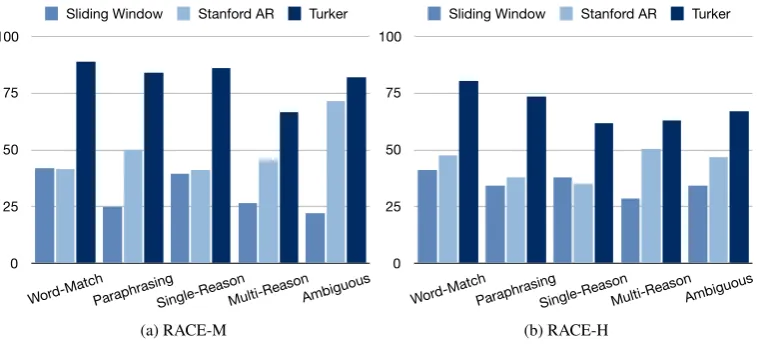
Figure 1: Test accuracy of different baselines on each reasoning type category introduced in Section3.2, where Word-Match, Single-Reason, Multi-Reason and Ambiguous are the abbreviations for Word match-ing, Single-sentence Reasonmatch-ing, Multi-sentence Reasoning and Insufficient/Ambiguous respectively.
a bilinear attention. We pass the scores through softmax to get a probability distribution. Specif-ically, the probability of option ibeing the right answer is calculated as
pi= Softmaxi(hoiW2sd) (2)
Gated-Attention Reader Gated AR (Dhingra et al.,2016) is the state-of-the-art model on mul-tiple datasets. To build query-specific represen-tations of tokens in the document, it employs an attention mechanism to model multiplicative in-teractions between the query embedding and the document representation. With a multi-hop ar-chitecture, GA also enables a model to scan the document and the question iteratively for multi-ple passes. In other words, the multi-hop struc-ture makes it possible for the reader to refine token representations iteratively and the attention mech-anism find the most relevant part of the document. We refer readers to (Dhingra et al.,2016) for more details.
After obtaining a query specific document rep-resentationsd, we use the same method as bilinear operation listed in Equation2to get the output.
Note that our implementation slightly differs from the original GA reader. Specifically, the At-tention Sum layer is not applied at the final layer and no character-level embeddings are used.
Implementation Details We follow Chen et al.
of the gradient is larger than 10. We use a grid search on validation set to choose the learning rate within {0.05,0.1,0.3,0.5} and dropout rate within {0.2,0.5,0.7}. The highest accuracy on validation set is obtained by setting learning rate to 0.1for Stanford AR and0.3for GA and dropout rate to0.5. The data of RACE-M and RACE-H is used together to train our model and testing is performed separately.
5.2 Human Evaluation
As described in section 3.2, a randomly sam-pled subset of test set has been labeled by Ama-zon Turkers, which contains 500 questions with half from RACE-H and with the other half from RACE-M. The turkers’ performance is 85% for RACE-M and 70% for RACE-H. However, it is hard to guarantee that every turker performs the survey carefully, given the difficult and long pas-sages of high school problems. Therefore, to ob-tain the ceiling human performance on RACE, we manually labeled the proportion of valid ques-tions. A question is valid if it is unambiguous and has a correct answer. We found that 94.5% of the data is valid, which sets the ceiling human per-formance. Similarly, the ceiling performance on RACE-M and RACE-H is 95.4% and 94.2% re-spectively.
5.3 Main Results
We compare models’ and human ceiling perfor-mance on datasets which have the same evalua-tion metric with RACE. The compared datasets include RACE, MCTest, CNN/Daily Mail (CNN and DM), CBT and WDW. On CBT, we report per-formance on two subsets where the missing token is either a common noun (CBT-C) or name entity (CBT-N) since the language models have already reached human-level performance on other types (Hill et al.,2015). The comparison is shown in Table5.
Performance of Sliding Window We first com-pare MCTest with RACE using Sliding Window, where it is unable to train Stanford AR and Gated AR on MCTest’s limited training data. Slid-ing Window achieves an accuracy of 51.5% on MCTest while only37.3%on RACE, meaning that to answer the questions of RACE requires more reasoning than MCTest.
The performance of sliding window on RACE is not directly comparable with CBT and WDW
since CBT has ten candidate answers for each question and WDW has an average of three. In-stead, we evaluate the performance improvement of sliding window on the random baseline. Larger improvement indicates more questions solvable by simple matching. On RACE, Sliding Window is 28.6%better than the random baseline, while the improvement is58.5%,92.2%and50%for CBT-N, CBT-C and WDW.
The accuracy on M (37.3%) and RACE-H (30.4%) indicates that the middle school ques-tions are simpler based on the matching algorithm.
Performance of Neural Models We further compare the difficulty of different datasets by state-of-the-art neural models’ performance. A lower performance means that more problems are unsolvable by machines. The Stanford AR and Gated AR achieve an accuracy of only43.3%and 44.1% on RACE while their accuracy is much higher on CNN/Daily Mail, Childrens Book Test and Who-Did-What. It justifies the fact that, among current large-scale machine comprehen-sion datasets, RACE is the most challenging one.
Human Ceiling Performance The human per-formance is94.5%which shows our data is quite clean compared to other large-scale machine com-prehension datasets. Since we cannot enforce ev-ery turker do the test cautiously, the result shows a gap between turkers’ performance and human performance. Reasonably, problems in the high school group with longer passages and more com-plex questions lead to more significant divergence. Nevertheless, the start-of-the-art models still have a large room to be improved to reach turkers’ per-formance. The performance gap is 41% for the middle school problems and 25% for the high school problems. What’s more, The performance of Stanford AR and GA is only less than a half of the ceiling human performance, which indicates that to match the humans’ reading comprehension ability, we still have a long way to go.
5.4 Reason Types Analysis
on the word matching category than reasoning cat-egories. A possible reason is that the proportion of data in reasoning categories is larger than that of data. Also, the candidate answers of simple matching questions may share similar word em-beddings. For example, if the question is about color, it is difficult to distinguish candidate an-swers, “green”, “red”, “blue” and “yellow”, in the embedding vector space. The similar performance on different categories also explains the reason that the performance of the neural models is close in the middle and high school groups in Table5.
6 Conclusion
We introduce a large, high-quality dataset for read-ing comprehension that is carefully designed to examine human ability on this task. Some desir-able properties of RACE include the broad cover-age of domains/styles and the richness in the ques-tion format. Most importantly, it requires substan-tially more reasoning to do well on RACE than on other datasets, as there is a significant gap be-tween the performance of state-of-the-art machine comprehension models and that of the human. We hope this dataset will stimulate the development of more advanced machine comprehension models.
Acknowledgement
We would like to thank Graham Neubig for sug-gestions on the draft and Diyi Yang’s help on ob-taining the crowdsourced labels.
This research was supported in part by DARPA grant FA8750-12-2-0342 funded under the DEFT program.
References
Ondrej Bajgar, Rudolf Kadlec, and Jan Kleindi-enst. 2016. Embracing data abundance: Booktest dataset for reading comprehension. arXiv preprint arXiv:1610.00956.
Danqi Chen, Jason Bolton, and Christopher D Man-ning. 2016. A thorough examination of the cn-n/daily mail reading comprehension task. arXiv preprint arXiv:1606.02858.
Bhuwan Dhingra, Hanxiao Liu, William W Cohen, and Ruslan Salakhutdinov. 2016. Gated-attention readers for text comprehension. arXiv preprint arXiv:1606.01549.
Karl Moritz Hermann, Tomas Kocisky, Edward Grefenstette, Lasse Espeholt, Will Kay, Mustafa Su-leyman, and Phil Blunsom. 2015. Teaching
ma-chines to read and comprehend. InAdvances in Neu-ral Information Processing Systems. pages 1693– 1701.
Felix Hill, Antoine Bordes, Sumit Chopra, and Jason Weston. 2015. The goldilocks principle: Reading children’s books with explicit memory representa-tions.arXiv preprint arXiv:1511.02301.
Rudolf Kadlec, Martin Schmid, Ondrej Bajgar, and Jan Kleindienst. 2016. Text understanding with the attention sum reader network. arXiv preprint arXiv:1603.01547.
Daniel Khashabi, Tushar Khot, Ashish Sabhar-wal, Peter Clark, Oren Etzioni, and Dan Roth. 2016. Question answering via integer programming over semi-structured knowledge. arXiv preprint arXiv:1604.06076.
Chin-Yew Lin and Eduard Hovy. 2003. Auto-matic evaluation of summaries using n-gram co-occurrence statistics. In Proceedings of the 2003 Conference of the North American Chapter of the Association for Computational Linguistics on Hu-man Language Technology-Volume 1. Association for Computational Linguistics, pages 71–78. Tri Nguyen, Mir Rosenberg, Xia Song, Jianfeng Gao,
Saurabh Tiwary, Rangan Majumder, and Li Deng. 2016. Ms marco: A human generated machine reading comprehension dataset. arXiv preprint arXiv:1611.09268.
Takeshi Onishi, Hai Wang, Mohit Bansal, Kevin Gim-pel, and David McAllester. 2016. Who did what: A large-scale person-centered cloze dataset. arXiv preprint arXiv:1608.05457.
Kishore Papineni, Salim Roukos, Todd Ward, and Wei-Jing Zhu. 2002. Bleu: a method for automatic eval-uation of machine translation. In Proceedings of the 40th annual meeting on association for compu-tational linguistics. Association for Computational Linguistics, pages 311–318.
Anselmo Pe˜nas, Yusuke Miyao, ´Alvaro Rodrigo, Ed-uard H Hovy, and Noriko Kando. 2014. Overview of clef qa entrance exams task 2014. InCLEF (Work-ing Notes). pages 1194–1200.
Jeffrey Pennington, Richard Socher, and Christopher D Manning. 2014. Glove: Global vectors for word representation. InEMNLP. volume 14, pages 1532– 1543.
Pranav Rajpurkar, Jian Zhang, Konstantin Lopyrev, and Percy Liang. 2016. Squad: 100,000+ questions for machine comprehension of text. arXiv preprint arXiv:1606.05250.
Matthew Richardson, Christopher JC Burges, and Erin Renshaw. 2013. Mctest: A challenge dataset for the open-domain machine comprehension of text. In
´Alvaro Rodrigo, Anselmo Pe˜nas, Yusuke Miyao, Ed-uard H Hovy, and Noriko Kando. 2015. Overview of clef qa entrance exams task 2015. InCLEF (Work-ing Notes).
Hideyuki Shibuki, Kotaro Sakamoto, Yoshinobu Kano, Teruko Mitamura, Madoka Ishioroshi, Kelly Y Itakura, Di Wang, Tatsunori Mori, and Noriko Kando. 2014. Overview of the ntcir-11 qa-lab task. InNTCIR.
Adam Trischler, Tong Wang, Xingdi Yuan, Justin Har-ris, Alessandro Sordoni, Philip Bachman, and Ka-heer Suleman. 2016. Newsqa: A machine compre-hension dataset.arXiv preprint arXiv:1611.09830. Zhilin Yang, Junjie Hu, Ruslan Salakhutdinov, and