Inducing Document Plans for Concept-to-text Generation
Ioannis KonstasandMirella Lapata
Institute for Language, Cognition and Computation School of Informatics, University of Edinburgh
10 Crichton Street, Edinburgh EH8 9AB
[email protected], [email protected]
Abstract
In a language generation system, a content planner selects which elements must be in-cluded in the output text and the ordering be-tween them. Recent empirical approaches per-form content selection without any ordering and have thus no means to ensure that the out-put is coherent. In this paper we focus on the problem of generating text from a database and present a trainable end-to-end generation system that includes both content selection and ordering. Content plans are represented intuitively by a set of grammar rules that op-erate on the document level and are acquired automatically from training data. We de-velop two approaches: the first one is inspired from Rhetorical Structure Theory and repsents the document as a tree of discourse re-lations between database records; the second one requires little linguistic sophistication and uses tree structures to represent global patterns of database record sequences within a doc-ument. Experimental evaluation on two do-mains yields considerable improvements over the state of the art for both approaches.
1 Introduction
Concept-to-text generation broadly refers to the task of automatically producing textual output from non-linguistic input (Reiter and Dale, 2000). Depend-ing on the application and the domain at hand, the input may assume various representations including databases, expert system knowledge bases, simula-tions of physical systems, or formal meaning rep-resentations. Generation systems typically follow a pipeline architecture consisting of three compo-nents: content planning(selecting and ordering the
parts of the input to be mentioned in the output text), sentence planning (determining the structure and lexical content of individual sentences), andsurface realization(verbalizing the chosen content in natu-ral language). Traditionally, these components are hand-engineered in order to ensure output of high quality.
More recently there has been growing interest in the application of learning methods because of their promise to make generation more robust and adaptable. Examples include learning which con-tent should be present in a document (Duboue and McKeown, 2002; Barzilay and Lapata, 2005), how it should be aligned to utterances (Liang et al., 2009), and how to select a sentence plan among many al-ternatives (Stent et al., 2004). Beyond isolated com-ponents, a few approaches have emerged that tackle concept-to-text generation end-to-end. Due to the complexity of the task, most models simplify the generation process, e.g., by treating sentence plan-ning and surface realization as one component (An-geli et al., 2010), by implementing content selection without any document planning (Konstas and Lap-ata, 2012; Angeli et al., 2010; Kim and Mooney, 2010), or by eliminating content planning entirely (Belz, 2008; Wong and Mooney, 2007).
In this paper we present a trainable end-to-end generation system that captures all components of the traditional pipeline, including document plan-ning. Rather than breaking up the generation pro-cess into a sequence of local decisions, each learned separately (Reiter et al., 2005; Belz, 2008; Chen and Mooney, 2008; Kim and Mooney, 2010), our model performs content planning (i.e., document planning and content selection), sentence planning (i.e.,
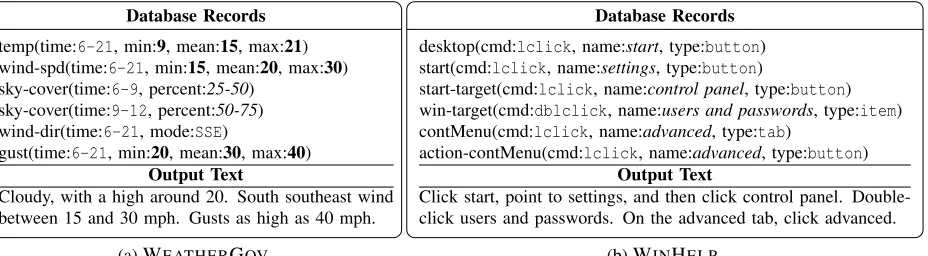
Database Records
temp(time:6-21, min:9, mean:15, max:21) wind-spd(time:6-21, min:15, mean:20, max:30) sky-cover(time:6-9, percent:25-50)
sky-cover(time:9-12, percent:50-75) wind-dir(time:6-21, mode:SSE)
gust(time:6-21, min:20, mean:30, max:40)
Output Text
Cloudy, with a high around 20. South southeast wind between 15 and 30 mph. Gusts as high as 40 mph.
(a)WEATHERGOV
Database Records
desktop(cmd:lclick, name:start, type:button) start(cmd:lclick, name:settings, type:button)
start-target(cmd:lclick, name:control panel, type:button) win-target(cmd:dblclick, name:users and passwords, type:item) contMenu(cmd:lclick, name:advanced, type:tab)
action-contMenu(cmd:lclick, name:advanced, type:button)
Output Text
Click start, point to settings, and then click control panel. Double-click users and passwords. On the advanced tab, Double-click advanced.
[image:2.612.76.540.60.188.2](b)WINHELP
Figure 1: Database records and corresponding text for (a) weather forecasting and (b) Windows trou-bleshooting. Each record has a type (e.g., win-target), and a set of fields. Each field has a value, which can be categorical (intypewriter), an integer (inbold), or a literal string (initalics).
icalization of input entries), and surface realization jointly. We focus on the problem of generating text from a database. The input to our model is a set of database records and collocated descriptions, exam-ples of which are shown in Figure 1.
Given this input, we define a probabilistic context-free grammar (PCFG) that captures the structure of the database and how it can be verbal-ized. Specifically, we extend the model of Kon-stas and Lapata (2012) which also uses a PCFG to perform content selection and surface realization, but does not capture any aspect of document plan-ning. We represent content plans with grammar rules which operate on the document level and are embedded on top of the original PCFG. We essen-tially learn a discourse grammar following two ap-proaches. The first one is linguistically naive but applicable to multiple languages and domains; it ex-tracts rules representing global patterns of record sequences within a sentence and among sentences from a training corpus. The second approach learns document plans based onRhetorical Structure The-ory(RST; Mann and Thomson, 1988); it therefore has a solid linguistic foundation, but is resource in-tensive as it assumes access to a text-level discourse parser.
We learn document plans automatically using both representations and develop a tractable decod-ing algorithm for finddecod-ing the best output, i.e., deriva-tion in our grammar. To the best of our knowledge, this is the first data-driven model to incorporate doc-ument planning in a joint end-to-end system. Exper-imental evaluation on the WEATHERGOV (Liang et
al., 2009) andWINHELP(Branavan et al., 2009)
do-mains shows that our approach improves over Kon-stas and Lapata (2012) by a wide margin.
2 Related Work
Content planning is a fundamental component in a natural generation system. Not only does it deter-mine which information-bearing units to talk about, but also arranges them into a structure that cre-ates coherent output. It is therefore not surpris-ing that many content planners have been based on theories of discourse coherence (Hovy, 1993; Scott and de Souza, 1990). Other work has re-lied on generic planners (Dale, 1988) or schemas (Duboue and McKeown, 2002). In all cases, con-tent plans are created manually, sometimes through corpus analysis. A few researchers recognize that this top-down approach to planning is too inflexible and adopt a generate-and-rank architecture instead (Mellish et al., 1998; Karamanis, 2003; Kibble and Power, 2004). The idea is to produce a large set of candidate plans and select the best one according to a ranking function. The latter is typically devel-oped manually taking into account constraints relat-ing to discourse coherence and the semantics of the domain.
al-gorithms. More recent data-driven work focuses on end-to-end systems rather than individual compo-nents, however without taking document planning into account. For example, Kim and Mooney (2010) first define a generative model similar to Liang et al. (2009) that selects which database records to talk about and then use an existing surface real-izer (Wong and Mooney, 2007) to render the cho-sen records in natural language. Their content plan-ner has no notion of coherence. Angeli et al. (2010) adopt a more unified approach that builds on top of the alignment model of Liang et al. (2009). They break record selection into a series of locally coher-ent decisions, by first deciding on what records to talk about. Each choice is based on a history of previous decisions, which is encoded in the form of discriminative features in a log-linear model. Analogously, they choose fields for each record, and finally verbalize the input using automatically extracted domain-specific templates from training data.
Konstas and Lapata (2012) propose a joint model, which recasts content selection and surface realiza-tion into a parsing problem. Their model optimizes the choice of records, fields and words simultane-ously, however they still select and order records lo-cally. We replace their content selection mechanism (which is based on a simple markovized chaining of records) with global document representations. A planin our model is identified either as a sequence of sentences, each containing a sequence of records, or as a tree where the internal nodes denote dis-course information and the leaf nodes correspond to records.
3 Problem Formulation
The generator takes as input a set of database recordsd and outputs a textg that verbalizes some of these records. Each record token ri ∈d, with 1≤i≤ |d|, has a typeri.t and a set of fields f as-sociated with it. Fields have different values f.vand types f.t(i.e., integer, categorical, or literal strings). For example, in Figure 1b, win-target is a record type with three fields: cmd (denotes the action the user must perform on an object on their screen, e.g., left-click), name (denotes the name of the ob-ject), and type (denotes the type of the object). The values of these fields aredblclick,users and pass-words, anditem; name is a literal string, the rest are
Grammar Rules
1. S→R(start)
2. R(ri.t)→FS(rj,start)R(rj.t)|FS(rj,start)
3. FS(r,r.fi)→F(r,r.fj)FS(r,r.fj)|F(r,r.fj)
4. F(r,r.f)→W(r,r.f)F(r,r.f)|W(r,r.f)
5. W(r,r.f)→α|g(f.v)
Figure 2: GrammarGof the original model. Paren-theses denote features, and impose constraints on the grammar.
categorical.
During training, our algorithm is given a corpus consisting of severalscenarios, i.e., database records paired with texts w (see Figure 1). For each sce-nario, the model first decides on aglobal document plan, i.e., it selects whichtypes of recordsbelong to each sentence (or phrase) and how these sentences (or phrases) should be ordered. Then it selects ap-propriate record tokens for each type and progres-sively chooses the most relevant fields; then, based on the values of the fields, it generates the final text, word by word.
4 Original Model
Our work builds on the model developed by Kon-stas and Lapata (2012). The latter is essentially a PCFG which captures both the structure of the input database and the way it renders into natural language. This grammar-based approach lends it-self well to the incorporation of document planning which has traditionally assumed tree-like represen-tations. We first briefly describe the original model and then present our extensions in Section 5.
Grammar Grammar G in Figure 2 defines a set of non-recursive CFG rewrite rules that capture the structure of the database, i.e., the relationship be-tween records, records and fields, fields and words. These rules are domain-independent and could be applied to any database provided it follows the same structure. Non-terminal symbols are in capitals, the terminal symbolαcorresponds to the vocabulary of
act as constraints and impose non-recursion (e.g., in rule (2)i6= j, so that a record cannot emit itself).
Rule (1) defines the expansion from the start sym-bol S to the first record R of typestart. The rules in (2) implement content selection, by choosing ap-propriate records from the database and generating a sequence. R(ri.t) is the source record, R(rj.t) is the target record and FS(rj.start)is a place-holder symbol for the set of fields of record tokenrj. This method is locally optimal, since it only keeps track of the previous type of record for each re-write. The rules in (3) conclude content selection on the field level, i.e., after we have chosen a record, we select and order the corresponding fields. Finally, the rules in (4) and (5) correspond to surface realization. The former rule binarizes the sequence of words emitted by a particular fieldr.fin an attempt to capture local dependencies between words, such as multi-word expressions (e.g., right click, radio button). The lat-ter rule defines the emission of words and integer numbers1, given a field type and its value. Note that the original model lexicalizes field values of cate-gorical and integer type only.
Training The rules of grammar Gare associated with weights that are learned using the EM algo-rithm (Dempster et al., 1977). During training, the records, fields and values of database d and the wordswfrom the associated text are observed, and the model learns the mapping between them. Notice that we use wto denote the gold-standard text and gto refer to the words generated by the model. The mapping between the database and the observed text is unknown and thus the weights of the rules define a hidden correspondence h between records, fields and their values.
Decoding Given a trained grammar Gand an in-put scenario from a databased, the model generates text by finding the most likely derivation, i.e., se-quence of rewrite rules for the input. Although re-sembling parsing, the generation task is subtly dif-ferent. In parsing, we observe a string of words and our goal is to find the most probable syntactic struc-ture, i.e., hidden correspondence ˆh. In generation,
1The functiong(f.v):
Z→Z, generates an integer in the following six ways (Liang et al., 2009): identical, rounding up/down to a multiple of 5, rounding off a multiple of 5 and adding or subtracting some noise modelled by a geometric dis-tribution.
however, the string is not observed; instead, we must find the best text ˆg, by maximizing both overhandg, whereg=g1. . .gN is a sequence of words licensed
byG. More formally:
ˆ g= f
arg max
g,h P (g,h)
(1)
where f is a function that takes as input a derivation tree(g,h)and returns ˆg. Konstas and Lapata (2012) use a modified version of the CYK parser (Kasami, 1965; Younger, 1967) to find ˆg. Specifically, they intersect grammarGwith an-gram language model and calculate the most probable generation ˆgas:
ˆ g= f
arg max g,h p(g)
·p(g,h|d) (2)
wherep(g,h|d)is the decoding likelihood for a se-quence of wordsg=g1. . .gN of length N and the
hidden correspondencehthat emits it, i.e., the likeli-hood of the grammar for a given database input sce-nariod. p(g)is a measure of the quality of each out-put and is provided by then-gram language model.
5 Extensions
In this section we extend the model of Konstas and Lapata (2012) by developing two more sophisticated content selection approaches which are informed by a global plan of the document to be generated.
5.1 Planning with Record Sequences
Grammar Our key idea is to replace the content selection mechanism of the original model with a document plan which essentially defines a gram-mar on record types. We split a document into sentences, each terminated by a full-stop. Then a sentence is further split into a sequence of record types. Contrary to the original model, we observe a complete sequence2 of record types, split into sen-tences. This way we learn domain-specific pat-terns of frequently occurring record type sequences among the sentences of a document, as well as more local structures within a sentence. We thus substitute rules (1)–(2) in Figure 2 with sub-grammar GRSE based on record type sequences:
Definition 1 (GRSEgrammar)
GRSE={ΣR,NRSE,PRSE,D}
where ΣR is a set of terminal symbols R(r.t), and NRSEis a set of non-terminal symbols:
NRSE={D,SENT}
where D represents the start symbol and SENT a sequence of records.PRSEis a set of production rules of the form:
(a) D→SENT(ti, . . . ,tj) . . . SENT(tl, . . . ,tm)
(b) SENT(ti, . . . ,tj)→R(ra.ti) . . . R(rk.tj)·
wheretis a record type,ti,tj,tl andtmmay overlap andra,rk are record tokens of typeti andtj respec-tively. The corresponding weights for the production rulesPRSE are:
Definition 2 (GRSEweights)
(a) p(ti, . . . ,tj, . . .tl, . . . ,tm|D)
(b) p(ti) ·...·p(tj) =|s(1ti)| ·. . . ·|s(1tj)|
wheres(t)is a function that returns the set of records with typet(Liang et al., 2009).
Rule (a) defines the expansion from the start sym-bolDto a sequence of sentences, each represented by the non-terminalSENT. Similarly to the original grammarG, we employ the use of features (in paren-theses) to denote a sequence of record types. The same record types may recur in different sentences, but not in the same one. The weight of rule (a) is simply the joint probability of all the record types present, ordered and segmented appropriately into sentences in the document, given the start symbol.
Once record types have been selected (on a per sentence basis) we move on to rule (b) which de-scribes how each non-terminal SENT expands to an ordered sequence of records R, as they are ob-served within a sentence (see the terminal sym-bol ‘.’ at the end of the rule). Notice that a record typeti may correspond to several record tokensra. Rules (3)–(5) in grammarGmake decisions on these tokens based on the overall content of the database and the field/value selection. The weight of this rule is the product of the weights of each record type. This is set to the uniform distribution over {1, ..., |s(t)|} for record typet, where |s(t)|is the number of records with that type.
Figure 3d shows an example tree for the database input in Figure 1b, usingGRSEand assuming that the alignments between records and text are given. The
top level of the tree refers to the sequence of record types as they are observed in the text. The first sen-tence contains three records with types ‘desktop’, ‘start’ and ‘start-target’, each corresponding to the textual segments click start, point to settings, and then click control panel. The next level on the tree, denotes the choice of record tokens for each sen-tence, provided that we have decided on the choice and order of their types (see Figure 3b). In Fig-ure 3d, the bottom-left sub-tree corresponds to the choice of the first three records of Figure 1b.
Training A straightforward way to train the ex-tended model would be to embed the parameters of GRSE in the original model and then run the EM al-gorithm using inside-outside at the E-step. Unfortu-nately, this method will induce a prohibitively large search space. Rule (a) enumerates all possible com-binations of record type sequences and the number grows exponentially even for a few record types and a small sequence size. To tackle this problem, we ex-tracted rules forGRSE from the training data, based on the assumption that there will be far fewer unique sequences of record types per dataset than exhaus-tively enumerating all possibilities.
For each scenario, we obtain a word-by-word alignment between the database records and the cor-responding text. In our experiments we used Liang et al.’s (2009) unsupervised model, however any other semi- or fully supervised method could be used. As we show in Section 7, the quality of the alignment inevitably correlates with the quality of the extracted grammar and the decoder’s output. We then map the aligned record tokens to their corre-sponding types, merge adjacent words with the same type and segment on punctuation (see Figure 3b). Next, we create the corresponding tree according to GRSE (Figure 3d) and binarize it. We experimented both with left and right binarization and adhered to the latter, as it obtained a more compact set of rules. Finally, we collectively count the rule weights on the resulting treebank and extract a rule set, discarding rules with frequency less than three.
desktop1
Click start,
start1
point to settings,
start-target1
and then click control panel.
win-target1
Double-click users and passwords.
contMenu1
On the advanced tab ,p
action-contMenu1
click advanced.
(a) Record token alignments
h
desktop start start-targetkwin-targetkcontMenu action-contMenuki
(b) Record type segmentation
[Click start,]desktop1.t [point to settings, ]start1.t [and then
click control panel.]start−target1.t [Double-click users and
passwords.]win−target1.t [On the advanced tab,]contMenu1.t [click
advanced.]action−contMenu1.t
(c) Segmentation of text into EDUs
D
SENT(c,a-c)
R(a-c1.t) R(c1.t)
SENT(w-t)
R(w-t1.t) SENT(d,s,s-t)
R(s-t1.t) R(s1.t)
R(d1.t)
(d) Document plan using theGRSEgrammar
D
Elaboration[N][S]
Elaboration[N][S]
R(a-c1.t) R(c1.t)
Elaboration[N][S]
R(w-t1.t) Elaboration[N][S]
Joint[N][N]
R(s-t1.t) R(s1.t)
R(d1.t)
[image:6.612.71.542.64.91.2](e) Document plan using theGRSTgrammar
Figure 3: Grammar extraction example from theWINHELPdomain usingGRSEandGRST. ForGRSE, we take
the alignments of records on words and map them to their corresponding types (a); we then segment record types into sentences (b); and finally, create a tree using grammarGRSE (c). ForGRST, we segment the text into EDUs based on the records they align to (d) and output the discourse tree (omitted here for brevity’s sake); we build the document plan once we substitute the EDUs with their corresponding record types (e).
bound of the Viterbi search algorithm. Note that the original grammar is limited to the generation of cat-egorical and integer values. We extend it to support the generation of strings. The following rule adds a simple verbatim lexicalization for string values:
W(r,r.f)→gen str(f.v,i)
gen str(f.v,i):V→V, f.v∈V
where V is the set of words for the fields of type string, andgen str is a function that takes the value of a string-typed field f.v, and the position i in the string, and generates the corresponding word at that position. For example,gen str(users and pass-words, 3) =passwords. The weight of this rule is set to 1.
5.2 Planning with Rhetorical Structure Theory
Grammar RST (Mann and Thompson, 1988) is a theory of text organization which provides a frame-work for analyzing text. A basic tenet of the the-ory is that a text consists of hierarchically organized text spans or elementary discourse units (EDUs) that
stand in various relations to one another (e.g., Elab-oration, Attribution). These “rhetorical relations” hold between two adjacent parts of the text, where typically, one part is “nuclear” and one a “satellite”. An analysis of a text consists in identifying the re-lations holding between successively larger parts of the text, yielding a natural hierarchical description of the rhetorical organization of the text. From its very inception, RST was conceived as a way to char-acterize text and textual relations for the purpose of text generation.
Definition 3 (GRST grammar)
GRST ={ΣR,NRST,PRST,D}
where ΣR is the alphabet of leaf nodes as de-fined in Section 5.1,NRST is a set of non-terminals corresponding to rhetorical relations augmented with nucleus-satellite information (e.g., Elabora-tion[N][S] stands for the elaboration relation be-tween the nucleus EDU left-adjoining with the satel-lite EDU),PRST is the set of production rules of the formPRST⊆NRST× {NRST∪ΣR} × {NRST∪ΣR} as-sociated with a weight for each rule, andD∈NRST is the root symbol. Figure 3e gives the discourse tree for the database input of Figure 1b, usingGRST.
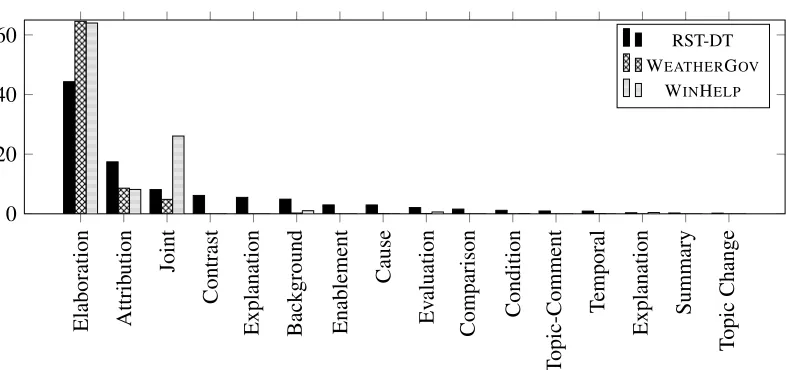
Training In order to obtain the weighted produc-tions ofGRST, we use an existing state-of-the-art dis-course parser3(Feng and Hirst, 2012) trained on the RST-DT corpus (Carlson et al., 2001). The latter contains a selection of 385 Wall Street Journal arti-cles which have been annotated using the framework of RST and an inventory of 78 rhetorical relations, classified into 18 coarse-grained categories (Carl-son and Marcu, 2001). Figure 4 gives a compari(Carl-son of the distribution of relations extracted for the two datasets we used, against the gold-standard annota-tion of RST-DT. The statistics for the RST-DT cor-pus are taken from Williams and Power (2008). The relative frequencies of relations on both datasets fol-low closely the distribution of those in RST-DT, thus empirically supporting the application of the RST framework to our data.
We segment each document in our training set into EDUs based on the record-to-text alignments given by the model of Liang et al. (2009) (see Fig-ure 3c). We then run the discourse parser on the resulting EDUs, and retrieve the corresponding dis-course tree; the internal nodes are labelled with one of the RST relations. Finally, we replace the leaf EDUs with their respective terminal symbols R(r.t) ∈ ΣR (Figure 3e) and collect the resulting grammar productions; their weights are calculated via maximum likelihood estimation based on their collective counts in the parse trees licensed byGRST. Training and decoding of the extended generation model (after we embedGRST in the original gram-marG) is performed identically to Section 5.1.
3Publicly available from http://www.cs.toronto.edu/
˜weifeng/software.html.
6 Experimental Design
Data Since our aim was to evaluate the planning component of our model, we used datasets whose documents are at least a few sentences long. Specif-ically, we generated weather forecasts and trou-bleshooting guides for an operating system. For the first domain (henceforthWEATHERGOV) we used
the dataset of Liang et al. (2009), which consists of 29,528 weather scenarios for 3,753 major US cities (collected over four days). The database has 12 record types, each scenario contains on average 36 records, 5.8 out of which are mentioned in the text. A document has 29.3 words and is four sen-tences long. The vocabulary is 345 words. We used 25,000 scenarios from WEATHERGOV for training,
1,000 scenarios for development and 3,528 scenar-ios for testing.
For the second domain (henceforthWINHELP) we
used the dataset of Branavan et al. (2009), which consists of 128 scenarios. These are articles from Microsoft’s Help and Support website4and contain step-by-step instructions on how to perform tasks on the Windows 2000 operating system. In its original format, the database provides a semantic representa-tion of the textual guide, i.e., it represents the user’s actions on the operating system’s UI. We semi-automatically converted this representation into a schema of records, fields and values, following the conventions adopted in Branavan et al. (2009).5 The final database has 13 record types. Each scenario has 9.2 records and each document 51.92 words with 4.3 sentences. The vocabulary is 629 words. We per-formed 10-fold cross-validation on the entire dataset for training and testing. Compared to WEATHER -GOV, WINHELPdocuments are longer with a larger
vocabulary. More importantly, due to the nature of the domain, i.e., giving instructions, content selec-tion is critical not only in terms of what to say but also in what order.
Grammar Extraction and Parameter Setting
We obtained alignments between database records and textual segments for both domains and gram-mars (GRSEandGRST) using the unsupervised model of Liang et al. (2009). On WEATHERGOV, we
ex-tracted a GRSE grammar with 663 rules (after
bi-4support.microsoft.com
5The dataset can be downloaded fromhttp://homepages.
Elaboration Attrib ution Joint
Contrast
Explanation Background Enablement
Cause
Ev
aluation
Comparison Condition
T
opic-Comment
T
emporal
Explanation Summary
T
opic
Change
0 20 40
60 RST-DT
WEATHERGOV
[image:8.612.110.503.55.240.2]WINHELP
Figure 4: Distribution of RST relations onWEATHERGOV,WINHELP, and the RST-DT (Williams and Power,
2008).
narization). The WINHELP dataset is considerably
smaller, and as a result the procedure described in Section 5.1 yields a very sparse grammar. To al-leviate this, we horizontally markovized the right-hand side of each rule (Collins, 1999; Klein and Manning, 2003).6 After markovization, we obtained
aGRSE grammar with 516 rules. OnWEATHERGOV, we extracted 434 rules forGRST. OnWINHELP we
could not follow the horizontal markovization pro-cedure, since the discourse trees are already bina-rized. Instead, we performedvertical markovization, i.e., annotated each non-terminal with their parent node (Johnson, 1998) and obtained aGRST grammar with 419 rules. The model of Konstas and Lapata (2012) has two parameters, namely the number of k-best lists to keep in each derivation, and the or-der of the language model. We tunedk experimen-tally on the development set and obtained best re-sults with 60 for WEATHERGOV and 120 for WIN -HELP. We used a trigram model for both domains,
trained on each training set.
Evaluation We compared two configurations of our system, one with a content planning compo-nent based on record type sequences (GRSE) and
6When horizontally markovizing, we can encode an arbi-trary amount of context in the intermediate non-terminals that result from this process; in our case we store h=1 horizontal siblings plus the mother left-hand side (LHS) non-terminal, in order to uniquely identify the Markov chain. For example, A→B C D becomesA→BhA. . .Bi, hA. . .Bi →ChA. . .Ci,
hA. . .Ci →D.
another one based on RST (GRST). In both cases content plans were extracted from (noisy) unsuper-vised alignments. As a baseline, we used the orig-inal model of Konstas and Lapata (2012). We also compared our model to Angeli et al.’s system (2010), which is state of the art onWEATHERGOV.
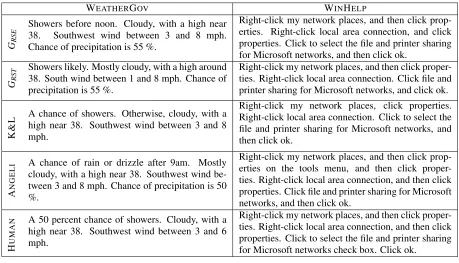
System output was evaluated automatically, using the BLEU modified precision score (Papineni et al., 2002) with the human-written text as reference. In addition, we evaluated the generated text by eliciting human judgments. Participants were presented with a scenario and its corresponding verbalization and were asked to rate the latter along three dimensions: fluency (is the text grammatical?), semantic correct-ness (does the meaning conveyed by the text corre-spond to the database input?) and coherence (is the text comprehensible and logically structured?). Par-ticipants used a five point rating scale where a high number indicates better performance. We randomly selected 12 documents from the test set (for each do-main) and produced output with the system of Kon-stas and Lapata (2012) (henceforth K&L), our two models usingGRSE andGRST, respectively, and An-geli et al. (2010) (henceforth ANGELI). We also in-cluded the original text (HUMAN) as gold-standard. We obtained ratings for 60 (12×5) scenario-text pairs for each domain. Examples of the documents shown to the participants are given in Table 1.
us-WEATHERGOV WINHELP
GRS
E
Showers before noon. Cloudy, with a high near 38. Southwest wind between 3 and 8 mph. Chance of precipitation is 55 %.
Right-click my network places, and then click prop-erties. Right-click local area connection, and click properties. Click to select the file and printer sharing for Microsoft networks, and then click ok.
GRS
T Showers likely. Mostly cloudy, with a high around 38. South wind between 1 and 8 mph. Chance of precipitation is 55 %.
Right-click my network places, and then click proper-ties. Right-click local area connection. Click file and printer sharing for Microsoft networks, and click ok.
K
&
L A chance of showers. Otherwise, cloudy, with ahigh near 38. Southwest wind between 3 and 8
mph.
Right-click my network places, click properties. Right-click local area connection. Click to select the file and printer sharing for Microsoft networks, and then click ok.
A
N
G
E
L
I A chance of rain or drizzle after 9am. Mostly
cloudy, with a high near 38. Southwest wind be-tween 3 and 8 mph. Chance of precipitation is 50 %.
Right-click my network places, and then click prop-erties on the tools menu, and then click proper-ties. Right-click local area connection, and then click properties. Click file and printer sharing for Microsoft networks, and then click ok.
H
U
M
A
N A 50 percent chance of showers. Cloudy, with a
high near 38. Southwest wind between 3 and 6 mph.
[image:9.612.75.534.58.321.2]Right-click my network places, and then click proper-ties. Right-click local area connection, and then click properties. Click to select the file and printer sharing for Microsoft networks check box. Click ok.
Table 1: Human-authored text and system output onWEATHERGOVandWINHELP.
ing Amazon Mechanical Turk7, and involved 200 volunteers (100 for WEATHERGOV, and 100 for
WINHELP), all self reported native English
speak-ers. ForWINHELP, we made sure participants were
computer-literate and familiar with the Windows op-erating system by administering a short question-naire prior to the experiment.
7 Results
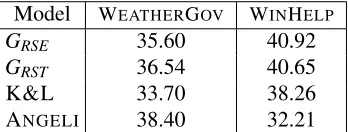
The results of the automatic evaluation are summa-rized in Table 2. Overall, our models outperform K&L’s system by a wide margin on both datasets. The two content planners (GRSEand GRST) perform comparably in terms of BLEU. This suggests that document plans induced solely from data are of sim-ilar quality to those informed by RST. This is an encouraging result given that RST-style discourse parsers are currently available only for English. AN
-GELIperforms better onWEATHERGOVpossibly due
to better output quality on the surface level. Their system defines trigger patterns that specifically lexi-calize record fields containing numbers. In contrast, onWINHELPit is difficult to explicitly specify such
patterns, as none of the record fields are numeric; as a result their system performs poorly compared to
7https://www.mturk.com
the other models.
To assess the impact of the alignment on the content planner, we also extracted GRSE from cleaner alignments which we obtained automat-ically via human-crafted heuristics for each do-main. The heuristics performed mostly anchor matching between database records and words in the text (e.g., the value Lkly of the field rainChance, matches with the string rain likely in the text). Using these alignments, GRSE obtained a BLEU score of 39.23 onWEATHERGOVand 41.35 onWIN -HELP. These results indicate that improved
align-ments would lead to more accurate grammar rules. WEATHERGOV seems more sensitive to the
align-ments than WINHELP. This is probably because
the dataset shows more structural variations in the choice of record types at the document level, and therefore the grammar extracted from the unsuper-vised alignments is noisier. Unfortunately, perform-ing this kind of analysis forGRST would require gold standard segmentation of our training corpus into EDUs which we neither have nor can easily approx-imate via heuristics.
Model WEATHERGOV WINHELP
GRSE 35.60 40.92
GRST 36.54 40.65
K&L 33.70 38.26
[image:10.612.99.273.60.126.2]ANGELI 38.40 32.21
Table 2: Automatic evaluation of system output us-ing BLEU-4.
WEATHERGOV WINHELP
Model FL SC CO FL SC CO
GRSE 4.25 3.75 4.18 3.59 3.21 3.35 GRST 4.10 3.68 4.10 3.45 3.29 3.22 K&L 3.73 3.25 3.59 3.27 2.97 2.93 ANGELI 3.90 3.44 3.82 3.44 2.79 2.97 HUMAN 4.22 3.72 4.11 4.20 4.41 4.25
Table 3: Mean ratings for fluency (FL), semantic correctness (SC) and coherence (CO) on system out-put elicited by humans.
type (GRSE,GRST, K&L, ANGELI, and HUMAN) on fluency, semantic correctness and coherence ratings. Means differences of 0.2 or more are significant at the 0.05 level using a post-hoc Tukey test. Interest-ingly, we observe that document planning improves system output overall, not only in terms of coher-ence. Across all dimensions our models are per-ceived better than K&L and ANGELI. As far as co-herence is concerned, the two content planners are rated comparably (differences in the means are not significant). Both GRSE andGRST are significantly better than the comparison systems (ANGELI and
K&L). Table 1 illustrates examples of system out-put along with the gold standard content selection for reference, for the WEATHERGOV and WINHELP
domains, respectively.
In sum, we observe that integrating document planning either via GRSE or GRST boosts perfor-mance. Document plans induced from record sequences exhibit similar performance, compared to those generated using expert-derived linguistic knowledge. Our systems are consistently better than K&L both in terms of automatic and human eval-uation and are close or better than the supervised model of Angeli et al. (2010). We also show that feeding the system with a grammar of better qual-ity can achieve state-of-the-art performance, without
further changes to the model.
8 Conclusions
In this paper, we have proposed an end-to-end sys-tem that generates text from database input and cap-tures all components of the traditional generation pipeline, including document planning. Document plans are induced automatically from training data and are represented intuitively by PCFG rules cap-turing the structure of the database and the way it renders to text. We proposed two complementary approaches to inducing content planners. In a first linguistically naive approach, a document is mod-elled as a sequence of sentences and each sentence as a sequence of records. Our second approach draws inspiration from Rhetorical Structure Theory (Mann and Thomson, 1988) and represents a docu-ment as a tree with intermediate nodes correspond-ing to discourse relations, and leaf nodes to database records.
Experiments with both approaches demonstrate improvements over models that do not incorporate document planning. In the future, we would like to tackle more challenging domains, such as NFL re-caps, financial articles and biographies (Howald et al., 2013; Schilder et al., 2013). Our models could also benefit from the development of more sophis-ticated planners either via grammar refinement or more expressive grammar formalisms (Cohn et al., 2010).
Acknowledgments
We are grateful to Percy Liang and Gabor Angeli for providing us with their code and data. Thanks to Giorgio Satta and Charles Sutton for helpful com-ments and suggestions. We also thank the members of the Probabilistic Models reading group at the Uni-versity of Edinburgh for useful feedback.
References
Gabor Angeli, Percy Liang, and Dan Klein. 2010. A simple domain-independent probabilistic approach to generation. InProceedings of the 2010 Conference on Empirical Methods in Natural Language Processing, pages 502–512, Cambridge, MA.
[image:10.612.81.291.184.280.2]Empirical Methods in Natural Language Processing, pages 331–338, Vancouver, British Columbia. Anja Belz. 2008. Automatic generation of
weather forecast texts using comprehensive probabilis-tic generation-space models. Natural Language Engi-neering, 14(4):431–455.
S.R.K. Branavan, Harr Chen, Luke Zettlemoyer, and Regina Barzilay. 2009. Reinforcement learning for mapping instructions to actions. In Proceedings of the Joint Conference of the 47th Annual Meeting of the ACL and the 4th International Joint Conference on Natural Language Processing of the AFNLP, pages 82–90, Suntec, Singapore.
L. Carlson and D. Marcu. 2001. Discourse tagging ref-erence manual. Technical report, Univ. of Southern California / Information Sciences Institute.
Lynn Carlson, Daniel Marcu, and Mary Ellen Okurowski. 2001. Building a discourse-tagged corpus in the framework of rhetorical structure theory. In Proceed-ings of the Second SIGdial Workshop on Discourse and Dialogue - Volume 16, SIGDIAL ’01, pages 1–10, Stroudsburg, PA, USA. Association for Computational Linguistics.
David L. Chen and Raymond J. Mooney. 2008. Learn-ing to sportscast: A test of grounded language acqui-sition. InProceedings of International Conference on Machine Learning, pages 128–135, Helsinki, Finland. Trevor Cohn, Phil Blunsom, and Sharon Goldwater. 2010. Inducing tree-substitution grammars. Journal of Machine Learning Research, 11(November):3053– 3096.
M. Collins. 1999. Head-Driven Statistical Models for Natural Language Parsing. Ph.D. thesis, University of Pennsylvania.
Robert Dale. 1988. Generating referring expressions in a domain of objects and processes. Ph.D. thesis, Uni-versity of Edinburgh.
A. P. Dempster, N. M. Laird, and D. B. Rubin. 1977. Maximum likelihood from incomplete data via the em algorithm. Journal of the royal statistical society, se-ries B, 39(1):1–38.
Pablo A. Duboue and Kathleen R. McKeown. 2001. Em-pirically estimating order constraints for content plan-ning in generation. In Proceedings of the 39th An-nual Meeting on Association for Computational Lin-guistics, pages 172–179.
Pablo A. Duboue and Kathleen R. McKeown. 2002. Content planner construction via evolutionary algo-rithms and a corpus-based fitness function. In Pro-ceedings of International Natural Language Genera-tion, pages 89–96, Ramapo Mountains, NY.
Vanessa Wei Feng and Graeme Hirst. 2012. Text-level discourse parsing with rich linguistic features. In
Pro-ceedings of the 50th Annual Meeting of the Associa-tion for ComputaAssocia-tional Linguistics, pages 60–68, Jeju Island, Korea.
Eduard Hovy. 1993. Automated discourse generation using discourse structure relations. Artificial Intelli-gence, 63:341–385.
Blake Howald, Ravikumar Kondadadi, and Frank Schilder. 2013. Domain adaptable semantic clustering in statistical nlg. InProceedings of the 10th Interna-tional Conference on ComputaInterna-tional Semantics (IWCS 2013) – Long Papers, pages 143–154, Potsdam, Ger-many, March. Association for Computational Linguis-tics.
Mark Johnson. 1998. Pcfg models of linguistic tree rep-resentations. Computational Linguistics, 24(4):613– 632, December.
Nikiforos Karamanis. 2003. Entity Coherence for De-scriptive Text Structuring. Ph.D. thesis, University of Edinburgh.
Tadao Kasami. 1965. An efficient recognition and syntax analysis algorithm for context-free languages. Techni-cal Report AFCRL-65-758, Air Force Cambridge Re-search Lab, Bedford, MA.
Rodger Kibble and Richard Power. 2004. Optimising referential coherence in text generation. Computa-tional Linguistics, 30(4):401–416.
Joohyun Kim and Raymond Mooney. 2010. Generative alignment and semantic parsing for learning from am-biguous supervision. InProceedings of the 23rd Con-ference on Computational Linguistics, pages 543–551, Beijing, China.
Dan Klein and Christopher D. Manning. 2003. Accurate unlexicalized parsing. InProceedings of the 41st An-nual Meeting on Association for Computational Lin-guistics, pages 423–430. Association for Computa-tional Linguistics Morristown, NJ, USA.
Ioannis Konstas and Mirella Lapata. 2012. Unsupervised concept-to-text generation with hypergraphs. In Pro-ceedings of the 2012 Conference of the North Ameri-can Chapter of the Association for Computational Lin-guistics: Human Language Technologies, pages 752– 761, Montr´eal, Canada.
Percy Liang, Michael Jordan, and Dan Klein. 2009. Learning semantic correspondences with less supervi-sion. InProceedings of the Joint Conference of the 47th Annual Meeting of the ACL and the 4th Interna-tional Joint Conference on Natural Language Process-ing of the AFNLP, pages 91–99, Suntec, Singapore. William C. Mann and Sandra A. Thompson. 1988.
Rhetorical structure theory: Toward a functional the-ory of text organization.Text, 8(3):243–281.
Chris Mellish, Alisdair Knott, Jon Oberlander, and Mick O’Donnell. 1998. Experiments using stochastic search for text planning. In Proceedings of Interna-tional Natural Language Generation, pages 98–107, New Brunswick, NJ.
Kishore Papineni, Salim Roukos, Todd Ward, and Wei-Jing Zhu. 2002. Bleu: a method for automatic eval-uation of machine translation. InProceedings of 40th Annual Meeting of the Association for Computational Linguistics, pages 311–318, Philadelphia, Pennsylva-nia.
Ehud Reiter and Robert Dale. 2000. Building natural language generation systems. Cambridge University Press, New York, NY.
Ehud Reiter, Somayajulu Sripada, Jim Hunter, and Ian Davy. 2005. Choosing words in computer-generated weather forecasts. Artificial Intelligence, 167:137– 169.
Frank Schilder, Blake Howald, and Ravi Kondadadi. 2013. Gennext: A consolidated domain adaptable nlg system. InProceedings of the 14th European Work-shop on Natural Language Generation, pages 178– 182, Sofia, Bulgaria, August. Association for Compu-tational Linguistics.
Donia Scott and Clarisse Sieckenius de Souza. 1990. Getting the message across in RST-based text gener-ation. In Robert Dale, Chris Mellish, and Michael Zock, editors,Current Research in Natural Language Generation, pages 47–73. Academic Press, New York. Amanda Stent, Rashmi Prasad, and Marilyn Walker. 2004. Trainable sentence planning for complex infor-mation presentation in spoken dialog systems. In Pro-ceedings of Association for Computational Linguis-tics, pages 79–86, Barcelona, Spain.
Sandra Williams and Richard Power. 2008. Deriving rhetorical complexity data from the rst-dt corpus. In
Proceedings of the Sixth International Language Re-sources and Evaluation (LREC’08), May.