2131
Argument Mining for Understanding Peer Reviews
Xinyu Hua, Mitko Nikolov, Nikhil Badugu, Lu Wang
Khoury College of Computer Sciences Northeastern University
Boston, MA 02115
{hua.x, nikolov.m, badugu.n}@husky.neu.edu
Abstract
Peer-review plays a critical role in the scien-tific writing and publication ecosystem. To as-sess the efficiency and efficacy of the review-ing process, one essential element is to un-derstand and evaluate the reviews themselves. In this work, we study the content and struc-ture of peer reviews under the argument min-ing framework, through automatically detect-ing (1) argumentative propositions put forward by reviewers, and (2) their types (e.g., evalu-ating the work or making suggestions for im-provement). We first collect 14.2K reviews from major machine learning and natural lan-guage processing venues.400reviews are an-notated with10,386 propositions and corre-sponding types of EVALUATION, REQUEST, FACT, REFERENCE, or QUOTE. We then train state-of-the-art proposition segmentation and classification models on the data to evalu-ate their utilities and identify new challenges for this new domain, motivating future di-rections for argument mining. Further ex-periments show that proposition usage varies across venues in amount, type, and topic.
1 Introduction
Peer review is a process where domain experts scrutinize the quality of research work in their field, and it is a cornerstone of scientific discov-ery (Hettich and Pazzani,2006;Kelly et al.,2014; Price and Flach, 2017). In 2015 alone, approxi-mately63.4million hours were spent on peer re-views (Kovanis et al., 2016). To maximize their benefit to the scientific community, it is crucial to understand and evaluate the construction and lim-itation of reviews themselves. However, minimal work has been done to analyze reviews’ content and structure, let alone to evaluate their qualities.
As seen in Figure 1, peer reviews resemble arguments: they contain argumentative propo-sitions (henceforth propositions) that convey
re-Review#1(rating:5,# sentences:11)
[Quality: This paper demonstrates that convolutional and
re-lational neural networks fail to solve visual relation prob-lems . . . ]FACT [This points at important limitations of
cur-rent neural network architectures where architectures depend
mainly on rote memorization.]EVAL . . . [Significance: This
work demonstrates failures of relational networks on relational tasks. . .]FACT[Pros: Important message about network
limita-tions.]EVAL [Cons: Straightforward testing of network
perfor-mance on specific visual relation tasks.]EVAL. . .
Review#2(rating:5,# sentences:10)
[The authors present two autoregressive models. . .]FACT. . .[In
that context , this work can be viewed as applying deep autore-gressive density estimators to policy gradient methods.]EVAL. . .
[At least one of those papers ought to be cited.]REQ[It also seems
like a simple, obvious baseline is missing from their experi-ments. . .]EVAL. . .[The method could even be made to capture
dependencies between different actions by adding a latent prob-abilistic layer. . .]EVAL. . .[A direct comparison against one of the
related methods in the discussion section would help]REQ. . .
Figure 1: Sample ICLR review excerpts. Propositions are annotated with types, such as FACT(fact), EVAL
(evaluation), and REQ(request). Review #2 contains in-depth evaluation and actionable suggestion, thus is perceived to be of a higher quality.
viewers’ interpretation and evaluation of the re-search. Constructive reviews, e.g., review#2, of-ten contain in-depth analysis as well as concrete suggestions. As a result, automatically identify-ing propositions and their types would be useful to understand the composition of peer reviews.
propositions, and (2)proposition classification— labeling the propositions according to their types (e.g., evaluation vs. request).
Since there was no annotated dataset for peer re-views, as part of this study, we first collect14.2K reviews from major machine learning (ML) and natural language processing (NLP) venues. We create a dataset,AMPERE(Argument Mining for PEer REviews), by annotating 400 reviews with 10,386propositions and labeling each proposition with the type of EVALUATION, REQUEST, FACT, REFERENCE, QUOTE, or NON-ARG.1 Significant
inter-annotator agreement is achieved for propo-sition segmentation (Cohen’s κ = 0.93), with good consensus level for type annotation (Krip-pendorf’sαU = 0.61).
We benchmark our new dataset with state-of-the-art and popular argument mining models to better understand the challenges posed in this new domain. We observe a significant drop of perfor-mance for proposition segmentation on AMPERE, mainly due to its different argument structure. For instance,25%of the sentences contain more than one proposition, compared to that of 8% for es-says (Stab and Gurevych, 2017), motivating new solutions for segmentation and classification.
We further investigate review structure differ-ence across venues based on proposition usage, and uncover several patterns. For instance, ACL reviews tend to contain more propositions than those in ML venues, especially with more quests but fewer facts. We further find that re-views with extreme ratings, i.e., strong reject or accept, tend to be shorter and make much fewer requests. Moreover, we probe the salient words for different proposition types. For example, ACL reviewers ask for more “examples” when making requests, while ICLR reviews contain more evalu-ation of “network” and how models are “trained”.
2 AMPERE Dataset
We collect review data from three sources: (1)
openreview.net—an online peer reviewing
platform for ICLR 2017, ICLR 2018, and UAI 2018 2; (2) reviews released for accepted papers at NeurIPS from 2013 to 2017; and (3) opted-in reviews for ACL 2017 fromKang et al.(2018).
1Dataset and annotation guideline can be found athttp:
//xinyuhua.github.io/Resources/naacl19/.
2ICLR reviews are downloaded from the public API:
https://github.com/iesl/openreview-py. UAI reviews are collected by the OpenReview team.
EVALUATION: Subjective statements, often containing
qual-itative judgment. Ex: “This paper shows nice results on a
number of small tasks.”
REQUEST: Statements suggesting a course of action. Ex:
“The authors should compare with the following methods.”
FACT: Objective information of the paper or commonsense
knowledge. Ex: “Existing works on multi-task neural
net-works typically use hand-tuned weights. . .”
REFERENCE: Citations and URLs. Ex: “see MuseGAN (Dong et al), MidiNet (Yang et al), etc ”
QUOTE: Quotations from the paper. Ex:“The author wrote ‘where r is lower bound of feature norm’.”
NON-ARG: Non-argumentative statements. Ex: “Aha, now I understand.”
Table 1: Proposition types and examples.
Dataset #Doc #Sent #Prop
Comments (Park and Cardie,2018) 731 3,994 4,931 Essays (Stab and Gurevych,2017) 402 7,116 6,089 News (Al Khatib et al.,2016) 300 11,754 14,313 Web (Habernal and Gurevych,2017) 340 3,899 1,882
AMPERE 400 8,030 10,386
Table 2: Statistics for AMPERE and some argument mining corpora, including # of annotated propositions.
In total, 14,202 reviews are collected (ICLR: 4,057; UAI: 718; ACL: 275; and NeurIPS: 9,152). All venues except NeurIPS have paper rating scores attached to the reviews.
Annotation Process. For proposition segmenta-tion, we adopt the concepts fromPark et al.(2015) and instruct the annotators to identify elementary argumentative discourse units on sentence or sub-sentence level, based on their discourse functions and topics. They then classify the propositions into five types with an additional non-argument category, as explained in Table1.
400ICLR 2018 reviews are sampled for annota-tion, with similar distributions of length and rating to those of the full dataset. Two annotators who are fluent English speakers first label the400 re-views with proposition segments and types, and a third annotator then resolves disagreements.
We calculate the inter-annotator agreement be-tween the two annotators. A Cohen’sκof0.93is achieved for proposition segmentation, with each review treated as a BIO sequence. For classifi-cation, unitized Krippendorf’s αU (Krippendorff, 2004), which considers disagreements among seg-mentation, is calculated per review and then av-eraged over all samples, and the value is 0.61. Among the exactly matched proposition segments, we report a Cohen’sκof0.64.
min-ing datasets of different genres. We also show the number of propositions in each category in Table 3. The most frequent types are evaluation (38.3%) and fact (36.5%).
[image:3.595.319.512.64.157.2]EVAL REQ FACT REF QUOT NON-A Total 3,982 1,911 3,786 207 161 339 10,386
Table 3: Number of propositions per type in AMPERE.
3 Experiments with Existing Models
We benchmark AMPERE with popular and state-of-the-art models for proposition segmentation and classification. Both tasks can be treated as se-quence tagging problems with the setup similar to Schulz et al.(2018). For experiments,320reviews (7,999propositions) are used for training and80 reviews (2,387propositions) are used for testing. FollowingNiculae et al.(2017),5-fold cross vali-dation on the training set is used for hyperparam-eter tuning. To improve the accuracy of tokeniza-tion, we manually replace mathematical formulas, variables, URL links, and formatted citation with special tokens such as <EQN>, <VAR>, <URL>, and <CIT>. Parameters, lexicons, and features used for the models are described in the supple-mentary material.
3.1 Task I: Proposition Segmentation
We consider three baselines. FullSent: treat-ing each sentence as a proposition. PDTB-conn: further segmenting sentences when any discourse connective (collected from Penn Discourse Tree-bank (Prasad et al., 2007)) is observed. RST-parser: segmenting discourse units by the RST parser inFeng and Hirst(2014).
For learning-based methods, we start with Con-ditional Random Field (CRF) (Lafferty et al., 2001) with features proposed by Stab and Gurevych ((2017), Table 7), andBiLSTM-CRF, a bidirectional Long Short-Term Memory network (BiLSTM) connected to a CRF output layer and further enhanced with ELMo representation (Pe-ters et al., 2018). We adopt the BIO scheme for sequential tagging (Ramshaw and Marcus,1999), with O corresponding to NON-ARG. Finally, we
considerjointly modelingsegmentation and clas-sification by appending the proposition types to BI tags, e.g., B-fact, with CRF (CRF-joint) and BiLSTM-CRF (BiLSTM-CRF-joint).
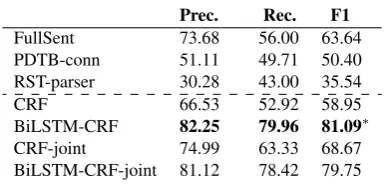
Table 4shows that BiLSTM-CRF outperforms other methods in F1. More importantly, the
perfor-Prec. Rec. F1
FullSent 73.68 56.00 63.64 PDTB-conn 51.11 49.71 50.40 RST-parser 30.28 43.00 35.54
CRF 66.53 52.92 58.95
BiLSTM-CRF 82.25 79.96 81.09∗
[image:3.595.306.527.215.379.2]CRF-joint 74.99 63.33 68.67 BiLSTM-CRF-joint 81.12 78.42 79.75
Table 4: Proposition segmentation results. Result that is significantly better than all comparisons is marked with∗(p <10−6, McNemar test).
Overall EVAL REQ FACT REF QUOT With Gold-Standard Segments
Majority 40.75 57.90 – – – – PropLexicon 36.83 40.42 36.07 32.23 59.57 31.28 SVM 60.98 63.88 69.02 54.7469.47 7.69 CNN 66.56∗ 69.02 63.26 66.1767.44 52.94
With Predicted Segments
Majority 33.30 47.60 – – – – PropLexicon 23.21 22.45 23.97 23.73 35.96 16.67 SVM 51.46 54.05 48.16 52.77 52.27 4.71 CNN 55.48 57.75 53.71 55.19 48.78 33.33 CRF-joint 50.69 46.78 55.74 52.2755.77 26.47
BiLSTM-CRF-joint
62.64∗ 62.36∗67.31∗ 61.8654.74 37.36
Table 5: Proposition classification F1 scores. Re-sults that are significant better than other methods are marked with∗(p <10−6, McNemar test).
mance on reviews is lower than those reached on existing datasets, e.g., an F1 of86.7is obtained by CRF for essays (Stab and Gurevych,2017). This is mostly due to essays’ better structure, with fre-quent use of discourse connectives.
3.2 Task II: Proposition Classification
With given proposition segments, predicted or gold-standard, we experiment with proposition-level models to label proposition types.
We utilize two baselines. Majoritysimply as-signs the majority type in the training set. Pro-pLexiconmatches the following lexicons for dif-ferent proposition types in order, and returns the first corresponding type with a match; if no lexi-con is matched, the proposition is labeled as NON
-ARG:
• REFERENCE:<URL>,<CIT>
• QUOTE: “, ”, ’
• REQUEST: should, would be nice, why, please, would like to, need
• EVALUATION:highly, very, unclear, clear, interesting, novel, well, important, similar, clearly, quite, good • FACT: author, authors, propose, present, method,
For supervised models, we employ linearSVM with a squared hinge loss and group Lasso regu-larizer (Yuan and Lin,2006). It is trained with the top500features selected from Table 9 in (Stab and Gurevych,2017) byχ2test. We also train a convo-lutional neural network (CNN) proposed byKim (2014), with the same setup and pre-trained word embeddings from word2vec (Mikolov et al., 2013). Finally, results by joint models of CRF and BiLSTM-CRF are also reported.
F1 scores for all propositions and each type are reported in Table5. A prediction is correct when both segment and type are matched with the true labels. CNN performs better for types with sig-nificantly more training samples, i.e., evaluation and fact, indicating the effect of data size on neu-ral model’s performance. Joint models (CRF-joint and BiLSTM-CRF-joint) yield the best F1 scores for all categories when gold-standard segmenta-tion is unavailable.
4 Proposition Analysis by Venues
Here we leverage the BiLSTM-CRF-joint model trained on the annotated AMPERE data to iden-tify propositions and their types in unlabeled re-views from the four venues (ICLR, UAI, ACL, and NeurIPS), to understand the content and structure of peer reviews at a larger scale.
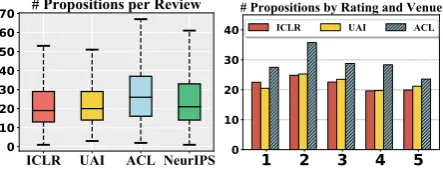
Proposition Usage by Venue and Rating. Fig-ure 2 shows the average number of propositions per review, grouped by venue and rating. Scores in 1−10 are scaled to 1−5 by dx/2e, with 1 as strong reject and5as strong accept. ACL and NeurIPS have significantly more propositions than ICLR and UAI. Ratings, which reflect a reviewer’s judgment of paper quality, also affect proposition usage. We find that reviews with extreme ratings, i.e.,1and5, tend to have fewer propositions.
ICLR UAI ACL NeurIPS
0 10 20 30 40 50 60
70 # Propositions per Review
1 2 3 4 5
0 10 20 30 40
# Propositions by Rating and Venue
[image:4.595.304.524.64.134.2]ICLR UAI ACL
Figure 2: Proposition number in reviews. Differences among venues are all significant except UAI vs. ICLR and ACL vs. NeurIPS (p <10−6, unpairedt-test).
We further study the distribution of proposition type in each venue. As observed in Figure3, ACL
Evaluation Request Fact Reference Quote Non-Arg 0
10 20 30
40 % of Proposition TypeICLR UAI
[image:4.595.313.520.167.289.2]ACL NeurIPS
Figure 3: Distribution of proposition type per venue.
1 2 3 4 5 0
15 30
45 Evaluation
1 2 3 4 5 0
10 20
Request
1 2 3 4 5 0
10 20 30
40 Fact
1 2 3 4 5 0
1 2
3 Reference
1 2 3 4 5 0.0
0.5 1.0 1.5 2.0
2.5 Quote
1 2 3 4 5 0
5 10
15 Non-Arg
Figure 4: Distribution of proposition type per rating (in
%) on AMPERE.
reviews contain more requests but fewer facts than other venues. Specifically, we find that94.6%of ACL reviews have at least one REQUEST propo-sition, compared to 81.5% for ICLR and 84.7% for UAI. We also show proposition type distribu-tion based on ratings in Figure 4. Reviews with the highest rating tend to use fewer evaluation and reference, while reviews with ratings of3−4 (bor-derline or weak accept) contain more requests. We further observe a sharp decrease of QUOTEusage in rating group4, and a surge of NON-ARGfor rat-ing group5, while FACTremains consistent across rating ranges.
Proposition Structure. Argumentative structure, which is usually studied as support and attack relations, reveals how propositions are organized into coherent text. According toPark and Cardie (2018),75%of support relations happen between adjacent propositions in user comments. We thus plot the proposition transition probability matrix in Figure5, to show the argument structure in AM-PERE. The high probabilities along the diagonal line imply that propositions of the same type are often constructed consecutively, with the excep-tion of quote, which is more likely to be followed by evaluation.
[image:4.595.69.291.604.689.2]represen-EVALUATION REQUEST FACT REFERENCE QUOTE
All Venues overall, unclear, not, contribution, seem, in-teresting
please, could, should, if, why, would, more, suggest
think, each, some,
data, useful, written, proposes
<URL>, et, al., confer-ence, paper, proceed-ings, arxiv
”, paper, we, :, our
ICLR network, general,
ac-ceptance, convinced,
trained
network, appendix,
recommend, because, novelty
training, results, work, then, image
deep, ;, nips, pp.,
speech
not, section, 4, 5,
agent
UAI quality, relevant,
found, presentation,
major
<VAR>, model, method, nice, column
stochastic, called, con-siders, sense, writing
artificial, discovery,
etc., via, systems
–, second, column,
processes,
connec-tions
ACL weaknesses, strengths,
so, word, main
consider, examples,
further, models,
proposed
word, method, words, proposed, embeddings
language, extraction,
emnlp, computational, linguistics
NeurIPS theoretical, <EQN>, interest, practical, nips
following, clarity,
address, significance, quality
<EQN>, maximum,
may, comments,
characters
for, see, class, de-tailed, guidelines
[image:5.595.90.271.277.346.2]of, in, which,<EQN>, reviewer
Table 6: Salient words (α= 0.001,χ2test) per proposition type. Top5frequent words that are unique for each
venue are shown. “<EQN>”, “<URL>”, and “<VAR>” are equations, URL links, and variables.
EVALREQFACT REF QUOTNON-A EVAL 50.3 17.2 27.3 1.0 1.4 2.9 REQ 32.2 41.6 19.4 1.8 2.3 2.8 FACT 33.5 11.0 51.2 1.3 0.9 2.0 REF 15.0 10.8 18.0 50.9 3.6 1.8 QUOT 31.2 23.6 25.5 1.3 12.1 6.4 NON-A 31.9 15.5 22.7 1.3 2.8 25.9
Figure 5: Proposition transition prob. on AMPERE.
tative words in each proposition type compared to other types. Table 6 shows both the commonly used salient words across venues and the unique words with top frequencies for each venue (α = 0.001, χ2 test). For evaluation, all venues tend to focus on clarity and contribution, with ICLR discussing more about “network” and NeurIPS of-ten mentioning equations. ACL reviews then fre-quently request for “examples”.
5 Related Work
There is a growing interest in understanding the content and assessing the quality of peer re-views. Authors’ feedback such as satisfaction and helpfulness have been adopted as quality indica-tors (Latu and Everett,2000;Hart-Davidson et al., 2010; Xiong and Litman, 2011). Nonetheless, they suffer from author subjectivity and are often influenced by acceptance decisions (Weber et al., 2002). Evaluation by experts or editors proves to be more reliable and informative (van Rooyen et al., 1999), but requires substantial work and knowledge of the field. Shallow linguistic fea-tures, e.g., sentiment words, are studied in Born-mann et al.(2012) for analyzing languages in peer reviews. To the best of our knowledge, our work is the first to understand the content and structure
of peer reviews via argument usage.
Our work is also in line with the growing body of research in argument mining (Teufel et al., 1999;Palau and Moens,2009). Most of the work focuses on arguments in social media posts (Park and Cardie,2014;Wei et al.,2016;Habernal and Gurevych,2016), online debate portals or Oxford-style debates (Wachsmuth et al., 2017; Hua and Wang, 2017; Wang et al.,2017), and student es-says (Persing and Ng, 2015;Ghosh et al.,2016). We study a new domain of peer reviews, and iden-tify new challenges for existing models.
6 Conclusion
We study the content and structure of peer reviews under the argument mining framework. AM-PERE, a new dataset of peer reviews, is collected and annotated with propositions and their types. We benchmark AMPERE with state-of-the-art ar-gument mining models for proposition segmenta-tion and classificasegmenta-tion. We leverage the classifiers to analyze the proposition usage in reviews across ML and NLP venues, showing interesting patterns in proposition types and content.
Acknowledgements
References
Khalid Al Khatib, Henning Wachsmuth, Johannes Kiesel, Matthias Hagen, and Benno Stein. 2016. A news editorial corpus for mining argumentation strategies. In Proceedings of COLING 2016, the 26th International Conference on Computational Linguistics: Technical Papers, pages 3433–3443. The COLING 2016 Organizing Committee.
Lutz Bornmann, Markus Wolf, and Hans-Dieter Daniel. 2012. Closed versus open reviewing of jour-nal manuscripts: how far do comments differ in lan-guage use? Scientometrics, 91(3):843–856.
Vanessa Wei Feng and Graeme Hirst. 2014. A linear-time bottom-up discourse parser with constraints and post-editing. InProceedings of the 52nd Annual Meeting of the Association for Computational Lin-guistics (Volume 1: Long Papers), pages 511–521. Association for Computational Linguistics.
Debanjan Ghosh, Aquila Khanam, Yubo Han, and Smaranda Muresan. 2016. Coarse-grained argu-mentation features for scoring persuasive essays. In Proceedings of the 54th Annual Meeting of the Association for Computational Linguistics (Volume 2: Short Papers), pages 549–554. Association for Computational Linguistics.
Ivan Habernal and Iryna Gurevych. 2016. Which ar-gument is more convincing? analyzing and predict-ing convincpredict-ingness of web arguments uspredict-ing bidirec-tional lstm. InProceedings of the 54th Annual Meet-ing of the Association for Computational LMeet-inguistics (Volume 1: Long Papers), pages 1589–1599. Asso-ciation for Computational Linguistics.
Ivan Habernal and Iryna Gurevych. 2017. Argumenta-tion mining in user-generated web discourse. Com-putational Linguistics, 43(1):125–179.
William Hart-Davidson, Michael McLeod, Christopher Klerkx, and Michael Wojcik. 2010. A method for measuring helpfulness in online peer review. In Pro-ceedings of the 28th ACM international conference on design of communication, pages 115–121. ACM.
Seth Hettich and Michael J Pazzani. 2006. Mining for proposal reviewers: lessons learned at the national science foundation. In Proceedings of the 12th ACM SIGKDD international conference on Knowl-edge discovery and data mining, pages 862–871. ACM.
Xinyu Hua and Lu Wang. 2017. Understanding and detecting supporting arguments of diverse types. In Proceedings of the 55th Annual Meeting of the As-sociation for Computational Linguistics (Volume 2: Short Papers), pages 203–208, Vancouver, Canada. Association for Computational Linguistics.
Dongyeop Kang, Waleed Ammar, Bhavana Dalvi, Madeleine van Zuylen, Sebastian Kohlmeier, Ed-uard Hovy, and Roy Schwartz. 2018. A dataset of peer reviews (peerread): Collection, insights and nlp
applications. InProceedings of the 2018 Confer-ence of the North American Chapter of the Associ-ation for ComputAssoci-ational Linguistics: Human Lan-guage Technologies, Volume 1 (Long Papers), pages 1647–1661. Association for Computational Linguis-tics.
Jacalyn Kelly, Tara Sadeghieh, and Khosrow Adeli. 2014. Peer review in scientific publications: ben-efits, critiques, & a survival guide. EJIFCC, 25(3):227.
Yoon Kim. 2014. Convolutional neural networks for sentence classification. In Proceedings of the 2014 Conference on Empirical Methods in Natural Lan-guage Processing (EMNLP), pages 1746–1751. As-sociation for Computational Linguistics.
Michail Kovanis, Rapha¨el Porcher, Philippe Ravaud, and Ludovic Trinquart. 2016. The global burden of journal peer review in the biomedical literature: Strong imbalance in the collective enterprise. PLoS One, 11(11):e0166387.
Klaus Krippendorff. 2004. Measuring the reliability of qualitative text analysis data. Quality and Quantity, 38:787–800.
John Lafferty, Andrew McCallum, and Fernando CN Pereira. 2001. Conditional random fields: Prob-abilistic models for segmenting and labeling se-quence data.
Tavite M Latu and Andr´e M Everett. 2000. Review of satisfaction research and measurement approaches. Citeseer.
Chin-Yew Lin and Eduard Hovy. 2000.The automated acquisition of topic signatures for text summariza-tion. InCOLING 2000 Volume 1: The 18th Interna-tional Conference on ComputaInterna-tional Linguistics.
Tomas Mikolov, Ilya Sutskever, Kai Chen, Greg S Cor-rado, and Jeff Dean. 2013. Distributed representa-tions of words and phrases and their compositional-ity. InAdvances in neural information processing systems, pages 3111–3119.
Vlad Niculae, Joonsuk Park, and Claire Cardie. 2017. Argument mining with structured svms and rnns. In Proceedings of the 55th Annual Meeting of the As-sociation for Computational Linguistics (Volume 1: Long Papers), pages 985–995. Association for Com-putational Linguistics.
Raquel Mochales Palau and Marie-Francine Moens. 2009. Argumentation mining: the detection, clas-sification and structure of arguments in text. In Pro-ceedings of the 12th international conference on ar-tificial intelligence and law, pages 98–107. ACM.
Joonsuk Park and Claire Cardie. 2014. Identifying appropriate support for propositions in online user comments. InProceedings of the First Workshop on Argumentation Mining, pages 29–38. Association for Computational Linguistics.
Joonsuk Park and Claire Cardie. 2018. A corpus of erulemaking user comments for measuring evalua-bility of arguments. InProceedings of the Eleventh International Conference on Language Resources and Evaluation (LREC-2018). European Language Resource Association.
Andreas Peldszus and Manfred Stede. 2013. From ar-gument diagrams to arar-gumentation mining in texts: A survey. International Journal of Cognitive Infor-matics and Natural Intelligence (IJCINI), 7(1):1–31.
Isaac Persing and Vincent Ng. 2015. Modeling ar-gument strength in student essays. InProceedings of the 53rd Annual Meeting of the Association for Computational Linguistics and the 7th International Joint Conference on Natural Language Processing (Volume 1: Long Papers), pages 543–552. Associa-tion for ComputaAssocia-tional Linguistics.
Matthew Peters, Mark Neumann, Mohit Iyyer, Matt Gardner, Christopher Clark, Kenton Lee, and Luke Zettlemoyer. 2018. Deep contextualized word repre-sentations. InProceedings of the 2018 Conference of the North American Chapter of the Association for Computational Linguistics: Human Language Technologies, Volume 1 (Long Papers), pages 2227– 2237. Association for Computational Linguistics.
Rashmi Prasad, Eleni Miltsakaki, Nikhil Dinesh, Alan Lee, Aravind Joshi, Livio Robaldo, and Bonnie L Webber. 2007. The penn discourse treebank 2.0 an-notation manual.
Simon Price and Peter A Flach. 2017. Computational support for academic peer review: A perspective from artificial intelligence. Communications of the ACM, 60(3):70–79.
Lance A Ramshaw and Mitchell P Marcus. 1999. Text chunking using transformation-based learning. In Natural language processing using very large cor-pora, pages 157–176. Springer.
Susan van Rooyen, Nick Black, and Fiona Godlee. 1999. Development of the review quality instru-ment (rqi) for assessing peer reviews of manuscripts. Journal of clinical epidemiology, 52(7):625–629.
Claudia Schulz, Steffen Eger, Johannes Daxenberger, Tobias Kahse, and Iryna Gurevych. 2018. Multi-task learning for argumentation mining in low-resource settings. InProceedings of the 2018 Con-ference of the North American Chapter of the Asso-ciation for Computational Linguistics: Human Lan-guage Technologies, Volume 2 (Short Papers), pages 35–41. Association for Computational Linguistics.
Christian Stab and Iryna Gurevych. 2017. Parsing ar-gumentation structures in persuasive essays. Com-putational Linguistics, 43(3):619–659.
Simone Teufel et al. 1999. Argumentative zoning: In-formation extraction from scientific text. Ph.D. the-sis, Citeseer.
Henning Wachsmuth, Nona Naderi, Ivan Habernal, Yufang Hou, Graeme Hirst, Iryna Gurevych, and Benno Stein. 2017. Argumentation quality assess-ment: Theory vs. practice. In Proceedings of the 55th Annual Meeting of the Association for Compu-tational Linguistics (Volume 2: Short Papers), pages 250–255. Association for Computational Linguis-tics.
Lu Wang, Nick Beauchamp, Sarah Shugars, and Kechen Qin. 2017. Winning on the merits: The joint effects of content and style on debate outcomes. Transactions of the Association for Computational Linguistics, 5:219–232.
Ellen J Weber, Patricia P Katz, Joseph F Waeckerle, and Michael L Callaham. 2002. Author perception of peer review: impact of review quality and accep-tance on satisfaction.JAMA, 287(21):2790–2793.
Zhongyu Wei, Yang Liu, and Yi Li. 2016. Is this post persuasive? ranking argumentative comments in on-line forum. InProceedings of the 54th Annual Meet-ing of the Association for Computational LMeet-inguistics (Volume 2: Short Papers), pages 195–200. Associa-tion for ComputaAssocia-tional Linguistics.
Wenting Xiong and Diane Litman. 2011. Automat-ically predicting peer-review helpfulness. In Pro-ceedings of the 49th Annual Meeting of the Asso-ciation for Computational Linguistics: Human Lan-guage Technologies, pages 502–507. Association for Computational Linguistics.