
Comfort as a Service with SMART HVAC : a constructive technology assessment of the developments in the HVAC industry
79
0
0
Full text
(2) Comfort as a Service with SMART HVAC. COLOPHON Document:. Buildings become computers: Innovations in Smart HVAC systems for buildings A Constructive Technology assessment for the SMART Concepts in the HVAC industry.. Version:. 1.0. Date:. 26-06-2016. Name:. Ing. J.W. (Jan Willem) Kattouw. Student. S1383515. Number:. Page 1 of 79. Address:. Maandenweg 62, 1335 KR, Almere. Telephone:. 0646535734. Email-Address:. [email protected]. University:. University of Twente. Faculty:. Engineering Technology (CTW). Address:. Drienerlolaan 5, Enschede. Department:. Construction Management and Engineering. First mentor:. Dr. Ir. Ing. W. (Wilco) Tijhuis. Department:. Construction Management and Engineering. Faculty:. Engineering Technology. Second mentor:. Prof. Dr. Ir. J. (Jörg) Henseler. Department:. Product-Market Relations. Faculty:. Engineering Technology. Previous mentor:. Dr. T. (Timo) Hartmann. Department:. Construction Management and Engineering. Faculty:. Engineering Technology. Research Firm:. BIM Intelligence BV. Mentor:. Jaco Poldervaart. Address:. Van Nelleweg 1307, 3044 BC, Rotterdam. Jan Willem Kattouw.
(3) ABSTRACT The integration of Intelligent hard- and software tends to grow in the construction industry because of the increased connectivity by concepts like the Internet of Things. In the building industry, the HVAC components have a lot potential benefits in the exchange of information with the surrounding. This research identifies the new developments and presents a business model called Comfort as a Service in order to increase the implementation of the communication of (SMART) HVAC components. In this research, multiple stakeholders explaining their vision on the future technology, challenges and benefits, effects on the society and market strategies of HVAC by a qualitative interview. The results of these interviews are surprising and controversial to the past movement. The main driver of the developments in HVAC appears to be energy (CO2) reduction, rather than flexibility or higher comfort as was expected in the literature research. Intelligent HVAC has the ability to reduce energy, by a better selection, timing and distribution of the energy. However, it requires more hard- and software for to coordinate this consumption, internally, but also with the SMART GRID. SMART HVAC is capable of self-improving, sensing and coordination of the comfort within a building. This characteristic is really a step forward in the development of HVAC. Currently, we are on the edge of implementing this small form of Artificial Intelligence into our buildings. However, the adoption of these technologies is not happening as quickly as in other industries. Stakeholders identified several challenges for implementing SMART HVAC. The most discussed challenge is the non-feasible business cases. The technology is too expensive for the benefits (mostly energy savings). Secondly, there is a lack of knowledge and poor alignment of main drivers between the real estate owners and the contractors. This gab of knowledge is most probably due to the conservative mind-set in the industry of the past decades. Finally yet importantly, the replacement cycle of an HVAC component is so long (multiple decades), new technologies are very slowly adopted in the market. In order to face these challenges, this research presents a new fee-based business model: Comfort as a Service (CaaS). This model promises to face most of the challenges identified in this research. In CaaS, the contractor is the owner of the installation and delivers comfort conform a service level agreement (SLA). This will align the main drivers for the contractor and the client, because it transfers the responsibilities of the comfort levels to the contractor. The client does not need to know how he want it, but only what he wants. This requires less knowledge and therefore reduces the barrier to adopt these technologies. The. Jan Willem Kattouw. Page 2 of 79.
(4) Comfort as a Service with SMART HVAC contractor can invest in the research and development and supply chain of these technologies in order to make the business cases more feasible. The contractor can and most probably will optimize the costs with SMART components and will re-use the components/materials via the Circular Economy concept (as presented on the cover of this research). The Circular Economy concept in CaaS will increase the feasibility of the replacement of components, and therefore, the replacement cycle will drop. This results in a faster adoption of SMART Technology in HVAC installations. Comfort as a Service will increase the adoption of SMART HVAC, and thereby increase the comfort for the users as well as stabilizing the energy market and reduce CO2 emission at the same time.. Page 3 of 79. Jan Willem Kattouw.
(5) READING GUIDE This report is the result of the research to SMART HVAC for the master course Construction Management and Engineering at the University of Twente. The main document describes the global research methodology, results and the conclusion. The appendices providing more information about the topics and the sources of the statements used in this document. During this research, definitions are used which might not be familiar to all readers of this document. Therefore, the first appendix conducts of a table of definitions to get a proper understanding of the abbreviations and terms used in this document. The main document is build up in two parts: . Part 1: The research plan (chapter 1 & 2). . Part 2: Results and conclusion (Chapter 3 & 4). The first part contains an introduction (chapter 1) towards the problem definition (part 2). This problem definition describes the environment where HVAC is acting in and the upcoming concepts from the literature study. Chapter 2 describes the methodology and includes a stakeholder mapping. The appendices 2, 3, 4, 5 and 6, support this chapter. Part 2 of the main document is focussed on the data gathered during the research (included in appendix 9 and summarized in appendix 7) and how this data is used to provide an answer to the problem defined in part 1. This part consists of a result chapter (chapter 3) which is a summary of the analysis provided in appendix 8. The business model Comfort as a Service is described in chapter 4, which is the result of all findings from chapter 3. Based on this analysis a conclusion is drawn and presented in chapter 5. Chapter 6 describes some limitations of this research due to research environment and characteristics. Chapter 6 will define recommendations for the market and recommendations for future research are stated. Although the main document describes the global information for the research, the appendices providing a more detailed discussion on the topics discussed in this main document.. Jan Willem Kattouw. Page 4 of 79.
(6) Comfort as a Service with SMART HVAC. ACKNOWLEDGEMENTS I would like to express my gratitude to the professors, Dr. Ir. Ing. W. (Wilco) Tijhuis, Dr. T. (Timo) Hartmann and Prof. Dr. Ir. J. (Jörg) Henseler for their support during this research. A special thanks to Jörg Henseler who was able to fit in as second mentor within this research, where Timo Hartmann was leaving to the University of Berlin. Also my gratitude towards Wilco Tijhuis who was able to replace Timo Hartmann as first mentor and presented Jörg Henseler on a short notice as second mentor. I also want to thank BIM Intelligence, Jaco Poldervaart, for his expertise and help during this research. All have helped me through the hard times and supported me where I was asking for advice. I would also like to thank all the companies who have supported this research by spending time to go over this topic and share their thoughts and knowledge. Their input has been the basis of the success of this research. The contributing companies are:. Page 5 of 79. . ABN Amro. . DWA. . Flora Holland. . Heijmans. . Remeha. . Rijksgebouwendienst. . Schiphol. . TNO. . Uneto-VNI. . Unica. . Vabi Software. Jan Willem Kattouw.
(7) TABLE OF CONTENTS 1. Research Environment ........................................................................................................................... 9 1.1. Introduction .......................................................................................................................................... 9. 1.2. Problem Definition ........................................................................................................................... 10. 2. Research plan.......................................................................................................................................... 14 2.1. Literature methodology ................................................................................................................. 14. 2.2. Research methodology ................................................................................................................... 14. 2.3. Questions ............................................................................................................................................. 15. 2.4. Stakeholders & Interviewees ........................................................................................................ 16. 3. Results ....................................................................................................................................................... 18 3.1. Developments in the technology and ....................................................................................... 18. 3.2. Effects on the society ...................................................................................................................... 20. 3.3. Challenges in the HVAC Industry ................................................................................................ 20. 4. Comfort as a Service ............................................................................................................................ 22. 5. Conclusion ............................................................................................................................................... 26. 6. Limitations ............................................................................................................................................... 28 6.1. Limitations to the CTA .................................................................................................................... 28. 6.2. Limitations to the research conditions...................................................................................... 29. 7. Recommendations ................................................................................................................................ 30 7.1. Recommendations for Future Research ................................................................................... 30. 7.2. Recommendations for the market .............................................................................................. 30. 8. Bibliography ............................................................................................................................................ 31. 9. Appendices .............................................................................................................................................. 33 9.1. Appendix 1 - Table of Definitions ............................................................................................... 34. 9.2. Appendix 2 - Methodology........................................................................................................... 35 9.2.1. Technology Assessment ................................................................................................... 35. 9.2.2. Constructive Technology Assessment ......................................................................... 36. 9.2.3. CTA Strategies ...................................................................................................................... 37. 9.3. Appendix 3 – Stakeholder analysis ............................................................................................. 39. 9.4. Appendix 4 - Interview groups .................................................................................................... 43. Jan Willem Kattouw. Page 6 of 79.
(8) Comfort as a Service with SMART HVAC 9.5. 9.5.1. Bringing the interviewee to proper level of understanding ................................ 44. 9.5.2. Be unbiased and provide room for the interviewee to tell their story ............ 44. 9.5.3. Requirements Interviewees ............................................................................................. 45. 9.5.4. Interview analysis................................................................................................................ 45. 9.6. Appendix 6: Interview Questions ................................................................................................ 48. 9.7. Appendix 7 - Results ....................................................................................................................... 49. 9.8. 9.9. Page 7 of 79. Appendix 5 - Interview Protocol ................................................................................................. 44. 9.7.1. SMART Buildings ................................................................................................................ 49. 9.7.2. SMART HVAC ....................................................................................................................... 49. 9.7.3. SMART GRID and SMART HVAC ................................................................................... 50. 9.7.4. Innovations in SMART HVAC .......................................................................................... 51. 9.7.5. Barriers to implement “SMART” HVAC ....................................................................... 51. 9.7.6. catalysts for innovation .................................................................................................... 52. 9.7.7. Market dynamics ................................................................................................................ 53. Appendix 8 – In-depth analysis ................................................................................................... 54 9.8.1. Product developments in the HVAC installation industry ................................... 54. 9.8.2. Effects of SMART HVAC on the user and the Society as a whole ..................... 64. 9.8.3. Challenges of (SMART) HVAC in the next decade .................................................. 67. 9.8.4. Pillar 4 – Strategy ................................................................................................................ 71. Appendix 9 - Interview Transcripts ............................................................................................ 78 9.9.1. Interview 1 .......................................................... Fout! Bladwijzer niet gedefinieerd.. 9.9.2. Interview 2 .......................................................... Fout! Bladwijzer niet gedefinieerd.. 9.9.3. Interview 3 .......................................................... Fout! Bladwijzer niet gedefinieerd.. 9.9.4. Interview 4 .......................................................... Fout! Bladwijzer niet gedefinieerd.. 9.9.5. Interview 5 .......................................................... Fout! Bladwijzer niet gedefinieerd.. 9.9.6. Interview 6 .......................................................... Fout! Bladwijzer niet gedefinieerd.. 9.9.7. Interview 7 .......................................................... Fout! Bladwijzer niet gedefinieerd.. 9.9.8. Interview 8 .......................................................... Fout! Bladwijzer niet gedefinieerd.. 9.9.9. Interview 9 .......................................................... Fout! Bladwijzer niet gedefinieerd.. 9.9.10. Interview 10 ....................................................... Fout! Bladwijzer niet gedefinieerd.. Jan Willem Kattouw.
(9) 9.9.11. Interview 11 ........................................................ Fout! Bladwijzer niet gedefinieerd.. Jan Willem Kattouw. Page 8 of 79.
(10) Comfort as a Service with SMART HVAC. 1 1.1. RESEARCH ENVIRONMENT INTRODUCTION. For years, installations in buildings are manual controlled components. However, since the developments in the IT industry, computers are taking over the manual control and therefore, are becoming more and more intelligent themselves. Installations within buildings are being digitally connected to each other and which excellence to SMART Buildings. (Sinopoli, 2009) However, how will new buildings be looking like in 10 years? If buildings are getting smart and are able to determine and control the states of individual parts in the building itself, they are likely to increase the comfort and probably save energy. This line of thought seems to be very future oriented, but the innovations are going faster than the maturity may think. Installations and software are becoming more important than the building structure itself in the near future. (Sinopoli, 2009) Current construction industry is focussing on the physical building, where a transition will focus more towards installations and building automation. This research will be focussing on the HVAC components of the installation landscape within a building. HVAC is an abbreviation for Heating Ventilation, and Air conditioning. These air treatment installations are in utility buildings a major part of the expenses and coordination (Sinopoli, 2009). This industry is very conservative and the replacement cycle of components in a building is very long. Both characteristics that results in a slow adoption of new technology. To increase the adoption and development of these innovations in the HVAC systems for buildings potentially require a policy from the government and/or branch organisations or other market mechanisms who will change the current pace of the industry. This research will both focus on the developments in the HVAC industry and will investigate how to increase the adoption of these new technologies, while looking at the external environment where users and other stakeholders are adopting the innovations with the constructive technology assessment. This research will scratch the boundaries of HVAC systems with SMART GRIDs, sensing and Artificial Intelligence for HVAC systems. The outcome of this research will suggest a business model, which helps catalysing the adoption of Intelligent HVAC systems (SMART HVAC) in the market. This outcome will align with the issues and concerns multiple stakeholders among the industry currently have. The goal of this business model is to increase the comfort levels and deliver this comfort against a lower price with lower (fossil) energy consumption. BIM Intelligence has asked to develop an advice on how to provide advice on the future of SMART HVAC contractors and manufacturers. BIM Intelligence requested advice for. Page 9 of 79. Jan Willem Kattouw.
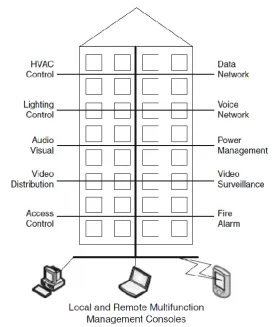
(11) contractors of buildings and HVAC installation firms and clients. BIM Intelligence is specialised in implementing information management for construction contractors, clients and manufacturers. There is little experience with SMART HVAC. In order to extend the knowledge of the future, and to provide meaningful advice, Jaco Poldervaart of BIM Intelligence has asked to conduct this research.. 1.2 PROBLEM DEFINITION Nowadays the internet of things (Wortmann & Flüchter, 2015) concept is a major element in IT innovations across multiple industries. The Internet of things is a concept that describes the exchange of information in a network of devices. This concept affects most of the industries, and the building industry has a lot of potential benefit to adopt these. (Firner, Moore, Howard, Martin, & Zhang, 2011) The innovations in the building automation are on the edge of a new era with incremental changes to the intelligence of the system. Plotting the philosophy of the Internet of things on the built environment, there are two major levels: (1) SMART Cities and (2) SMART Buildings. SMART cities are cities where information is generated and gathered by the city itself to help operating the city (Bach, Wilhelmer, & Palensky, 2010). In example, there is an accident in Amsterdam, and the network recognizes a traffic jam. Based on the routes in the city, the signs in the city can automatically reroute the traffic. This creates the ability that the city can organise the complete traffic in the city and uses the roads in the city optimally. These kinds of interactions are possible because the city can receive information from the sensors within the infrastructure, buildings and other assets within the city. A city with these kinds of functionalities are SMART Cities. SMART Buildings are (utility) buildings where information is generated and gathered by the building itself to operate the building (Sinopoli, 2009). Individual parts of the buildings like installations, but also windows and doors (Open or closed), temperature and so forth are valuable information to the building in order to optimize the comfort, energy consumption, flexibility and the ability to enlarge the functionalities of the building itself. See all connected systems towards a management console in figure 1. Besides these two levels, this research will focus one level more in detail. In order to exchange information within buildings, the individual parts of the building have to be exchanging information as well. For HVAC systems (Heating, Ventilation and Air Conditioning), this is one of the larger aspects within a building (Sinopoli, 2009) and is currently not exchanging information with each other.. Jan Willem Kattouw. Page 10 of 79.
(12) Comfort as a Service with SMART HVAC Nowadays the automated systems in buildings is starting to adopt, where the building security might be the biggest example of building automation. But the predicted innovations in IT Technology are promising, i.e. more calculation power (Mack, 2011) which enables more complex and therefore more intelligent building automation systems.. Figure 1 - SMART Building Components (Sinopoli, 2009). Besides the broad integration of components within a city or a building, there is another movement in the SMART philosophy: SMART GRID (Gungor et al., 2011). SMART GRID is a philosophy that connects all electricity demanding and supplying assets to each other to improve the efficiency of the electricity network as a whole. In the Netherlands, many network managers are investing in the market in order to develop SMART electricity meters for households. The current energy market is facing a transition from fossil-based energy towards renewable energy. This transformation is creating more problems for the electricity-net owners, since electricity cannot be stored very easily. Currently, when the sun is shining and the wind is blowing, there is too much energy and all power plants have to shut down. But, we do need the power plants to back-up the electricity demands while there is not much. Page 11 of 79. Jan Willem Kattouw.
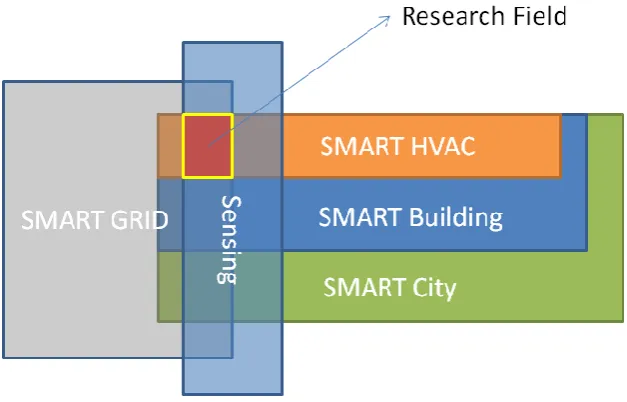
(13) renewable energy available (for example during a solar eclipse). Using a SMART GRID will reduce the peaks in the energy-network. In the future, it is likely that installations within buildings (like SMART HVAC systems) are connected to the SMART GRID in order to prevent electricity peeks and in return real-time pricing of the electricity (Brown, 2008). This concept is relevant to the HVAC installations, since the SMART GRID communicates (indirectly) with the SMART GRID. This research will focus on the innovations of IT in the HVAC systems in the next decade. Concerning the improvements on the Building automation in the Netherlands, there is a lack of knowledge about the future of these systems within the literature. Figure 2 provides a breakdown of all the presented concepts. The internet of things is the overall concept of connecting devices to each other to create a network of live information. SMART City focusses with this philosophy on the devices in the city, which enables the city to think for itself.. Figure 2 - Concepts Breakdown. Buildings within the city have also sensors, which connects the buildings with the internet of things philosophy. The literature calls these buildings SMART Buildings. For this research, there is one-step more focus, which is called SMART HVAC systems. HVAC are the air treatment units within a building. Connecting these components can create a smart and automated system, which optimize the effectiveness of the system and therefore provides more comfort and saves energy. The availability of knowledge of the developments and effects of the systems requires is required, in order to govern the innovations within SMART HVAC systems. The existing literature does not describes this concept, since there is a lack of knowledge about the effects of the developments within the SMART HVAC systems over the next decade. The. Jan Willem Kattouw. Page 12 of 79.
(14) Comfort as a Service with SMART HVAC research will investigate this future HVAC in this environment and will seek for a solution to enhance the adoption of the new developments.. Page 13 of 79. Jan Willem Kattouw.
(15) 2 RESEARCH PLAN To investigate the described problem, a research plan is required. This research plan consists a methodology and the stakeholders and interviewees that are required to investigate this problem. Appendix 2 describes a more detailed outline of the research plan with a discussion about the literature of the (Constructive) Technology Assessment, appendix 3 for the stakeholder mapping, appendix 4 for the conducted interviews and appendix 5 for the interview protocol.. 2.1. LITERATURE METHODOLOGY. For this research, a constructive technology assessment is used. This methodology compares the internal environment of the technology to the external environment of the HVAC stakeholder landscape. The technology assessment is the basis methodology and the constructive technology assessment is a derived methodology of this technology assessment. Appendix 2 is describing a more detailed description of these methodologies. This section will provide a short explanation. At first, the technology assessment (TA) will explore the impacts of technology on people, social and governmental structures and societies. This method defines an internal environment, which includes stakeholders who have direct influence on the technology. The external environment is including the society and governmental structures. The constructive technology assessment (CTA) reverses this premise in the investigation. At first, the external environment is investigated and based on this outcome the technology will be adjusted to meet these desires from the external environment. This research uses multiple strategies of CTA. These are presented in appendix 2.3, these strategies are taken into account while executing the research and defining the conclusion.. 2.2 RESEARCH METHODOLOGY For this research, the constructive technology assessment is used. This methodology is suitable for the problem definition since the external environment has demands and developments where the SMART HVAC can adjust the development route on.. External Environment. Internal Environment. Define strategy. develop conclusion. Figure 3 – research steps This research contains of two sections, the internal environment and the external environment. Both of the environments consists of stakeholders. Figure 3 represents a small. Jan Willem Kattouw. Page 14 of 79.
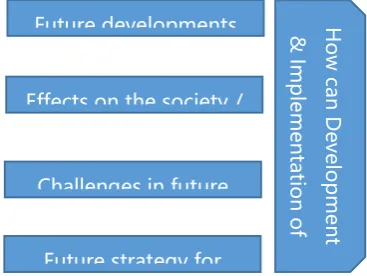
(16) Comfort as a Service with SMART HVAC roadmap of the research. The first step is to interview the external environment, and thereafter, the internal environment. These interviews forming a strategy, which combined forms the conclusion of this research. The time path of this investigation is six months and additionally two months of developing a conclusion and reporting the research.. 2.3 QUESTIONS The question of BIM Intelligence is to provide insight in the developments of HVAC systems, where the company can advise clients, contractors and manufacturers with business in (SMART) HVAC systems. To provide valuable advice to BIM Intelligence, the main research question is:. How can the development and implementation of the SMART HVAC technology be optimized to gain maximal effectiveness of the technologies in the future? There are two sections in this question: the internal and external environment. In the methodology, the constructive technology assessment is explained where the focus is more on the internal effects of an innovation. In the stakeholder analysis, there is a distinction between internal stakeholders and external stakeholders. Since the focus is how the external world effect the internal developments and how they can cooperate on the external environment. To answer the main question, there are two separated sections. The first section defines the external environment. Interviewing all stakeholders in the external environment, based on the following questions and topics: . What are the technological needs of the society within the HVAC industry for the next decade?. . What non-technological effects could occur if the SMART HVAC is implemented in the society?. Having these questions answered, the needs and demands of the external environment is set. Projecting the effects of the external environment on the internal environment, will give the ability to investigate the perception differences. . What possible future technologies are there within the HVAC industry for the next decade?. . What are the effects of the new developments in HVAC systems on the society for the next decade?. . What possible technological challenges are possible facing the developments of SMART HVAC?. Page 15 of 79. Jan Willem Kattouw.
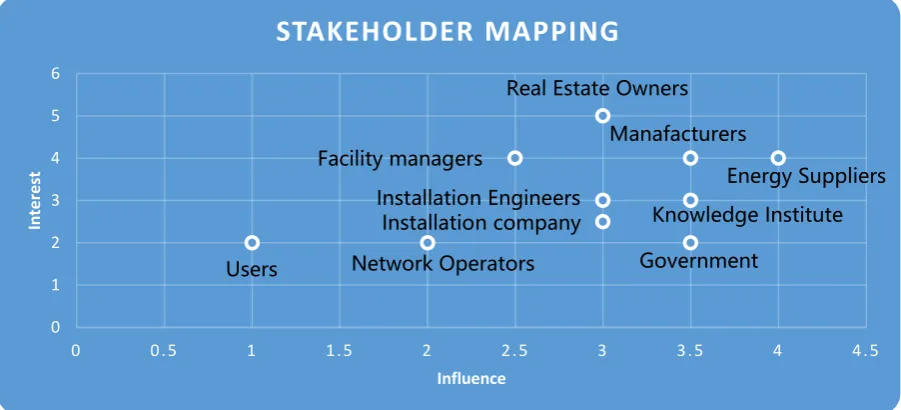
(17) . Which strategy seems optimal for enabling the innovations within the HVAC Industry to become SMART?. These last sub questions together answers the main arguments from the first two subsidiary questions about supply and demand at this moment and for the next decade. The second set of questions investigates the implementation of the technologies. The results dividing in four parts; (1) Future developments, (2) Effects on the society, (3) challenges in the future and, (4) future strategy for HVAC adoption.. Future strategy for HVAC. How can Development &. Challenges in future HVAC. be optimized. Effects on the society / user. Implementation of HVAC. Future developments HVAC. adoption. Figure 4 – research pillars These pillars are the basis for the interview topics and analysis topics. This is a breakdown of the research subsidiary questions into a main research model. Based on this graph, the report is build up. The research conducts of in-depth analysis of the different pillars in qualitative interviews. To make a consistent and valuable outcome of the interviews, appendix 5 presents an interview protocol. The interviews are build based on this protocol.. 2.4 STAKEHOLDERS & INTERVIEWEES In appendix 3, a stakeholder analysis is included. This stakeholder analysis is developing a strategy on which stakeholders are mapped. In the research and in what environment they are placed regarding the CTA methodology. The following graph (figure 5) describes the position of the stakeholders on the influence and interest for HVAC installations.. Jan Willem Kattouw. Page 16 of 79.
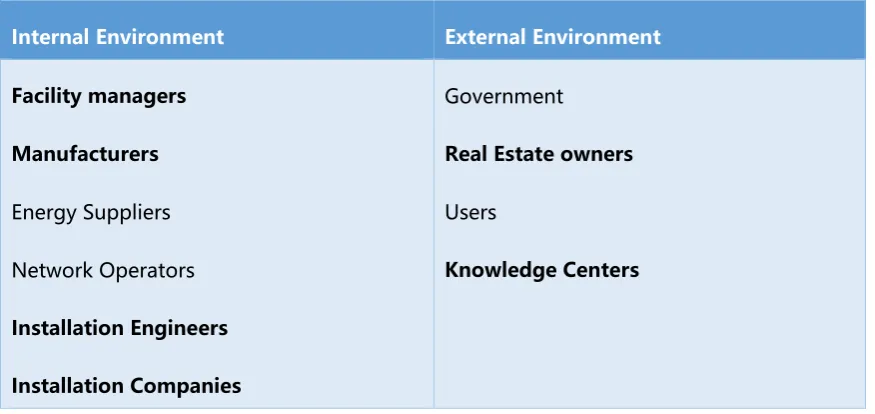
(18) Comfort as a Service with SMART HVAC. STAKEHOLDER MAPPING 6. Real Estate Owners. 5. Facility managers. Energy Suppliers. Interest. 4. Manafacturers. Installation Engineers Installation company. 3 2. Users. Knowledge Centers Government. Network. 1. Operators. 0 0. 0.5. 1. 1.5. 2. 2.5. 3. 3.5. 4. 4.5. Influence. Figure 5 - Stakeholder mapping Due to limited resources in this research, interviewing all stakeholders in this analysis is not possible. Therefore, this analysis conducts of a selection based on the interest and method of investigation. I.e. to investigate the wishes and visions of the users, a qualitative research is required. This research focusses on qualitative interviews and is therefore not able to investigate all stakeholders. The following list divides the stakeholders into the internal and external environment. This research is interviewing bold market stakeholders. Internal Environment. External Environment. Facility managers. Government. Manufacturers. Real Estate owners. Energy Suppliers. Users. Network Operators. Knowledge Centers. Installation Engineers Installation Companies. Table 1 – Stakeholder group. Page 17 of 79. Jan Willem Kattouw.
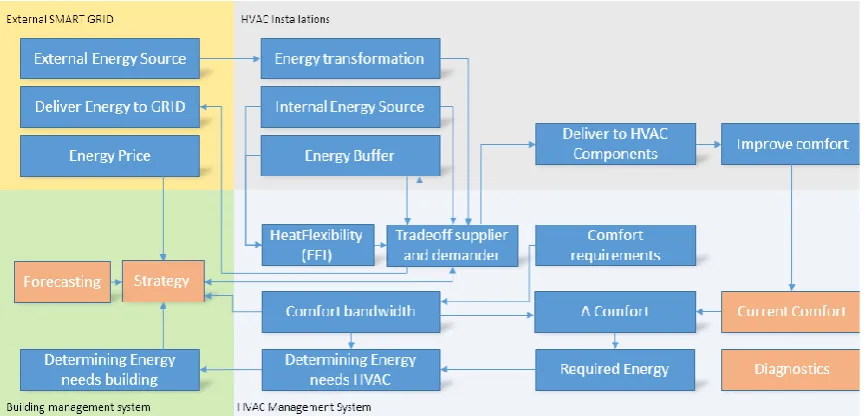
(19) 3 RESULTS As presented in chapter 2.3, the four research pillars are the foundation of the main research question. Each pillar describes a part of the main conclusion. Appendix 8 describes in depth the results of the interview. Based on the results are analysed (appendix 7). This chapter summarizes the in depth analysis. For more information, please consult the appendices.. 3.1. DEVELOPMENTS IN THE TECHNOLOGY AND. The first pillar describes the developments within the HVAC industry. For years, the developments of HVAC based only on increasing the efficiency of the heat-transfer. Currently, the developments are changing towards energy saving systems by buffering energy and the use non-fossil energy resources. These developments are increasing the efficiency of the HVAC installation, but not directly increase of the effectiveness of the HVAC installation. The effectiveness of the installation is hardly mentioned by the interviewees and therefore seems to be no major development focus of the current market. The identified external developments in this research are mainly a combination between SMART GRID and SMART HVAC. This concept will have a key role in the future of the energy network and since the HVAC installation is one of the major energy consumers in the network, the developments in SMART GRID are influencing the developments in HVAC installations. This connection will have a key role in the developments. Especially, since interviewees are mentioning that energy is the most important problem, which the market need to solve in the next decade. The energy market and thereby the SMART GRID concept is most likely evolve to a marketbased pricing system where supply and demand are compared to each other. This market price is thus the representation of the available energy in the network. It would be interesting if a building can buy and sell energy based on the available energy. The building can store energy, produce energy and uses energy. If the building can anticipate on the market price, and thereby indirectly to the supply/demand status, it can provide stability in the energy network. Currently, no such system exists and therefore the interviewees were asked what a SMART HVAC could be. The stakeholders define SMART HVAC as: a HVAC installation that is flexible communicates with other devices and is ready for future use where the user of the building is the key-factor. All stakeholders have told their vision on the development of SMART HVAC. All these mentioned innovations are developed in to one analytic model (figure 6). This model is the layout of a self-improving SMART HVAC system, which is able to communicate with the SMART GRID with real-time cost information of energy.. Jan Willem Kattouw. Page 18 of 79.
(20) Comfort as a Service with SMART HVAC. Figure 6 – SMART HVAC This model contains of four main phases (described by Gartner (2010)): (1) Prescriptive analysis, (2) Descriptive analysis, (3) diagnostic analysis and (4) Predictive analysis. Since in a SMART HVAC the components can exchange information with each other, the state of each component is communicated to the central intelligent hub. Together with the sensor information within the building, this central brain is able to develop strategies on how the building is using which energy source based on the current comfort levels and the current state of the building. This strategy is put into a policy for the installation how to function. Diagnosing the effectiveness of the installation will create the ability to gain more effectiveness of the HVAC installation. Appendix 5 describes the explanation of this model and more functionalities. If SMART HVAC systems are configured like the model below, it has many benefits. In the list below, the major benefits for the users, building owners. . The performance of the building is more accurate . Since the building measures the effect of the executed policy, it can adjust the performance while executing in order to optimize the comfort. This is a major improvement compared to the existing installations, where the settings are not changing after the initial installation. That leads to big in-efficiency and lack of performance. Due to the measurements and the feedback loops, the system is able to learn through the lifetime of the asset. A simulation of a building is never 100% matching the actual conditions. Therefore, a self-learning system can improve his own settings, by experimenting and learning from previous decisions and policies.. Page 19 of 79. Jan Willem Kattouw.
(21) 3.2 EFFECTS ON THE SOCIETY The second pillar in this research is the effect of the developments in the SMART HVAC industry towards the society. Interviewees brought up multiple effects that are be applicable to the society due to the future developments of SMART HVAC. The major effects mentioned by the interviewees are: . Increasing effectiveness and flexibility of the installations towards the users. Since the user experiences more ways to adjust the comfort to his own preferences, he is expecting more functionalities. These effects are challenging for the HVAC market and building owners.. . Open data is mentioned the interviewees as one of the major effects since more data is exchanged and stored. Exchanging and gathering the data on a global level, with detailed information. This can reveal a part of the identity of a user (i.e. his activities). If the user is not comfortable by the extent to which the information is shared, the use of SMART HVAC will possibly get into a downfall. The internal market is aware of this situation, but does not understand what these boundaries are.. . The reduction of CO2 emissions. This because the efficiency of HVAC will increase by a better alignment of the components within the system, but also since the system can determine which resource is used. The reduction of CO2 is also the main goal of the government. With this technology, the goals (and the drivers) of the market and government are aligned.. These challenges affect the developments within the HVAC industry. Most innovations focus on one of these aspects, and again, mostly reducing energy consumption. However, the other two topics will be more hot topics in the next decade.. 3.3 CHALLENGES IN THE HVAC INDUSTRY Although the previous pillars have presented promising developments, there are still some challenges in the market before or during the implementation of SMART HVAC that require a solution. Based on the literature research, the impression was that most challenges are in the technology part of the industry. During the research, this was not to be the case. The required technology is available, and most challenges are elsewhere in the industry. The existing major challenges are: . The knowledge of the newest developments and the SMART concepts are not available for most stakeholders. Individuals with personal interests in the matter. Jan Willem Kattouw. Page 20 of 79.
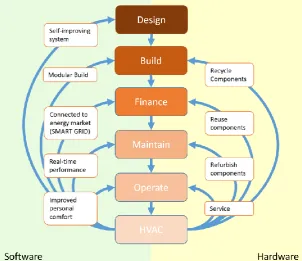
(22) Comfort as a Service with SMART HVAC mostly obtain the knowledge for a company about the innovations in HVAC. These people often work for bigger companies, since they can afford these employees. Modern contracts are minimizing the responsibilities for the owner, so the knowledge disappears from the owner. Users are unaware of the latest developments and therefore not requesting the newest technology. . The drivers within the market are currently not aligning. Everyone in the supply chain is aiming for the highest rate of return, and are therefore often not aligning to the goals of the owner.. . Low replacement cycle of HVAC Installations. Forcing technology in a market is the easiest when there is a short replacement cycle. A replacement cycle means the lifetime of an asset from the initial installation towards the point in time where it requires replacement. If this replacement cycle is long, the adoption of the innovation is slow. For HVAC installations, these cycles are very long (multiple decades). Practically, to adopt SMART HVAC, existing installation will not completely be replaced.. . Low energy prices. At the moment of investigating, the oil price has reached a new low record resulting in un-feasible business cases. Thereby, innovations should minimize energy consumption are often not feasible or the rate of return is more than a decade. This risk is too high for the owner to invest in radical innovations.. These challenges are clearly available in the market. Although, it is not clear for all stakeholders that these exist. This most probably have something to do with the lack of knowledge, but also experience in the market on the leading-edge technology. Since the market is conservative, these challenges are not really seen as “solvable” challenges. Although this might be the case on short term, during this research, there is a business model that has the potential to solve these challenges. The next chapter will go in to this solution.. Page 21 of 79. Jan Willem Kattouw.
(23) 4 COMFORT AS A SERVICE The chapter describes last pillar with presents the strategy how to face the challenges from pillar 3. During the interviews, interviewees provided information about ways to solve these challenges. The solution to these challenges is a business model, where the contractual form between the owner/client and his contractor is based on delivering a service. Traditionally, the contractor receives this contract per lifecycle stage to different actors within the supply chain. For this business model, all lifecycle stages together combined for one contractor that delivers a service on a fee-based contract. Appendix 8 defines different contract forms, with the result that the business model “As a Service” is the most suitable for this situation. The goal of an HVAC installation is to deliver comfort to the user and therefore, this business model is called Comfort as a Service (CaaS). This means that the contractor delivers a service towards the owner/client that the comfort is on a proper level. This is a fee-based contract based on the delivered service, in this model; the comfort. A service level agreement (SLA) defines the comfort levels that the owner desires to apply to the building. If the contractor deviates from this SLA, and the performance has not been met, the fee will be restrained from the contractor or even a fine will be imposed if the performance was lacking significantly. There are four similar existing models in the current market: . Software as a service is the most used contracting type, and defines multiple levels of ownership and responsibility.. . DBFMO (Design, Build, Finance, Maintain and Operate) originates from the civil industry and is mainly between public organisations and private companies. DBFMO are complete lifecycle contracts where the contractor is also rewarded and/or punished by the fee-based contract. For this research, these methodologies are used to define the CaaS model and predict which challenges they can solve.. . Light as a service is more alike the CaaS model and is introduced by Phillips and others, they deliver light as a service, meaning they are responsible for providing light on the surface according to the Service Level Agreement.. . Energy Service Companies (ESCo’s). These companies are delivering energy as a service to the assets. This model is most similar to the CaaS model, only ESCo’s are limited to delivering energy. The method of delivering is up to the contractor. The. Jan Willem Kattouw. Page 22 of 79.
(24) Comfort as a Service with SMART HVAC next step is to transfer the responsibility is transport the energy and transform it into comfort for the users. CaaS complies with the CTA strategy to align both External and internal environment (see page 14, Loci for reflexivity and feedback). The development of SMART HVAC can align both internal and external environment and thereby creates multiple benefits: . The CaaS model offers an alignment between client and owner about the output of the HVAC installation. Since the contractor is responsible and therefore involved in all the lifecycle stages, the contractor needs to have a total-lifecycle mindset. This improves the incentive to place qualitative components and therefore increase the overall quality.. . The CaaS model will eliminate the investment costs and risks of the owner, which was another challenge in the previous research pillar. Because the contractor is responsible, the contractor will be earlier adopting innovations, since the owner does not have to be convinced. They have more experiences with the newer (more efficient) technology and have more incentive to implement these, since they also paying the energy bills of the installation.. . The CaaS model requires less knowledge of owners and/or clients. Due to the transferred responsibility, the owner does not need to have the knowledge as currently is required (and is lacking). Therefore, the innovations might speed up, since the passive behaviour will be minimized.. Nevertheless, a service model alone does not solve the last challenge namely, the slow adoption speed due to the slow replacement cycle. Using a circular economy model (CE) solves this challenge. This model defines the re-use and recycling of components, material and energy and used elsewhere. Since the contractor has now many different installations in ownership, this model can re-use components and thereby reduces the price of the installation even more. This model is called the circular economy, introduced in China (Geng, Zhu, Doberstein, & Fujita, 2009). This concept tries to add value to businesses by optimizing the use of resources by collaborating in the supply chain with different parties. Since the contractor is a big actor in the supply chain of the CaaS market, the ability of the contractor to use the circular economy concept is valuable.. Page 23 of 79. Jan Willem Kattouw.
(25) Figure 7 explains the circular economy for CaaS:. Figure 7 – Circular Economy in a CaaS model with SMART HVAC This model enables the re-usability of the components on multiple stages in the lifecycle. For this approach, a modular installation is required. This modular installation is easier to adjust using a SMART HVAC, since the software contains of a self-improving system. The contractor can re-locate/refurbish the components and thereby save the costs of complete replacement. In addition, the replacement of components can be more cost-efficient and therefore reducing the replacement cycle, which enables the adoption of innovations. The use of fewer resources is also available on the software side, where a better alignment, sensing and the exchange of information with other systems will reduce the required resources (mainly energy). Another layout explains of the Circular Economy model in Comfort as a Service even better (see figure 8). This model has the same basic principle as the model above, only is this drawn in in a chain. This model has three cycles: (1) The performance cycle, (2) the material cycle and, (3) the energy cycle. Closing the cycle leads to more efficient use of material/energy. Therefore, the cycles will be smaller and thus more efficient. The product is central in this model and represents any HVAC component.. Jan Willem Kattouw. Page 24 of 79.
(26) Comfort as a Service with SMART HVAC. Figure 8 – Improving Circular Economy in a CaaS model with SMART HVAC. Nevertheless, this business model contains of some challenges as well. The challenges still facing are the following challenges: . The contracting periods are longer, since these contracts are lifecycle based. This might not be desirable for the owner, but since they have an SLA, the owner is able to add a clause in the contract to end the contract if the performance is significantly failing over time. This also results in big contracts that eliminates small & medium enterprises (SME’s) in this market. These big contractors can hire the smaller enterprises for subsidiary activities. In that case, the general contractor is the coordinator of all activities.. . Open data, which is more open than in “standard” contracts. Therefore, the contract CaaS needs to include the use and exchange of data by the service company.. Page 25 of 79. Jan Willem Kattouw.
(27) 5 CONCLUSION This research investigated the future developments of HVAC, with the focus on SMART Concepts like SMART GRID and SMART Building. SMART HVAC is part of a SMART Building and is described as: A Heating, Ventilating and Air Conditioning system with components. that exchange information of their status and can anticipate on orders from the central controlling software to optimize the effectiveness and efficiency of the installation within a building. For this research, the following research question was stated central: How can the. development and implementation of the SMART HVAC technology be optimized to gain maximal effectiveness of the technologies in the future? This question can be divided by four pillars: (1) Future developments in HVAC, (2) Effects on the society, (3) challenges in HVAC and (4) a strategy to face these challenges. The future developments within the HVAC industry are mainly focussing on increasing the efficiency of the installations rather than increasing the effectiveness. Looking at the developments in the next decade, this will more be focussing on the timing of the energy consumption and reallocation. The HVAC systems will evolve to a SMART HVAC system in the future, which is conducts of feedback-loops to increase the effectiveness and efficiency of the HVAC installations. Currently, the society is searching for ways to minimize the CO 2 emissions. SMART HVAC systems in combination with SMART GRID concepts are a proper solution for this challenge. These intelligent systems exchange information about the building and its users. The effects of SMART HVAC are also recognizable for the user, since these systems can handle more flexibility for the user together with more effectiveness of the HVAC system. Multiple challenges turning into opportunities when applying the CaaS model in the next decade. The literature expected that there were challenges on the technological side, but the challenges are more on the combination of the internal and the external environment due to different drivers between client and contractors and the failing business cases for the clients. The business model Comfort as a Service (CaaS) presents a solution to face these challenges. This model is a fee-based service contract where the contractor delivers the comfort within the building as a service to the client. This business model forces the client to think in comfort levels to define the Service Level Agreement and aligns the drivers of both client and contractor towards lifecycle thinking. Thereby, CaaS transfers the incentive of energy reduction from the client towards the contractor that probably leads to more innovations (as can be found in similar models from other industries). The Circular Economy concept. Jan Willem Kattouw. Page 26 of 79.
(28) Comfort as a Service with SMART HVAC within the CaaS model improves the value towards the client and reduces the resources of the contractor by recycling and reusing products, material and energy, [SMART] Therefore, the business model Comfort as a Service catalyses the development and implementation of SMART HVAC technology by the use of a SMART HVAC installation. Thereby, the connection with a market-based SMART GRID is enabling a SMART HVAC to be more cost-efficient.. Page 27 of 79. Jan Willem Kattouw.
(29) 6 LIMITATIONS This conclusion is valid in the environment of this research, but might not be valid for all environments. In this section presents the limitations to this conclusion based on the factors in this environment.. 6.1. LIMITATIONS TO THE CTA. The limitations are separated in two parts; the first part is describing the limitations of the research methodology CTA. These are according to the literature the limitations of the CTA methodology: . The responsibility of managing the technology in the society is not limited to the governmental actors. Companies and even individuals can be responsible as well for the technology in the society. (Johan Schot & Rip, 1997). . The new innovation has been introduced and new platforms are created. CTA will investigate certain platforms to find the effects of the innovation on among others, the current platforms. When a new platform is raised by the introduction of new innovations, the effects may be different from those that were expected. (Johan Schot & Rip, 1997) “The dynamics of the process are central, and impacts are viewed as being built up, and co-produced, during the process of technical change.” (J. W. Schot, 1992). . After introducing a new innovation, new “nexuses have been developed between variation and selection, or supply and demand”. So, new investigated innovations may already be evolving to other extends than the calculated effects to serve mostly an even better outcome.. . Actors are often try to reduce space for negotiating to the direction and nature of technical change (Johan Schot & Rip, 1997). This can strongly influence the outcome of the assessment.. In the methodology are the actions described to limit the risks and limitations to this assessment in order to increase the value of the research outcome.. Jan Willem Kattouw. Page 28 of 79.
(30) Comfort as a Service with SMART HVAC. 6.2 LIMITATIONS TO THE RESEARCH CONDITIONS Besides the limitations to the research method, the researched environment was not optimal. . The interviewee requirements eliminates a certain population and creates a Survivor-bias (Elton, Gruber, & Blake, 1996), which results in a biased representation of the industry as a whole. Nevertheless, without this requirement, the interviewees were not able to discuss these concepts, due to the lack of knowledge.. . This research is only limited to the Dutch market. Although some interviewees work in multinationals, and the literature is applicable to not only the Dutch market, this research is limited to the Dutch market only. This might also be applicable to similar countries like Germany or Belgium.. Page 29 of 79. Jan Willem Kattouw.
(31) 7 RECOMMENDATIONS 7.1 RECOMMENDATIONS FOR FUTURE RESEARCH Since the conclusion is valid in a specific environment, this chapter recommends how this research can expand in order to create more scientific value. As mentioned in the previous section, the limitations to this research are shaping the conclusion of this research. To enforce this conclusion conducted more on two these fields will increase the scientific value: (1) Internal dynamics of a SMART HVAC system and (2) the CaaS model. Appendix 8 is suggesting the internal dynamics as described by the interviewees. These internal dynamics requires to be validated by an experiment that include a SMART GRID market price and an anticipating SMART HVAC system where the alignment of the components and their feedback loops are working properly. Pilot projects will retrieve empirical data to adjust and/or confirm the use of this model is working. In addition, the presented Comfort as a Service requires more investigation. Currently this is a combined business model, and promises to solve many challenges in the industry. However, can this model be used at the first place (concerning the possible legal issues), and thereby, is this model really dealing with the challenges as expected. These two major future topics complimenting this research and are valuable to the future of HVAC and the energy GRID.. 7.2 RECOMMENDATIONS FOR THE MARKET This research has developed this promising business model Comfort as a Service. To apply this model in the market, recommendations are made for the market. Contractors have to take bigger steps and take responsibility, by delivering a service instead of a product. This includes the use of CaaS. With the use of CaaS, contractors are able to help many clients with delivering comfort to the building. Bigger companies, who can afford to spend some R&D, must focus more on IT. Focussing SMART HVAC can help the next step in efficiency and effectivity, which is currently underexposed. Last recommendation, which is more affecting the benefits of SMART HVAC using a SMART GRID: Government must review the current energy-market. Innovations are developed and adopted faster if there is a correct incentive. Subsidy is currently compensating this adverse incentive. New forms as mentioned in this research like real-time pricing of energy and the use of Co2 tax will increase the value of renewable energy.. Jan Willem Kattouw. Page 30 of 79.
(32) Comfort as a Service with SMART HVAC. 8 BIBLIOGRAPHY AgentschapNL. (2013). Infoblad Energieneutraal bouwen: definitie & ambitie. (2FLOK1302). Utrecht. Bach, B., Wilhelmer, D., & Palensky, P. (2010). Smart buildings, smart cities and governing innovation in the new millennium. Paper presented at the Industrial Informatics (INDIN), 2010 8th IEEE International Conference on. Brown, R. E. (2008). Impact of smart grid on distribution system design. Paper presented at the Power and Energy Society General Meeting-Conversion and Delivery of Electrical Energy in the 21st Century, 2008 IEEE. Daey Ouwens, C., van Hoogstraten, P., Jelsma, J., Prakke, F., & Rip, A. (1987). Constructief technologisch aspectenonderzoek. Nederlandse Organisatie voor Technologisch Aspecten Onderzoek, Den Haag. Douma, K. F. L., Karsenberg, K., Hummel, M. J. M., Bueno-De-Mesquita, J. M., & van Harten, W. H. (2007). Methodology of constructive technology assessment in health care. International Journal of Technology Assessment in Health Care, 23(2), 162-168. doi:Doi 10.1017/S0266462307070262 Ellram, L. M. (1995). Total cost of ownership: an analysis approach for purchasing. International Journal of Physical Distribution & Logistics Management, 25(8), 4-23. Elton, E. J., Gruber, M. J., & Blake, C. R. (1996). Survivor bias and mutual fund performance. Review of Financial Studies, 9(4), 1097-1120. Firner, B., Moore, R. S., Howard, R., Martin, R. P., & Zhang, Y. (2011). Poster: Smart buildings, sensor networks, and the internet of things. Paper presented at the Proceedings of the 9th ACM Conference on Embedded Networked Sensor Systems. Gartner. (2010). Analytic Framework. Retrieved from www.gartner.com Geng, Y., Zhu, Q., Doberstein, B., & Fujita, T. (2009). Implementing China’s circular economy concept at the regional level: A review of progress in Dalian, China. Waste Management, 29(2), 996-1002. Gungor, V. C., Sahin, D., Kocak, T., Ergut, S., Buccella, C., Cecati, C., & Hancke, G. P. (2011). Smart grid technologies: communication technologies and standards. Industrial informatics, IEEE transactions on, 7(4), 529-539. Mack, C. A. (2011). Fifty years of Moore's law. Semiconductor Manufacturing, IEEE Transactions on, 24(2), 202-207. Matzler, K., Bailom, F., Hinterhuber, H. H., Renzl, B., & Pichler, J. (2004). The asymmetric relationship between attribute-level performance and overall customer satisfaction: a reconsideration of the importance–performance analysis. Industrial Marketing Management, 33(4), 271-277. Reed, M. S., Graves, A., Dandy, N., Posthumus, H., Hubacek, K., Morris, J., . . . Stringer, L. C. (2009). Who's in and why? A typology of stakeholder analysis methods for natural resource management. Journal of environmental management, 90(5), 1933-1949. Rodemeyer, M., Sarewitz, D., & Wilsdon, J. (2005). The future of technology assessment: Citeseer. Schilling, M. A. (2005). Strategic management of technological innovation: Tata McGraw-Hill Education. Schot, J., Leyten, A., Roggen, M., & Smits, R. (1987). Aanzet voor inventarisatie van onderzoek in Nederland van belang voor technologisch aspectenonderzoek (TA): Nederlandse Organisatie voor Technologisch Aspectenonderzoek. Schot, J., & Rip, A. (1997). The past and future of constructive technology assessment. Technological forecasting and social change, 54(2), 251-268. Schot, J. W. (1992). Constructive Technology-Assessment and Technology Dynamics - the Case of Clean Technologies. Science Technology & Human Values, 17(1), 36-56. doi:Doi 10.1177/016224399201700103. Page 31 of 79. Jan Willem Kattouw.
(33) Sinopoli, J. M. (2009). Smart buildings systems for architects, owners and builders: ButterworthHeinemann. Winch, G. M. (2010). Managing construction projects: John Wiley & Sons. Wortmann, A.-P. D. F., & Flüchter, K. (2015). Internet of Things. Business & Information Systems Engineering, 57(3), 221-224.. Jan Willem Kattouw. Page 32 of 79.
(34) Comfort as a Service with SMART HVAC. 9 APPENDICES. Page 33 of 79. Appendix 1. Table of definitions. Appendix 2. Methodology. Appendix 3. Stakeholder analysis. Appendix 4. Interview Groups. Appendix 5. Interview Protocol. Appendix 6. Interview Questions. Appendix 7. Results. Appendix 8. In-Depth Analysis. Appendix 9. Interview Transcripts. Jan Willem Kattouw.
(35) 9.1. APPENDIX 1 - TABLE OF DEFINITIONS. BAS. Building Automation Systems – The digital “brain” of the building. This system controls all connected systems.. CaaS. Comfort as a Service – A fee-based contract where the contractor delivers a service to provide comfort to the users. The ownership (and responsibilities) of the installation is transferred from the client to the contractor.. Comfort. Comfort for HVAC are the state when the temperature of the building and its air conditions are in a way that the user of the building feels pleasurable physical ease.. CTA. Constructive Technology Assessment – Research method which is built around the attempt to anticipate effects or impacts of new technologies or new projects with a strong technological component. HVAC. Heating, Ventilation and Air Conditioning installations. Major energy consumer in an utility building.. SMART. Buildings where information is generated and gathered by the building. Buildings. itself to operate the building (Sinopoli, 2009). SMART GRID. A philosophy which connects all electricity demanding and supplying assets to each other to improve the efficiency of the electricity network as a whole.. SMART HVAC. A Heating, Ventilating and Air Conditioning system with components that exchange information of their status and can anticipate on orders from the central controlling software to optimize the effectiveness and efficiency of the installation within a building.. TES. Thermal Energy Storage – An energy buffer technique where energy in the form of heat is stored in the ground. This technique can handle long buffer cycles.. Jan Willem Kattouw. Page 34 of 79.
(36) Comfort as a Service with SMART HVAC. 9.2 APPENDIX 2 - METHODOLOGY In this research, the innovations will be analysed by the Constructive Technology Assessment (CTA). This methodology enables the opportunity to define the external environment and align the internal environment towards the external environment. The Technology Assessment is the foundation methodology of many other technology assessments. One of these derived methodologies is the CTA (Constructive Technology Assessment), and is developed at the University of Twente (Johan Schot & Rip, 1997). 9.2.1. Technology Assessment. Technology assessment is the process of exploring the impacts of a new technology on people, social and governmental structures, and societies. Together, a technology assessment and environmental analysis can provide useful inputs into how a company or organization can develop a strong strategy. (JW Schot, Leyten, Roggen, & Smits, 1987) The Technology assessments are used to “Reduce the human costs of trial and error learning in society's handling of new technologies, and to do so by anticipating potential impacts and feeding these insights back into decision making, and into actors' strategies.” (Johan Schot & Rip, 1997). In the Netherlands, there is an Organisation which executes such assessments: Rathenau Insitute (Former NOTA or Netherlands Organisation of Technology Assessment). This institute provides researchers to conduct Technology assessments.. 9.2.1.1. steps in a Technology Assessment. The acronym often used in the literature is: VIMP-SPC (Vaulue, Interests, Motives, and Perspectives – Socioeconomic, Political, and Cultural). This acronym is used to describe 3 steps in the technology assessment: (Rodemeyer, Sarewitz, & Wilsdon, 2005) The pace and direction of advancing knowledge and application is determined by human choice. The specific directions in which technoscience is steered, and the pace of its advance, reflect who is making the decisions—their interests, values, motives, and perspectives. The decisions that are made are determined within a complex social setting that encompasses a range of socioeconomic, cultural, and political components. This complex social setting interacts with the results of techno scientific advance to create social outcomes. The setting, the science, and the outcomes mutually evolve over time. These steps are used in TA, but can also be partial used in the CTA. For example in the book of Daey Ouwens, van Hoogstraten, Jelsma, Prakke, and Rip (1987), there are examples with social maps and policy aspects. These can be compared to these 4 steps defined by. Page 35 of 79. Jan Willem Kattouw.
(37) Rodemeyer et al. (2005). For this research we use some of these aspects within the Constructive Technology Assessment. 9.2.2. Constructive Technology Assessment. Constructive Technology Assessment (CTA) is based on theories of technology dynamics and attempts to influence technological design and implementation to improve the effectiveness of the technology in clinical practice. (Daey Ouwens et al., 1987) CTA is built around the attempt to anticipate effects or impacts of new technologies or new projects with a strong technological component. This is a core component of any TA effort. “Whereas traditional TA focuses more on the external effects of a technology and the choice between different technological options, the new field of CTA shifts attention to the steering of the internal development of the technology.” (J. W. Schot, 1992) CTA is based on the idea that during the course of technological development, choices are constantly being made about the form, the function, and the use of that technology and, consequently, that technological development can be steered to a certain extent (J. W. Schot, 1992).. Figure 9 - Process of CTA Since its first use, CTA has developed from assessing the exact impact of a new technology to a broader approach, including the analysis of design, development, and implementation of that new technology. The literature on technology assessment methods can be divided between diagnostic and intervention methods. Diagnostic methods of CTA include traditional social sciences techniques and also sociotechnical mapping techniques to identify the past and possible future scenarios of technological dynamics. Intervention methods are action techniques, including awareness initiatives, controlled experimentation,. consensus. conferences,. and. dialogue. workshops,. to. influence. technological development and application. There is also a difference in focus on the CTA. There is a focus on the consumer (cCTA) and a focus on the producer (pCTA) (Johan Schot & Rip, 1997). These two separate focusses are important to understand to consider with the outcome of the research.. Jan Willem Kattouw. Page 36 of 79.
(38) Comfort as a Service with SMART HVAC Second distinction which can be made is the difference between variation and selection. Variations are by no means tried out purely at random during the search process. Heuristics are guidelines that promise, but do not guarantee, finding solutions to problems. (J. W. Schot, 1992) Selection between variations occurs in two ways: Ex ante (Obtains when products and processes produced by heuristics are exposed to market-selection pressures, like survival of the fittest) and ex post (Influence is exerted on the generation of variations and thus on the shaping and the choice of the heuristics, more anticipation by a firm for the market). “The method and design of the exact research activities is determined by the nature of the technology” (Douma, Karsenberg, Hummel, Bueno-De-Mesquita, & van Harten, 2007). The methodology is therefore not explicit described, but will depend and rest on the principles presented above. 9.2.3. CTA Strategies. J. W. Schot (1992) is presenting three CTA strategies for the future. Technology Forcing, Niche Management and Stimulation of Alignment. A short explanation of the strategies down below: Inverse anticipation and feedback: Technology forcing With inverse anticipation, the required social goals are taken, and desired technology is forced to head in this direction. Where TA uses the technology and searches for the impacts. (J. W. Schot, 1992) This inverse anticipation is commonly used for governmental applications to find and force suited technologies for the society. Graded Learning and feedback: Strategic Niche Management When forcing a technology, the regulating actors and the technology developers experience a distance. There is time between the introduction of the regulation and the technology developed based on this regulation. This may create problems when modulating and broaden the design process. Sometimes, agencies will develop alternativetechnologies themselves to help the industry a step further. This strategy of CTA will help actors to learn of the taken steps before they make new goals. This will lead to a controlled innovation trajectory. So, a graduated learning process based on the feedback of CTA before making next goals for technology regulations. (Johan Schot & Rip, 1997) Loci for Reflexivity and feedback: Alignment. Page 37 of 79. Jan Willem Kattouw.
(39) When forcing technology, as described before, there is a distance between actor and developer. This distance can be minimalized by own developments (as in Niche Management) but can also be connected by informative platforms to inform the technology developers in order to align the developments towards the desired outcome. (Johan Schot & Rip, 1997). Jan Willem Kattouw. Page 38 of 79.
(40) Comfort as a Service with SMART HVAC. 9.3 APPENDIX 3 – STAKEHOLDER ANALYSIS To discover the effects on the industry, the stakeholders within the industry are interviewed. Therefore a small stakeholder analysis will be conducted to support the validity of the reseach. All stakeholders (9) involved in the HVAC industry are determined as: Government, Network operators, Energy companies, facility managers, real-estate owners, Users, facility managers, manufacturers, Installation companies and installation engineers. These stakeholders are assessed on the goal of the stakeholder and the influence on the HVAC market. Government, has influence on the regulations for the energy consumption and can stimulate innovations and use of specific technologies by provide funding. The goal of the government is to create a better situation for the society as a whole, therefore is their interest in SMART HVAC moderate. Facility Managers, are maintaining the building and are responsible for a good functioning HVAC system. Their influence is not large, but their interest in SMART HVAC is large, since it will improve their way of working and makes it more transparent what is happening within the installation. Network Operators, are interested in a better spread of energy consumption (see SMART GRID). Therefore, SMART HVAC can help the SMART GRID functioning. SMART HVAC is not the core-business of the network operators but have certain interest in these developments. The influence of the network operators is not that big, but are able to adjust the price, by for example using SMART HVAC systems. Energy suppliers are focussed on delivering enough energy at the correct time with the lowest production price (competitive advantage). The interest of energy suppliers in SMART HVAC systems is large, since the SMART HVAC systems can minimalize the peeks in the energy demands and supplies. The influence of the energy suppliers are also large, since they are determining the price of the energy. If SMART HVAC can be connected to SMART GRID, the energy suppliers will save a lot of energy due to the less peek powers and therefore less required performance of the energy production systems. Users are not specifically interested in SMART HVAC. When the building has the correct air conditions (humidity, temperature etcetera), users are happy. When users can have reduced energy bills by using SMART HVAC, they can be attracted to SMART HVAC as well. The influence of a user as an individual is very small. Real estate owners are most of the time in control of large amounts of property. The interest of SMART HVAC of these owners are due to the lower cost on OPEX (operating expenses). Page 39 of 79. Jan Willem Kattouw.
(41) due to less energy consumption, possible lower energy price (by SMART GRID method) and lower operate and maintenance costs since the information about errors are more transparent, which reduces time, and thus money. Manufacturers are focused on selling goods in order to make a profit. Often, innovative products will improve the efficiency and therefore reduce cost for the user. This will make a competitive advantage for the manufacturers. The manufacturers are thus focused on innovation and providing cost saving products for their clients. Installation Companies are companies which deliver and install the HVAC installations. They have interest in new technology, but have not much influence in the matter, since an engineering company decides what installation specs there are required. The influence they have is the cheaper or better installation brands, which they can gain profit on by cheaper products or faster installation time. Installation engineers are companies which engineer the ventilation plan and systems for the building. They can decide what technology is the best for the building and which performances the installations are required (effectiveness and efficiency). Therefore is their influence high, and their interest is high if companies demanding state of the art systems. Putting these descriptions together in one diagram gives: (hereby is the influence and the interest presented on a scale of 1-5.. STAKEHOLDER MAPPING 6. Real Estate Owners. 5. Interest. Manafacturers. Facility managers. 4. Energy Suppliers. Installation Engineers Installation company. 3 2. Users. 1. Knowledge Institute Government. Network Operators. 0 0. 0.5. 1. 1.5. 2. 2.5. 3. 3.5. 4. 4.5. Influence. figure 10 - Stakeholdermapping. Jan Willem Kattouw. Page 40 of 79.
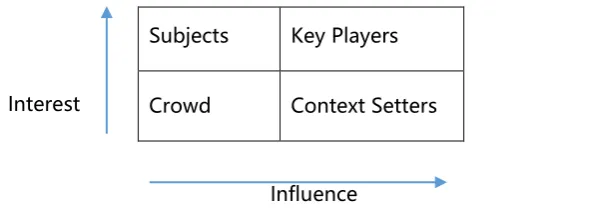
(42) Comfort as a Service with SMART HVAC. Interest. Subjects. Key Players. Crowd. Context Setters. Influence. Figure 11 – Stakeholder mapping layout According to Reed et al. (2009) all stakeholders are useful, but the key players are the ones where really to focus on. Using this chart, and saying the dividing parameter is 2.5, the following stake holders are categorized: Key Players: Real Estate owners, Network Operators, Manufacturers, Facility managers, Energy Users, installation companies and installation engineers. Subjects: Network Operators, Government. Context Setters: Crowd: Users For this research, there will be another distinction between the stakeholders. Because the CTA methodology focusses on the internal developments of the innovation, we first have to know what the external environment demands. The external environment is determined by the stakeholders: Government, branch organizations & users. The internal environment is defined by the stakeholders: Facility managers, real estate owners, manufacturers, Energy suppliers, Network operators, installation companies and installation engineers.. Page 41 of 79. Internal Environment. External Environment. Facility managers. Government. Manufacturers. Real Estate owners. Energy Suppliers. Users. Jan Willem Kattouw.
Figure

+7

Related documents
b In cell B11, write a formula to find Condobolin’s total rainfall for the week.. Use Fill Right to copy the formula into cells C11
(rs2243123, rs2243151, rs668998, and rs17826053) in IL12A and asthma and allergy-related (serum total and allergen-specific IgE, and skin test reactivity [STR] to two common
Assessing the Impact of Biodiversity Conservation in the Management of Maize Stalk Borer (Busseola f
Field experiments were conducted at Ebonyi State University Research Farm during 2009 and 2010 farming seasons to evaluate the effect of intercropping maize with
Al-Hazemi (2000) suggested that vocabulary is more vulnerable to attrition than grammar in advanced L2 learners who had acquired the language in a natural setting and similar
Infraestructura del Perú INTERNEXA REP Transmantaro ISA Perú TRANSNEXA, 5% investment through INTERNEXA and 45% through INTERNEXA (Perú) COLOMBIA ARGENTINA CENTRAL AMERICA
Scan 2 digits from the option code chart in Appendix, then FuzzyScan will terminate this selection automatically. FIN
This study showed reduced abundances in the predicted functions of DNA synthesis and repair mechanisms in bacteria from smokers (compared to non-smoking participants)
