
Abstract—Recently a new method has been developed for arriving at an Initial Basic Feasible solution (IBF) with an adequate number of entries needed to initiate the transportation simplex algorithm [1], which is then used to get an optimal solution. Two methods are being used extensively for getting the IBF. One of them is the Northwest Corner Rule Method and the other one is the Russell Method.[2] Both of these methods have some drawbacks. The IBF obtained from the Northwest Corner Rule is far from the optimal solution. The IBF obtained using the Russell Method does not give enough number of entries to start the transportation simplex algorithm. On the other hand, the Northwest Corner Rule consumes much time to get the optimal. So the new method will be used to get the IBF along with the optimal solution. Two problems are discussed and the values of their optimal solution are given. Then a comparison is made among the three methods: the Northwest Corner Rule, the Russell Method, and the new method. Also a computer software has been developed based on the new proposed method to get the IBF solution and hence the optimal solution.
Index Terms—Russell Method, Transportation Simplex Method
I. INTRODUCTION
There are two most popular methods used in literature for deriving the Initial Basic Feasible solution (IBF) and hence the optimal solution. One of them is the Northwest Corner Rule for a given transportation problem. The Russell Method is the other one, which is much complicated for obtaining the optimal solution. Both of these methods give some IBF, which are far from optimal solution. To begin constructing an IBF solution, all source rows and destination columns of the transportation simplex tableau are initially under consideration for providing a basic variable (allocation). ____________________
Manuscript received September 16, 2009.
1Chandrasekhar Putcha, Ph.D., FASE, Professor of Civil and Environmental Engineering, California State University, Fullerton, CA, 92834, USA. e-Mail: [email protected] , Phone: (657) 278-7017; Fax: (657) 278-3916.
2Aditya Putcha, Financial Analyst, Paramount Studios, Hollywood, CA, 92834, USA.
3MD Rohul Amin Bhuiyan, Graduate Student, Department of Civil and Environmental Engineering, California State University, Fullerton, CA, 92834, USA.
4 Ms. Nasima Farzana Hoque, Graduate Student, Department of Civil and Environmental Engineering, California State University, Fullerton, CA 92834, USA.
1. From the rows and columns still under consideration, select the next basic variable (allocation) according to some criterion.
2. Make that allocation large enough to exactly use up the remaining supply in its row or remaining demand in its column (whichever is smaller).
3. Eliminate that row or column (whichever had the smaller remaining supply or demand from further consideration. If the row and column have the same remaining supply and demand, then arbitrarily select the row as the one to be eliminated. The column will be used to provide a degenerate basic variable, i.e., a circled allocation of zero.)
4. If only one row or only one column remains under consideration, then the procedure is completed by selecting every remaining variable (i.e, those variables that were neither previously selected to be basic nor eliminated from consideration by eliminating their row or column) associated with that row or column to be basic with the only feasible allocation. Otherwise return to step1. [2, 3]
Putcha and Ali [1] developed a method which gives adequate number of entries for starting the transportation simplex algorithm.
II. EXISTING METHODOLOGIES The basic transportation problem can be stated as Minimize Z=
∑∑
= = m i n j 1 1
cijxij (1) Subject to
∑
=
n j 1
xij=si for i=1,2,…,m, (2)
∑
=
m i 1
xij=di for j=1,2,…,n, (3) and xij
≥
0, for all i and j.The general procedure for obtaining the optimal solution is stated below.
Development of a New Optimal Method
for Solution of Transportation Problems
A. Northwest Corner Rule
Begin by selecting x11 (that is, start in the northwest corner of the transportation simplex tableau). Thereafter, if xij was the last basic variable selected, then next select xi,j+1 (that is, move one column to the right), if source I has any supply remaining. Otherwise, next select xi+1,j (that is, move one row down). Then using the iterations the optimal solution can be obtained. [2]
B. Russell Method
For each source row and column, after entering the basic variables (No of entries=m+n-1) into the cells as required after getting the IBF, then assume the value of u=0 (basically start with the row having the maximum number of entries). Then calculate the values of v and then the other us by using the formula cij=ui+vj (using the basic cells only). After that calculate Δij= cij- ui-vj for all the non-basic cells. And do the iterations until we get the all positive values in the non basic cells, which will give the optimal solution.[2]
Using the IBF generated using Putcha and Ali method [1], a new method has been developed in this paper which gives the optimal solution almost immediately. In this method, the basic variables are entered using the formula m+n-1 for the first iteration. But if it gives all the negative values of the Δij= cij- ui-vj for the non basic cells then go for the next iterations. This time enter the basic variables into all the cells containing negative values of Δij= cij- ui-vj from the previous iteration and make the sufficient balance at the end of the rows and columns according to the supply and demand respectively. This time the number of the basic entries will be more than m+n-1. This gives all the positive values of Δij within the limited number of iterations and hence helps getting the optimal values.[2]
III. CHECK FOR OPTIMALITY
Two different transportation problems are discussed in which the IBF solutions are obtained using Putcha-Ali Method. Now further steps are discussed to check for the optimality of these solutions.
IV. IBF EXAMPLES
Example 1
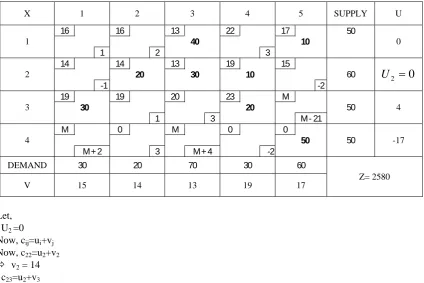
[image:2.595.86.511.433.716.2]Consider the transportation problem having the following parameters (see Table I below) [1].
Table I. Transportation Problem Data Set 1.
X 1 2 3 4 5 SUPPLY U
16 16 13 22 17
40 10
1
1 2 3 50
0
14 14 13 19 15
20 30 10
2
-1 -2
60
U
2=
0
19 19 20 23 M30 20
3
1 3 M - 21
50 4
M 0 M 0 0
50
4
M + 2 3 M + 4 -2
50 -17
DEMAND 30 20 70 30 60
V 15 14 13 19 17
Z= 2580
Let, U2 =0 Now, cij=ui+vj Now, c22=u2+v2
Example 2:
Consider the transportation problem having the following parameters (see Table II below) [1].
Table II. Transportation Problem Data Set 2.
X 1 2 3 4 5 SUPPLY U
8 6 3 7 5
20
1
1 3 1 2 20
2
5 M 8 4 7
25 5
2
M - 1 7 6
30 U2=0
6 3 9 6 8
25 5
3
-1 6 5
30 2
0 0 0 0 0
0 0 20
4
0 -3
20 -1
DEMAND 25 25 20 10 20
V 5 1 1 4 1
Z = 310
Let, U2 =0 Now, cij=ui+vj c21=u2+v1
v1 =5 c24=u2+v4
v4 = 4 and so on.
Here, for all the non basic cells 31 and 44 the values of cij- ui-vj <0 . So the solution is not optimal.[1]
Example 1
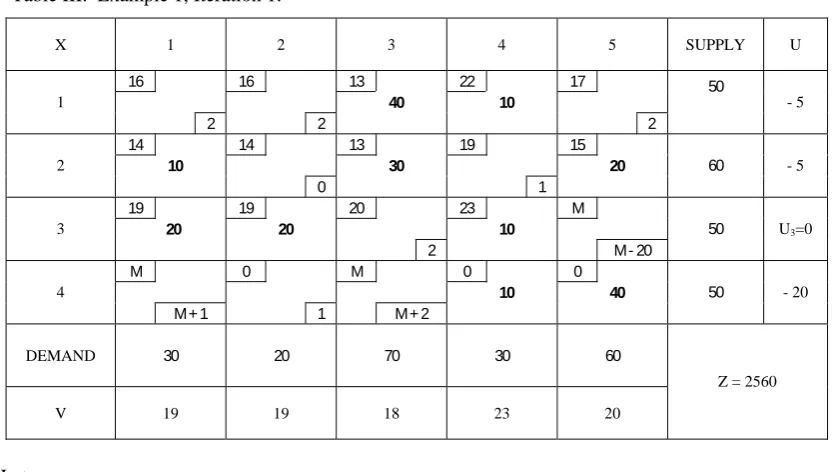
Table III. Example 1, Iteration 1.
X 1 2 3 4 5 SUPPLY U
16 16 13 22 17 40 10
1
2 2 2 50
- 5
14 14 13 19 15
10 30 20
2
0 1
60 - 5
19 19 20 23 M
20 20 10
3
2 M - 20
50 U3=0
M 0 M 0 0 10 40
4
M + 1 1 M + 2
50 - 20
DEMAND 30 20 70 30 60
V 19 19 18 23 20 Z = 2560
Let,
U3 =0, Now, cij=ui+vj and Now, c31=u3+v1 => v1 = 19
Since all the values of cij- ui-vj >0 for the non basic cells, the solution is optimal.
Z=13(40)+22(10)+14(10)+13(30)+15(20)+19(20)+19(20)+23(10)+0(10)+0(40) = 2560 [1]
Example 2
Table IV. Example 2, Iteration 1.
X 1 2 3 4 5 SUPPLY U
8 6 3 7 5
20
1
5 6 5 2 20
3
5 M 8 4 7
20 10
2
M + 8 3 2
30 U2 = 5
6 3 9 6 8
5 25
3
3 1 2
30 6
0 0 0 0 0
0 0 0 20
4
3
20 0
DEMAND 25 25 20 10 20
V 0 -3 0 -1 0
Z = 305
Let,
U2 =5 and c21=u2+v1 => v1 =0 and so on.
VII. RESULTS
Table V. Results Comparison for the Optimal Solution Among the Methods Example 1
Northwest Corner Russell Method New Method
No. Entries Z Value No. Entries Z Value No. Entries Z Value
8 2470+M 8 2570 11 2560
Example 2
Northwest Corner Russell Method New Method
No. Entries Z Value No. Entries Z Value No. Entries Z Value
8 209+25M 8 305 9 305
VIII. THEORETICAL BACKGROUND OF THE NEW METHOD
The basic transportation simplex method basically uses the concept of chain reaction. There is no requirement that the optimal solution has to have (m+n-1) entries. The new method developed as part of this research work is based on the combination of these principles.[2,3].
IX. CONCLUSION
As was shown there were two methods for solving the transportation problems by finding the Initial Basic Feasible solution (IBF) and hence the optimal solution. As was discussed both methods (the Russell Method, and the Northwest Corner rule) had some drawbacks. The Russell Method, the Northwest Corner rule, and also the newly developed Putcha-Ali method [1] use chain reaction to obtain the optimal solution. As a result these problems become cumbersome and also take a long time to come to the optimal solution. However, the new method developed in this paper is able to get the optimal value without using chain reaction. Therefore use of this method for simplex transportation problems can be very helpful and easy.
REFERENCES
[1] C. S. Putcha and A. Shekaramiz, Development of a new method for arriving at Initial Basic Feasible Solution for optimization problems in Engineering, 23rd European Conference on Operational Research, Bonn, July 5-8, 2009. [2] F. S. Hillier and G. J. Lieberman, Introduction to Operations
Research. McGraw Hill,2001.
[3] C. S. Revelle, E. Earl Whit latch and Jeff R. Wright, Civil and Environmental Systems Engineering, 2nd Edition, 2004.
![Avaliando a similaridade semântica entre frases curtas através de uma abordagem híbrida (A hybrid approach to measure Semantic Textual Similarity between short sentences in Brazilian Portuguese)[In Portuguese]](data:image/gif;base64,R0lGODlhAQABAIAAAP///wAAACH5BAEAAAAALAAAAAABAAEAAAICRAEAOw==)