Hedge Classification with Syntactic Dependency Features based on an
Ensemble Classifier
Yi Zheng, Qifeng Dai, Qiming Luo, Enhong Chen Department of Computer Science,
University of Science and Technology of China, Hefei, China.
{xiaoe, dqf2008}@mail.ustc.edu.cn
{luoq, cheneh}@ustc.edu.cn
Abstract
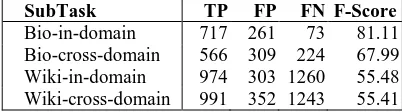
We present our CoNLL-2010 Shared Task system in the paper. The system operates in three steps: sequence labeling, syntactic de-pendency parsing, and classification. We have participated in the Shared Task 1. Our experi-mental results measured by the in-domain and cross-domain F-scores on the biological do-main are 81.11% and 67.99%, and on the Wikipedia domain 55.48% and 55.41%.
1 Introduction
The goals of the Shared Task (Farkas et al., 2010) are: (1) learning to detect sentences containing uncertainty and (2) learning to resolve the in-sentence scope of hedge cues. We have partici-pated in the in-domain and cross-domain chal-lenges of Task 1. Specifically, the aim of Task 1 is to identify sentences in texts that contain unre-liable or uncertain information, and it is formu-lated as a binary classification problem.
Similar to Morante et al. (2009), we use the BIO-cue labels for all tokens in a sentence to predict whether a token is the first one of a hedge cue (B-cue), inside a hedge cue (I-cue), or out-side of a hedge cue (O-cue). Thus we formulate the problem at the token level, and our task is to label tokens in every sentence with BIO-cue. Fi-nally, sentences that contain at least one B-cue or I-cue are considered as uncertain.
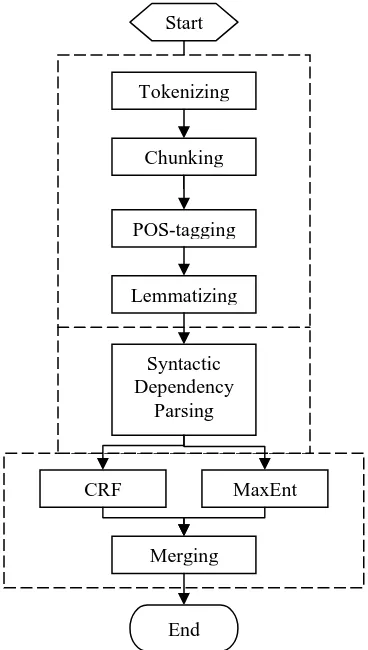
Our system operates in three steps: sequence labeling, syntactic dependency parsing, and clas-sification. Sequence labeling is a preprocessing step for splitting sentence into tokens and obtain-ing features of tokens. Then a syntactic depend-ency parser is applied to obtain the dependdepend-ency information of tokens. Finally, we employ an ensemble classifier based on combining CRF (conditional random field) and MaxEnt (maxi-mum entropy) classifiers to label each token with the BIO-cue.
Our experiments are conducted on two train-ing data sets: one is the abstracts and full articles from BioScope (biomedical domain) corpus (Vincze et al., 2008)1, the other one is paragraphs from Wikipedia possibly containing weasel in-formation. Both training data sets have been an-notated manually for hedge/weasel cues. The annotation of weasel/hedge cues is carried out at the phrase level. Sentences containing at least one hedge/weasel cue are considered as uncertain, while sentences with no hedge/weasel cues are considered as factual. The results show that em-ploying the ensemble classifier outperforms the single classifier system on the Wikipedia data set, and using the syntactic dependency information in the feature set outperform the system without syntactic dependency information on the biologi-cal data set (in-domain).
In related work, Szarvas (2008) extended the methodology of Medlock and Briscoe (2007), and presented a hedge detection method in bio-medical texts with a weakly supervised selection of keywords. Ganter and Strube (2009) proposed an approach for automatic detection of sentences containing linguistic hedges using Wikipedia weasel tags and syntactic patterns.
The remainder of this paper is organized as follows. Section 2 presents the technical details of our system. Section 3 presents experimental results and performance analysis. Section 4 pre-sents our discussion of the experiments. Section 5 concludes the paper and proposes future work.
2 System Description
This section describes the implementation of our system.
2.1 Information Flow of Our System
Common classification systems consist of two steps: feature set construction and classification. The feature set construction process of our
1http://www.inf.u-szeged.hu/rgai/bioscope
tem consists of sequence labeling and syntactic dependency parsing. Figure 1 shows the main information flow of our system.
Figure 1: The main information flow of our sys-tem
2.2 Sequence labeling
The sequence labeling step consists of the fol-lowing consecutive stages: (1) tokenizing, (2) chunking, (3) POS-tagging, (4) lemmatizing. Firstly, the PTBTokenizer2 is employed to split sentence into tokens. Then, tokens are labeled with BIO-tags by the OpenNLP3 chunker. Fi-nally, Stanford Parser4 is used to obtain the POS and lemma of tokens.
2.3 Syntactic Dependency Parsing
In the syntactic dependency parsing stage, we use the Stanford Parser again to obtain depend-ency information of tokens. Based on the Stan-ford typed dependencies manual (Marneffe and Manning 2008), we have decided to obtain the tree dependencies structure. During the process of parsing, we found that the parser may fail due
2a tokenizer from Stanford Parser.
3 http://www.opennlp.org/ 4
http://nlp.stanford.edu/software/lex-parser.shtml
to either empty sentences or very long sentences. To deal with very long sentences, we decided to allocate more memory. To deal with empty sen-tences, we decided to simply label them as cer-tain ones because there are only a few empty sentences in the training and test data sets and we could ignore their influence.
2.4 Features
After sequence labeling and syntactic depend-ency parsing, we obtain candidate features. In our system, all the features belong to the follow-ing five categories: (1) token features, (2) de-pendency features, (3) neighbor features, (4) data features, (5) bigram and trigram features.
Token features of the current token are listed below:
• token: the current token.
• index: index of the current token in the sen-tence
• pos: POS of the current token. • lemma: lemma of the current token.
• chunk: BIO-chunk tags of the current token.
Dependency features of the current token are listed below:
• parent_index: the index of the parent token of the current token.
• parent_token: the parent token of the current token.
• parent_lemma: the lemma of the parent token of the current token.
• parent_pos: the POS of the parent token of the current token.
• parent_relation: the dependency relation of the current token and its parent token.
Neighbor features of the current token include token, lemma, pos, chunk tag of three tokens to the right and three to the left.
Data features of current token are listed below:
• type: indicating documentPart5 type of the sentence which contains the current token, such as Text, SectionTitle and so on.
• domain: distinguishing the Wikipedia and biological domain.
• abstract_article: indicating document type of the sentence which contains the current token, abstract or article.
5documentPart, SectionTitle, Text and so on are tags in the training and test data sets.
CRF MaxEnt
Start
Merging
End Tokenizing
Chunking
POS-tagging
Lemmatizing
Syntactic Dependency
We empirically selected some bigram features and trigram features as listed below:
• left_token_2+left_token_1 • left_token_1+token • token+right_token_1 • right_token_1+right_token_2 • left_token_2+left_token_1+token • left_token_1+token+right_token_1 • token+right_token_1+right_token_2
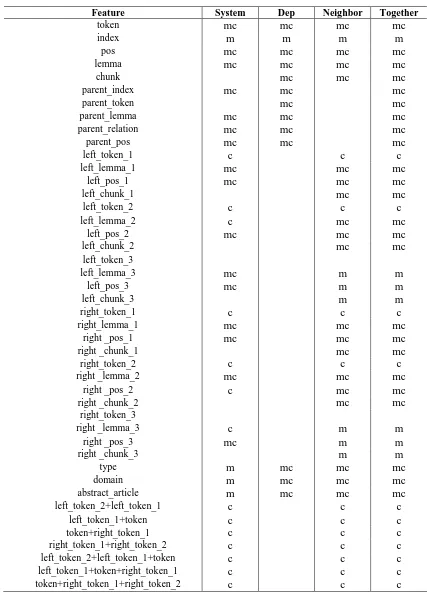
These are the complete set of features for our system. If the value of a feature is empty, we set it to a default value. In the ensemble classifier, we have selected different features for each indi-vidual classifier. Details of this are described in the next subsection.
2.5 Classification
In our system, we have combined CRF++6 and OpenNLP MaxEnt7 classifiers into an ensemble classifier. The set of features for each classifier are shown in the column named “system” of Ta-ble 6. And the two classifiers are used in training and prediction separately, based on their individ-ual set of features. Then we merge the results in this way: for each token, if the two predictions for it are both O-cue, then we label the token with an O-cue; otherwise, we label the token with a B-cue (one of the predictions is B-cue) or an I-cue (no B-cue in the predictions). The moti-vation of the ensemble classifier approach is based on the observation of our internal experi-ments using 10-fold cross validation, which we describe in Section 3. In addition, the parameters of OpenNLP MaxEnt classifier are all set to de-fault values (number of iterations is 100, cutoff is 0 and without smoothing). For CRF++, we only set the option “-f” as 3 and the option “-c” as 1.5, and the others are set to default values.
3 Experimental Results
We have participated in four subtasks, biological in-domain challenge (Bio-in-domain), biological cross-domain challenge (Bio-cross-domain), Wikipedia in-domain challenge (Wiki-in-domain) and Wikipedia cross-domain challenge (Wiki-cross-domain). In all the experiments, TP, FP, FN and F-Score for the uncertainty class are used as the performance measures. We have
6http://crfpp.sourceforge.net/
7
http://maxent.sourceforge.net/
tested our system with the test data set and ob-tained official results as shown in Table 1. In addition, we have performed several internal ex-periments on the training data set and several experiments on the test data set, which we de-scribe in the next two subsections. The feature sets used for each subtask in our system are shown in Table 6, where each column denotes a feature set named after the title of the column (“System”, “dep”, …). Actually, for different subtasks, we make use of the same feature set named “system”.
SubTask TP FP FN F-Score
[image:3.595.314.515.236.292.2]Bio-in-domain 717 261 73 81.11 Bio-cross-domain 566 309 224 67.99 Wiki-in-domain 974 303 1260 55.48 Wiki-cross-domain 991 352 1243 55.41
Table 1: Official results of our system.
3.1 Internal Experiments
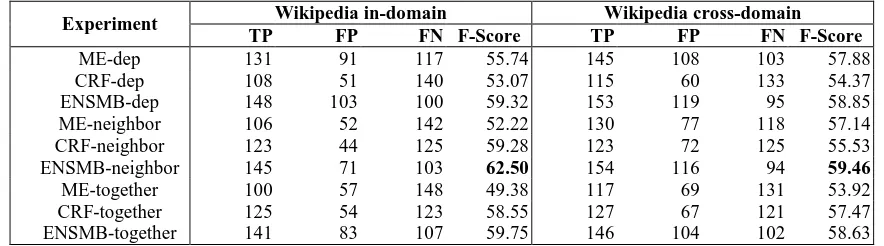
Initially we only used a single classifier instead of an ensemble classifier. We performed 10-fold cross validation experiments on the training data set at the sentence level with different feature sets. The results of these experiments are shown in Table 2 and Table 3.
In internal experiments, we mainly focus on the results of different models and different fea-ture sets. In Table 2 and Table 3, CRF and ME (MaxEnt) indicate the two classifiers; ENSMB stands for the ensemble classifier obtained by combining CRF and MaxEnt classifiers; the three words “dep”, “neighbor” and “together” indicate the feature sets for different experiments shown in Table 6, and “together” is the union set of “dep” and “neighbor”.
Biological in-domain Biological cross-domain Experiment
TP FP FN F-Score TP FP FN F-Score
ME-dep 244 28 34 88.73 220 24 58 84.29
CRF-dep 244 20 34 90.04 230 19 48 87.29
ENSMB-dep 248 32 30 88.89 235 28 43 86.88
ME-neighbor 229 14 49 87.91 211 12 67 84.23
CRF-neighbor 244 16 34 90.71 228 21 50 86.53 ENSMB-neighbor 247 22 31 90.31 241 26 37 88.44
ME-together 234 11 44 89.48 205 12 73 82.83
CRF-together 247 13 31 91.82 234 21 44 87.80 ENSMB-together 253 17 25 92.36 242 26 36 88.64
Table 2: Results of internal experiments on the biological training data set.
Wikipedia in-domain Wikipedia cross-domain
Experiment
TP FP FN F-Score TP FP FN F-Score
ME-dep 131 91 117 55.74 145 108 103 57.88
CRF-dep 108 51 140 53.07 115 60 133 54.37
ENSMB-dep 148 103 100 59.32 153 119 95 58.85 ME-neighbor 106 52 142 52.22 130 77 118 57.14 CRF-neighbor 123 44 125 59.28 123 72 125 55.53 ENSMB-neighbor 145 71 103 62.50 154 116 94 59.46
ME-together 100 57 148 49.38 117 69 131 53.92 CRF-together 125 54 123 58.55 127 67 121 57.47 ENSMB-together 141 83 107 59.75 146 104 102 58.63
Table 3: Results of internal experiments on the Wikipedia training data set.
Biological in-domain Biological cross-domain
Experiment
TP FP FN F-Score TP FP FN F-Score
System-ME 650 159 140 81.30 518 265 272 65.86 System-CRF 700 197 90 82.99 464 97 326 68.69
[image:4.595.81.513.82.206.2]System-ENSMB 717 261 73 81.11 566 309 224 67.99
Table 4: Results of additional experiment of biological test data set.
Wikipedia in-domain Wikipedia cross-domain
Experiment
TP FP FN F-Score TP FP FN F-Score
System-ME 794 235 1440 48.67 798 284 1436 48.13 System-CRF 721 112 1513 47.02 747 153 1487 47.67 System-ENSMB 974 303 1260 55.48 991 352 1243 55.41
Table 5: Results of additional experiment of Wikipedia test data set.
Based on this analysis, we propose an ensem-ble classifier approach to decrease FN in order to improve the recall ratio. The results of the en-semble classifier show that: along with the de-creasing of FN, FP and TP are both inde-creasing. Although the recall ratio increases, the precision ratio decreases at the same time. Therefore, the ensemble classifier approach is a trade-off be-tween precision and recall. For data sets with low recall ratio, such as Wikipedia, the ensemble classifier outperforms each single classifier in terms of F-score, just as the ME, CRF and ENSMB experiments show in Table 2 and Table 3.
In addition, we have performed simple feature selection in the internal experiments. The com-parison of “dep”, “neighbor” and “together” ex-periments shown in Table 2 demonstrates that the dependency and neighbor features are both beneficial only for the biological in-domain ex-periment. This may be because that sentences of the biological data are more regular than those of the Wikipedia data.
3.2 Additional experiments on test data set
[image:4.595.75.517.242.365.2]sys-tem as shown in Table 6, we have performed three experiments: System-ME (ME denotes MaxEnt classifier), System-CRF (CRF denotes CRF classifier) and System-ENSMB (ENSMB denotes ensemble classifier), where “System” denotes the feature set in Table 6. The meanings of these words are similar to internal experiments.
As Table 4 and Table 5 show, for the Wikipe-dia test data set, the ensemble classifier outper-forms each single classifier in terms of F-score by improving the recall ratio with a larger extent than the extent of the decreasing of the precision ratio. For the biological test data set, the ensem-ble classifier outperforms System-ME but under-performs System-CRF. This may be due to the relatively high values of the precision and recall ratios already obtained by each single classifier.
4 Discussion
The features in our experiments are selected em-pirically, and the performance of our system could be improved with more elaborate feature selection. From the experimental results, we ob-serve that there are still many uncertain sen-tences predicted as certain ones. This indicates that the ability of learning uncertain information with the current classifiers and feature sets needs to be improved. We had the plan of exploring the ensemble classifier by combining CRF, MaxEnt and SVM (Support Vector Machine), but it was given up due to limited time. In addition, we were not able to complete experiments with MaxEnt classifier based on bigram and trigram features due to limited time. Actually only two labels I and O are needed for Task 1. We have not done the experiments with only I and O la-bels, and we plan to do it in the future.
According to our observation, the low F-score on the Wikipedia data set is due to many uncer-tain phrases. By contrast, for the biological data set, the uncertain information consists of mostly single words rather than phrases. It is difficult for a classifier to learn uncertain information con-sisting of 3 words or more. As we have observed, these uncertain phrases follow several patterns. A hybrid approach based on rule-based and sta-tistical approaches to recognize them seems to be a promising.
5 Conclusion and Future Work
Our CoNLL-2010 Shared Task system operates in three steps: sequence labeling, syntactic de-pendency parsing, and classification. The results show that employing the ensemble classifier
out-performs each single classifier for the Wikipedia data set, and using the syntactic dependency in-formation in the feature set outperform the sys-tem without syntactic dependency information for the biological data set (in-domain). Our final system achieves promising results. Due to lim-ited time, we have only performed simple feature selection empirically. In the future, we plan to explore more elaborate feature selection and ex-plore ensemble classifier by combining more classifiers.
Acknowledgments
The work was supported by the National Natural Science Foundation of China (No.60775037), the National High Technology Research and Devel-opment Program of China (863 Program, No.2009 AA01Z123), and Specialized Research Fund for the Doctoral Program of Higher Educa-tion (No.20093402110017).
References
Richárd Farkas, Veronika Vincze, György Móra, János Csirik, and György Szarvas. 2010. The CoNLL-2010 Shared Task: Learning to Detect Hedges and their Scope in Natural Language Text. In Proceedings of CoNLL-2010: Shared Task, pages 1–12.
Viola Ganter, and Michael Strube. 2009. Finding hedges by chasing weasels: Hedge detection using Wikipedia tags and shallow linguistic features. In
Proceedings of the ACL-IJCNLP 2009 Con-ference Short Papers, pages 173–176.
Marie-Catherine de Marneffe, and Christopher D. Manning. 2008. Stanford typed dependencies manual, September 2008.
Ben Medlock, and Ted Briscoe. 2007. Weakly super-vised learning for hedge classification in scientific literature. In Proc. of ACL 2007, pages 992–999.
Roser Morante, and Walter Daelemans. 2009. Learn-ing the scope of hedge cues in biomedical texts. In
Proc. of the BioNLP 2009 Workshop, pages 28–36.
György Szarvas. 2008. Hedge classification in bio-medical texts with a weakly supervised selection of keywords. In Proc. of ACL 2008, pages 281–289.
Feature System Dep Neighbor Together
token mc mc mc mc
index m m m m
pos mc mc mc mc
lemma mc mc mc mc
chunk mc mc mc
parent_index mc mc mc
parent_token mc mc
parent_lemma mc mc mc
parent_relation mc mc mc
parent_pos mc mc mc
left_token_1 c c c
left_lemma_1 mc mc mc
left_pos_1 mc mc mc
left_chunk_1 mc mc
left_token_2 c c c
left_lemma_2 c mc mc
left_pos_2 mc mc mc
left_chunk_2 mc mc
left_token_3
left_lemma_3 mc m m
left_pos_3 mc m m
left_chunk_3 m m
right_token_1 c c c
right_lemma_1 mc mc mc
right _pos_1 mc mc mc
right _chunk_1 mc mc
right_token_2 c c c
right _lemma_2 mc mc mc
right _pos_2 c mc mc
right _chunk_2 mc mc
right_token_3
right _lemma_3 c m m
right _pos_3 mc m m
right _chunk_3 m m
type m mc mc mc
domain m mc mc mc
abstract_article m mc mc mc
left_token_2+left_token_1 c c c
left_token_1+token c c c
token+right_token_1 c c c
right_token_1+right_token_2 c c c
left_token_2+left_token_1+token c c c
left_token_1+token+right_token_1 c c c
[image:6.595.76.503.76.673.2]token+right_token_1+right_token_2 c c c