Proceedings of the 2019 Conference on Empirical Methods in Natural Language Processing 302
Multi-Input Multi-Output Sequence Labeling for Joint Extraction of Fact
and Condition Tuples from Scientific Text
Tianwen Jiang‡†,1, Tong Zhao†, Bing Qin‡, Ting Liu‡, Nitesh V. Chawla†, Meng Jiang† ‡
Harbin Institute of Technology, Harbin, Heilongjiang, China †University of Notre Dame, Notre Dame, Indiana, USA
‡{twjiang,bqin,tliu}@ir.hit.edu.cn †{tzhao2,nchawla,mjiang2}@nd.edu
Abstract
Condition is essential in scientific statement. Without the conditions (e.g., equipment, en-vironment) that were precisely specified, facts (e.g., observations) in the statements may no longer be valid. Existing ScienceIE methods, which aim at extracting factual tuples from sci-entific text, do not consider the conditions. In this work, we propose a new sequence label-ing framework (as well as a new tag schema) to jointly extract the fact and condition tuples from statement sentences. The framework has (1) a multi-output module to generate one or multiple tuples and (2) a multi-input module to feed in multiple types of signals as sequences. It improves F1 score relatively by 4.2% on BioNLP2013 and by 6.2% on a new bio-text dataset for tuple extraction.
1 Introduction
Conditions such as environment and equipment provide validation supports for facts, while the facts focus on scientific observation and hypoth-esis in scientific literature (Miller, 1947). Exist-ing ScienceIE methods, which extract (subject, re-lational phrase, object)-tuples from scientific text, do not distinguish the roles of fact and condition. Simply adding a tuple classification module has two weak points: (1) one tuple may have different roles in different sentences; (2) the tuples in one sentence have high dependencies with each other, for example, given a statement sentence in a bio-chemistry paper (Tomilin et al.,2016):
“We observed that ... alkaline pH increases the activity of TRPV5/V6 channels in Jurkat T cells.”
an existing system (Stanovsky et al.,2018) would return one tuple as below:
1This work was done when the first author was visiting
the University of Notre Dame.
Encoder Decoder LSTMd
Feed Forward
Feed Forward Softmax Softmax
{!"#, !%#, … !'#} {!"(, !%(, … !)(}
Feed Forward Feed
Forward
...
Feed Forward Feed
Forward
...
SoftmaxSoftmax Softmax Softmax
LM POS CAP
Multi-Input Module
+ +
Statement Sentence relation names
Multi-Output Module
Multi-Head Multi-Head Relation name
tagging layer Tuple completion tagging layer
Input Sequences
+
Input-Gates
{*+,-", *+,-%… *+,-'} {./01", ./01%… ./01)}
[image:1.595.306.526.217.525.2]2[":5]789 , 2
[":5] 7:9
… 2[":5]7;9 2 [":5] 78< , 2
[":5] 7:< … 2
[":5] 7=<
Input-Gates
Input-Gates
fact condition
Figure 1: Our framework has two modules: (1) a multi-input module (bottom) based on a multi-head encoder-decoder model with input gates; (2) a multi-output module (top) of a relation name tagging layer and a tuple completion tagging layer.
(alkaline pH, increases, activity of TRPV5/V6
channels in Jurkat T cells).
where (a) the object should just be the channel’s activity and (b) the condition tuple (TRPV5/V6 channels, in, Jurkat T cells) was not found. Note
that the term “TRPV5/V6 channels” isnot only
the concept in the fact tuple’s objectbut alsothe condition tuple’s subject.
are formatted as “B/I-XYZ”, where
• X∈ {fact, condition};
• Y∈ {1: subject; 2: relation; 3: object};
• Z∈ {concept, attribute, relational phrase}. Note that if Y=“2” then Z=“p”. So, the number of non-“O” tags is20. Now each fact/condition tuple can be represented as a tag sequence. Moreover, it is the first work in sequence labeling that concepts and attributes are separated. The fact tuple in the example will ideally be: (alkaline pH, increases, {TRPV5/V6 channels:activity}).
Figure1shows our framework. Multiple tag
se-quences are generated after the LSTMd decoder, each of which represents a fact or condition tuple. This multi-output module has two layers: one is a relation name tagging layer that predicts the tags of relational phrases and determines the number of output sequences; the other is a tuple completion tagging layer that generates the tag sequences for completing the fact and condition tuples.
To address the challenge of modeling the com-plex tag schema, besides language model, we in-corporate as much information as possible from upstream tools such as Part-of-Speech tagging (POS), Concept detection, Attribute name extrac-tion, and Phrase mining (CAP). And we transform them into tag sequences as the model input. We observe strong dependencies between the token’s POS/CAP tags and target tags. We appreciate the high accuracy of existing techniques making the multi-input sequences available for new datasets.
The multi-input multi-output sequence label-ing framework is named as MIMO. Experiments demonstrate that it improves F1 score relatively by 6.2% over state-of-the-art models for tuple ex-traction on a new bio-text dataset we will intro-duce in the later section. When transferred to the BioNLP2013 dataset without additional training, it improves F1 score relatively by 4.2%. We apply MIMO to a large set of 15.5M MEDLINE papers and construct a knowledge graph: An example can be found in Figure4.
2 A New Dataset
We built a system with GUI (Figure2) to collect a new dataset for the joint tuple extraction purpose, named Biomedical Conditional Fact Extraction (BioCFE). Three participants (experts in biomedi-cal domain) manually annotated the fact and con-dition tuples from statement sentences from 31 pa-per abstracts in the MEDLINE database. The
an-alkaline pH
increases the activity of TRPV5/V6 channels in
Jurkat .
Add a fact Add a condition Save for statement
Fact 1: alkaline pH
concept
NIL
attribute
TRPV5/V6...
concept
activity
attribute
increase relation
Condition 1: TRPV5/V6... NIL in Jurkat T c... T cells
We showed that extracellular acidic pH reduces the
activity of TRPV5/V6 channels , whereas
Fact 2: extracellul... NIL reduces TRPV5/V6... activity
subject object
Figure 2: Annotation by four steps: (1) merge token(s) into a span; (2) make slots for a new tuple; (3) drag spans into the slots; (4) save annotations.
notation procedure took over 30 minutes on aver-age for each paper. Here is a brief guide to the system. First, the users merged the token(s) into a span. Second, they gave a proper number of fact and/or condition tuple(s), where the proper num-ber is not fixed but depends on the concrete sen-tence. Each tuple has five slots (subject’s concept, subject’s attribute, relation phrase, object’s con-cept, and object’s attribute). Third, they dragged the spans filling into the slots. If the three anno-tations are inconsistent, we filtered out the case. Eventually we have 756 fact tuples and 654 con-dition tuples from 336 annotated sentences. It is common to see one sentence having multiple facts and/or conditions, and actually 61%/52% state-ment sentences have more than one fact/condition tuples.
3 The Proposed Approach
Our approach has two modules: (1) a multi-input module that harnesses recent NLP development to process the text for input sequences from multiple tasks and feeds them into a multi-head encoder-decoder model with input gates; (2) a multi-output module that generates multiple tuple tag se-quences for fact and condition tuples, which con-sists of a relation name tagging layer and a tuple completion tagging layer, as shown in Figure1.
3.1 The Multi-Input Module
Preprocessing for input sequences: Following
fundamental NLP techniques have achieved high accuracy requiring no additional training with
labeled data: Language Model (LM) (Howard
[image:2.595.307.526.60.217.2]et al., 2018; Wang et al., 2018a). For any given input sentence, we tokenize it and represent each token by its word embedding (pre-trained GloVe vector in this paper). Then we get another three input sequences by the input sentence and the above three fundamental NLP techniques. (1) A pre-trained LSTM-based language model takes the sentence as input and returns semantic embedding sequence, where the dependencies between a to-ken and its predecessors in distant contexts are preserved. (2) We employ NLTK tool to gener-ate the POS tag sequence for the given sentence. The POS tag sequence indicates syntactic patterns of the words in a sentence, that is the dependencies between POS tags and output tags, like verbs (e.g., VBD) and predicates (e.g., B-f2p). (3) Multiple complementary IE techniques are used to detect concepts, attributes and phrases from the given sentences, being merged and resulting a CAP sequence. We make tags in the format of “B/I -c/a/p” for the tokens of concepts, attributes, and phrases.
Each sequence encodes a specific type of depen-dencies. A combination of multi-type dependen-cies learns the complicated dependendependen-cies on the 21 tuple tags better than any sole type. LM learns the dependencies between a token and its prede-cessors in distant contexts, which helps predict the position of subject, relation, and object. POS encodes the syntactic features of words. Depen-dencies between the POS tag and tuple tag (e.g., “VBD” and “B-f2p”) can be modeled. We also spot high dependencies between the CAP tag and tuple tag. For example, the tokens of “B/I-c” (con-cept) and “B/I-a” (attribute) tags have high prob-ability of being labeled as XYc” and “B/I-XYa” in the output sequences, respectively.
Multi-head Encoder-Decoder: We investigate two neural models as encoder: one is bidirec-tional LSTM (BiLSTM), the other is the renown, bidirectional encoder representations from Trans-formers (BERT). We adopt a LSTM structure as the decoding layer (LSTMd) (Zheng et al.,2017). We observe that the input sequences may have different tag predictability on different sentences. For short sentences, POS and CAP are more use-ful (modeling local dependencies); for long sen-tences, LM is more effective (modeling distant de-pendencies). In order to secure the model’s ro-bustness on massive data, we apply a multi-head mechanism to the encoder-decoder model. Each
head of the encoder-decoder is fed with one type of input sequence, and they are combined at the end of decoder layer. Thus, the tag prediction be-comes more stable than using a simple encoder-decoder without the multi-head.
Multi-input gates: We adopt the multi-input gates in ResNet (He et al.,2016) to take the most use of the multi-input sequences. We add the gates to the input of BiLSTM or BERT encoder, the input of LSTMd decoder, and the multi-output module.
3.2 Multi-Output Module
We propose to generate multiple output sequences. As annotating multiple tuples from one sentence is common, a token may have different expected tags in the tuples. On BioCFE, we observe that 93.8% statement sentences make multiple tuples: 21.7% of the sentences have at least one token that appears in at least one fact tuple and at least one condition tuple, expecting tags “B/I-fYZ” and “B/I-cYZ”; 18.1% of the sentences have at least one token that appears in one condition tuple as a part of subject and in another condition tuple as a part of object, expecting tags c1Z” and “B/I-c3Z”. Therefore, we extend the typical one-output sequence labeling to a multi-output design.
Then what is the number of output sequences? We reveal the significant role of relation names in making tuples. If we tagged the relation names out, for each relation name, of tags beginning with “B-f2p” as a fact’s and “B-c2p” as a condition’s, the module would generate an output sequence, respectively. Then we extract all possible tuples, whose relation has been specified, from every out-put sequence. Two observations on the annotated data support this idea: We transform each of the 1,410 tuples into a tag sequence. For the same sen-tence, if the tuples’ relation names are the same, we merge their tag sequences into one and then use the matching function in (Stanovsky et al.,2018) to recover the tuples. First, 0 token has conflict-ing tags among the 240 merged sequences. Sec-ond, the recovery has 0 missing or wrong tuple. So, generating one output sequence and complet-ing the tuples per relation name is practical.
The multi-output module has two layers: one is a relation name tagging layer and the other is a tuple completion tagging layer.
and the softmax predict the probability distribution of tags on fact and condition, respectively:
pfi = softmax(FFNfRN T(di)), (1)
pci = softmax(FFNcRN T(di)). (2)
wheref is for fact andcfor condition.didenotes thei-th token’s vector given by the LSTMd.
Now we have two tag sequences, one for fact and the other for condition. As we have argued with one-output, extracting tuples from the “two-output” sequences cannot resolve the tag con-flicts, either. Here we extract only the relation names: {r1f, rf2,· · ·, rfn} denotes the n relation names (beginning with “B-f2p” tag) in fact tuples and{r1c, r2c,· · ·, rcm}denotes themrelation names (beginning with “B-c2p” tag) in condition tuples. Tuple completion tagging (TCT) Layer: This
layer predictsnfact tag sequences and m
condi-tion tag sequences. Each sequence is generated by a FFN and a softmax layer. The FFN obtains the relation name from the RNT layer. The FFN’s input also includes the token’s vectors from the encoder-decoder model of the multi-input module. Here we take condition sequences as an exam-ple to describe the details of the method. When predicting thej-th tag sequence, we define the po-sition embedding of thei-th token as follows, rep-resenting the relative position to thej-th relation name’s tag “B-c2p”:
vci,j =gemb(rjc, i). (3)
Thus, the tag probability distributions of the i-th token in the condition tag sequences are:
p(r
c
1)
i = softmax(FFNcT CT(vi,c1+di)),
p(r
c
2)
i = softmax(FFNcT CT(vi,c2+di)),
· · ·, p(rcm)
i = softmax(FFNcT CT(vci,m+di)). (4)
Similarly, we have the following tag distributions for thei-th token in the fact tag sequences:
p(r
f
1)
i = softmax(FFN f
T CT(v
f
i,1+di)),
p(r
f
2)
i = softmax(FFN f
T CT(v
f
i,2+di)),
· · ·,
p(r
f
n)
i = softmax(FFN f
T CT(v
f
i,n+di)), (5)
wherevi,jf is the position embedding of thei-th to-ken in thej-th fact sequence, representing the rel-ative position to the relation name’s tag “B-f2p”.
Finally, we apply the matching function in (Stanovsky et al., 2018) to complete and extract the tuples (i.e., the concepts and/or attributes in the subjects and objects) for each output sequence.
3.3 Loss Function and Training
Given a sentences, the loss function of the relation name tagging layer can be written as below:
`sRN T =−
Ns X
i=1
(log(pf
i,yfi) + log(p c i,yc
i)), (6)
wherepfi,y andpci,y are the probability of predict-ing y as the tag of thei-th token in the fact and condition tag sequences, respectively. yfi andyic
are the observed tag of the i-th token in the fact and condition tuple, respectively.Nsis the length of the sentences.
The loss function of the tuple completion tag-ging layer is consisted of two parts, loss on fact tuples and loss on condition tuples:
`sT CT =`sf act+`scond.,
`sf act =−PNs i=1
Pn
j=1log(p (rfj)
i,yi,jf ),
`scond. =−PNs i=1
Pm
j=1log(p (rc
j) i,yc
i,j),
(7)
wherenandmare the number of fact and
condi-tion tag sequences for the sentences, respectively.
p(r
f j) i,yi,jf andp
(rc j) i,yc
i,j are the probability of predicting
yi,jf andyci,j as the tag of thei-th token in thej-th fact and condition tag sequence, respectively.
The overall loss function for optimization is:
`=`RN T +`T CT =
X
s∈S
(`sRN T +`sT CT), (8)
whereSis the set of statement sentences.
4 Experiments
We evaluate the performance of condition/fact tag prediction and tuple extraction by the proposed MIMO model, its variants, and state-of-the-art models on the newly annotated BioCFE dataset and transferred to the BioNLP2013 dataset.
4.1 Experimental Setup
Datasets: Statistics of BioCFE has been given in
the Section 2. Additionally, the attribute-related tags take 11.7% and 9.4% of non-“O” tags in fact and condition tuples, respectively. So, it is impor-tant to distinguish concept and attribute. To the best of our knowledge, it is the first time that con-ditional information was carefully annotated on biomedical literature.
We use the system in Figure 2 to annotate a
subset of BioNLP2013 Cancer Genetics (CG) task
dataset (N´edellec et al., 2013). We have 197
fact tuples and 173 condition tuples. We use this BioNLP dataset as an extra test set for task of fact and condition tuples extraction, but the model will not be trained on this dataset.
Validation:The ratio of training:validation:test is 60:8:32. For BioCFE, the evaluation set has 242 fact tuples and 209 condition tuples (on average from 108 sentences). We repeat five times, evalu-ate the performance, and report average results.
Evaluation metrics: For tag prediction, We use
standard metrics, precision, recall, and F1 scores. We have similar observations on Micro F1 scores as Macro F1 scores, so we report Macro F1 only. For evaluating tuple extraction, we use pair-wise comparison to match the extracted and ground-truth tuples. We evaluate the correctness on the tuple’s five slots using the same metrics.
Baselines: We compare with statistical sequence
labeling methods: Structured Support Vector
Ma-chine (SVM) (Tsochantaridis et al., 2005) and
Conditional random field (CRF) (Lafferty et al.,
2001). We compare with a neural sequence
la-beling method, BiLSTM-LSTMd (Zheng et al.,
2017). We replace its encoder with BERT (
De-vlin et al., 2018) to make it a more competitive baseline. We also compare against two renown OpenIE systems, Stanford OpenIE (Angeli et al.,
2015) and AllenNLP OpenIE (Stanovsky et al.,
2018) followed by a condition/fact classification. We enhance statistical sequence labeling mod-els with multi-input signals for fairness, and train them for fact tuple and condition tuple
extrac-tion separately. In the neural baselines (BiLSTM-LSTMd and BERT-(BiLSTM-LSTMd), fact extraction and condition extraction share the encoder-decoder model and use different, proper parameters in the linear-softmax layer.
Hyperparameters: The multi-input module has
a BiLSTM/BERT encoder and a LSTM de-coder. The word embeddings were obtained from GloVe (Pennington et al.,2014) with the
dimen-sion sizedW E = 50. The language model
dimen-sion size nsdLM = 200. The size of POS tag
em-bedding isdP OS= 6. The size of CAP tag
embed-ding isdCAP = 3. The number of LSTM units in
the encoding layer is 300. The number of trans-former units in the BERT encoding layer is 768.
4.2 Results on BioCFE
In this section, we present overall performance, ablation study, error analysis, and efficiency.
4.2.1 Overall Performance
Table1shows that the proposed input multi-output sequence labeling model with a BERT en-coder consistently performs the best over all the baselines on tag prediction and tuple extraction. Compared to BiLSTM-LSTMd, BiLSTM-based MIMO improves F1 score relatively by 7.1% on tag prediction and by 8.8% on tuple extraction; compared to BERT-LSTMd, BERT-based MIMO
improve F1 by4.7%and6.2%on the two tasks,
respectively. Apparently the BERT encoder sig-nificantly improves the performance (by 16.9– 17.2% on tag prediction and 7.7–10.3% on tu-ple extraction). And the MIMO design can fur-ther improve it. Neural sequence labeling models perform better than OpenIE systems and statisti-cal methods. Neural sequence labeling models are more adaptive to learning structures with the new tag schema. Open IE method plus a condition/fact classification is not effective.
Compared to BERT-LSTMd, the BERT-based MIMO improves precision and recall relatively by 8.3% and 1.3% on tag prediction; and relatively by 3.1% and 9.3% on tuple extraction, respectively. When the tags were more precisely predicted, the tuple’s five slots would be more accurately filled, and we would have more complete tuples.
Methods Tag Prediction (%) Tuple Extraction(%)
Prec. Rec. F1 / F1F act, F1Cond. Prec. Rec. F1 / F1F act, F1Cond.
Allennlp OpenIE (Stanovsky et al.,2018) - - - 42.60 38.22 40.29 / ,
-Stanford OpenIE (Angeli et al.,2015) - - - 47.11 41.62 44.19 / ,
-Structured SVM (Tsochantaridis et al.,2005) 32.68 25.80 28.83 / 32.76, 24.71 47.62 46.15 46.87 / 45.01, 48.72 CRF (Lafferty et al.,2001) 60.07 41.92 49.37 / 56.23, 41.87 65.19 62.44 63.78 / 64.07, 63.44 BiLSTM-LSTMd (Zheng et al.,2017) 61.00 56.26 58.53 / 65.16, 51.78 71.57 66.55 68.97 / 69.51, 68.41 BERT-LSTMd 70.07 70.19 70.13 / 74.30, 65.88 78.64 73.67 76.08 / 76.14, 75.99
MIMO (BiLSTM based) 67.80 58.24 62.66 / 66.67, 58.58 75.35 74.67 75.01 / 74.91, 75.10 MIMO (BERT based) 75.91 71.08 73.41/76.01,70.75 81.06 80.53 80.79/79.94,81.64
Table 1: The proposed MIMO outperforms existing methods on tag prediction and tuple extraction in the BioCFE dataset. The MIMO with BERT-based encoder performs the best. Higher score performs better.
4.2.2 Ablation Study
Table2compares variants of the proposed model
to evaluate the effectiveness of the following com-ponents: (1)multi-input sequences, such as none, or one (in LM, POS, and CAP), double combi-nation, or triple combination; (2) multi-input en-coder model, BiLSTM or BERT; (3)multi-output module, with the RNT layer only (generating one fact tag sequence and one condition tag sequence) or a combination of RNT and TCT layers (gener-ating multiple sequences for each tuple type).
Multi-input sequences: When the choices of the
encoder model and multi-output layers are speci-fied, we observe that triple combination of input sequences performs better than double combina-tions and the double combinacombina-tions win over the sole input. An additional sequence makes a rel-ative F1 improvement by 1.0–2.4%. The triple combination improves F1 relatively by 3.2–4.1%. This demonstrates that the three types of input
sequences encodecomplementary informationfor
learning dependencies in the proposed tag schema. First, the language model learns the dependen-cies between a token and its predecessors in dis-tant contexts. Having the LM sequence recognizes subjects and objects relative to the relation names and reduces the false positives of “B/I-X1Z” and “B/I-X3Z”. Second, the POS tag encodes the to-ken’s syntactic feature. Having the POS sequence improves the precision of tag prediction. For ex-ample, verbs and prepositions (e.g., “in”, “dur-ing”) often act as the relation name of facts and conditions, respectively; conjunction words (e.g., “that”, “which”) indicate subordinate clauses, so the noun phrase before the conjunction word is likely to be the subject of the tuple given by the
clause. Third, the formerly-detected concepts, at-tribute names, and phrases are absolutely useful for tagging the slots of subjects and objects. In other words, the tags “B/I-c” and “B/I-a” in the CAP sequence are strongly associated with the tar-get tags “B/I-XYc” and “B/I-XYa”, respectively.
Encoder in the multi-input module:
Compar-ing the middle three columns (BiLSTM-based en-coder) and the right-hand three columns (BERT-based encoder), one can easily tell the significant improvement brought by the BERT model.
Layers in the multi-output module:If the
multi-output models have both RNT and TCT layers, the F1 score is relatively 1.4–5.0% higher than the models that have the RNT layer only. Moreover, the recall is improved relatively by 1.5–9.0%. So the TCT layer, which generates multiple tag se-quences for each type of tuple (i.e., fact and con-dition), plays a very important role in recognizing the multiple tuples from one statement sentence.
4.2.3 Error Analysis
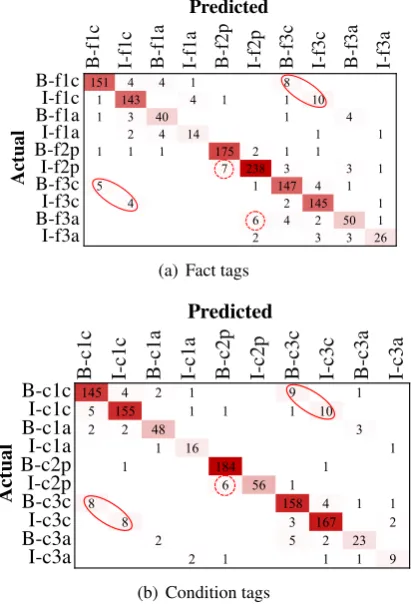
Table3 presents the confusion matrices made by
the BERT-based MIMO on predicting non-“O” tags for facts and conditions, respectively. The columns are predicted tags and the rows are actual ones. Perfect results would be diagonal matrices.
Settings BiLSTM-based Encoder (%) BERT-based Encoder (%) LM POS CAP MO Prec. Rec. F1/F1F act, F1Cond. Prec. Rec. F1/F1F act, F1Cond.
7 71.57 66.55 68.97 / 69.51, 68.41 78.64 73.67 76.08 / 76.14, 75.99
4 7 72.84 67.36 69.99 / 69.22, 70.75 79.57 74.77 77.10 / 77.47, 76.71
4 7 72.68 68.11 70.32 / 71.85, 68.78 79.66 74.59 77.04 / 76.80, 77.27
4 7 72.84 67.69 70.17 / 69.42, 70.91 79.01 74.02 76.43 / 77.43, 75.43
4 4 7 73.38 68.81 71.02 / 71.86, 70.15 80.66 75.52 78.01 / 77.91, 78.09
4 4 7 73.71 68.14 70.82 / 70.34, 71.27 80.90 76.20 78.48 / 78.35, 78.60
4 4 7 74.17 69.12 71.56 / 70.89, 72.21 81.13 76.20 78.59 / 78.42, 78.73
4 4 4 7 74.63 69.21 71.82 / 71.68, 71.94 81.74 76.29 78.92 / 78.67, 79.16
4 71.80 72.34 72.07 / 72.39, 71.73 77.38 79.19 78.27 / 76.64, 79.89
4 4 72.41 73.35 72.88 / 71.99, 73.77 79.04 79.87 79.45 / 79.09, 79.81
4 4 73.85 73.74 73.80 / 72.64, 74.96 79.40 79.50 79.45 / 78.66, 80.24
4 4 72.69 74.27 73.47 / 72.19, 74.75 79.05 79.72 79.39 / 78.41, 80.36
4 4 4 74.43 73.73 74.08 / 73.19, 74.96 79.67 80.65 80.16 / 79.16, 81.14
4 4 4 74.31 74.33 74.32 / 74.45, 74.19 79.97 79.56 79.76 / 79.06, 80.47
4 4 4 75.15 74.12 74.63 / 74.69, 74.57 79.41 79.98 79.70 / 79.49, 79.90
[image:7.595.75.527.60.324.2]4 4 4 4 75.35 74.67 75.01/74.91,75.10 81.06 80.53 80.79/79.94,81.64
Table 2: The proposed MIMO that employs (a) multi-input Language Models, POS tags, and Concept-Attribute-Phrase sequences, (b) multi-output tag sequences, (c) BERT-based encoder performs the best on tuple extraction.
The ovals in each confusion matrix present the most significant type of error. Of a small set of ac-tual subjects, the model predicted them as objects, and vise versa, though the fact/condition role and concept role were correctly predicted.
The dashed circles show the second frequent type of error. Of the actual “I-f2p” tokens, the model predicted that 7 were “B-f2p”; for the ac-tual “I-c2p”, it predicted that 6 were “B-c2p”. Ba-sically, it was because of missing the beginning word of the relational phrases. Of the actual “B-f3a” tokens, the model predicted 6 were “I-f2p”. Future work will aim at improving the prediction of the boundaries of long relational phrases.
4.2.4 Efficiency
All the experiments were conducted on 16 Graph-ics Cards (GeForce GTX 1080 Ti), where one individual model only used 1 GPU. Each model was trained for 1,000 epochs. For the BiLSTM-LSTMd MIMOs, the pre-training took 2.4 hours and the re-training (TCT layer) took 0.4 hour. For the BERT-LSTMd MIMOs of the best perfor-mance, the ptraining took 3.5 hours and the re-training took 0.9 hour. It took 5.7 hours to extract fact and condition tuples from 141 million sen-tences in the MEDLINE text data. It is comparable with existing approaches in terms of scalability.
4.3 Results on BioNLP2013
As shown in Table 3, the BERT-LSTMd MIMO
model achieves an F1 score of 0.790 on tuple ex-traction from BioNLP2013. Note that the model was trained on BioCFE that has no overlapping sentence with BioNLP2013. This score is com-parable with the testing F1 score on the BioCFE (0.808), which demonstrates the effectiveness and reliability of the proposed model.
Our model improves the F1 score relatively by 4.2% over the best baseline BERT-LSTMd. The improvement on recall is more substantial: It im-proves recall relatively by 5.8%. It was because of the design of the multi-output module: the TCT layer generates multiple tag sequences based on the relation names predicted by the RNT layer. A token in a statement sentence may have differ-ent roles in differdiffer-ent tuples of the same type (fact or condition). For example, given the following statement sentence:
“Immunohistochemical staining of the tumors demonstrated a decreased number of blood ves-sels in the treatment group versus the controls.”
The proposed model is able to find one fact tuple and two condition tuples precisely:
B-f1c I-f1c B-f1a I-f1a B-f2p I-f2p B-f3c I-f3c B-f3a I-f3a B -f 1c I-f1c B -f 1a I-f1a B -f 2p I-f2p B -f 3c I-f3c B -f 3a I-f3a A ct u al Predicted
151 4 4 1 8
1 143 4 1 1 10
1 3 40 1 4
2 4 14 1 1
1 1 1 175 2 1 1
7 238 3 3 1
5 1 147 4 1
4 2 145 1
6 4 2 50 1
2 3 3 26
(a) Fact tags
B-c1c I-c1c B-c1a I-c1a B-c2p I-c2p B-c3c I-c3c B-c3a I-c3a B -c 1c I-c1c B -c 1a I-c1a B -c 2p I-c2p B -c 3c I-c3c B -c 3a I-c3a A ct u al Predicted
145 4 2 1 9 1
5 155 1 1 1 10
2 2 48 3
1 16 1
1 184 1
6 56 1
8 158 4 1 1
8 3 167 2
2 5 2 23
2 1 1 1 9
[image:8.595.306.523.61.186.2](b) Condition tags
Figure 3: Confusion matrices on predicting fact tags (Top) and condition tags (Bottom) in BioCFE data.
-Condition 1:(blood vessels,in,treatment group) -Condition 2: (treatment group,versus,controls) Note that the concept “treatment group” acts as theobjectof Condition Tuple 1 (having tags “B/I-c3c”) and thesubjectof Condition Tuple 2 (having tags “B/I-c1c”). The multi-output design tackled this issue while other models could not.
Compared with BioCFE: On BioCFE, the F1 score on condition tuple extraction is a bit higher than that on fact tuple extraction (81.64 vs 79.94). On BioNLP2013, we have the opposite observa-tion (78.58 vs 79.42). They are still comparable but if we look at the error cases, we find that most of the false predictions of condition tuple come from long sentences (having more than 30 words). And 35% of the sentences in BioNLP are long sen-tences, while only 5% in Bio CFE are long. Long dependency modeling is always challenging for IE, especially condition extraction. We will study it in the future work.
4.4 A Visualized Case Study
Scientific knowledge graph enables effective search and exploration. It is certainly important to represent the conditions of the corresponding fact
Methods Prec. (%) Rec. (%) F1 (%)
Allennlp OpenIE 41.84 37.87 39.75
Stanford OpenIE 45.04 42.99 43.99
Structured SVM 49.69 47.54 48.59
CRF 59.55 56.29 57.88
BiLSTM-LSTMd 65.33 63.09 64.19
BERT-LSTMd 76.99 74.74 75.85
MIMO (BERT based) 78.93 79.07 79.00
Table 3: The BERT-LSTMd MIMO model performs the best on tuple extraction in BioNLP2013.
stmt5 stmt10 stmt1 stmt8 increased reduced fact condition fact fact fact condition condition condition cell proliferation VPA treatment HDLs MiR-199a-5p Chlorin e6-PDT incubation inhibition subj. obj. subj. obj. subj.obj. obj . subj.
in vitro pre-mature-senescence mode using obj. from des-fluoro-anacetrapib-treated animals obj.
polycystic kidney disease
obj. HDLs subj. in cell proliferation subj. nimotuzumab
in combination with
cetuximab
obj. Chlorin e6-PDT
subj.
[image:8.595.79.285.64.368.2]obj.
Figure 4: Structuring tuples detected from four state-ment sentences that state-mention “cell proliferation” into a snapshot of scientific knowledge graph with fact tuples on the left and condition tuples on the right.
being valid in the graph. As we have applied our
model to the large MEDLINE dataset, Figure 4
visualizes the fact and condition tuples extracted from four statement sentences about “cell prolif-eration”. On the left side, we find (1) “VPA treat-ment” and the “incubation” of “HDLs” increased cell proliferation, while (2)“Chlorin e6-PDT” and the “inhibition” of “MiR-199a-5p” decreased cell proliferation. On the right, we are aware of the conditions of the factual claims. They describe the methodology of the observation (e.g., “using”, “in combination with”) or the context (e.g., “in” a spe-cific disease or “from” spespe-cific animals). In some other cases, we find the temperature and pH values are detected as the conditions of observations.
5 Related Work
5.1 Scientific Information Extraction
Information extraction in scientific literature, e.g., computer science, biology and chemistry, has been receiving much attention in recent years. Scien-ceIE in computer science focus on concept recog-nition and factual relation extraction (Luan et al.,
[image:8.595.308.527.240.321.2](i.e., proteins, diseases, drugs and genes) (Kang et al., 2012; Liu et al., 2018; Xu et al., 2018). Rule-based approaches were used in early stud-ies (Rindflesch and Fiszman, 2003; Kang et al.,
2012). Recently, a wide line of neural network
models have been proposed and outperformed tra-ditional methods (Wang et al., 2018b;Liu et al.,
2018;Xu et al., 2018;Jiang et al., 2019). Wang
et al.(2018b) investigated different kinds of word embeddings on different NLP tasks in the biologi-cal domain. Liuet al.(2018) employed attention-based neural networks to extract chemical-protein
relations. Xu et al. (2018) used the BiLSTM
model to recognize the drug interaction. In our work, we extract biological relational facts as well as their conditions. The condition tuples are es-sential to interpreting the factual claims.
5.2 Open-Domain IE
Open IE refers to the extraction of (subject, rela-tion, object)-triples from plain text (Angeli et al.,
2015; Stanovsky et al., 2018; Saha et al., 2018;
Wang et al.,2018a). The schema for the relations does not need to be specified in advance. Dis-tant supervision has been widely used because the size of the benchmark data is often limited (Banko et al., 2007; Wu and Weld, 2010). Stanovsky et al.(2018) proposed supervised neural methods for OpenIE. The idea was to transform annotated tu-ples into tags and learn via sequence tagging. We create a new tag schema and propose a novel se-quence labeling framework.
5.3 Sequence Labeling for IE
Statistical models have been studied for long, in-cluding Hidden Markov Models (HMM), Support Vector Machine (SVM), and Conditional Random Fields (CRF) (Lafferty et al.,2001;Tsochantaridis et al.,2005;Passos et al.,2014;Luo et al.,2015;Li et al.,2018). However, these methods rely heav-ily on hand-crafted features. Then neural network models become popular and obtain more promis-ing performance than traditional statistical meth-ods (Yang and Mitchell,2017;Zheng et al.,2017;
Wang et al., 2019; Yu et al., 2019). So, we use them as strong baselines.
6 Conclusions
We present a new problem to find conditional
in-formation in scientific statements. We created
a new tag schema for jointly extracting
condi-tion and fact tuples from scientific text. We pro-posed a multi-input multi-output sequence label-ing model to utilize results from well-established related tasks and extract an uncertain number of fact(s)/condition(s). Our model yields improve-ment over all the baselines on a newly annotated dataset BioCFE and a public dataset BioNLP2013. We argue that structured representations of knowl-edge, such as fact/condition tuple, for scientific statements will enable more intelligent down-stream applications. In the future work, we will explore the use of the structured tuples to bridge the gap between text content and knowledge-based applications, such as knowledge-based scientific literature search.
Acknowledgments
he authors would like to thank the anonymous re-viewers for their valuable comments and insight-ful suggestions. This work was supported in part by National Key Research and Development Pro-gram of China No. 2018YFB1005103, National Natural Science Foundation of China (NSFC) No. 61632011, and NSF Grant CCF-1901059.
References
Gabor Angeli, Melvin Jose Johnson Premkumar, and Christopher D Manning. 2015. Leveraging linguis-tic structure for open domain information extraction. In Proceedings of the 53rd Annual Meeting of the Association for Computational Linguistics and the 7th International Joint Conference on Natural Lan-guage Processing (Volume 1: Long Papers), vol-ume 1, pages 344–354.
Michele Banko, Michael J Cafarella, Stephen Soder-land, Matthew Broadhead, and Oren Etzioni. 2007. Open information extraction from the web. In IJ-CAI, volume 7, pages 2670–2676.
Jacob Devlin, Ming-Wei Chang, Kenton Lee, and Kristina Toutanova. 2018. Bert: Pre-training of deep bidirectional transformers for language understand-ing.arXiv preprint arXiv:1810.04805.
Kata G´abor, Davide Buscaldi, Anne-Kathrin Schu-mann, Behrang QasemiZadeh, Haifa Zargayouna, and Thierry Charnois. 2018. Semeval-2018 task 7: Semantic relation extraction and classification in sci-entific papers. InSemEval, pages 679–688.
Kaiming He, Xiangyu Zhang, Shaoqing Ren, and Jian Sun. 2016. Deep residual learning for image recog-nition. InCVPR, pages 770–778.
Proceedings of the 56th Annual Meeting of the As-sociation for Computational Linguistics (Volume 1: Long Papers), volume 1, pages 328–339.
Meng Jiang, Jingbo Shang, Taylor Cassidy, Xiang Ren, Lance M Kaplan, Timothy P Hanratty, and Jiawei Han. 2017. Metapad: Meta pattern discovery from massive text corpora. In Proceedings of the 23rd ACM SIGKDD International Conference on Knowl-edge Discovery and Data Mining, pages 877–886. ACM.
Tianwen Jiang, Tong Zhao, Bing Qin, Ting Liu, Nitesh V Chawla, and Meng Jiang. 2019. The role of “condition”: A novel scientific knowledge graph representation and construction model. In Proceed-ings of the 25th ACM SIGKDD International Con-ference on Knowledge Discovery & Data Mining, pages 1634–1642. ACM.
Ning Kang, Bharat Singh, Zubair Afzal, Erik M van Mulligen, and Jan A Kors. 2012. Using rule-based natural language processing to improve disease nor-malization in biomedical text. Journal of the Amer-ican Medical Informatics Association, 20(5):876– 881.
Matthieu Labeau, Kevin L¨oser, and Alexandre Al-lauzen. 2015. Non-lexical neural architecture for fine-grained pos tagging. InProceedings of the 2015 Conference on Empirical Methods in Natural Lan-guage Processing, pages 232–237.
John Lafferty, Andrew McCallum, and Fernando CN Pereira. 2001. Conditional random fields: Prob-abilistic models for segmenting and labeling se-quence data.
Qi Li, Meng Jiang, Xikun Zhang, Meng Qu, Timothy P Hanratty, Jing Gao, and Jiawei Han. 2018. Truepie: Discovering reliable patterns in pattern-based infor-mation extraction. InProceedings of the 24th ACM SIGKDD International Conference on Knowledge Discovery & Data Mining, pages 1675–1684. ACM.
Sijia Liu, Feichen Shen, Ravikumar Komandur Elayav-illi, Yanshan Wang, Majid Rastegar-Mojarad, Vipin Chaudhary, and Hongfang Liu. 2018. Extract-ing chemical–protein relations usExtract-ing attention-based neural networks. Database, 2018:bay102.
Yi Luan, Luheng He, Mari Ostendorf, and Hannaneh Hajishirzi. 2018. Multi-task identification of enti-ties, relations, and coreferencefor scientific knowl-edge graph construction. InProc. Conf. Empirical Methods Natural Language Process. (EMNLP).
Yi Luan, Mari Ostendorf, and Hannaneh Hajishirzi. 2017. Scientific information extraction with semi-supervised neural tagging. In Proceedings of the 2017 Conference on Empirical Methods in Natu-ral Language Processing, pages 2641–2651, Copen-hagen, Denmark. Association for Computational Linguistics.
Gang Luo, Xiaojiang Huang, Chin-Yew Lin, and Za-iqing Nie. 2015. Joint entity recognition and disam-biguation. InProceedings of the 2015 Conference on Empirical Methods in Natural Language Pro-cessing, pages 879–888.
David L Miller. 1947. The nature of scientific state-ments. Philosophy of Science, 14(3):219–223.
Claire N´edellec, Robert Bossy, Jin-Dong Kim, Jung-Jae Kim, Tomoko Ohta, Sampo Pyysalo, and Pierre Zweigenbaum. 2013. Overview of bionlp shared task 2013. In Proceedings of the BioNLP Shared Task 2013 Workshop, pages 1–7. Association for Computational Linguistics.
Alexandre Passos, Vineet Kumar, and Andrew Mc-Callum. 2014. Lexicon infused phrase embed-dings for named entity resolution. arXiv preprint arXiv:1404.5367.
Jeffrey Pennington, Richard Socher, and Christopher Manning. 2014. Glove: Global vectors for word representation. InEMNLP, pages 1532–1543.
Thomas C Rindflesch and Marcelo Fiszman. 2003. The interaction of domain knowledge and linguis-tic structure in natural language processing: inter-preting hypernymic propositions in biomedical text.
Journal of biomedical informatics, 36(6):462–477.
Swarnadeep Saha et al. 2018. Open information ex-traction from conjunctive sentences. In COLING, pages 2288–2299.
Jingbo Shang, Jialu Liu, Meng Jiang, Xiang Ren, Clare R Voss, and Jiawei Han. 2018. Automated phrase mining from massive text corpora. IEEE Transactions on Knowledge and Data Engineering, 30(10):1825–1837.
Gabriel Stanovsky, Julian Michael, Luke Zettlemoyer, and Ido Dagan. 2018. Supervised open information extraction. InProceedings of the 2018 Conference of the North American Chapter of the Association for Computational Linguistics: Human Language Technologies, Volume 1 (Long Papers), volume 1, pages 885–895.
Victor N Tomilin, Alena L Cherezova, Yuri A Neg-ulyaev, and Svetlana B Semenova. 2016. Trpv5/v6 channels mediate ca2+ influx in jurkat t cells under the control of extracellular ph. Journal of cellular biochemistry, 117(1):197–206.
Ioannis Tsochantaridis, Thorsten Joachims, Thomas Hofmann, and Yasemin Altun. 2005. Large mar-gin methods for structured and interdependent out-put variables.Journal of machine learning research, 6(Sep):1453–1484.
Xuan Wang, Yu Zhang, Qi Li, Yinyin Chen, and Ji-awei Han. 2018a. Open information extraction with meta-pattern discovery in biomedical literature. In
Xueying Wang, Haiqiao Zhang, Qi Li, Yiyu Shi, and Meng Jiang. 2019. A novel unsupervised approach for precise temporal slot filling from incomplete and noisy temporal contexts. In The World Wide Web Conference, pages 3328–3334. ACM.
Yanshan Wang, Sijia Liu, Naveed Afzal, Majid Rastegar-Mojarad, Liwei Wang, Feichen Shen, Paul Kingsbury, and Hongfang Liu. 2018b. A compari-son of word embeddings for the biomedical natural language processing. Journal of biomedical infor-matics, 87:12–20.
Fei Wu and Daniel S Weld. 2010. Open information extraction using wikipedia. In Proceedings of the 48th annual meeting of the association for compu-tational linguistics, pages 118–127. Association for Computational Linguistics.
Bo Xu, Xiufeng Shi, Zhehuan Zhao, and Wei Zheng. 2018. Leveraging biomedical resources in bi-lstm for drug-drug interaction extraction. IEEE Access, 6:33432–33439.
Bishan Yang and Tom Mitchell. 2017. Leveraging knowledge bases in lstms for improving machine reading. In Proceedings of the 55th Annual Meet-ing of the Association for Computational LMeet-inguistics (Volume 1: Long Papers), volume 1, pages 1436– 1446.
Wenhao Yu, Zongze Li, Qingkai Zeng, and Meng Jiang. 2019. Tablepedia: Automating pdf table read-ing in an experimental evidence exploration and an-alytic system. InThe World Wide Web Conference, pages 3615–3619. ACM.