Gaussian Visual-Linguistic Embedding for Zero-Shot Recognition
Tanmoy Mukherjee and Timothy Hospedales Queen Mary University of London
School of Electronic Engineering and Computer Science
{k.m.tanmoy,t.hospedales}@qmul.ac.uk
Abstract
An exciting outcome of research at the inter-section of language and vision is that of zero-shot learning (ZSL). ZSL promises to scale visual recognition by borrowing distributed semantic models learned from linguistic cor-pora and turning them into visual recognition models. However the popular word-vector DSM embeddings are relatively impoverished in their expressivity as they model each word as a single vector point. In this paper we ex-plore word-distributionembeddings for ZSL. We present a visual-linguistic mapping for ZSL in the case where words and visual cat-egories are both represented by distributions. Experiments show improved results on ZSL benchmarks due to this better exploiting of intra-concept variability in each modality
1 Introduction
Learning vector representations of word meaning is a topical area in computational linguistics. Based on the distributional hypothesis (Harris, 1954) – that words in similar context have similar meanings – distributed semantic models (DSM)s build vector representations based on corpus-extracted context. DSM approaches such as topic models (Blei et al., 2003), and more recently neural networks (Collobert et al., 2011; Mikolov et al., 2013) have had great success in a variety of lexical and semantic tasks (Arora et al., 2015; Schwenk, 2007).
However despite their successes, classic DSMs are severely impoverished compared to humans due to learning solely from word cooccurrence without grounding in the outside world. This has motivated a
wave of recent research into multi-modal and cross-modal learning that aims toground DSMs in non-linguistic modalities (Bruni et al., 2014; Kiela and Bottou, 2014; Silberer and Lapata, 2014; ?). Such multi-modal DSMs are attractive because they learn richer representations than language-only models (e.g., that bananas are yellow fruit (Bruni et al., 2012b)), and thus often outperform language only models in various lexical tasks (Bruni et al., 2012a). In this paper, we focus on a key unique and prac-tically valuable capability enabled by cross-modal DSMs: that of zero-shot learning (ZSL). Zero-shot recognition aims to recognise visual categories in the absence of any training examples by cross-modal transfer from language. The idea is to use a lim-ited set of training data to learn a linguistic-visual mapping and then apply the induced function to map images from novel visual categories (unseen during training) to a linguistic embedding: thus enabling recognition in the absence of visual training exam-ples. ZSL has generated big impact (Lampert et al., 2009; Socher et al., 2013; Lazaridou et al., 2014) due to the potential of leveraging language to help visual recognition scale to many categories without labor intensive image annotation.
DSMs typically generate vector embeddings of words, and hence ZSL is typically realised by vari-ants of vector-valued cross-modal regression. How-ever, such vector representations have limited ex-pressivity – each word is represented by a point, with no notion of intra-class variability. In this paper, we consider ZSL in the case where both visual and linguistic concepts are represented byGaussian dis-tribution embeddings. Specifically, our
embedding approach to ZSL learns concept distri-butions in both domains: Gaussians representing in-dividual words (as in (Vilnis and McCallum, 2015)) and Gaussians representing visual concepts. Simul-taneously, it learns a cross-domain mapping that warps language-domain Gaussian concept represen-tations into alignment with visual-domain concept Gaussians. Some existing vector DSM-based cross-modal ZSL mappings (Akata et al., 2013; Frome et al., 2013) can be seen as special cases of ours where the within-domain model is pre-fixed as vector cor-responding to the Gaussian means alone, and only the cross-domain mapping is learned. Our results show that modeling linguistic and visual concepts as Gaussian distributions rather than vectors can signif-icantly improve zero-shot recognition results. 2 Methodology
2.1 Background
Vector Word Embeddings In a typical setup for unsupervised learning of word-vectors, we observe a sequence of tokens {wi}and their context words
{c(w)i}. The goal is to map each word w to ad -dimensional vector ew reflecting its distributional properties. Popular skip-gram and CBOW models (Mikolov et al., 2013), learn a matrixW ∈ R|V|×d of word embeddings for each ofV vocabulary words (ew = W(w,:)) based on the objective of predicting
words given their contexts.
Another way to formalise a word vector represen-tation learning problem is to search for a representa-tion W so that wordsw have high representational similarity with co-occuring words c(w), and low similarity with representations of non-co-occurring words¬c(w). This could be expressed as optimisa-tion of max-margin lossJ; requiring that each word w’s representationewis more similar to that of con-text wordsepthan non-context wordsen.
J(W) = X w,wp∈c(w),wn∈¬c(w)
max(0, δ−E(ew, ewp)+E(ew, ewn))
(1) where similarity measureE(·,·)is a distance inRd space such as cosine or euclidean.
Gaussian Word Embeddings Vector-space mod-els are successful, but have limited expressivity in
terms of modelling the variance of a concept, or asymmetric distances between words, etc. This has motivated recent work into distribution-based em-beddings (Vilnis and McCallum, 2015). Rather than learning word-vectors ew, the goal here is now to learn a distribution for each word, represented by a per-word meanµwand covarianceΣw.
In order to extend word representation learning approaches such as Eq. (1) to learning Gaussians, we need to replace vector similarity measureE(·,·) with a similarity measure for Gaussians. We fol-low (Vilnis and McCallum, 2015) in using the inner product between distributionsf andg – the proba-bility product kernel (Jebara et al., 2004).
E(f, g) =
Z
x∈Rn
f(x)g(x). (2)
The probability product kernel (PPK) has a conve-nient closed form in the case of Gaussians:
E(f, g) =
Z
x∈RnN
(x;µf,Σf)N(x;µg,Σg)dx
=N(0;µf −µg,Σf + Σg) (3)
whereµf, µg are the means andΣf,Σg are the co-variances of the probability distributionf andg.
2.2 Cross-Modal Distribution Mapping
Gaussian models of words can be learned as in the previous section, and that Gaussian models of im-age categories can be trivially obtained by maximum likelihood. The central task is therefore to estab-lish a mapping between word-and image-Gaussians, which will be of different dimensionsdwanddx.
We aim to find a projection matrixA ∈ Rdx×dw
such that a word w generates an image vector as ex = Aew. Working with distributions, this im-plies that we haveµx = Aµw andΣx = AΣwAT. We can now evaluate the similarity of concept dis-tributions across modalities. The similarity between image-and text-domain Gaussiansf andgis:
E(f, g) =N(0;µf −Aµg,Σf +AΣgAT) (4)
Using this metric, we can train our cross-modal pro-jectionAvia the cross-domain loss:
J(A) = X f,g∈P, h,k∈N
where P is the set of matching pairs that should be aligned (e.g., the word Gaussian ‘plane’ and the Gaussian of plane images) andN is the set of mis-matching pairs that should be separated (e.g., ‘plane’ and images of dogs). This can be optimised with SGD using the gradient:
∂E ∂A =
1
2((Σf +AΣgA
T)−1A(Σ
g+ ΣTg))
+ ((µTg(Σf +AΣgAT)−1(µf −Aµg)
+ (µf −Aµg)T(Σf +AΣgAT)−1µTg
+ (µf −Aµg)T(Σf +AΣgAT)−1
AT(Σg+ ΣTj)(Σf +AΣgAT)−1(µf −Aµg))
2.3 Joint Representation and Mapping
The cross-domain mappingAcan be learned (Eq. 5) for fixed within-domain representations (word and image Gaussians). It is also possible to simulta-neously learn the text and image-domain gaussians ({µi,Σi}text,{µj,Σj}img) by optimising the sum of three coupled losses: Eq. 1 with Eq. 3, Eq. 5 and max-margin image-classification using Gaussians. We found jointly learning the image-classification Gaussians did not bring much benefit over the MLE Gaussians, so we only jointly learn the text Gaus-sians and cross-domain mapping.
2.4 Application to Zero-Shot Recognition
Once the text-domain Gaussians and cross-domain mapping have been trained for a set of known words/classes, we can use the learned model to recognise any novel/unseen but name-able visual category was follows: 1. Get the word-Gaussians of target categoriesw,N(µw,Σw). 2. Project those Gaussians to image modality,N(Aµw, AΣwAT). 3. Classify a test image xby evaluating its likelihood under each Gaussian, and picking the most likely Gaussian:p(w|x)∝ N(x|Aµw, AΣwAT).
2.5 Contextual Query
To illustrate our approach, we also experiment with a new variant of the ZSL setting. In conventional ZSL, a novel word can be matched against images by projecting it into image space, and sorting images by their distance to the word (vector), or likelihood under the word (Gaussian). However, results may be unreliable when used with polysemous words,
or words with large appearance variability. In this case we may wish to enrich the query with contex-tual words that disambiguate the visual meaning of the query. With regular vector-based queries, the typical approach is to sum the word-vectors. For example: For contextual disambiguation of poly-semy, we may hope that vec(‘bank’)+vec(‘river’) may retrieve a very different set of images than vec(‘bank’)+vec(‘finance’). For specification of a specific subcategory or variant, we may hope that vec(‘plane’)+vec(‘military’) retrieves a different set of images than vec(‘plane’)+vec(‘passenger’). By using distributions rather than vectors, our frame-work provides a richer means to make such queries that accounts for the intra-class variability of each concept. When each word is represented by a Gaussian, a two-word query can be represented by their product, which is the new Gaussian
N(Σ−11µ1+Σ−21µ2
Σ−11+Σ−21 ,(Σ −1
1 + Σ−21)−1).
3 Experiments
3.1 Datasets and Settings
Datasets: We evaluate our method 1 using the main Animals with Attributes (AWA) and Ima-geNet1Kbenchmarks. To extract visual features we use the VGG-16 CNN (Simonyan and Zisserman, 2015) to extract adx= 4096dimensional feature for each image. To train the word Gaussian represen-tation, we use a combination of UkWAC (Ferraresi et al., 2008) and Wikipedia corpus of 25 million tokens, and learn a dw = 100 dimensional Gaus-sian representation. We set our margin parameter to ∆ = 1.
Settings: Our zero-shot setting involves training a visual recogniser (i.e., our mappingA) on a subset of classes, and evaluating it on a disjoint subset. For AWA, we use the standard 40/10 class split (Lampert et al., 2009), and for ImageNet we use a standard 800/200 class split (Mensink et al., 2012).
(a) Top: ‘Military’+‘Plane’ (Gaussian), Middle: ‘Passen-ger’+‘Plane’ (Gaussian), Bottom: ‘Passenger’+’Plane’ (Vector)
[image:4.612.78.542.62.210.2](b) Top: ‘White’+‘Horse’ (Gaussian), Middle: ‘Black’+‘Horse’ (Gaussian), Bottom: ‘Black’+’Horse’ (Vector)
Figure 1:Qualitative visualisation of zero-shot query with context words.
Vector space models Ours Dataset LinReg NLinReg CME ES-ZSL Gaussian
AWA 44.0 48.4 43.1 58.2 65.4
Table 1:Zero-shot recognition results on AWA (% accuracy).
ES-ZSL (Romera-Paredes and Torr, 2015), and a max-margin cross-modal energy function method (CME, (Akata et al., 2013; Frome et al., 2013)). Note that the CME strategy is the most closely re-lated to ours in that it also trains a dx×dw matrix with max-margin loss, but uses it in a bilinear en-ergy function with vectorsE(x, y) = xTAy; while our energy function operates on Gaussians.
3.2 Results
Table 1 compares our results on the AWA bench-mark against alternatives using the same visual fea-tures, and word vectors trained on the same corpus. We observe that: (i) Our Gaussian-embedding ob-tains the best performance overall. (ii) Our method outperforms CME which shares an objective func-tion and optimisafunc-tion strategy with ours, but oper-ates on vectors rather than Gaussians. This sug-gests that our new distribution rather than vector-embedding does indeed bring significant benefit.
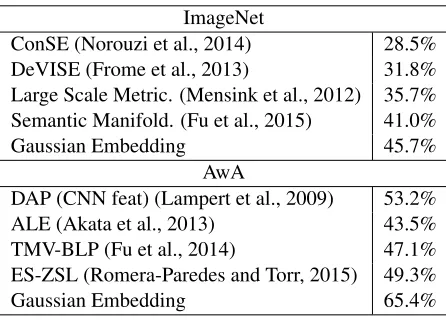
A comparison to published results obtained by other studies on the same ZSL splits is given in Ta-ble 2, where we see that our results are competitive despite exploitation of supervised embeddings such as attributes (Fu et al., 2014), or combinations of embeddings (Akata et al., 2013) by other methods.
We next demonstrate our approach qualitatively by means of the contextual query idea introduced in
ImageNet
ConSE (Norouzi et al., 2014) 28.5%
DeVISE (Frome et al., 2013) 31.8%
Large Scale Metric. (Mensink et al., 2012) 35.7% Semantic Manifold. (Fu et al., 2015) 41.0%
Gaussian Embedding 45.7%
AwA
DAP (CNN feat) (Lampert et al., 2009) 53.2%
ALE (Akata et al., 2013) 43.5%
TMV-BLP (Fu et al., 2014) 47.1%
ES-ZSL (Romera-Paredes and Torr, 2015) 49.3%
[image:4.612.316.539.244.404.2]Gaussian Embedding 65.4%
Table 2:Comparison of our ZSL results with state of the art.
Sec 2.5. Fig. 1 shows examples of how the top re-trieved images differ intuitively when querying Im-ageNet for zero-shot categories ‘plane’ and ‘horse’ with different context words. To ease interpretation, we constrain the retrieval to the true target class, and focus on the effect of the context word. Our learned Gaussian method retrieves more relevant im-ages than the word-vector sum baseline. E.g., with the Gaussian model all of the top-4 retrieved images for Passenger+Plane are relevant, while only two are relevant with the vector model. Similarly, the re-trieved black horses are more clearly black.
3.3 Further Analysis
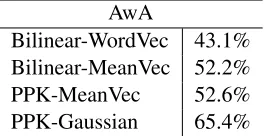
representa-AwA
[image:5.612.120.252.58.126.2]Bilinear-WordVec 43.1% Bilinear-MeanVec 52.2% PPK-MeanVec 52.6% PPK-Gaussian 65.4%
Table 3:Impact of training and testing with distribution rather than vector-based representations
tions used. Variants include: (i) Bilinear-WordVec: Max-margin training on word vector representations of words and images with a bilinear energy func-tion. (ii) Bilinear-MeanVec: As before, but using our Gaussian means as vector representations in im-age and text domains. (iii) PPK-MeanVec: Train the max-margin model with Gaussian representa-tion and PPK energy funcrepresenta-tion as in our full model, but treat the resulting means as point estimates for conventional vector-based ZSL matching at testing-time. (v) PPK-Gaussian: Our full model with Gaus-sian PPK training and testing by GausGaus-sian matching. From the results in Table 3, we make the observa-tions: (i) MeanVec outperforming Bilinear-WordVec shows that cross-modal (Sec 2.3) train-ing of word Gaussians learns better point esti-mates of words than conventional word-vector train-ing, since these only differ in the choice of vector representation of class names. (ii) PPK-Gaussian outperforming PPK-MeanVec shows that having a model of intra-class variability (as provided by the word-Gaussians) allows better zero-shot recogni-tion, since these differ only in whether covariance is used at testing time.
3.4 Related Work and Discussion
Our approach models intra-class variability in both images and text. For example, the variability in visual appearance of military versus passenger ‘plane’s, and the variability in context according to whether a the word ‘plane’ is being used in a military or civilian sense. Given distribution-based represen-tations in each domain, we find a cross-modal map that warps the two distributions into alignment.
Concurrently with our work, Ren et al (2016) present a related study on distribution-based visual-text embeddings. Methodologically, they benefit from end-to-end learning of deep features as well as cross-modal mapping, but they only
discrimi-natively train word covariances, rather than jointly training both means and covariances as we do.
With regards to efficiency, our model is fast to train if fixing pre-trained word-Gaussians and op-timising only the cross-modal mapping A. How-ever, training the mapping jointly with the word-Gaussians comes at the cost of updating the repre-sentations of all words in the dictionary, and is thus much slower.
In terms of future work, an immediate improve-ment would be to generalise our of Gaussian embed-dings to model concepts as mixtures of Gaussians or other exponential family distributions (Rudolph et al., 2016; Chen et al., 2015). This would for exam-ple, allow polysemy to be represented more cleanly as a mixture, rather than as a wide-covariance Gaussian as happens now. We would also like to explore distribution-based embeddings of sen-tences/paragraphs for class description (rather than class name) based zero-shot recognition (Reed et al., 2016). Finally, besides end-to-end deep learning of visual features, training non-linear cross-modal mappings is also of interest.
4 Conclusion
In this paper, we advocate using distribution-based embeddings of text and images when bridging the gap between vision and text modalities. This is in contrast to the common practice of point vector-based embeddings. Our distribution-vector-based approach provides a representation of intra-class variability that improves zero-shot recognition, allows more meaningful retrieval by multiple keywords, and also produces better point-estimates of word vectors.
References
[Akata et al.2013] Z. Akata, F. Perronnin, Z. Harchaoui, and C. Schmid. 2013. Label-embedding for attribute-based classification. InComputer Vision and Pattern Recognition.
[Arora et al.2015] Sanjeev Arora, Yuanzhi Li, Yingyu Liang, Tengyu Ma, and Andrej Risteski. 2015. Ran-dom walks on context spaces: Towards an explanation of the mysteries of semantic word embeddings. CoRR, abs/1502.03520.
[Blei et al.2003] David M. Blei, Andrew Y. Ng, and Michael I. Jordan. 2003. Latent dirichlet allocation.
[Bruni et al.2012a] Elia Bruni, Gemma Boleda, Marco Baroni, and Nam-Khanh Tran. 2012a. Distributional semantics in technicolor. InProceedings of the 50th Annual Meeting of the Association for Computational Linguistics: Long Papers - Volume 1, pages 136–145. [Bruni et al.2012b] Elia Bruni, Jasper Uijlings, Marco
Baroni, and Nicu Sebe. 2012b. Distributional seman-tics with eyes: Using image analysis to improve com-putational representations of word meaning. InACM Multimedia.
[Bruni et al.2014] Elia Bruni, Nam Khanh Tran, and Marco Baroni. 2014. Multimodal distributional se-mantics. J. Artif. Int. Res., 49(1):1–47, January. [Chen et al.2015] Xinchi Chen, Xipeng Qiu, Jingxiang
Jiang, and Xuanjing Huang. 2015. Gaussian mix-ture embeddings for multiple word prototypes. arXiv preprint arXiv:1511.06246.
[Collobert et al.2011] Ronan Collobert, Jason Weston, L´eon Bottou, Michael Karlen, Koray Kavukcuoglu, and Pavel Kuksa. 2011. Natural language processing (almost) from scratch. J. Mach. Learn. Res., 12:2493– 2537, November.
[Dinu et al.2015] Georgiana Dinu, Angeliki Lazaridou, and Marco Baroni. 2015. Improving zero-shot learn-ing by mitigatlearn-ing the hubness problem. InICLR Work-shop Paper.
[Ferraresi et al.2008] Adriano Ferraresi, Eros Zanchetta, Marco Baroni, and Silvia Bernardini. 2008. Introduc-ing and evaluatIntroduc-ing ukwac, a very large web-derived corpus of english. InIn Proceedings of the 4th Web as Corpus Workshop (WAC-4.
[Frome et al.2013] Andrea Frome, Greg Corrado, Jonathon Shlens, Samy Bengio, Jeffrey Dean, Mar-cAurelio Ranzato, and Tomas Mikolov. 2013. Devise: A deep visual-semantic embedding model. InNeural Information Processing Systems (NIPS).
[Fu et al.2014] Yanwei Fu, Timothy Hospedales, Tony Xiang, Zhenyong Fu, and Shaogang Gong. 2014. Transductive multi-view embedding for zero-shot recognition and annotation. InEuropean Conference on Computer Vision.
[Fu et al.2015] Z. Fu, T. A. Xiang, E. Kodirov, and S. Gong. 2015. Zero-shot object recognition by se-mantic manifold distance. In2015 IEEE Conference on Computer Vision and Pattern Recognition (CVPR), pages 2635–2644, June.
[Harris1954] Zellig Harris. 1954. Distributional struc-ture. Word, 10(23):146–162.
[Jebara et al.2004] T. Jebara, R. Kondor, and A. Howard. 2004. Probability product kernels. Journal of Ma-chine Learning Research, 5:819–844.
[Kiela and Bottou2014] Douwe Kiela and L´eon Bottou. 2014. Learning image embeddings using convo-lutional neural networks for improved multi-modal
semantics. In Proceedings of the Conference on Empirical Methods in Natural Language Processing (EMNLP-14).
[Lampert et al.2009] Christoph H. Lampert, Hannes Nickisch, and Stefan Harmeling. 2009. Learning to detect unseen object classes by between-class attribute transfer. InComputer Vision and Pattern Recognition. [Lazaridou et al.2014] Angeliki Lazaridou, Elia Bruni, and Marco Baroni. 2014. Is this a wampimuk? cross-modal mapping between distributional semantics and the visual world. InProceedings of the 52nd Annual Meeting of the Association for Computational Linguis-tics (Volume 1: Long Papers), June.
[Mensink et al.2012] Thomas Mensink, Jakob Verbeek, Florent Perronnin, and Gabriela Csurka. 2012. Metric learning for large scale image classification: General-izing to new classes at near-zero cost. In European Conference on Computer Vision.
[Mikolov et al.2013] Tomas Mikolov, Ilya Sutskever, Kai Chen, Greg S Corrado, and Jeff Dean. 2013. Dis-tributed representations of words and phrases and their compositionality. InAdvances in Neural Information Processing Systems 26, pages 3111–3119.
[Norouzi et al.2014] Mohammad Norouzi, Tomas Mikolov, Samy Bengio, Yoram Singer, Jonathon Shlens, Andrea Frome, Greg Corrado, and Jef-frey Dean. 2014. Zero-shot learning by convex combination of semantic embeddings. InICLR. [Reed et al.2016] Scott Reed, Zeynep Akata, Honglak
Lee, and Bernt Schiele. 2016. Learning deep repre-sentations of fine-grained visual descriptions. InIEEE Computer Vision and Pattern Recognition (CVPR). [Ren et al.2016] Zhou Ren, Hailin Jin, Zhe Lin, Chen
Fang, and Alan Yuille. 2016. Joint image-text repre-sentation by gaussian visual semantic embedding. In
Proceeding of ACM International Conference on Mul-timedia (ACM MM).
[Romera-Paredes and Torr2015] Bernardino Romera-Paredes and Philip H. S. Torr. 2015. An embar-rassingly simple approach to zero-shot learning. In
ICML.
[Rudolph et al.2016] Maja R. Rudolph, Francisco J. R. Ruiz, Stephan Mandt, and David M. Blei. 2016. Ex-ponential Family Embeddings, August.
[Schwenk2007] Holger Schwenk. 2007. Continuous space language models. Computer Speech and Lan-guage, 21.
[Silberer and Lapata2014] Carina Silberer and Mirella Lapata. 2014. Learning grounded meaning represen-tations with autoencoders. InACL.
[Socher et al.2013] Richard Socher, Milind Ganjoo, Christopher D. Manning, and Andrew Y. Ng. 2013. Zero Shot Learning Through Cross-Modal Trans-fer. In Advances in Neural Information Processing Systems 26.