43
Controlling Sequence-to-Sequence Models - A Demonstration on
Neural-based Acrostic Generator
Liang-Hsin Shen, Pei-Lun Tai, Chao-Chung Wu, Shou-De Lin Department of Computer Science and Information Engineering,
National Taiwan University
{laurice, b04902105, r05922042, sdlin}@csie.ntu.edu.tw
Abstract
An acrostic is a form of writing for which the first token of each line (or other recurring features in the text) forms a meaningful se-quence. In this paper we present a generalized acrostic generation system that can hide cer-tain message in a flexible pattern specified by the users. Different from previous works that focus on rule-based solutions, here we adopt a neural-based sequence-to-sequence model to achieve this goal. Besides acrostic, users can also specify the rhyme and length of the output sequences. To the best of our knowledge, this is the first neural-based natural language gen-eration system that demonstrates the capability of performing micro-level control over output sentences.
1 Introduction
Acrostic is a form of writing aiming at hiding messages in text, often used in sarcasm or to de-liver private information. In previous works, En-glish acrostic have been generated by searching for paraphrases in WordNet’s synsets (Stein et al.,
2014). Synonyms that contain needed characters replace the corresponding words in the context to generate the acrostic. Nowadays Seq2Seq mod-els have become a popular choice for text gen-eration, including generating text from table (Liu et al., 2018), summaries (Nallapati et al., 2016), short-text conversations (Shang et al., 2015), ma-chine translation (Bahdanau et al.,2015;Sutskever et al.,2014) and so on. In contrast to a rule-based or template-based generator, such Seq2Seq solu-tions are often considered more general and cre-ative, as they do not rely heavily on pre-requisite knowledge or patterns to produce meaningful con-tent. Although several works have presented au-tomatic generation on rhymed text (Zhang and Lapata, 2014; Ghazvininejad et al., 2016), the works do not focus on controlling the rhyme
of the generated content. One drawback of a neural-based Seq2Seq model is that the outputs are hard to control since the generation follows certain non-deterministic probabilistic model (or language model), which makes it non-trivial to impose a hard-constraint such as acrostic (i.e. micro-controlling the position of a specific to-ken) and rhyme. In this work, we present an NLG system that allows the users to micro-control the generation of a Seq2Seq model without any post-processing. Besides specifying the tokens and their corresponding locations for acrostic, our model allows the users to choose the rhyme and length of the generated lines. We show that with simple adjustment, a Seq2Seq model such as the Transformer (Vaswani et al., 2017) can be trained to control the generation of the text. Our demo system focuses on Chinese and English lyrics, which can be regarded as a writing style in between articles and poetry. We consider a general version of acrostic writing, which means the users can arbitrarily choose the position to place acrostic tokens. The 2-minute demonstra-tion video can be found at https://youtu. be/9tX6ELCNMCE.
2 Model Description
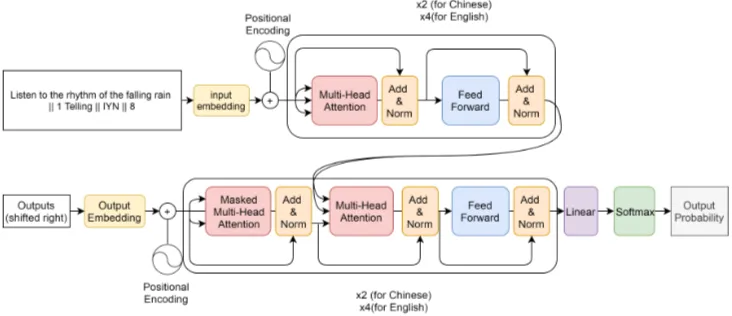
Figure 1: The structure of Transformer model.
fine-grained manner. In our demo, the users are al-lowed to control three aspects of the generated se-quences: rhyme, sentence length and the positions of designated tokens. In other words, our Seq2Seq model not only is capable of generate next line sat-isfying the length and rhyme constraints provided by the user, it can also produce the exact word at a position specified by the user. The rhyme of a sentence is the last syllable of the last word in that sentence. The length of a sentence is the number of tokens in that sentence. To elaborate how our model is trained, we use three consecutive lines (denoted as S1, S2, S3) of lyrics from the song “Rhythm of the Rain” as an example. Normally a Seq2Seq model is trained based on the following input/output pairs.
S1: Listen to the rhythm of the falling rain → S2: Telling me just what a fool I’ve been
S2: Telling me just what a fool I’ve been →S3: I wish that it would go and let me cry in vain
With some experiments on training Seq2Seq mod-els, we have discovered an interesting fact: By appending thecontrol signals in the end of the input sequences, after seeing sufficient amount of such data, the Seq2Seq model can automatically discover the association between input signals and outputs. Once the associations are identified, then we can use thecontrol signalsto guide the output of the model. For instance, here we append addi-tional control information to the end of the training sequence as below
S1: Listen to the rhythm of the falling
rain || 1 T elling || IY N || 8 → S2: Telling me just what a fool I’ve been
S2: Telling me just what a fool I’ve been ||2wish6go||EY N ||12→S3: I wish that it would go and let me cry in vain
The three types ofcontrol signalsare separated by “||”. The firstcontrol signalindicates the po-sition of the designated words.1T ellingtells the system the token T elling should be produced at the first position of the output sequences2. Sim-ilarly, 2 wish 6 go means that the second/sixth token in the output sequence shall be wish/go. The second control signal is the rhyme of the target sentence. For instance, IHN corresponds to a specific rhyme (/In/) and EY N corresponds to another (/en/). Note that here we use the formal name of the rhyme (e.g. EY N) to improve read-ability. To train our system, any arbitrary symbol would work. The third part contains a digit (e.g. 8) to control the length of the output line.
By adding such additional information, Seq2Seq models can eventually learn the meaning of the control signal as they can produce outputs according to those signals with very high accuracy. Note that in our demo, all results are produced by our Seq2Seq model without any post-processing, nor do we provide any prerequisite knowledge about what length, rhyme or position really stands for to the model.
We train our system based on the Transformer model (Vaswani et al., 2017), though additional experiments show that other RNN-based Seq2Seq models such as the one based on GRU (Cho et al.,
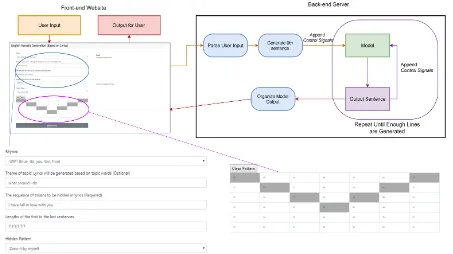
Figure 2: The structure of our acrostic generating system.
consists of two identical layers when training on Chinese lyrics and four identical layers when training on English lyrics. Each layer includes two sub-layers. The first is a multi-head attention layer and the second one is a fully connected feed-forward layer. Residual connections (He et al.,
2016) are implemented between the sub-layers. The decoder also consists of two identical layers when training on Chinese lyrics and four identical layers when training on English lyrics.. Each layer includes three sub-layers: a masked multi-head at-tention layer, a multi-head atat-tention layer that per-forms attention over the output of encoder and a fully-connected feed-forward layer. The model structure is shown in Figure 1. Note that in the original paper (Vaswani et al.,2017), Transformer consists of six identical layers for both encoder and decoder. To save resource, we start training with fewer layers than the original paper and dis-cover that the model still performs well. Thus, we use fewer layers than the proposed Transformer model.
3 User Interface
Figure2 illustrates the interface and data flow of our acrostic lyric generating system. First, there are several conditions (or control signals) that can be specified by the users:
• Rhyme: For Chinese lyrics, there are 33
different rhymes for users to choose from. As for English lyrics, there are 30 different rhymes for users to choose from.
• Theme of topic: The theme given by user is used to generate the zeroth sentence. In Chinese Acrostic demonstration, our system would pick a sentence from training set that is most similar to the user input, measured by the number of n-grams. As for English Acrostic demo, the user input of theme is di-rectly used as the zeroth sentence.
• Length of each line: User can specify the length of every single line (separated by ;). For example, “5;6;7” means that the user wants to generate acrostic that contains 3 lines, with length equals to 5, 6, 7, respec-tively.
• The sequence of tokens to be hidden in the output sequences.
Figure2, a table based on the length of each line specified by the users is created for the users to select the positions to place acrostic tokens.
The generation is done on the server side. After receiving thecontrol signalsprovided by users, the server first uses the given theme to search for a related line (denoted as zeroth sequence) from the lyric corpus, based on both sentence-level matching and character-level matching. Then the given condition of first sentence is appended to this zeroth sequence to serve as initial input to the Seq2Seq model for generating first line of out-puts. Next, the given condition of second sentence is appended to the generated first line as input to generate the second line. The same process is re-peated until all lines are generated.
4 Experiment and Results
4.1 Data set
We have two versions: one training on Chinese lyrics and one on English lyrics.
The Chinese lyrics are crawled from Mojim lyrics siteandNetEase Cloud. To avoid rare char-acters, the vocabulary size is set to the most fre-quent 50,000 characters. The English lyrics are crawled fromLyrics Freak. The vocabulary size is set to the most frequent 50,000 words. For each line of lyrics, we first calculate its length and then retrieve the rhyme of the last token. To generate the training pairs, we randomly append to the input sequence some tokens and their positions of the targeting sequence as the firstcontrol signal, followed by therhymeand then length. Below are two example training pairs:
S1: Listen to the rhythm of thef alling rain||2 me 3 just||IY N ||8 → S2: Telling me just what a fool I’ve been
S2: Telling me just what a fool I’ve been ||2wish6go7and||EY N ||12→S3: I wish that it would go and let me cry in vain
In total there are about 651,339/1,000,000 training pairs we use to train our Chinese/English acrostic systems.
4.2 Evaluation
Our system has three controllable conditions on generating acrostic: the positions of designated
tokens, the rhyme of each line and the length of each line. The evaluation set consists of 30,000 lines that are not included in training data. We first evaluate how accurate the control con-ditions can be satisfied. As shown in Table 1, the model can almost perfectly satisfy the request from users. We also evaluate the quality of learned language model for Chinese/English lyrics. The bi-gram perplexity of original training corpus is 54.56/53.2. The bi-gram perplexity of generated lyrics becomes lower (42.33/42.34), which indi-cates the language model does learn a better way to represent the lyrics data. In this experiment we find that training on English lyrics is harder than training on Chinese lyrics. English has strict grammatical rules while Chinese lyrics have more freedom in forming a sentence. We also observe that the model tends to generate sentences that use the same words that appear in their previous sen-tences. This behavior might be learned from the repetition of lyrics lines.
4.3 Demonstration of Results
We provide our system outputs from different as-pects.
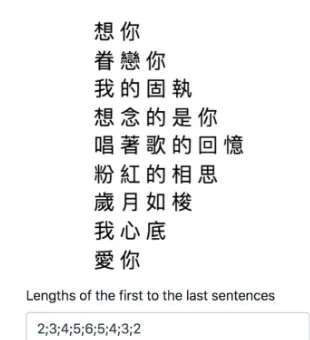
[image:4.595.334.489.456.626.2]The first example in Figure 3 shows that we can control the length of each line to produce a triangle-shaped lyrics.
Figure 3: Length control of each sentence.
Second, we would like to demonstrate the re-sults in generating acrostic. Some people use acrostic to hide message that has no resemblance with the content of the full text. We would show both English and Chinese examples generated by our system.
Condition Accuracy(Chinese) Accuracy(English) Character (CH) / Word (EN) Position 99.38% 98.21%
Rhyme 99.31% 97.67%
Sentence Length 99.90% 99.85%
Source Perplexity(Chinese) Perplexity(English)
Training data 54.56 53.2
[image:5.595.114.488.62.160.2]Model generated data 42.33 42.34
Table 1: The accuracy of each condition tested on 30,000 lines and the perplexity of the original text and the text generated by our model.
[image:5.595.309.526.220.296.2]word of each sentences. The sentence that be-ing concealed in the lyrics is I don′t like you, which is very different from the meaning of the full lyrics.
Figure 4: Message in English lyrics:I don′t like you.
Figure 5: Hidden message in Chinese lyrics:甚麼都可
以藏with rhymeeng.
Figure5shows a Chinese acrostic generated by our system. We hide a message 甚麼都可以藏 (Anything can be hidden) in the diagonal line of a piece of lyrics that talks about relationship and dream.
Third, we can also play with the visual shape of the designated words. Figure6shows an example
Figure 6: Message in English lyrics: be the change you wish to see in the world. To make the diamond shape clearer, the words are aligned.
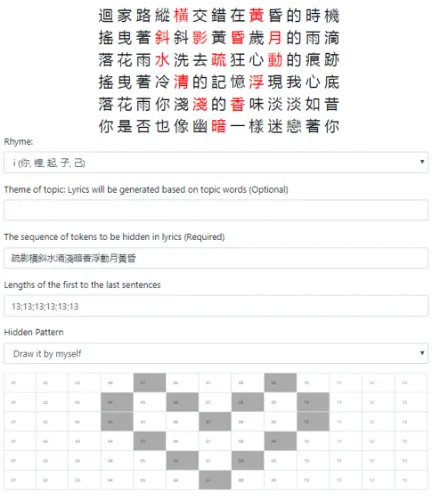
of hiding a sentence in the shape of diamond in the generated lyrics. The message being concealed is be the change you wish to see in the world. Figure7shows that we can hide the message using the shape of a heart.
Figure 7: The designated characters form a heart. The sentence hidden in the lyrics is疏影橫斜水清淺暗香
浮動月黃昏(The shadow reflects on the water and the
[image:5.595.89.276.397.623.2] [image:5.595.308.526.446.697.2]5 Conclusion
We show that by appending additional informa-tion in the training input sequences, it is possi-ble to train a Seq2Seq model whose outputs can be controlled in a fine-grained level. This find-ing enables us to design and demonstrate a gen-eral acrostic generating system with various fea-tures controlled, including the length of each line, the rhyme of each line and the target tokens to be produced and their corresponding positions. Our results have shown that the proposed model not only is capable of generating meaningful content, it also follows the constraints with very high ac-curacy. We believe that this finding can further lead to other useful applications in natural lan-guage generation.
References
Dzmitry Bahdanau, Kyunghyun Cho, and Yoshua Ben-gio. 2015. Neural machine translation by jointly
learning to align and translate. In 3rd
Inter-national Conference on Learning Representations, ICLR 2015, San Diego, CA, USA, May 7-9, 2015, Conference Track Proceedings.
Kyunghyun Cho, Bart van Merrienboer, Çaglar Gülçehre, Dzmitry Bahdanau, Fethi Bougares, Hol-ger Schwenk, and Yoshua Bengio. 2014a. Learning phrase representations using RNN encoder-decoder
for statistical machine translation. InProceedings of
the 2014 Conference on Empirical Methods in Nat-ural Language Processing, EMNLP 2014, October 25-29, 2014, Doha, Qatar, A meeting of SIGDAT, a Special Interest Group of the ACL, pages 1724– 1734.
Kyunghyun Cho, Bart van Merriënboer, Çalar Gülçehre, Dzmitry Bahdanau, Fethi Bougares, Hol-ger Schwenk, and Yoshua Bengio. 2014b. Learning phrase representations using rnn encoder–decoder
for statistical machine translation. InProceedings of
the 2014 Conference on Empirical Methods in Nat-ural Language Processing (EMNLP), pages 1724– 1734, Doha, Qatar. Association for Computational Linguistics.
Marjan Ghazvininejad, Xing Shi, Yejin Choi, and Kevin Knight. 2016. Generating topical poetry. In
Proceedings of the 2016 Conference on Empirical Methods in Natural Language Processing, EMNLP 2016, Austin, Texas, USA, November 1-4, 2016, pages 1183–1191.
Kaiming He, Xiangyu Zhang, Shaoqing Ren, and Jian Sun. 2016. Deep residual learning for image
recog-nition. In2016 IEEE Conference on Computer
Vi-sion and Pattern Recognition, CVPR 2016, Las Ve-gas, NV, USA, June 27-30, 2016, pages 770–778.
Tianyu Liu, Kexiang Wang, Lei Sha, Baobao Chang, and Zhifang Sui. 2018. Table-to-text generation
by structure-aware seq2seq learning. In
Proceed-ings of the Thirty-Second AAAI Conference on Ar-tificial Intelligence, (AAAI-18), the 30th innovative Applications of Artificial Intelligence (IAAI-18), and the 8th AAAI Symposium on Educational Advances in Artificial Intelligence (EAAI-18), New Orleans, Louisiana, USA, February 2-7, 2018, pages 4881– 4888.
Ramesh Nallapati, Bowen Zhou, Cícero Nogueira dos Santos, Çaglar Gülçehre, and Bing Xiang. 2016.
Abstractive text summarization using
sequence-to-sequence rnns and beyond. InProceedings of the
20th SIGNLL Conference on Computational Natural Language Learning, CoNLL 2016, Berlin, Germany, August 11-12, 2016, pages 280–290.
Lifeng Shang, Zhengdong Lu, and Hang Li. 2015.
Neural responding machine for short-text
conver-sation. In Proceedings of the 53rd Annual
Meet-ing of the Association for Computational LMeet-inguistics and the 7th International Joint Conference on Natu-ral Language Processing of the Asian Federation of Natural Language Processing, ACL 2015, July 26-31, 2015, Beijing, China, Volume 1: Long Papers, pages 1577–1586.
Benno Stein, Matthias Hagen, and Christof Bräutigam. 2014. Generating acrostics via paraphrasing and
heuristic search. In COLING 2014, 25th
Inter-national Conference on Computational Linguistics, Proceedings of the Conference: Technical Papers, August 23-29, 2014, Dublin, Ireland, pages 2018– 2029.
Ilya Sutskever, Oriol Vinyals, and Quoc V. Le. 2014.
Sequence to sequence learning with neural
net-works. InAdvances in Neural Information
Process-ing Systems 27: Annual Conference on Neural In-formation Processing Systems 2014, December 8-13 2014, Montreal, Quebec, Canada, pages 3104– 3112.
Ashish Vaswani, Noam Shazeer, Niki Parmar, Jakob Uszkoreit, Llion Jones, Aidan N. Gomez, Lukasz Kaiser, and Illia Polosukhin. 2017. Attention is all
you need. InAdvances in Neural Information
Pro-cessing Systems 30: Annual Conference on Neural Information Processing Systems 2017, 4-9 Decem-ber 2017, Long Beach, CA, USA, pages 6000–6010.
Xingxing Zhang and Mirella Lapata. 2014. Chinese
poetry generation with recurrent neural networks. In