Morphological Segmentation for Keyword Spotting
Karthik Narasimhan1, Damianos Karakos2, Richard Schwartz2, Stavros Tsakalidis2, Regina Barzilay1
1Computer Science and Artificial Intelligence Laboratory, Massachusetts Institute of Technology
2Raytheon BBN Technologies
{karthikn, regina}@csail.mit.edu
{dkarakos, schwartz, stavros}@bbn.com
Abstract
We explore the impact of morpholog-ical segmentation on keyword spotting (KWS). Despite potential benefits, state-of-the-art KWS systems do not use mor-phological information. In this paper, we augment a state-of-the-art KWS sys-tem with sub-word units derived from su-pervised and unsusu-pervised morphological segmentations, and compare with phonetic and syllabic segmentations. Our exper-iments demonstrate that morphemes im-prove overall performance of KWS sys-tems. Syllabic units, however, rival the performance of morphological units when used in KWS. By combining morphologi-cal, phonetic and syllabic segmentations, we demonstrate substantial performance gains.
1 Introduction
Morphological analysis plays an increasingly im-portant role in many language processing appli-cations. Recent research has demonstrated that adding information about word structure increases the quality of translation systems and alleviates sparsity in language modeling (Chahuneau et al., 2013b; Habash, 2008; Kirchhoff et al., 2006; Stal-lard et al., 2012).
In this paper, we study the impact of morpho-logical analysis on the keyword spotting (KWS) task. The aim of KWS is to find instances of a given keyword in a corpus of speech data. The task is particularly challenging for morphologi-cally rich languages as many target keywords are unseen in the training data. For instance, in the Turkish dataset (Babel, 2013) we use, from the 2013 IARPA Babel evaluations, 36.06% of the test words are unseen in the training data. However, 81.44% of these unseen words have a morpholog-ical variant in the training data. Similar patterns
are observed in other languages used in the Babel evaluations. This observation strongly supports the use of morphological analysis to handle out-of-vocabulary (OOV) words in KWS systems.
Despite this potential promise, state-of-the-art KWS systems do not commonly use morphologi-cal information. This surprising fact can be due to multiple reasons, ranging from the accuracy of ex-isting morphological analyzers to the challenge of integrating morphological information into exist-ing KWS architectures. While usexist-ing morphemes is likely to increase coverage, it makes recogni-tion harder due to the inherent ambiguity in the recognition of smaller units. Moreover, it is not clear a priori that morphemes, which are based on the semantics of written language, are appropriate segmentation units for a speech-based application. We investigate the above hypotheses in the context of a state-of-the-art KWS architec-ture (Karakos et al., 2013). We augment word lattices with smaller units obtained via segmenta-tion of words, and use these modified lattices for keyword spotting. We consider multiple segmen-tation algorithms, ranging from near-perfect su-pervised segmentations to random segmentations, along with unsupervised segmentations and purely phonetic and syllabic segmentations. Our exper-iments show how sub-word units can be used ef-fectively to improve the performance of KWS sys-tems. Further, we study the extent of impact of the subwords, and the manner in which they can be used in KWS systems.
2 Related Work
Prior research on applications of morphological analyzers has focused on machine translation, lan-guage modeling and speech recognition (Habash, 2008; Chahuneau et al., 2013a; Kirchhoff et al., 2006). Morphological analysis enables us to link together multiple inflections of the same root, thereby alleviating word sparsity common in
phologically rich languages. This results in im-proved language model perplexity, better word alignments and higher BLEU scores.
Recent work has demonstrated that even mor-phological analyzers that use little or no supervi-sion can help improve performance in language modeling and machine translation (Chahuneau et al., 2013b; Stallard et al., 2012). It has also been shown that segmentation lattices improve the qual-ity of machine translation systems (Dyer, 2009).
In this work, we leverage morphological seg-mentation to reduce OOV rates in KWS. We in-vestigate segmentations produced by a range of models, including acoustic sub-word units. We in-corporate these subword units into a lattice frame-work within the KWS system. We also demon-strate the value of using alternative segmentations instead of or in combination with morphemes. In addition to improving the performance of KWS systems, this finding may also benefit other appli-cations that currently use morphological segmen-tation for OOV reduction.
3 Segmentation Methods
Supervised Morphological Segmentation Due to the unavailability of gold morphological seg-mentations for our corpus (Babel, 2013), we use a resource-rich supervised system as a proxy. As training data for this system, we use the Mor-phoChallenge 2010 corpus1 which consists of 1760 gold segmentations for Turkish.
We consider two supervised frameworks, both made up of two stages. In the first stage, com-mon to both systems, we use a FST-based mor-phological parser (C¸¨oltekin, 2010) that generates a set of candidate segmentations, leveraging a large database of Turkish roots and affixes. This stage tends to overgenerate, segmenting each word in eight different ways on average. In the next stage, we filter the resulting segmentations using one of two supervised filters (described below) trained on the MorphoChallenge corpus.
In the first approach, we use a binary log-linear classifier to accept/reject each segmentation hy-pothesis. For each word, this classifier may ac-cept multiple segmentations, or rule out all the al-ternatives. In the second approach, to control the number of segmentations per word, we train a log-linear ranker that orders the segmentations for a word in decreasing order of likelihood. In our 1http://research.ics.aalto.fi/events/morphochallenge2010/
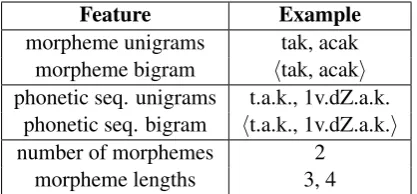
Feature Example
morpheme unigrams tak, acak morpheme bigram htak, acaki phonetic seq. unigrams t.a.k., 1v.dZ.a.k.
phonetic seq. bigram ht.a.k., 1v.dZ.a.k.i number of morphemes 2
[image:2.595.313.522.62.159.2]morpheme lengths 3, 4
Table 1: Example of features used in the super-vised filters for the segmentationtak-acak. Each phone is followed by a dot for clarity.
training corpus, each word has on average 2.5 gold segmentations. Hence, we choose the top two seg-mentations per word from the output of the ranker to use in our KWS system. In both filters, we use several features like morpheme unigrams, bi-grams, lengths, number of morphemes, and phone sequences corresponding to the morphemes.
In our supervised systems, we can encode fea-tures that go beyond individual boundaries, like the total number of morphemes in the segmenta-tion. This global view distinguishes our classi-fier/ranker from traditional approaches that model segmentation as a sequence tagging task (Ruoko-lainen et al., 2013; Kudo et al., 2004; Kru-engkrai et al., 2006). Another departure of our approach is the use of phonetic information, in the form of phonetic sequences corresponding to the morpheme unigrams and bigrams. The hy-pothesis is that syllabic boundaries are correlated with morpheme boundaries to some extent. The phonetic sequences for words are obtained using a publicly available Text-to-Phone (T2P) system (Lenzo, 1998).
Unsupervised Morphological Segmentation We employ a widely-used unsupervised sys-tem Morfessor (Creutz and Lagus, 2005) which achieves state-of-the-art unsupervised perfor-mance in the MorphoChallenge evaluation. Mor-fessor uses probabilistic generative models with sparse priors which are motivated by the Minimum Description Length (MDL) principle. The system derives segmentations from raw data, without re-liance on extra linguistic sources. It outputs a sin-gle segmentation per word.
Sub-word units Example Morphemes tak - acak
[image:3.595.337.495.61.171.2]Random t - aka - c - a - k Phones t - a - k - 1v - dZ - a - k Syllables ta - k1v - dZak
Table 2: Segmentations of the word takacakinto different types of sub-word units.
types of random segmentations that match the su-pervised morphological segmentations in terms of the number of uniques morphemes and the average morpheme length, respectively. These segmenta-tions are obtained by adjusting the segmentation probabilitypappropriately.
Phones and Syllables In addition to letter-based segmentation, we also consider other sub-word units that stem from sub-word acoustics. In par-ticular, we consider segmentation using phones and syllables, which are available for the Babel data we work with.
Table 2 shows examples of different segmenta-tions for the Turkish wordtakacak.
4 Keyword Spotting
The keyword spotting system used in this work follows, to a large extent, the pipeline of (Bulyko et al., 2012). Using standard speech recognition machinery, the system produces a detailed lattice of word hypotheses. The resulting lattice is used to extract keyword hits with nominal posterior prob-ability scores.
We modify this basic architecture in two ways. First, we use subwords instead of whole-words in the decoding lexicon. Second, we represent key-words using all possible paths in a lattice of sub-words. For each sequence of matching arcs in the lattice, the posteriors of these arcs are multiplied together to form the score of detection (hit). A post-processing step adds up (or takes the max of) the scores of all hits of each keyword which have significant overlap in time. Finally, the hit lists are processed by the score normalization and combi-nation method described in (Karakos et al., 2013). We use whole-word extraction for words in vo-cabulary, but rely on subword models for OOV words. Since we combine the hits separately for IV and OOV keywords, using subwords can only improve the performance of the overall system.
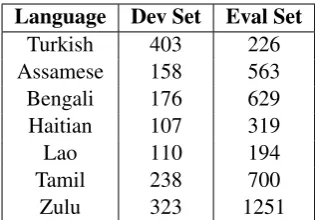
Language Dev Set Eval Set Turkish 403 226 Assamese 158 563 Bengali 176 629 Haitian 107 319
Lao 110 194
Tamil 238 700
[image:3.595.82.283.61.132.2]Zulu 323 1251
Table 3: Number of OOV keywords in the differ-ent Dev and Eval sets.
5 Experimental Setup
Data The segmentation algorithms described in Section 3 are tested using the setup of the KWS system described in Section 4. Our experiments are conducted using the IARPA Babel Program language collections for Turkish, Assamese, Ben-gali, Haitian, Lao, Tamil and Zulu (Babel, 2013)2. The dataset contains audio corpora and a set of keywords. The training corpus for KWS consists of 10 hours of speech, while the development and test sets have durations of 10 and 5 hours, respec-tively. We evaluate KWS performance over the OOV keywords in the data, which are unseen in the training set, but appear in the development/test set. Table 3 contains statistics on the number of OOV keywords in the data for each language.
In our experiments, we consider the pre-indexed condition, where the keywords are known only af-ter the decoding of the speech has taken place.
Evaluation Measures We consider two differ-ent evaluation metrics. To evaluate the accuracy of the different segmentations, we compare them against gold segmentations from the MorphoChal-lenge data for Turkish. This set consists of 1760 words, which are manually segmented. We use a measure of word accuracy (WordAcc), which captures the accuracy of all segmentation deci-sions within the word. If one of the segmenta-tion boundaries is wrong in a proposed segmen-tation, then that segmentation does not contribute towards the WordAcc score. We use 10-fold cross-validation for the supervised segmentations, while we use the entire set for unsupervised and acoustic cases.
tual Term Weighted Value (ATWV) measure, as described in (Fiscus et al., 2007). This measure uses a combination of penalties for misses and false positives to score the system. The maximum score achievable is 1.0, if there are no misses and false positives, while the score can be lower than 0.0 if there are a lot of misses or false positives.
6 Results
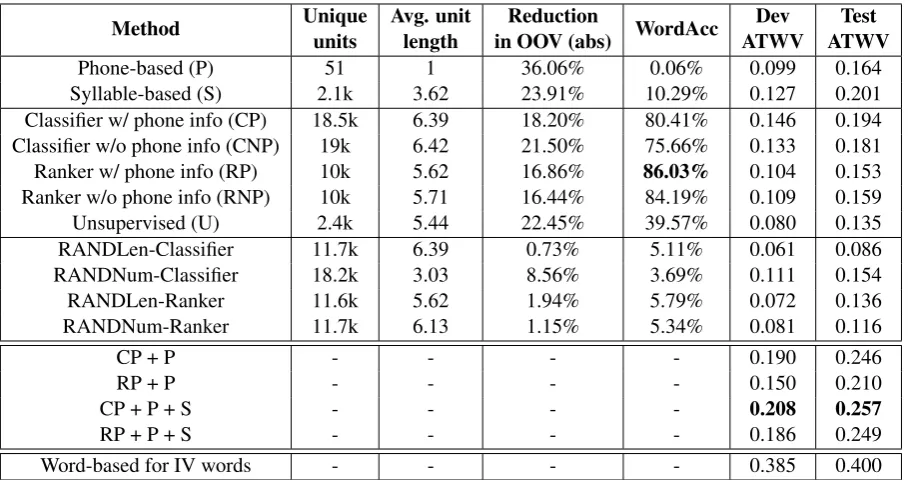
Table 4 summarizes the performance of all con-sidered segmentation systems in the KWS task on Turkish. The quality of the segmentations com-pared to the gold standard is also shown. Table 5 shows the OOV ATWV performance on the six other languages, used in the second year of the IARPA Babel project. We summarize below our conclusions based on these results.
Using sub-word units improves overall KWS performanceIf we use a word-based KWS sys-tem, the ATWV score will be 0.0 since the OOV keywords are not present in the lexicon. En-riching our KWS system with sub-word segments yields performance gains for all the segmentation methods, including random segmentations. How-ever, the observed gain exhibits significant vari-ance across the segmentation methods. For in-stance, the gap between the performance of the KWS system using the best supervised classifier-based segmenter (CP) and that using the unsuper-vised segmenter (U) is 0.059, which corresponds to a 43.7% in relative gain. Table 4 also shows that while methods with shorter sub-units (U,P) yield lower OOV rate, they do not necessarily fare better in the KWS evaluation.
Syllabic units rival the performance of mor-phological unitsA surprising discovery from our experiments is the good performance of the syl-labic segmentation-based KWS system (S). It out-performs all the alternative segmentations on the test set, and ranks second on the development set behind theCPsystem. These units are particularly attractive as they can easily be computed from acoustic input and do not require any prior linguis-tic knowledge. We hypothesize that the granular-ity of this segmentation is crucial to its success. For instance, a finer-grained phone-based segmen-tation (P) performs substantially worse than other segmentation algorithms as the derived sub-units are shorter and hence, harder to recognize.
Improving morphological accuracy beyond a certain level does not translate into improved
KWS performanceWe observe that the segmen-tation accuracy and KWS performance are not positively correlated. Clearly, bad segmentations translate into poor ATWV scores, as in the case of random and unsupervised segmentations. How-ever, gains on segmentation accuracy do not al-ways result in better KWS performance. For in-stance, the ranker systems (RP, RNP) have better accuracies on MC2010, while the classifier sys-tems (CP, CNP) perform better on the KWS task. This discrepancy in performance suggests that fur-ther gains can be obtained by optimizing segmen-tations directly with respect to KWS metrics.
Adding phonetic information improves mor-phological segmentationFor all the morpholog-ical systems, adding phonetic information results in consistent performance gains. For instance, it increases segmentation accuracy by 4% when added to the classifier (CNP andCP in table 4). The phonetic information used in our experiments is computed automatically using a T2P system (Lenzo, 1998), and can be easily obtained for a range of languages. This finding sheds new light on the relation between phonetic and morphologi-cal systems, and can be beneficial for morpholog-ical analyzers developed for other applications.
Combining morphological, phonetic and syl-labic segmentations gives better results than ei-ther in isolationAs table 4 shows, the best KWS results are achieved when syllabic and morphemic systems are combined. The best combination sys-tem (CP+P+S) outperforms the best individual system (S) by 5.5%. This result suggests that mor-phemic, phonemic and syllabic segmentations en-code complementary information which benefits KWS systems in handling OOV keywords.
Morphological segmentation helps KWS across different languagesTable 5 demonstrates that we can obtain gains in KWS performance across different languages using unsupervised seg-mentation. The improvement is significant in 3 of the 6 languages - as high as 3.2% for Assamese and Bengali, and 2.7% for Tamil (absolute per-centages). As such, the results of Table 2 can-not be directly compared to those of Table 1 since the system architecture is slightly different3.
Method Uniqueunits Avg. unitlength in OOV (abs) WordAccReduction ATWVDev ATWVTest Phone-based (P) 51 1 36.06% 0.06% 0.099 0.164 Syllable-based (S) 2.1k 3.62 23.91% 10.29% 0.127 0.201 Classifier w/ phone info (CP) 18.5k 6.39 18.20% 80.41% 0.146 0.194 Classifier w/o phone info (CNP) 19k 6.42 21.50% 75.66% 0.133 0.181 Ranker w/ phone info (RP) 10k 5.62 16.86% 86.03% 0.104 0.153 Ranker w/o phone info (RNP) 10k 5.71 16.44% 84.19% 0.109 0.159 Unsupervised (U) 2.4k 5.44 22.45% 39.57% 0.080 0.135 RANDLen-Classifier 11.7k 6.39 0.73% 5.11% 0.061 0.086 RANDNum-Classifier 18.2k 3.03 8.56% 3.69% 0.111 0.154 RANDLen-Ranker 11.6k 5.62 1.94% 5.79% 0.072 0.136 RANDNum-Ranker 11.7k 6.13 1.15% 5.34% 0.081 0.116
CP + P - - - - 0.190 0.246
RP + P - - - - 0.150 0.210
CP + P + S - - - - 0.208 0.257
RP + P + S - - - - 0.186 0.249
Word-based for IV words - - - - 0.385 0.400
Table 4: Segmentation Statistics and ATWV scores on Babel Turkish data along with WordAcc on MorphoChallenge 2010 data. All rows except the last are for OOV words. Absolute reduction is from an initial OOV of 36.06%. Higher ATWV scores are better. Best system scores are shown in bold.
Assamese Bengali Haitian Lao Tamil Zulu
Dev Test Dev Test Dev Test Dev Test Dev Test Dev Test
[image:5.595.72.528.61.301.2]P + S 0.213 0.230 0.277 0.296 0.371 0.342 0.228 0.139 0.349 0.267 0.279 0.215 P + S + U 0.214 0.263 0.294 0.328 0.393 0.342 0.237 0.146 0.395 0.284 0.275 0.218
Table 5: ATWV scores for languages used in the second year of the IARPA Babel project, using two KWS systems: Phone + Syllable (P+S) and Phone + Syllable + Unsupervised Morphemes (P+S+U). Bold numbers show significant performance gains obtained by adding morphemes to the system.
ever, they are indicative of the large gains (1.5%, on average, over the six languages) that can be ob-tained through unsupervised morphology, on top of a very good combined phonetic/syllabic system.
7 Conclusion
We explore the extent of impact of morphological segmentation on keyword spotting (KWS). To in-vestigate this issue, we augmented a KWS system with sub-word units derived by multiple segmen-tation algorithms. Our experiments demonstrate that morphemes improve the overall performance of KWS systems. Syllabic units, however, rival the performance of morphemes in the KWS task. Fur-thermore, we demonstrate that substantial perfor-mance gains in KWS perforperfor-mance are obtained by combining morphological, phonetic and syllabic was done with audio features supplied by BUT (Karafi´at et al., 2014), which were improved versions of those used for Turkish.
segmentations. Finally, we also show that adding phonetic information improves the quality of mor-phological segmentation.
Acknowledgements
References
IARPA Babel. 2013. Language collection re-leases; Turkish: IARPA-babel105b-v0.4, As-samese: babel102b-v0.5a, Bengali: IARPA-babel103b-0.4b, Haitian Creole: IARPA-babel201b-v0.2b, Lao: IARPA-babel203b-v3.1a, Tamil: IARPA-babel204b-v1.1b, Zulu: IARPA-babel206b-v0.1e.
Ivan Bulyko, Owen Kimball, Man-Hung Siu, Jos´e Her-rero, and Dan Blum. 2012. Detection of un-seen words in conversational Mandarin. InProc. of ICASSP, Kyoto, Japan, Mar.
Victor Chahuneau, Eva Schlinger, Noah A. Smith, and Chris Dyer. 2013a. Translating into morpholog-ically rich languages with synthetic phrases. In
EMNLP, pages 1677–1687. ACL.
Victor Chahuneau, Noah A. Smith, and Chris Dyer. 2013b. Knowledge-rich morphological priors for bayesian language models. In HLT-NAACL, pages 1206–1215. The Association for Computational Lin-guistics.
C¸a˘grı C¸¨oltekin. 2010. A freely available morpho-logical analyzer for Turkish. In Proceedings of the 7th International conference on Language Re-sources and Evaluation (LREC2010), pages 820– 827.
Mathias Creutz and Krista Lagus. 2005. Inducing the morphological lexicon of a natural language from unannotated text. In Proceedings of the Interna-tional and Interdisciplinary Conference on Adaptive Knowledge Representation and Reasoning (AKRR), pages 106–113.
Chris Dyer. 2009. Using a maximum entropy model to build segmentation lattices for MT. In Proceed-ings of Human Language Technologies: The 2009 Annual Conference of the North American Chap-ter of the Association for Computational Linguis-tics, NAACL ’09, pages 406–414, Stroudsburg, PA, USA. Association for Computational Linguistics. Jonathan G. Fiscus, Jerome Ajot, John S. Garofolo, and
George Doddington. 2007. Results of the 2006 spoken term detection evaluation. InWorkshop on Searching Spontaneous Conversational Speech. Nizar Habash. 2008. Four techniques for online
han-dling of out-of-vocabulary words in arabic-english statistical machine translation. InProceedings of the 46th Annual Meeting of the Association for Compu-tational Linguistics on Human Language Technolo-gies: Short Papers, HLT-Short ’08, pages 57–60, Stroudsburg, PA, USA. Association for Computa-tional Linguistics.
Martin Karafi´at, Frantiˇsek Gr´ezl, Mirko Hanne-mann, Karel Vesel´y, Igor Szoke, and Jan ”Honza” ˇCernock´y. 2014. BUT 2014 Babel system: Anal-ysis of adaptation in NN based systems. In Pro-ceedings of Interspeech 2014, Singapore, Septem-ber. IEEE.
Damianos Karakos and Richard Schwartz. 2014. Sub-word modeling. InIARPA Babel PI Meeting, July. Damianos Karakos, Richard Schwartz, Stavros
Tsaka-lidis, Le Zhang, Shivesh Ranjan, Tim Ng, Roger Hsiao, Guruprasad Saikumar, Ivan Bulyko, Long Nguyen, John Makhoul, Frantisek Grezl, Mirko Hannemann, Martin Karafiat, Igor Szoke, Karel Vesely, Lori Lamel, and Viet-Bac Le. 2013. Score normalization and system combination for improved keyword spotting. InProc. ASRU 2013, Olomouc, Czech Republic.
Katrin Kirchhoff, Dimitra Vergyri, Jeff Bilmes, Kevin Duh, and Andreas Stolcke. 2006. Morphology-based language modeling for conversational arabic speech recognition. Computer Speech and Lan-guage, 20(4):589–608.
Canasai Kruengkrai, Virach Sornlertlamvanich, and Hitoshi Isahara. 2006. A conditional random field framework for Thai morphological analysis. In
LREC.
Taku Kudo, Kaoru Yamamoto, and Yuji Matsumoto. 2004. Applying conditional random fields to Japanese morphological analysis. In In Proc. of EMNLP, pages 230–237.
Kevin Lenzo. 1998. Text-to-phoneme converter builder. http://www.cs.cmu.edu/afs/cs.
cmu.edu/user/lenzo/html/areas/t2p/.
Accessed: 2014-03-11.
Teemu Ruokolainen, Oskar Kohonen, Sami Virpioja, and Mikko Kurimo. 2013. Supervised morpholog-ical segmentation in a low-resource learning setting using conditional random fields. InProceedings of the Seventeenth Conference on Computational Nat-ural Language Learning, pages 29–37, Sofia, Bul-garia, August. Association for Computational Lin-guistics.
David Stallard, Jacob Devlin, Michael Kayser, Yoong Keok Lee, and Regina Barzilay. 2012. Unsu-pervised morphology rivals suUnsu-pervised morphology for Arabic MT. In ACL (2), pages 322–327. The Association for Computer Linguistics.