Modeling Term Translation for Document-informed Machine Translation
Fandong Meng1,2 Deyi Xiong3 Wenbin Jiang1,2 Qun Liu4,1 1Key Laboratory of Intelligent Information Processing Institute of Computing Technology, Chinese Academy of Sciences
2University of Chinese Academy of Sciences
{mengfandong,jiangwenbin,liuqun}@ict.ac.cn
3School of Computer Science and Technology, Soochow University
4Centre for Next Generation Localisation, Dublin City University
Abstract
Term translation is of great importance for statistical machine translation (SMT), es-pecially document-informed SMT. In this paper, we investigate three issues of term translation in the context of document-informed SMT and propose three cor-responding models: (a) a term trans-lation disambiguation model which se-lects desirable translations for terms in the source language with domain information, (b) a term translation consistency model that encourages consistent translations for terms with a high strength of translation consistency throughout a document, and (c) a term bracketing model that rewards translation hypotheses where bracketable source terms are translated as a whole unit. We integrate the three models into hierarchical phrase-based SMT and eval-uate their effectiveness on NIST Chinese-English translation tasks with large-scale training data. Experiment results show that all three models can achieve sig-nificant improvements over the baseline. Additionally, we can obtain a further improvement when combining the three models.
1 Introduction
A term is a linguistic expression that is used as the designation of a defined concept in a language (ISO 1087). As terms convey concepts of a text, term translation becomes crucial when the text is translated from its original language to another language. The translations of terms are often af-fected by the domain in which terms are used and the context that surrounds terms (Vasconcellos et al., 2001). In this paper, we study domain-specific and context-sensitive term translation for SMT.
In order to achieve this goal, we focus on three issues of term translation: 1) translation ambigu-ity, 2) translation consistency and 3) bracketing. First, term translation ambiguity is related to trans-lations of the same term in different domains. A source language term may have different transla-tions when it occurs in different domains. Second, translation consistency is about consistent trans-lations for terms that occur in the same document. Usually, it is undesirable to translate the same term in different ways as it occurs in different parts of a document. Finally, bracketing concerns whether a multi-word term is bracketable during transla-tion. Normally, a multi-word term is translated as a whole unit into a contiguous target string.
We study these three issues in the context of informed SMT. We use document-informed information to disambiguate term trans-lations in different documents and maintain con-sistent translations for terms that occur in the same document. We propose three different models for term translation that attempt to address the three issues mentioned above. In particular,
• Term Translation Disambiguation Model: In this model, we condition the translations of terms in different documents on correspond-ing per-document topic distributions. In do-ing so, we enable the decoder to favor trans-lation hypotheses with domain-specific term translations.
• Term Translation Consistency Model: This model encourages the same terms with a high strength of translation consistency that occur in different parts of a document to be trans-lated in a consistent fashion. We calculate the translation consistency strength of a term based on the topic distribution of the docu-ments where the term occurs in this model. • Term Bracketing Model: We use the
brack-eting model to reward translation
ses where bracketable multi-word terms are translated as a whole unit.
We integrate the three models into hierarchical phrase-based SMT (Chiang, 2007). Large-scale experiment results show that they are all able to achieve significant improvements of up to 0.89 BLEU points over the baseline. When simulta-neously integrating the three models into SMT, we can gain a further improvement, which outper-forms the baseline by up to 1.16 BLEU points.
In the remainder of this paper, we begin with a brief overview of related work in Section 2, and bilingual term extraction in Section 3. We then elaborate the proposed three models for term translation in Section 4. Next, we conduct experi-ments to validate the effectiveness of the proposed models in Section 5. Finally, we conclude and pro-vide directions for future work in Section 6. 2 Related Work
In this section, we briefly introduce related work and highlight the differences between our work and previous studies.
As we approach term translation disambigua-tion and consistency via topic modeling, our mod-els are related to previous work that explores the topic model (Blei et al., 2003) for machine trans-lation (Zhao and Xing, 2006; Su et al., 2012; Xiao et al., 2012; Eidelman et al., 2012). Zhao and Xing (2006) employ three models that enable word alignment process to leverage topical con-tents of document-pairs with topic model. Su et al. (2012) establish the relationship between out-of-domain bilingual corpus and in-out-of-domain monolin-gual corpora via topic mapping and phrase-topic distribution probability estimation for translation model adaptation. Xiao et al. (2012) propose a topic similarity model for rule selection. Eidel-man et al. (2012) use topic models to adapt lexical weighting probabilities dynamically during trans-lation. In these studies, the topic model is not used to address the issues of term translation mentioned in Section 1.
Our work is also related to document-level SMT in that we use document-informed informa-tion for term translainforma-tion. Tiedemann (2010) pro-pose cache-based language and translation mod-els, which are built on recently translated sen-tences. Gong et al. (2011) extend this by further introducing two additional caches. They employ a static cache to store bilingual phrases extracted
from documents in training data that are similar to the document being translated and a topic cache with target language topic words. Recently we have also witnessed efforts that model lexical co-hesion (Hardmeier et al., 2012; Wong and Kit, 2012; Xiong et al., 2013a; Xiong et al., 2013b) as well as coherence (Xiong and Zhang, 2013) for document-level SMT. Hasler et al. (2014a) use topic models to learn document-level transla-tion probabilities. Hasler et al. (2014b) use topic-adapted model to improve lexical selection. The significant difference between our work and these studies is that term translation has not been inves-tigated in these document-level SMT models.
Itagaki and Aikawa (2008) employ bilingual term bank as a dictionary for machine-aided trans-lation. Ren et al. (2009) propose a binary feature to indicate whether a bilingual phrase contains a term pair. Pinis and Skadins (2012) investigate that bilingual terms are important for domain adapta-tion of machine translaadapta-tion. These studies do not focus on the three issues of term translation as discussed in Section 1. Furthermore, domain and document-informed information is not used to as-sist term translation.
Itagaki et al. (2007) propose a statistical method to calculate translation consistency for terms with explicit domain information. Partially inspired by their study, we introduce a term translation consistency metric with document-informed infor-mation. Furthermore, we integrate the proposed term translation consistency model into an actual SMT system, which has not been done by Itagaki et al. (2007). Ture et al. (2012) use IR-inspired tf-idf scores to encourage consistent translation choice. Guillou (2013) investigates what kind of words should be translated consistently. Term translation consistency has not been investigated in these studies.
Our term bracketing model is also related to Xiong et al. (2009)’s syntax-driven bracket-ing model for phrase-based translation, which pre-dicts whether a phrase is bracketable or not using rich syntactic constraints. The difference is that we construct the model with automatically created bilingual term bank and do not depend on any syn-tactic knowledge.
3 Bilingual Term Extraction
ex-tending a bilingual term bank, which in turn can be used to improve other tasks such as information retrieval and machine translation. In this paper, we want to automatically build a bilingual term bank so that we can model term translation to improve translation quality of SMT. Our interest is to ex-tract multi-word terms.
Currently, there are mainly two strategies to conduct bilingual term extraction from parallel corpora. One of them is to extract term candi-dates separately for each language according to monolingual term metrics, such as C-value/NC-value (Frantzi et al., 1998; Vu et al., 2008), or other common cooccurrence measures such as Log-Likelihood Ratio, Dice coefficient and Point-wise Mutual Information (Daille, 1996; Piao et al., 2006). The extracted monolingual terms are then paired together (Hjelm, 2007; Fan et al., 2009; Ren et al., 2009). The other strategy is to align words and word sequences that are transla-tion equivalents in parallel corpora and then clas-sify them into terms and non-terms (Merkel and Foo, 2007; Lefever et al., 2009; Bouamor et al., 2012). In this paper, we adopt the first strategy. In particular, for each sentence pair, we collect all source phrases which are terms and find aligned target phrases for them via word alignments. If the target side is also a term, we store the source and target term as a term pair.
We conduct monolingual term extraction using the C-value/NC-value metric and Log-Likelihood Ratio (LLR) measure respectively. We then com-bine terms extracted according to the two metrics mentioned above. For the C-value/NC-value met-ric based term extraction, we implement it in the same way as described in Frantzi et al. (1998). This extraction method recognizes linguistic pat-terns (mainly noun phrases) listed as follows.
((Adj|Noun)+|((Adj|Noun)∗
(NounP rep)?)(Adj|Noun)∗)Noun
It captures the linguistic structures of terms. For the LLR metric based term extraction, we imple-ment it according to Daille (1996), who estimate the propensity of two words to appear together as a multi-word expression. We then adopt LLR-based hierarchical reducing algorithm proposed by Ren et al. (2009) to extract terms with arbitrary lengths. Since the C-value/NC-value metric based extrac-tion method can obtain terms in strict linguistic patterns while the LLR measure based method
ex-tracts more flexible terms, these two methods are complementary to each other. Therefore, we use these two methods to extract monolingual multi-word terms and then combine the extracted terms.
4 Models
This section presents the three models of term translation. They are the term translation dis-ambiguation model, term translation consistency model and term bracketing model respectively.
4.1 Term Translation Disambiguation Model The most straightforward way to disambiguate term translations in different domains is to cal-culate the conditional translation probability of a term given domain information. We use the topic distribution of a document obtained by a topic model to represent the domain information of the document. Since Latent Dirichlet Alloca-tion (LDA) (Blei et al., 2003) is the most widely-used topic model, we exploit it for inferring topic distributions of documents. Xiao et al. (2012) proposed a topic similarity model for rule selec-tion. Different from their work, we take an eas-ier strategy that estimates topic-conditioned term translation probabilities rather than rule-topic dis-tributions. This makes our model easily scalable on large training data.
With the bilingual term bank created from the training data, we calculate the source-to-target term translation probability for each term pair con-ditioned on the topic distribution of the source document where the source term occurs. We main-tain a K-dimension (K is the number of topics) vector for each term pair. The k-th component p(te|tf, z = k) measures the conditional transla-tion probability from source termtf to target term tegiven the topick.
p(te|tf, z=k)as follows: p(te|tf, z=k)
=
P
iP∈I,i.tf=tf,i.te=tei.c∗p(z=k|D) i∈I,i.tf=tf i.c∗p(z=k|D)
(1)
We associate each extracted term pair in our bilingual term bank with its corresponding topic-conditioned translation probabilities estimated in the Eq. (1). When translating sentences of docu-mentD0, we first get the topic distribution ofD0 using LDA tool. Given a sentence which contains T terms{tfi}T1 inD
0
, our term translation disam-biguation modelT ermDiscan be denoted as
T ermDis=YT
i=1
Pd(tei|tfi, D
0
) (2)
where the conditional source-to-target term trans-lation probability Pd(tei|tfi, D
0
) given the docu-mentD0 is formulated as follows:
Pd(tei|tfi, D
0
)
=XK
k=1
p(tei|tfi, z=k)∗p(z=k|D
0
)(3)
Whenever a source term tfi is translated into tei, we check whether the pair oftfiand its translation tei can be found in our bilingual term bank. If it can be found, we calculate the conditional transla-tion probability fromtfitotei given the document D0 according to Eq. (3).
The term translation disambiguation model is integrated into the log-linear model of SMT as a feature. Its weight is tuned via minimum error rate training (MERT) (Och, 2003). Through the fea-ture, we can enable the decoder to favor translation hypotheses that contain target term translations ap-propriate for the domain represented by the topic distribution of the corresponding document.
4.2 Term Translation Consistency Model The term translation disambiguation model helps the decoder select appropriate translations for terms that are in accord with their domains. Yet another translation issue related to the domain-specific term translation is to what extent a term should be translated consistently given the domain where it occurs. Term translation consistency in-dicates the translation stability that a source term is translated into the same target term (Itagaki et al., 2007). When translating a source term, if the translation consistency strength of the source term
is high, we should take the corresponding target term as the translation for it. Otherwise, we may need to create a new translation for it according to its context. In particular, we want to enable the decoder to choose between: 1) translating a given source term into the extracted corresponding tar-get term or 2) translating it in another way accord-ing to the strength of its translation consistency. In doing so, we can encourage consistent transla-tions for terms with a high translation consistency strength throughout a document.
Our term translation consistency model can ex-actly measure the strength of term translation con-sistency in a document. Since the essential com-ponent of our term translation consistency model is the translation consistency strength of the source term estimated under the topic distribution, we de-scribe how to calculate it before introducing the whole model.
With the bilingual term bank created from training data, we first group each source term and all its corresponding target terms into a 2-tupleGhtf, Set(te)i, where tf is the source term and Set(te) is the set of tf’s corresponding tar-get terms. We maintain a K-dimension (K is the number of topics) vector for each 2-tuple Ghtf, Set(te)i. The k-th component measures the translation consistency strengthcons(tf, k)of the source termtf given the topick.
We calculate cons(tf, k) for each Ghtf, Set(te)i with counts from training data as follows:
cons(tf, k) = M X
m=1 Nm
X
n=1
(qmn∗Qp(k|m)
k )
2(4)
Qk = M X
m=1 Nm
X
n=1
qmn∗p(k|m) (5)
where they occur. According to Eq. (4), the trans-lation consistency strength is a score between 0 and 1. If a source term only occurs in a document and all its translations are the same, the translation consistency strength of this term is 1.
We reorganize our bilingual term bank into a list of 2-tuples Ghtf, Set(te)is, each of which is associated with a K-dimension vector storing the topic-conditioned translation consistency strength calculated in the Eq. (4). When translating sen-tences of documentD, we first get the topic dis-tribution of D via LDA tool. Given a sentence which contains T terms {tfi}T1 in D, our term translation consistency modelT ermConscan be denoted as
T ermCons=YT
i=1
exp(Sc(tfi|D)) (6)
where the strength of translation consistency for tfi given the document D is formulated as fol-lows:
Sc(tfi|D) =log( K X
k=1
cons(tfi, k)∗p(k|D)) (7)
During decoding, whenever a hypothesis just translates a source term tfi into te, we check whether the translationtecan be found inSet(te) oftfifrom the reorganized bilingual term bank. If it can be found, we calculate the strength of trans-lation consistency for tfi given the documentD according to Eq. (7) and take it as a soft con-straint. If theSc(tfi|D)oftfi is high, the decoder should translatetfi into the extracted correspond-ing target terms. Otherwise, the decoder will se-lect translations from outside ofSet(te)fortfi. In doing so, we encourage terms to be translated in a topic-dependent consistency pattern in the test data similar to that in the training data so that we can control the translation consistency of terms in the test data.
The term translation consistency model is also integrated into the log-linear model of SMT as a feature. Through the feature, we can enable the decoder to translate terms with a high translation consistency in a document into corresponding tar-get terms from our bilingual term bank rather than other translations in a consistent fashion.
4.3 Term Bracketing Model
The term translation disambiguation model and consistency model concern the term translation ac-curacy with domain information. We further
pro-pose a term bracketing model to guarantee the in-tegrality of term translation. Xiong et al. (2009) proposed a syntax-driven bracketing model for phrase-based translation, which predicts whether a phrase is bracketable or not using rich syntac-tic constraints. If a source phrase remains con-tiguous after translation, they refer to this type of phrase as bracketable phrase, otherwise unbrack-etable phrase. For multi-word terms, it is also desirable to be bracketable since a source term should be translated as a whole unit and its trans-lation should be contiguous.
In this paper, we adapt Xiong et al. (2009)’s bracketing approach to term translation and build a classifier to measure the probability that a source term should be translated in a bracketable man-ner. For all source parts of the extracted bilingual term bank, we find their target counterparts in the word-aligned training data. If the corresponding target counterpart remains contiguous, we take the source term as a bracketable instance, otherwise an unbracketable instance. With these bracketable and unbracketable instances, we train a maximum entropy binary classifier to predict bracketable (b) probability of a given source termtf within par-ticular contextsc(tf). The binary classifier is for-mulated as follows:
Pb(b|c(tf)) = exp( P
jθjhj(b, c(tf))) P
b0exp( P
jθjhj(b0, c(tf))) (8) wherehj ∈ {0,1}is a binary feature function and θj is the weight ofhj. We use the following fea-tures: 1) the word sequence of the source term, 2) the first word of the source term, 3) the last word of the source term, 4) the preceding word of the first word of the source term, 5) the succeeding word of the last word of the source term, and 6) the number of words in the source term.
Given a source sentence which containsTterms {tfi}T1, our term bracketing model T ermBrack can be denoted as
T ermBrack=YT
i=1
Pb(b|c(tfi)) (9)
Whenever a hypothesis just covers a source term tfi, we calculate the bracketable probability oftfi according to Eq. (8).
Source Target D M F´angy`u X`ıtˇong defence mechanisms
F´angy`u X`ıtˇong defence systems
F´angy`u X`ıtˇong defense programmes 470 56 F´angy`u X`ıtˇong prevention systems
... ...
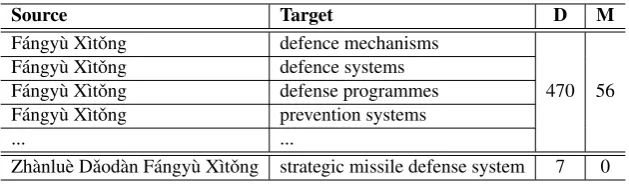
[image:6.595.142.457.61.153.2]Zh`anlu`e Dˇaod`an F´angy`u X`ıtˇong strategic missile defense system 7 0
Table 1: Examples of bilingual terms extracted from the training data. “D” means the total number of documents in which the corresponding source term occurs and “M” denotes the number of documents in which the corresponding source term is translated into different target terms. The source side is Chinese Pinyin. To save space, we do not list all the 23 different translations of the source term “F´angy`u X`ıtˇong”.
5 Experiments
In this section, we conducted experiments to an-swer the following three questions.
1. Are our term translation disambiguation, consistency and bracketing models able to improve translation quality in BLEU? 2. Does the combination of the three models
provide further improvements?
3. To what extent do the proposed models affect the translations of test sets?
5.1 Setup
Our training data consist of 4.28M sentence pairs extracted from LDC1 data with document
bound-aries explicitly provided. The bilingual training data contain 67,752 documents, 124.8M Chinese words and 140.3M English words. We chose NIST MT05 as the MERT (Och, 2003) tuning set, NIST MT06 as the development test set, and NIST MT08 as the final test set. The numbers of docu-ments/sentences in NIST MT05, MT06 and MT08 are 100/1082, 79/1664 and 109/1357 respectively. The word alignments were obtained by running GIZA++ (Och and Ney, 2003) on the corpora in both directions and using the “grow-diag-final-and” balance strategy (Koehn et al., 2003). We adopted SRI Language Modeling Toolkit (Stol-cke and others, 2002) to train a 4-gram language model with modified Kneser-Ney smoothing on the Xinhua portion of the English Gigaword cor-pus. For the topic model, we used the open source 1The corpora include LDC2003E07, LDC2003E14, LDC2004T07, LDC2004E12, LDC2005E83, LDC2005T06, LDC2005T10, LDC2006E24, LDC2006E34, LDC2006E85, LDC2006E92, LDC2007E87, LDC2007E101, LDC2008E40, LDC2008E56, LDC2009E16 and LDC2009E95.
LDA tool GibbsLDA++2 with the default setting
for training and inference. We performed 100 it-erations of the L-BFGS algorithm implemented in the MaxEnt toolkit3 with both Gaussian prior and
event cutoff set to 1 to train the term bracketing prediction model (Section 4.3).
We performed part-of-speech tagging for mono-lingual term extraction (C-value/NC-vaule method in Section 3) of the source and target languages with the Stanford NLP toolkit4. The bilingual term
bank was extracted based on the following param-eter settings of term extraction methods. Empiri-cally, we set the maximum length of a term to 6 words5. For both the C-value/NC-value and
LLR-based extraction methods, we set the context win-dow size to 5 words, which is a widely-used set-ting in previous work. And we set C-value/NC-value score threshold to 0 and LLR score threshold to 10 according to the training corpora.
We used the case-insensitive 4-gram BLEU6as
our evaluation metric. In order to alleviate the im-pact of the instability of MERT (Och, 2003), we ran it three times for all our experiments and pre-sented the average BLEU scores on the three runs following the suggestion by Clark et al. (2011).
We used an in-house hierarchical phrase-based decoder to verify our proposed models. Although the decoder translates a document in a sentence-by-sentence fashion, it incorporates document-informed information for sentence translation via the proposed term translation models trained on documents.
2http://sourceforge.net/projects/gibbslda/
3http://homepages.inf.ed.ac.uk/lzhang10/maxent toolkit.html 4http://nlp.stanford.edu/software/tagger.shtml
5We determine the maximum length of a term by testing {5, 6, 7, 8}in our preliminary experiments. We find that length 6 produces a slightly better performance than other values.
Zhǐyǒu Wěiyuánhuì Chéngyuán Cái Kě Cānjiā Wěiyuánhuì Shěnyì DŽ
Only members of the commission shall take part in the commission deliberations .
DŽ
He these proposals
Tā Jiāng Zhèxiē Jiànyì Jiāo Yóu Yī Gè Bùzhǎngjí Wěiyuánhuì Shěnyì
submit for approval to a committee of ministers . (a)
[image:7.595.97.505.63.173.2](b)
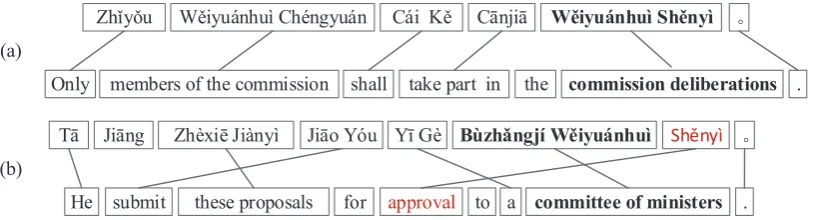
Figure 1: An example of unbracketable source term in the training data. In (a), “Wˇeiyu´anhu`ı Shˇeny`ı” is bracketable while in (b) it is unbracketable. The solid lines connect bilingual phrases. The source side is Chinese Pinyin.
5.2 Bilingual Term Bank
Before reporting the results of the proposed mod-els, we provide some statistics of the bilingual term bank extracted from the training data.
According to our statistics, about 1.29M bilin-gual terms are extracted from the training data. 65.07% of the sentence pairs contain bilingual terms in the training data. And on average, a source term has about 1.70 different translations. These statistics indicate that terms are frequently used in real-world data and that a source term can be translated into different target terms.
We also present some examples of bilingual terms extracted from the training data in Table 1. Accordingly, we show the total number of doc-uments in which the corresponding source term occurs and the number of documents in which the corresponding source term is translated into different target terms. The source term “F´angy`u X`ıtˇong” has 23 different translations in total. They are distributed in 470 documents in the training data. In 414 documents, “F´angy`u X`ıtˇong” has only one single translation. However, in the other 56 documents it has different translations. This indicates that “F´angy`u X`ıtˇong” is not consistently translated in these 56 documents. Different from this, the source term “Zh`anlu`e Dˇaod`an F´angy`u X`ıtˇong” only has one translation. And it is trans-lated consistently in all 7 documents where it oc-curs. In fact, according to our statistics, there are about 5.19% source terms whose translations are not consistent even in the same document.
These examples and statistics suggest 1) that source terms have domain-specific translations and 2) that source terms are not necessarily trans-lated in a consistent manner even in the same doc-ument. These are exactly the reasons why we
pro-pose the term translation disambiguation and con-sistency model based on domain information rep-resented by topic distributions.
Actually, 36.13% of the source terms are not necessarily translated into target strings as a whole unit. We show an example of such terms in Fig-ure 1. In FigFig-ure 1-(a), “Wˇeiyu´anhu`ı Shˇeny`ı” is a term, and is translated into “commission deliber-ations” as a whole unit. Therefore “Wˇeiyu´anhu`ı Shˇeny`ı” is bracketable in this sentence. How-ever, in Figure 1-(b), “Wˇeiyu´anhu`ı” and “Shˇeny`ı” are translated separately. Therefore “Wˇeiyu´anhu`ı Shˇeny`ı” is an unbracketable term in this sentence. This is the reason why we propose a bracketing model to predict whether a source term is brack-etable or not.
5.3 Effect of the Proposed Models
In this section, we validate the effectiveness of the proposed term translation disambiguation model, consistency model and bracketing model respec-tively. In addition to the traditional hiero (Chi-ang, 2007) system, we also compare against the “CountFeat” method in Ren et al. (2009) who use a binary feature to indicate whether a bilingual phrase contains a term pair. Although Ren et al. (2009)’s experiments are conducted in a phrase-based system, the idea can be easily applied to a hierarchical phrase-based system.
Models MT06 MT08 Avg
Baseline 32.43 24.14 28.29
CountFeat 32.77 24.29 28.53
Dis-Model
K= 50 32.94* 24.53 28.74 K= 100 33.10* 24.57 28.84 K= 150 33.16* 24.67* 28.92 K= 200 33.08* 24.55 28.81
Cons-Model
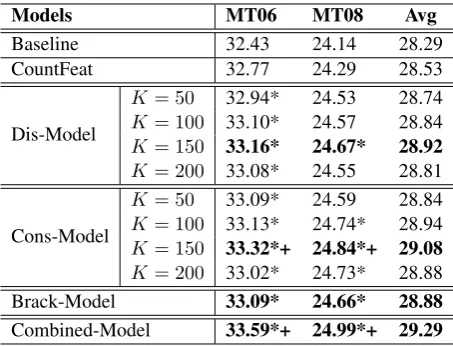
[image:8.595.185.412.61.234.2]K= 50 33.09* 24.59 28.84 K= 100 33.13* 24.74* 28.94 K= 150 33.32*+ 24.84*+ 29.08 K= 200 33.02* 24.73* 28.88 Brack-Model 33.09* 24.66* 28.88 Combined-Model 33.59*+ 24.99*+ 29.29
Table 2: BLEU-4 scores (%) of the term translation disambiguation model (Dis-Model), the term transla-tion consistency model (Cons-Model), the term bracketing model (Brack-Model), and the combinatransla-tion of the three models, on the development test set MT06 and the final test set MT08.K ∈ {50,100,150,200} which is the number of topics for the Dis-Model and the Cons-Model. “Combined-Model” is the combi-nation of the three single modes with topic number 150 for the Dis-Model and the Cons-Model. “Base-line” is the traditional hierarchical phrase-based system. “CountFeat” is the method that adds a counting feature to reward translation hypotheses containing bilingual term pairs. The “*” and “+” denote that the results are significantly (Clark et al., 2011) better than those of the baseline system and the CountFeat method respectively (p<0.01).
ranging from 50 to 150. However, when we setK to 200, the performance drops. The highest BLEU scores 33.16 and 24.67 are obtained at the topic setting K = 150. In fact, our Dis-Model gains higher performance in BLEU than both the tradi-tional hiero baseline and the “CountFeat” method with all topic settings. The “CountFeat” method rewards translation hypotheses containing bilin-gual term pairs. However it does not explore any domain information. Our Dis-Model incorporates domain information to conduct translation disam-biguation and achieves higher performance. When the topic number is set to 150, we gain the high-est BLEU score, which is higher than that of the baseline by 0.73 and 0.53 BLEU points on MT06 and MT08, respectively. The final gain over the baseline is on average 0.63 BLEU points.
We conducted the second group of experiments to study whether the term translation consistency model (Cons-Model) is able to improve the per-formance in BLEU, as well as to investigate the impact of different topic numbers on the Cons-Model. Results are shown in Table 2, from which we observe the similar phenomena to what we have found in the Dis-Model. Our Cons-Model gains higher BLEU scores than the baseline sys-tem and the “CountFeat” method with all topic
settings. Setting topic number to 150 achieves the highest BLEU score, which is higher than base-line by 0.89 BLEU points and 0.70 BLEU points on MT06 and MT08 respectively, and on average 0.79 BLEU points.
We also conducted experiments to verify the ef-fectiveness of the term bracketing model (Brack-Model), which conducts bracketing prediction for source terms. Results in Table 2 show that our Brack-Model gains higher BLEU scores than those of the baseline system and the “CountFeat” method. The final gain of Brack-Model over the baseline is 0.66 BLEU points and 0.52 points on MT06 and MT08 respectively, and on average 0.59 BLEU points.
5.4 Combination of the Three Models
Models MT06 MT08
[image:9.595.101.265.61.130.2]Best-Dis-Model 30.89 30.14 Best-Cons-Model 38.04 36.70 Brack-Model 60.46 55.78 Combined-Model 54.39 50.85
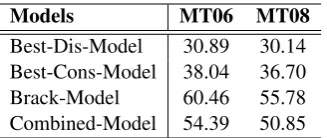
Table 3: Percentage (%) of 1-best translations which are generated by the Combined-Model and the three single models with best settings on the development test set MT06 and the final test set MT08. The topic number is 150 for Best-Dis-Model and Best-Cons-Best-Dis-Model.
of the Combined-Model over the baseline is 1.16 BLEU points and 0.85 points on MT06 and MT08 respectively, and on average 1.00 BLEU points.
5.5 Analysis
In this section, we investigate to what extent the proposed models affect the translations of test sets. In Table 3, we show the percentage of 1-best trans-lations affected by the Combined-Model and the three single models with best settings on test sets MT06 and MT08. For single models, if the corre-sponding feature (disambiguation, consistency or bracketing) is activated in the 1-best derivation, the corresponding model has impact on the 1-best translation. For the Combined-Model, if any of the corresponding features is activated in the 1-best derivation, the Combined-Model affects the 1-best translation.
From Table 3, we can see that 1-best transla-tions of source sentences affected by any of the proposed models account for a high proportion (30%∼60%) on both MT06 and MT08. This in-dicates that all proposed models play an important role in the translation of both test sets. Among the three proposed models, the Brack-Model is the one that affects the largest number of 1-best trans-lations in both test sets. And the percentage is 60.46% and 55.78% on MT06 and MT08 respec-tively. The Brack-Model only considers source terms during decoding, while the Dis-Model and Cons-Model need to match both source and target terms. The Brack-Model is more likely to be acti-vated. Hence the percentage of 1-best translations affected by this model is higher than those of the other two models. Since we only investigate the 1-best translations generated by the Combined-Model and single models, the translations gener-ated by some single models (e.g., Brack-Model)
may not be generated by the Combined-Model. Therefore it is hard to say that the numbers of 1-best translations affected by the Combined-Model must be greater than those of single models.
6 Conclusion and Future Work
We have studied the three issues of term lation and proposed three different term trans-lation models for document-informed SMT. The term translation disambiguation model enables the decoder to favor the most suitable domain-specific translations with domain information for source terms. The term translation consistency model encourages the decoder to translate source terms with a high domain translation consistency strength into target terms rather than other new strings. Finally, the term bracketing model re-wards hypotheses that translate bracketable terms into continuous target strings as a whole unit. We integrate the three models into a hierarchical phrase-based SMT system7and evaluate their
ef-fectiveness on the NIST Chinese-English transla-tion task with large-scale training data. Experi-ment results show that all three models achieve significant improvements over the baseline. Ad-ditionally, combining the three models achieves a further improvement. For future work, we would like to evaluate our models on term translation across a range of different domains.
Acknowledgments
This work was supported by National Key Tech-nology R&D Program (No. 2012BAH39B03) and CAS Action Plan for the Development of Western China (No. KGZD-EW-501). Deyi Xiong’s work was supported by Natural Science Foundation of Jiangsu Province (Grant No. BK20140355). Qun Liu’s work was partially supported by Science Foundation Ireland (Grant No. 07/CE/I1142) as part of the CNGL at Dublin City University. Sin-cere thanks to the anonymous reviewers for their thorough reviewing and valuable suggestions. The corresponding author of this paper, according to the meaning given to this role by University of Chinese Academy of Sciences and Soochow Uni-versity, is Deyi Xiong.
References
David M Blei, Andrew Y Ng, and Michael I Jordan. 2003. Latent dirichlet allocation. the Journal of ma-chine Learning research, 3:993–1022.
Houda Bouamor, Aur´elien Max, and Anne Vilnat. 2012. Validation of sub-sentential paraphrases ac-quired from parallel monolingual corpora. In Pro-ceedings of the 13th Conference of the European Chapter of the Association for Computational Lin-guistics, pages 716–725. Association for Computa-tional Linguistics.
David Chiang. 2007. Hierarchical phrase-based trans-lation. Computational Linguistics, 33(2):201–228. Jonathan H Clark, Chris Dyer, Alon Lavie, and Noah A
Smith. 2011. Better hypothesis testing for statistical machine translation: Controlling for optimizer insta-bility. InProceedings of the 49th Annual Meeting of the Association for Computational Linguistics: Hu-man Language Technologies: short papers-Volume 2, pages 176–181.
B´eatrice Daille. 1996. Study and implementation of combined techniques for automatic extraction of ter-minology. Journal of The balancing act: Combin-ing symbolic and statistical approaches to language, 1:49–66.
Vladimir Eidelman, Jordan Boyd-Graber, and Philip Resnik. 2012. Topic models for dynamic translation model adaptation. In Proceedings of the 50th An-nual Meeting of the Association for Computational Linguistics: Short Papers-Volume 2, pages 115–119. Association for Computational Linguistics.
Xiaorong Fan, Nobuyuki Shimizu, and Hiroshi Nak-agawa. 2009. Automatic extraction of bilin-gual terms from a chinese-japanese parallel corpus. In Proceedings of the 3rd International Universal Communication Symposium, pages 41–45. ACM. Katerina T Frantzi, Sophia Ananiadou, and Junichi
Tsujii. 1998. The c-value/nc-value method of au-tomatic recognition for multi-word terms. In Re-search and Advanced Technology for Digital Li-braries, pages 585–604. Springer.
Zhengxian Gong, Min Zhang, and Guodong Zhou. 2011. Cache-based document-level statistical ma-chine translation. InProceedings of the Conference on Empirical Methods in Natural Language Pro-cessing, pages 909–919.
Liane Guillou. 2013. Analysing lexical consistency in translation. InProceedings of the Workshop on Discourse in Machine Translation, pages 10–18. Christian Hardmeier, Joakim Nivre, and J¨org
Tiede-mann. 2012. Document-wide decoding for phrase-based statistical machine translation. In Proceed-ings of the 2012 Joint Conference on Empiri-cal Methods in Natural Language Processing and Computational Natural Language Learning, pages 1179–1190.
Eva Hasler, Phil Blunsom, Philipp Koehn, and Barry Haddow. 2014a. Dynamic topic adaptation for phrase-based mt. InProceedings of the 14th Confer-ence of the European Chapter of the Association for Computational Linguistics, Gothenburg, Sweden.
Eva Hasler, Barry Haddow, and Philipp Koehn. 2014b. Dynamic topic adaptation for smt using distribu-tional profiles. In Proceedings of the Ninth Work-shop on Statistical Machine Translation, pages 445– 456, Baltimore, Maryland, USA, June. Association for Computational Linguistics.
Hans Hjelm. 2007. Identifying cross language term equivalents using statistical machine translation and distributional association measures. InProceedings of 16th Nordic Conference of Computational Lin-guistics Nodalida, pages 97–104.
Masaki Itagaki and Takako Aikawa. 2008. Post-mt term swapper: Supplementing a statistical machine translation system with a user dictionary. InLREC.
Masaki Itagaki, Takako Aikawa, and Xiaodong He. 2007. Automatic validation of terminology trans-lation consistency with statistical method. Proceed-ings of MT summit XI, pages 269–274.
Philipp Koehn, Franz Josef Och, and Daniel Marcu. 2003. Statistical phrase-based translation. In Proceedings of the 2003 Conference of the North American Chapter of the Association for Computa-tional Linguistics on Human Language Technology-Volume 1, pages 48–54.
Els Lefever, Lieve Macken, and Veronique Hoste. 2009. Language-independent bilingual terminology extraction from a multilingual parallel corpus. In Proceedings of the 12th Conference of the European Chapter of the Association for Computational Lin-guistics, pages 496–504.
Magnus Merkel and Jody Foo. 2007. Terminology extraction and term ranking for standardizing term banks. In Proceedings of 16th Nordic Conference of Computational Linguistics Nodalida, pages 349– 354.
Franz Josef Och and Hermann Ney. 2003. A sys-tematic comparison of various statistical alignment models. Computational linguistics, 29(1):19–51.
Franz Josef Och. 2003. Minimum error rate training in statistical machine translation. InProceedings of the 41st Annual Meeting on Association for Compu-tational Linguistics-Volume 1, pages 160–167.
Pinis and Skadins. 2012. Mt adaptation for under-resourced domains–what works and what not. In Human Language Technologies–The Baltic Perspec-tive: Proceedings of the Fifth International Confer-ence Baltic HLT 2012, volume 247, page 176. IOS Press.
Zhixiang Ren, Yajuan L¨u, Jie Cao, Qun Liu, and Yun Huang. 2009. Improving statistical machine trans-lation using domain bilingual multiword expres-sions. InProceedings of the Workshop on Multiword Expressions: Identification, Interpretation, Disam-biguation and Applications, pages 47–54.
Andreas Stolcke et al. 2002. Srilm-an extensible lan-guage modeling toolkit. InProceedings of the inter-national conference on spoken language processing, volume 2, pages 901–904.
Jinsong Su, Hua Wu, Haifeng Wang, Yidong Chen, Xiaodong Shi, Huailin Dong, and Qun Liu. 2012. Translation model adaptation for statistical machine translation with monolingual topic information. In Proceedings of the 50th Annual Meeting of the Association for Computational Linguistics: Long Papers-Volume 1, pages 459–468.
J¨org Tiedemann. 2010. Context adaptation in statisti-cal machine translation using models with exponen-tially decaying cache. In Proceedings of the 2010 Workshop on Domain Adaptation for Natural Lan-guage Processing, pages 8–15.
Ferhan Ture, Douglas W Oard, and Philip Resnik. 2012. Encouraging consistent translation choices. InProceedings of the 2012 Conference of the North American Chapter of the Association for Computa-tional Linguistics: Human Language Technologies, pages 417–426. Association for Computational Lin-guistics.
Muriel Vasconcellos, Brian Avey, Claudia Gdaniec, Laurie Gerber, Marjorie Le´on, and Teruko Mita-mura. 2001. Terminology and machine translation. Handbook of Terminology Management, 2:697–723.
Thuy Vu, Ai Ti Aw, and Min Zhang. 2008. Term ex-traction through unithood and termhood unification. In Proceedings of the third international joint con-ference on natural language processing.
Billy Wong and Chunyu Kit. 2012. Extending ma-chine translation evaluation metrics with lexical co-hesion to document level. In Proceedings of the 2012 Joint Conference on Empirical Methods in Natural Language Processing and Computational Natural Language Learning, pages 1060–1068.
Xinyan Xiao, Deyi Xiong, Min Zhang, Qun Liu, and Shouxun Lin. 2012. A topic similarity model for hi-erarchical phrase-based translation. InProceedings of the 50th Annual Meeting of the Association for Computational Linguistics: Long Papers-Volume 1, pages 750–758.
Deyi Xiong and Min Zhang. 2013. A topic-based coherence model for statistical machine translation. InProceedings of the Twenty-Seventh AAAI Confer-ence on Artificial IntelligConfer-ence (AAAI-13), Bellevue, Washington, USA, July.
Deyi Xiong, Min Zhang, Aiti Aw, and Haizhou Li. 2009. A syntax-driven bracketing model for phrase-based translation. InProceedings of the Joint Con-ference of the 47th Annual Meeting of the ACL and the 4th International Joint Conference on Natural Language Processing of the AFNLP, pages 315– 323.
Deyi Xiong, Guosheng Ben, Min Zhang, Yajuan L¨u, and Qun Liu. 2013a. Modeling lexical cohesion for document-level machine translation. InProceedings of the Twenty-Third international joint conference on Artificial Intelligence, pages 2183–2189. AAAI Press.
Deyi Xiong, Yang Ding, Min Zhang, and Chew Lim Tan. 2013b. Lexical chain based cohesion mod-els for document-level statistical machine transla-tion. InProceedings of the Conference on Empiri-cal Methods in Natural Language Processing, pages 1563––1573.