1
MASTER THESIS
Vasileia Vassou
s1707108
MSc Educational Science and Technology
University of Twente
Enschede, the Netherlands
Graduation Committee Dr. Maaike Endedijk Rike Bron, MSc
Enschede, October 2017
How Highly Self-Regulated Learners Work and
2
How the Workforce Learns in 2016
Courtesy of Degreed, 2016.
3
Abstract
Self-regulated learning (SRL) has gained ground in today’s knowledge societies and contemporary work organizations as an effective way for the employees to manage their own learning and to ameliorate their performance at the workplace. Although literature has given an insight on how individuals regulate their learning, there is currently limited research at the workplace context. From the perspective of the basic psychological needs that are introduced in the Self Determination Theory (SDT), this study aimed at identifying recurring patterns of learning and working that emerged through the experiences of 39 highly self-regulated knowledge workers concerning specific learning strategies and autonomy so as to explain how highly self-regulated learners could meet their basic needs. The focus of this research as part of a team project was on the adult working life of the individuals. Semi-structured biographical interviews were used for the data collection and the data was coded. The findings revealed that peer learning and digital technology use as learning strategies and perceived autonomy support provided by the organizations could enable highly self-regulated individuals to meet their basic needs for relatedness, competence and autonomy at the workplace. These results set the ground for future research and practical implications concerning the ways that organizations and Human Resource Development (HRD) practitioners could promote and support SRL as a new way of learning at the workplaces of today.
4 Preface
This thesis is written to acquire the Masters degree in Educational Science and Technology at
the University of Twente. The data collection was performed by Prof.dr. Anoush Margaryan
and the project was conducted by Evangelia Tiniakou, Maria Tsiakala and Vasileia Vassou.
I would like to thank my supervisors, Maaike, Tim and Rike, for all of your critical feedback
and support during this year of writing the Master thesis. Your guidance, your help and your
knowledge on the topic were always more than useful to me. Thanks to Prof.dr. Margaryan for
providing us with all these valuable data so as to carry out the project. Special thanks to my
fellow project mates, Eva and Maria, for your moral and practical support.
Thanks to the University of Twente (UT), for making me feel at home from the very first moment
and for making my experience as a student abroad unique and unforgettable. Indisputably, I
shared here some of the best moments and feelings with people from all over this world which
made me a better and more tolerant person.
Special thanks to all the colleagues I met in the Marketing & Communications department two
years ago who made me love international and social media marketing and for the opportunity
I had to guide and help prospective students of UT, who will soon be in my place. I really hope
that the enthusiasm and satisfaction of this (part-time) job will follow me at all the workplaces
in the future.
Many thanks to all the lovely people I met here in Enschede, especially to the ones who stood
by me from the beginning till the end of this journey. Massive thanks to all my friends, the ones
here in Enschede but also the ones a bit more far, in Greece. Thanks for the support, the
motivational talks and of course the fun moments we had together these two years on and off
campus. I owe part of this achievement to all of you.
The last but greatest thanks go to my family and especially my mother, for always embracing
my dreams and for being my research buddy. I would always be grateful for all the
opportunities I had in my life so far thanks to you.
It was a long and valuable self-regulated learning journey! Preparing my backpack for many
more that are coming
5
Table of Contents
Abstract ... 1
Preface ... 4
1. Introduction ... 6
2. Theoretical Framework ... 8
2.1 Self-regulated Learning (SRL) ... 8
2.2 SDT and SRL ... 8
2.2.1 Learning Strategies ... 10
2.2.2 Perceived Autonomy Support ... 15
3. Research Question ... 18
4. Methodology ... 19
4.1 Research Design ... 19
4.2 Participants ... 19
4.3 Instrumentation ... 20
4.4 Procedure ... 20
4.5 Data Analysis ... 21
5. Results ... 24
6. Discussion and Conclusions ... 34
7. Limitations and Future Reccommendations ... 38
8. Practical Implications ... 41
References ... 43
6
1.
Introduction
Learning and knowledge have always been inseparable elements of the economic growth of contemporary societies which have been gradually transformed into “knowledge societies” (Kessels, 2001). Today’s societies focus on the learning occurring at the workplace where the individuals develop new skills and competencies that could attribute to the competitiveness of the organizations (Kunjiapu & Yasin, 2010). Concerning the employees as members of these new learning working environments, they prefer to learn in a more informal way by taking advantage of the opportunities for learning offered inside the organizations rather than following the proposed long-established ways for learning and development such as trainings or courses (Margaryan, Milligan, Littlejohn, Hendrix, & Graeb-Koenneker, 2009). More specifically, knowledge workers also opt for a self-directed way of learning at the workplace (Margaryan, Milligan, Littlejohn, Hendrix, & Graeb-Koenneker, 2009).
In this new workplace context, self-regulated learning as a contemporary way of learning, is defined as a social and collaborative process that permits the individuals to set and define their own learning goals, to plan, to self-reflect on what they learn (Margaryan et al., 2009) and to take responsibility of their general learning and development (Fontana, Milligan, Littlejohn, & Margaryan, 2015). Moreover, employees’ SRL skills development is important for their effective learning and their better performance at the workplace (Fontana et al., 2015). Self-regulation is also crucial for individuals’ success at the contemporary working environments (Lord, Diefendorff, Schmidt, & Hall, 2010).
7
life, the ways individuals regulate their learning are defined and influenced by the workplace context. In this workplace context, despite their capacity to self- regulate their learning, individuals need the autonomous will to do so (Reeve, Ryan, Deci, & Jang, 2008) influenced by their need to experience feelings of competence, relatedness and autonomy which are described in the Self Determination Theory (SDT) and so as to be successful at their workplace (Broeck, Vansteenkiste, Witte, Soenens, & Lens, 2010). Reeve et al. (2008) suggested for instance that when the learning experiences lead to satisfaction of these feelings, then individuals are more intrinsically motivated and more autonomous self-regulated learners. Crouse, Doyle, and Young (2011) stated that both the workplace learning strategies the employees use and the autonomy support provided by the organization could be indicators of how highly self-regulated learners fulfil these three basic psychological needs. As a result, based on the study of Reeve et al. (2008), which was conducted at the school context, this research will introduce a new perspective by identifying this time these indicators at the workplace context.
8
2.
Theoretical Framework
2.1Self-regulated Learning (SRL)
Zimmerman (2005) in his definition of SRL stated that “regulation includes self-generated thoughts, feelings and actions that are planned and cyclically adapted to the attainment of personal goals” (p.14). During SRL, the learning is seen as “a cyclical and open-ended process that includes three phases: forethought, performance or volitional control and self-reflection” (Zimmerman, 1998, p. 2). In the model which is introduced by Zimmerman, Boekarts, Pintrich, and Zeidner (2000), forethought includes mainly the goal setting and the planning towards the attainment of these goals, performance depicts the self-control in order to gain focus and attention while self-reflection stands for the self-evaluation and assessment of the whole learning process. Moreover, self-regulation, as an essential component of workplace learning (Fontana et al., 2015), is beneficial for the enhancement of the growth of individuals and positively affects their well-being (Lord et al., 2010).
Therefore, additional research is required on how employees who have the capacities to regulate their learning use the affordances at the workplace so as to be highly self-regulated learners (Margaryan, Littlejohn, & Milligan, 2013). The focus of this research is at the workplace since workplace conditions are changeable not only over time but also among different workplace environments and could be influenced so as to meet the needs of individuals for competence, relatedness and autonomy.
2.2 SDT and SRL
9
to interact and control the sources provided by their environment, relatedness depicts the need of individuals to interact, connect with others and have the sense of belongingness while autonomy is explained as the need for a sense of freedom and control in the lives of individuals (Deci & Ryan, 2000). Reeve et al. (2008) illustrated that from the perspective of SDT, self-regulation is autonomous when the self-regulation of individuals’ behavior is based on their interests and values. Moreover, concerning the different requirements so as to reach an effective and autonomous self-regulation, the fulfilment of the basic psychological needs for competence, relatedness and autonomy is mentioned as one of them (Reeve et al., 2008). So far the relationship among SDT and SRL has been measured and it has been found that the fulfilment of the aforementioned needs of students has led to an autonomous self-regulated learning at classroom settings. More specifically, teachers were the ones responsible for providing students with autonomy support and the appropriate learning materials and for promoting relatedness among students and their peers at school. In all these cases students fulfilled their basic psychological needs and also developed their initial and amateur self-regulated learning skills (Reeve et al., 2008).
10
to become self-regulated learners by translating external and social regulation to a more internal one.
This interview study is focusing on revealing the strategies that employees use to learn at the workplace and the autonomy provided by the organization from the general scope of how their basic needs could be fulfilled. Perceived autonomy support is also expected to have a positive effect on the two learning strategies mentioned above. Hence, the investigation of peer learning, use of digital technology and perceived autonomy support will further explain the relationship between SRL and SDT at the workplace.
2.2.1 Learning Strategies
11
employees engage in both individual and social informal learning (Janssens, Smet, Onghena, & Kyndt, 2017).
After taking into consideration the study of Niemiec and Ryan (2009) referring to a school context, the types of learning strategies used by self-regulated learners could reveal how highly self-regulated learners work and learn so as to experience feelings of competence and relatedness at the workplace. Taking into account the previously discussed needs of the SDT (relatedness and competence), this current study is focusing on two specific learning strategies at the workplace: peer learning and digital technology use.
Peer learning. Peer learning can be defined as a process which permits and facilitates
12
After taking into account the findings of previous studies, it is possible to examine how peer learning is used as a strategy to work and learn at the workplace from the perspective of relatedness which are described in the SDT. For example, the need for relatedness could be fulfilled by using help seeking behaviors at the workplace where the employees count on the help of their peers while learning (Holman, Epitropaki, & Fernie, 2001). Furthermore, it is interesting to investigate peer learning and its forms as a strategy that self-regulated learners use since individuals have been found to be highly dependent on the social network and on collective knowledge and to count on their colleagues so as to obtain knowledge when needed at the workplace (Margaryan et al., 2009).
More specifically, peer learning seems to be important for both the helpers and the ones
13
workplace is needed. Additionally, it is important to investigate specifically whether the individuals tend to seek or to give help or advice and feedback. Peer- coaching at the workplace is a beneficial strategy for the learning of employees when the relationship among coach and coachee is being built with a view to their professional development (Parker et al., 2008). In the proposed research model of Schunk and Mullen (2013) referring to managers and protégés, the post mentoring effects seem beneficial since their self-regulatory initiatives are being activated. This study’s focus is on whether the individuals tend to be coaches themselves or receive coaching/mentoring at their workplaces. Finally, as for role models, previous studies have proved that individuals are in favor of role models who promote their chosen self-regulation in academic settings (Lockwood, Jordan, & Kunda, 2002). The importance of enough opportunities provided by managers to individuals so as to find easily their role models is also underlined (Gibson, 2004). Therefore, it is useful also to focus the present study on who the employees consider as role models and whether the role models remain the same throughout the professional life of the knowledge workers (Gibson, 2004). To conclude with, the different forms of peer learning investigated in this current research will give a better understanding on which strategies how self-regulated learners use to learn at the workplace from the perspective of their basic psychological need for relatedness.
Use of digital technology. Digital technology use can be defined as the use of digital
14
According to the different forms of technology found in the literature, a main distinction among interactive and non –interactive ones can be made. Concerning the interactive types of technology, they include the use of tools and services that allow users to interact with each other. Collaborative web tools like google services for sharing documents or data as well as applications for texting online are included in the interactive types of technology (Thompson, 2013). Remote work is also included in the interactive forms of digital technology and was found to facilitate the long distance workers who are working fully or partially online as an effort to maintain a balance between work and family life (Hardill & Green, 2003). At a recent study, users identify communication technology as an interactive type of technology which includes all kinds of online communication ranging from social media to blogs or forums (Thompson, 2013). By contrast, non-interactive types of technology include the tools or services that do not promote the interaction among users. For instance, web reading, and online databases for journals or books (Thompson, 2013). Online search engines could also be considered as a non-interactive type of digital technology. E-learning could be classified as a specific type of technology neither interactive nor non-interactive one. It refers to the use of electronic devices, computers or in general the web for learning, educational and training purposes (Moore, Dickson-Deane, & Galyen, 2011). Concerning e-learning, it is used at the workplace as a means of informal learning (Tynjälä & Häkkinen, 2005).
15
and especially communication and interaction tools for the accomplishment of tasks and assignments (Dabbagh & Kitsantas, 2005). Social media together with blogs or forums have also been found to be useful for the creation of successful learning environments for SRL where the need for competence is fulfilled as these environments provide their users with solutions for online communication, sharing of information and e-learning (Dabbagh & Kitsantas, 2012). The need for competence could also be covered through e-learning, since a previous study revealed that when self-regulated learners use an appropriate e-learning system they could improve their learning performance by permitting the evaluation and examination of their own learning goals (Chen, 2009). Therefore, this research is useful so as to realize how the different types of technology that self-regulated learners use at the workplace could help them to meet their basic need for competence.
2.2.2 Perceived Autonomy Support
In the study of Hicks, Bagg, Doyle, and Young (2007), autonomy was identified as an important factor which facilitates learning at the workplace. Furthermore, perceived autonomy support is also considered to facilitate the self-regulated learning of individuals (Margaryan et al., 2013). As a result, this study focuses on perceived autonomy support since when provided by the organization it could cover employees’ innate psychological need for autonomy, according to the SDT, during their efforts to self-regulate their learning.
16
acknowledged the benefits of autonomy of the individuals at the workplace by linking it with the better attainment of the professional goals (Sabiston & Lascbinger, 1995).
Both individual and group autonomy at the workplace have been found to promote the effectiveness of the organizations (Langfred, 2000). Concerning employees’ autonomy, previous studies have tried to investigate whether the perceived autonomy support by the employees was the same as the real autonomy that they seem to have when they were rated not by themselves but by other sources (Breaugh, 1999). A recent study on perceived autonomy support revealed that college students who experienced the autonomy support by their supervisors tend to become more empowered and to seek for more feedback by building relationships with their supervisors (Beenen, Pichler, & Levy, 2016). Moreover, perceived autonomy support experienced by teachers when it comes to the choice of the school they work, led to their better performance and to higher personal investment (Gawlik, 2007). Furthermore, the two recent studies of Moreau and Mageau (2012) and Gillet, Colombat, Michinov, Pronost, and Fouquereau (2013) including health professionals and their colleagues and supervisors, revealed that perceived autonomy support was linked with individuals well-being and job satisfaction. Autonomy has been studied in the context of learning and a significant relationship was also identified between students’ autonomous learning and the development of their self-regulation (Niemiec & Ryan, 2009). Moreover, high autonomy support from teachers was connected to more self-regulated strategies for learning used by students (Vansteenkiste et al., 2012). Therefore, in line with these past studies focusing in the educational field, more research is needed at the workplace.
17
18
3.
Research Question
It is noticable that the study of Reeve et al. (2008) set the ground for some theories of SRL in the educational field by defining how self-regulated learning is promoting the fulfilment of the basic psychological needs which are described in SDT: competence, relatedness and autonomy. However, the ways in which highly self-regulated learners work and learn at the workplace in the general context of the above psychological needs are still not well investigated.
Despite the ability of some individuals to self-regulate their learning, they are influenced by their need for relatedness, competence and autonomy at the workplace. Therefore, the main research question is formulated which could reveal how self-regulated learners work and learn at their work environments.
The research question is:
How do highly self-regulated learners use peer learning, technology and seek for
autonomy support so as to fulfil their need for relatedness, competence and autonomy at the
workplace?
19
4.
Methodology
4.1 Research Design
This particular study can be categorized as a qualitative interview study since it was based on semi-structured interviews of a broader life history (biographical) study. In this biographical study, the researchers inspired by the study of Roe (1953), were trying to identify patterns which recur in the respondents’ life span from early childhood till adult working life so as to correlate them with particular characteristics the knowledge workers have later in their working life. The whole study was a team project conducted with two more researchers who focused on early childhood and school factors respectively. However, the focus of this current paper was on the adult working life and especially on identifying common patterns in the experiences of the participants concerning both the learning strategies they use and the perceived autonomy support provided by the organization from the scope of the three basic psychological needs – competence, relatedness and autonomy- of the SDT.
4.2 Participants
20
participants at the initial selection phase of the SRL@WORK questionnaire made the sample homogeneous.
4.3 Instrumentation
In this research, the data was provided by Prof. Anoush Margaryan in 2014. Semi-structured face to face interviews were used as a qualitative method so as to gather data from each of the 39 highly self-regulated knowledge workers. In the interviews there were open-ended, semi-structured questions which triggered the whole discussion between the researcher and the respondents (e.g “How about self-regulated learners at work? So would that work in a different way?”). This instrumentation was the most appropriate since the participants provided information about their experiences or opinions on a specific topic and even on sensitive topics (van Teijlingen & Forrest, 2004). In this case, the research aimed at gathering information concerning specific patterns in the adult working lives of the participants. Moreover, the interviews were conducted through physical meetings with the researcher and the participants were audio-recorded.
4.4 Procedure
21
and a copy of them were provided to the participants in order to give their consent for using them for this research. Participants were also thanked for their contribution to the study with a written letter. The individuals who had already been interviewed were asked to suggest other potential participants for this study.
4.5 Data Analysis
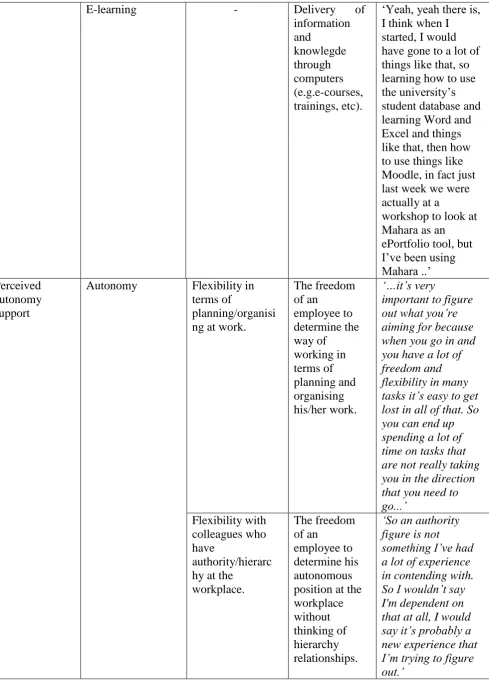
Atlas ti, the software for Qualitative Data Analysis, was used in this research. A coding scheme was created with all the variables, the labels and sublabels, definitions and examples on how highly self-regulated learners work and learn based on the learning strategies they use and the provided perceived autonomy support by the workplace (see Appendix). The creation of coding schemes is one of the three proposed ways for a qualitative content analysis that are described by Hsieh and Shannon (2005) where the codes-labels are created taking into account the content of the dataset.
Regarding the coding scheme, it was initially designed by the researcher in collaboration with the other two researchers of the team project, was revised several times and the final version was eventually used for coding the interviews. The coding scheme initially included some theory-driven labels for the variables of our study (peer learning, use of technology and perceived autonomy support) retrieved from the literature. However, at a later stage more data-driven sublabels were added in the existing coding scheme in order to specify in a more comprehensive way our variables, which means that the researcher created them after being inspired by the content of the data. The labels and the sublabels were also discussed and revised several times by the three coders and the supervisor’s suggestions.
22
interviews. For instance, the following quotation ‘In my daily work we use very much Google services, like Google Docs or Google Forums or Google Presentation and such which we are
using just now’ was segmented as the variable ‘use of digital technology’. At a second phase, the theory-driven labels were assigned to the same segmented parts. For example, the label ‘Interactive types of technology use’ was also assigned to the segmented answer of a participant included above. Lately, more data driven sublabels were created, for instance ‘communication’ was assigned as well to the segment above in order to define better the variable ‘use of digital technology’.
Concerning the validity of this research, there was a checking by all the three researchers on whether the created codes (labels and sublabels) display the same information for each of the variables as the information found in the literature for them. Furthermore, all the three researchers assigned codes-labels in one third of the interviews covering the three life phases, making the coding procedure more objective and equal and assuring that each interview is being coded by at least two researchers. The patterns which appeared repetitively in the interviews were coded with the same labels by all the three researchers. For the complete coding scheme (See Appendix).
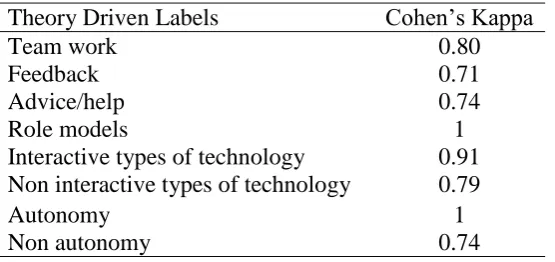
Concerning the reliability, Cohen’s kappa for qualitative content analysis was calculated in order to ensure that the measures- and in this case the variables and the theory driven labels used in this study- were reliable and that there is high quality agreement among the researchers-raters (Burla et al., 2008). Reliability checking concerning the segmentation was performed to a 10% of the total amount of interviews, thus 4 interviews and their average Cohen’s Kappa was 0.75.
23
[image:23.595.162.440.326.457.2]included Team work with Cohen’s Kappa=0.80, Feedback with Cohen’s Kappa=0.71, Advice/help with Cohen’s Kappa=0.74, Role models with Cohen’s Kappa=1 (however for this label the number of quotations were not enough to perform the reliability check strictly according to the formula which is described above). Furthermore, use of digital technology included the label Interactive Types of Technology with Kohen’s kappa=0.91 and Non Interactive Types of Technology with Kohen’s Kappa=0.79. Finally, perceived autonomy support included Autonomy with Cohen’s Kappa=1 and Non Autonomy with Cohen’s Kappa=0.74.
Table 1. The Cohen’s Kappa for the theory driven labels
Theory Driven Labels Cohen’s Kappa
Team work 0.80
Feedback 0.71
Advice/help 0.74
Role models 1
Interactive types of technology 0.91 Non interactive types of technology 0.79
Autonomy 1
24
5.
Results
In this current study, based on coded segments of interviews, two different learning strategies (peer learning and use of digital technology) at the workplace and perceived autonomy support revealed how 39 knowledge workers with high self-regulated learning skills work and learn at their workplaces. Based on the final coding scheme, all the statements were coded and analyzed in accordance with the three general categories-variables: peer learning, use of digital technology and perceived autonomy support. It is important to mention at this point that the labels of the coding scheme were assigned to segments only when the participants referred to them as something that it does happen at their workplaces. Thus, there was no need of including negative answers for all the labels. For instance, when in one interview there is the label/code “peer learning” this means that this participant uses peer learning and not that the participant mentioned “peer learning” but he/she did not use it at the workplace.
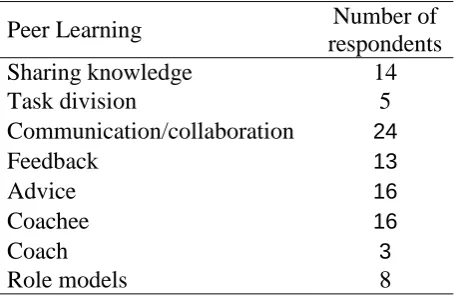
Peer learning. Within this category, almost all participants (N=37) declared that they are
25
Table 2. Number of responses for the data driven sub-labels of ‘peer learning’
Peer Learning Number of
respondents
Sharing knowledge 14
Task division 5
Communication/collaboration 24
Feedback 13
Advice 16
Coachee 16
Coach 3
Role models 8
For instance, a respondent mentioned:
‘I mean the same way having discussions with other people or doing projects together,
that’s also a way, so those publications are a way of communicating, it’s our way of
communicating in the academic world and seeing that was the importance, so the discussion is
the importance and the trying to get the thinking on issues one step further is the goal, not that
much this one publication.’
Fourteen of the respondents mentioned that they work in teams in order to share knowledge with each other. For example, one participant declared that:
‘So there are two colleagues I might just ring back and say ‘Have you been trying to contact
me? We’ll meet informally, just bump into each other and talk about things. We have team
meetings every semester, every couple of months anyway. We had one yesterday and we also
have research meetings once a month now. So we share what people are researching and
somebody usually does a presentation and we hear about it.’
26
For example in one of the interviews a participant said:
‘I think though for me the best form of learning is actually working with people, so
collaborating and trying to solve a problem. So part of that can be in conversation or part of it
can be in the output that you’re trying to produce, the process of producing that output, for me
is the learning experience (…) That’s not true, I did have a coach, briefly when I was at
Glasgow Caledonian, so my development funding was used to pay a coach and I would meet
with a coach every month or so (…).’
In general, the participants mentioned peer learning and more specifically communication/collaboration in terms of team work as a significant indicator regarding the ways they choose to learn at the workplace and monitor their learning with the help of their peers. As a result, peer learning is a learning strategy that highly self-regulated learners use when they work and learn at their workplace and after taking into account the basic needs of SDT, it can be considered as an indicator of how individuals with high SRL skills could fulfil their need for relatedness as well.
Use of digital technology. Concerning this category, almost all the participants (N=38)
[image:26.595.154.442.606.753.2]identified themselves using digital technology for their learning at the workplace according to the analysis of the interviews.
Table 3. Number of responses for the data driven sub-labels of ‘use of digital technology’
Use of digital technology Number of
respondents Web tools for communication (Interactive) 12
Social media (Interactive) 14
Forums (Interactive) 4
Blogs (Interactive) 5
Remote work (Interactive) 7
Journals (Non interactive) 14
Search engines (Non interactive) 15
27
The different types of digital technology used by the participants according to their answers could be seen in Table 3 above. More specifically, 15 respondents stated that they use search engines and prefer a non-interactive type of technology in order to get the information they need. Concerning search engines use, the answers in the interviews most of times connected search engines with google search where the participants often preferred to look up a term or information that was unknown to them rather than asking to follow a course or asking for a formal type of learning provided by their organization.
For example, one of them stated:
‘Yes so I suppose a fairly simplistic starting point would be I use Google. So obviously
there’s a lot behind that, but yes I do use the web a lot.’
Concerning the two second most recurring patterns of digital technology use presented in Table 3 above, 14 participants stated that when they want to gain some knowledge on something they do not know, they prefer to search for published articles online with specific and scientific knowledge on the topic, thus again using a non-interactive type of technology. Fourteen respondents stated that they also prefer to use social media to gain knowledge on a topic that they do not know when they wanted to learn at work, which is an interactive type of technology. However, although social media use was perceived as an interactive type of technology, the majority of the respondents declared that they prefer to be more consuming rather than contributing users. For this reason, it is important to mention here that although sometimes the same participants declared that they used both non-interactive and interactive types of technology, it seems that the majority of them are rather non-interactive technology users.
28
‘But on the other hand there are a lot of publications on the internet and one of the other
things is that we have a special interest group within our organization about different subjects.’
‘So I was doing all of that from online library, the databases and then I get ideas by just
reading my Facebook feeds.’
E-learning in the form of courses at the workplace was used by 13 participants most of times as a means of their professional development. Furthermore, web tools for communication follows as recurring pattern mentioned by 12 participants when searching information and supplementary knowledge online for their work. Concerning the types of technology, participants were found to look for information using both search engines and journals online. Participants who used to search for information online, used sometimes e-learning as well so as to gain more knowledge. Moreover, web tools for communication and social media were in their combination chosen by the participants so as to communicate online with their peers at work.
For instance, two participants stated that:
‘Internet, previous publications probably is the first source I would turn to when I need some information.’
‘Of course email and that kind of thing I’m very active there. I mean if people contact
me, this is just every day kind of medium and internet of course, those kind of things, that’s
something I’m using every day for several hours (…) But with regard to social media, yeah I
don’t know, I think there is so much out there and it’s so overwhelming all this information I
think if you want to find me you can find me’.
29
their work. However, non-interactive types of technology seem to be the leading pattern when participants take the initiative to search for information in terms of their need for additional knowledge at the workplace. As a result, from the perspective of SDT and the general need of individuals for competence, digital technology is used as a learning strategy at the workplace and more specifically non-interactive types of technology.
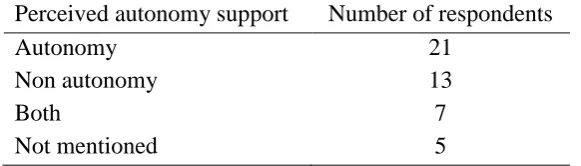
Perceived autonomy support. In this category, more than half of the respondents (N=
[image:29.595.154.445.415.498.2]21) mentioned perceived autonomy provided by the organization as important while learning at work (Table 4). On the other hand, thirteen of the participants stated that non autonomy plays an important role when it comes to the ways they learn at work. Seven participants referred to both autonomy and non-autonomy as important factors for the regulation of learning at work, while five respondents did not refer to perceived autonomy support at all in their interviews.
Table 4. Numbers of responses for ‘Perceived autonomy support’ Perceived autonomy support Number of respondents
Autonomy 21
Non autonomy 13
Both 7
Not mentioned 5
Concerning autonomy, most participants tried to define perceived autonomy at work in terms of either the flexibility given by their fellow colleagues who had a degree of authority at their workplace or in terms of their flexibility to plan and organize their work. Most of the participants revealed that autonomy was perceived most of times as flexibility given by colleagues with authority rather than flexibility in planning or organizing at work but the difference between the two was not striking.
30
‘I’ve almost always worked in a research context and that means I’ve had a lot of
freedom and flexibility about how I use my time and that is something that I value, not very
good at being in a situation where somebody tells me what to do, in fact I don’t like that at all.’
‘Work is great, as I said I’m completely self-managed at work, so I can focus on things I
want to do and I manage my time very effectively at work.’
Concerning non autonomy, respondents identified it as important and accepted at their workplace and almost half of them experienced autonomy and non-autonomy simultaneously at their workplaces (Table 4). More specifically, some of them recognized themselves as followers of authority by choice which means that they chose consciously to obey to authority while some others stated that they accept authority because they are affected by regulations and rules that are established at the workplace.
For example, two of the participants who experienced non autonomy mentioned:
‘Well at work I am a follower because I have a manager and she decides things and for my
former job there was no way you could say to the manager I don’t do that because for this and
this reason.’
‘I’m a good doer, I’m not a good manager I would say. I don’t set a lot of deadlines for
myself because I have a lot of deadlines set for me already. When you have to meet those it’s,
well it happens, I mean if I have 5 projects going on at the same time I tell myself ‘ok until the
end of the day I will have to complete at least this much’ I do that, but it is just to meet the
deadlines that I already have, not that I set a deadline myself.’
31
for self-regulated learners especially when the norms and regulations at the workplace seem not to be the appropriate and employees have a different and innovative idea to suggest. As a result, even when non autonomy was mentioned it was often perceived as an opportunity for self-regulation and together with autonomy was influencing the way the employees regulate their learning at the workplace.
For instance, one of the participants mentioned:
‘No I think I can handle that one. I think I can cope with authority, but in my work situations
I always had quite a lot of authority myself, so it’s ok for me to have a general path to walk on,
but the details should be left for myself.’
[image:31.595.93.505.454.619.2]In conclusion, perceived autonomy support, seen from the perspective of the basic needs in SDT, was mentioned as an important factor for the freedom of employees to set their own boundaries when they learn and work.
Table 5. Quantitative overview of the responses per interview
The qualitative overview of the responses presented above (Table 5), including the most frequently recurring patterns mentioned in the interviews of highly self-regulated learners, shows that most of the participants (N=21) used both learning strategies (peer learning and digital technology use) while being facilitated by autonomy provided by the workplace. To be more precise, communication and collaboration among colleagues when using peer learning,
One variable mentioned Number of respondents
Peer learning 1
Use of digital technology 1
Autonomy -
Two variables mentioned
Peer learning & Use of digital technology 15
Peer learning & Autonomy -
Use of digital technology & Autonomy 1 Three variables mentioned
Peer learning & Use of digital technology & Autonomy 21
32
search engines as a non-interactive type of technology use and autonomy support provided by the work environment with a focus on autonomy given by colleagues with a degree of authority form altogether the most fruitful combination. The reason of the importance of this combination from the perspective of the basic psychological needs that are introduced in the SDT is that it can better enable highly self-regulated learners to experience feelings of relatedness, competence and autonomy at the workplace simultaneously and at once.
For instance one participant mentioned:
‘Sometimes yeah I think I’m quite independent thinker, yeah. I don’t do things because
my boss tells me to, yeah…Also it means you can get feedback from them which would mean
that you might have to do something a little bit different, but I notice you get further….So I’m
getting more and more of these Skype meetings from home. Yeah and I don’t think there are too
many people doing that. So also I don’t, like… so ICT for work, like last month I invited a group
of colleagues for a webinar, so we sit together and do a webinar for nutritional development.’
Another important finding is that the two learning strategies (peer learning and digital technology use) were used in their combination by nearly half the participants which shows that the existence of the one learning strategy might be a prerequisite for the existence of the other (Table 5). In fact, the respondents’ answers revealed that most of times they used digital technology so as to use peer learning at the workplace since technology made their communication with their colleagues easier.
For instance one participant mentioned:
‘But on the other hand there are a lot of publications on the internet and one of the other
things is that we have a ‘kenniskring’, special interest group within our organization about
different subjects. So one of the subjects is curriculum and ICT and there we try to share
33
where we share our results and what are the new insights and also people who went to
34
6.
Discussion and Conclusions
The aim of this current study was to identify how highly self-regulated learners work and learn at the workplace taking into account the basic psychological needs for relatedness, competence and autonomy as they are described in the SDT. The focus of this study was on the learning strategies the highly self-regulated learners use at the workplace and especially on the use of digital technology and peer learning. The role of perceived autonomy support provided by the workplace was also investigated. The method used included data from semi-structured interviews which were collected in 2014 by Dr. Anoush Margaryan. The researchers tried to identify common and frequently recurring workplace patterns concerning both the learning strategies and the perceived autonomy support in the interviews of the 39 knowledge workers.
Answering the following research question “How do highly self-regulated learners fulfil their need for relatedness, competence and autonomy at the workplace?”, this study revealed that peer learning and digital technology (especially non interactive types of technology) as learning strategies, and the autonomy provided by the workplace in their combination were used by most participants in the context of their needs for relatedness, competence and autonomy. A great number of the respondents indicated also that they used both technology and peer learning. This finding might also suggest that technology use is sometimes a prerequisite for peer learning and is in line with previous research which showed that certain forms of peer learning like for instance help seeking is a beneficial strategy when peer learning takes place in technologically enhanced and self-regulated learning environments (Järvelä, 2011) and with the study of Keppell, Au, Ma, and Chan (2006), where technology use was also connected to different aspects of peer learning like assessment used among students so to grade their peers.
35
occurring at the workplace. The results revealed that most of the employees tend to learn through communication or collaboration with their peers. Advice or help seeking was also a frequently recurring pattern followed by the fact that a lot of knowledge workers had a coach or mentor at their workplaces. Boud and Middleton (2003), suggested that peer learning triggers informal learning opportunities and initiatives at the workplace where the individuals collaborate with their colleagues or even their seniors. Furthermore, in a recent study teachers were found to engage in informal learning effectively when interacting with their colleagues (Grosemans et al., 2015). In line with these findings, this current study suggests that highly self-regulated learners in contemporary organizations tend to learn from their peers and to take initiative to gain additional knowledge when needed by asking for others’ opinion or help at the workplace. This means that peer learning as a learning strategy is used by employees who learn and work at their workplaces.
36
70% of the employees (white collar workers) using computer technology and Great Britain follows with a considerable amount of employees using technology as well (Dhondt, Kraan, & Sloten, 2002). The study of Steffens (2006) revealed that technologically-enhanced learning environments seem to trigger individuals’ initiatives to keep track on their learning progress and reflect on that using online tools offered by their learning environment. Moreover, Ellingson and Noe (2017) recognized technology use as a facilitator of an autonomous learning which promotes the online communication of employees at the workplace. In line with these two findings, this current study revealed that knowledge workers felt free to utilize all the sources for their learning provided online such as articles on journals or to search for information and knowledge through different search engines online. Furthermore, knowledge workers found to use social media to keep themselves up-to-date, to engage in peer learning and obtain additional information or knowledge when necessary. As a result, highly self-regulated employees used technology as a means to learn and work at their workplaces. Moreover, digital technology found to be linked to peer learning as well when it comes to the combination of strategies individuals choose to use at the workplace. This finding is supported by the study of Olgren (2000) where the employees were engaged in peer learning and controlled the sources provided by their workplaces.
self-37
reflection, self-evaluation and monitoring strategies that are triggered when they learn. Another study suggested that autonomy at the workplace is responsible for the arise of learning opportunities for employees by moderating the relationship between workload and opportunities for learning at work (van Ruysseveldt & van Dijke, 2011). The results of this study are in line with these two findings since the knowledge workers mentioned autonomy as a significant factor influencing the initiatives they take for their learning at work and specified autonomy mostly as the ability to take action and have their opinion heard even among work teams where there were superiors, managers or supervisors with more authority than them. Hicks et al. (2007) that an autonomous environment is the prerequisite for the choice of the right strategies which could trigger not only workplace learning but also its effective regulation by the individuals (Crouse et al., 2011). As a result, perceived autonomy support can be counted as an important trigger for the learning strategies used by highly self-regulated learners in this study (peer learning and technology use) in the general context for fulfilment of competence, relatedness and autonomy at the workplace.
38
7.
Limitations and Future Recommendations
This current study tried to identify how highly self-regulated learners work and learn at the workplace using the perspective of the basic psychological needs as they are described in the SDT and providing the current literature on the relationship between SRL and SDT with a deeper insight concerning workplace context. However, there are some limitations to reflect upon which are going to be presented and discussed below.
First of all, through the sampling technique of this current study 39 individuals were selected and all of them were knowledge workers in private or public sector. Hence, the sample consisted of participants from almost the same workplace environments and sectors, making the findings of this study not highly generalizable (Bornstein, Jager, & Putnick, 2013). In addition, the way the interviews were conducted and the questions asked to the individuals included some overlap between work and learning thus making it difficult both for the interviewer and the interviewee to distinguish among the two and emphasize on (self-regulated) learning at the workplace. Additionally, concerning the method of this study, biographical interviews were used as a tool to identify the ways in which 39 highly self-regulated knowledge workers work and learn which could enable them to meet their needs for relatedness, competence and autonomy. Although life history method is an appropriate qualitative method so as to reveal experiences and opinions on a specific topic as previously mentioned, it is difficult to generalize its findings which include personal experiences about the lives of specific individuals (Germeten, 2013).
39
results concerning all the four different variables included in this study (peer learning, digital technology use, perceived autonomy support and self-regulated learning) at the same time without being as costly option as a longitudinal study for instance. A quantitative study would also be suitable for the measurement of these specific variables together as the bias will be eliminated since the researchers will be at a distance from the subjects of the study, something that was not the case when using biographical interviews. Additionally, the generalizability of the findings could be higher by using quantitative method since the researchers would have the opportunity to include larger samples and compare their study with a greater number of previous researches on the same topic. In addition, new scales to measure SRL could also be developed in this new proposed quantitative method in order to foster the preliminary findings of the existing initial SRL@WORK questionnaire. New scales measuring whether highly self-regulated learners who use peer learning and technology while provided with autonomy indeed meet their basic psychological needs –competence, relatedness, autonomy- could add some practical results to this current study which used just the perspective of SDT so as to focus on working and learning at the workplace.
40
41
8.
Practical Implications
The findings of this present study on how highly self-regulated learners work and learn at today’s contemporary work environments could be used as a suggestion for the L&D departments and HRD practitioners whose main goal - from the perspective of SDT - should be the satisfaction of the three basic psychological needs of employees competence, relatedness and autonomy. Moreover, the ways that employees learn at their workplace in 2016 presented in the graph of DEGREED, which was the inspiration for this study and was confirmed by its results, underline the importance of a supportive embracement of self-regulated learning by the organizations. Therefore, a useful practical implication for the organizations and L&D departments could be to promote a “social and searching approach” for employees’ learning combined with the required autonomy support.
42
43
References
Aleven, V., Stahl, E., Schworm, S., Fischer, F., & Wallace, R. (2003). Help seeking and help design in interactive learning environments. Review of educational research, 73(3), 277-320.
Beenen, G., Pichler, S., & Levy, P. E. (2016). Self‐Determined Feedback Seeking: The Role of Perceived Supervisor Autonomy Support. Human resource management.
Benson, A. D., Johnson, S. D., & Kuchinke, K. P. (2002). The use of technology in the digital workplace: A framework for human resource development. Advances in Developing Human Resources, 4(4), 392-404.
Bornstein, M. H., Jager, J., & Putnick, D. L. (2013). Sampling in developmental science: Situations, shortcomings, solutions, and standards. Developmental Review, 33(4), 357-370.
Boud, D., & Middleton, H. (2003). Learning from others at work: communities of practice and informal learning. Journal of workplace learning, 15(5), 194-202.
Boud, D., & Molloy, E. (2013). Rethinking models of feedback for learning: the challenge of design. Assessment & Evaluation in Higher Education, 38(6), 698-712.
Breaugh, J. A. (1999). Further investigation of the work autonomy scales: Two studies. Journal of Business and Psychology, 13(3), 357-373.
Broeck, A., Vansteenkiste, M., Witte, H., Soenens, B., & Lens, W. (2010). Capturing autonomy, competence, and relatedness at work: Construction and initial validation of the Work‐related Basic Need Satisfaction scale. Journal of Occupational and Organizational Psychology, 83(4), 981-1002.
Burla, L., Knierim, B., Barth, J., Liewald, K., Duetz, M., & Abel, T. (2008). From text to codings: intercoder reliability assessment in qualitative content analysis. Nursing research, 57(2), 113-117.
Chen, C.-M. (2009). Personalized E-learning system with self-regulated learning assisted mechanisms for promoting learning performance. Expert Systems with Applications, 36(5), 8816-8829.
Chi, M. T. (2009). Active‐constructive‐interactive: A conceptual framework for differentiating learning activities. Topics in Cognitive Science, 1(1), 73-105.
Crouse, P., Doyle, W., & Young, J. D. (2011). Workplace learning strategies, barriers, facilitators and outcomes: a qualitative study among human resource management practitioners. Human Resource Development International, 14(1), 39-55.
Dabbagh, N., & Kitsantas, A. (2005). Using web-based pedagogical tools as scaffolds for self-regulated learning. Instructional Science, 33(5), 513-540.
Dabbagh, N., & Kitsantas, A. (2012). Personal Learning Environments, social media, and self-regulated learning: A natural formula for connecting formal and informal learning. The Internet and higher education, 15(1), 3-8.
Deci, E. L., & Ryan, R. M. (2000). The" what" and" why" of goal pursuits: Human needs and the self-determination of behavior. Psychological inquiry, 11(4), 227-268.
Dhondt, S., Kraan, K., & Sloten, G. v. (2002). Work organisation, technology and working conditions.
Ellingson, J. E., & Noe, R. A. (2017). Autonomous Learning in the Workplace: Taylor & Francis.
Eraut, M. (2009). 2.1 Transfer of knowledge between education and workplace settings. Knowledge, values and educational policy: A critical perspective, 65.
44
Fontana, R. P., Milligan, C., Littlejohn, A., & Margaryan, A. (2015). Measuring self‐regulated learning in the workplace. International Journal of Training and Development, 19(1), 32-52.
Gawlik, M. A. (2007). Beyond the charter schoolhouse door: Teacher-perceived autonomy. Education and Urban Society, 39(4), 524-553.
Germeten, S. (2013). Personal narratives in life history research. Scandinavian Journal of Educational Research, 57(6), 612-624.
Gibson, D. E. (2004). Role models in career development: New directions for theory and research. Journal of Vocational Behavior, 65(1), 134-156.
Gillet, N., Colombat, P., Michinov, E., Pronost, A. M., & Fouquereau, E. (2013). Procedural justice, supervisor autonomy support, work satisfaction, organizational identification and job performance: the mediating role of need satisfaction and perceived organizational support. Journal of Advanced Nursing, 69(11), 2560-2571.
Grosemans, I., Boon, A., Verclairen, C., Dochy, F., & Kyndt, E. (2015). Informal learning of primary school teachers: Considering the role of teaching experience and school culture. Teaching and Teacher Education, 47, 151-161.
Gunawardena, C. N., Hermans, M. B., Sanchez, D., Richmond, C., Bohley, M., & Tuttle, R. (2009). A theoretical framework for building online communities of practice with social networking tools. Educational Media International, 46(1), 3-16. doi:10.1080/09523980802588626
Hagger, M. S., Chatzisarantis, N. L., Hein, V., Pihu, M., Soós, I., & Karsai, I. (2007). The perceived autonomy support scale for exercise settings (PASSES): Development, validity, and cross-cultural invariance in young people. Psychology of Sport and Exercise, 8(5), 632-653.
Hardill, I., & Green, A. (2003). Remote working—altering the spatial contours of work and home in the new economy. New Technology, Work and Employment, 18(3), 212-222. Hicks, E., Bagg, R., Doyle, W., & Young, J. D. (2007). Canadian accountants: Examining
workplace learning. Journal of workplace learning, 19(2), 61-77.
Holman, D., Epitropaki, O., & Fernie, S. (2001). Understanding learning strategies in the workplace: A factor analytic investigation. Journal of Occupational and Organizational Psychology, 74(5), 675-681.
Hsieh, H.-F., & Shannon, S. E. (2005). Three approaches to qualitative content analysis. Qualitative health research, 15(9), 1277-1288.
Jang, H. (2008). Supporting students' motivation, engagement, and learning during an uninteresting activity. Journal of educational psychology, 100(4), 798.
Janssens, L., Smet, K., Onghena, P., & Kyndt, E. (2017). The relationship between learning conditions in the workplace and informal learning outcomes: a study among police inspectors. International Journal of Training and Development, 21(2), 92-112.
Järvelä, S. (2011). How does help seeking help?–New prospects in a variety of contexts. Learning and Instruction, 21(2), 297-299.
Järvelä, S., & Järvenoja, H. (2011). Socially constructed self-regulated learning and motivation regulation in collaborative learning groups. Teachers College Record, 113(2), 350-374. Johnson, W., McGue, M., & Krueger, R. F. (2005). Personality stability in late adulthood: A
behavioral genetic analysis. Journal of personality, 73(2), 523-552.
Keppell, M., Au, E., Ma, A., & Chan, C. (2006). Peer learning and learning‐oriented assessment in technology‐enhanced environments. Assessment & Evaluation in Higher Education, 31(4), 453-464.
45
Kollar, I., & Fischer, F. (2010). Peer assessment as collaborative learning: A cognitive perspective. Learning and Instruction, 20(4), 344-348.
Kunjiapu, S., & Yasin, R. M. (2010). Stepping up the ladder: competence development through workplace learning among employees of small tourism enterprises. Procedia-Social and Behavioral Sciences, 7, 10-18.
Langfred, C. W. (2000). The paradox of self-management: Individual and group autonomy in work groups. Journal of Organizational Behavior, 563-585.
Lee, P.-L., Hamman, D., & Lee, C. C. (2007). The relationship of family closeness with college students' self-regulated learning and school adjustment. College Student Journal, 41(4), 779-788.
Lockwood, P., Jordan, C. H., & Kunda, Z. (2002). Motivation by positive or negative role models: regulatory focus determines who will best inspire us. Journal of Personality and Social Psychology, 83(4), 854.
Lord, R. G., Diefendorff, J. M., Schmidt, A. M., & Hall, R. J. (2010). Self-regulation at work. Annual review of psychology, 61, 543-568.
Margaryan, A., Littlejohn, A., & Milligan, C. (2013). Self‐regulated learning in the workplace: strategies and factors in the attainment of learning goals. International Journal of Training and Development, 17(4), 245-259.
Margaryan, A., Littlejohn, A., & Vojt, G. (2011). Are digital natives a myth or reality? University students’ use of digital technologies. Computers & Education, 56(2), 429-440.
Margaryan, A., Milligan, C., Littlejohn, A., Hendrix, D., & Graeb-Koenneker, S. (2009). Self-regulated learning and knowledge sharing in the workplace. Paper presented at the Proceedings of International Conference on Organisational Learning, Knowledge and Capabilities.
Moore, J., Dickson-Deane, C., & Galyen, K. (2011). E-Learning, online learning, and distance learning environments: Are they the same? (Vol. 14).
Moreau, E., & Mageau, G. A. (2012). The importance of perceived autonomy support for the psychological health and work satisfaction of health professionals: Not only supervisors count, colleagues too! Motivation and Emotion, 36(3), 268-286.
Niemiec, C. P., & Ryan, R. M. (2009). Autonomy, competence, and relatedness in the classroom: Applying self-determination theory to educational practice. School Field, 7(2), 133-144.
Olgren, C. H. (2000). Learning strategies for learning technologies. New directions for adult and continuing education, 2000(88), 7-16.
Parker, P., Hall, D. T., & Kram, K. E. (2008). Peer coaching: A relational process for accelerating career learning. Academy of Management Learning & Education, 7(4), 487-503.
Reeve, J., Ryan, R., Deci, E. L., & Jang, H. (2008). Understanding and promoting autonomous self-regulation: A self-determination theory perspective. Motivation and self-regulated learning: Theory, research, and applications, 223-244.
Roe, A. (1953). A psychological study of eminent psychologists and anthropologists, and a comparison with biological and physical scientists. Psychological monographs: General and applied, 67(2), 1.
Sabiston, J. A., & Lascbinger, H. K. S. (1995). Staff Nurse Work Empowerment and Perceived Autonomy: Testing Ranter's Theory of Structural Power in Organizations. Journal of nursing administration, 25(9), 42-50.
46
Sierens, E., Vansteenkiste, M., Goossens, L., Soenens, B., & Dochy, F. (2009). The synergistic relationship of perceived autonomy support and structure in the prediction of self‐ regulated learning. British Journal of Educational Psychology, 79(1), 57-68.
Steffens, K. (2006). Self‐regulated learning in technology‐enhanced learning environments: Lessons of a European peer review. European Journal of Education, 41(3‐4), 353-379. Thompson, P. (2013). The digital natives as learners: Technology use patterns and approaches
to learning. Computers & Education, 65, 12-33.
Topping, K. J. (2005). Trends in peer learning. Educational psychology, 25(6), 631-645. Truss, K., Baron, A., Crawford, D., Debenham, T., Emmott, M., Harding, S., . . . Totterdill, P.
(2014). Job design and employee engagement.
Tynjälä, P., & Häkkinen, P. (2005). E-learning at work: theoretical underpinnings and pedagogical challenges. Journal of workplace learning, 17(5/6), 318-336.
Van den Bossche, P., Gijselaers, W. H., Segers, M., & Kirschner, P. A. (2006). Social and cognitive factors driving teamwork in collaborative learning environments: Team learning beliefs and behaviors. Small group research, 37(5), 490-521.
van der Rijt, J., Van den Bossche, P., van de Wiel, M. W., De Maeyer, S., Gijselaers, W. H., & Segers, M. S. (2013). Asking for help: A relational perspective on help seeking in the workplace. Vocations and Learning, 6(2), 259-279.
van Ruysseveldt, J., & van Dijke, M. (2011). When are workload and workplace learning opportunities related in a curvilinear manner? The moderating role of autonomy. Journal of Vocational Behavior, 79(2), 470-483.
van Teijlingen, E., & Forrest, K. (2004). The range of qualitative research methods in family planning and reproductive health care. The journal of family planning and reproductive health care, 30(3), 171.
Vansteenkiste, M., Sierens, E., Goossens, L., Soenens, B., Dochy, F., Mouratidis, A., . . . Beyers, W. (2012). Identifying configurations of perceived teacher autonomy support and structure: Associations with self-regulated learning, motivation and problem behavior. Learning and Instruction, 22(6), 431-439.
Wrzesniewski, A., & Dutton, J. E. (2001). Crafting a job: Revisioning employees as active crafters of their work. Academy of management review, 26(2), 179-201.
Zimmerman, B. J. (1998). Academic studing and the development of personal skill: A self-regulatory perspective. Educational psychologist, 33(2-3), 73-86.
Zimmerman, B. J. (2002). Becoming a self-regulated learner: An overview. Theory into practice, 41(2), 64-70.
Zimmerman, B. J., & Schunk, D. H. (2001). Self-regulated learning and academic achievement: Theoretical perspectives: Routledge.
47
Appendix: Coding Scheme
Variables Theory driven labels
Data driven sublabels
Definitions Examples Peer learning Team work Sharing
knowledge
The process of working together with colleagues in order to share knowledge with each other.
‘I always thought it was very important to work with people that I thought I could learn a lot from and that influenced who I wanted to work with.’
Task division The process when team work is done in order to divide tasks among different colleagues at work.
‘Obviously there’s a lot of networking and interaction and making sure that we understand who’s doing what, so we would generally have a shared document in Google Docs and try to communicate through that what we’re trying to do next...’
Communication/ collaboration
Team work is occuring in order to collaborate on a specific task or to
communicate with the other colleagues concerning a job matter.
‘We can go to colleagues about more technical things. I go to institutes that are working on that topic for especially linked data and so I work together with people to develop knowledge in that area.’
Feedback Giving Individuals
give some feedback to their colleagues concerning their work.