Vol. 9, No. 2, pp. 459–475
A MATHEMATICAL MODEL FOR THE HARD SPHERE
REPULSION IN IONIC SOLUTIONS∗
YUNKYONG HYON†, BOB EISENBERG‡, AND CHUN LIU§
Abstract. We introduce a mathematical model for the finite size (repulsive) effects in ionic solutions. We first introduce an appropriate energy term into the total energy that represents the hard sphere repulsion of ions. The total energy then consists of the entropic energy, electrostatic potential energy, and the repulsive potential energy. The energetic variational approach derives a boundary value problem that includes contributions from the repulsive term with a no flux boundary condition for charge density which is a consequence of the variational approach, and physically implies charge conservation. The resulting system of partial differential equations is a modification of the Poisson-Nernst-Planck (PNP) equations widely if not universally used to describe the drift-diffusion of electrons and holes in semiconductors, and the movement of ions in solutions and protein channels. The modified PNP equations include the effects of the finite size of ions that are so important in the concentrated solutions near electrodes, active sites of enzymes, and selectivity filters of proteins. Finally, we do some numerical experiments using finite element methods, and present their results as a verification of the utility of the modified system.
Key words.Finite size effects, energetic variational approach, Poisson-Nernst-Planck equations, hard sphere, Lennard-Jones repulsive potential, hard sphere potential in density functional theory.
AMS subject classifications. 76A05, 76M99, 65C30.
1. Introduction
We introduce a mathematical model for ionic dynamics including the Brownian motion of ions, electrostatic interactions among charged ions, and finite size/volume (excluded volume) effects (steric effects) that uses a variational method to extend the classical literature [17, 21, 41, 42, 43, 44] from equilibrium to nonequilibrium. The finite size effects are an important part of a physical model of ions in water but have rarely been dealt with away from equilibrium, even though most applications of ion dynamics in fact involve ion flows.
Finite size effects do not occur in ‘ideal’ infinitely dilute solutions of independent components, but size effects are important in almost every other case where ionic solutions are involved [65]. Indeed, in most applications ions are concentrated in the special regions where they are important. For example, in electrochemistry ions are highly concentrated near electrodes. In biology ions are highly concentrated near the active sites of enzymes (the protein catalysts which do so much of life’s chemistry), inside and near DNA and ion channels. In general, ions have their size, and their size is important: the dynamics of ions in small scale cannot be described without including finite size effects. A widely used model of an ion is a hard sphere of finite radius with charge located at the center. Much work has shown that a model of ionic solutions consisting of hard spheres in a uniform frictional dielectric does surprisingly well at equilibrium when all flows are zero. The literature of finite size effects is vast
∗Received: June 10, 2010; accepted (in revised version): September 18, 2010. Communicated by Shi Jin.
†Institute for Mathematics and Its Applications, University of Minnesota, 114 Lind, 207 Church St. S.E., Minneapolis, MN 55455, USA ([email protected]).
‡Department of Molecular Biophysics & Physiology Rush Medical Center, 1653 West Congress, Parkway, Chicago, IL 60612, USA ([email protected]).
§Department of Mathematics, Pennsylvania State University, University Park, PA 16802, USA, and Institute for Mathematics and Its Applications, University of Minnesota, 114 Lind, 207 Church St. S.E., Minneapolis, MN 55455, USA ([email protected], or [email protected]).
and includes many different treatments of finite size. Fortunately, the literature is well summarized in a recent book [65] and indeed in textbooks [42, 43]. We are not qualified to evaluate the different treatments of finite size effects because the issues are fundamentally those of physical chemistry, experimental and theoretical. But finite size effects are important. A leading worker writes “... it is still a fact that over the last decades, it was easier to fly to the moon than to describe the free energy of even the simplest salt solutions beyond a concentration of 0.1M or so.” [65] Our contribution is to use a variational approach that extends the physics of previous equilibrium models to nonequilibrium [41, 42, 43, 44]. Previous extensions to nonequilibrium involving Density Functional Theory (of liquids) are discussed in Section 3.1.
Our research on the excluded volume of ions is particularly motivated by the study of the selectivity of ion channels in cell membranes [15, 16, 19, 20]. Two key physical properties are the basis for the ion selectivity in these channels: one is electrostatic interactions with the side-chains of the protein that forms the channel; the other is the excluded volume effects of ions and side chains [17]. These physical properties can be included as parameters in a mathematical model of an individual ion. However, it is not so easy to obtain an appropriate mathematical system of equations for the flow of ions that includes such finite size effects [58, 59, 60] and deals consistently with the electric field by satisfying sum rules [57, 66] and Gauss’s law.
Our model in this paper can be directly linked to the selectivity phenomena of channels [23, 24, 15, 16]. It can also be used to establish a time dependent model for ensembles of single channels [22, 24, 27, 28, 25, 26] that can be related to the classical Hodgkin-Huxley phenomenological representations. Although the excluded volume effect is one of the crucial determinants of the selectivity of channels, it is not the only one. A variety of other factors are involved including the properties of side chains of the channel protein (modified in mutation experiments), confinement in the small volume of the pore of the channel, the inhomogeneous dielectric coefficient of the channel protein, and channel pore and so on. Detailed modeling and numerical computations involving these features are presented elsewhere [18].
One of the advantages of the variational approach is that it deals directly and consistently with the coupling of the flow of ions one to another. The issues of coupling of ions one to another, and to the channel, have been central topics of biological investigation since the discovery of channels and transporters [67, 68, 69, 70, 71]. Indeed, channels and transporters were defined by the properties of the coupling between ion flows long before the proteins involved were isolated. Even today it is likely that structural measurements cannot actually resolve the functional difference between channels and transporters. The functional difference is the coupling of fluxes of ions. The variational approach deals directly with interactions of ions and coupling of fluxes.
In this paper, we concentrate on the specific subject of the finite size effects and its mathematical modeling. This has practical significance: for example, the only difference between the biologically crucial ions Na+ and K+ is their diameter; they are otherwise indistinguishable. We consider a hard sphere model for ions to verify the model. We use the energetic variational approach [18, 6, 12] to determine the contribution of ion repulsion and finite size effects and create a modified Poisson-Nernst-Planck (PNP) model of ions in solution.
energy representing the coulomb interaction between the charged ions, and the re-pulsive potential energy caused by the excluded volume effect. (To avoid confusing some readers, we remark that we use the word ‘energy’ in the tradition of varia-tional analysis. This is not the ‘energy’ of classical thermodynamics.) If we include only the entropy and electrostatic potential for the total energy, then the result-ing system of partial differential equations (after variational derivatives are taken) is the classical PNP equation [6]. The PNP equations have been applied to solve charge transport problems in semiconductor and ion dynamics in biological phenom-ena [13, 14, 8, 45, 46, 47, 48, 49, 50, 51, 61, 62, 63, 64].
To perform our task, we need to define a proper repulsive potential energy de-scribing the excluded volume energy in ion-ion interactions. There are several types of potential energy for the hard sphere repulsion: for instance, the Yukawa poten-tial, the hard core potenpoten-tial, the repulsive term of Lennard-Jones (LJ) potenpoten-tial, and the hard sphere potential in Rosenfeld’s [35, 36, 52, 53, 54] density functional theory (DFT) of fluids [55, 56, 57, 38], which is different from the DFT of electrons used in Quantum Chemistry. In this work, we employ the LJ repulsive potential for the excluded volume effects [11] and also the hard sphere potential in DFT [29, 30, 35, 36] for comparison. Then we take variational derivatives of the total energy for the case of the LJ repulsive potential and the hard sphere chemical potential of DFT. This leads us to a system of equations including the contributions of the finite size effect that we call the modified PNP system. These equations are of course different for the hard sphere and DFT descriptions of finite size effects.
We also demonstrate the utility of this description of finite size effects by show-ing some numerical computations for the modified PNP system. Since the energetic variational approach is based on the variational structure of the underlying mathe-matical model, it is very important to preserve the characteristic variational structure in computational methods as well as analysis. For that reason, we use finite element methods in numerical computations of the modified PNP system previously shown to preserve the important characteristics of the variational procedure [6, 12].
The organization of the paper is this: In the next section, we briefly discuss the PNP equations and summarize their derivation through the energetic variational ap-proach. Section 3 covers the derivation of the modified PNP that includes the finite size effect after defining a proper total energy. In Section 4, we present several numer-ical experiments for the verification of the modified PNP equations, and especially the finite size effects. Finally, we make some general remarks, looking to the future.
2. Poisson-Nernst-Planck equations
The PNP equations for electrokinetic theory are
∂ci
∂t =∇ ·
Di
∇ci+
zie
kBT
ci∇φ
, (2.1)
∇ ·(ε∇φ) =− ρ0+
N
X
i=1 zieci
!
(2.2)
whereciis the ion density forith species,Diis the diffusion constant,ziis the valence,
eis the unit charge,kB is the Boltzmann constant,T is the absolute temperature, ε is the dielectric constant,φis the electrostatic potential, ρ0 is the permanent (fixed)
The system (2.1), (2.2) satisfies the following dissipative energy law:
d dt
Z (
kBT N
X
i=1
cilogci+ 1 2 ρ0+
N
X
i=1 zieci
!
φ
)
d~x
=−
Z (N
X
i=1 Dici
kBT
kBT ∇ci
ci
+zie∇φ
2)
d~x. (2.3)
The second term in the total energy, the left hand side of (2.3), can be rewritten as
ε|∇φ| 2
2 under the proper boundary condition for electrostatic potential. This is the
electrostatic potential energy with the definition of electric field,E~=−∇φ, in classical electromagnetic theory [1].
When an energy equation is well defined to describe a physical phenomenon, one can derive a system of differential equations satisfying the energy equation by the energetic variational approach. In other words, the energetic variational approach forms a framework (or procedure) that derives a system of equations corresponding to the energy law. Thus, for the PNP system (2.1), (2.2), one can derive (2.1) from (2.3) using the energetic variational approach [6].
The derivation of PNP system from the energy is not a trivial task. The varia-tional calculus needs addivaria-tional ingredients. In the energetic variavaria-tional approaches, the variational derivative, δ Etotal
δci , gives the chemical potential µi for each ith ion, i= 1,···,N. The Nernst-Planck equation (2.1) is then given by
∂ci
∂t =∇ ·
Di
kBT
ci∇µi
, fori= 1,···,N. (2.4)
To make this paper self-contained, we briefly summarize the derivation of the Nernst-Planck equation (2.1) from the energy (2.3). For the derivation we note the electro-static potentialφwith the Green’s kernelG(~x,~y) is
φ(~x) =−4π
ε
Z
G(~x,~y) ρ0+
N
X
i=1 zieci
!
d~y. (2.5)
The total energyE which is in the left-hand side of (2.3) is
Etotal=
Z (
kBT N
X
i=1
cilogci+ 1 2 ρ0+
N
X
i=1 zieci
!
φ
)
d~x. (2.6)
We can easily see that the electrostatic potential is not independent of the ion densities
ci, which is physically obvious because the densities describe charge. Hence when we take the variational derivative with respect toci we need to consider the electrostatic potential as a functional of the ion density. Thus, we have that
δE=
Z "
kBT(logci+ 1)δci+ 1 2
(
4πzieδci
ε
Z
G(~x,~y) ρ0+
N
X
i=1
zieci(~y)
!
d~y
+ ρ0+
N
X
i=1 zieci
!
4πzie
ε
Z
G(~x,~y)δcid~y
)#
Combining the last two terms in (2.7), we obtain
δE=
Z
{kBT(logci+ 1) +zieφ}δcid~x, fori= 1,···,N. (2.8)
Hence we obtain the chemical potentialµi:
µi=kBT(logci+ 1) +zieφ, fori= 1,···,N. (2.9)
Therefore, using (2.4) we obtain the Nernst-Planck equation,
∂ci
∂t =∇ ·
Di
kBT
ci∇(kBT(logci+ 1) +zieφ)
=∇ ·
Di
∇ci+
zie
kBT
ci∇φ
. (2.10)
A simplification leads us to the Nernst-Planck equation (2.1) for the ion density ci, fori= 1,···,N.
The framework of the energetic variational approach is briefly summarized as follows:
i. Find a mathematical description of the physical phenomenon of interest. ii. Define an appropriate energy equation to describe the desired physical
phe-nomenon.
iii. Apply the energetic variational approach to obtain a system of differential equations.
iv. Verify the system of equations in numerical experiments, and mathematical analysis.
Remark 2.1. Note that the boundary condition for charge density is a direct
conse-quence of the energy variational principle. In this sense, the natural boundary condi-tion for charge density is a no flux boundary condicondi-tion that itself — without addicondi-tional assumptions — implies charge conservation of the system. One may not explicitly see the point in the derivation of the chemical potential µi from (2.6) to (2.10), but one can easily see the consequences of the no flux boundary condition by looking at our derivation of the energy dissipation law (2.6) 1rom the PNP equation (2.10).
3. Modified PNP system with hard sphere repulsion
In this section we discuss the excluded volume effects in a hard sphere model of ionic fluids. In chemical physics of fluids on the atomic scale and in colloidal suspensions, the excluded volume effect is a crucial physical factor for modeling hard sphere mixtures [31]. The excluded volume often appears in physical chemistry in the equation of state (EOS); for instance, a well-known EOS is the Van der Waals equation.
In Subsection 3.2 we utilize the excluded volume energy, which is a nonlocal type of repulsion potential proposed in [11]. Then we define the total energy with the repulsive potential energy, and derive a modified PNP system including the hard sphere repulsion. The detailed derivation is presented in Subsection 3.2.
3.1. Density functional theory. The DFT is based on the fundamental
measure theory for uncharged (atomic) fluids [35, 36]. In Rosenfeld’s DFT the energy density function is introduced for the free energy functional including the hard sphere repulsion energy. Moreover, DFT uses an (underived) ansatz for the energy density function. From the energy density function one can separately obtain the chemical potentials for hard sphere and electrostatic interactions. The errors in this ansatz are unknown and customarily estimated by comparison with Monte Carlo simulations of hard spheres.
PNP and DFT were coupled in a straightforward approach in [39], and the model called PNP-DFT shows significant results for ionic mixtures, especially the layering phenomena of charge density near a charged wall [39]. However, it is not clear that PNP-DFT satisfies the sum rules of statistical mechanics [57, 66] or Gauss’ law of electrostatics and it does not allow changes in the shape of the ionic atmosphere with flow, as discussed in [58, 59, 60].
However, the approach leaves out many effects (e.g., electrophoretic and relax-ation terms) known to be important in determining the conductance of ionic solutions [58, 59, 60]. These terms are probably small enough to be neglected when ions flow through a protein channel, judging from the success of the model that leaves them out [40]. That success cannot be guaranteed by the derivation of the PNP-DFT theory because these terms are quite important in other cases, and it is in fact not safe to assume they are uniformly small in any situation, including ion channels.
Here, we derive the chemical potential of hard sphere repulsion from the inter-pretation of the energetic variational framework using results from Rosenfeld’s DFT. First, let ΦHS be the energy functional for the hard sphere. Then the energy of the uncharged hard spheres is defined in this DFT by
EHSDF T=
Z
ΦHS({nα},{~nβ})d~x, forα= 0,···,3, β= 4,5 (3.1)
where
ΦHS({nα},{~nβ}) =−n0log(1−n3) +
n1n2−~n4·~n5
1−n3
+ n
3 2
24π(1−n3)2
1−|~n5|
2
n2 2
3
, (3.2)
nα= N
X
i
Z
ci(~y)ω(iα)(~y−~x)d~y, for α= 0,···,3, (3.3)
~nβ= N
X
i
Z
The weight functionsω(iα),~ω(iβ), fori= 1,···,N,α= 0,···,3,β= 4,5 are given by
4πa2iωi(0)(~r) = 4πaiωi(1)(~r) =ω
(2)
i (~r), (3.5) 4πai~ωi(4)(~r) =~ω
(5)
i (~r), (3.6)
ωi(2)(~r) =δ(|~r| −ai), (3.7)
ωi(3)(~r) =θ(|~r| −ai), (3.8)
~
ωi(5)(~r) = ~r
|~r|δ(|~r| −ai) (3.9)
whereai, fori= 1,···,N are the radius of ion speciesi,δ(r) is the Dirac delta function, andθ(r) is the unit step function defined as
θ(r) =
(
0, r≥0,
1, r <0. (3.10)
Through the variational derivative, δEHSDF T
δci gives us the chemical potential µ
HS i , for
i= 1,···,N,
µHSi =kBT
3
X
α=0
Z ∂ΦHS
∂nα
(~y)ω(iα)(~x−~y)d~y
+
5
X
β=4
Z
∂ΦHS
∂~nβ
(~y)~ωi(β)(~x−~y)d~y
. (3.11)
If we impose this hard sphere chemical potential µHS
i into the Nernst-Planck equation (2.4), then we have a modification of the Nernst-Planck equation,
∂ci
∂t =∇
Di
kBT
ci∇ µP N Pi +µHSi
, fori= 1,···,N (3.12)
whereµP N P
i , fori= 1,···,N is the chemical potentialµi in (2.4).
The coupling with the Poisson equation (2.2) gives us a modified PNP system with DFT hard sphere repulsion potential. Moreover, this modified system satisfies the following energy equation:
d dt
Z (
kBT N
X
i=1
cilogci+ 1 2 ρ0+
N
X
i=1 zieci
!
φ+ ΦHS({nα},{~nβ})
)
d~x
=−
Z ( N
X
i=1 Dici
kBT
kBT ∇ci
ci
+zie∇φ+∇µHSi
2)
d~x. (3.13)
3.2. Lennard-Jones hard sphere repulsion. In this subsection we use the
energetic variational approach to derive a system of differential equations including hard sphere repulsion using the LJ repulsive potential. To include the repulsive effect of ions which are modeled as hard spheres, we first define an appropriate energy term. In ion-ion interaction, a regularized repulsive interaction potential is introduced in [5] as
Ψi,j(|~x−~y|) =εi,j(ai+aj)
12
forith andjth ions located at~xand~y with the radii ai,aj, respectively, whereεi,j is an appropriate energy constant, chosen empirically. Then the contribution of the repulsive potential Ψ to the total free energy is defined by
Ei,jr =1 2
Z Z
Ψi,j(|~x−~y|)ci(x~)cj(~y)d~xd~y (3.15)
whereci,cj are the densities ofith,jth ions, respectively.
For the sake of simplicity in this derivation, we consider a two-ion system with the charge densitiescn,cp. All derivations and programs have been written for a multiple ion system, with ions of any charge. Then, the total repulsive energy is defined by
Er= X i=n,p
X
j6=i
Ei,jr = X i=n,p
X
j6=i 1 2
Z Z
Ψi,j(|~x−~y|)ci(x~)cj(~y)d~xd~y. (3.16)
We here take a variational derivative with respect to each ion, δEr
δci to obtain the
repulsive energy term into the system of equations. This leads us to the following Nernst-Planck equations for the charge densities,cn,cp:
∂cn
∂t =∇ ·
Dn
∇cn+
cn
kBT
zne∇φ−
Z 12εn,n(a
n+an)12(~x−~y)
|~x−~y|14 cn(~y)d~y
−
Z 6εn,p(a
n+ap)12(~x−~y) |~x−~y|14 cp(~y)d~y
, (3.17)
∂cp
∂t =∇ ·
Dp
∇cp+
cp
kBT
zpe∇φ−
Z 12εp,p(a
p+ap)12(~x−~y)
|~x−~y|14 cp(~y)d~y
−
Z 6εn,p(a
n+ap)12(~x−~y)
|~x−~y|14 cn(~y)d~y
. (3.18)
The details of the derivation of the repulsive terms in the chemical potentials are pre-sented in Appendix A. We now have the coupled system (2.2), (3.17), (3.18) including finite size effects. We will call the system a modified PNP system. One advantage of the variational approach is the fact that the resulting system, the modified PNP, naturally satisfies the energy dissipation law,
d dt Z
kBT
X
i=n,p
cilogci+ 1 2
ρ0+
X
i=n,p
zieci
φ+
X
i,j=n,p
ci 2
Z
Ψi,jcjd~y
d~x =− Z X
i=n,p
Dici
kBT
kBT ∇ci
ci
+zie∇φ−
X
j=n,p ∇
Z
˜ Ψi,jcjd~y
2
d~x (3.19)
where ˜Ψi,j= 12Ψi,j fori=j, and ˜Ψi,j= 6Ψi,j fori6=j.
4. Numerical simulations
conditions for the ion concentrations. The boundary conditions for the electrostatic potential will be specified in the following discussions.
In DFT, the Rosenfeld functional has been developed from a 1-dimensional study of inhomogeneous hard sphere mixture [29, 30]. The reduction of DFT to 1-dimensional space is given as follows:
EDF T1d
HS =
Z
ΦHS1d({nα})dx forα= 0,1 (4.1)
where
nα(x) = N
X
i=1
Z
ci(y)ωi(α)(x−y)dy, (4.2)
ωi(0)(z) =1
2{δ(z−ai) +δ(z+ai)}, (4.3)
ωi(1)(z) =θ(|z| −ai). (4.4)
Then the chemical potential for the hard spheres is given by
µHS1d
i =kBT
1
X
α=0
Z ∂Φ
∂nα
(y)ωi(α)(x−y)dy
=kBT
Z
−log(1−n1)w(0)i (x−y) + n0
1−n1
ωi(1)(x−y)
dy. (4.5)
Then we substitute the hard sphere repulsion potentialµHS
i (3.11) withµHS
1d
i in (4.5) for theith ion species.
To solve the system of equations we use finite element methods, especially the edge averaged finite element method (EAFE) which is developed for drift-diffusion type of equation in [7], to solve the modified Nernst-Planck equation (3.17), (3.18). A standard finite element method is used for the electrostatic potential [3, 4]. To ensure self consistency between ionic concentrations and the electrostatic potential solutions we employ a convex iteration scheme [2, 6]. The iterative algorithm to solve the modified PNP system is summarized in the following.
Remark 4.1. Note that Algorithm 4.1 does not satisfy the finite dimensional
(nu-merical) energy law. The variational approach for the energy law helps us to find the analytic system of equations. However, it requires a specific variational structure corresponding to the physical structure of the problem. In the case of modified PNP equations, even PNP, the appropriate finite dimensional (numerical) realization of such an energy law is a totally open question. The specific variational structure of the modified PNP equations, and even of PNP itself, requires an L1logL1 space for the energy law whereL1 is the Lp space in mathematics when p= 1. But the appropriate numerical implementation of that in a finite dimensional space is unknown. There are some attempts to deal with this issue in [73], but it is still quite open. Our future work on the modified PNP equations needs to deal with this issue, among others.
Algorithm 4.1 Iterative scheme to solve the modified PNP system
Givenc0i,0,φi0,0, fori= 1,···,N.
form= 0,··· do
fork= 0,··· do
Solve Nernst-Planck equation using EAFE forcm,ki +1,i= 1,···,N,
cm,ki +1−cm,i 0
∆t =∇ ·
Di
∇cm,ki +1+ zie
kBT
cm,ki +1∇φ˜m,k
.
where
˜
φm,k=
φm,k+
Z
Ω
Ψ(|~x−~y|)cim,k(~y)d~y, for LJ-HS,
φm,k+µHS
i , for DFT-HS.
Solve the Poisson equation using standard FEM forφm,k+1 2,
∇ ·ε∇φm,k+12
=− ρ0+
N
X
i=1
ziecm,ki +1
!
.
Update the electrostatic potential solutionφm,k+1,
φm,k+1=αφm,k+12+ (1−α)φm,k, 0< α≪1.
end for
Assign the solutions as initial data for the next time iteration,cmi +1,0,φm+1,0,
cim+1,0=cim,k+1, i= 1,···,N, φm+1,0=φm,k+1.
end for
of self-consistent (inner) iteration between ion concentrations and the electrostatic potential. In non-local repulsion terms we use the previous step value for the ion concentration. In this case, we have to be careful to have a small enough time step to ensure convergence of the numerical scheme.
The LJ repulsive kernel is intrinsically singular when ions are overlapped, i.e.,
~
x=~y. For that reason, a separate treatment of this singular behavior is required in numerical computations. We apply a cut-off in integral domain with respect to the size of ions instead of the integration over the whole domain. An obvious choice of cut-off is
Z
|~x−~y|≥Rn,n
12εn,n(an+an)12(~x−~y)
|~x−~y|14 cn(~y)d~y (4.6)
for the first repulsion term in (3.17) whereRi,j=ai+aj fori,j=n,p. Choosing a cut-off is very sensitive in computations, and is automatically connected to the stability. When a large value forRi,j is chosen, the contribution of finite size could be lost. On the other hand, if a small value is chosen, then numerical instability may occur.
Remark 4.2. The cut-off of the nonlocal repulsive term (4.6) used in numerical
cut-off is related to the strength of repulsion potential. The repulsive kernel Ψi,j can be chosen in a different form, which approximates experimental data and is related to the hardness/softness of ions.
The time consumed in evaluating the non-local repulsion terms is a significant limitation. A fast Fourier transformation (FFT) might allow a different and local representation of the repulsion term that allows faster computation and is accurate enough. The local representation would be best determined by a systematic approxi-mation procedure based on the fundamental properties used in the original derivation of the nonlocal repulsive terms used in this paper.
−600 −40 −20 0 20 40 60
1 2 3 4 5 6 7 8x 10
−5
Position
Ion Density
Ion Density Profiles of PNP: No Repulsion Positive Ion Density Negative Ion Density
−600 −40 −20 0 20 40 60
1 2 3 4 5 6 7 8x 10
−5 Comparision of Ion Density Profiles with Different Repulsions
Position
Ion Density
[image:11.612.89.416.216.352.2]Positive Ion Density with PNP Negative Ion Density with PNP Positive Ion Density with PNP and LJ Negative Ion Density with PNP and LJ Positive Ion Density with PNP and DFT−HS Negative Ion Density with PNP and DFT−HS
Fig. 4.1. The ionic concentration profile without finite size effects (left), and the
com-parison of ionic concentrations with the finite size effects, LJ repulsive potential and DFT hard sphere potential (right) under the Robin boundary condition.
−600 −59 −58 −57 −56 −55 −54 −53 −52 −51 −50 1
2 3 4 5 6 7 8x 10
−5 Comparision of Ion Density Profiles with Different Repulsions
Position
Ion Density
Positive Ion Density with PNP Negative Ion Density with PNP Positive Ion Density with PNP and LJ Negative Ion Density with PNP and LJ Positive Ion Density with PNP and DFT−HS Negative Ion Density with PNP and DFT−HS
50 51 52 53 54 55 56 57 58 59 60 0
1 2 3 4 5 6 7 8x 10
−5 Comparision of Ion Density Profiles with Different Repulsions
Position
Ion Density
Positive Ion Density with PNP Negative Ion Density with PNP Positive Ion Density with PNP and LJ Negative Ion Density with PNP and LJ Positive Ion Density with PNP and DFT−HS Negative Ion Density with PNP and DFT−HS
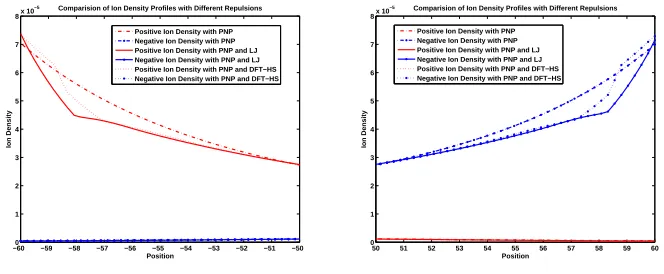
Fig. 4.2. The zoom-in pictures of the left-hand side picture in Figure 4.1 near boundary.
So that our numerical computations observe the finite size effects, we consider the zero permanent charge density case in the system, that is,ρ0= 0 in (2.2). The
compu-tational domain is Ω = [−60,60]. The Robin boundary conditions for the electrostatic potential are chosen so that
φ−η∂φ ∂x
x=−60
=
φ+η∂φ ∂x
x=60
[image:11.612.86.418.432.569.2]Throughout the numerical experiments we useη= (εrε0)4, whereεris the relative per-mittivity, 78.5 for water, andε0is the permittivity of vacuum, 8.8542V mC . This simple
situation shows a finite size effect. We compare modified and pure PNP equations with the same computational condition except the repulsion term. The comparison of these results is presented in the right-hand side panel of Figure 4.1. The left-hand side panel in Figure 4.1 is for the ion density profiles of PNP system without any finite size effects for clarification. According to the results, both numerical solutions to PNP with LJ repulsive potential and with DFT hard sphere potential have the same overall behavior of ion concentration, but in detail the ion concentrations show a different profile. In particular, the difference near the boundary is larger than that in bulk. In this case, the largest contribution of the repulsion term is apparent near the boundary. It is caused by the high concentration of ions near the boundary obey-ing the electrostatic field. The zoom-in panels in Figure 4.2 show the behavior of the solutions in more detail. One can easily observe that the DFT hard sphere potential gives a more complex behavior than the LJ repulsive potential. The differences be-tween LJ and DFT clearly deserve investigation but we believe that this is not very useful unless both calculations, as well as Monte Carlo simulations, are done in three dimensions. We are working hard on this.
Remark 4.3. In Figure 4.2 the discontinuous behavior of the gradient of charge
density near the wall is obvious. One-dimensional DFT computations also show this behavior [30] and it is in fact well known in the literature of one dimensional excluded volume effects; see references in [72].
Next, we consider a little more complicated situation that has a charged wall. The right-hand side boundary/wall is negatively charged. The left-hand side bound-ary/wall has no charge. We establish the charged wall through the variableρ0in the
Poisson equation (2.2). We setρ0= 0 on the left-hand side boundary, andρ0= 1 on
the right-hand side boundary. The domain Ω is [−10,10]. In this case, we impose the Dirichlet and Neumann boundary conditions for the left-hand side and the right-hand side boundary, respectively:
φ|x=−10= 0, ∂φ ∂~ν
x=10
= 0
where~ν is the unit outer normal vector.
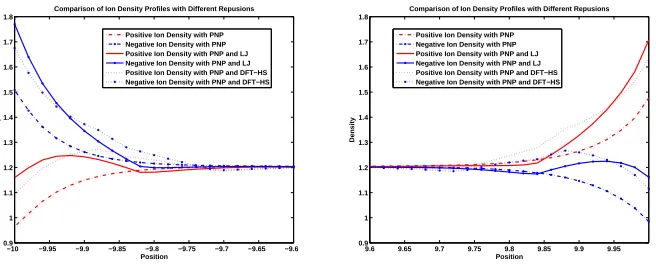
The numerical results with one charged wall is presented in Figure 4.3. The left-hand side panel in Figure 4.3 is the ion concentration profiles without any finite size effects and the right-hand side panel is those with the finite size effects. The results on the right-hand side panel shows the very important phenomena of the finite size effects — the so called layering phenomena (charge inversion). The comparison shows a rigorous evidence of the finite size effects in the modified PNP system.
−10 −8 −6 −4 −2 0 2 4 6 8 10 0.9
1 1.1 1.2 1.3 1.4 1.5 1.6
Ion Density Profiles of PNP: No Repusion
Position
Density
Positive Ion Density Negative Ion Density
−10 −8 −6 −4 −2 0 2 4 6 8 10 1
1.2 1.4 1.6 1.8
Comparison of Ion Density Profiles with Different Repusions
Position
Density
[image:13.612.83.416.98.235.2]Positive Ion Density with PNP Negative Ion Density with PNP Positive Ion Density with PNP and LJ Negative Ion Density with PNP and LJ Positive Ion Density with PNP and DFT−HS Negative Ion Density with PNP and DFT−HS
Fig. 4.3. The ionic concentration profile without finite size effects (left), and the
com-parison of ionic concentrations with the finite size effects, LJ repulsive potential and DFT hard sphere potential (right) under the no-flux boundary condition.
−10 −9.95 −9.9 −9.85 −9.8 −9.75 −9.7 −9.65 −9.6 0.9
1 1.1 1.2 1.3 1.4 1.5 1.6 1.7 1.8
Comparison of Ion Density Profiles with Different Repusions
Position
Density
Positive Ion Density with PNP Negative Ion Density with PNP Positive Ion Density with PNP and LJ Negative Ion Density with PNP and LJ Positive Ion Density with PNP and DFT−HS Negative Ion Density with PNP and DFT−HS
9.6 9.65 9.7 9.75 9.8 9.85 9.9 9.95 0.9
1 1.1 1.2 1.3 1.4 1.5 1.6 1.7 1.8
Comparison of Ion Density Profiles with Different Repusions
Position
Density
Positive Ion Density with PNP Negative Ion Density with PNP Positive Ion Density with PNP and LJ Negative Ion Density with PNP and LJ Positive Ion Density with PNP and DFT−HS Negative Ion Density with PNP and DFT−HS
Fig. 4.4.The zoom-in pictures of the left-hand side picture in Figure 4.3 near boundary
5. Conclusion
The purpose of this present paper is to develop a mathematical model for the finite size effect using a regularized LJ repulsive potential under the energy variational framework, and its numerical verification to recover a layering behavior which is a well-know feature of finite size effects. We have introduced a mathematical model system, modified PNP, for ionic solutions including hard sphere repulsion. The modified PNP has been derived from the energy dissipation law using the energetic variational approach. We also presented some numerical results showing the finite size effects in modified PNP equations.
[image:13.612.89.417.305.439.2]elsewhere.
The model and calculations might be improved by using another type of repulsive potential instead of the Lennard-Jones or DFT hard sphere repulsion potentials we use here. Moreover, the comparison of PNP equations with different types of repulsive potentials would also reveal interesting physics and biophysics. The electrodiffusion of finite sized spheres underlies an enormous range of phenomena central to biology, chemistry, and physics. Indeed, the crucial ions Na+and K+ differ only because they are charged and have different diameters. Ion solutions are not made of uncharged point particles and it is necessary for mathematics to deal with that reality; investi-gation of the mathematical properties of PNP with finite size effects is necessary. It is also likely to be useful and interesting.
Acknowledgement. We would like to thank Professor Wolfgang Nonner, Dezs˝o
Boda, Dirk Gillespie, and Roland Roth for a communication on the DFT related to the hard sphere repulsion. Chun Liu is supported by NSF grant DMS-0707594. Bob Eisenberg was supported in part by NIH grant GM076013.
Appendix A. The variational derivative of the total repulsive energy.
We here present the detailed derivation of the finite size effect terms in (3.17)–(3.18).
δErepulsion=1 2
Z Z
εn,n(an+an)12
|~x−~y|12 δcn(~x)cn(~y)d~xd~y
+1 2
Z Z εn,n(a
n+an)12
|~x−~y|12 cn(~x)δcn(~y)d~xd~y
+1 2
Z Z εn,p(a
n+ap)12
|~x−~y|12 δcn(~x)cp(~y)d~xd~y.
(A.1)
Therefore, we have the repulsive termµr
cn, in the chemical potential for
Nernst-Planck equation, of the charge densitycn:
µrcn=
Z 12εn,n(a
n+an)12 |~x−~y|12 cn(~y) +
Z 6εn,p(a
n+ap)12
|~x−~y|12 cp(~y)d~y. (A.2)
Similarly, we have the repulsive term forcp.
µrcp=
Z 12
εp,p(ap+ap)12 |~x−~y|12 cp(~y) +
Z 6
εp,n(ap+an)12
|~x−~y|12 cn(~y)d~y. (A.3)
REFERENCES
[1] J.D. Jackson,Classical Electrodynamics, 3rd, Wiley, New York, 1998.
[2] C. Lee, H. Lee, Y. Hyon, C. Liu and T.C. Lin,Renormalized Poisson-Boltzmann equations: one-dimensional solutions, Nonlinearity, submitted, 2010.
[3] P.G. Cialet,The Finite Element Method for Elliptic Equations, North-Holland, Amsterdam, 1978.
[4] F. Brezzi and M. Fortin,Mixed and Hybrid Finite Element Methods, Springer-Verlag, New York, 1991.
[6] R. Ryham,An Energetic Variational Approach To Mathematical Modeling Of Charged Fluids: Charge Phases, Simulation And Well Posedness, Thesis, Pennsylvania State University, 2006.
[7] J. Xu and L. Zikatanov,A monotone finite element scheme for convection-diffusion equations, Math. Comput., 68(228), 1429–1446, 1999.
[8] F. Brezzi, L.D. Marini, S. Micheletti, P. Pietra, R. Sacco and S. Wang,Finite element and finite volume discretizations of drift-diffusion type fluid models for semiconductors, Centre National de la Recherche Scientifique Paris, France, Technical Report, 2002–1302, 2002. [9] R. Ryham, C. Liu and L. Zikatanov,An mathematical models for the deformation of electrolyte
droplets, Discrete Contin. Dyn. Syst. Ser., B 8(3), 649–661, 2007.
[10] R. Ryham, C. Liu and Z.Q. Wang,On electro-kinetic fluids: one dimensional configurations, Discrete Contin. Dyn. Syst. Ser., B 6(2), 357–371, 2006.
[11] J. Zhang, X. Gong, C. Liu, W. Wen and P. Sheng, Electrorheological fluid dynamics, Phys. Review Lett., 101(19), 194503-1–4, 2008.
[12] Y. Hyon, D.Y. Kwak and C. Liu,Energetic variational approach in complex fluids: maximum dissipation principle, DCDS-A, 24(4), 1291–1304, 2010.
[13] P.A. Markowich,The Stationary Seminconductor Device Equations, Springer-Verlag, Vienna, 1986.
[14] J.H. Park and J.W. Jerome,Qualitative properties of steady-state Poisson-Nernst-Planck sys-tems: mathematical study, SIAM J. Appl. Math., 57(3), 609–630, 1997.
[15] B. Eisenberg, Ionic channels in biological membranes: natural nanotubes, Acc. Chem. Res., 31, 117–123, 1998.
[16] W. Nonner, D.P. Chen and B. Eisenberg,Progress and prospects in permeation, J. Gen. Phys-iol., 113, 773–782, 1999.
[17] D. Boda, W. Nonner, M. Valisk´o , D. Henderson, B. Eisenberg and D. Gillespie,Steric selectivity in Na channels arising from protein polarization and mobile side chains, Biophys. J., 93, 1960–1980, 2007.
[18] B. Eisenberg, Y. Hyon and C. Liu,Energy variational analysis EnVarA of ions in water and channels: field theory for primitive models of complex ionic fluids, J. Chem. Phys., 133, 104104-1–23, 2010.
[19] P. Graf, M.G. Kurikova, R.D. Coalson and A. Nitzan, Comparison of dynamic lattice monte carlo simulations and the dielectric selt-energy Poisson-Nernst-Planck continuum theory for model ion channels, J. Phys. Chem. B, 108, 2006–2015, 2004.
[20] R.D. Coalson and M.G. Kurikova,Poisson-Nernst-Planck theory approach to the calculation of current through biological ion channels, IEEE Transaction on NanoBioscience, 4, 81–93, 2005.
[21] M.S. Kilic and M.Z. Bazant, Steric effects in the dynamics of electrolytes at large applied voltages. II. Modified Poisson-Nernst-Planck equations, Phys. Review, E75, 021503-1–11, 2007.
[22] A.L. Hodgkin and A.F. Huxley, A qualitative description of the membrane current and its application to conduction and excitation in nerve, J. Physiology, 117, 500–544, 1952. [23] J.P. Keener and J. Sneyd,Mathematical Physiology, Springer-Verlag, New York, 1998. [24] B. Hille,Ion Channels of Excitable Membranes, 3rd Edition, Sinauer Associates, Inc., 2001. [25] D. Purves,Neuroscience, 4th Edition, Sinauer Associates, Inc., 2007.
[26] C. Koch,Biophysics of Computation, Oxford University Press, New York, 2004.
[27] Y. Mori, J.W. Jerome and C.S. Peskin,A Three-dimensional model of cellular electrical activity, Bulletin of the Institute of Mathematics Academia Sinica, 2(2), 367–390, 2007.
[28] Y. Mori, A Three-Dimensional Model of Cellular Electrical Activity, PhD thesis, New York University, 2007.
[29] J.K. Percus, Equilibrium State of a classical fluid of hard dods in an external field, J. Stat. Phys., 15, 505–511, 1976.
[30] T.K. Vanderlick, H.T. Davis and J.K. Percus,The statistical mechanics of inhomogeneous hard rod mixtures, J. Chem. Phys., 91(11), 7136–7145, 1989.
[31] J.P. Hansen and I.R. McDonald,Theory of Simple Liquids, Academic Press, London, 1986. [32] N.F. Carnahan and K.E. Starling,Equation of state for nonattracting rigid spheres, J. Chem.
Phys., 51(2), 635–636, 1969.
[33] J.K. Percus and G.J. Yevick,Analysis of classical statistical mechanics by means of collective coordinates, Phys. Rev., 110(1), 1–13, 1958.
[34] J.C. Lebowitz, Exact solution of generalized Percus-Yevick equation for a mixture of hard spheres, Phys. Rev., 133(4A), 895–899, 1964.
[36] Y. Rosenfeld, Free-energy model for the inhomogeneous hard-sphere fluid in D dimensions: structure factors for the hard-disk (D= 2) mixtures in simple explicit form, Phys. Rev. A, 42(10), 5978–5989, 1990.
[37] H. Hansen-Goos and R. Roth,A new generalization of the Carnahan-Starling equation of state to additive mixtures of hard spheres, J. Chem. Phys., 124, 154506-1–8, 2006.
[38] R. Roth,Fundamental measure theory for hard-sphere mixtures: a review, J. Phys., Condens. Matter, 22(6), 063102-1–18, 2010.
[39] D. Gillespie, M. Valisk´o and D. Boda,Density functional theory of the electrical double layer: the RFD functional, J. Phys., Condens. Matter, 17, 6609–6626, 2005.
[40] D. Gillespie, Energetics of divalent selectivity in a calcium channel: the ryanodine receptor case study, Biophys. J., 94(4), 1169–1184, 2008.
[41] J. Barthel, H. Krienke and W. Kunz, Physical Chemistry of Electrolyte Solutions: Modern Aspects, Springer-Verlag, New York, 1998.
[42] W.R. Fawcett,Liquids, Solutions, and Interfaces: From Classical Macroscopic Descriptions to Modern Microscopic Details, Oxford University Press, New York, 2004.
[43] L.L. Lee, Molecular Thermodynamics of Electrolyte Solutions, World Scientific, Singapore, 2008.
[44] K.S. Pitzer,Thermodynamics, McGraw Hill, New York, 1995.
[45] M.Z. Bazant, K. Thornton and A. Ajdari,Diffuse-charge dynamics in electrochemical systems, Physical Review E, 70, 021506-1–24, 2004.
[46] IBM Research,Damocles Web Site: http://www.research.ibm.com/DAMOCLES/home.html., 2007.
[47] B. Eisenberg, Living Transistors: a physicist’s view of ion channels. Version 2., 1–24, 2008. http://arxiv.org/abs/q-bio/0506016v2
[48] R. Eisenberg and D. Chen, Poisson-Nernst-Planck (PNP) theory of an open ionic channel, Biophysical J., 64, A22, 1993.
[49] J.W. Jerome,Analysis of Charge Transport. Mathematical Theory and Approximation of Semi-conductor Models, Springer-Verlag, New York, 1995.
[50] P.A. Markowich, C.A. Ringhofer and C. Schmeiser,Semiconductor Equations, Springer-Verlag, New York, 1990.
[51] S. Selberherr,Analysis and Simulation of Semiconductor Devices, Springer-Verlag, New York, 1984.
[52] Y. Rosenfeld,Geometrically based density-functional theory for confined fluids of asymmetric (“complex”) molecules, Chemical Applications of Density-Functional Theory. B.B. Laird, R.B. Ross and T. Ziegler. Washington, D.C., American Chemical Society, 629, 198–212, 1966.
[53] Y. Rosenfeld and L. Blum,Statistical mechanics of charged objects: General method and ap-plication to simple systems, J. Chem. Phys., 85, 1556–1566, 1986.
[54] Y. Rosenfeld, M. Schmidt, H.L. Wen and P. Tarazona,Fundamental-measure free-energy den-sity functional for hard spheres: Dimensional crossover and freezing, Physical Review E, 55, 4245–4263, 1997.
[55] R. Evans,Density Functionals in the Theory of Nonuniform Fluids, Fundamentals of Inhomo-geneous Fluids. D. Henderson. Marcel Dekker: 606, New York, 1992.
[56] D. Gillespie, W. Nonner and R.S. Eisenberg, Coupling Poisson-Nernst-Planck and Density Functional theory to calculate ion flux, J. Phys., Condens. Matter, 14, 12129–12145, 2002. [57] D. Henderson,Fundamentals of Inhomogeneous Fluids, Marcel Dekker, New York, 1992. [58] R.M. Accascina and R.M. Fuoss,Electrolytic Conductance, Interscience, New York, 1959. [59] R.M. Fuoss and L. Onsager,Conductance of strong electrolytes at finite dilutions, Proc. Natl.
Acad. Sci., 41(5), 274–283, 1955.
[60] J.C. Justice,Conductance of electrolyte solutions, Comprehensive Treatise of Electrochemistry, Thermondynbamic and Transport Properties of Aqueous and Molten Electrolytes, B.E. Conway, J.O.M. Bockris and E. Yaeger. Plenum, New York, 5, 223–338, 1983.
[61] V. Barcilon, D.P. Chen, R.S. Eisenberg and J.W. Jerome,Qualitative properties of steady-state Poisson-Nernst-Planck systems: perturbation and simulation study, SIAM J. Appl. Math., 57(3), 631–648, 1997.
[62] A. Singer and J. Norbury, A Poisson-Nernst-Planck model for biological ion channels — An asymptotic analysis in a Three-Dimensional narrow funnel, SIAM J. Appl. Math., 70(3), 949–968, 2009.
[63] B. Eisenberg and W. Liu, Poisson-Nernst-Planck systems for ion channels with permanent charges, SIAM J. Math. Anal., 38(6), 1932–1966, 2007.
[65] W. Kunz,Specific Ion Effects, World Scientific Publishing, Singapor, 2009.
[66] P.A. Martin,Sum Rules in Charged Fluids, Reviews of Modern Physics, 60, 1076–1127, 1988. [67] A.L. Hodgkin, The ionic basis of electrical activity in nerve and muscle, Biological Reviews,
26, 339–409, 1951.
[68] A.L. Hodgkin and A.F. Huxley,Movement of radioactive potassium and membrane current in a giant axon, J. Physiol., 121, 403–414, 1953.
[69] A.L. Hodgkin and R.D. Keynes,The potassium permeability of a giant nerve fibre, J. Physiol., 128, 61–88, 1955.
[70] P.F. Baker, M.P. Blaustein, A.L. Hodgkin and R.A. Steinhardt,The influence of calcium on sodium efflux in squid axons, J. Physiol., 200, 431–458, 1969.
[71] M.P. Blaustein and W.J. Lederer, Sodium/Calcium exchange: its physiological implications, Physiological Reviews, 79, 763–854, 1999.
[72] H.T. Davis, Statistical Mechanics of Phases, Interfaces, and Thin Films, Wiley-VCH, New York, 1996.