GoKrg A, Boguth G, Obermaier C, Posch A and Weiss W (1995) Two-dimensional polyacrylamide gel elec-trophoresis with immobilized pH gradients in theRrst dimension (IPG-Dalt): the state of the art and the con-troversy of vertical versus horizontal systems. Elec-trophoresis16: 1079.
GoKrg A, Boguth G, Obermaier C and Weiss W (1998) Two-dimensional electrophoresis of proteins in an im-mobilized pH 4}12 gradient.Electrophoresis19: 1516. Humphrey-Smith I, Cordwell SJ and Blackstock WP (1997) Proteome research: complementarity and limitations with respect to the RNBA and DNA words. Elec-trophoresis18: 1217.
Rabilloud T, Vuillard L, Gilly C and Lawrence JJ (1994) Silver-staining of proteins in polyacrylamide gels: a gen-eral overview.Cellular and Molecular Biology40: 57. Rabilloud T, Adessi C, Giraudel A and Lunardi J (1997)
Improvement of the solubilization of proteins in
two-dimensional electrophoresis with immobilized pH gradi-ents.Electrophoresis18: 307.
Rabilloud T (1998) Use of thiourea to increase the solubil-ity of membrane proteins in two-dimensional elec-trophoresis.Electrophoresis19: 758}760.
Sanchez JC, Rouge V, Pisteur Met al. (1997) Improved and simpliRed in-gel sample application using reswelling of dry immobilized pH gradients.Electrophoresis 18: 324.
Tissot JD and Spertini F (1995) Analysis of immuno-globulins by two-dimensional gel electrophoresis. Jour-nal of Chromatography A698: 225.
Traini M, Gooley AA, Ou K et al. (1998) Towards an automated approach for protein identiRcation in pro-teome projects.Electrophoresis19: 1941.
Wilkins MR, Williams KL, Appel RD and Hochstrasser DF (eds) (1997)Proteome Research:New Frontiers in Func-tional Genomics. Berlin: Springer-Verlag.
EXTRACTION
Analytical Extractions
M. K.L.Bicking, ACCTA Inc., Woodbury, MN, USA
Copyright^ 2000 Academic Press
Introduction
The process of generating analytical data involves some combination of planning, sampling, sample preparation, quantiRcation, data review and report-ing. Initially, each step in the method required com-parable effort. Sample preparation, generally involv-ing some form of extraction followed by analyte enrichment, has in the past been a laborious process, with only a few tools available. Likewise, quantiR ca-tion usually consisted of a ‘wet’ chemistry process such as titration or precipitation. Before the develop-ment of personal computers, the planning, sampling, data review and reporting steps also required con-siderable effort. Since each step presented formidable challenges to the analytical scientist, the relative im-portance of each step remained about the same.
Modern techniques, particularly chromatography, have changed the situation. The rapid and successful development of gas and liquid chromatography dra-matically reduced quantiRcation steps from hours or days to a matter of minutes, often with better accu-racy and precision. The other steps in the method,
especially sample preparation, were regarded as of secondary importance, serving only to support the ultimate (i.e. chromatographic) step in the method. Since most of the creative}andRnancial}resources Sowed into chromatography development, research in the other areas slowed and sample preparation came to be viewed as the ‘low tech’ part of the method.
Chromatography is now considered a mature science, being an integral part of nearly every analyti-cal laboratory. The slower pace of chromatographic research, coupled with outside pressures to improve the efRciency of the entire analytical method, has Rnally resulted in an increased interest in sample preparation. These efforts have produced a number of advances that improve efRciency, selectivity and time required. The discussion will provide an overview of some of the many sample preparation principles and techniques available, focusing on the analytical extraction part of the process. The goal is to provide the reader with a more balanced view of this important part of analytical methodology.
Principles of Extraction
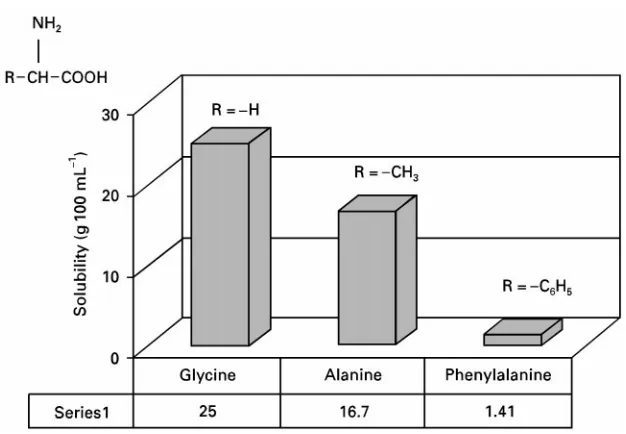
Figure 1 Solubility of amino acids in water as a function of structure. appreciation of these principles can full advantage be taken of them.
De\nition of Analytical Extraction
Extraction is the process of moving one or more compounds of interest (analytes) from their original location (usually referred to as the sample or matrix) to a physically separate location where further pro-cessing and analysis occur. The sample may be a solid, liquid or gas. The separate location is usually aSuid (an extracting solvent), but extractions into the gas phase and on to solid sorbents are also common. Finally, the word analytical implies that this process involves small amounts of analyte (as opposed to preparative extraction). Most analytical methods aim at complete extraction although situations frequently exist where good analytical results are possible with only partial extraction.
Thermodynamics and Kinetics
These two terms are often interchanged, when in fact they have very different chemical meanings. Thermo-dynamics is the study of energy, in this case the energy associated with the chemical process of extraction. Through this study of energy, we can determine if the process is favourable or unfavourable. That is, will this extraction give a good result or a bad one? Even if the process is favourable, it may not happen quickly because of kinetic factors. Kinetics is the study of the rate at which these processes occur.
It is important to realize that these two principles are completely independent of each other. Complete extraction is not necessarily a fast process and
devel-opment of a successful extraction method requires that consideration to be given to both aspects.
Like Dissolves Like
A compound will be soluble in, or mix with, another compound that is chemically like it. That is, the two compounds must be from the same, or similar, chem-ical families. This simple principle is an implied re-quirement in every analytical extraction. The concept of moving analytes from the matrix to some other location requires them to be transported using some medium in which they are soluble. Therefore, we must carefully consider how the like-dissolves-like concept can help to achieve the desired result: extract-ing the desired compounds and not extractextract-ing the undesired ones.
Figure 1illustrates how simple changes in molecu-lar structure can have a profound inSuence on solu-bility behaviour. This plot shows the solusolu-bility of three related amino acids in water. Amino acids are generally considered to be polar, so their solubility in the polar solvent, water, is generally high. As nonpo-lar functionality is added to the molecule, in the sequence from glycine to phenylalanine, the nonpolar character of the entire molecule increases (i.e. it be-comes less like water). The result is a signiRcant reduction in water solubility.
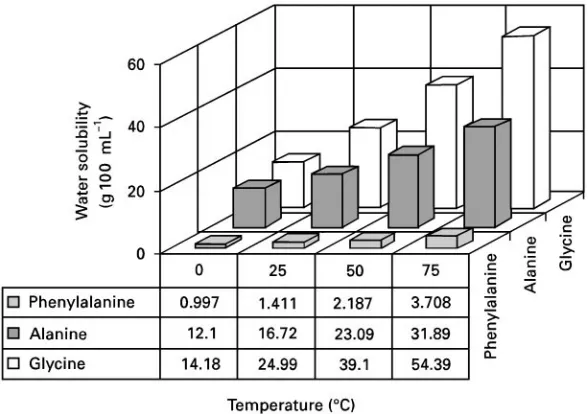
Figure 2 Solubility of amino acids in water as a function of temperature. Temperature Effects
Temperature has an effect on three important phe-nomena: solubility, vapour pressure and kinetics. While increasing temperature generally increases the magnitude of each effect, there are some aspects of this principle that are particularly relevant to analyti-cal extractions.
Effect of temperature on solubility In most cases involving organic analytes, increasing the temper-ature of a liquid results in increased analyte solubility. Figure 2 illustrates that for the same three amino acids as shown in Figure 1 a temperature increase from 0 to 753C results in a three- to fourfold increase in solubility. Even marginally soluble compounds show a dramatic improvement from this simple change in conditions. Indeed, as will be seen later, this principle is used in most extraction procedures.
Effect of temperature on vapour pressure Increasing the temperature of a liquid will result in an increase in vapour pressure. Boiling occurs when the vapour pressure above the liquid equals the applied (usually atmospheric) pressure.
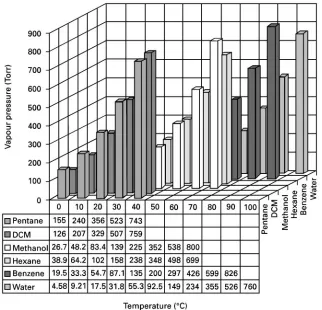
Figure 3shows calculated vapour pressures for sev-eral common solvents. Note that the vapour pressure is relatively large at temperatures as much as 203C below the boiling point of the solvent. Simple evapor-ation in a stream of nitrogen at room temperature uses this fact to evaporate a solvent rapidly without boiling. If the applied pressure is raised, the boiling point is also raised, so that the solvent can be main-tained in its liquid state at higher temperatures.
Press-urizedSuid extraction uses this phenomenon to ad-vantage. Similarly, lowering the applied pressure, as in a rotary evaporator, reduces the boiling point, allowing faster evaporation at lower temperatures. Finally, at any given temperature, the relative vapour pressure of each compound above the liquid phase provides an estimate of the relative evaporation rates of the liquids. Such knowledge is essential when per-forming critical steps such as solvent evaporation or solvent exchange.
Effect of temperature on kinetics All chemical pro-cesses are affected by the temperature at which the process is occurring, although the exact change in reaction rate with temperature is unique for any pro-cess. However, many reaction rates will approxim-ately double for each 103C increase in temperature, and this rule of thumb can be a helpful guide in understanding the effects of temperature changes. These changes can be either positive or nega-tive, depending on whether the temperature change is increasing or decreasing. For example, storing sam-ples and solutions at low temperatures slows down evaporation and degradation. These processes are about four times slower if the solution is stored at 43C compared to room temperature.
Effect of pH
Figure 3 Vapour pressaure of common solvents as a function of temperature. (Calculated from data inHandbook of Chemistry and Physics (1971).)
Table 1 Properties of individual forms in acid}base equilibria
Neutral form Ionic form
HA#H2O 8 A\#H3O#
Acid Conjugate base B#H2O 8 BH##OH\
Base Conjugate acid
More soluble in organic solvents Less soluble in organic solvents Insoluble in water Soluble in water
More volatile Nonvolatile Sour/bitter taste, bad odour Little odour
Reproduced with permission of ACCTA, Inc.
Extraction of organic acids from water is only practical at pH values more than two units below the pKa of the acid. Only at this pH is most of the compound in the neutral form and amenable to ex-traction with an organic solvent. Similarly, to keep a base, such as an aromatic amine, in the neutral (extractable) form, the pH of the solution must be adjusted to at least two units above the pKb of the base. Readings with a pH meter are likely to be unstable and/or unreliable in the presence of organic solvents, and the equilibrium constant, Ka, is also
likely to change, often in an unpredictable way. Any required pH adjustments and measurements must, therefore, be made before the organic component is added.
Two-phase Distribution Equilibria
DeVnitions The process of extraction, by deRnition, requires that the analyte be transferred from the matrix to a different phase. When the extracting medium Rrst contacts the matrix, the analytes will become distributed between the two phases in a well-deRned ratio. Since the matrix is usually a liquid or solid, and the extracting medium can be a solid, liquid orSuid, this usually refers to liquid}liquid and liquid}solid distribution equilibria.
These distribution equilibria can be described by several important equations. First, the distribution ratio,D, for extracting from phase 1 into phase 2 is deRned as:
D"C2 C1
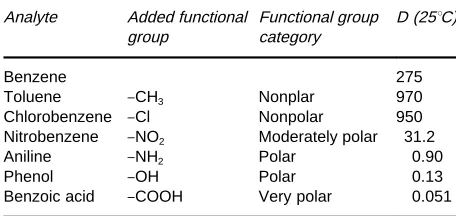
[image:4.568.51.277.581.696.2]Table 2 Distribution ratios for extraction from water into hexane
Analyte Added functional group
Functional group category
D (253C)
Benzene 275
Toluene }CH3 Nonplar 970 Chlorobenzene }Cl Nonpolar 950 Nitrobenzene }NO2 Moderately polar 31.2 Aniline }NH2 Polar 0.90 Phenol }OH Polar 0.13 Benzoic acid }COOH Very polar 0.051
[image:5.568.289.517.528.698.2]Reproduced with permission from Sekine and Hasegawa (1977)
Table 3 Equations used for multiple extractions
Extraction number Fraction extracted into phase 2
Fraction remaining in phase 1
1 1!
2 (1!) (1!)2 3 (1!)2 (1!)3 n (1!)n\1 (1!)n
Table 4 Total per cent recovery as a function of , D and number of extractions
Phase ratio D After 1st After 2nd After 3rd After 4th "V2/V1 extraction extraction extraction extraction
1/1 1 50 75 88 94 2 67 89 96
10 91 99 100 99
1/4 1 20 36 49 59 2 33 56 70 80 10 71 92 98 99 100 96 99
1/10 1 9 17 25 32 2 17 31 42 52 10 50 75
100 91 99
Reproduced with permission of ACCTA, Inc. to the ratio of activities rather than concentration,
but in dilute solution the difference is negligible.) This ratio is a constant that depends on the analyte, the two phases, the composition of the phases (pH, ionic strength, etc.) and the temperature.
The fraction extracted,, in any one equilibration is deRned as:
"1#DD
whereis the phase ratio, the ratio of the volumes of the two phases ("V2/V1). The fraction remaining in the initial phase (V1) is, of course 1!.
The amount extracted depends on the physico-chemical interactions between the two phases and the analyte, and the volume of each phase. A change in these variables will cause a change in the extraction result.
Effect of analyte structure on D Actual values of DinTable 2show how simple changes in molecular structure have a profound inSuence on the success of an extraction.
The addition of nonpolar functional groups (methyl- and chloro-) to benzene make the molecule more nonpolar, so that the new molecule favours the hexane phase (larger value forD). Conversely, adding polar groups (amine, hydroxy, carboxylic acid) makes the molecule more like the water phase (small-erD). It is important to keep these general principles in mind when developing an extraction method and understanding the results.
Multiple extractions When multiple extractions are performed on the same sample, the amount extracted into phase 2 and the amount remaining in phase 1 are calculated using the equations shown inTable 3.
In general, several extractions with the same total volume of extracting solvent will always produce better recovery than a single extraction with the same
volume of solvent, although it is seldom worth carry-ing out more than three extractions.
Effect of variations in D and The effects of variations inDandon extraction results are shown inTable 4. The total recovery after multiple extrac-tions is calculated for various combinaextrac-tions ofDand
. These calculations show the importance of all three variables: phase ratio, distribution ratio and number of extractions.
In summary, two-phase distribution equilibria are an important part of every analytical extraction, and the laboratory scientist must ensure that all critical variables are controlled in order to generate reliable results.
Other Principles
The preceding principles do not represent an exhaust-ive list. Certainly, there are other chemical principles that contribute to the extraction process, but play a more minor role. Some of these are discussed brieSy below.
[image:5.568.49.277.589.697.2]Figure 4 Continuous liquid}liquid extractor for use with extract-ing solvents that are denser than water. (Reproduced from Bur-ford and Hawthorne (1994)Journal of Chromatography A 65: 75}94, with permission of ACCTA, Inc.)
analytes, reagents and solvents are nonvolatile, stable and do not react with each other. If these assumptions are not valid, longer extraction times may actually produce poorer recoveries.
Ionic strength The addition of ionic species to an aqueous solution results in a ‘salting-out’ effect. This procedure often enhances extraction of neutral or-ganic analytes from water by increasingD.
Surface area Reducing the particle size of a solid matrix, thereby increasing contact areas between phases, can cause a dramatic increase in extraction rates.
Stirring/mixing Adequate stirring enhances the rate of procedures that are otherwise limited by diffusion processes.
Analytical Extraction Techniques
This discussion will focus on the most popular tradi-tional techniques, and provide an introduction to some of the newer extraction technologies. In each case, the principles involved will be considered to-gether with some practical operating tips.
Liquid+Liquid Extraction Techniques
Separatory funnel techniques There are few limita-tions on what size or type of liquid samples can be extracted, except that the two liquid phases must be immiscible and unreactive with each other. Separ-atory funnels are available to handle samples from as small as a few millilitres to several litres. Extraction times vary from 1 to 15 min, depending on the speci-Rc requirements of the method, but equilibration is usually fast in all but the most viscous liquids. As noted in the section on principles of extraction, mul-tiple extractions with a smaller volume of extracting solvent are preferred over a single extraction with a larger volume. The primary disadvantages of separ-atory funnels are the labour necessary, the need to evaporate an often large volume of solvent and the formation of emulsions.
The following practical points should be con-sidered:
E Funnel size: to allow adequate mixing, the Sask size should be chosen so that at least 25% of the funnel volume is free space.
E Venting: regular venting is a required safety pro-cedure, especially at the start of the extraction process.
E Draining layers: too much time should not be
wasted draining off one layer, except after theRnal equilibration.
E Shaking: the most important variable is the time spent shaking the two layers, not the intensity of the shaking. Because of this, automated shakers provide adequate extraction, even though the intensity of mixing may be quite low.
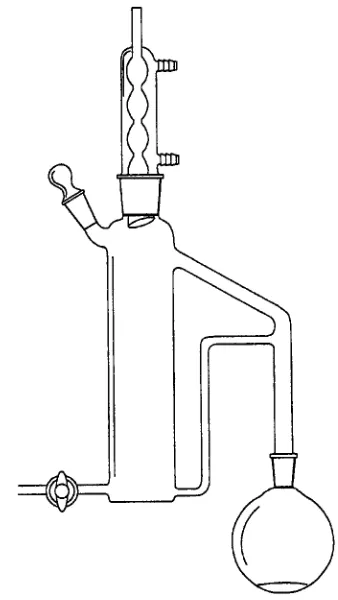
Continuous liquid+liquid extractors These systems are usually reserved for larger water samples and/or situations where a long extraction time is required. There are two basic design types, depending on whether the extracting solvent is more dense (Figure 4) or less dense (Figure 5) than water. In each design, the solvent in theSask is heated to boiling, causing solvent vapours to collect in the condenser. The condensed solvent then passes through the sample in the main chamber.
Figure 5 Continuous liquid}liquid extractor for use with extract-ing solvents that are less dense than water. (Reproduced with permission of ACCTA, Inc.)
Figure 6 MixxorTM extraction device. (A) Upper chamber; (B) sample reservoir; (C) axial chamber; (D) organic solvent. (Reproduced with permission of New Biology Systems Ltd.) recovery. The primary disadvantages are the set-up
time, lengthy extraction time (6}24 h), and large quantities of solvent. The latter problem has been solved somewhat by integrated extraction systems that allow extraction, evaporation and concentration of solvent in one apparatus.
For continuous liquid}liquid extractors the follow-ing considerations are important:
E The extractor only works properly if the con-densed solvent passes through the bulk of the sample, rather than along the sides of theSask.
E The reSux (boiling) rate determines the overall extraction rate, and some minimum rate must be maintained to ensure complete extraction.
E Emulsions can be a problem. See below for ways to deal with them.
Other liquid+liquid extraction devices While the chemistry and mechanics of liquid}liquid extraction have not changed, many practical variations have improved the speed and convenience of the technique. Two examples of these improvements are the Mix-xor2+ extractor (New Biology Systems Ltd, Haifa,
Israel) and the VectaSep CLE威 system (Whatman, Inc., Clifton, NJ, USA).
The Mixxor2+system (Figure 6) consists of a re-ceiver and piston assembly. The aqueous sample is placed in the receiver (B) with a small quantity of immiscible organic solvent (D). The sample is extrac-ted by moving piston (A) up and down a number of times. After extraction, the plunger is moved to the bottom and the separated organic solvent is forced into the axial chamber (C), where it is easily removed. The entire extraction and separation process is com-pleted in less than 5 min and can provide a concentra-tion factor of 30 or more. Extractors are available for samples with volumes ranging from 2 to 50 mL. This system is more convenient than separatory funnels, although at the expense of someSexibility in sample and extraction solvent volumes. Also, the design pre-cludes the use of heavier-than-water solvents.
[image:7.568.357.450.397.674.2]Figure 7 VectaSep CLE extraction system. (Reproduced with permission of Whatman, Inc.)
the inside of the tube to the bottom. After centrifu-gation, the sample dispenser is removed and the sep-arating cup is added to locate the phase separation boundary. Evaporation of the upper organic layer then deposits extracted analytes in the separating cup, where they can be readily redissolved in an appropri-ate solvent. Although sample size and extraction sol-vent choices are somewhat limited, this system makes clever use of the extraction principles discussed earlier. In this case, the sample is passed through the extraction solvent (a reverse of the other methods) in small droplets, increasing surface area (kinetics) and offering a very favourable phase ratio.
These systems offer advantages in terms of sample handling, safety and efRciency considerations. So, despite their limitations, both of these systems, and others like them, merit consideration as a replace-ment for the more traditional techniques.
Emulsions No discussion of liquid}liquid extrac-tion would be complete without menextrac-tion of the emul-sion problem. Emulemul-sions are a mixture of two
nor-mally immiscible phases that won’t separate in prac-tice. This problem is often caused by the presence of surfactants or solids at the phase interface, high vis-cosity of one of the phases, or a small phase ratio (not enough organic phase). Although each emulsion is unique, one of the following remedies will often result in separation into two distinct layers:
E Wait: many emulsions will disappear with sufR -cient time.
E Gentle mechanical agitation/stirring with a glass rod or spatula.
E Immersion in an ultrasonic cleaning bath.
E Add ‘a salt’: this makes the aqueous phase less like the organic phase.
E Increase the phase ratio: add more organic phase.
E Pass through a bed packed with glass wool or diatomaceous earth.
E Centrifuge.
E Freeze the aqueous layer with dry ice/acetone or liquid nitrogen, then simply pour off the organic layer.
Liquid+Solid Extraction Techniques
Soxhlet techniques The Soxhlet extractor (Figure 8) is one of the oldest extraction systems available but is still very common. A solid sample is placed in an extraction thimble inside the middle chamber. Upon boiling, the solvent vapours from the bottom Sask travel up to the condenser and then drip through the sample. The sample is soaked in solvent (a two-phase distribution equilibrium), which then returns to theSask when the liquid reaches the top of the siphon. The sample is exposed to fresh solvent after every siphon cycle, usually at a rate of about six cycles per hour. Typical extraction times are 6}24 h. Once assembled and operating, there is little that can go wrong with this system. However, operators must be aware of the following general hints:
E Proper cycling is required: the rate (cycles per hour) is usually speciRed in the method, and the operator must ensure that the unit siphons in distinct events rather than continuously draining.
E Solvent level in the thimble: if too high, sample may be lost from the thimble, contaminating the extract.
E Moisture content: dry samples work best; add a drying agent to remove free moisture.
Figure 8 Soxhlet extractor. (Reproduced with permission of ACCTA, Inc.)
use, primarily because of its excellent reputation for providing complete extraction. Indeed, Soxhlet values are often used as the standard against which other extraction methodologies are compared.
ModiVed Soxhlet extractors The lengthy Soxhlet extraction times have prompted the development of modiRed extractors, such as the Soxtec威system (Foss Tecator AB, HoKganaKs, Sweden). The sample is placed in an extraction thimble, but the thimble is then directly immersed in boiling solvent, rather than bathed in cooler condensed solvent. The increased temperature means faster extraction kinetics. After about 1 h equilibration, the sample is removed from the solvent andSushed with fresh condensed solvent for an additional hour. The apparatus even allows
the evaporation and collection of solvent, further improving efRciency. These alternatives offer considerable advantages in terms of time and solvent use, and results are generally comparable to the tradi-tional method.
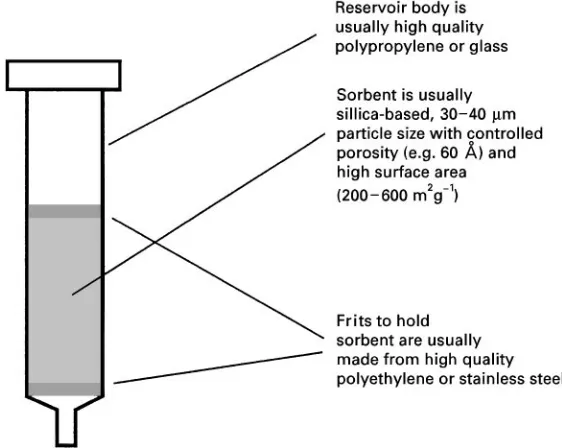
Solid-phase extraction Solid-phase extraction (SPE) is an alternative to liquid}liquid extraction where the extraction solvent is replaced with a solid sorbent. The sorbent is usually packed into a cartridge (Figure 9) that can vary in size from about 1 mL to more than 50 mL. The quantity of sorbent can range from about 500 mg to 10 g. Extraction is accomp-lished by forcing the aqueous sample past the sorbent (via vacuum or pressure), causing analytes in the sample to be sorbed. This two-phase distribution is similar to the partitioning that occurs in chromatog-raphy. After the sample has passed through the sorbent bed, the sorbed analytes are eluted with a strong solvent, such as methanol, acetonitrile or carbon disulRde.
The SPE process involves the following sequential steps:
E Conditioning/cleaning of the sorbent with an or-ganic solvent such as methanol
E Extraction of the sample.
E Air drying or rinsing to remove any remaining sample.
E Elution of analytes using a strong organic solvent.
SPE offers three primary advantages over conven-tional liquid}liquid extraction: reduced solvent usage, extraction speed and selective chemistry. In an ideal method, only a few millilitres of organic solvent may be necessary for an extraction and it is possible to extract and elute 10 100-mL samples or more in as little as 15}20 min. Finally, by varying the nature of the sorbent, it is possible to achieve selective extrac-tion and/or selective elution. For example, a minor change in bonded phase from a C18 phase to a C8phase can actually result in a signiRcant change in selectivity. The shorter chain C8phase is less reten-tive towards more hydrophobic molecules and ex-poses somewhat more of the polar character from the underlying silica. This trend can be extended using even shorter aliphatic bonded phases or by adding a polar functional group to the chain (e.g. cyano- or phenyl-). There are no analogous series in liquid} liquid systems.
Figure 9 Solid-phase extraction (SPE) cartridge design. (Reproduced with permission of ACCTA, Inc.)
results, with considerably less effort. It should also be noted that SPE can be performed on nonaqueous samples using a polar sorbent, but this application is usually used for sample clean-up rather than extrac-tion.
Finally, it is important to note SPE’s limitations:
E High particulate samples will often plug the frits.
E Extracting capacity (total extractable mass) is more limited than with conventional solvent ex-traction.
E Reproducibility (batch-to-batch) can be a problem, although this is less of a concern now than during early development of the technique.
Membrane disc extraction Membrane extraction discs,Rrst sold under the brand name Empore威(3M, St Paul, MN, USA), are an alternative SPE system. In the membrane discs the sorbent is enclosed in a sup-port network rather than simply being packed into a cartridge. The unique Empore威 design consists of 90% (w/w) sorbent particles (8}10m diameter), in a network of polytetraSuoroethyleneRbrils, in a disc format that resembles a thicker version of conven-tional synthetic membrane Rlters. A typical disc is about 0.5 mm thick with diameters ranging from 1 to 90 cm.
A membrane disc extraction method would typi-cally consist of the following steps:
E Pre-washing the disc with theRnal eluting solvent.
E Pre-wetting the disc with methanol or some other
solvent that is miscible with the sample (which is usually aqueous).
E Extraction, i.e. drawing the sample through the disc.
E Elution of analytes, which involves a soak with the elution solvent for a period of time, followed by elution with the aid of a vacuum. This elution step may be repeated with different solvents if necessary.
Membrane discs have the same advantages over liquid}liquid extraction as SPE but are superior to conventional SPE because the extraction rate is faster; Sow rates of 100}200 mL min\1 are typical. The small particles also provide greater capacity and uni-formity of packing. Unfortunately, the discs are more sensitive to the presence of particulates, so a pre-Rlter is often necessary.
Early applications of membrane discs focused on environmental analysis, where large sample sizes made the fast extraction rates attractive. Membrane discs can also be formulated into SPE-like car-tridges, allowing the efRcient processing of small cli-nical samples (e.g. serum, urine, etc.). Use of membrane disc applications continues to grow, al-though the number of reported applications is not as high as SPE, due to the relative age of the two tech-niques.
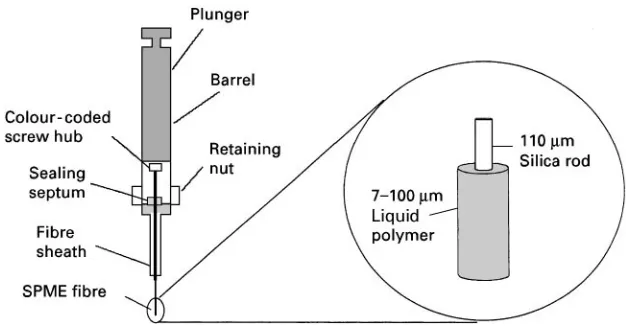
Figure 10 Solid-phase microextraction system. (Reproduced with permission of ACCTA, Inc.)
phase consists of a fused silica Rbre coated with a sorbent (e.g. dimethylsilicone or other immobilized polymer) with thicknesses ranging from about 10 to 100m (Figure 10). The Rbre is placed in contact with the liquid or gas sample and analytes are sorbed on to the phase, from which they are directly desor-bed into a chromatograph.
Unlike the other techniques discussed here, SPME is a completely solvent-free extraction method. The extraction step tends to be rapid, usually requiring 10}20 min, and desorption can take only a few sec-onds. Thus, a fast analysis with a good lower limit of detection is possible, since the entire extract is ana-lysed. Furthermore, the selectivity and extractability can be affected by changes inRbre chemistry as well as solution pH, ionic strength, etc. Sampling by im-mersion in the sample or extraction from the head-space above the liquid (often a faster extraction) provides additional Sexibility. However, SPME, by its nature, is not applicable to as wide a range of samples as other techniques, and there are currently a more limited number of sorbents available compared to SPE. However, SPME offers some unique advantages that make it an attractive alterna-tive for many applications.
Pressurized Fluid Extraction
So far, each extraction medium discussed has been either a conventional liquid or solid, each performing its function at or near room pressure and at or below the boiling point of the liquid phase. Experimentally, these conditions are easiest to attain in the laboratory and require relatively unsophisticated equipment. Unfortunately, in some cases these conditions can also result in slow extraction kinetics and/or incom-plete extraction because of the (relatively) mild condi-tions employed. Such problems can often be solved
simply by maintaining the extraction Suid at a higher pressure so that higher temperatures can be used. This can result in a dramatic improvement in extraction efRciency. In addition to the pressurization of conventional solvents in a closed vessel, supercriti-calSuids may also be used at high temperature and pressure.
Accelerated liquid extraction As noted earlier, in-creased temperature improves solubility and extrac-tion kinetics, and increases the vapour pressure. In addition, an increase in applied pressure causes an increase in the boiling point of a liquid. Logically, then, one would expect improvement in extraction results at higher applied pressure, where the increased boiling point would then allow liquid extractions above the normal boiling point of the solvent. This approach has been successfully applied in two differ-ent ways.
In theRrst method, called microwave-assisted sol-vent extraction (MASE), the sample and extraction solvent are placed in a sealed vessel, usually construc-ted of polytetraSuoroethylene or other inert polymer. When placed in a microwave Reld, polar materials (e.g. water) absorb energy and the sample heats up. Since the vessel is closed, the pressure also increases, resulting in a signiRcantly elevated boiling point. For example, hexane}acetone mixtures can be used at 1153C, which is more than 403C above the boiling point of either solvent. The increased temperature has several beneRcial effects on the extraction, such as increased solubility, faster diffusion, reduced viscos-ity and reduced surface tension (increased wetta-bility).
The second approach uses conventional electrical conduction heating in a sealed stainless steel vessel (Dionex Corporation, Salt Lake City, UT, USA) to accomplish the same effect. With this equipment, the pressure and temperature can be set independently, whereas in the MASE process the pressure increase results from the temperature increase.
Both methods allow Soxhlet-type extractions to be completed in 30 min or less and require small solvent volumes. This approach has received widespread ac-ceptance because it draws from existing experience with organic extraction solvents. The basic chemistry of the extraction does not change signiRcantly, only the rate. In theory, then, any liquid solvent-based extraction method could be adapted for accelerated liquid extraction.
The primary disadvantages involve the safety as-pects associated with the use of organic solvents at high temperatures and pressures. In addition, the same process that enhances analyte extraction may also cause extraction of other unwanted components from the matrix. However, the reductions in solvent use and extraction time make accelerated liquid ex-traction an attractive alternative to unpressurized techniques.
Supercritical Wuid extraction As the temperature and pressure on a compound are raised, a point is reached, called the critical point, where the substance is no longer a gas or liquid, but has properties inter-mediate between these two states. SupercriticalSuids are good solvents with gas-like viscosities and dif-fusivities and no surface tension.
Carbon dioxide is the most popular choice for a supercriticalSuid, because of its relatively low criti-cal point (313C, 73 atm). Supercritical Suid extrac-tion (SFE) then involves placing the sample in a high pressure vessel and contacting the sample with the supercriticalSuid. Extraction temperature can be var-ied from about 403C to more than 1503C while pres-sures may be adjusted between 100 and as high as 680 atm or more. Since carbon dioxide is actually a nonpolarSuid, 10}20% of polar modiRers such as methanol can be added to improve the range of solubilities. A typical extraction will be complete in less than 20 min.
SFE receives much attention because the tions are fast and, with carbon dioxide as the extrac-tion Suid, evaporation of the extracting medium is spontaneous upon decompression to atmospheric conditions. The ability to control extracting power, through changes in temperature, pressure and
modi-Rer, offers more selectivity andSexibility than with liquid solvents. While SFE is not a universal replace-ment for liquid solvent-based methods, it is clearly the best choice for many speciRc applications, espe-cially foods, natural products, polymers and environ-mental samples.
Final Comments
Analytical extraction (and sample preparation in gen-eral) has returned to its rightful place as an equally important part of the analytical method. There are many options available to achieve extraction, de-pending on the type and size of sample as well as other more practical considerations. The laboratory worker can choose from 100-year-old techniques that still provide excellent results, or instrumental-based technologies that offer faster extractions on smaller samples.
The extraction step, as a distinct part of the analyti-cal method, will retain its importance as long as chromatographic procedures are used for quantiR ca-tion. The objective of moving the analytes from the sample to the point of quantiRcation will still be required. Future research is likely to focus on better ways of accomplishing this movement, resulting in reduced solvent usage and sample size, automation and online transfer of extracts to subsequent process-ing and quantiRcation steps. But throughout these changes, it will be important to remember that, al-though the names may change, the chemistry will remain the same.
Further Reading
Freiser H (1973) Solvent extraction. In: Karger BL, Snyder LR and Horvath C (eds).An Introduction to Separation Science, Ch. 9. New York: Wiley-Interscience.
Lopez-Avila V, Young R and Teplitsky N (1996) Microwave-assisted extraction as an alternative to Sox-hlet, sonication, and supercriticalSuid extraction. Jour-nal of the Association of OfTcial Analytical Chemists International79: 142}156.
Peleg I and Vromen S (1983) An efRcient novel device for solvent extraction. Chemistry and Industry 61: 615}616.
Sekine Y and Hasegawa Y (1977) Solvent Extraction Chemistry, p. 105. New York: Marcel Dekker. Weast RC (ed.) (1971)Handbood of Chemistry and
Phys-ics, p. C-743, D-151. Cleveland, OH: Chemical Rubber Co.