Effect of Predator Mutual Interference on an
Autonomous Leslie-Gower Predator-prey Model
Shengbin Yu
Abstract—This article studies an autonomous Leslie-Gower predator-prey model with predator mutual interference and shows that the unique positive equilibrium of the system is globally stable unconditionally by constructing a suitable Lyapunov function. Mathematic analysis also indicates that predator mutual interference has same effect on both prey and predator species which is quite different with conclusions on Lotka-Volterra type system. Numerical simulations have been presented to validate the analytical results.
Index Terms—Globally stable, Leslie-Gower model, Mutual interference, Positive equilibrium, Lyapunov function.
I. INTRODUCTION
I
N the last few decades, one of important predator-prey models is Leslie-Gower model [1,2] where the “carrying capacity” of the predator’s environment is proportional to the number of prey:
dH
dt = (r1−b1H−a1P)H, dP
dt =
r2−a2
P H
P.
(1)
In system (1), H and P stand for the density of the prey species and predator species at time t, respectively. Parameters b1 andri, ai ,i= 1,2 are all positive constants
and have the following biological meanings: r1 and r2
are the intrinsic growth rates of prey H and predator P, respectively; b1 is the strength of competition among
individuals of species H; a1 is the maximum value of
the per capita reduction rate of H due to P and a2 has a
similar meaning toa1. By using Lyapunov function method,
Korobeinikov [3] obtained the following result on the global stability of system (1):
Theorem 1.1 ([3]).The unique coexisting fixed point
(H1∗, P1∗)of system (1) is globally stable, where
H1∗=
r1a2
a1r2+a2b1
, P1∗=
r1r2
a1r2+a2b1
.
Chen et al. [4] further considered system (1) with a prey refuge and showed that the prey refuge has no influence on the persistent property of both predator and prey species, but could influence the densities of both prey and predator species greatly. Mohammadi and Mahzoon [5] extended sys-tem (1) by incorporating partial prey protection and studied the existence, uniqueness and stability of positive equilibrium also the influence of the effects of strong prey becoming weak prey. For more works on system (1) or its analogs, one could refer to [6-36] and the references cited therein.
Manuscript received July 12, 2018; revised October 9, 2018.
Shengbin Yu is with the Department of Basic Teaching and Research, Yango University, Fuzhou, Fujian 350015, China. ([email protected])
Furthermore, Wang [29] pointed out that a more typical system should consider the mutual interference which was introduced by Hassell [30] in 1971. During Hassell’s research of the capturing behavior between the host (a bee) and parasite (a butterfly), he discovered that the host or parasite had the tendency to leave each other when they met, which interfered the hosts capturing effects. It is clear that the mutual interference will be stronger when the densities of the host and parasite become larger. Therefore he introduced the concept of mutual interference constantm(0< m≤1), see [28-33] for more details. Especially, Chen et al. [33] and Ma et al. [34] considered a Lotka-Volterra predator-prey model incorporating predator mutual interference with a constant number of refuge and a constant fraction refuge, respectively. Both Chen et al. [33] and Ma et al. [34] show that mutual interference of predator species plays an essential role on the persistent property of the system. Since the results obtained by Chen et al. [33] and Ma et al. [34] are based on Lotka-Volterra type system, what is the role of mutual interference in Leslie-Gower type system is an another interesting question. Stimulated by the above reasons, in this paper, we extend system (1) by incorporating predator mutual interference and obtain the following system:
dH
dt = (r1−b1H−a1P
m)H,
dP dt =
r2−a2
P H
P,
(2)
wherer1, b1, a1, r2, a2are positive constants andmis mutual
interference constant. Obviously, system (1) investigated by Korobeinikov [3] is a special cases of (2) withm= 1, i.e. there is no mutual interference between predator species. So we only investigate system (2) in the case of 0 < m < 1
combining with the following initial conditions for the bio-logical meaning:
H(0)>0, P(0)>0. (3) It is not difficult to obtain that the corresponding solution
(H(t), P(t))T satisfies H(t)>0, P(t)>0 for allt≥0. The organization of this paper is as follows. In Section 2, we discuss the existence and stability of positive equilibrium point of system (2). The influence of predator mutual inter-ference is discussed in Section 3. Then, in Section 4, two examples with numerical simulations are given to illustrate the feasibility of the main results. Finally, we conclude in Section 5.
II. EXISTENCE AND STABILITY OF POSITIVE EQUILIBRIUM
In this part, we investigate the existence and stability of positive equilibrium point.
IAENG International Journal of Applied Mathematics, 49:2, IJAM_49_2_11
Theorem 2.1.System (2) admits a unique positive equilibri-um point (H∗, P∗).
Proof.Obviously, positive equilibrium point (H∗, P∗) of
system (2) satisfies the following equalities:
r1−b1H∗−a1P∗m= 0, r2−a2
P∗
H∗
= 0. (4)
That isH∗ satisfies
a2mr1−a1rm2 H∗m−am2b1H∗= 0. (5)
Set f(H) =am
2r1−a1rm2 Hm−am2b1H, then
(a)f(0) =am
2r1>0;
(b) f r
1
b1
=−a1r
m
2r1m
bm
1
<0;
(c) df
dH =−ma1r
m
2H
m−1−am
2b1<0.
Thus, equation f(H) = 0 has at least one positive root in (0,r1
b1) by Zero point theorem. On the other hand, (c)
shows thatf(H)is monotonically decreasing over(0,+∞), so f(H) = 0 has a unique positive root H∗ in (0,+∞).
Hence, positive equilibrium point (H∗, P∗) is unique and
this completes the proof.
Theorem 2.2.The positive equilibrium point(H∗, P∗)of the
system (2) is globally stable.
Proof.Inspired by the idea of Korobeinikov [3], Lu and
Liu [35], in order to prove Theorem 2.2, we construct the following function
V(H, P) =lnH H∗
+H∗
H −1 + a1H∗
a2
Z P
P∗
ξm−Pm
∗
ξ2 dξ. (6)
In the following, we will show thatV(H, P)is a Lyapunov function. One can easily verified that function V(H, P)
is zero at the equilibrium (H∗, P∗) and the fixed point
(H∗, P∗) is the only extremum of V(H, P) in the positive
quadrant. Now, We come to show that V(H, P)is positive for all positive values of(H, P)except(H∗, P∗). Firstly, set
y= HH
∗ andg(y) =lny+
1
y−1, theny >0and dg
dy =
y−1
y2 .
Hence, g(y)≥g(1) = 0.Secondly, WhenP > P∗, for any
ξ∈(P∗, P), since 0< m <1,we haveξm> P∗mand then
RP
P∗
ξm−Pm
∗
ξ2 dξ >0. If P < P∗, one can similarly obtain
RP
P∗
ξm−P∗m
ξ2 dξ > 0. So V(H, P) > 0 for all positive
values of(H, P)except(H∗, P∗)and(H∗, P∗)is the global
minimum of V(H, P). To sum up, V(H, P)is a Lyapunov function.
Using equalities (4) and calculating the derivatives of
V(H, P)along the solution of system (2) lead to dV
dt =
1
H
1−H∗
H dH
dt +
a1H∗(Pm−P∗m)
a2P2
dP dt
=
H−H∗
H
(b1H∗+a1P∗m−b1H−a1Pm) +a1H∗(P
m−Pm
∗ )
a2P
a2
P∗
H∗
−a2
P H
= −b1(H−H∗) 2
H +
a1(H−H∗)(P∗m−Pm)
H
+a1(P
m−Pm
∗ )(P∗−P)
P
+a1(P
m−Pm
∗ )(H−H∗)
H
= −b1(H−H∗) 2
H +
a1(Pm−P∗m)(P∗−P)
P <0
(7) strictly for all H, P > 0 except the positive equilibrium
(H∗, P∗), where dVdt = 0. Therefor (H∗, P∗) is globally
stable which completes the proof of Theorem 2.2.
III. THE INFLUENCE OF PREDATOR MUTUAL INTERFERENCE
We will discuss this on two aspects:
(1) Predator mutual interference has no impact on the persistent property of the system.
Definition 3.1. System (2) is permanent if any positive
solution(H(t), P(t))T of system (2) satisfies
m1≤lim inf
t→+∞H(t)≤lim supt→+∞
H(t)≤M1,
m2≤lim inf
t→+∞P(t)≤lim supt→+∞ P(t)≤M2,
wheremi, Mi, i= 1,2 are all positive constants.
Theorem 2.2 shows that
lim
t→+∞H(t) =H∗, t→lim+∞P(t) =P∗. (8)
Since H∗ andP∗ depend only on the coefficient of system
(2), thus (8) indicates that system (2) is always permanent and predator mutual interference has no impact on the persistent property of the system.
Chen et al. [33] and Ma et al. [34] pointed out that mutual interference of predator species plays an essential role on the persistent property of the Lotka-Volterra type system. Obviously our results on system (2) are quite different with theirs. We think this can be more attributed to that Leslie-Gower predator-prey systems do not follow the “mass con-servation” principle while Lotka-Volterra ones are based on the principles of “mass conservation” and “decomposition of the dynamics of a population into birth and death processes” (see for instance [36]).
(2)Predator mutual interference has same effect on prey densities and predator densities.
According to (5), by implicit differentiation, one can get r1am2lna2−a1rm2lnr2H∗m−b1am2lna2H∗−b1am2
dH∗
dm
−a1rm2 H∗m
lnH∗+m
1
H∗
dH∗
dm
= 0,
IAENG International Journal of Applied Mathematics, 49:2, IJAM_49_2_11
or dH∗
dm =
am2 lna2(r1−b1H∗)−a1r2mH
m
∗ ln(r2H∗)
b1am2 +ma1rm2H
m−1
∗
=
am2 (r1−b1H∗)ln
a2
r2H∗
b1am2 +ma1r2mH
m−1
∗
.
(9) It follows from (9) and the second equation of (4) that
dP∗
dm = r2
a2
dH∗
dm =
r2am2(r1−b1H∗)ln
a2
r2H∗
b1am2+1+ma1a2r2mH
m−1
∗
(10)
Since H∗ ∈ (0,br11) or r1 > b1H∗, then equations (9) and
(10) together with the second equation of (4) lead to the following result:
Proposition 3.1. dH∗
dm > 0 and
dP∗
dm > 0 if H∗ < a2
r2 or
P∗<1, while dHdm∗ <0and dPdm∗ <0ifH∗> ar22 orP∗>1.
Remark 3.1. Proposition 3.1 shows that mutual interference of predator species has same effect on both prey and predator species. When prey species or predator is at low density (H∗ < ar22 or P∗ < 1), mutual interference of predator species has positive effect on both two species; and has negative effect on both two species when prey species or predator is at high density (H∗> ar22 orP∗>1).
IV. THE INFLUENCE OF PREDATOR MUTUAL INTERFERENCE
In this section, we will give the following two examples to verify the feasibilities of our results. Since dP∗
dm =
r2
a2
dH∗ dm
i.e. P∗ andH∗ have same monotonicity with respect to m,
we only use mandH∗ instead of P∗ for convenient.
Example 4.1. Consider the following system:
dH
dt = (3−H−2P
m)H,
dP
dt = (1− P
2H)P.
(11)
In this case, we have a2
r2 = 0.5andf(H∗) = 3( 1 2)
m−2Hm
∗ −
(12)mH∗ = 0. According to Theorem 2.1 and Theorem 2.2,
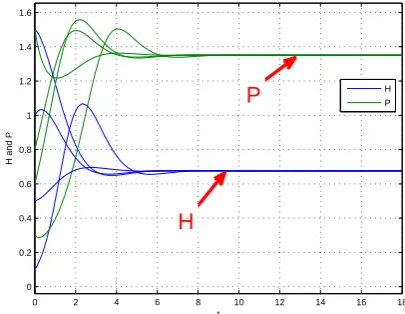
system (11) has a unique equilibrium which is globally stable (see Fig. 1). Moreover, Fig. 1 also shows that H∗ is greater
than0.5, so it follows from Proposition 3.1 that H∗ strictly
decreasing form∈(0,1) which is supported by Fig. 2.
Example 4.2. Consider the following system:
dH
dt = (3−H−2P
m)H,
dP
dt = (2−
4P H )P.
(12)
In this case, we have a2 r2
= 2 and f(H∗) = 3×4m−
2m+1Hm
∗ −4mH∗ = 0. According to Theorem 2.1 and
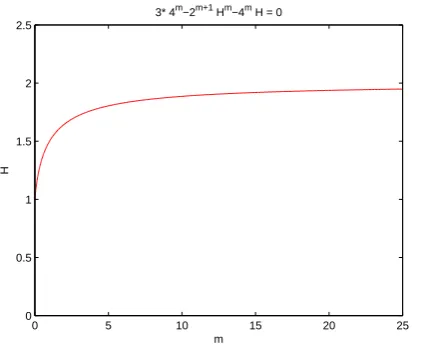
Theorem 2.2, system (12) has a unique equilibrium which is globally stable (see Fig. 3). Moreover, Fig. 3 also shows thatH∗is less than2, so it follows from Proposition 3.1 that
H∗ strictly increasing for m∈(0,1). Numerical simulation
confirms our result (see Fig. 4).
0 2 4 6 8 10 12 14 16 18
0 0.2 0.4 0.6 0.8 1 1.2 1.4 1.6
t
H and P
H P
H
[image:3.595.321.524.65.222.2]P
Fig. 1. Dynamic behavior of system (11) with m = 1/2 and the initial condition(H(0), P(0)) = (0.1,0.3)T,(1,0.8)T,(1.5,0.6)T, and
(0.5,1.5)T, respectively.
m
H
3*(1/2)m−2*Hm−(1/2)m H = 0
0 5 10 15 20 25
[image:3.595.322.526.285.457.2]0 0.2 0.4 0.6 0.8 1 1.2
Fig. 2. Numeric simulations ofH∗(m)for system (11), wherem∈(0,1).
0 2 4 6 8 10 12 14 16 18
0 0.2 0.4 0.6 0.8 1 1.2 1.4 1.6
t
H and P
H P
H
[image:3.595.321.524.518.682.2]P
Fig. 3. Dynamic behavior of system (12) with m = 1/2 and the initial condition(H(0), P(0)) = (0.1,0.3)T,(1,0.8)T,(1.5,0.6)T, and
(0.5,1.5)T, respectively.
V. CONCLUSION
In this paper, we consider an autonomous Leslie-Gower predator-prey model with predator mutual interference and
IAENG International Journal of Applied Mathematics, 49:2, IJAM_49_2_11
m
H
3* 4m−2m+1 Hm−4m H = 0
0 5 10 15 20 25
[image:4.595.64.275.54.228.2]0 0.5 1 1.5 2 2.5
Fig. 4. Numeric simulations ofH∗(m)for system (12), wherem∈(0,1).
show that predator mutual interference has no influence on the persistent property of system and has same effect on both prey and predator species: when prey species or predator is at low density (H∗< ar2
2 orP∗<1), mutual interference of
predator species has positive effect on both two species; and has negative effect on both two species when prey species or predator is at high density (H∗ > ar22 or P∗>1). However,
based on Lotka-Volterra type system with predator mutual in-terference, Chen et al. [33] and Ma et al. [34] discovered that “mutual interference of predator species plays an essential role on the persistent property of the Lotka-Volterra predator-prey dynamics” and “the mutual interference of predator species has positive effect on the prey species if predator species is at low density; and has negative effect on the prey species if predator species is at high density. Also, if predator and prey species are at low density, then the mutual interference of predator species has positive effect on the density of predator species.” (see Remark 3.1-3.2 in [34]). So, our results are quite different with the above ones. It is well known that a suitable predator-prey model should consider the functional response of the predator species, it seems interesting to investigate the dynamic behaviors of the Leslie-Gower predator-prey model with some kind of functional response and the mutual interferences of predator species, and this can be studied in the future.
ACKNOWLEDGMENT
The research was supported by the Natural Science Foun-dation of Fujian Province (2019J01089), Program for New Century Excellent Talents in Fujian Province University (2018) and Program for Outstanding Youth Scientific Re-search Talents Cultivation in Fujian Province University (2016).
REFERENCES
[1] P. Leslie, “Some further notes on the use of matrices in population mathematics,”Biometrika, vol. 35, pp. 213-245, 1948.
[2] P. Leslie, “A stochastic model for studying the properties of certain biological systems by numerical methods,”Biometrika, vol. 45, pp. 16-31, 1958.
[3] A. Korobeinikov, “A Lyapunov function for Leslie-Gower predator-prey models,”Appl. Math. Lett., vol. 14, pp. 697-699, 2001.
[4] F. Chen, L. Chen and X. Xie, “On a Leslie-Gower predator-prey model incorporating a prey refuge,”Nonlinear Anal. Real World Appl., vol. 10, pp. 2905-2908, 2009.
[5] H. Mohammadi and M. Mahzoon, “Effect of weak prey in Leslie-Gower predator-prey model,” Appl. Math. Comput., vol. 224, pp. 196-204, 2013.
[6] M. Aziz-Alaoui and M. Okiye, “Boundedness and global stability for a predator-prey model with modified Leslie-Gower and Holling-type II schemes,”Appl. Math. Lett., vol. 16, pp. 1069-1075, 2003.
[7] S. Yu, “Global asymptotic stability of a predator-prey model with modified Leslie-Gower and Holling-type II schemes,” Discrete Dyn. Nat. Soc., vol. 2012, Article ID 208167, 8 pages.
[8] S. Yuan and Y. Song, “Stability and Hopf bifurcations in a delayed Leslie-Gower predator-prey system,”J. Math. Anal. Appl., vol. 355 , pp. 82-100, 2009.
[9] Y. Li and C. Li, “Stability and Hopf bifurcation analysis on a delayed Leslie-Gower predator-prey system incorporating a prey refuge,”Appl. Math. Comput., vol. 219, pp. 4576-4589, 2013.
[10] T. Kar and A. Ghorai, “Dynamic behaviour of a delayed predator-prey model with harvesting,”Appl. Math. Comput., vol. 217, pp. 9085-9104, 2011.
[11] S. Yu, “Global stability of a modified Leslie-Gower model with Beddington-DeAngelis functional response,” Adv. Difference Equ., 2014, 2014:84
[12] Q. Yue, “Dynamics of a modified Leslie-Gower predator-prey model with Holling- type II schemes and a prey refuge,”SpringerPlus, vol. 5, pp. 1-12, 2016.
[13] S. Yu and F. Chen, “Dynamic behaviors of a competitive system with Beddington-DeAngelis functional response,”Discrete Dyn. Nat. Soc., vol. 2019, Article ID 4592054, 12 pages.
[14] G. Liu, Y. Luo and L. Shu, “Asymptotic synchronization of complex dynamical networks with time-varying delays on time scales,” Engi-neering Letters, vol. 26, pp210-215, 2018.
[15] H. Zhou and M. Liu, “Analysis of a stochastic predator-prey model in polluted environments,” IAENG International Journal of Applied Mathematics, vol. 46, pp. 445-456, 2016.
[16] C. Kang, H. Miao and X. Chen, “Global stability analysis for a delayed HIV infection model with general incidence rate and cell immunity,”Engineering Letters, vol. 24, pp. 392-398, 2016.
[17] K. Yang, Z. Miao, F. Chen and X. Xie, “Influence of single feedback control variable on an autonomous Holling-II type cooperative system,” J. Math. Anal. Appl., vol.435, pp. 874-888, 2016.
[18] M. Hu and L. Wang, “Almost periodic solution for a Nabla BAM neural networks on time scales,”Engineering Letters, vol. 25, no.3, pp. 290-295, 2017.
[19] Y. Liao, “Dynamics of two-species harvesting model of almost periodic facultative mutualism with discrete and distributed delays,” Engineering Letters, vol. 26, no.1, pp7-13, 2018.
[20] L. Wang and P. Xie, “Permanence and extinction of delayed stage-structured predator-prey system on time scales,”Engineering Letters, vol. 25, no.2, pp. 147-151, 2017.
[21] F. Chen, X. Xie, Z. Miao and L. Pu, “Extinction in two species nonautonomous nonlinear competitive systems,”Appl. Math. Comput., vol. 274, pp. 119-124, 2016.
[22] H. Alfifi and T. Marchant, “Feedback control for a diffusive delay Lo-gistic equation: semi-analytical solutions,”IAENG International Journal of Applied Mathematics, vol. 48, pp. 317-323, 2018.
[23] L. Yang, Y. Yang, Y. Li and T. Zhang, “Almost periodic solution for a Lotka-Volterra recurrent neural networks with harvesting terms on time scales,”Engineering Letters, vol. 24, pp. 455-460, 2016.
[24] L. Li and B. Du, “Global asymptotical stability in a stochastic predator-prey system with variable delays,” IAENG International Journal of Applied Mathematics, vol. 46, pp. 241-246, 2016.
[25] L. Pang, Y. Liao and T. Zhang, “Almost periodic solutions for Lasota-Wazewska model with multiple delays,”IAENG International Journal of Applied Mathematics, vol. 46, pp. 311-316, 2016.
[26] Y. Li, L. Xu and T. Zhang, “Dynamics of almost periodic mutualism model with time delays,” IAENG International Journal of Applied Mathematics, vol. 48, pp. 168-176, 2018.
[27] H. Qu, X. Gan and T.Zhang, “The properties of stochastic mutual-ism model with time-lagged delays,”IAENG International Journal of Applied Mathematics, vol. 46, pp. 194-201, 2016.
[28] L. Xu and Y. Liao, “On an almost periodic Gilpin-Ayala competition model of phytoplankton allelopathy,”IAENG International Journal of Applied Mathematics, vol. 47, pp.182-190, 2017.
[29] K. Wang, “Permanence and global asymptotical stability of a predator-prey model with mutual interference,” Nonlinear Anal. Real World Appl., vol. 12, pp. 1062-1071, 2011.
[30] M. Hassel, “Density dependence in single-species population,” J. Anim. Ecol., vol. 44, pp. 283-295, 1975.
[31] K. Wang, “Existence and global asymptotic stability of positive periodic solution for a predator-prey system with mutual interference,” Nonlinear Anal. Real World Appl., vol. 10, pp. 2774-2783, 2009.
IAENG International Journal of Applied Mathematics, 49:2, IJAM_49_2_11
[32] S. Yu and F. Chen, “Almost periodic solution of a modified Leslie-Gower predator-prey model with Holling-type II schemes and mutual interference,”Int. J. Biomath., vol. 7, 1450028 (15 pages), 2014. [33] L. Chen, F. Chen and Y. Wang, “Influence of predator mutual
in-terference and prey refuge on Lotka-Volterra predator-prey dynamics,” Commun. Nonlinear. Sci. Numer. Simulat., vol. 18, pp. 3174-3180, 2013. [34] Z. Ma, F. Chen, C. Wu and W. Chen, “Dynamic behaviors of a Lotka-Volterra predator-prey model incorporating a prey refuge and predator mutual interference,”Appl. Math. Comput., vol. 219, pp.7945-7953, 2013.
[35] Z. Lu and X. Liu, “Analysis of a predator-prey model with modified Holling-Tanner functional response and time delay,”Nonlinear Anal. Real World Appl., vol. 9, pp.641-650, 2008.
[36] N. Ali and M. Jazar, “Global dynamics of a modified Leslie-Gower predator-prey model with Crowley-Martin functional responses,” J. Appl. Math. Comput., vol. 43, pp. 271-293, 2013.