Comparative Performance Analysis of DSDV, DSR and
OLSR Routing Protocols to Determine the Best Suited
Routing Approach through Simulation in Mobile Wimax
Network
Sultana Jahan Soheli
Assistant Professor
Information & Communication Engineering Department, Noakhali Science & Technology
University Noakhali, Bangladesh
Zayed-Us-Salehin
Assistant Professor
Information & Communication Engineering Department, Noakhali Science & Technology
University Noakhali, Bangladesh
Farjana Afroz Nila
Information & Communication Engineering Department, Noakhali Science & Technology
University Noakhali, Bangladesh
Md. Ashikur Rahman Khan,
PhD Professor, Information & Communication Engineering Department, Noakhali Science &Technology University Noakhali, Bangladesh
ABSTRACT
Worldwide Interoperability for Microwave Access (WiMAX) is one of the most efficient and well known area based networking system that provide fixed, and more newly, mobile broadband connectivity between fixed and mobile network access in a define coverage areas. There are a large number of research works that have been conducted to measure the performance of WiMAX network using different ad-hoc routing protocols. Most of them are concerned only about the protocols and how they work in WiMAX networks. There are no such comparisons purely based on the nature of protocols, whether they are reactive or proactive, or distance vector or link state. If the most suited approach of routing can be determined, research area can be narrowed to that particular approach. In this paper, four different protocols are taken, namely, Destination Sequence Distance Vector (DSDV) routing protocol, which is a proactive distance vector routing protocol; Dynamic Source Routing (DSR), which is a reactive distance vector protocol; Optimized Link State Routing Protocol (OLSR), which is a proactive link state routing protocol. For simulation of WiMAX network, Network Simulator- 3 (NS-3) simulation software in Linux environment is used. For measuring and comparing performances of the protocols, primarily Packet Delivery Ratio, Throughput, End-to-End Delay, Normalized Routing overhead, Number of dropped data packets have been used. Results of simulation shows that, OLSR, as well as, Proactive Link State routing approach outperform other two approaches in simulated WiMAX network. Then also tried to improve the performance of WiMAX by analyzing the network with and without mobility.
Keywords
WiMAX, DSDV, DSR, OLSR, NS-3
1.
INTRODUCTION
In recent years, broadband Internet connections were restricted to wire-line infrastructure using Digital Subscriber Line (DSL), T1 or cable-modem based connection. However, these wire-line infrastructures are considerably more expensive
and time consuming to deploy than a wireless one [1]. Moreover, in rural areas and developing countries, providers are unwilling to install the necessary equipment (optical fiber or copper-wire or other infrastructures) for broadband services expecting low profit. Broadband Wireless Access (BWA) has emerged now as a promising solution for “last mile” access technology to provide high speed connections. Institute of Electrical and Electronics Engineers (IEEE) 802.16 standard for BWA and its associated industry consortium, WiMAX forum promise to offer high data rate over large areas to a large number of users where broadband is unavailable. This is the first industry wide standard that can be used for fixed wireless access with substantially higher bandwidth than most cellular networks [1]. Development of this standard facilitates low cost equipment, ensure interoperability, and reduce investment risk for operators. In the present decade, IEEE 802.16 working group has developed a number of standards for WiMAX. The first standard IEEE 802.16 was published in 2001 and focused on the frequency range between 10 and 66 GHz and required Line of Sight (LOS) propagation between the sender and the receiver [1]. This reduces multi-path distortion, thereby increases communication efficiency.
packets, there is a probability of high routing overhead. If the underlying routing protocol is not correctly chosen, a large number of data packets may be lost. For real time traffic, such as in case of streaming services, communication may continue, but quality degrades, which is not acceptable in subscriber’s point of view. To compare protocols performance in a particular communication technology, simulation is the most preferable way for researchers. In this simulation study, Network Simulator – 3 (NS3) is chosen for its open access to both the simulator and related resources. Unlike NS2, It has built in module for simulating WiMAX network. That why NS3 preferred over NS2. Protocols are compared using the performance parameters Packet Delivery Ratio (PDR), Throughput, Normalized Routing Overhead and Average End to End (E2E) Delay.
1.1 Problem Statement
For wireless communication, huge numbers of routing protocols are designed. Theses protocols can be categorized in a number of ways. Performance comparison among some set of routing protocols are already performed by the researchers which are carried out for both ad-hoc and Mobile WiMAX networks. But the purpose of almost all of them is to just compare the protocol performance on the basis of some matrices and making decision which performs better under the circumstances. There are no pure comparisons that take into account the way the protocols calculate the routes and updates routing information.Comparisons should be done among the approaches, not among specific protocols solely. So that refining to a particular approach may lead to researchers to concentrate more on that approach to improve the performance more effectively. In this work, four protocols have been taken for comparison concerning the fact that their approaches are different while routing and updating. These protocols are, DSDV, DSR, ZRP, and OLSR. The comparison among them will lead to a specific approach, not to a specific protocol.
1.2 Objective
The Main objective of this paper is to study various aspects of WiMAX network and to measure the performance of the routing approaches applied to it with the study of the behavior of DSDV, DSR, and OLSR in WiMAX environment, examine the impact of mobility on the performance of the chosen routing protocols. To study the responses of the routing approaches to different traffic loads over mobile WiMAX networks. To evaluate the networks performance and compare the routing approaches, calculating and analyzing the Packet Delivery Ratio (PDR), Throughput, Normalized Routing Overhead and Average End to End Delay from trace files.
2.
RELATED WORKS
Many studies have evaluated the performance of the WIMAX network. The authors in [4] examined the performance of a new WIMAX and said that it can be affected by different subscriber speeds in different propagation models. They have shown that OPNET Modeler 14.5 was utilized to simulate a typical WIMAX network in three different scenarios to evaluate its performance in terms of average throughput, average delay, average load, and average downlink signal-to-noise ratio. They showed result at low speed (i.e. 3 km/h); the subscriber station of the WIMAX network can achieve good performance in different propagation models, particularly in term of throughput and SNR. In [5], the authors evaluate the performance of WIMAX network in Baghdad City by only using different audio codecs. The performance evaluation is done solely for
VoIP service based on integrated Wireless "MAN/WAN" and various encoding schemes supported by Codecs: (GSM, G729, G723 IP service, and G711) and OPNET simulator. I n [ 6 ] , a u t h o r s presented the analysis on three routing protocols (AODV, OLSR, GRP) for WiMAX environment. The performance metrics include Delay, Load, and throughput. They also used OPNET Simulator for the analysis of performance. Simulation results showed that AODV protocol outperform the OLSR and GRP. The authors have investigated different routing protocols and evaluated their performances on 802.16 WiMAX networks and provided performance comparison of routing protocols such as AODV, OLSR, ZRP and RIP based on the parameters including average throughput, average jitter and average End-to-End delay by using Qualnet 6.1simulators. They talked about to improve the performance of WiMAX by analyzing the network with and without mobility [7]. A review about the WIMAX Technology and simulators available in the public domain and standalone was presented in [8]. The authors in [9] analyzed different routing protocols of MANETs with performance metrics of throughput, end-to-end delay and network load by simulating multimedia (video conferencing) traffic. The simulation results show that proactive protocol OLSR outperforms reactive protocol AODV and hybrid protocol TORA due to readily available routing paths. In [10], the authors used an NS-2.33 simulator to evaluate the QoS performance of a mobile WIMAX under different propagation environments in terms of average throughput, average delay, and average jitter. Authors propose a Heuristic earliest deadline first (H-EDF) uplink scheduler in the MAC layer of the ICN-WiMAX such that it can efficiently schedule user’s request and provide a fairness in the system and further, assessed the performance of ICN-WiMAX using H-EDF scheme via simulations and provide an analysis of its outcomes where no decision was proposed about which protocol or routing is best [11].
3.
SYSTEM MODELING
3.1 Wimax Network Architecture
WiMAX architecture consists of two types of stations [12], Subscriber Stations (SS) or individual Base station (BS) t h a t connects to public network and provide SS with first-mile access to public networks. The communication path between SS and BS has two directions: a) Uplink (from SS to BS) b) Downlink (from BS to SS). Figure 1 shows WiMAX network architecture. WiMAX/802.16 is based on the physical and data link layer of the OSI reference model where physical layer is single-carrier (PHY) layer and the data link layer is subdivided into Logical Link Control (LLC) and the Medium Access Control (MAC) sub-layer [2]. Physical layer functions are encoding /decoding of signals, preamble generation/removal, and bit transmission/reception [12]. Figure 2 shows the protocol layers.
3.2 Wimax Deployment
Figure 1: WiMAX Network Architecture. [12]
[image:3.596.308.553.220.405.2]Figure 2: WiMAX Protocol Layers. [2][12]
Table 1: Comparative features of 802.16, 802.16d and 802.16e standards. [14]
802.16 802.16d 802.16e Freq. band
(GHz)
10-66 2-11 2-11 for fixed, 2-6 for mobile Application Fixed
LOS
Fixed NLOS Fixed and mobile NLOS MAC
Architecture
PMP, mesh
PMP, mesh PMP, mesh
Transmission scheme
Single carrier
only
Single carrier,
256
OFDM or 2048 OFDM
Single carrier, 256 OFDM or Scalable
OFDM
sub carriers. Modulation QPSK, QPSK, 16-16- QAM, 64-QAM
QAM, 64- QAM
QPSK, 16-QAM, 64-QAM
Gross data rate 32 Mbps-
134.4 Mbps
1-74 Mbps 1-74 Mbps
Multiplexing Burst TDM/TD
MA
Burst TDM/TDM A/OFDMA
Burst TDM/TDMA/OFDM
A Duplexing TDD and
FDD
TDD and FDD
TDD and FDD Channel
bandwidths (MHz)
20,25,28 1.25, 3.5, 5, 7, 8.75,
10, 14, 15
1.25, 3.5, 5, 7, 8.75, 10, 14, 15
3.3 Ip Connectivity and Setup
An IP address is assigned to the SS by the network once the connection is made by the help of dynamic host configuration protocol (DHCP) [15]. Service flows are used in order to have a one-way transportation of packets in the UL or DL. Different parameters like Jitter derive the quality of QoS. Two-Phase activation method is utilized by WiMAX in order to have better performance in a network. A CID is allocated to every service flow which is also mapped on a MAC. In WiMAX the service flows are pre- planned and configured and the final phase is that BS initializes the service flows when SS is also initialized [15].This can be shown as the following figure (Figure 3)
Figure 3: SS Authentication and Registration, IP address allocation, Connection Set up. [15]
3.4 Spectrum Management in Wimax
One of the best advantages of WiMAX system is that, it can operate in both license and license free frequency bands which helps for global deployment of WiMAX and have certain advantages over the wired network.
3.5 Wimax License Spectrum
Most of the country around the world uses 2.5 GHz band as a license frequency band for WiMAX application. Since allocation of spectrum is varies among country to country, so spectrum allocation can varies between 2.6 to 4.2 GHz. The advantage of this band is its penetration capability. Low range of license frequency band 2.5 GHz and 3.5 GHz can easily penetrate the obstacles which is effective for NLOS communication. It is also good for interference free services and better QoS [16].
3.6 Quality Of Service (Qos) in Wimax
WiMAX protocol gives the option to the service provider to maintain QoS. Provider can give priority to a particular data or dedicated bandwidths for real time traffic while properly maintain the normal data on the other line. 802.16 standards define five QoS application and service classes [17]. WiMAX system should maintain these five classes for getting the certificate from WiMAX Forum.
3.7 Wimax Network Parameters
Table 3 depicts WiMAX system parameters [18].
[image:3.596.55.288.493.770.2]This setup reflects the real environment wherein the user and the service provider can exist in places of different natures. In this analysis, the cell radius is fixed to 1.00 km, and the subscriber node transmission power (W) and the BS transmission power (W) are 0.5.The protocols that have been chosen for this simulation study, according to the classifications mentioned above, can be represented as:
Table 2: WiMAX QoS application classes [17].
Bandwidth Latency Jitter
Cla ss
Application Guideline Guideline Guideline
1 Interactive Gaming Low Bandwidth 50 kbit/ s Low Latency 80 ms N/A
2 Video Telephone (VOIP), Video Conference Low Bandwidth 32-64 kbit/ s Low Latency 160 ms Low Jittering <50 ms
3 Streaming Media
Moderate to High Bandwidth <2 Mbit /s N/A Low Jittering <100 ms
4 Instant Messaging,
Web Browsing Moderate Bandwidth
2 Mbit
/s
N/A N/A
5 Media Content Download High Bandwidth 10 Mbit /s
[image:4.596.49.294.483.771.2]N/A N/A
Table 3: WiMAX system parameters.[18]
Parameters Value
Number of 3-Sector Cells 19 Operating Frequency 2500 MHz
Duplex TDD
Channel Bandwidth 10 MHz BS-to-BS Distance 2.8 kilometers Minimum Mobile-to-BS Distance 36 meters
Antenna pattern 70° (-3 dB) with front-to-back ratio 0f
20db BS Height 32 meters Mobile Terminal Height 1.5 meters BS Antenna Gain 15 dBi MS Antenna Gain -1 dBi BS Maximum Power Amplifier Power 43 dBm Mobile Terminal Maximum PA Power 23 dBm
No. of Tx/Rx Antenna in BS Tx: 2 or 4; Rx: 2 or 4 No. of Tx/Rx Antenna in MS Tx: 1; Rx: 2
BS Noise Figure 4 dB MS Noise Figure 7 dB
3.8 Destination-Sequenced Distance-Vector
(Dsdv)
The Destination-Sequenced Distance-Vector Routing protocol (DSDV) described in [19] is a table-driven algorithm based on the classical Bellman-Ford routing mechanism [20]. The route labeled with the most recent sequence number is always used. In the event that two updates have the same sequence number, the route with the smaller metric is used in order to optimize (shorten) the path. Mobiles also keep track of the settling time of routes, or the weighted average time that routes to a destination will fluctuate before the route with the best metric is received. By delaying the broadcast of a routing update by the length of the settling time, mobiles can reduce network traffic and optimize routes by eliminating those broadcasts that would occur if a better route was discovered in the very near future.
3.9 Dynamic Source Routing (Dsr)
The Dynamic Source Routing (DSR) [rfc4728] is one of the purest examples of an on- demand routing protocol that is based on the concept of source routing. It is designed especially for use in multi-hop ad hoc networks of mobile nodes [1]. It allows the network to be completely self-organizing and self-configuring and does not need any existing network infrastructure or administration. DSR uses no periodic routing messages, thereby reduces network bandwidth overhead, conserves battery power and avoids large routing updates. Instead DSR needs support from the MAC layer to identify link failure. DSR is composed of the two mechanisms of Route Discovery and Route Maintenance, which work together to allow nodes to discover and maintain source routes to arbitrary destinations in the network [1][20][21]. The next task is Route discovery. When a mobile node has a packet to send to some destination, it first checks its route cache to determine whether it already has a route to the destination. If it has an unexpired route, it will use this route to send the packet to the destination. On the other hand, if the cache does not have such a route, it initiates route discovery by broadcasting a route request packet. Each node receiving the route request packet searches throughout its route cache for a route to the intended destination. If no route is found in the cache, it adds its own address to the route record of the packet and then forwards the packet to its neighbors. This request propagates through the network until either the destination or an intermediate node with a route to destination is reached. Figure 4 demonstrates the formation of the route record as the route request propagates through the network. Whenever route request reaches either to the destination itself or to an intermediate node which has a route to the destination, a route reply is unicasted back to its originator. In DSR, route is maintained through the use of route error packets and acknowledgments. When a packet with source route is originated or forwarded, each node transmitting the packet is responsible for confirming that the packet has been received by the next hop. The packet is retransmitted until the conformation of receipt is received. If the packet is transmitted by a node the maximum number of times and yet no receipt information is received, this node returns a route error message to the source of the packet. When this route error packet is received, the hop in error is removed from the host’s route cache and all routes containing the hop are truncated at that point [1][20].
3.10 Optimized Link State Routing (Olsr)
networks [1][20]. It is proactive in nature and has the advantage of having routes immediately available when needed. The key concept used in this protocol is that of multipoint relays (MPRs) [1][20]. MPRs are selected set of nodes in its neighbor, which forward broadcast messages during the flooding process. OLSR reduces the size of control packet by declaring only a subset of links with its neighbors who are its multipoint relay selectors and only the multipoint relays of a node retransmit its broadcast messages. Hence, the protocol does not generate extra control traffic in response to link failures and additions.
Figure 4: Propagation of Route Request message across the network. [1][16].
4.
SIMULATION
4.1 Simulation Tools
Network Simulator- 3 (NS-3) for simulating the WiMAX Network in Linux environment has been used. Specifically, ns 3.27 will be used in the Ubuntu 16.04 LTS version. NS-3 is open-source, and the project strives to maintain an open environment for researchers to contribute and share their software [22].
4.2 Simulation Framework
Simulation is done by following the steps given below [23]: a) One experiment trial is conducted by one instance of a
simulation program.
b) A control script executes instances of the simulation, varying parameters as necessary.
c) Data is collected and stored for plotting and analysis using external scripts and existing tools. d) Measures within the NS-3 core are taken by
connecting the stat framework to existing trace signals.
e) Trace signals or direct manipulation of the framework may be used to instrument custom simulation code.
Those basic components of the framework and their interactions are depicted in Figure 5.
4.3 Tracing Results in Ns3
The whole point of simulation is to generate output for further study, and the NS-3 tracing system is a primary mechanism for this. The basic goals of the NS-3 tracing system are:
a) For basic tasks, the tracing system should allow the user to generate standard tracing for popular tracing sources, and to customize which objects generate the tracing;
b) Intermediate users must be able to extend the tracing system to modify the output format generated, or to insert new tracing sources, without modifying the core of the simulator;
[image:5.596.321.534.272.531.2]c) Advanced users can modify the simulator core to add new tracing sources and sinks. The NS-3 tracing system is built on the concepts of independent tracing sources and tracing sinks, and a uniform mechanism for connecting sources to sinks. Trace sources are entities that can signal events that happen in a simulation and provide access to interesting underlying data. For example, a trace source could indicate when a packet is received by a net device and provide access to the packet contents for interested trace sinks.
Figure 5: NS-3 Simulation Framework. [23]
Figure 6: Screenshot of ASCII tracing .tr file.
Figure 7: Screenshot of PCAP tracing .pcap file.
4.4 Visualizing Simulation in Ns-3
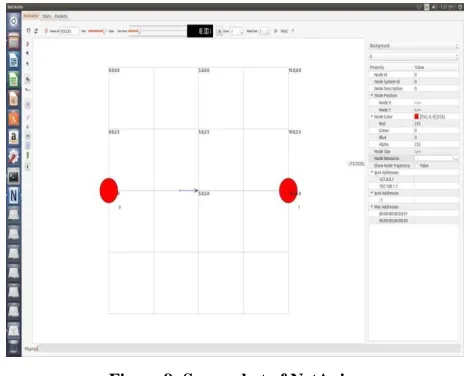
Animation is an important tool for network simulation. While NS-3 does not contain a default graphical animation tool NetAnim animation tool was also used which is a standalone, Qt4- based software executable that uses a trace file generated during an NS-3 simulation to display the topology and animate the packet flow between nodes. Qt4 is an application framework that allows creating user interfaces that run on multiple platforms [24]. Figure 8 shows the NetAnim Interface.
Figure 8: Screenshot of NetAnim
4.5 Performance Metrics for Making
Comparison
To evaluate and compare the performance of the routing protocols, four different quantitative metrics have been used. They are:
1) Packet Delivery Ratio (PDR): PDR is the ratio of data packets delivered to the destination to those generated by the sources and is calculated as follows: [25].
(1)
2) Throughput: Throughput is the number of bytes received successfully and is calculated by [25]:
(2)
3) Normalized Routing Overhead (NROH): Normalized Routing Overhead is the number of routing packets transmitted per data packet towards destination and calculated as follows [25].
4) Average End to End (E2E) Delay: Average End-to-End delay is the average time of the data packet to be successfully transmitted across a MANET from source to destination. It includes all possible delays such as buffering during the route discovery latency, queuing at the interface queue, retransmission delay at the MAC (Medium Access Control), the propagation and the transfer time, processing time at Transport Layer [26]. The average e2e delay is computed by,
(4)
[image:6.596.53.291.76.532.2]End-to-End Delay should be less for high performance.
5.
RESULT AND DISCUSSION
5.1 Simulation Environment
The result of this work is based on simulations using the network simulator-3 (NS-3) which is a Linux based open source simulator. Ubuntu 16.04 LTS platform is used for running simulation. As signal propagation model, the “Cost231” model is used. As QoS specification, rpts service class is used. To evaluate simulation results the time duration of each simulation was set to 60 seconds. WiMAX network was set up by configuring a cluster of three base stations and subscriber stations w h i c h are connected with each other. The traffic starts at 6 second to provide time for initial ranging and other synchronization and authentication. All MAC and Network layer operations of the wireless network interfaces are logged in ascii trace files. Post simulation analyses are performed to each of the trace file by using perl language
5.2 Simulation Results
The results of this simulation study are separately considered into two sections. Varying the traffic load, in this section simulation has been carried out to evaluate the performance of the protocols by varying the number of subscriber stations from 5 to 50. Varying the maximum node velocity, in this section simulation has been carried out to evaluate the performance of the protocols by varying the maximum node speed from 2 to 20 meters/second.
5.3 Varying the Traffic Load
[image:7.596.306.549.70.266.2]The simulation parameters which have been considered for performance evaluation in this section are as follows,
Table 4: Parameters for simulation to evaluate the protocols performance for traffic variations.
Number of nodes 5,10,15,20,25,30,35,40,45,50 Minimum speed of
nodes(m/s)
1 Maximum speed of nodes
(m/s)
10 Pause time (s) 0 BS Transmission Power(dB) 43 (20 W)
Packet size (Byte) 1520 Propagation Model Cost231
Mobility Model Random Waypoint Mobility Model
Traffic UDP
Figure 9 illustrates that OLSR achieves better PDR values than the other two routing protocols. This is due to the fact that in spite of having proactive nature, using multipoint relay stations, OLSR can reduce its routing overhead. This reduction in overhead results in better PDR values. DSDV suffers from heavy overheads which make its PDR values lower than OLSR. Although DSR is Proactive, as a centralized network, there are frequent event driven routing updates in WiMAX network, which causes DSR becoming unstable and having poor PDR values
Figure 9: Packet Delivery Ratio (PDR) as function of the traffic load.
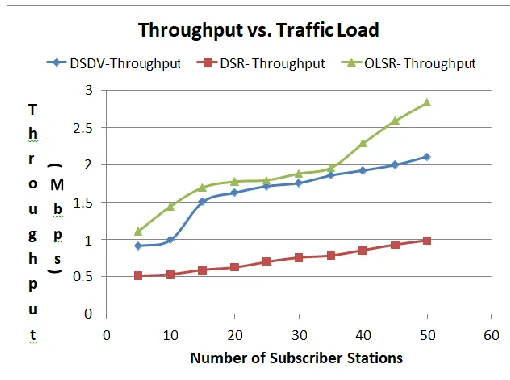
Figure 10 shows throughput values for the protocols. As OLSR achieves better PDR values, its throughput is also better than the other two. Again DSR has the lowest throughput values.As discussed in the previous two subsections, figure 11 illustrates that the routing overhead is the most for DSDV. DSR has the lowest overhead. Multiple relay mechanism of OLSR reduces its overhead a lot when comparing with DSDV.Figure 12 illustrates the delays of the protocols. Excessive routing overhead makes the receiving queue full most of the time in case of DSDV, that cause packets to wait, which increases the average delay. In case of OLSR, overhead is lower than DSDV, and as it is a table driven link state protocol, more stable than DSR. These factors results in OLSR having the lowest average end-t-End Delay.
[image:7.596.46.294.435.565.2] [image:7.596.307.562.456.646.2]Figure 11: Normalized Routing Overheads as function of the traffic load.
[image:8.596.300.581.147.317.2]Figure 12: Average End-to-End Delay as function of the traffic load.
Table 5: Parameters for simulation to evaluate the protocols performance in varying mobility.
Number of nodes 10
Minimum speed of nodes (m/s)
1
Maximum speed of nodes (m/s)
2, 4, 6, 8, 10, 12, 14, 16, 18, 20
Pause time (s) 0
Packet size (Byte) 1520
Propagation Model TwoRayGround
Mobility Model Random Waypoint Mobility Model
Traffic UDP
5.4 Varying the Mobility for Result Variation
Maximum Node Speed has been varied from 2 meters/second to 20 meters/second with an interval of 2 units. The following table shows the parameters used in simulation of this section.
[image:8.596.62.279.292.483.2]5.5 Varying the Mobility for Result Variation
Maximum Node Speed has been varied from 2 meters/second to 20 meters/second with an interval of 2 units. The following table shows the parameters used in simulation of this section.
Table 6: Parameters for simulation to evaluate the protocols performance in varying mobility.
Number of nodes 10
Minimum speed of nodes (m/s) 1
Maximum speed of nodes (m/s) 2, 4, 6, 8, 10, 12, 14, 16, 18, 20
Pause time (s) 0
Packet size (Byte) 1520
Propagation Model TwoRayGround
Mobility Model Random Waypoint Mobility Model
Traffic UDP
5.6 Packet Delivery Ratio
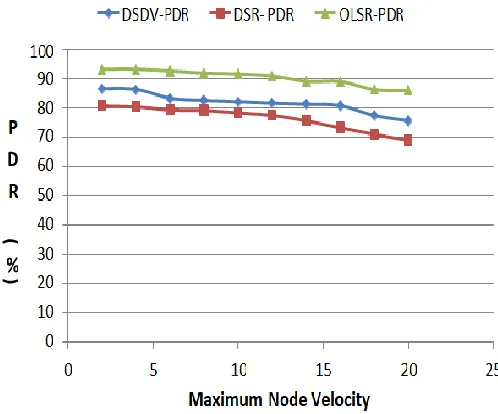
For three different algorithms it will show the ratio (Figure 13).
5.7 Throughput
Comparative throughput can be seen from figure 14. From where it is very clear that OSLR has the best result.
5.8 Normalized Routing Overhead
Figure 15 show the NROH.
[image:8.596.309.558.446.653.2]Figure 14: Throughput as function of the Maximum Node Velocity.
Figure 15: Normalized Routing Overhead (NROH) as function of the Maximum Node Velocity.
5.9
Average End-To-End Delay
[image:9.596.303.543.197.415.2]Estimated delay function will be as figure 16.
Figure 16: Average End to End (E2E) Delay as function of the Maximum Node Velocity.
5.10
Comparative Analysis of Simulated
Algorithms
The optimized routing algorithm will be found as graph 17. Where algo1 is DSDV, algo2 is DSR and algo3 is OLSR. From figure 13, 14, 15, 16, 17 it can be said that, while increasing the maximum speed of the mobile nodes, all of the protocols degrades in performance. But in all the cases, except in case of routing overhead, OLSR outperforms the other two protocols. It reduces minimizes its overhead issue by its proactive table driven nature. Therefore this simulation study produces results in favor of OLSR in WiMAX network.
Figure 17: Comparison of OLSR, DSDV and DSR
6.
CONCLUSION
Mobile WiMAX technology is a promising solution to the broadband Internet access especially in urban areas. If data can be routed efficiently with the least amount of overhead, WiMAX could replace the wired broadband. The goal of this simulation study is to refine the research trend of routing protocols in WiMAX networks to a specific routing approach. This refinement may result in more effective research to improve that approach from the WiMAX network’s point of view, which may lead to more efficient wireless broadband communication. As the result of simulation shows, OLSR protocol, which is a representative of Link state table driven protocol with some optimizations, performs better than the proactive DSDV and reactive DSR. This result clearly proposes that the link state approach can be applied in WiMAX networks for getting better performance. Though the work produced efficient output for most cases, it can be extended to more efficient work like vertical handover between WiMAX and Wi-Fi can be studied and simulated, different propagation models can be applied and compared in WiMAX to find the best model.
7.
REFERENCES
[1] F. Anwar, M. S. Azad, M. A. Rahman and M. M. Uddin, “Performance Analysis of Wireless Routing Protocols in Mobile WiMAX Environment”, IAENG International Journal of Computer Science, vol. 35, no. 3, IJCS_35_3_13, Aug., 2008.
[2] M. S. Islam and M. T. Alam, “Wimax: An Analysis Of The Existing Technology And Compare With The Cellular Networks”, Master Thesis, Blekinge Institute of Technology, Sweden, January 2009.
[image:9.596.61.279.570.738.2]Study of Fractional Frequency Reuse in WiMAX Networks”, FUJITSU Sd. Tech. J., vol. 44, no. 3, July, pp.318-324, 2008.
[4] Muna Al-Hawawreh, Aymen Zreikat, “Performance Analysis of a WIMAX Network in Different Propagation Models”, International Journal of Computer Science and Information Security (IJCSIS), Vol. 15, No. 1, January 2017
[5] M Haider, Turki A, Ali H, Najim A, Alsahlany “ Performance Of Baghdad City Using Different Audio Codecs. Evaluation Of WIMAX Network” , In Proc. IEEE 16th RoEduNet Conference: Networking in Education and Research (RoEduNet), 2017, DOI: 10.1109/ROEDUNET.2017.8123762
[6] T. Alkaa, S. Meenakshib and S. Pankaj, “Performance Evaluation of 802.16 (Wimax) Based Mesh Network Using Routing Protocols”, International Journal of Advanced Engineering Technology, vol. 4, no. 4, Oct/Dec issue, pp. 93-96, 2013.
[7] Rajeev P, Anil K, “To Evaluate the Performance of IEEE 802.16 Routing Protocols using Qualnet 6.1 Simulator” International Journal of Computer Applications (0975 – 8887) , Volume 92 – No.3, April 2014.
[8] Anuragsingh R, Namarata G, Aakash P, Poonam P, “ A Review Paper on WiMAX Technology”, International Journal of Advanced Research in Computer Engineering & Technology (IJARCET) Volume 5, Issue 6, June 2016. [9] [9] Salman N, Hussain S, I Raza, S R Chaudry, J. S.
Mirza, M. H. Raza, “Mobile Ad-hoc Network Routing Protocols: A Simulation and Performance Analysis Using Multimedia Traffic”, Journal of Basic and Applied Scientific Research, Vol.2(10)9925-9930, 2012
[10]Yahya A, Yahya Z, “Performance Analysis of the Impact of the Propagation Environments on the WIMAX Service Classes”, International Journal of Future Generation Communication and Networking Vol. 8, No. 1 (2015), pp. 117-126, 2015.
[11]Kumari N, Anoj K, “ICN-WiMAX: An Application of Network coding based Centrality-measures caching over IEEE 802.16”, 6th International Conference on Smart Computing and Communications, ICSCC 2017, 7-8 December 2017.
[12]M. Seyedzadegan and M. Othman, “IEEE 802.16: WiMAX Overview, WiMAX Architecture”, International Journal of Computer Theory and Engineering, vol. 5, no. 5, October, pp. 784-787, 2013.
[13]S. Fili, “Fixed nomadic, portable and mobile applications for 802.16-2004 and802.16e WiMAX networks”, WiMAX forum, November, 2005.
[14]J. G. Andrews, A. Ghosh and R. Muhamed, Fundamentals
of WiMAX, Pearson Education, Inc, ISBN 0-13-222552-2, 2007.
[15]P. Asher, “Comprehensive Analysis of Dynamic Routing Protocols in Computer Networks”, International Journal of Computer Science and Information Technologies, vol. 6, no. 5, pp. 4450-4455, 2015.
[16]Tariq, Umar et. al., 2007, “Analysis on Fixed and Mobile WiMAX”, Master Thesis, Blekinge Institute of Technology.
[17]Andrews, Jeffrey G. et. al., 2007, “Fundamentals of WiMAX”, First Edition, PearsonEducation, Inc, ISBN 0-13-222552-2.
[18]Islam, Mohammad Saiful & Mohammad Tawhidul Alam, January 2009, “WiMAX: An Analysis of the existing technology and compare with the cellular networks”, Master Thesis, Blekinge Institute of Technology.
[19]C. E. Perkins and P. Bhagwat, “Highly Dynamic Destination-Sequenced Distance- Vector Routing (DSDV) for Mobile Computers,” SIGCOMM, London, UK, August, 1994, pp. 234-244.
[20]E. M. Royer and C. K. Toh, “A Review of Current Routing Protocols for Ad Hoc Mobile Wireless Networks”, IEEE Personal Communications, July, pp. 46-55, 1999.
[21]A. O. A. Salem, G. Samara and T. Alhmiedat, “Performance Analysis of Dynamic Source Routing Protocol”, Journal of Emerging Trends in Computing and Information Sciences, vol. 5, no. 2, February, pp. 97-100, 2014.
[22]NS-3 project, “ns-3 Manual Release ns-3.27”, October, 2017.
[23]NS-3 developers, “Statistical Framework for Network Simulation”, 2008. [Online].
[24]Available:https://www.nsnam.org/wiki/
Statistical_Framework_for_Network_Simulation. [Accessed: June 21, 2018].
[25]NS-3 project, “ns-3 Model Library Release ns-3.27”, October, 2017.
[26]P. Periyasamy and E. Karthikeyan, “Impact of Variation in Pause Time and Network Load in AODV and AOMDV Protocols”, International Journal of Information Technology and Computer Science, no. 3, pp. 38-44, 2012. [27]T. Alkaa, S. Meenak ,S. Pankaj, “Performance Evaluation of
802.16 (Wimax) Based Mesh Network Using Routing Protocols”, International Journal of Advanced Engineering Technology, vol. 4, no. 4, Oct/Dec issue, pp. 93-96, 2013.
![Figure 1: WiMAX Network Architecture. [12]](https://thumb-us.123doks.com/thumbv2/123dok_us/9301955.429438/3.596.80.269.78.278/figure-wimax-network-architecture.webp)
![Table 3: WiMAX system parameters.[18]](https://thumb-us.123doks.com/thumbv2/123dok_us/9301955.429438/4.596.49.294.483.771/table-wimax-system-parameters.webp)
![Figure 5: NS-3 Simulation Framework. [23]](https://thumb-us.123doks.com/thumbv2/123dok_us/9301955.429438/5.596.321.534.272.531/figure-ns-simulation-framework.webp)