ISSN Print: 2333-9705
DOI: 10.4236/oalib.1104737 Jul. 25, 2018 1 Open Access Library Journal
Design of a High Frequency Driving Circuit of
Surface Acoustic Wave Transducer
Guan Zhao
Automotive Engineering College, Shanghai University of Engineering Science, Shanghai, China
Abstract
In this paper, a high frequency driving circuit of surface acoustic wave trans-ducer has been designed to separate oil from oil/water mixed droplet. The transmission frequency of the surface acoustic wave transducer driving circuit can be up to 1 MHz. The transmit frequency of conventional ultrasonic driv-ing circuit is mostly 40 kHz. However, the high transmit frequency drivdriv-ing circuit presents a good stability and accuracy. By establishing the surface acoustic wave driving circuit model, the actual circuit and debugging verifica-tion, the driving circuit can excite the frequency signal required for the expe-riment. Thus, the surface acoustic wave driving circuit could provide neces-sary technical support for application in other fields.
Subject Areas
Applied Physics, Electric Engineering
Keywords
Surface Acoustic Wave, Driving Circuit, High Frequency, Transducer
1. Introduction
With the development of industry and the advancement of science and technol-ogy, ultrasonic technology has been widely developed and used. Ultrasonic technology has long been gradually integrated into people’s daily lives to become an inseparable part. Ultrasonic technology has been applied in various fields, which is usually divided into two major categories of ultrasonic testing and power ultrasound [1]. For example, hospitals use B-ultrasound to diagnose dis-eases [2], which is simple, convenient, high diagnostic accuracy. Above all, it can prevent patients from suffering unnecessary pain. M Yamamoto et al. [3] used How to cite this paper: Zhao, G. (2018)
Design of a High Frequency Driving Circuit of Surface Acoustic Wave Transducer. Open Access Library Journal, 5: e4737.
https://doi.org/10.4236/oalib.1104737
Received: June 24, 2018 Accepted: July 22, 2018 Published: July 25, 2018
Copyright © 2018 by author and Open Access Library Inc.
This work is licensed under the Creative Commons Attribution International License (CC BY 4.0).
http://creativecommons.org/licenses/by/4.0/
DOI: 10.4236/oalib.1104737 2 Open Access Library Journal cessfully designed a car anti-collision system using ultrasonic wireless transmis-sion and ultrasonic ranging technology. J Tsujino [5] studied the latest technol-ogy of ultrasonic welding, and Qiu et al. [6] conducted numerical simulation and analysis of ultrasonic traveling wave driving droplet motion on the glass surface.
However, for practical applications in these fields of ultrasonic technology, the driving frequency of the drive circuit is mostly 40 kHz, and it is rare for the high frequency of 1 MHz for the transmission frequency. Therefore, in order to improve the accuracy, stability, and reliability of related ultrasound experi-ments. In this paper, a surface acoustic wave transducer driving circuit with a transmission frequency of up to 1 MHz is designed. Through appropriate de-bugging, this circuit can stimulate the waveforms required for the experiment and achieve the functions required to separate oil from an oil/water mixed droplet.
2. Theory of Surface Acoustic Wave Driving Circuit
In recent years, surface acoustic wave (SAW) technologies have received signifi-cant attention to be applied in various fields. And the (SAWs) have been used to drive and manipulate microfluidic flow, such as Rayleigh [7] [8] and Lamb waves [9] [10]. Some researchers have applied the SAW technologies to make SAW transducers, which the device can convert electrical energy into sound energy and convert sound energy into electrical energy. And these technical characteristics are usually applied in microfluidics community, such as acoustic microreactors [11], and microseparattors [12].
On the basis of the several potential applications of droplet propulsion and emulsion separation by using the ultrasonic waves, the SAW driving circuit could be applied to separate two immiscible liquids. In this study, the surface acoustic wave driving circuit has functions of operate at high frequency, good install, low cost, and high efficiency. Flow chart of the SAW driving circuit de-sign shows in Figure 1.
3. Driving Circuit Design
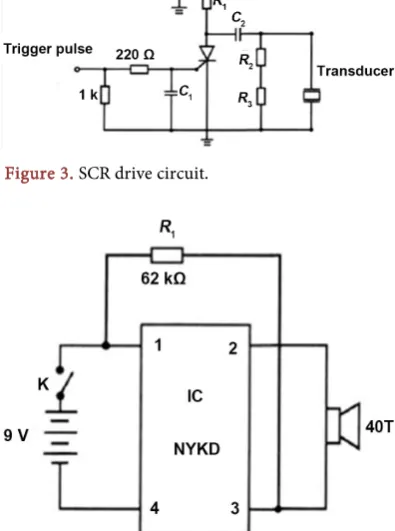
There are some conventional ultrasonic driving circuits that are used in various fields [13] (shown in Figures 2-5). However, one of the biggest drawbacks of these driving circuits is that the frequencies are all 40 kHz, which is not suffi-cient for the unique field and experiment requirements.
DOI: 10.4236/oalib.1104737 3 Open Access Library Journal
Figure 1. Flow chart of the SAW driving circuit design.
[image:3.595.270.504.81.584.2]Figure 2. Self-excited driving circuit.
Figure 3. SCR drive circuit.
Figure 4. Dedicated integration of driving circuit.
[image:3.595.274.472.314.580.2]DOI: 10.4236/oalib.1104737 4 Open Access Library Journal
Figure 5. Ultrasound transducer driving circuit
[image:4.595.276.473.73.239.2]com-posed of 55.
Figure 6. Schematic of SAW driving circuit.
integrated easily. And the integration circuit is used to replace triodes, resis-tances, and diodes that are needed in this designed. Thus, driving circuit of SAW is high-precision integration.
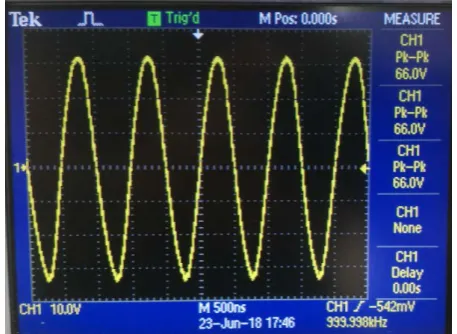
The important feature of the SAW driving circuit is different from traditional circuit, which the frequency can up to 1 MHz. It can present good stability, and high accuracy to be applied to separate oil from an oil/water mixed droplet. In this experiment, water droplet and oil droplet are mixed to produce an oil/water mixed droplet as Figure 7(a). The oil/water mixed droplet will be promoted under the effect of the SAW streaming forces as Figure 7(b). With the time goes on, the oil/water mixed droplet will get critical separation position as Figure 7(c). At last, the oil droplet will be separated from an oil/water mixed drop as Figure 7(d). The experiment phenomenon of oil/water mixed droplet separation process can be seen in Figure 7. And the output interface can be attain 1 MHz attenuation sine wave pulse of SAW driving circuit as shown in Figure 8.
4. Conclusion
[image:4.595.208.540.283.370.2]DOI: 10.4236/oalib.1104737 5 Open Access Library Journal
Figure 7. Separation process of oil/water mixed droplet.
Figure 8. Attenuation sine wave pulse of SAW driving circuit.
higher precision requirements in the future. And the SAW driving circuit could be used to separate two kinds of immiscible liquids.
References
[1] Kinoshita, M.M. (2001) Ultrasonic Testing Improves Power Plant Efficiency. Tur-bomachinery International, 5, 39-40.
[2] Su, L.Y., Sun, C.K. and Zhang, Z. (2013) Comparative Study of the B-Ultrasound and Molybdenum X-Ray in the Diagnosis of Breast Disease. Journal of Bengbu Medical College,38, 1471-1472.
[3] Yamamoto. M., Tamura, K., Yanagisita, S. and Inagaki, S. (2009) An Ultrasonic Flow Measurement System for Sewage and Waste Water. Transactions of the Socie-ty of Instrument & Control Engineers, 14, 564-571.
https://doi.org/10.9746/sicetr1965.14.564
[4] Zhong, Y. and Yu, H. (2016) Design of Car Reversing Anti-Collision Warning De-vice Based on Ultrasonic Ranging Principle. Electronic Design Engineering, 24, 158-161.
[5] Tsujino, J. (1995) Recent Developments of Ultrasonic Welding. Ultrasonics Sympo-sium, 2, 1051-1060. https://doi.org/10.1109/ULTSYM.1995.495743
[image:5.595.259.488.251.418.2]DOI: 10.4236/oalib.1104737 6 Open Access Library Journal Convection inside a Colloidal Droplet. Physics of Fluids, 25, Article ID: 042001.
https://doi.org/10.1063/1.4797497
[8] Agostini, M., Grecoa, G. and Cecchini, M. (2018) A Rayleigh Surface Acoustic Wave (R-SAW) Resonator Biosensor Based on Positive and Negative Reflectors with Sub-Nanomolar Limit of Detection. Sensors and Actuators B: Chemical, 254, 1-7.
https://doi.org/10.1016/j.snb.2017.07.014
[9] Schmitt, M., Stich, S., Fromm, S., Fischer, F. and Lindner, G. (2010) Detection and Removal of Droplets on Non-Piezoelectric Substrates via Mode Conversion of Lamb Waves. British Journal for the Philosophy of Science, 143, 304-308.
https://doi.org/10.1109/ICSENS.2010.5689878
[10] Savva, N. and Kalliadasis, S. (2013) Droplet Motion on Inclined Heterogeneous Substrates. Journal of Fluid Mechanics, 725, 462-491.
https://doi.org/10.1017/jfm.2013.201
[11] Dong, Z., Yao, C. and Zhang, Y. (2016) Hydrodynamics and Mass Transfer of Os-cillating Gas-Liquid Flow in Ultrasonic Microreactors. AIChE Journal, 62, 1294-1307. [12] Watanabe, S., Matsumoto, S. and Higurashi, T. (2015) Almost Complete Separation
of a Fluid Component from a Mixture Using Burgers Networks of Microseparators. Journal of the Physical Society of Japan, 84, Article ID: 043401 (1-4).
https://doi.org/10.1002/aic.15091