
molecular dynamics
Robert Darkins∗London Centre for Nanotechnology, University College London, Gower Street, London, WC1E 6BT, UK
Pui-Wai Ma
UK Atomic Energy Authority, Culham Science Centre, Abingdon, Oxfordshire, OX14 3DB, UK
Samuel T. Murphy
Department of Engineering, Lancaster University, Bailrigg, Lancaster, LA1 4YM, UK
Dorothy M. Duffy
London Centre for Nanotechnology, University College London, Gower Street, London, WC1E 6BT, UK
(Dated:)
Radiation can drive the electrons in a material out of thermal equilibrium with the nuclei, pro-ducing hot, transient electronic states that modify the interatomic potential energy surface. We present a rigorous formulation of two-temperature molecular dynamics that can accommodate these electronic effects in the form of electronic-temperature-dependent force fields. Such a force field is presented for silicon which has been constructed to reproduce theab initio-derived thermodynamics of the diamond phase for electronic temperatures up to 2.5 eV, as well as the structural dynamics observed experimentally under nonequilibrium conditions in the femtosecond regime. This includes nonthermal melting on a sub-picosecond timescale to a liquid-like state for electronic temperatures above∼1 eV. The methods presented in this paper lay a rigorous foundation for the large-scale atomistic modelling of electronically-driven structural dynamics with potential applications span-ning the entire domain of radiation damage.
I. INTRODUCTION
When the electrons in a material are driven slowly rel-ative to the electron-phonon coupling timescale, the elec-trons and nuclei will remain in thermal equilibrium with each other, with much of the energy supplied to the elec-trons translating into atomic motion. On the other hand, when electrons are driven more rapidly than they can couple with the phonons, the electrons and nuclei may be driven transiently from equilibrium, producing hot elec-trons and cool nuclei. Hot electronic states give rise to modified interatomic potential energy surfaces which can induce rapid phase transitions. This is referred to as a nonthermal process because it occurs before the electrons and nuclei have thermalized with each other.
Nonthermal phase transitions have been observed in multiple semiconducting and dielectric materials: Si [1– 6], Ge [7, 8], GaAs [9], InSb [10], Ge2Sb2Te5 [11], and
C [12]. Band gap materials are particularly amenable to nonthermal processes because their band gaps inhibit electronic relaxation. Moreover, their atomic interactions in the ground state are determined by highly localised va-lence electrons whose excitation across the Fermi surface can dramatically alter the potential energy surface.
Silicon is a widely studied material in the context of strongly-driven phase transitions, both experimentally [1–6] and theoretically [13–29], where it is found to melt
on a sub-picosecond timescale at high excitations. Most theoretical studies of nonthermal melting in silicon have employed ab initio simulation methods. However, the cost of these techniques make them unsuitable for study-ing large length or time scale processes such as abla-tion and spallaabla-tion. It is within this domain of large-scale atomistic modelling of radiation damage that two-temperature molecular dynamics (2T-MD) has prevailed as the method of choice [30].
The idea of 2T-MD is to decompose the system into two subsystems: the nuclear coordinates, and a contin-uous scalar field representing the electronic temperature Te throughout space. The nuclear coordinates are
inte-grated over time using Newton’s second law of motion, while theTe field evolves according to a heat equation.
The two subsystems are coupled with a thermostat that serves to thermalize them, emulating the nonadiabatic electron-phonon coupling mechanism.
into the significance of the electronic distribution. Most
ab initio studies of nonthermal melting in silicon have been built on two assumptions: thermalized electrons, and the Born-Oppenheimer approximation which ex-cludes nonadiabatic effects such as electron-phonon cou-pling, e.g. [16–22]. These studies do predict bond soften-ing at high excitations but they predict meltsoften-ing to occur at higher excitations than expected based on experiment. More recent methods [13, 14] have avoided these two as-sumptions and, consequently, predicted melting at lower excitations. However, it is unclear to what extent this is attributable to the more realistic electronic distributions versus the nonadiabatic effects. Despite this uncertainty, we proceed with the assumption that the electrons in-stanteously thermalize, and find that the resulting model behaves in good agreement with experiment andab initio
simulation.
To capture the effects of electronic excitations on atomic interactions, it is necessary for the interatomic potentials to vary as a function of Te. Deploying Te
-dependent force fields has been attempted for just four materials that we are aware of: Si [32–34], W [35, 36], Au [37], and Mo [38]. However, each one of these studies has a significant flaw.
Firstly, there is confusion regarding whether the inter-atomic potentials should be optimized to reproduce the energy or the free energy at finite temperatures. In the Si force field, the potential was fitted to the energy, while the other three were all fitted to the free energy. The source of confusion is that these studies have involved op-timizing the interatomic potentials to fit data produced by finite-temperature density functional theory (DFT). Finite-temperature DFT ostensibly minimizes the atomic structure with respect to the free energy, specifically the grand canonical potential, which might lead one to as-sume the free energy should be reproduced. However, to simplify the force evaluations at the implementation level, DFT codes evaluate forces in the adiabatic limit. Minimizing the free energy in the adiabatic limit is equiv-alent to minimizing the energy under isothermal condi-tions [39, 40], and so it is the energy that should be repro-duced by the interatomic potential, not the free energy.
Secondly, none of these studies deploy the Te
-dependent potentials in a way that conserves energy. Changes in the temperature give rise to changes in the potential energy, but no effort has been made to account for where this energy goes to or comes from. This concern has been raised before [41] without solution. In this paper we present the solution for correctly conserving energy in 2T-MD withTe-dependent potentials. The solution is
deceptively simple: rather than use a heat capacity pre-computed for a particular phase, the heat capacity must be re-evaluated for each nuclear configuration, which can be done straightforwardly using the interatomic poten-tials themselves. However, expressing the heat capacity in terms of the interatomic potential places an implicit constraint on the potential which, in general, may not be satisfied for all configurations. To counter this, we
introduce a potential energy correction to the Hamilto-nian that is designed specifically to maintain a physically realistic heat capacity.
This new energy-conserving scheme is applied to sili-con for which a newTe-dependent potential is introduced.
We do not use the existing Si potential of Shokeen et al. [32–34] because their potential is parameterized by high-degree polynomials which leads to rapid oscillations in the energy and, consequently, negative heat capacities for the crystalline phases. Futhermore, their potential gives rise to nonthermal melting at much higher energies than predicted experimentally, which our own analysis suggests is because their parameter optimization was un-derdetermined. In constructing a new potential, our ob-jective was to accurately reproduce the thermodynamics of the diamond phase of silicon for a range of electronic temperatures, as well as capture the structural evolution of nonequilibrium silicon insofar as it is determined ex-perimentally.
II. THEORY
This section presents a rigorous formulation of 2T-MD withTe-dependent potentials, revealing how the energy
of the system should be conserved. It is shown that some potentials may not be suitable for the energy-conserving scheme, for which a general-purpose many-body energy correction is introduced.
For simplicity, this paper only considers a collection of identical atoms with a uniform electronic temper-ature. However, the methods described may be ex-tended straightforwardly to multi-component materials with a spatially inhomogeneous electronic subsystem in the same way as existing 2T-MD formalisms.
A. Two-temperature molecular dynamics
In our two-temperature molecular dynamics formal-ism, the Hamiltonian for the entire system is assumed to take the form
H=X
i
1 2mv
2
i +U({Ri}, Te) +He(Te), (1)
where m is the atomic mass, vi are the atomic
veloci-ties,U({Ri}, Te) is aTe-dependent interatomic potential,
{Ri} are the nuclear degrees of freedom, and He is the
Hamiltonian for the electronic subsystem. We need not specify the functional form ofHebut assume its state to
be solely determined by the electronic temperatureTe.
correction to this adiabatic approximation, it does not naturally arise from the Hamiltonian. Instead, electron-phonon coupling may be incorporated via the Langevin equation of motion, which treats the nuclei as experienc-ing fluctuation forces from the electronic thermal reser-voir,
mdvi dt =−
∂U
∂Ri −γvi+fi, (2)
where γ is a damping parameter and fi is a delta-correlated stochastic force that satisfies the conditions hfii= 0 andhfiα(t)fjβ(t0)i=µδijδαβδ(t−t0). It follows
from the fluctuation-dissipation theorem [42–44] that, when the electrons and nuclei are in thermal equilibrium with each other, µ= 2γkBTe, where kB is Boltzmann’s
constant. As with previous work [45, 46], we make the assumption that this relation holds true even out of equi-librium. The damping parameterγ may then be chosen such that the electronic and nuclear temperatures con-verge on a desired timescale after being driven from equi-librium.
It follows from the Hamiltonian in Eq. (1) that the time-derivative for the total energy of the system will be
dE dt =
X
i
vi·(−γvi+fi) +
∂U
∂Te
+dEe dTe
dT
e
dt , (3)
where Eeis the energy of the electronic subsystem, and
we have substituted Eq. (2). The rate at which the energy of the system changes will equal the rate at which energy is dumped into the system by an external heat sourceQ, and so Eq. (3) begets the heat equation
Ce
dTe
dt =−
X
i
vi·(−γvi+fi) +Q, (4)
where the first term on the right-hand side is to be inter-preted as the electron-phonon coupling power, and the electronic heat capacity is
Ce=
dEe
dTe
+ ∂U ∂Te
. (5)
The heat sourceQonly measures the power of the ab-sorbed energy over time. It is indifferent to the nature of the source, whether laser or swift heavy ion, and to the mechanism of absorption. Note that, to model a spa-tially inhomogeneous electronic subsystem with thermal conductivityκ, a diffusion flux∇ ·κ∇Teshould be added
to Eq. (4).
At this stage, Eqs. (1), (2), (4), and (5) provide a Te-dependent 2T-MD formalism that conserves energy.
Where it differs from previous applications of 2T-MD, which fail to conserve energy, is that the heat capac-ity Ce has an explicit ∂U/∂Te component, making it a
function of both Te and the nuclear configuration {Ri},
rather than a function ofTealone.
As is common practice, we replace the electron-phonon coupling power in Eq. (4) with its ensemble average,
which can be derived by applying the Furutsu-Novikov theorem to the term containing the stochastic force [47– 49], resulting in
*
−X
i
vi·(−γvi+fi) +
= 3γkBN
m (Tn−Te), (6)
where Tn is the nuclear temperature and N the
num-ber of atoms. Phillips et al. [50] have cautioned against this substitution since it introduces energy drift into the system. However, for the large system sizes used in the present work, we found the drift to be indistinguishable from that produced by the symplectic integrator. More-over, using the ensemble average has the advantage that the heat equation (4) may be numerically integrated more efficiently with use of Suzuki-Trotter decomposition [51]. Some previous efforts [26, 27, 41, 52] to model silicon with a two-temperature model have been based on the framework of van Driel [23] which parameterizes the sys-tem with the carrier density, in addition to the usual electronic and nuclear temperatures. The carrier den-sity evolves according to a separate differential equation that captures carrier generation, diffusion, and recombi-nation. This approach has the advantage that the elec-tronic heat capacity may be expressed as a function of the carrier density, and the optical properties of the ma-terial are more straightforwardly accounted for by using the carrier density to attenuate the radiation intensity as it passes through the material. However, as previously noted [30], explicitly including a term for the carrier den-sity is superfluous since the carrier denden-sity has a one-to-one relationship with the electronic temperature under (quasi)equilibrium conditions. It follows that any func-tion of the carrier density may instead be written as a function of electronic temperature. Moreover, expressing the electronic heat capacity as a function of the carrier density fails to give rise to a configuration-dependence, and so such a model is ill-suited to modelling phase tran-sitions. In any case, we do not model radiation attenua-tion in this work and so do not require an explicit carrier density.
B. On-the-fly energy correction
One of the challenges with deploying the energy-conserving formalism described above is that it is nec-essary for the heat capacityCe to always be positive, as
one would expect on purely physical grounds. Even more strictly, the heat capacity should not be able to become arbitrarily close to zero for any configuration or electronic temperature. It is therefore necessary for the heat capac-ity to have a finite lower bound(Te) that holds for all
nuclear configurations. This gives rise to the following constraint on the potentialU:
min {Ri}
∂U ∂Te
({Ri}, Te)≥(Te)−
dEe
dTe
In general, a Te-dependent potential will not
sat-isfy this constraint and so it must be explicitly im-posed. Typically, this will not be possible through careful parameterization alone, but will instead demand changes to the functional form of the potential. To illustrate the need for such an intervention, consider a simple Te-dependent pairwise potential of the form
U =P
i<jA(Te)φR(rij)−B(Te)φA(rij), where φR (φA)
are repulsive (attractive) functions of the atomic sepa-rations rij. The Te-dependence of A and B might
rea-sonably exhibit, for some Te, the property dA/dTe = 0
anddB/dTe>0. In this case, given an arbitrary number
of atoms packed arbitrarily densely, one could make the per-atom value of∂U/∂Tearbitrarily negative, and thus
no minimum for ∂U/∂Te would even exist. But this is
not just a hypothetical problem that arises for extreme configurations. Rather, the derivative ∂U/∂Te may
be-come too negative for entirely plausible configurations, as will be shown to be the case for the silicon potential introduced later in this paper.
To understand why this problem should arise at all, note that interatomic potential functional forms, and their parameterizations, are generally constructed to re-produce the potential energy surface of materials near to crystalline phases. It is not surprising then that they should behave unphysically for, say, certain highly-dense amorphous configurations with highly excited electrons.
In the absence of more accurate many-body poten-tials, we resolve the issue by introducing a general many-body energy correctionW({Ri}, Te) that is added to the
Hamiltonian of Eq. (1). The correction is general in the sense that it is evaluated numerically on-the-fly at each integration time-step and works for any potentialU. The correction takes the form
W({Ri}, Te) =
Z Te
0
w(Ce({Ri}, Te0), (Te0))dTe0, (8)
wherewis specifically constructed to satisfy
Ce+w(Ce, )≥. (9)
This correction leads to the heat capacity Ce in the
heat equation (4) being replaced with Ce+w which is
now guaranteed to be not less than, per Eq. (9). It also gives rise to auxiliary atomic forces which depend on the forces from the interatomic potentialU,
−∂W ∂Rk =−
∂w ∂Ce
∂U ∂Rk +
Z Te
0
∂2w
∂T0
e∂Ce
∂U ∂Rk dT
0
e. (10)
The derivation is provided in Appendix A where it has been assumed that∂U/∂Te(Te= 0)≡0.
The precise functional form ofwis of little significance, but it should be twice-differentiable and satisfy
w(Ce≤0, ) =−Ce, (11)
w(Ce≥f , ) = 0, (12)
−1≤ ∂w ∂Ce
(0< Ce< f , )≤0, (13)
for some constantf in the interval
1< f ≤min
Te 1 (Te)
dEe
dTe
(Te). (14)
The value off determines how hard or soft the energy correction is asCe approaches the lower bound. In the
limitf →1+, the corrective energy becomes hard, giving rise to infinitely large forces. It is bounded from above to ensure thatW = 0 for the isolated system. A suitable expression forwis provided in Appendix A which has an f value of 2.
The action of the auxiliary forces in Eq. (10) may be understood as follows: For a given configuration, if Te changes such that Ce becomes too close to , or
even smaller than, then the forces−∂U(Te)/∂Rk are
smoothly switched off and replaced with an average of forces that would act at lower electronic temperatures in regions whereCeis above. Essentially, the energy
land-scape is perturbed towards its form at lower electronic temperatures where the potential is better behaved.
To summarize, any Te-dependent potential U may be
safely deployed in an energy-conserving two-temperature molecular dynamics scheme without further modifica-tion, so long as the energy correctionW described above is incorporated. And while it is true that this correction isad hocwith the purpose of producing more physically realistic heat capacities, its use can be further justified with a few observations: Firstly, the heat capacity will only become too small if the potential energyUdecreases too rapidly. The correction therefore gives rise to more physically realistic potential energies U +W than pro-duced byU alone. Secondly, the correction will typically only be activated under highly nonequilibrium conditions for which the true structure and dynamics are seldom known. Thirdly, interatomic potentials are themselves approximations, and so introducing an approximate cor-rection is not antithetical to the molecular mechanics en-terprise. Finally, the alternative approaches to satisfying Eq. (7) appear to be highly non-trivial, although future research may reveal better solutions.
It is worth lingering briefly on the implementation de-tails for this energy correction since it effectively requires that, at each integration time-step, the energyU and all of the atomic forces−∂U/∂Rkare known at all electronic
temperatures ranging from 0 K up to the prevailing tem-perature Te. At first glance, one might expect this to
incur a tremendous computational burden, but there ex-ist optimizations; in particular, the energy and atomic forces do need to be evaluated over a discrete set of elec-tronic temperatures, but this can be done with little ad-ditional cost if evaluated concurrently such that theTe
source.
III. Te-DEPENDENT SILICON FORCE FIELD
In this section, a new Te-dependent force field for
sil-icon is presented. It is described in enough detail to be understood, but the complete functional form and pa-rameterization is provided in Appendix B.
The MOD [53] version of the Tersoff potential [54] for silicon is well-established and known [55, 56] to reason-ably reproduce the experimental cohesive energy, crys-talline and liquid heat capacities, elasticity properties, latent heat of melting, and melting temperature of the diamond phase, as well as ab initio defect energies. Its functional form is
U = 1 2
X
i6=j
fc(rij)(Ae−λ1rij −bijBe−λ2rij), (15)
whererijis theijatomic distance andfcis a cutoff
func-tion which smoothly switches off interacfunc-tions between the cutoff radii R1 and R2. There is also a bond order bij
which makesU a many-body potential and takes the form
bij = (1 +ζ η ij)
−δ, (16)
ζij =
X
k6=i,j
fc(rik)g(θijk)eα(rij−rik)
β
, (17)
where θijk is the angle between the ij and ik bonds,
and the angle-dependence g(θijk) serves to emulate
di-rectional bonding. All other terms are parameters. In this work, the same functional form for the ground state (Te= 0) is adopted. To introduce aTe-dependence
into the potential, the parametersAandB are assumed to vary withTe and will thus need to be optimized over
a range of different electronic temperatures, while all of the other parameters are held constant. However, while scaling A and B will reproduce the energy in the crys-tal phase, it alone will not reduce the activation barri-ers between the diamond and amorphous phases, and so a further modification is required to induce nonthermal melting.
Observe that the electronic structure in the ground state of the diamond silicon phase consists of sp3 hy-bridized orbitals which are responsible for the tetrahedral bond geometry. When the electrons become excited, this bond directionality will diminish, thus destabilizing the crystal structure and inducing the phase transition. To incorporate the softening of the bond directions into the potential, the bond-angle dependenceg(θ) in Eq. (17) is substituted with the function
g(θijk)←g(θijk)−Λ(g(θijk)−g0, λ(Te)), (18)
where g0 = g(cos−1(−1/3)) is the value of g for
tetra-hedral geometry, and the Λ function is constructed such that Λ(|∆g| λ, λ) = sgn(∆g)λand Λ(|∆g| λ, λ) = ∆g, with a smooth variation between these two bounds.
The purpose of this modification is to shiftg(θ) closer to the constantg0 by an amount no greater thanλ(Te),
and to do so in a differentiable manner. To clarify, Fig-ure 1(d) shows a plot ofg(θ)−Λ(g(θ)−g0, λ) forλ= 0
(in which case Λ = 0), 0.2, and 0.4. The consequence is that, as λ increases from 0 to its finite value at higher electronic temperatures, the angle dependence within the potential flattens out in the region whereg(θ) =g0. This
amounts to a softening of the directionality of the bond-ing which helps to destabilize the diamond structure and induce rapid nonthermal melting.
A. Parameter fitting
Following Shokeen et al. [33], the ground state param-eters are chosen to match those of the MOD potential, except the cutoff radii are increased to R1 = 3.1 and
R2 = 3.4 ˚A and the α parameter is adjusted to a value
of 1.90 to improve the melting temperature.
As described in the previous section, theTe-dependent
parameters in our potential areA(Te),B(Te), andλ(Te).
In addition to these, the Langevin damping constant γ and the lower bound on the heat capacity(Te) are also
required. In the diamond phase, where the bonds ex-hibit perfect tetrahedral geometry,λis designed to have no effect on the potential. The parametersAandB may therefore be optimized for the diamond phase indepen-dently ofλ.
To this end, ab initio methods were used to com-pute the potentialUab for the diamond phase over the
range 0 ≤ Te ≤ 2.5 eV in increments of 0.05 eV. This
involved two steps: Firstly, for each Te, the energy
Eab({Ri}, Te) was computed for atomic volumes ranging
from 12 to 43 ˚A3. And secondly, for the same
tempera-ture range, the energy of the isolated system, E0 ab(Te),
where the atoms are effectively separated to infinity, was computed. The ab initio potential may then be computed as Uab({Ri}, Te) = Eab({Ri}, Te)−Eab0 (Te),
while the energy of the electronic subsystem isEe(Te) =
E0
ab(Te)−Eab0 (0). This necessarily fulfils the requirement
that when the system is isolated atTe= 0, bothUaband
Eewill equal zero.
Recall that the potential U has already been chosen for the ground state. It would be unlikely for this U to perfectly align with the ab initio potential Uab at
Te = 0. The parameters A and B are therefore instead
fitted such thatU({Ri}, Te) reproducesUab({Ri}, Te) +
U({Ri},0)−Uab({Ri},0). This way our ground state
potential is preserved while theTe-dependence obtained
from theab initiocalculations is reproduced.
FIG. 1: (a) The dependence of theAandB force field parameters on electronic temperatureTe. (b) The
interatomic potentialU for a range of atomic volumes in the diamond phase, and forTe= 0, 1.5, and 2 eV.
The lines are the 2T-MD interatomic potential while the circles are theab initio calculations. (c) The evolution of the nuclear temperatureTn in response to a
low-fluence excitation att= 0. The line is the 2T-MD calculation, the circles are experimental data points [1].
(d) The modified angle-dependence forλ= 0,0.2,0.4, corresponding to a weakening of bond directionality.
The inset shows the dependence of λon electronic temperature.
box and only the Γ-point sampled. An electronic tem-perature is introduced by treating the electronic states as distributed according to the Fermi-Dirac distribution [61]. We used the M06-L [62] exchange-correlation func-tional which produces a band gap of 1.12 eV [63] in good agreement with the experimental band gap of 1.11 eV [64]. By contrast, the GGA-PBE [65] functional pro-duces a band gap of 0.75 eV, while the hybrid functional is an order of magnitude slower to execute than M06-L. The resulting Te-dependence of A and B is shown in
Figure 1(a). At low Te, both parameters are constant,
with a steady increase inBas the temperature increases, followed by a rapid increase in bothAandBat high tem-peratures. The result is a potential energy surface that deepens with increasing electronic temperature, with a minor reduction in the equilibrium atomic volume, as shown in Figure 1(b). The deepening of the potential is presumably a result of the electrons becoming less local-ized, leading to the positively-charged nuclei being ex-posed to a greater negative charge.
Before optimizing the λ function, it is necessary to obtain the Langevin damping parameter γ which char-acterizes the electron-phonon coupling rate. For this we turn to the experimental data of Harb et al. [1, 2] who
measured the structural response of silicon nanofilms to ultrafast photoexcitations. The relevant details of their experiment along with our approach to modelling it can be found in Appendix C. In one particular experiment, the nuclear temperature was recorded with femtosecond resolution following a laser irradiation event with an ab-sorbed fluence of Φ = 5.6 mJ/cm2. This fluence is be-low the damage threshold and excites the lattice ther-mally, and so the parameterλ may be fixed to zero at this stage. The damping parameterγcould then be opti-mized such that the nuclear temperature evolves over the same timescale as seen experimentally. Excellent agree-ment was achieved with a value ofγ = 1 g/mol/ps, as shown in Figure 1(c).
The next parameter to optimize is the function λ(Te),
which is responsible for inducing rapid nonthermal melt-ing. There is currently not enough information available to optimize λfor each individual temperature. Instead, it is constructed somewhat arbitrarily to satisfy certain constraints. In the ground stateλ is necessarily 0, but to establish its value in excited states we return to the experimental data of Harb et al. (cf. Appendix C). Ex-perimentally, a damage threshold was observed at an ab-sorbed fluence of Φ = 6 mJ/cm2, below which the Bragg
peaks decay in accordance with the Debye-Waller factor. One might therefore predict that the shape of the po-tential begins to change around the damage threshold. Based on the value of γ previously obtained, the dam-age threshold in our model was found to correspond to a peak electronic temperature of 0.45 eV. It is at this tem-perature, therefore, that λ will begin to increase from 0. Another data point is that above an absorbed flu-ence of approximately Φ = 30 mJ/cm2 the crystal melts nonthermally in under a picosecond. In our model it is found thatλ≥0.2 is sufficient to induce rapid melting, and that the reported fluence corresponds to a peak elec-tronic temperature of 1 eV. In summary, the parameter λshould satisfy λ(Te ≤ 0.45 eV) = 0 and pass through
λ(1 eV) = 0.2. With use of a polynomial, a smooth curve satisfying these conditions was constructed, and it can be seen in the inset of Figure 1(d).
The final function to be optimized is (Te) which
im-poses a lower bound on the electronic heat capacities. Based on the shape of thewfunction that we employed, must satisfy the constraint (Te) ≤ 12dEdTe
e(Te), per Eq. (14). It should also be small enough that Ce ≥ 2
(and thusW = 0 per Eq. (12)) for the diamond crystal structures for whichU was optimized, sinceU was tacitly optimized under the assumption that W = 0. To sat-isfy these constraints and estimate a lower bound on the heat capacity, the minimum value forCe was computed
for each temperature from theab initio data ∂Eab/∂Te
over the range of atomic volumes sampled, and the re-sults were halved. It was found that(Te) = 17dEdTee(Te)
[image:6.612.54.304.53.262.2]FIG. 2: (a) Several normalized Bragg peaks decaying in response to a low-fluence laser pulse at t= 0. The lines
are predicted from 2T-MD while the circles are experimental measurements [1]. From top to bottom, the peaks are: (111), (220), (311), (331), (531), (620). (b) The normalized response of the (220) Bragg peak to
a high-fluence laser pulse that nonthermally melts the crystal. Theab initio data (dashed line) was taken from
[13] and the experimental data (circles) from [2].
IV. DISCUSSION
Having presented a new Te-dependent force field for
silicon (Section III), and a formalism for conserving en-ergy (Section II), this section answers the following ques-tions: How does the predicted structural evolution of ir-radiated silicon compare to experiment? How does the system evolve during a phase transition? How is energy conserved and how do the results compare to analogous simulations that fail to conserve energy? And what effect does the on-the-fly energy correction have on the dynam-ics of the system?
The structural evolution of silicon in response to elec-tronic excitation displays two distinct domains: ther-mal agitation at low excitations, and rapid melting at high excitations that sufficiently modify the potential en-ergy surface. In the experiments of Harb et al. (cf. Ap-pendix C) the Bragg peak response was measured for silicon nanofilms irradiated with an ultrafast laser pulse across both the low and high fluence domains. Fig-ure 2(a) shows the evolution of several normalized Bragg peaks for a low absorbed fluence of Φ = 5.6 mJ/cm2,
as predicted by our model (lines) along with the corre-sponding experimental measurements (circles). There is generally very good agreement.
The experiments also determined that above a fluence of approximately 30 mJ/cm2, the crystal structure melts
rapidly. Our force field was constructed specifically to satisfy this condition, and the evolution of the (220) peak at a fluence of 65 mJ/cm2 is shown (solid line) in
Figure 2(b) along with the experimental measurements (circle). Also shown is the (220) peak decay computed with real-time time-dependent density functional theory by Lian et al. [13] for the same level of excitation. The peak rapidly decays within a picosecond in all cases,
al-FIG. 3: The evolution of the centrosymmetry order parameter in response to an ultrafast laser pulse at t= 0 for a range of absorbed fluences for simulations
that (a) conserve energy, and (b) do not conserve energy. A larger value corresponds to more order (centrosymmetry), but note the inverted axis.
though the simulations both predict a quicker collapse of the structure than the experimental data would imply. However, in the experiment, the optical pump and the probe have overlapping distributions such that the probe is really measuring the average decay over a range of flu-ences, with the reported fluence being the average. This could explain the observed discrepancy between exper-iment and simulation, and would be supported by ear-lier experiments that found the crystal structure to melt within only 150 fs [5].
To see how the system evolves over time for a broad range of fluences, simulations of the ultrafast irradia-tion of nanofilms (as described in Appendix C) were per-formed for absorbed fluences 0≤ Φ ≤60 mJ/cm2 and
over a time interval−1 ≤t ≤10 ps, where the excita-tion event occurs at t = 0. The degree of order in the atomic structure over this (Φ, t)-space can be quantified with the centrosymmetry order parameter [26] as shown
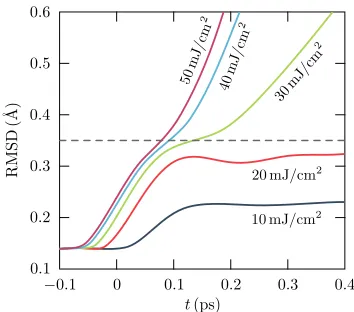
FIG. 4: The root-mean-square deviation of the atomic positions in response to a laser pulse att= 0 with the
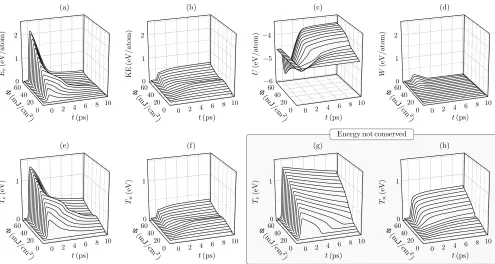
[image:7.612.316.568.53.176.2] [image:7.612.55.305.53.171.2] [image:7.612.347.524.516.672.2]FIG. 5: (a)-(d) The time evolution of the four Hamiltonian components in response to an ultrafast laser pulse at t= 0 for a range of absorbed fluences Φ, as well as the (e) electronic temperature and (f) nuclear temperature. (g)
and (h) are the same as (e) and (f), respectively, but for simulations that do not conserve energy.
in Figure 3(a). When modelling phase transitions with a femtosecond temporal resolution, it is not practical to define a hard threshold that demarcates the crystalline phase from the melt. Nevertheless, a qualitative change in the order parameter can be seen to occur in the vicin-ity of∼30 mJ/cm2, indicative of a phase transition, as
expected. Further information about the melting pro-cess can be gleaned from the root-mean-square deviation (RMSD) of the atomic positions over time, shown in Fig-ure 4. For the fluences that do not give rise to nonther-mal melting (Φ < 30 mJ/cm2), the RMSD is confined
to approximately 0.35 ˚A of deviation, which is the same bound estimated from nonadiabaticab initio simulation [13]. The nonlinearity of the RMSD in the initial∼150 fs after the excitation indicates that a small activation barrier to melting remains, in general agreement with Refs [2, 13]. The steady and rapid rise of the RMSD after the structure has melted is indicative of a liquid-like phase rather than an amorphous solid, as previously established to be true [2, 13, 14].
Having deployed an energy-conserving 2T-MD scheme, it is insightful to see how the individual components of the Hamiltonian evolve in response to an electronic exci-tation. Figure 5 shows this for (a) the electronic energy Ee, (b) the nuclear kinetic energy, (c) the interatomic
potential energyU, and (d) the on-the-fly correctionW. Also shown is (e) the electronic temperature Te and (f)
the nuclear temperature Tn. The initial excitation
pro-duces a jump in the electronic energy Ee and
tempera-tureTe, as well as a drop in the potential energyU due
to its Te-dependence. This excitation is attenuated by
the electron-phonon coupling which leads to an increase in the nuclear kinetic energy. As previously described, for the fluence range Φ&30 mJ/cm2, the change in the
potential energy surface leads to the formation of a disor-dered liquid-like phase. This disordering of the configu-ration results in a significant decline in the heat capacity Ce, as evidenced by the more rapid decline in Ee than
Te. This means that, while the electronic temperature
re-mains high, the energy content stored in the electrons has greatly diminished due to the disordering of the atomic structure. The electronic energy is therefore depleted much more rapidly by its exchange with the phonons, leading to a rapid drop in Te at high fluences and an
equilibration with the nuclei within several picoseconds. Note that an initial increase of the fluence across the ∼30 mJ/cm2 threshold causes a decrease in the nuclear temperature by up to 400 K. This non-monotonicity of Tn with respect to Φ is a result of the structure melting
to form a higher-energy configuration which necessarily leads to a decline in the nuclear velocities. The energy componentW will be discussed further below.
It is interesting to compare the evolution of the elec-tronic and nuclear temperatures in our model to those produced using the same method as previous papers which fail to conserve energy. This non-conserving ap-proach involves precomputing the heat capacityCe(Te)
[image:8.612.61.556.56.320.2]di-amond phase, and also neglects the W correction. The resulting temperature evolution is shown in Figures 5(g) and (h) and should be compared with the respective plots in Figures 5(e) and (f) for which the energy is correctly conserved. Since the heat capacity is not a function of the configuration in the non-conserving approach, it is unperturbed by the phase transition, displaying a steady increase inTewith increasing fluence, and a
correspond-ingly large increase in the nuclear temperature. Even af-ter 10 ps the two subsystems have yet to equilibrate, and yet the nuclear temperature has reached twice its value in the conserved system. Taking care to correctly conserve the energy, therefore, has significant consequence for the evolution of the system.
In Section IIB, a many-body energy correctionW was introduced to the Hamiltonian to compensate for the fact that certain configurations produce, at certain electronic temperatures, heat capacities Ce that are unphysically
small or even negative. This correction is indeed acti-vated for our potential, as shown in Figure 5(d). Specif-ically, it is activated when the structure is highly dis-ordered and the electronic temperature sufficiently el-evated. The magnitude of W is visibly small, on the order of one-tenth of the energy dumped into the sys-tem by the laser, but it nevertheless has some observable dynamical effects. Figure 3 shows the evolution of the centrosymmetry order parameter for (a) when energy is conserved and the on-the-fly energy correction enabled, and (b) when the energy is not conserved and the cor-rection disabled. In the latter case, the order param-eter initially spikes as the large Te flattens the
poten-tial energy surface, permitting the exploration of highly non-centrosymmetric configurations. As the electronic temperature begins to drop, the atomic forces are par-tially restored, driving the configuration back towards increased centrosymmetry. Thereafter, the nuclei heat up through electron-phonon coupling, providing enough energy for the structure to access regions of greater disor-der (less centrosymmetry). This initial spike is not seen when the on-the-fly correction is enabled, becauseW in-creases the energy cost of such highly disordered (highly non-centrosymmetric) structures, making them inacces-sible at the prevailing nuclear temperatures.
The activation of W for these highly non-centrosymmetric structures indicates that the potential energyUdeclines too rapidly with respect toTefor those
particular structures. The fact that the functional form and parameterization of our interatomic potential should exhibit an unphysical drop in U for these particular structures is not obviousa priori, and demonstrates the expediency of an on-the-fly correction.
V. CONCLUSIONS
When radiation is delivered on a femtosecond timescale, it can drive the electrons and nuclei out of equilibrium, producing hot electrons and cool nuclei. The
hot electrons modify the potential energy surface and can induce rapid phase transitions. Such electronic effects can be incorporated into two-temperature molecular sim-ulation with the use of electronic-temperature-dependent force fields. However, previous attempts to deploy such force fields have failed to conserve energy.
In this paper, a rigorous formulation for two-temperature molecular dynamics with electronic-temperature-dependent force fields has been presented, revealing that the interatomic potential energy forms a component of the electronic heat capacity, and that evaluating the heat capacity as a function of the atomic configuration leads to conserved energy. It transpires, however, that an energy-conserving scheme imposes a constraint on the interatomic potential which, in general, may not be satisfied. To resolve this, we advocate for the use of an on-the-fly correction to the Hamiltonian that introduces an energy penalty where necessary so as to retain a physical electronic heat capacity.
Within this energy-conserving framework, a new semi-empirical force field has been derived for silicon. The force field was optimized to reproduceab initio data in the diamond phase, and to melt to form a liquid-like phase at the same excitation observed experimentally. The melting is induced by relaxing the directionality of the bonding, allowing the centrosymmetry of the struc-ture to collapse.
The new force field will enable, for the first time, the accurate simulation of nonthermal processes in strongly-driven silicon systems on large length and time scales. More generally, the new formalism developed in this pa-per lays a foundation for the study of ultrafast dynamics in response to extreme irradiation conditions over large length and time scales.
ACKNOWLEDGMENTS
RD, STM, and DMD acknowledge funding from the Leverhulme Trust under Grant No. RPG-2013-331. PWM has worked within the framework of the EUROfu-sion Consortium and has received funding from the Eu-ratom research and training programme 2014-2018 under Grant Agreements No. 633053 and No. 755039, and has been partially funded by the RCUK Energy Programme (Grant No. EP/P012450/1). The views and opinions ex-pressed herein do not necessarily reflect those of the Eu-ropean Commission.
Appendix A: On-the-fly energy correction: functional form and force derivation
In this work, the Hamiltonian contains a many-body energy correction W which is expressed in terms of its Te-derivativew. As described in Section II B, the precise
in Eqs. (11)-(13). In this work we employ the following function:
w(Ce, >0) =
−Ce Ce≤0
−9 8
πsin
π
2
Ce
+183πsin 32πCe
−1
2Ce 0< Ce<2
0 Ce≥2
, (A1)
which has a correspondingf value of 2. The auxiliary forces that arise from the energy correc-tionW are given in Eq. (10). Here we provide a deriva-tion that follows on from Eq. (8):
−∂W ∂Rk
({Ri}, Te) =−
Z Te
0
∂w ∂Rk
(Ce({Ri}, Te0), (T
0
e))dT
0
e (A2)
=− Z Te
0
∂w ∂Ce
(Ce({Ri}, Te0), (Te0))
∂2U
∂Rk∂T0
e
({Ri}, Te0)dTe0 (A3)
=−∂w ∂Ce
(Ce({Ri}, Te), (Te))
∂U
∂Rk({Ri}, Te)
+ ∂w ∂Ce
(Ce({Ri},0), (0))
∂U
∂Rk({Ri},0) (A4)
+ Z Te
0
∂2w
∂T0
e∂Ce
(Ce({Ri}, Te0), (T
0
e))
∂U ∂Rk
({Ri}, Te0)dTe0
where partial integration has been applied to Eq. (A3) to obtain Eq. (A4). If we assume∂U/∂Te(Te= 0)≡0 then
Ce({Ri},0) =dEe/dTe(0) which is greater than or equal
tof (0) per Eq. (14). It then follows from Eq. (12) and the differentiability ofw that ∂w/∂Ce(Te= 0) ≡0 and
thus the second term in Eq. (A4) is zero, giving rise to the expression for the auxiliary forces given in Eq. (10).
Appendix B:Te-dependent silicon force field in full
Here we assemble the Te-dependent silicon force field
presented in this paper, including all of the functions and parameters, except for the functions A(Te), B(Te), and
λ(Te), which are provided as tabulations in the
Supple-mental Material[66].
The equations that collectively define the Te
U({Ri}, Te) =
1 2
X
i6=j
fc(rij)(A(Te)e−λ1rij−bij({Ri}, Te)B(Te)e−λ2rij), (B1)
bij({Ri}, Te) = (1 +ζij({Ri}, Te)η)−δ, (B2)
ζij({Ri}, Te) =
X
k6=i,j
fc(rik) [g(θijk)−Λ(g(θijk)−g0, λ(Te))]eα(rij−rik)
β
, (B3)
g0=g(cos−1(−1/3)), (B4)
g(θ) =c1+
c2(h−cosθ)2
c3+ (h−cosθ)2
1 +c4e−c5(h−cosθ) 2
, (B5)
Λ(x, y≥0) = sgn(x)
|x| |x| ≤y/√2
q
y2−(y√2− |x|)2 y/√2<|x|< y√2
y |x| ≥y√2
, (B6)
fc(r) =
1 r≤R1
1 2+
9 16cos
π r−R1 R2−R1
− 1
16cos
3π r−R1 R2−R1
R1< r < R2
0 r≥R2
. (B7)
A general description of this force field can be found in Section III. The value of each parameter is provided in Table I, where the values were taken from [53] except forR1,R2, andαwhich were taken from [33].
Also required to apply our 2T-MD model is the Langevin damping parameter γ = 1 g/mol/ps, which determines the electron-phonon coupling rate; a lower bound on the electronic heat capacity for which we use (Te) = 17dEdTee(Te); and the following function for the
elec-tronic energy Ee(Te) was obtained by fitting to the ab
initio data:
Ee(Te) = (10−3)Te+ (1.05125)Te2+ (0.0770416)T
4
e (B8)
where Te is assumed to be in units of eV, and Ee has
units of eV/atom.
Appendix C: Simulation of laser-irradiated nanofilms
The simulations in this paper are intended to re-produce the system studied experimentally by Harb et al. [1, 2] which involved 50 nm thick Si nanofilms irradi-ated with a single ultrafast optical pulse. The pulse had a spot size of 230 µm and a temporal full width at half maximum (FWHM) of 150 fs.
We model this setup using two-temperature molecular dynamics, the theoretical details of which are presented in Section IIA. Our simulation cell consists of a 50×50× 92 silicon lattice composed of 1,840,000 atoms, with a lattice parameter of 5.431 ˚A. The cell is periodic only in the xy-plane so as to represent a 50 nm thick nanofilm that extends infinitely laterally. The nuclei and electrons are equilibrated at 300 K, after which the configuration is integrated in the microcanonical ensemble.
Parameter Value
λ1 (˚A−1) 3.2300135
λ2 (˚A−1) 1.3457970
η 1
δ 0.53298909
α 1.9
β 1
c1 0.20173476
c2 730418.72
c3 1000000
c4 1
c5 26
h −0.365
R1(˚A) 3.1
[image:11.612.145.562.66.479.2]R2(˚A) 3.4
TABLE I: The force field parameters employed in this work, taken from Refs [33, 53]. The parametersA,B andλare provided asTe-dependent tabulations in the
Supplemental Material[66].
The laser pulse is delivered with a Gaussian tempo-ral profile and is assumed to excite the crystal uniformly. This is justified by the following observations: The exper-imental probe observes a smaller spot size than the pulse, and on the picosecond timescale, there will be negligible lateral thermal diffusion over the∼102 µm length scale.
equation (4),
Q(t) = Φ tph
r 4 log 2
π exp(−4 log 2(t−t0)
2/t2
p), (C1)
where Φ is the absorbed fluence, h is the thickness of the nanofilm, t0 is the time at which the pulse is at a
maximum, andtp is the FWHM.
The method, including the Te-dependent force field,
has been implemented into an in-house LAMMPS [67] package which is available upon request.
[1] M. Harb, R. Ernstorfer, T. Dartigalongue, C. T. Hebeisen, R. E. Jordan, and R. D. Miller, The Jour-nal of Physical Chemistry B110, 25308 (2006).
[2] M. Harb, R. Ernstorfer, C. T. Hebeisen, G. Sciaini, W. Peng, T. Dartigalongue, M. A. Eriksson, M. G. La-gally, S. G. Kruglik, and R. D. Miller, Physical review letters100, 155504 (2008).
[3] S. Sundaram and E. Mazur, Nature materials 1, 217 (2002).
[4] C. Shank, R. Yen, and C. Hirlimann, Physical Review Letters50, 454 (1983).
[5] H. W. Tom, G. Aumiller, and C. Brito-Cruz, Physical review letters60, 1438 (1988).
[6] J. Van Vechten, R. Tsu, and F. Saris, Physics Letters A
74, 422 (1979).
[7] C. W. Siders, A. Cavalleri, K. Sokolowski-Tinten, C. Toth, T. Guo, M. Kammler, M. H. Von Hoegen, K. R. Wilson, D. von der Linde, and C. P. Barty, Science286, 1340 (1999).
[8] A. Cavalleri, C. Siders, F. Brown, D. Leitner, C. Toth, J. Squier, C. Barty, K. Wilson, K. Sokolowski-Tinten, M. H. Von Hoegen,et al., Physical review letters85, 586 (2000).
[9] K. Sokolowski-Tinten, J. Bialkowski, and D. von der Linde, Physical Review B51, 14186 (1995).
[10] A. Lindenberg, I. Kang, S. L. Johnson, T. Missalla, P. Heimann, Z. Chang, J. Larsson, P. Bucksbaum, H. Kapteyn, H. Padmore, et al., Physical review letters
84, 111 (2000).
[11] X.-B. Li, X. Liu, X. Liu, D. Han, Z. Zhang, X. Han, H.-B. Sun, and S. Zhang, Physical review letters107, 015501 (2011).
[12] K. Bennemann, Journal of Physics: Condensed Matter
23, 073202 (2011).
[13] C. Lian, S. Zhang, and S. Meng, Physical Review B94, 184310 (2016).
[14] N. Medvedev, Z. Li, and B. Ziaja, Physical Review B
91, 054113 (2015).
[15] T. Zier, E. S. Zijlstra, S. Krylow, and M. E. Garcia, Applied Physics A123, 625 (2017).
[16] V. Recoules, J. Cl´erouin, G. Z´erah, P. Anglade, and S. Mazevet, Physical review letters96, 055503 (2006). [17] P. L. Silvestrelli, A. Alavi, M. Parrinello, and D. Frenkel,
Physical review letters77, 3149 (1996).
[18] P. L. Silvestrelli and M. Parrinello, Journal of applied physics83, 2478 (1998).
[19] T. Zier, E. S. Zijlstra, A. Kalitsov, I. Theodonis, and M. E. Garcia, Structural Dynamics2, 054101 (2015). [20] T. Zier, E. S. Zijlstra, and M. E. Garcia, Applied Physics
A117, 1 (2014).
[21] P. Stampfli and K. Bennemann, Physical Review B42, 7163 (1990).
[22] P. Stampfli and K. Bennemann, Physical Review B49,
7299 (1994).
[23] H. M. Van Driel, Physical Review B35, 8166 (1987). [24] G. S. Khara, S. T. Murphy, S. L. Daraszewicz, and D. M.
Duffy, Journal of Physics: Condensed Matter28, 395201 (2016).
[25] P. Lorazo, L. J. Lewis, and M. Meunier, Physical Review B73, 134108 (2006).
[26] V. Lipp, B. Rethfeld, M. Garcia, and D. Ivanov, Physical Review B90, 245306 (2014).
[27] A. R¨amer, O. Osmani, and B. Rethfeld, Journal of Ap-plied Physics116, 053508 (2014).
[28] Y. Gan and J. Chen, Applied Physics A105, 427 (2011). [29] D. Korfiatis, K. T. Thoma, and J. Vardaxoglou, Journal
of Physics D: Applied Physics40, 6803 (2007).
[30] R. Darkins and D. M. Duffy, Computational Materials Science147, 145 (2018).
[31] K. Bennemann, Journal of Physics: Condensed Matter
16, R995 (2004).
[32] L. Shokeen and P. K. Schelling, Applied Physics Letters
97, 151907 (2010).
[33] L. Shokeen and P. K. Schelling, Journal of Applied Physics109, 073503 (2011).
[34] L. Shokeen and P. K. Schelling, Computational Materials Science67, 316 (2013).
[35] S. Khakshouri, D. Alfe, and D. Duffy, Physical Review B78, 224304 (2008).
[36] S. T. Murphy, S. L. Daraszewicz, Y. Giret, M. Watkins, A. L. Shluger, K. Tanimura, and D. M. Duffy, Physical Review B92, 134110 (2015).
[37] G. Norman, S. Starikov, and V. Stegailov, Journal of Experimental and Theoretical Physics114, 792 (2012). [38] J. A. Moriarty, R. Q. Hood, and L. H. Yang, Physical
review letters108, 036401 (2012).
[39] M. Weinert and J. Davenport, Physical Review B 45, 13709 (1992).
[40] R. M. Wentzcovitch, J. L. Martins, and P. B. Allen, Physical Review B45, 11372 (1992).
[41] V. Lipp, D. Ivanov, B. Rethfeld, and M. Garcia, Journal of Optical Technology81, 254 (2014).
[42] S. Chandrasekhar, Reviews of modern physics 15, 1 (1943).
[43] R. Kubo, Reports on progress in physics29, 255 (1966). [44] W. T. Coffey, Y. P. Kalmykov, and J. Waldron, Chem-istry and Electrical Engineering. World Scientific (2004). [45] A. Rutherford and D. Duffy, Journal of Physics:
Con-densed Matter19, 496201 (2007).
[46] P.-W. Ma, S. Dudarev, and C. Woo, Physical Review B
85, 184301 (2012).
[47] K. Furutsu, J. Res. Natl. Bur. Stand., Sect. D67, 303 (1963).
[48] E. A. Novikov, Sov. Phys. JETP20, 1290 (1965). [49] I. Cook, Plasma Physics20, 349 (1978).
physics131, 074701 (2009).
[51] N. Hatano and M. Suzuki, in Quantum annealing and other optimization methods (Springer, 2005) pp. 37–68. [52] G. Tsibidis, M. Barberoglou, P. Loukakos, E. Stratakis,
and C. Fotakis, arXiv preprint arXiv:1007.5415 (2010). [53] T. Kumagai, S. Izumi, S. Hara, and S. Sakai,
Computa-tional materials science39, 457 (2007). [54] J. Tersoff, Physical Review B38, 9902 (1988).
[55] G. P. Pun and Y. Mishin, Physical Review B95, 224103 (2017).
[56] P. K. Schelling, Computational Materials Science44, 274 (2008).
[57] G. Kresse and J. Hafner, Physical Review B 47, 558 (1993).
[58] G. Kresse and J. Hafner, Physical Review B 49, 14251 (1994).
[59] G. Kresse and J. Furthm¨uller, Computational materials science6, 15 (1996).
[60] G. Kresse, Phys. Rev. B54, 11169 (1996).
[61] N. D. Mermin, Physical Review137, A1441 (1965). [62] Y. Zhao and D. G. Truhlar, The Journal of chemical
physics125, 194101 (2006).
[63] Y. Zhao and D. G. Truhlar, The Journal of chemical physics130, 074103 (2009).
[64] J. W. Precker and M. A. da Silva, American Journal of Physics70, 1150 (2002).
[65] J. P. Perdew, K. Burke, and M. Ernzerhof, Physical review letters77, 3865 (1996).
[66] See Supplemental Material at [URL] for a tabulation file containing the dependence ofA,B, andλonTe. [67] S. Plimpton, Journal of computational physics 117, 1
![FIG. 1: (a) The dependence of the Aevolution of the nuclear temperaturecalculation, the circles are experimental data points [1]](https://thumb-us.123doks.com/thumbv2/123dok_us/9323358.434251/6.612.54.304.53.262/fig-dependence-aevolution-nuclear-temperaturecalculation-circles-experimental-points.webp)
![TABLE I: The force field parameters employed in thiswork, taken from Refs [33, 53]. The parametersand A, B λ are provided as Te-dependent tabulations in theSupplemental Material[66].](https://thumb-us.123doks.com/thumbv2/123dok_us/9323358.434251/11.612.145.562.66.479/parameters-employed-parametersand-provided-dependent-tabulations-thesupplemental-material.webp)
