© 2019, IRJET | Impact Factor value: 7.34 | ISO 9001:2008 Certified Journal | Page 1429
DESIGN AND ANALYSIS OF PROGRESSIVE TOOL FOR U-BRACKET OF
POWER METER CABINET
Narayan Chouhan
1, N Manjunath Gowda
2, Satish Kumar S
31
M.Tech Student, Dept. of studies in mechanical Engg, UBDTCE, Davangere, Karnataka, India
2Assistant Professor, Dept. of studies in mechanical Engg, UBDTCE, Davangere, Karnataka, India
3
Partner, Elite Insulators, Mallashettyhalli (Davangere dist), Karnataka, India
---***---Abstract -
In the present situation, the production ofU-brackets are made with a new raw material and in a two different tools, each tool requires press machines which leads to the usage of more resources and considerable financial loss thus the industry stopped the production of U-brackets and given out sources for the production. The present U-bracket components can be done using scrap material which is sufficiently available in industry and it has not all used for any other production. Considering all these criteria, the existing tools can be simplified with a single progressive tool so that usage of more resources can be simplified and can be done using scrap material and raw material cost will be saved. In this work a three stage progressive tool has been designed and analyzed the stresses and deformation for different parts of progressive tool like top plate, bottom plate, die plate, stripper plate and guide pillar. A progressive tool performs two or more operations at different stages in a single stroke of ram to produce the part as the strip moves through the die. Modeling is carried out in SOLID EDGE VERSION 20 and simulation is carried out in ANSYS WORKBENCH 18.1 and result obtained from analysis is validated with manual calculations. The designed tool will help the industry to manufacture the part rather than outsourcing and hence saves money. 30T available mechanical press can be used with newly designed tool as the press capacity is greater than the required.
Key Words: Progressive tool, U-Bracket, Scrap material, Raw material, Press capacity
1. INTRODUCTION
In recent day’s different kinds of sheet metal developing processes were using in sheet metal product manufacturing companies. These sheet metal developing processes have been using for manufacturing various sections of airplanes, vehicles and ships etc. by using the complicated devices discovered from modern innovations. With the ever growing knowledge of science and technology, the progressive tool design process has become more precise to satisfy the demand of more productivity, low price and better exactness. For a better improvement, the more delicate design development of today has not replaced the need for basic sheet forming of dies and process. The popularity of sheet metal stamping process is due to its high productivity, ease in manufacturing of intricate shapes and will be done at lower cost. The parts manufactured from the
sheet metal have well good-looking qualities, better dimension accuracy, light weight and higher strength.
For a better improvement, the more delicate design development of today has not replaced the need for basic sheet forming of dies and process. The popularity of sheet metal stamping process is due to its high productivity, ease in manufacturing of intricate shapes and will be done at lower cost. The parts manufactured from the sheet metal have well good-looking qualities, better dimension accuracy, light weight and higher strength.
2. COMPONENT DATA
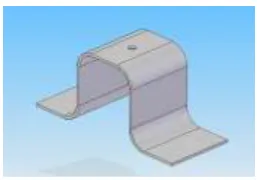
Component Name: U-Bracket Material: CRCA Steel
Thickness: 0.8mm
Shear strength: 36 Kg/mm2 Tempered Grade: Cold Rolled
Fig -1: Solid model of component
U-bracket is a small component used in the meter cabinets to fix the domestic power meters. The 2D drawing is received from the industry.
3. PROBLEM STATEMENT
Currently for window cutting operation of the top box, the material of dimension 100×90mm has been wasting as scrap material and decreasing the productivity.
The industry used separate two separate press tools and machines for each sheet metal operations of U-bracket thus stopped production and outsourcing it.
[image:1.595.369.498.460.550.2]© 2019, IRJET | Impact Factor value: 7.34 | ISO 9001:2008 Certified Journal | Page 1430
By analyzing the recorded problems it came to know that the problems became an obstacle to the production improvement.
3.1 Objectives of Work
To know the source of causes of less productivity in Elite Insulators and propose the possible of improvement in present production line.
Collecting geometrical details which describe size, shape and additional description of the component (U-bracket).
Modification of tool to use the available scrap material.
Suggesting the new tool as progressive tool.
4. METHODOLOGY
Fig -2: Methodology Adopted
5.
MODELING AND MATERIAL SELECTION
5.1 3D Model of Progressive Tool
Fig -3: Progressive Tool Assembly
Fig -4: Strip Layout
5.2 2D Drawings of Progressive tool and component
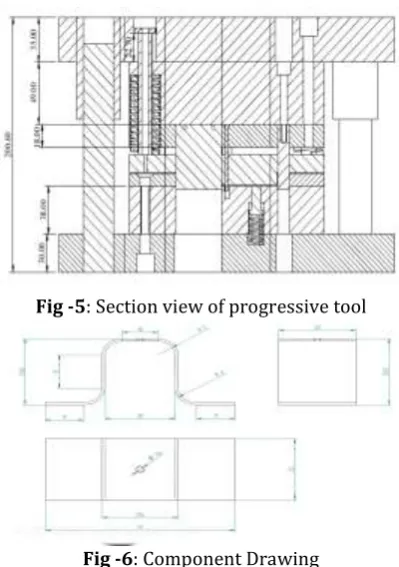
Fig -5: Section view of progressive tool
Fig -6: Component Drawing
5.3 Mechanical Properties of Tool Materials
Table -1: Mechanical properties
Property Mild steel
(st-42) HCHC steel (D2 steel)
EN-31 Steel Mass Density
(Kg/m3) 7850 7700 7700
Yield strength
(Mpa) 250 1532 450
Ultimate Tensile Strength (mpa)
460 1320 750
Possion’s ratio 0.303 0.3 0.3 Shear
modulus(Gpa) 78 79 86
Young’s
[image:2.595.318.549.99.211.2] [image:2.595.333.533.242.526.2] [image:2.595.56.263.287.521.2] [image:2.595.51.536.582.789.2]© 2019, IRJET | Impact Factor value: 7.34 | ISO 9001:2008 Certified Journal | Page 1431
6. DESIGN CALCULATIONS
6.1 Strip layout Development
Scrap Bridge (B) = (1 to 1.25)t B=1mm
Margin (M) = (1.25 to 1.5).t
M=1.5mm
Area of Blank (component) = 22×87 =1914mm
No. of Rows = 1
Pitch=Advance of die = L+B, where L = Length of blank =24mm
Economy Factor = (blank size area × No. of rows)/ (Strip breadth × Pitch) ×100
Economy Factor = 92.46%
% of strip used = ×100
=88.61%
% of scrap = 100-88.61 = 11.31%
6.2 Die clearance and Tool Life
Die clearance = thickness of work piece× suggested % For steel, Die clearance = (2.5 - 5%) t, where t=thickness of sheet
Min. Die clearance = 0.02mm Max. Die clearance = 0.04mm
Max clearance can cause burr and min clearance cause repeated reshaping of die and tool life decreases.
For better tool life, the die clearance has an optimum average value. Optimum value can be calculated by averaging the min and max die clearances.
Optimum clearance = 0.02+0.04/2 = 0.03mm
6.3 Force calculations Shearing force
Fsh = L×t×fs
Where Fsh = shear force or cutting force in tons fs = shear strength in Kg/mm2
L = cutting length in mm t= thickness of sheet = 0.8mm
At stage 1, pitch punch Cutting length L1 = 54mm
At stage 2, parting with embossing Cutting length L2 = 171mm
At stage 3, small cut-off Cutting Lengt L3 = 20mm
Total cutting length L = L1+L2+L3 =245mm
Fsh = 7056Kgf
Fsh = 7056×0.6 (for safety purpose 60% additional force is added)
Fsh = 4233.3Kgf
Fsh1 = 7056+4233.3 = 11529.6 Kgf
Again 20% of force is added to make the tool theoretically strong
Fsh2 = 11529.6×0.2 = 2305.92 Kgf
Total shearing force = Fsh1+Fsh2 = 13835.52 =14000 Kgf
= 14T Stripping Force
Stripping force = 15% of shear force = 0.15×14 = 2.1T
Total Force (F) = stripping Force+ Shearing Force ` = 14+2.1+2.1 = 16.1T
6.4 Press Capacity
The total press capacity is 125% more than the total force calculated therefore
Pc = total tonnage×1.25 = 20.125T
6.5 Stress and deflection calculation for different elements of Progressive tool
a) Die Plate
Die plate is considered as a fixed beam. The shoe deflection is computed from strength of material concept for fixed beam. Equation for deflection is given by
δ =
Where,
F=80% of shearing force = 109834.4N E - Young’s modulus = 2.1×10⁵N/mm2 I- Moment of inertia of plate in mm4
L- Least distance b/w successive fasteners=45.6mm Width, B = 167mm and thickness, H = 38mm
F = 109834.4 N I =
I = 763635.33 mm4 δ= 0.0003382mm
Stress generated in the die plate is given by, σ = Where A = B×H = 167×38 = 6346mm2
σ =17.304 N/mm2
b) Bottom Plate
Bottom plate is supported by number of parallel blocks hence we consider it as a simply supported beam. Using strength of materials, the deflection for simply supported beam with concentrated load, deflection equation is given below
© 2019, IRJET | Impact Factor value: 7.34 | ISO 9001:2008 Certified Journal | Page 1432
B = 287mm and H = 30mmL = 62mm I = 645750 mm4 δ = 0.0040215mm σ = = 6.172 N/mm2
C) Top Plate
For analysis top plate is considered as a simply supported beam with concentrated load acting on it. The equation is given by
δ =
,
where F=80%shearing force = 109834.4NB = 287mm and H = 35mm L = 60mm
I = = 1025427.083mm4 δ =0.0022952mm
σ = = 10.93N/mm2
D) Stripper Plate
Assuming stripper plate to be a fixed beam, the deflection and stress calculation is done by adopting SOM concept as
F = 20% shearing force = 27458.6 N B = 167mm and H = 24mm
L = 60mm
F = 20% shearing force = 27458.6 N I = = 192384mm4
δ = = 0.0007468mm
σ = = 6.850N/mm2
E) Guide Pillar
Considering guide pillar as a cantilever beam with load acting vertically on it and guide pillar is considered as one side fixed and another side for free column construction. From strength of material, for column construction of one side is fixed and another side is free type.
Load acting on guide pillar = 80% shearing force = 109834.4N
Load per pillar P = = 54917N
Crippling load Pc =
Where, E = 2.15×10⁵ N/mm2 Diameter of pillar = d = 28mm Pillar length = l = 150mm
I = = 30175.768 mm4
Pc = 482708.54 N < 54917N
Since applied load is less than the crippling load therefore applied load is harmless for design.
A = = 615.83mm2
δ = = = 0.0636969 mm
σ = = 89.9N/mm2
7. FINITE ELEMENT ANALYSIS
Finite element analysis was carried out in Ansys workbench 18.1. For analysis of tool, the five major elements of tool were chosen based on the maximum loading conditions. This helps to predict real condition of tool components in the operation. This helps to eliminate traditional way of validating the results by making prototype model and also saves time and money.
Meshing Condition
Table-2: Meshing Conditions
Parameters Chosen Physical preference Mechanical Element used Solid 185
Element shape Tetra hadron(Default) Element size Default
Mesh type Medium size mesh
Analysis is done on die plate, bottom plate, top plate, and stripper plate and guide pillar. The results obtained from analysis is given below
i) Die Plate: for Die Plate D2 steel is chosen
© 2019, IRJET | Impact Factor value: 7.34 | ISO 9001:2008 Certified Journal | Page 1433
Fig-8: Equivalent stresses on Die Plateii) Bottom Plate: For bottom plate Mild steel is used
Fig-9: Total deformation of bottom Plate
Fig-10: Equivalent stresses on bottom Plate
iii) Top Plate
Fig-11: Total deformation of Top Plate
Fig-12: Equivalent stresses on Top Plate
iv) Stripper Plate: For Stripper plate EN-31 steel is used for Analysis
Fig-13: Total deformation of Stripper Plate
Fig-14: Equivalent stresses on die Plate
v) Guide Pillar
© 2019, IRJET | Impact Factor value: 7.34 | ISO 9001:2008 Certified Journal | Page 1434
Fig-16: Equivalent stresses on Guide Pillar8. RESULT AND DISCUSSION
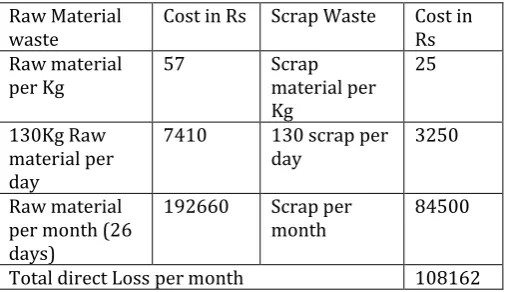
[image:6.595.46.280.102.230.2]The following Table- 3 shows the results of the cost analysis done for the raw materials and scrap materials which has been wasting and not using for any other purposes.
Table-3: Cost Analysis of Material for U-Bracket
Raw Material
waste Cost in Rs Scrap Waste Cost in Rs Raw material
per Kg 57 Scrap material per Kg
25
130Kg Raw material per day
7410 130 scrap per
day 3250
Raw material per month (26 days)
192660 Scrap per
month 84500
Total direct Loss per month 108162
[image:6.595.36.290.347.493.2]Table- 4 shows the U-bracket component cost analysis and savings done by use of new designed tool
Table-4: Cost analysis of component
Description Cost
Present cost of component Rs.2 New component raw material cost per
piece 0.32 paise
Processing cost for new component 0.50 paise
Savings per component Rs.1.18
Table 5 and table 6 show the results obtained by ANSYS and theoretical calculations are made for different components of the progressive tool and results are compared with the Ansys Result
Table- 4: Deformation Result
Components Ansys Result Theoretical Result Deformation
in mm Deformation in mm Die plate 0.00093685 0.0003382
Top Plate 0.00035361 0.0040215 Bottom Plate 0.001256 0.0022952 Stripper
[image:6.595.34.291.564.650.2]Plate 0.00014901 0.0007468 Guide Pillar 0.076174 0.0636969
Table-4: Stress Result
Components Yield strength (Mpa)
Ansys
Result Theoretical Result
Stress in
Mpa Stress in Mpa
Die Plate 1532 15.52 17.304
Top Plate 250 4.0376 6.172
Bottom Plate 250 12.19 10.93
Stripper Plate 450 3.4116 6.850
Guide Pillar 450 96.9 89.5
9. CONCLUSION
Progressive die is a cost-effective method to produce sheet metal parts with different characteristics which include strength, toughness and abrasion resistance, by the use of newly designed progressive tool it is possible to overcome the financial losses facing by the industry and Rs. 1, 08, 162 can be saved per month and also with this tool the cost of the component per piece is saved by Rs. 1.18. FEA analysis done for different parts and it is seen that results are in acceptable range and stress values obtained are less then yield strength of material and Deformations obtained from manual calculations closely match with Ansys results and were small in the range of recommended deformation. Bed size of mechanical press is 558×358 and tool dimension is 287×228mm therefore designed progressive tool perfectly fits onto the bed of mechanical press.
REFERENCES
[1] Gashaw Desie and YONAS Mitiku Degu, “Progressive Die Design for Engineering and Science (IJES), volume 3, issue 3, Pages 75-85, 2014.
[2] Sunil Kumar and Lokeswar Patnaik, “Design and Analysis of Four stage Progressive Tool for House-wiring Wire Clip”, CVR Journal of Science and Technology, Volume13, December 2017.
© 2019, IRJET | Impact Factor value: 7.34 | ISO 9001:2008 Certified Journal | Page 1435
[4] M Subrahmanyam, A Mokhalingam, “InternationalJournal of Engineering Research and Technology (IJERT)”, Volume 5, Issue 06, June-2016.
[5] Gaurav C Rathode, Samadhan Adlinge, Dr. D N Raut, “International Journal of Engineering Research and Technology (IJERT)’, ISSN : 2278-0181.
[6] Prabhakar Purushothaman, Prashant Thankachan, “American Journal of Mechanical and Industrial Engineering”, October -2016; 1(3): 31-37 pages. [7] Kassahun Nigussie Asfew, Wassihum Yimer Amdie,
“International Journal of Industrial and Manufacturing Systems Engineering”, Volume 2(3), 2017, pages 19-23 [8] Cyril Donaldson, George H LeCain, V C Goold, Tool
Design 4th edition, Tata McGraw – Hill.