© 2019, IRJET | Impact Factor value: 7.34 | ISO 9001:2008 Certified Journal
| Page 787
Optimization of Process Parameters in MIG Welding of AISI 316L
Mr. Dahitankar Suhas Baliram
1, Prof.
S.S. Sarpate
21
PG Student, MPGI, Intigrated Campus, Nanded, Nanded, Maharashtra, India.
2Assistent Professor, MPGI, Intigrated Campus, Nanded, Maharashtra, India.
---***---Abstract -
Now a days the scope of arc welding is increasing in the various engineering fields such as aerospace, nuclear & under water industries. Also, the traditional applications of arc welding have increased their demands in quality, cost, accuracy & volume. So, the process parameters are required to improve the existing process of welding. Metal Inert Gas (MIG) welding also known as Gas Metal Arc Welding (GMAW), is a process that utilizes a continuously feeding of solid electrode and electrical power to melt the electrode and deposit this molten material in the weld joint. The equipment automatically regulates the electrical characteristics of arc. MIG welding process is used for joining of similar and dissimilar metals. The main aim of our project is to study the MIG welding parameters optimization with the help of TAGUCHI. In this study, stainless steel 136 are joined by using MIG welding. Two parameters of MIG welding such as Current, Voltage are taken as input parameters. By varying these parameters, the tensile strength will be checked. The tensile strength was checked with the help of UTM. MINITAB software is used to get the optimization results. The analysis of signal to noise ratio will be done with the help of MINITAB software for higher the better characteristics. Finally, the confirmation tests will be performed to compare the predicted values with the experimental values which will confirm its effectiveness in the analysis of tensile strength of the joint & then the result & conclusion will be drawnINTRODUCTION
Welding is a process of joining of two metals. It is most economical process than casting and riveting. There are several methods of welding processes. Of all the arc welding processes, Metal Inert Gas (MIG) welding is capable of achieving the highest quality welds. MIG welding is one of the most widely used processes in industry. It can be used with virtually any weld-able metals, including dissimilar metals, and thicknesses from 0.5mm upwards. MIG welding is a commonly used high deposition rate welding process. The input parameters play a very significant role in determining the quality of a welded joint. In fact, weld geometry directly affects the complexity of weld schedules and thereby the construction and manufacturing costs of aluminum structures and mechanical devices reduces. Therefore, these parameters affecting the arc and welding path should be estimated and their changing conditions during process must be known before in order to obtain optimum results, in fact a perfect arc can be achieved when all the parameters are in conformity. These are combined in two groups as first order adjustable and second order
adjustable parameters defined before welding process. Former are welding current, arc voltage and welding speed. These parameters will affect the weld characteristics to a great extent. Because these factors can be varied over a large range, they are considered the primary adjustments in any welding operation. Their values should be recorded for every different type of weld to permit reproducibility. Other parameters are torch angle, nozzle distance, welding direction, position and the flow rate of gas. However, wire electrode diameter and its composition, type of protective gas are the defined parameters before starting welding and cannot be changed during the process.
Metal Inert Gas welding (MIG) process is an important welding operation for joining ferrous and non ferrous metals. The MIG input welding parameters are the most important factors affecting the quality of the welding and weld quality is strongly characterized by weld bead geometry. MIG welding is a versatile technique suitable for both thin sheet and thick section components. An arc is struck between the end of a wire electrode and the work piece, melting both of them to form a weld pool. MIG is widely used in most industry sectors because of flexibility, deposition rates and suitability for mechanization. Now-a-days, determination of optimum values of process parameters in manufacturing are the areas of great interest for researchers and manufacturing engineers. The input parameters play a very significant role in determining the quality of a welded joint. The parameters affecting the arc and welding should be estimated and their changing conditions during process must be known. The welding parameters are current, arc voltage and welding speed. These parameters will affect the weld characteristics to a great extent. Because these factors can be varied over a large range, they are considered the primary adjustments in any welding operation.
Depth of penetration is the dominant magnitude related to the weld ability of the processed material, the welding conditions, and the strength requirements. Therefore, attempt should be made to maximize depth of penetration.
Weld Bead Geometry.
© 2019, IRJET | Impact Factor value: 7.34 | ISO 9001:2008 Certified Journal
| Page 788
between the base plate top surface and depth to which the fusion has taken place. The more the penetration, the less is the number of welding passes required to fill the weld joint which consequently results in higher production rate. It is observed that the penetration is influenced by welding current, polarity, arc travel speed, electrode stick-out, basicity index and physical properties of the flux. The penetration was directly proportional to welding current.
Fig.1 Weld bead shape parameter. A: Bead width, B: Depth of penetration, C: HAZ width, D: Weld metal, E: Base metal.
Welding gun and wire feed unit
The typical GMAW welding gun has a number of key parts— a control switch, a contact tip, a power cable, a gas nozzle, an electrode conduit and liner, and a gas hose. The control switch, or trigger, when pressed by the operator, initiates the wire feed, electric power, and the shielding gas flow, causing an electric arc to be struck. The contact tip, normally made of copper and sometimes chemically treated to reduce spatter, is connected to the welding power source through the power cable and transmits the electrical energy to the electrode while directing it to the weld area. It must be firmly secured and properly sized, since it must allow the electrode to pass while maintaining electrical contact. On the way to the contact tip, the wire is protected and guided by the electrode conduit and liner, which help prevent buckling and maintain an uninterrupted wire feed. The gas nozzle directs the shielding gas evenly into the welding zone. Inconsistent flow may not adequately protect the weld area. Larger nozzles provide greater shielding gas flow, which is useful for high current welding operations that develop a larger molten weld pool. A gas hose from the tanks of shielding gas supplies the gas to the nozzle. Sometimes, a water hose is also built into the welding gun, cooling the gun in high heat operations.
The wire feed unit supplies the electrode to the work, driving it through the conduit and on to the contact tip. Most models provide the wire at a constant feed rate, but more advanced machines can vary the feed rate in response to the arc length and voltage. Some wire feeders can reach feed rates as high as 30 m/min (1200 in/min), but feed rates for semiautomatic GMAW typically range from 2 to 10 m/min (75 – 400 in/min).
USE OF MIG WELDING:
It can be used to weld all types of commercially available metals and alloys
Welding can be done in all positions with proper selection of equipment and parameters
Using a continuously-fed electrode maintains a high operator duty cycle and minimizes the occurrence of defects on starts and stops
Deep weld penetration can be obtained which permits the use of small weld sizes for equivalent weld strengths in certain applications
Minimal post-weld clean-up is required due to the absence of a covering slag on the weld bead
Welding speeds and weld metal deposition rates are higher than those obtained with Stick Welding
Ideal for multi-pass welding (with proper filler metal selection)
Less operator skill is required compared to Stick Welding
Fume rates are at very low levels compared to Stick Welding and Flux Cored Welding
A wide selection of filler metal compositions and diameters are available to weld thick or thin material
This process is ideal for mechanized welding
This process offers improved electrode deposition efficiency compared to Stick Welding and FCAW
X-ray quality welds can be produced
Welding gun and wire feed unit
© 2019, IRJET | Impact Factor value: 7.34 | ISO 9001:2008 Certified Journal
| Page 789
Tool style
The most common electrode holder is a semiautomatic air-cooled holder. Compressed air circulates through it to maintain moderate temperatures. It is used with lower current levels for welding lap or butt joints. The second most common type of electrode holder is semiautomatic water-cooled, where the only difference is that water takes the place of air. It uses higher current levels for welding T or corner joints. The third typical holder type is a water-cooled automatic electrode holder—which is typically used with automated equipment.
Power supply
Most applications of gas metal arc welding use a constant voltage power supply. As a result, any change in arc length (which is directly related to voltage) results in a large change in heat input and current. A shorter arc length causes a much greater heat input, which makes the wire electrode melt more quickly and thereby restore the original arc length. This helps operators keep the arc length consistent even when manually welding with hand-held welding guns. To achieve a similar effect, sometimes a constant current power source is used in combination with an arc voltage-controlled wire feed unit. In this case, a change in arc length makes the wire feed rate adjust to maintain a relatively constant arc length. In rare circumstances, a constant current power source and a constant wire feed rate unit might be coupled, especially for the welding of metals with high thermal conductivities, such as aluminum. This grants the operator additional control over the heat input into the weld, but requires significant skill to perform successfully.
PROBLEM STATEMENT:
1.Optimizing the machining parameters such as voltage, current & travel speed by using Taguchi method.
2.Different welding experiments are carried out by varying parameters and optimizing the material removal rate (MRR).
OBJECTIVES:
To minimize the uncontrollable factors by using Taguchi method. To study the response variation using Signal-To-Noise ratio. To optimize the machining parameters such as voltage & current.To find out the tensile strength of model.
LITERATURE SURVEY
1. "Multi-Response Optimization of Process Parameters for MIG Welding of AA2219-T87 by Taguchi Grey Relational Analysis " by Arunkumar Sivaramana, SathiyaPaulraja
Aluminium alloy AA2219 is a high strength alloy belonging to 2000 series. It has been widely used for aerospace applications, especially for construction of cryogenic fuel tanks in missiles. However, MIG welding of AA2219 material
is very critical. So, selection of proper process parameters plays a major role in determining the quality of the weld joint. This study focuses on the optimization of process parameters for MIG welding of the material AA219-T87 using Taguchi based grey relational analysis. The welding input parameters play a vital role in optimized desired weld quality. The input parameter chosen were the welding current, Voltage and welding speed. The experiments were conducted according to L9 orthogonal array. AN0VA method was used to assess the significance of factors on the best quality of the weldment. ANOVA results indicated that welding current played a major role on the quality targets (Transverse shrinkage, ultimate tensile strength and hardness) of the weldments followed by welding speed and voltage. Grey relational analysis was applied to optimize the input parameters simultaneously considering multiple output variables. Metallurgical aspects of the weld with highest and lowest grey relational grade was also discussed.
2. "Microstructure and corrosion resistance of Al5083 alloy hybrid Plasma-MIG welds " by Detao Cai, Shanguo Han, Shida Zheng, Ziyi Luo, Yupeng Zhang, Kai Wang The Al5083 alloy was welded by plasma-MIG hybrid welding with optimized parameters of 58A MIG current and 130A plasma current with speed of 4.75 mm/s. Good appearance with defect-free of the joint was got. Microstructures and corrosion resistance of electrochemical impedance spectroscopy and potentiodynamic polarization of the welds and base metal in a 0.5 M NaCl solution at room temperature were investigated. Combined with simulated equivalent circuit by program, the relationship between microstructures and corrosion resistance was obtained. Plasma-MIG hybrid welded metal with as-cast structure presents a better corrosion resistance than the base metal with rolling structure. Unlike other welding method, the plasma-MIG welding method is helpful for improving the corrosion resistance of Al5083 welding joints.
© 2019, IRJET | Impact Factor value: 7.34 | ISO 9001:2008 Certified Journal
| Page 790
welding deformation was similar to the experimental results. Based on the results, the methods to optimize the welding procedure will be provided by SYSWELD to improve muffler productivity.
4. "Parametric Optimization of MIG Welding on 316L Austenitic Stainless Steel by Grey-Based Taguchi Method " by Nabendu Ghosh, Pradip Kumar Palb , Goutam Nandi In the present work, visual inspection and X-ray radiographic test has been conducted in order to detect surface and sub-surface defects of weld specimens made of AISI 316L austenitic stainless steels. Effect of current, gas flow rate and nozzle to plate distance on quality of weld in metal inter gas arc welding of AISI 316L austenitic stainless steel has been studied in the present work through experiments and analyses. Butt welded joints have been made by using several levels of current, gas flow rate and nozzle to plate distance. The quality of the weld has been evaluated in terms of yield strength, ultimate tensile strength and percentage of elongation of the welded specimens. The observed data have been interpreted, discussed and analysed by using Grey - Taguchi methodology.
5. "Optimization of Welding Parameters of Ti 6al 4v Cruciform shape Weld joint to Improve Weld Strength Based on Taguchi Method" by Srinivasa Reddy Vempati, K.Brahma Raju, K.Venkata SubbaiahTIG welding is one of the most extensively used process in industry. The welding parameters are the main factors which affect the cost and quality of welding. In present paper the main objective is to the study the optimum welding parameters to obtain ultimate tensile strength of Ti 6Al 4V weld specimen of. Sequences of experiments are conducted based on Taguchi method. L9 orthogonal array has been used to conduct the experiments at different levels of welding parameters like welding current, travelling speed and welding voltage. These each and every one parameter has different effect on welding quality. Tensile Tests are carried out Tensile Testing Machine at a load range of 25 KN. Analysis of variance (ANOVA), Signal-to-noise ratio (S/N ratio), and graphical mean effect plots for S/N ratio are in use to investigate the optimal level of process parameters to identify the value of ultimate loads on weld and influence of welding parameters on weld strength.
6. "Parametric Optimization of Gas Metal Arc Welding Process by using Taguchi method on Ferritic Stainless Steel AISI409" by Nabendu Ghosha, Ramesh Rudrapatib, Pradip Kumar Palc, Gotam NandiWelding process parameters can play a very significant role in determining the quality of the welded joint in metal inert gas (MIG) welding operation. The elaborated experiments and analysis have been needed to precise control of the MIG welding process to obtain the desired quality characteristics in welded specimens. Present work is planned to study and analyse the effects of welding parameters: welding current, gas flow rate and nozzle to plate distance, on ultimate tensile
strength (UTS) and percentage elongation (PE) in MIG welding of AISI409 ferritic stainless-steel materials. Experiments have been conducted as per L9 orthogonal array of Taguchi method. The visual inspection and X-ray radiographic test have also been conducted in order to detect surface and sub-surface defects of welded specimens. The observed data of UTS and PE have been interpreted, discussed and analysed with use of Taguchi methodology and analysis of signal to noise ratio. Some conclusive remarks have been drawn from the study.
7. "Parametric Optimization of Gas metal arc welding process by PCA based Taguchi method on Austenitic Stainless Steel AISI 316L" by Nabendu Ghosh, Pradip Kumar Palb , Goutam Nandic and Ramesh Rudrapati In the present work AISI 316L stainless steel samples have been welded by MIG welding. Butt joints have been made. Plate thickness is kept constant (= 3mm). Some important parameters have been varied during welding. Thus, several butt-welded joints have been made. Each sample of the joints has been prepared under certain combination of welding parameters. The parameters considered for variation, in the present work have been welding current, gas flow rate and nozzle to plate distance. The influence of the process parameters (mainly current, gas flow rate and nozzle to plate distance) has been examined visually and also through X-ray radiographic tests. Next, samples have been cut, machined to conform to some specified dimensions for tensile testing. The quality of the weld has been evaluated in terms of ultimate strength, yield strength and percentage of elongation of the welded specimens. The observed data have been interpreted, discussed and analysed by using principal component analyses (PCA). Optimum parametric setting has been predicted and validated as well. Useful interpretations of the experimental results and subsequent analysis have been made to draw some meaningful conclusions.
© 2019, IRJET | Impact Factor value: 7.34 | ISO 9001:2008 Certified Journal
| Page 791
9. "Multi-response optimization of process parameters for TIG welding of Incoloy 800HT by Taguchi grey relational analysis " by Arun Kumar Srirangan, Sathiya Paulraj Incoloy 800HT which was selected as one of the prominent materials for fourth generation power plant can exhibit appreciable strength, good resistance to corrosion and oxidation in high temperature environment. This study focuses on the multi-objective optimization using grey relational analysis for Incoloy 800HT welded with tungsten inert arc welding process with N82 filler wire of diameter 1.2 mm. The welding input parameters play a vital role in determining desired weld quality. The experiments were conducted according to L9 orthogonal array. The input parameter chosen were the welding current, Voltage and welding speed. The output response for quality targets chosen were the ultimate tensile strength and yield strength (at room temperature, 750 °C) and impact toughness. Grey relational analysis was applied to optimize the input parameters simultaneously considering multiple output variables. The optimal parameters combination was determined as A2B1C2 i.e. welding current at 110 A, voltage at 10 V and welding speed at 1.5 mm/s. ANOVA method was used to assess the significance of factors on the overall quality of the weldment. The output of the mechanical properties for best and least grey relational grade was validated by the metallurgical characteristics.
10. "Optimization of 316 Stainless Steel Weld Joint Characteristics using Taguchi Technique" by P. Bharatha ,V.G. Sridharb , M. Senthil kumar Welding is one of the most popular methods of metal joining processes. The joining of the materials by welding provides a permanent joint of the components. The objective of this research is used to determine the influence of various welding parameters on the weld bead of AISI 316 welded joint. In this research work the ANOVA technique is used to identify the influence of the welding speed, current, electrode, root gap on the strength of the material. The result shows that speed is most influencing factor to have highest bend strength and current that is to be used while welding is the most influencing factor to get higher tensile strength.
Materials needed for MIG Wedling
Mig Welder
Wire for a Mig Welder
Pliers
Wire Cutter
Wire Brush
Gloves
Safety Glasses
Welding Helmet
Grounding Clamps
Angle Grinder
Extra Torch Tips
Clamps
Nozzle Gel
Cylinder for CO2
Fume Extraction Equipment
Fig.1 Specimens, with dimensions of 310 mm x 31mm x 3mm of each was used as the work pieces.
EXPERIMENTAL PROCEDURE:
The stainless steel 316 grade material was selected. The voltage and current rating in MIG welding process are found out. After that the orthogonal array was made with the help of MINITAB software. With the help of this orthogonal array, MIG welding was carried out for all these 9 operations. After this, the tensile strength of all the specimens is found out with the help of UTM. The signal to noise ration graph was obtained with the MINITAB software and then the result & conclusion was drawn.
EXPERIMENTAL TESTING:
© 2019, IRJET | Impact Factor value: 7.34 | ISO 9001:2008 Certified Journal
| Page 792
Merlin Testing Software for Tensile Test (b) da/dN Fatigue Crack Propagation Test. (c) Kic Fracture Toughness Test. (d) Jic Fracture Toughness Test.
[image:6.595.297.550.53.309.2]
Fig.2 UTM
Result of MIG weld Specimens
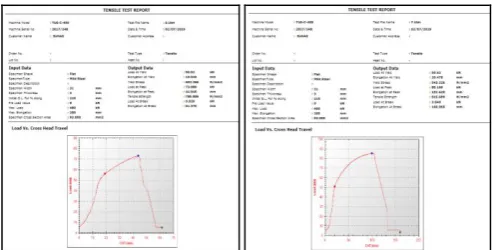
[image:6.595.59.267.137.253.2]Fig. 3 Test graph of 8th and 9th specimen.
[image:6.595.37.290.286.409.2]Fig. 4 Test graph of 6th and 7th specimen.
Fig. 5 Test graph of 4th and 5th specimen.
Fig. 6 Test graph of 2nd and 3rd specimen.
Fig. 7 Test graph of 1st specimen.
STEPS CARRIED OUT IN MINITAB:
Before using Minitab, we need to choose Independent factors such as Voltage & current for the inner array and Dependent factors such as Tensile Strength for the outer array. Independent factors are factors we can control to optimize the process. Dependent factors are factors that can affect the performance of a system but are not in control during the intended use of the product. Engineering knowledge should guide the selection of factors and responses. Minitab can help us design a Taguchi experiment that does not confound interactions of interest with each other or with main effects.
Conducting a Taguchi designed experiment can have the following steps:
[image:6.595.38.290.442.567.2] [image:6.595.35.289.551.729.2]© 2019, IRJET | Impact Factor value: 7.34 | ISO 9001:2008 Certified Journal
| Page 793
[image:7.595.37.303.58.438.2]
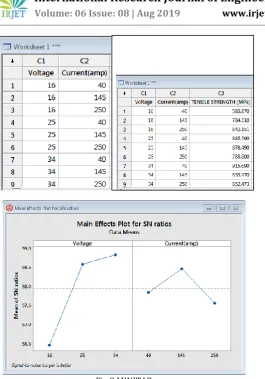
Fig 8 MINITAB
RESULT:
After making the graph plots of the MINITAB, the signal to noise ratio graph is obtained. From the graph the optimum result obtained is Voltage = 16V & Current = 250 amp so that the tensile strength of the specimen is more. So, the results are obtained.
Conclusion
Taguchi optimization method was applied to find the optimal process parameters for penetration. A Taguchi orthogonal array, the signal-to-noise (S/N) ratio and analysis of variance were used for the optimization of welding parameters. The experiment value that is observed from optimal welding parameters.
REFERENCES:
Multi-Response Optimization of Process Parameters for MIG Welding of AA2219-T87 by Taguchi Grey Relational Analysis BY Arunkumar Sivaramana, SathiyaPaulraja
Microstructure and corrosion resistance of Al5083 alloy hybrid Plasma-MIG welds BY Detao Cai,
Shanguo Han, Shida Zheng, Ziyi Luo, Yupeng Zhang, Kai Wang
Numerical analysis of thermal deformation and residual stress in automotive muffler by MIG welding BY S. H. LEE, E. S. Kim, J. Y. Park, J. Choi
Parametric Optimization of MIG Welding on 316L Austenitic Stainless Steel by Grey-Based Taguchi Method BY Nabendu Ghosh, Pradip Kumar Palb, Goutam Nandi
Optimization of Welding Parameters of Ti 6al 4v Cruciform shape Weld joint to Improve Weld Strength Based on Taguchi Method BY Srinivasa Reddy Vempati, K.Brahma Raju, K.Venkata Subbaiah
Parametric Optimization of Gas Metal Arc Welding Process by using Taguchi method on Ferritic Stainless Steel AISI409 BY Nabendu Ghosha, Ramesh Rudrapatib, Pradip Kumar Palc, Gotam Nandi
Parametric Optimization of Gas metal arc welding process by PCA based Taguchi method on Austenitic Stainless Steel AISI 316L BY Nabendu Ghosh, Pradip Kumar Palb , Goutam Nandic and Ramesh Rudrapati
Multi-Objective Optimization of Friction Stir Welding of Aluminium Alloy 6082-T6 Using hybrid Taguchi-Grey Relation Analysis- ANN Method BY K. N. Wakchaure, A. G. Thakurb, Vijay Gadakhc, A. Kumar
Multi-response optimization of process parameters for TIG welding of Incoloy 800HT by Taguchi grey relational analysis BY Arun Kumar Srirangan, Sathiya Paulraj