z
RESEARCH ARTICLE
DEVELOPMENT OF A QUASI-MONTE-CARLO GENERATOR FOR LINAC USING GEANT4 CODE
*EL Bakkali, J., El Bardouni, T., Kaddour, M., Zoubair, M., El Ouahdani, S. and Boukhal, H.
ERSN-LMR, Faculty of Sciences, University Abdelmalek Essaadi, Tetuan, Morocco
ARTICLE INFO ABSTRACT
The goal of this study is to evaluate the impact of using a Quasi-Monte-Carlo (QMC) generator on calculations of beam data, delivered by a 12 MV Saturne 43 LINAC photon beam. In this work, the Geant4.9.4.p04 is used to construct our Geant4-based application for Saturne 43 LINAC simulation. Both beam data calculations for two kinds of random generators (MC and QMC) have been compared to the measured ones using gamma index comparison tool. As known, that the least known parameters in a MC simulation of the treatment head, are often the properties of the initial electron beam. In previous study where a MC generator has been employed, we have found that the appropriate mean energy, sigma and its full width at half maximum were 11.5 MeV, 0.4 MeV and 1.177 mm with accuracy within 1.5%/ 1mm. Our results show that, both simulations share approximately the same value of CPU time, and its results have statistical uncertainly less than unity. The recent study emphasizes the electron beam configuration obtained from a MC generator and the accuracy of calculated beam data in a homogeneous water phantom has been improved to 1.31%/ 1mm.
Copyright © EL Bakkali, J et al. This is an open access article distributed under the Creative Commons Attribution License, which permits unrestricted use, distribution, and reproduction in any medium, provided the original work is properly cited.
INTRODUCTION
Simulations of random numbers are crucial. Because a board ranges of applications including physics, biology, finance and many others use this numbers. The only ways to simulate some randomness on computers are carried out by deterministic algorithms. As known, that the truly random (Eddelbuettel
et al., 2007), are the measurement of physical phenomena such
as thermal noise in zener diodes. Excluding truly random, there are two kinds of random generation: Pseudo-Random and Quasi-Random number generators. Quasi-Random numbers are also called low discrepancy sequences. Contrary to true random numbers, they are designed to be highly correlated, in a way such that they willfill space. InFigure 1, it can be seen that the Pseudo-Random sequence flaunts clustering of points, and there are empty regions with no points at all. Visual inspection of Figure 2 shows that the Sobol Quasi-Random sequences appear to cover the area more uniformly. Pseudo-Random number generation appear to seem random whereas Quasi-Random number generation aims to be deterministic but more equidistributed. This Quasi-Random sequence or low discrepancy sequences permit to improve the performance of MC method in several cases and it can offer higher accuracy. Geant4 toolkit (Agostinelli et al., 2003) is a simulation toolkit for the simulation of the passage of particles through matter. Its domain of application includes medical and space science, high energy and accelerator physics. The main participants in its development are more than 100 workers from Europe, Japan and many other institutes in the world. MC
*Corresponding author: EL Bakkali, J., ERSN-LMR, Faculty of Sciences, University Abdelmalek Essaadi, Tetuan, Morocco.
Geant4 code include the capability to model the geometry, the materials involved, the fundamental particles of interest, the generation of primary particles, the tracking of particles through materials and external electromagnetic fields, the physics processes governing particle interactions, the response of sensitive detector components, the generation of event data, the storage of events and tracks, the visualization of the detector and particle trajectories.
In this study the Geant4 toolkit version 9.4.p04 has been considered to develop our MC simulations and has been installed in Rocks cluster 5.4 (Rocks Clusters, 2011) Linux distribution. The parallelization of Geant4 simulation under Rocks cluster environment is not easy; some essential instructions need to be performed allowing Geant4 to safety integrate under the Rocks cluster. These tips can be found in our paper (EL Bakkali et al., 2013). Actually, there are several methods of successful use of parallel computing in Geant4 such as Ex Diane, ParGeant4 and Geant4 MPI Interface (Murakami, 2010). In this work the last one has been considered to perform the parallelization of our Geant4-based applications. Geant4 MPI Interface is a native interface with MPI libraries, within this interface Geant4 simulation can be parallelized with different MPI compliant libraries, such as LAM/MPI, Open MPI and MPICH2. The Geant4 toolkit provides through the CLHEP library several Pseudo-Random number generators. The default Geant4 random number
generation algorithm is the Hep James Random engine. All Geant4 generators use the Pseudo-Random numbers, but
Quasi-Random numbers are not included in the toolkit. In this work, a QMC generator class has been designed and developed
ISSN: 0975-833X
Available online at http://www.journalcra.com
International Journal of Current Research
Vol. 5, Issue, 12, pp.3673-3681, December, 2013
INTERNATIONAL JOURNAL OF CURRENT RESEARCH
Article History:
Received 10thSeptember, 2013 Received in revised form 28thOctober, 2013
Accepted 19thNovember, 2013 Published online 02ndDecember, 2013
Key words: Geant4, LINAC, QMC, Sobol, Rocks cluster, MPI, Saturne 43, Parallel Computing.
z
RESEARCH ARTICLE
DEVELOPMENT OF A QUASI-MONTE-CARLO GENERATOR FOR LINAC USING GEANT4 CODE
*EL Bakkali, J., El Bardouni, T., Kaddour, M., Zoubair, M., El Ouahdani, S. and Boukhal, H.
ERSN-LMR, Faculty of Sciences, University Abdelmalek Essaadi, Tetuan, Morocco
ARTICLE INFO ABSTRACT
The goal of this study is to evaluate the impact of using a Quasi-Monte-Carlo (QMC) generator on calculations of beam data, delivered by a 12 MV Saturne 43 LINAC photon beam. In this work, the Geant4.9.4.p04 is used to construct our Geant4-based application for Saturne 43 LINAC simulation. Both beam data calculations for two kinds of random generators (MC and QMC) have been compared to the measured ones using gamma index comparison tool. As known, that the least known parameters in a MC simulation of the treatment head, are often the properties of the initial electron beam. In previous study where a MC generator has been employed, we have found that the appropriate mean energy, sigma and its full width at half maximum were 11.5 MeV, 0.4 MeV and 1.177 mm with accuracy within 1.5%/ 1mm. Our results show that, both simulations share approximately the same value of CPU time, and its results have statistical uncertainly less than unity. The recent study emphasizes the electron beam configuration obtained from a MC generator and the accuracy of calculated beam data in a homogeneous water phantom has been improved to 1.31%/ 1mm.
Copyright © EL Bakkali, J et al. This is an open access article distributed under the Creative Commons Attribution License, which permits unrestricted use, distribution, and reproduction in any medium, provided the original work is properly cited.
INTRODUCTION
Simulations of random numbers are crucial. Because a board ranges of applications including physics, biology, finance and many others use this numbers. The only ways to simulate some randomness on computers are carried out by deterministic algorithms. As known, that the truly random (Eddelbuettel
et al., 2007), are the measurement of physical phenomena such
as thermal noise in zener diodes. Excluding truly random, there are two kinds of random generation: Pseudo-Random and Quasi-Random number generators. Quasi-Random numbers are also called low discrepancy sequences. Contrary to true random numbers, they are designed to be highly correlated, in a way such that they willfill space. InFigure 1, it can be seen that the Pseudo-Random sequence flaunts clustering of points, and there are empty regions with no points at all. Visual inspection of Figure 2 shows that the Sobol Quasi-Random sequences appear to cover the area more uniformly. Pseudo-Random number generation appear to seem random whereas Quasi-Random number generation aims to be deterministic but more equidistributed. This Quasi-Random sequence or low discrepancy sequences permit to improve the performance of MC method in several cases and it can offer higher accuracy. Geant4 toolkit (Agostinelli et al., 2003) is a simulation toolkit for the simulation of the passage of particles through matter. Its domain of application includes medical and space science, high energy and accelerator physics. The main participants in its development are more than 100 workers from Europe, Japan and many other institutes in the world. MC
*Corresponding author: EL Bakkali, J., ERSN-LMR, Faculty of Sciences, University Abdelmalek Essaadi, Tetuan, Morocco.
Geant4 code include the capability to model the geometry, the materials involved, the fundamental particles of interest, the generation of primary particles, the tracking of particles through materials and external electromagnetic fields, the physics processes governing particle interactions, the response of sensitive detector components, the generation of event data, the storage of events and tracks, the visualization of the detector and particle trajectories.
In this study the Geant4 toolkit version 9.4.p04 has been considered to develop our MC simulations and has been installed in Rocks cluster 5.4 (Rocks Clusters, 2011) Linux distribution. The parallelization of Geant4 simulation under Rocks cluster environment is not easy; some essential instructions need to be performed allowing Geant4 to safety integrate under the Rocks cluster. These tips can be found in our paper (EL Bakkali et al., 2013). Actually, there are several methods of successful use of parallel computing in Geant4 such as Ex Diane, ParGeant4 and Geant4 MPI Interface (Murakami, 2010). In this work the last one has been considered to perform the parallelization of our Geant4-based applications. Geant4 MPI Interface is a native interface with MPI libraries, within this interface Geant4 simulation can be parallelized with different MPI compliant libraries, such as LAM/MPI, Open MPI and MPICH2. The Geant4 toolkit provides through the CLHEP library several Pseudo-Random number generators. The default Geant4 random number
generation algorithm is the Hep James Random engine. All Geant4 generators use the Pseudo-Random numbers, but
Quasi-Random numbers are not included in the toolkit. In this work, a QMC generator class has been designed and developed
ISSN: 0975-833X
Available online at http://www.journalcra.com
International Journal of Current Research
Vol. 5, Issue, 12, pp.3673-3681, December, 2013
INTERNATIONAL JOURNAL OF CURRENT RESEARCH
Article History:
Received 10thSeptember, 2013 Received in revised form 28thOctober, 2013
Accepted 19thNovember, 2013 Published online 02ndDecember, 2013
Key words: Geant4, LINAC, QMC, Sobol, Rocks cluster, MPI, Saturne 43, Parallel Computing.
z
RESEARCH ARTICLE
DEVELOPMENT OF A QUASI-MONTE-CARLO GENERATOR FOR LINAC USING GEANT4 CODE
*EL Bakkali, J., El Bardouni, T., Kaddour, M., Zoubair, M., El Ouahdani, S. and Boukhal, H.
ERSN-LMR, Faculty of Sciences, University Abdelmalek Essaadi, Tetuan, Morocco
ARTICLE INFO ABSTRACT
The goal of this study is to evaluate the impact of using a Quasi-Monte-Carlo (QMC) generator on calculations of beam data, delivered by a 12 MV Saturne 43 LINAC photon beam. In this work, the Geant4.9.4.p04 is used to construct our Geant4-based application for Saturne 43 LINAC simulation. Both beam data calculations for two kinds of random generators (MC and QMC) have been compared to the measured ones using gamma index comparison tool. As known, that the least known parameters in a MC simulation of the treatment head, are often the properties of the initial electron beam. In previous study where a MC generator has been employed, we have found that the appropriate mean energy, sigma and its full width at half maximum were 11.5 MeV, 0.4 MeV and 1.177 mm with accuracy within 1.5%/ 1mm. Our results show that, both simulations share approximately the same value of CPU time, and its results have statistical uncertainly less than unity. The recent study emphasizes the electron beam configuration obtained from a MC generator and the accuracy of calculated beam data in a homogeneous water phantom has been improved to 1.31%/ 1mm.
Copyright © EL Bakkali, J et al. This is an open access article distributed under the Creative Commons Attribution License, which permits unrestricted use, distribution, and reproduction in any medium, provided the original work is properly cited.
INTRODUCTION
Simulations of random numbers are crucial. Because a board ranges of applications including physics, biology, finance and many others use this numbers. The only ways to simulate some randomness on computers are carried out by deterministic algorithms. As known, that the truly random (Eddelbuettel
et al., 2007), are the measurement of physical phenomena such
as thermal noise in zener diodes. Excluding truly random, there are two kinds of random generation: Pseudo-Random and Quasi-Random number generators. Quasi-Random numbers are also called low discrepancy sequences. Contrary to true random numbers, they are designed to be highly correlated, in a way such that they willfill space. InFigure 1, it can be seen that the Pseudo-Random sequence flaunts clustering of points, and there are empty regions with no points at all. Visual inspection of Figure 2 shows that the Sobol Quasi-Random sequences appear to cover the area more uniformly. Pseudo-Random number generation appear to seem random whereas Quasi-Random number generation aims to be deterministic but more equidistributed. This Quasi-Random sequence or low discrepancy sequences permit to improve the performance of MC method in several cases and it can offer higher accuracy. Geant4 toolkit (Agostinelli et al., 2003) is a simulation toolkit for the simulation of the passage of particles through matter. Its domain of application includes medical and space science, high energy and accelerator physics. The main participants in its development are more than 100 workers from Europe, Japan and many other institutes in the world. MC
*Corresponding author: EL Bakkali, J., ERSN-LMR, Faculty of Sciences, University Abdelmalek Essaadi, Tetuan, Morocco.
Geant4 code include the capability to model the geometry, the materials involved, the fundamental particles of interest, the generation of primary particles, the tracking of particles through materials and external electromagnetic fields, the physics processes governing particle interactions, the response of sensitive detector components, the generation of event data, the storage of events and tracks, the visualization of the detector and particle trajectories.
In this study the Geant4 toolkit version 9.4.p04 has been considered to develop our MC simulations and has been installed in Rocks cluster 5.4 (Rocks Clusters, 2011) Linux distribution. The parallelization of Geant4 simulation under Rocks cluster environment is not easy; some essential instructions need to be performed allowing Geant4 to safety integrate under the Rocks cluster. These tips can be found in our paper (EL Bakkali et al., 2013). Actually, there are several methods of successful use of parallel computing in Geant4 such as Ex Diane, ParGeant4 and Geant4 MPI Interface (Murakami, 2010). In this work the last one has been considered to perform the parallelization of our Geant4-based applications. Geant4 MPI Interface is a native interface with MPI libraries, within this interface Geant4 simulation can be parallelized with different MPI compliant libraries, such as LAM/MPI, Open MPI and MPICH2. The Geant4 toolkit provides through the CLHEP library several Pseudo-Random number generators. The default Geant4 random number
generation algorithm is the Hep James Random engine. All Geant4 generators use the Pseudo-Random numbers, but
Quasi-Random numbers are not included in the toolkit. In this work, a QMC generator class has been designed and developed
ISSN: 0975-833X
Available online at http://www.journalcra.com
International Journal of Current Research
Vol. 5, Issue, 12, pp.3673-3681, December, 2013
INTERNATIONAL JOURNAL OF CURRENT RESEARCH
Article History:
Received 10thSeptember, 2013 Received in revised form 28thOctober, 2013
Accepted 19thNovember, 2013 Published online 02ndDecember, 2013
starting from the fast Sobol sequences algorithm. The goal was to develop a QMC generator for a MC Geant4-based application used to simulate Saturne 43 LINAC producing 12 MV photon beams, view to check if the combination between QMC generator and MC simulation can increase the accuracy of beam data calculations in water phantom. This will contribute to the improvement of MC simulations in radiotherapy field. To our knowledge, this study is the first one illustrating the impact of combining these methods on calculated beam data From Linac accelerators.
Fig.1. Pseudo-random sequence points
Fig.2. Sobol sequence points
The comparison between calculated beam data and measured ones has been performed with gamma index comparison tools (Low et al., 1998). The MC dose calculations have been performed using IAEA phase-space (Phsp) files (R. Capote
et al., 2009). The use of Phsp is a technique to reduce the
computing time without affecting the computing accuracy. Our Phsp approach is based on the idea to divide the MC simulation into two distinct steps. First, using the parallel computing approach a Geant4-based application called Parasaturne43Writer has been developed for modeling the accelerator head and performed to produce multiple Phsp files at the same time. Each Phsp file is used to store incoming particles at 50 cm SSD (just after jaws components); the data of all the particles hitting the scoring plane are recorded in Phsp file which supports the IAEA format (Capote et al.,
2009). These data consists of photons from the target, as well as secondary particles originating from the primary collimator, the flattening filter and the secondary collimator. Second, by running multiple Phsp files from scoring plane the absorbed doses are calculated in water phantom for each configuration, these tasks are executed by our Geant4-based application called ParaSaturne43Reader.
METHODS
Overview of Sobol generation algorithm
The Sobol sequence, first introduced by the Russian mathematician I. M. Sobol in 1967, is the most reputable low discrepancy sequence, and is used for calculating multi-dimensional integrals, moreover in QMC simulation. A full description of Sobol generation algorithm and how it works can be found in (Bratley and Fox, 1988). Here we will confine ourselves to give a short outlines of the details about the fast algorithm of Sobol sequences proposed by (Antonov and Saleev, 1979). To begin, the prime number 2 is used as the base for d-dimensional Sobol sequence for all dimensions. The first dimension considered as van der Corput sequence in base 2, whereas higher dimensions are permutations of the sequence of the first dimension. These Permutations are carried out by set of direction numbers vi defined in the following way:
v
i=
m
i2
i,i= 1, w
(1)Where 0 < mi< 2 i
are odd integers.
These direction numbers vi are constructed form a sequence of binary fractions with w bits after the binary point. The definition of a Sobol sequence will be allowed until all of these direction numbers are defined. In the Sobol algorithm (Antonov and Saleev, 1979) a one-dimensional Sobol sequence is generated by:
0
...
⊕
21
a
v
a
v
,
n
v
a
=
x
n 1 2 w w (2)Where
∑
i=0
log n
a
i2
i is the binary representation of n and⊕
denotes a bit-by-bit exclusive-or-operation (XOR). For the construction of Sobol sequences the notion of Gray codes is used. The Gray Code of an integer i is defined by the following equation:
2
int
⊕
i
i
=
i
G
(3)Where int[i/2] represents the largest integer inferior or equal to i/2. We finished this paragraph by presenting all processes need to construct the Sobol sequence for each dimension d: 1. Generation of an integer x that must be chosen randomly.
This number defines the starting point of the sequence knows as the seed number.
2. Computation of the Gray Code for random number x. 3. Transformation of G(x) into binary representation.
4. Summation bit by bit (XOR) of the direction numbers associated with the digits of G(x).
starting from the fast Sobol sequences algorithm. The goal was to develop a QMC generator for a MC Geant4-based application used to simulate Saturne 43 LINAC producing 12 MV photon beams, view to check if the combination between QMC generator and MC simulation can increase the accuracy of beam data calculations in water phantom. This will contribute to the improvement of MC simulations in radiotherapy field. To our knowledge, this study is the first one illustrating the impact of combining these methods on calculated beam data From Linac accelerators.
Fig.1. Pseudo-random sequence points
Fig.2. Sobol sequence points
The comparison between calculated beam data and measured ones has been performed with gamma index comparison tools (Low et al., 1998). The MC dose calculations have been performed using IAEA phase-space (Phsp) files (R. Capote
et al., 2009). The use of Phsp is a technique to reduce the
computing time without affecting the computing accuracy. Our Phsp approach is based on the idea to divide the MC simulation into two distinct steps. First, using the parallel computing approach a Geant4-based application called Parasaturne43Writer has been developed for modeling the accelerator head and performed to produce multiple Phsp files at the same time. Each Phsp file is used to store incoming particles at 50 cm SSD (just after jaws components); the data of all the particles hitting the scoring plane are recorded in Phsp file which supports the IAEA format (Capote et al.,
2009). These data consists of photons from the target, as well as secondary particles originating from the primary collimator, the flattening filter and the secondary collimator. Second, by running multiple Phsp files from scoring plane the absorbed doses are calculated in water phantom for each configuration, these tasks are executed by our Geant4-based application called ParaSaturne43Reader.
METHODS
Overview of Sobol generation algorithm
The Sobol sequence, first introduced by the Russian mathematician I. M. Sobol in 1967, is the most reputable low discrepancy sequence, and is used for calculating multi-dimensional integrals, moreover in QMC simulation. A full description of Sobol generation algorithm and how it works can be found in (Bratley and Fox, 1988). Here we will confine ourselves to give a short outlines of the details about the fast algorithm of Sobol sequences proposed by (Antonov and Saleev, 1979). To begin, the prime number 2 is used as the base for d-dimensional Sobol sequence for all dimensions. The first dimension considered as van der Corput sequence in base 2, whereas higher dimensions are permutations of the sequence of the first dimension. These Permutations are carried out by set of direction numbers vi defined in the following way:
v
i=
m
i2
i,i= 1, w
(1)Where 0 < mi< 2 i
are odd integers.
These direction numbers viare constructed form a sequence of binary fractions with w bits after the binary point. The definition of a Sobol sequence will be allowed until all of these direction numbers are defined. In the Sobol algorithm (Antonov and Saleev, 1979) a one-dimensional Sobol sequence is generated by:
0
...
⊕
21
a
v
a
v
,
n
v
a
=
x
n 1 2 w w (2)Where
∑
i=0
log n
a
i2
i is the binary representation of n and⊕
denotes a bit-by-bit exclusive-or-operation (XOR). For the construction of Sobol sequences the notion of Gray codes is used. The Gray Code of an integer i is defined by the following equation:
2
int
⊕
i
i
=
i
G
(3)Where int[i/2] represents the largest integer inferior or equal to i/2. We finished this paragraph by presenting all processes need to construct the Sobol sequence for each dimension d: 1. Generation of an integer x that must be chosen randomly.
This number defines the starting point of the sequence knows as the seed number.
2. Computation of the Gray Code for random number x. 3. Transformation of G(x) into binary representation.
4. Summation bit by bit (XOR) of the direction numbers associated with the digits of G(x).
starting from the fast Sobol sequences algorithm. The goal was to develop a QMC generator for a MC Geant4-based application used to simulate Saturne 43 LINAC producing 12 MV photon beams, view to check if the combination between QMC generator and MC simulation can increase the accuracy of beam data calculations in water phantom. This will contribute to the improvement of MC simulations in radiotherapy field. To our knowledge, this study is the first one illustrating the impact of combining these methods on calculated beam data From Linac accelerators.
Fig.1. Pseudo-random sequence points
Fig.2. Sobol sequence points
The comparison between calculated beam data and measured ones has been performed with gamma index comparison tools (Low et al., 1998). The MC dose calculations have been performed using IAEA phase-space (Phsp) files (R. Capote
et al., 2009). The use of Phsp is a technique to reduce the
computing time without affecting the computing accuracy. Our Phsp approach is based on the idea to divide the MC simulation into two distinct steps. First, using the parallel computing approach a Geant4-based application called Parasaturne43Writer has been developed for modeling the accelerator head and performed to produce multiple Phsp files at the same time. Each Phsp file is used to store incoming particles at 50 cm SSD (just after jaws components); the data of all the particles hitting the scoring plane are recorded in Phsp file which supports the IAEA format (Capote et al.,
2009). These data consists of photons from the target, as well as secondary particles originating from the primary collimator, the flattening filter and the secondary collimator. Second, by running multiple Phsp files from scoring plane the absorbed doses are calculated in water phantom for each configuration, these tasks are executed by our Geant4-based application called ParaSaturne43Reader.
METHODS
Overview of Sobol generation algorithm
The Sobol sequence, first introduced by the Russian mathematician I. M. Sobol in 1967, is the most reputable low discrepancy sequence, and is used for calculating multi-dimensional integrals, moreover in QMC simulation. A full description of Sobol generation algorithm and how it works can be found in (Bratley and Fox, 1988). Here we will confine ourselves to give a short outlines of the details about the fast algorithm of Sobol sequences proposed by (Antonov and Saleev, 1979). To begin, the prime number 2 is used as the base for d-dimensional Sobol sequence for all dimensions. The first dimension considered as van der Corput sequence in base 2, whereas higher dimensions are permutations of the sequence of the first dimension. These Permutations are carried out by set of direction numbers vi defined in the following way:
v
i=
m
i2
i,i= 1, w
(1)Where 0 < mi< 2 i
are odd integers.
These direction numbers viare constructed form a sequence of binary fractions with w bits after the binary point. The definition of a Sobol sequence will be allowed until all of these direction numbers are defined. In the Sobol algorithm (Antonov and Saleev, 1979) a one-dimensional Sobol sequence is generated by:
0
...
⊕
21
a
v
a
v
,
n
v
a
=
x
n 1 2 w w (2)Where
∑
i=0
log n
a
i2
i is the binary representation of n and⊕
denotes a bit-by-bit exclusive-or-operation (XOR). For the construction of Sobol sequences the notion of Gray codes is used. The Gray Code of an integer i is defined by the following equation:
2
int
⊕
i
i
=
i
G
(3)Where int[i/2] represents the largest integer inferior or equal to i/2. We finished this paragraph by presenting all processes need to construct the Sobol sequence for each dimension d: 1. Generation of an integer x that must be chosen randomly.
This number defines the starting point of the sequence knows as the seed number.
2. Computation of the Gray Code for random number x. 3. Transformation of G(x) into binary representation.
Generation of Primary Particles Using Sobol Sequence
The Geant4 toolkit does not include the capability to generate Quasi-Random numbers. In this paper we attempted to exploit some characteristics of low discrepancy sequence; especially the equi-distribution property view to increase the performance of our MC simulations. A Quasi-Random sequence progressively covers a d-dimensional space with a set of points that are uniformly distributed. In aim to use Quasi-Random numbers for generating primary particles we have developed our own c++ class which inherits from G4VuserPrimaryGeneratorAction mandatory class. Notice that the fast Sobol sequence has been employed as the low discrepancy sequence in our MC simulations. The implementation of our own class dedicated for generating primary particles using the Sobol sequence is divided into four main parts:
Implementation of normal function
The uniform distribution can be generated with either Pseudo-Random numbers or Quasi-Pseudo-Random numbers. Various Algorithms are available to transform a uniform distribution in normal distribution. The main and direct way to do this transformation is by the cumulative distribution function inversion. A normal distribution is characterized by a mean value m and by a standard deviation or sigma s. The best-known general manner of generating normally distributed points is by using the Box- Muller algorithm. The code stated below allows the construction of normal or Gaussian distribution function and uses the Box- Muller method. The c++ method Quasi Normal has four arguments: mean, sigma and two independent uniform Quasi-Random numbers Q1 and Q2 (between 0 and 1). This method will be called three times: twice to generate a 2-D Gaussian distribution in the plane XY and once to generate the Gaussian energy spectrum.
G4double PrimaryGeneratorAction::QuasiNormal(G4double m,G4double s ,G4double Q1,G4double Q2) {
G4double y;
const G4double eps = 1.0e-6; const G4double twopi = 6.2831854; G4double r1 = Q1;
r1 = r1 > eps ? r1 : eps; G4double r2 = Q2; r2 = r2 > eps ? r2 : eps; r2 = r2 < 1.0 - eps ? r2 : 1.0 - eps;
y= std::sin(twopi * r1) * std::sqrt(-2.0 * std::log(r2)); return m + (s*y); }
Implementation of Sobol sequence
The Sobol sequence is somewhat more complicated in definition, based on XOR operations and needing a list of initializing numbers. Our own implementation of the fast Sobol sequence has been inspired by a c++ code provided by Emanouil Atanassov (E. Atanassov, 2004). We have rewritten this code in order to create a 4-dimensional Sobol sequence view to construct both Gaussian spatial distribution and Gaussian energy distribution.
Initialization of Sobol sequence
Taking into consideration that the number of simulated histories is strongly related to the RAM memory storage, since 4-dimensional Sobol sequence requires a lot of storage for a
high number of Quasi-Random points and our code generates all Sobol points at the same time and stores everything in RAM memory. The initialization of 10 million of Sobol points for 4-dimensional Sobol sequence required about half Giga of this memory. This initialization is carried out by the following code:
P = sobol_points(10000000);
Generation of primary particles
In this study, the way for generating the primary particles is based on the Sobol sequence. We considered a 4-dimensional Sobol sequence to construct both Gaussian energy distribution and Gaussian spatial distribution (plane XY). The generation of normal distribution with the QuasiNormal function required two independent Quasi-Random numbers. The generated normal distributions for the three parameters namely: energy, x coordinate and y coordinate are sharing the same value of the first Random number Q1, whereas the second Quasi-Random numbers are Q21, Q22 and Q23, respectively. The following code called when our Geant4-based application tried to generate a primary particle:
Void Primary Generator Action::GeneratePrimaries(G4Event* an Event) {G4double Q1, Q21, Q22, Q23 ;
int id=anEvent->GetEventID(); Q1=P[id][0];
Q21=P[id][1]; Q22=P[id][2]; Q23=P[id][3];
G4double x= QuasiNormal(0, 0.5*mm, Q1, Q21); G4double y= QuasiNormal (0, 0.5*mm, Q1, Q22);
G4double energy= QuasiNormal (11.5*MeV, 0.4*MeV, , Q1, Q23); particleGun->SetParticlePosition(G4ThreeVector(x,y, -28*cm)); particleGun->SetParticleEnergy(energy);
particleGun->GeneratePrimaryVertex(anEvent);}
Geant4 simulation
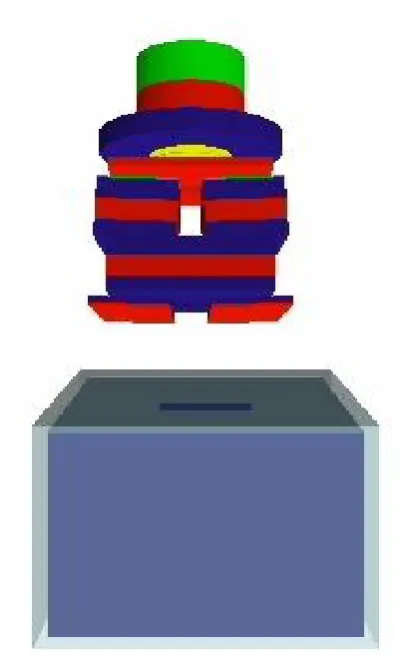
Using Geant4 (version 9.4.p04), we developed a complete model of Saturne 43 LINAC operating at 12 MV photons. The components of the Saturne 43 accelerator head were defined as precisely as possible, based on manufacturer-provided information. Different geometrical elements of the accelerator head are shown in Figure 3 using the Hepp Repp visualization system. These geometrical elements include titanium window, W target, primary collimator, flattening filter, ionization chamber and secondary collimator (Jaws). A flattening filter is used to achieve homogeneous intensity of photons over radiation field widths because this intensity from a LINAC is not uniform. Geant4 visualization was designed around an abstract interface that supports various families of graphics systems such as Ray Tracer visualization system. Using this graphics tool we show In Figure 4 our generated 3D view of the modeled LINAC head associated to a water phantom with dimension of 40 × 40 × 40 cm3that was placed at a source to surface distance (SSD) of 90 cm and secondary collimators was set to create a field size of 10x10 cm2on phantom surface. The depth in water is expressed from the external side of the entrance window of the phantom (a measurement of 10 cm depth means 4 mm of PMMA plus 9.6 cm of water).
Fig 3. Illustrating the modeled LINAC head using Hepp Repp visualization system
Fig 4. Generated Raytracer 3D view of the modeled LINAC head associated to a water phantom
In the development of a Geant4-based application, it is the user's responsibility to decide which physical processes are required, and then to include them in the Physics List. In realistic applications the physics list can become long and involved. The physics list is a consistent set of physics models
that is able to cover all combinations of incident particle type, energy, and target material. Geant4 provides several physics
settings through its physics lists. From “Geant4/source/ physics_lists/builders” we can findvarious physics lists. Each physics list has been specialized for a given area of application (high-energy physics, shielding, space-application, medical physics, etc.). All the Geant4 MC simulations presented in this work have been performed in a Linux cluster using Rocks cluster (version 5.4) software. For the Full setup of our simulations we have kept all optimized physics settings (including physics list, production threshold and variance reduction techniques) and related parameters founded in previous study (Bakkali et al., 2013) where the validation of Geant4 for LINAC Saturne 43 has been checked. The only change applied in simulations is the way of generating the primary particles where a QMC generator has been considered. The configuration of the electron beam incident on the target is typically unrecognized and must be obtained by running several MC simulations and compare its results to measured ones. Since Geant4 code is painfully slow compared to other MC codes, we have not had a chance to examine several primary electron beam configurations; choose from a variety of configurations to find one that more robust in accurately of calculating beam data is a difficult task due to a huge CPU time consuming. Consequently, we reused the same method used in previous study (Bakkali et al., 2013) to optimize the parameters of the electron beam proprieties, but in the present study the QMC generator has been taken into account instead of random generator. In this study, 8 configurations have been selected between 11 used in previous study. Thus, the ranges of mean energy and Sigma for 12 MV photons were 11.3-12 MeV (with a 0.1 MeV step) and 0.36-0.50 MeV (with a 0.2 MeV step) respectively. For gaussian spatial distributions the values of FHWM were set to 1.177 mm (standard deviation = 0.5 mm). Using both Rocks cluster software and Geant4 MPI interfaces, 8 simulations at the same time have been considered view to calculated beam data for each configuration. For the ParaSaturne43Writer program the number of simulated particles for treatment head simulations was set to ten million, so that represented 1/3 of the number of particles used in previous study where a MC generator has been employed, the reason of this choice has been explained in earlier paragraphs. The average treatment head simulation
[image:4.595.61.266.350.679.2]profile and less than 0.15% for PDD, the runtime for beam data calculations in water phantom was about five days. In aim to compare the calculated beam data to the measured ones, the gamma index comparison tool is considered and the gamma criterion was set to 1.5%/ 1mm (The tolerance value assigned to relative dose was 1.5% and the tolerance value for measured positions was 1 mm).
RESULTS
Primary electron spectra
Using GNU ROOT data mining tools, primary electron spectra have been made for two kinds of generator (MC and QMC),
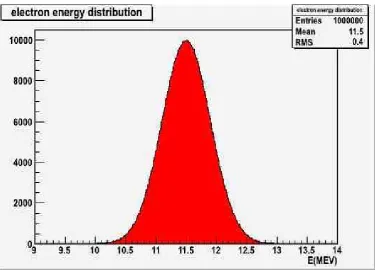
[image:5.595.118.487.223.475.2]share the same characteristic of the initial electron beam configuration and are equal in number of simulated histories. The Figure 5 shows primary electron spectrum after generating one million of histories using the GPS(G4 General Particle Source) generator which considered as MC generator, whereas the Figure 6 shown the primary electron spectrum produced by the Sobol generator which considered as the QMC generator. Visual inspection of Figure 6 shows that the spectrum produced by QMC generator is exceedingly smoothed, whereas the primary electron spectrum delivered by MC generator fluctuates as can be seen in the Figure 5. The results illustrate the capability of low discrepancy sequence to generate random numbers that designed to be highly correlated, in a way such that they willfill space.
Fig 5. Illustrating the primary electron spectrum produced by MC generator
Fig. 6. Illustrating the primary electron spectrum produced by QMC generator
[image:5.595.113.489.498.768.2]Photon energy spectra and Gamma angular distribution
The MC method is a convenient and accurate tool allowing the calculation of spectra possessing the essential features of real spectra. Photon energy spectra of Saturne 43 treatment head has been calculated with Geant4 (version 9.4.p04), using the QMC generator instead of the MC generator. The photon energy spectrum used is obtained after a 12 MeV Gaussian electrons hit with the tungsten target. The Figure 7 shows the comparison between energy dependent fluxes of a 12 MV photons beam at 100 cm SSD for two kinds of generators (MC and QMC). The photon energy spectra were created by simulating about 109 of photons. The field size for photon energy spectrum calculation was set to 10×10 cm2. The Energy bins have an homogeneous width of 0.1 MeV.
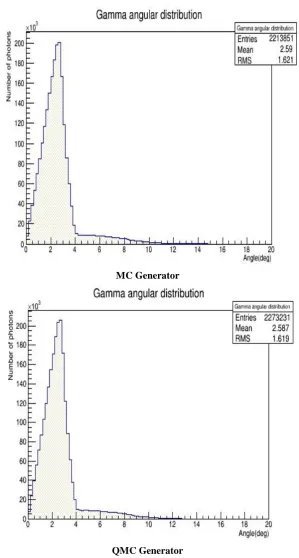
Our results showed that the spectrum delivered by a QMC generator was similar and comparable to other one obtained from MC generator. Additionally, we have compared the angular distributions of photons at 100 cm for simulation that uses QMC generator with another one which uses the MC generator. The results illustrated in Figure 8 shows that the photon angular distribution provided by QMC generator was similar and comparable to other one produced by MC generator. It shows be noted that the number of photons has been increased about 2.63% when the QMC generator has been used for generating primary particles.
The comparisons between simulated beam data for two kinds of generators
The comparisons between simulated beam data for two kinds of generators have been performed using the gamma index
MC Generator
Fig.7. MC calculated photon energy spectra from Saturne 43 treatment head at SSD 100 cm within a field size of 10 x 10 cm2,
for two kinds of generators
QMC Generator
Fig.7 MC calculated photon energy spectra from Saturne 43 treatment head at SSD 100 cm within a field size of 10 x 10 cm2,
MC Generator
[image:7.595.152.452.62.621.2]QMC Generator
Fig.8 MC calculated photon angular distributions of Saturne 43 treatment head at SSD 100 cm within a field size of 10 x 10 cm2
for two kinds of generators
Table 1. comparison between calculated PDD data obtained both from QMC generator and MC generator, for different electron beam configurations
QMC generator MC generator
Mean (MeV) Sigma (MeV) FWHM (mm) (GI < 1)% (GI < 0.5)% (GI < 1)% (GI <0.5)%
12 0.50 1.177 100% 100% 100% 97.90%
[image:7.595.102.498.672.789.2]Table 2. comparison between calculated Profile data obtained both from QMC generator and MC generator for different electron beam configurations
QMC generator MC generator
Mean (MeV) Sigma (MeV) FWHM (mm) (GI < 1)% (GI < 0.5)% (GI < 1)% (GI <0.5)%
12 0.50 1.177 77.8% 60% 80.0% 62.2%
11.9 0.48 1.177 88.9% 73.3% 86.7% 68.9% 11.8 0.46 1.177 77.8% 57.8% 86.7% 71.1% 11.7 0.44 1.177 91.1% 71.1% 82.2% 60.0% 11.6 0.42 1.177 77.8% 57.8% 73.9% 56.5% 11.5 0.40 1.177 91.1% 84.4% 91.1% 77.8%
11.4 0.38 1.177 82.2% 60% 80.4% 58.7%
11.3 0.36 1.177 84.4% 66.7% 77.8% 66.7%
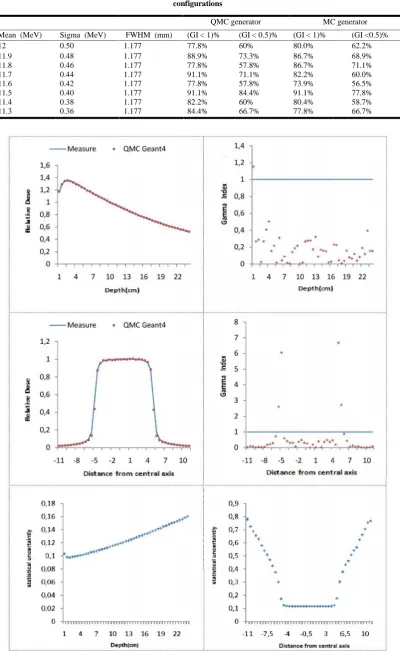
Fig.9. Comparison between calculated beam data and measured ones for Linac Saturne 43 within a field size of 10 x 10 cm2and all statistical
uncertainly associated to calculated beam data
Table 2. comparison between calculated Profile data obtained both from QMC generator and MC generator for different electron beam configurations
QMC generator MC generator
Mean (MeV) Sigma (MeV) FWHM (mm) (GI < 1)% (GI < 0.5)% (GI < 1)% (GI <0.5)%
12 0.50 1.177 77.8% 60% 80.0% 62.2%
11.9 0.48 1.177 88.9% 73.3% 86.7% 68.9% 11.8 0.46 1.177 77.8% 57.8% 86.7% 71.1% 11.7 0.44 1.177 91.1% 71.1% 82.2% 60.0% 11.6 0.42 1.177 77.8% 57.8% 73.9% 56.5% 11.5 0.40 1.177 91.1% 84.4% 91.1% 77.8%
11.4 0.38 1.177 82.2% 60% 80.4% 58.7%
11.3 0.36 1.177 84.4% 66.7% 77.8% 66.7%
Fig.9. Comparison between calculated beam data and measured ones for Linac Saturne 43 within a field size of 10 x 10 cm2and all statistical
uncertainly associated to calculated beam data
Table 2. comparison between calculated Profile data obtained both from QMC generator and MC generator for different electron beam configurations
QMC generator MC generator
Mean (MeV) Sigma (MeV) FWHM (mm) (GI < 1)% (GI < 0.5)% (GI < 1)% (GI <0.5)%
12 0.50 1.177 77.8% 60% 80.0% 62.2%
11.9 0.48 1.177 88.9% 73.3% 86.7% 68.9% 11.8 0.46 1.177 77.8% 57.8% 86.7% 71.1% 11.7 0.44 1.177 91.1% 71.1% 82.2% 60.0% 11.6 0.42 1.177 77.8% 57.8% 73.9% 56.5% 11.5 0.40 1.177 91.1% 84.4% 91.1% 77.8%
11.4 0.38 1.177 82.2% 60% 80.4% 58.7%
11.3 0.36 1.177 84.4% 66.7% 77.8% 66.7%
Fig.9. Comparison between calculated beam data and measured ones for Linac Saturne 43 within a field size of 10 x 10 cm2and all statistical
comparison tool. To find out the effects of the QMC generator notably the Sobol sequence on calculated beam data, we have run multiple simulations at some time. The eight electron beam configurations used in previous study were re-used in this study but a QMC generator has been introduced. For each configuration we show in Table 1 the comparison between calculated PDD data obtained both from QMC generator and MC generator, whereas in Table 2 we show a comparison between cross beam profiles data of these generators. It shows be noted that the numbers of simulated histories for QMC generator was set to 1/3 of the number of particles take by MC generator. For the CPU time computing, we observed a few CPU time different between the two kinds of generators for all simulations.
For the calculated PDD data, the results shown that a QMC generator is more accuracy than the MC generator. Since, after the gamma index (GI) analysis, it was found that the QMC generator gives closely the same results as default generator for (GI<1). Moreover, for (GI <0.5) we remarked that all of calculated PDD data produced by a QMC generator are more accurate than those from default generator. On the other hand, the results from Table 2 shows that the majority of calculating cross beam profiles from QMC generator are more accurate than ones provided by MC generator, since after (GI) examination, it was found that the accuracy of 6/8 of calculated cross beam profiles for (GI<1) have been improved considerably. Moreover, for (GI<0.5) we remarked that 5/8 of calculated cross profile data produced by a QMC generator are more accurate than those from MC generator. We can conclude that the results of our investigations indicate that MC simulations using a QMC generator are more robust in accurately calculating beam data and can be safely used without biasing the simulations. Previous MC dose calculations have been shown that the appropriate mean energy, sigma and its full width at half maximum are 11.5 MeV, 0.4 MeV and 1.177 mm with accuracy within 1.5%/ 1mm. In this study where a QMC generator is employed, we found that after gamma criterion analysis, that the appropriate electron beam configuration was exactly the same as founded in the previous study. Additionally, an improvement of 8.5% in accuracy of cross beam data has been obtained for (GI<0.5). When we set the accuracy of cross beam data to 1.31%/ 1mm, we can see for this configuration that the simulated data for cross beam profile agreed well with measured data, except data points who located in the penumbra region, where the dose profile has a high gradient, after all, 91.1% of the calculated data points seems agree with experience. The percent difference in this region was about 6%. The ambiguities may possibly come from inaccuracies in the simulation geometry, the approximation of the initial source configuration or uncertainties in the measured data. For the depth dose curve, it's seems that 97.6% of the calculated data points agree within 1 %/ 1 mm with the experimental measurements for depth 10 cm, so except the first data point all others ones were accepted, which could be explained by the incompletely known geometry on the one hand and by inconsistent data on the other hand. The Figure 9 shows a comparison between measured and calculated beam data points and the obtained statically uncertainly.
DISCUSSION
This study considered the first uses the combination between QMC and MC methods to improving the accuracy of MC dose calculations. In this work, a QMC generator has been developed and validated for LINAC Saturne 43. A comparison between simulations for two kinds of generator shows that the required CPU time are closely the same and both simulation results have a statistical uncertainly less than unity. This work emphasizes the electron beam configuration obtained from a MC generator where the accuracy of calculated beam data was within 1.5%/ 1mm. The QMC generator has been validated for Linac Saturne 43 simulation and the accuracy of calculating beam data in a homogeneous water phantom has been improved to 1.31%/ 1mm.
REFERENCES
Agostinelli, S. et al.“Geant4—a simulation toolkit,” Nuclear
Instruments and Methods in Physics Research A, Volume 506, Issue 3, 1 July 2003, Pages 250–303.
Antonov, I.A. and Saleev, V.M. (1979), "An economic method of computingLpτ-sequences, "Zh. Vych. Mat. Mat. Fiz.19: 243–245 (in Russian); U.S.S.R Comput. Maths. Math. Phys.19: 252–256.
Atanassov E., “The Package "Fast Generator for the Sobol Sequences”, 2004. [Online] Available http://parallel.bas. bg/~emanouil/sequences.html
Bratley P. and B. L. Fox, “Algorithm 659: Implementing Sobol’s quasirandom sequence generator“, ACM Trans.
Math. Softw. 14, 88–100, 1988.
Capote R. and I. Kawrakow, « Read/write routines implementing the IAEA phsp format », version of December 2009. [Online] Available: http://www.nds. iaea.org/phsp/software/iaeaphspDec2009.zip
Eddelbuettel, D, “random: True random numbers using random.org“, 2007. [Online] Available: http://www. random.org/.
EL Bakkali J., T. El Bardouni, and H. Boukhal,“Investigation
of Rocks cluster software for the parallelization of
Geant4-based LINAC Application,“International Journal of Engineering Research & Technology Vol. 2 No. 8, 2013,
pp. 2511-2518.
EL Bakkali J., T. El Bardouni, M. Zoubair, and H. Boukhal,
“Validation of Monte-Carlo Geant4 code for Saturne 43
LINAC, “International Journal of Innovation and Applied Studies Vol. 4 No. 2, 2013, pp. 424-436.
Fix M K, Keall P J and Siebers J V,“Photon-beam subsource sensitivity to the initial electron-beam parameters,” Med. Phys. Vol. 32, 2005, pp. 1164-75.
Low et al.“A technique for the quantitative evaluation of dose distributions,”Med. Phys. Vol. 25, 1998, pp. 656-661.
Murakami K., 2010. Geant4 MPI Interface, European Laboratory for Particle Physics.
Rocks Clusters, Open-Source Toolkit for Real and Virtual Clusters, 2013. [Online] Available: http://www.rocksclu sters.org/wordpress/