CONTEXTUAL IMPLICATIONS OF
REGIONAL DEVELOPMENT IN SLOVAKIA IN THE PERIOD OF TRANSFORMATION
Since the beginning of the 90-ties of the 20th
cen-tury, the development of settlements and regions in Slovakia has been significantly determined by the processes of deep and multilateral transformation in the character of the Slovak society, which gave rise to new social, economic, political and spatial conditions of development.
All the processes of social transformation after 1989 have their social-spatial dimensions. From this point of view the processes connected with the forma-tion of the independent Slovak Republic and the due changes in the geopolitical situation of Slovakia can be considered to be the most significant ones. However,
there were still other significant processes including the establishment of territorial (regional) autonomy, autonomy of settlement complexes, decentralization of public administration, development of localism and regionalism as civic initiatives, restoration of social, political and legal identities of municipali-ties, democratization of the system of settlements. The changes also occurred in individual proprietary relations and in proprietary relations of municipalities to the establishment of the public sector, especially its spatially oriented institutions, to the changes in spatial planning, etc. As a result of the transforma-tion processes, each of these dimensions has changed to a significant active component of social-spatial transformation of the Slovak society. If on the one hand the social transformation has its social-spa-tial dimensions, on the other hand the social-spasocial-spa-tial
Regional development in Slovakia – developmental
trends and social-spatial impacts
Regionálny rozvoj na Slovensku – vývojové trendy
a sociálno-priestorové dopady
P. GAJDOŠ
Institute for Sociology, Slovak Academy of Sciences, Bratislava, Slovak Republic
Abstract: The study deals with the problems of regional development in Slovakia, with the emphasis on presentation and critical reflexion of specific features and basic developmental tendencies characterizing the regional development in the transformation period (after 1990). The regional development is presented in broader social contexts of the development of the Slovak society, with the emphasis on its modernization stage, as well as the social-economic and social-spatial changes, characterizing the society development in the transformation period. The social and social-spatial implications and impacts of this development on social segments of the society, territorial and regional units and their social potentials are pointed out. In the conclusion, the dispositions of the regions and the developmental trends of the regional development of Slovakia are confronted with the conditions for the information society development.
Key words: society, regional development, disparity, transformation, social-spatial impacts
Abstrakt: Štúdia sa orientuje na problematiku regionálneho rozvoja na Slovensku s dôrazom na prezentáciu a kritickú reflexiu špecifík a základných vývojových tendencií charakterizujúcich regionálny rozvoj v transformačnom období (po roku 1990). Regionálny rozvoj prezentuje v širších spoločenských kontextoch vývoja slovenskej spoločnosti s dôrazom na stav jej modernizácie, ako i sociálno-ekonomické a sociálno-priestorové zmeny charakterizujúce vývoj spoločnosti v transformačnom období. Poukazuje najmä na sociálne a sociálno-priestorové súvislosti a dopady tohto vývoja na sociálne segmenty spoločnosti, územné a regionálne jednotky a ich sociálne potenciály. V závere konfrontuje disponibility regiónov ako i vývojové smerovanie regionálneho rozvoja Slovenska s podmienkami pre rozvoj informačnej spoločnosti.
situation influences the social transformation by its differentiated social-spatial structures.
The transformation period is characterized by spe-cific features and residues of the modernization pro-cess as a whole and of its present stage, the propro-cess that served as a starting-point of the transformation processes and that still exerts influence on them. It is the period of mutual overlapping of various processes pertaining to different civilization orientations (the terminating modernization, the starting globalization processes), while the regional communities and the territories of various types of regions and settlements are found to be in different modernization phases, with different developmental dispositions, as well as different time lags. The individual segments of the society differ in their developmental temporality as well, but also that of the territories, regions, as well as the particular problem spheres.
On the other hand, no less significant are the changes in the structure of the regions and settlements as well as the extending process of social-spatial opening of the Slovak society, starting with the settlements, regions and ending with the Slovak society as a whole and its individual social segments.
The globalization factors and economic changes connected with the market development resulted in the deepening of the competence between settlements and regions. It concerned both their own economic activities, as well as the luring of economic activities to their territories. This process got reflected in the acceleration of the processes of qualitative development of the settlement system, first of all of its polariza-tion. On the one hand, it contributed to the inten-sification of regional and interregional relationships in the settlement network, the necessity of mutual co-operation and integration with the employment of common planning activities, on the other hand, it resulted in the deepening of social and socioeconomic disparities. Their consequences are evident in the limited economic possibilities of the state, regions and municipalities for active participation and for taking preventive measures in this sphere mainly.
The transformation got rather intensely affected also by the processes of sub-urbanization and re-urban-ization. The dynamics of population development in Slovakia suddenly stopped, while in a greater extent it concerned the population of the towns than villages. This development got reflected in the cessation of the population decrease in rural settlements, with a certain increase of the population even (in the major-ity of Slovak regions). With the overall stabilization of the number of inhabitants, the growth of towns with the number of inhabitants over 20 thousand was minimized, the decrease of villages with 10 to 20
thousand inhabitants came to a stop and there was a mild population growth in the villages of 500 to 10 thousand inhabitants. With the changed values, but also changed economic and environmental condi-tions, the attractiveness of town centres started to grow as well, especially the centres of multi-regional and international significance, as well as the urban settlements in their agglomeration spaces (especially Bratislava and its region).
A significant factor in the development of settlements and regions represented the commencement of the public administration reform (on the level of settle-ments, later on also regions). The public administra-tion reform, started in 1990 already, has an extensive character, however, it has not been completed yet and so far it has resulted in the decentralization mainly. The reinforcement of competencies and financial instruments still represents a process that is com-plicated and obscure. The orientation to reinforcing the principle of subsidiarity and inter-settlement and interregional solidarity has been just little successful. This initiative has just partially contributed to mobili-zation of internal and acquisition of external resources for incorporation of more permanent developmental trends in municipalities and regions.
SPECIFIC FEATURES OF THE PRESENT SITUATION AND DEVELOPMENTAL TRENDS IN REGIONAL DEVELOPMENT
The transformation period is characterized by the deepening of social-economic differences between regions, differences in their potentials, life conditions and developmental dispositions even, in their abilities to respond to new developmental trends, etc. There is a considerable difference also in the “starting posi-tions” of particular Slovak regions at the time of their entry into the transformation process (Falťan et al. 1995; Falťan, Pašiak 2005; Gajdoš 1999, 2001).
infra-structural, civilization, but also positional factors that either increase or reduce the developmental dispositions and the attractiveness of the region. The mutual positions of the regions in applying for the limited resources (human resources, finances, ...) and markets get aggravated. It is the situation favorable for the growth of main economic centres and developed regions, where due to the offer of job opportunities there are usually no problems with saturation of hu-man resources claims.
On the basis of evaluation of spatial, social-demographic and economic-structural implications of regional development of Slovakia, it may be said that in the period of transformation the regional problems are found in a complicated situation. The analyses of regional development under conditions of transformation of the Slovak society indicate the developmental tendencies influencing the growth of competitiveness or marginalization of individual regions (Šikula 2003; Mederly, Vilinovič 2001; Gajdoš, Pašiak 1995; Falťan, Pašiak 2005)
Without claiming complexity, we will attempt a brief critical reflection of established developmental tendencies characterizing the regional development in Slovakia, with a brief reference to their social-spatial implications and impacts.
The regional development is considerably influenced by the complex and still unfinished transformation of the economy. The trend of economic develop-ment and the chosen tools create complicated (even though differentiated) conditions in economic bases
of majority of the regions and thus they deepen both the territorial and regional disparities with negative impacts into the social sphere even. The economic structural transformations, stressing the differences in the technical and social infrastructures, supported by specific geographical conditions of Slovakia, contribute to the deepening of interregional differences and to the evident profiling of marginal and successful regions. However, the above disparities did not dependent only on “adaptation capabilities” of economic subjects only, but in a great degree also on localization factors for new investments, on qualitative characteristics and adaptation abilities of the human potential, but also on the infrastructure background of the region.
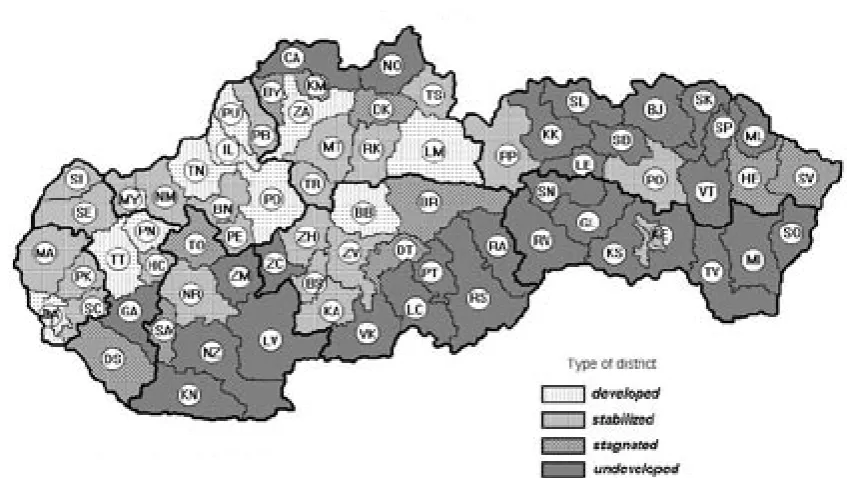
[image:3.595.85.509.488.727.2]The deepening of fragmentation and polarization of the Slovak society (on territorial, settlement and social-economic principles even) gets projected also into the differentiation of possibilities for reaching a balanced and permanently sustainable social-economic development of regions and settlements. There is a series of problems emerging in various spatial levels and social segments of the society and it turns aside the social-spatial situation of the society and complicates the maintaining of its stability. The basic polariza-tion lines of the society include partly the horizontal social-spatial differentiation and partly the vertical social-economic polarization. The complexity of the present situation is caused by the fact that both of these problem dimensions are as a rule found in the same regions and territories, where there is a concentration of social and economic problems (Figure 1).
Figure 1. Slovak Republic: Social-economical types of districts (NUTS 4) in 2000
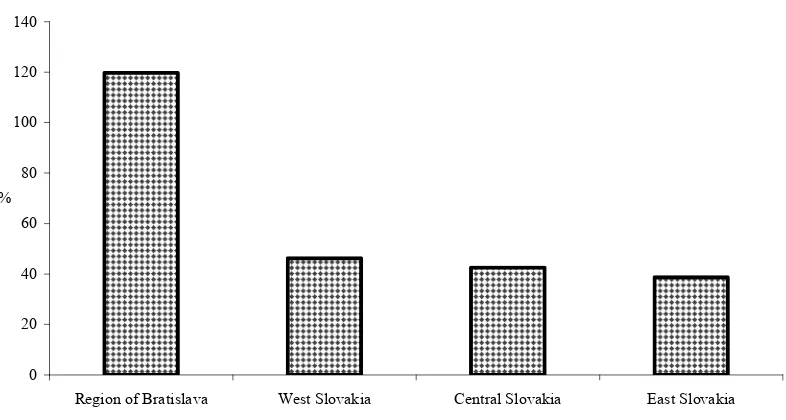
A clearer form has the line delimitating the group of regions with relatively good developmental dispositions and the much greater group of regions characterized by uneven economic, but also social development. On the one hand, they are the well-developed regions with the urban structure mostly, with the prevailing favorable synergic effect of multiple developmental factors. These regions dispose of developed tertiary and quaternary activities, providing suitable environment for investment activities, for modern social, technical and environmental infrastructures. On the other hand ,there is a group of underdeveloped regions, with the synergically unfavorable effect of multiple factors. They are the territories with unfavorable location potentials, with a rural structure mostly, with little developed and diversified economic structures, lower educational level of the inhabitants, etc. This line has gained clear spatial contours – in the direction from the Bratislava capital to the east of the Republic, the conditions of social-economic development of the regions get complicated. The gap between Bratislava (where more than 60% of foreign investments get al-located), the Bratislava region, or the Western Slovakia and the other regions of Slovakia (especially the south of the Central and Eastern Slovakia) becomes ever broader. There is a strong polarization between the Bratislava capital and the other regions in a series of indices decisive for the living standard and the qual-ity of life of the inhabitants (e.g. the GDP/inhabitant, the average wage, unemployment, etc.). Moreover, developmentally Bratislava tows the Bratislava region also, which is but partially true of other regional
[image:4.595.100.493.517.727.2]cen-tres and prevailingly they get developed as solitaires (Figure 2).
The products of such a regional development repre-sent the marginal regions, localized especially in the east and in the southern part of the Central Slovakia. They are the regions in which the economic problems get cumulated with the social ones, with the quality of the human resources, the infrastructure level, com-munication facilities, etc., that under conditions of the market economy cannot be attractive and competitive. They are characterized by deteriorating demographic and educational structures of inhabitants, reflected in a lower quality of the human potential, in the grow-ing numbers of the long-term unemployed and social welfare dependent inhabitants. The social-economic level of the districts close to the borders, especially in the southeast and northeast areas of Slovakia is lag-ging behind. Due to the insufficient transport com-munications (international and with the capital even) the investors, especially the foreign ones, remain to be disinterested in these territories. A considerable proportion of these regions have the character of poverty regions. The existing branch policies and their insufficient coordination contribute to the weaken-ing of attractiveness and competitiveness of problem regions, and thus still aggravate the problems and raise the exigency of revitalization measures. In spite of large amounts of money spent the non-systemic approaches and solutions have not contributed with any desirable results so far.
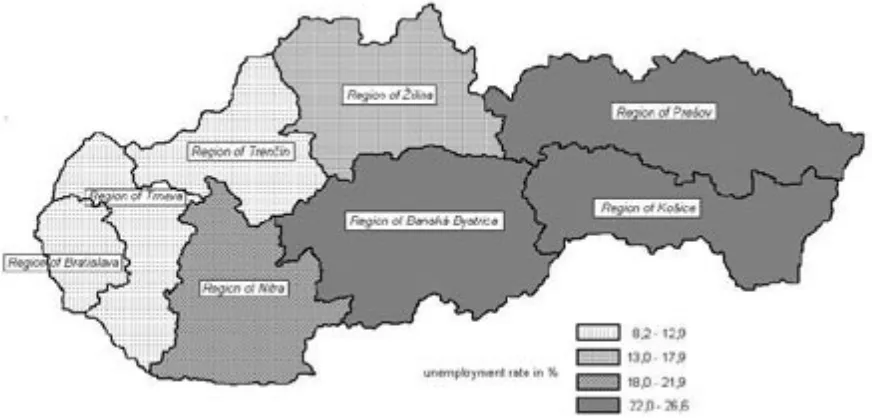
The deepening in regional differentiation in the unemployment rate appears. In the regions most
af-0 20 40 60 80 100 120 140
Region of Bratislava West Slovakia Central Slovakia East Slovakia
%
Figure 2. Slovak Republic: Regional GDP in PPP per head as % of the EU-25 average
fected by inevitable and usually extensive industrial restructuralization (in special and mining industries mainly), but also in the regions with more expressive orientation to agriculture, there is a high unemploy-ment rate, while the necessary structural transfor-mations meant to reduce it are not sufficiently quick and effective. The regions with high unemployment rates have a higher degree of the long-term unem-ployment as well. Even the internal structure of the unemployment is unfavorable. A great proportion of the unemployed consists of the primary and secondary school graduates, women and socially weaker groups of citizens. The unemployment development is also influenced by unsatisfactory interconnection between the school system and the labor market, but also the unsuitable ratio of social welfare and labor incomes, low mobility of labor force, limited possibilities of implementation of the instruments of active policy at the labor market (Figure 3).
The ongoing transformation of the society has resulted in new regional disparities, having at pres-ent the character of social inequalities mostly. In the background of these regional differences, there is ever more frequently to be found also the dif-ferentiation in social and demographic structures, in the unemployment rate, but also in the condi-tions of social dynamics (individual, family, ...), as well as in the population migration caused by them. As it has been shown, the differences in the living conditions, advantages or disadvantages of local or regional situations represent an expressive stimulus for individual behavior.
The process of the deepening of social polarization of the society is connected with the formation of a new social structure of the population, in which the processes of differentiation of the society, due to the new private property relations mainly, start to get clearly manifested. In this process, even the regional social disparities following from the living conditions and life perspectives that are complicated and con-nected with a whole series of psychosocial problems of the inhabitants become more expressive.
The endangered groups of inhabitants that have been outlined include mainly the Roma population, the young people, the generation of seniors, young families, incomplete families, the long-term unem-ployed, the people with lower education. Mostly they are the groups usually highly concentrated in rural regions, or rural settlements mainly.
[image:5.595.77.513.511.720.2]The deterioration of the population situation in the Slovak Republic goes hand in hand with the marked change in the demographic behavior of the inhabit-ants in the 90-ties. Especially in towns, where the populationally strong generation reaches the potential age period for getting married, there is a great short-age of disposable apartments. The most unfavorable demographic situation is found in the southern dis-tricts of the Western and Central Slovakia, with the population having a degressive character mostly. The dislocation of the good quality human potential (from the point of view of population, education, civilization) in the territory is considerably differentiated. It still remains to be concentrated in larger cities mainly, which is a complicating factor for the introduction
Figure 3. Slovak Republic: Unemployment rate of registered unemployed in regions (NUTS 3) in 2004
of developmental trends especially in villages and smaller towns, but there are marked differences even between the regions, resulting in considerably differ-ent “starting-point” conditions and developmdiffer-ental pre-dispositions.
The good quality human potential deteriorates and it disappears from the rural environment mainly. This is a long-lasting trend in smaller municipalities mostly (up to 500 inhabitants, representing 43.3% of rural municipalities in Slovakia) and thus their exis-tence as that of settlements with permanently residing population gets endangered, as well as the existence of whole regions, in which the centre of gravity of the settlement structure is based on small settlements. In spite of the fact that in the last decade the demo-graphic situation and the residential migration on the village-town level got stabilized, it did not have any fundamental effect on the social-demographic situation in rural areas. The reproduction capacity of the Slovak countryside has considerably deteriorated. The population aging with all its accompanying signs proceeds rapidly, reducing the participation in solving the public matters and problems (civic participation) in the respective communities (Buchta 2003).
The developmental problems of small communities, with still a significant share in the settlement structure of the Slovak Republic, become deeper. These mu-nicipalities and their self-administrations suffer from multiple problems, starting from those concerning the personnel, the infrastructure, up to the economic ones. In connection with further social-demographic characteristics of these municipalities (the highest proportion of post-productive population – 26%) and the continuing process of the transfer of competen-cies to municipalities, the above disintegration of the settlement structure causes a series of problems both in the performance of the administration as well as in solving the developmental problems.
The negative age structure of the countryside causes the stagnation in the level of its cultural capital also, in which there is an ever greater role played by the completed education and the professional qualification. Nowadays the cultural capital of these municipali-ties no longer corresponds with the contemporary requirements in the labor market and it results in the high unemployment rate, in the decreased standard of living and in the growing poverty.
The age structure and the decreasing number of inhabitants in the countryside, the spatial mobility limited by age impair and deform the social capital of the countryside, of the small settlements mainly. This capital is important for revitalization and sus-tainability of rural settlements. The social capital in the countryside is often impaired, or deformed,
which has a negative effect on the capability of active participation in sustainability ensuring and improving the living conditions within the settlement.
As a new form of organization of the rural space ,the formation of micro-regions has been also put through, connected with the transfer of autonomy and competencies to the local level. This form of co-operation between the settlements serves as a proof that the countryside gradually builds its mobilization potential. The gradual activation of the rural space represents the reaction to the unfavorable develop-ment and the growing problems in this type of the settlement and it is manifested in the formation of micro-regions on the basis of voluntariness and com-mon interest. At present there are about 90 subjects of this kind in Slovakia. The growth of local initia-tives creates suitable conditions for implementation of endogenous developmental strategies.
The cross-border co-operation and especially its euroregional forms are growing in their extent and in the future their role is going to be still more marked. The districts close to the borders, forming a significant segment of the Slovak territory, are the main partici-pants in this process. They form 59,7 % of the area of Slovakia and their population represents 49,9 % of the total population of Slovakia. The dislocation of euroregions is territorially uneven. The largest number of euroregions, or euroregional associations are found at the Slovak-Hungarian border, they are 9, there are 2 euroregions at the Slovak-Ukrainian border, 3 euroregions at the Slovak-Polish border, 3 euroregions at the Slovak-Czech border, one of them extending to Austria and Hungary, and there are 2 euroregions at the Slovak-Austrian border, both of them extending to the Czech Republic and Hungary (Falťan, Pašiak 2005).
The effective resolution of the above-mentioned problems of regional development is hindered be the absence of effective instruments and policies to solve the existing regional disparities. The applied solutions of the existing interregional differences and the for-mation of prerequisites (resources, investments, ...) for inevitable transformations in the economic and social development of the problem regions mainly have been little effective so far and they considerably lag behind the intentions in this sphere.
REGIONAL DEVELOPMENT OF SLOVAKIA IN THE CONTEXT OF FORMATION
OF THE INFORMATION SOCIETY
development of information society and it may be assumed that this development will precede asym-metrically rather. Slovakia and its settlement and regional asymmetry, reflected in social-economic, but also ecological spheres and in the civilization structure, will also form the component part of this asymmetric development within the European Union. The fact that the starting-point situation of Slovakia is characterized by great spatial disparities resulting in a higher degree of social-spatial polarization, impair-ing the cohesion of Slovakia, will make it still more complicated. In the period after the entry of Slovakia into the European Union, these spatial polarizations will still have an increasing tendency, especially on the basis of direct investments of the foreign capital, implemented in the western part of Slovakia mostly (Gajdoš et al., 2004).
In the context of regions and settlements, the dis-positions of Slovakia to transition to the informa-tion (knowledge oriented) society are considerably differentiated and thus the transition has been very slow so far. Slovakia is in the period of encounter of the values, priorities and trends of industrial and information societies. At the end of the 20th century, the transformation process of the Slovak society was in a stage when the innovations and modernizations connected with the industrial period and their deficits (in the spheres of economy, technologies, technical and social infrastructures, public service, education, culture) were not yet successfully balanced. The be-ginning of the 21st century, connected with the entry of Slovakia into the European Union, is then conse-quently more urgent in stressing the necessity of more intense providing of developmental prerequisites for the information stage of the society development.
CONCLUSION
In the context of the development of the society and its social-spatial structure, there is a disturbing fact, namely that the present transformation process and its developmental trend (in spite of the declarative support) do not sufficiently emphasize the rapid entry of the Slovak Republic into the knowledge oriented
society. This situation has not only its political di-mension, lying in the political and thus also the state support of a certain developmental trend, but also the dimension of the continued industrial (postindustrial) value orientation, emphasizing for example the devel-opment of industry, transport, etc., rather than the development of the human and knowledge capitals, information networks, the civic society, etc. This fact complicates the building of the Slovak society as an information society and its sustainable development in social, economic, ecological, cultural and civiliza-tion spheres (Gajdoš et al. 2004).
REFERENCES:
Buchta S. (2003): Slovak countryside at the end of the 20th century. Sociológia, 38 (2): 125–140.
Falťan L., Pašiak J. (eds.) (1995): Regional Develop-ment of Slovakia – Solutions and present situation. SÚ SAV, Bratislava.
Falťan L., Gajdoš P., Pašiak J. (1995): Social marginal-ity of territories of Slovakia. SPACE, Bratislava. Gajdoš P., Pašiak J. (1995): Development of
socio-ecological situation of Slovak society. VEDA, Bra-tislava, 262 p.
Gajdoš P. (1999): Socio-Spatial Situation in Slovakia and its Problems and Development in the 20th Century. Sociologia, 31 (2): 111–140.
Gajdoš P. (2001): On selected probléme of transfor-mation of social-spatial situation in Slovakia in 1990s. Sociológia, 33 (2): 185–206.
Gajdoš P. et al. (2004): Local and regional develop-ment. In: Development and utilisation of science and technology in Slovakia, in period up to 2015. PÚ SAV, Bratislava.
Mederly P., Vilinovič K. (2001): National Sustainable Development Strategy – Slovak Republic. REC Slovakia, Bratislava.
Šikula M. (ed.) (2003): Economic and social context of Slovakia’s integration into EU. ÚSSE SAV, Bra-tislava.
Arrived on 29th April 2005
Contact address: