Student loans and
debt aversion in
Portuguese higher
education
G a b r i ë l l a B a y s o y
M a s t e r t h e s i s P u b l i c A d m i n i s t r a t i o n
U n i v e r s i t y o f T w e n t e
This study is about to examine whether and to what extend prospective Portuguese students are debt averse; whether there are differences regarding students
1
Student loans and debt aversion in Portuguese higher
education
This study is about to examine whether and to what extend prospective Portuguese students
are debt averse; whether there are differences regarding students representing various
groups in terms of social and economic backgrounds, gender, school type, geographical
school location and earning expectations.
Master thesis Public Administration
Author: Gabriëlla Baysoy
Student number: s0213802
Thesis coordinators:
Prof. dr. J.J. Vossensteyn
Dr. H.G. Van der Kaap
May 2014
2
Preface
With this thesis, my time as a student in the University of Twente will come to an end. A
period during which, not only have I learned a lot, but I had also a lot to unlearn. It was also
a period during which I was able to meet a lot of people, but above all a period during which
I have developed myself into the person I am today. Therefore, this thesis, the last chapter
of this period, embraces many of the knowledge and skills I have gained during my studies;
while writing it, I tried to study/realize whether and to what extend Portuguese prospective
students are debt averse and to examine any differences among students from different
groups.
My interest in higher education systems urged me to contact Prof. Hans Vossensteyn, for a
graduation research abroad. After a short talk, we reached the conclusion that Portugal
would be the most fitting case for my study and Prof. Luisa Cerdeira the most appropriate
professional to contribute to its making. Prof. Vossensteyn assured me that I was at the right
place, during my stay in Portugal and that Prof. Cerdeira would do everything to make me
feel like at home, in a country that was foreign to me. Nothing has been more true. I have
never regretted the choice I made to go to Lisbon and collect my data there.
Therefore, with this preface, I would like to take the opportunity to thank several people.
First of all, my gratitude goes to my supervisor Prof. Hans Vossensteyn for the doors he has
opened for me, the time and effort he has put into me and the patience he has shown me
during the past year. Throughout the process, Prof Vossenteyn, a very good and at the same
time critical supervisor, has helped me a lot to overcome any difficulties and also provided
me with new perspectives and input. He also taught me to work independently.
I would also like to thank Prof. Luisa Cerdeira, for her sympathy and hospitality at the
University of Lisbon. She always managed to find some time for me when necessary, despite
her very busy work schedule. She helped me to translate my survey from English to
Portuguese and she opened several doors for me in Portugal. She has managed to bring me
in contact with the Portuguese Ministry of Education and with the various schools to which
the surveys were distributed. Moreover she offered me a place at her office with Prof.
Thomas Patrocinio and Prof. Belmiro Gil Cabrito. Both of them where very helpful and there
3
lot about the Portuguese language and culture. Obrigada for that! They also helped me with
the translation of my survey and the request for approval by the Portuguese Ministry of
Education. For this I would also like to thank Judite Soares. She contributed at its most to
make sure that the application process would be a fast pace. I would also like to thank all the
Portuguese students who took some time to fill in the surveys.
I could not conclude this chapter without mentioning my second supervisor, Dr. Van der
Kaap who offered me a helping hand when I found troubles analyzing my data statistically.
He also offered me several insights to make my thesis a better success.
I also find necessary to deeply thank my parents. They always make me realize how
important it is to study and they always taught me that with the help of God many things are
possible. Finally, I would like to thank the rest of my family and friends. They have been
comprehensive shown understanding for the time that this thesis has demanded from me,
and besides they have always supported and motivated me. Special thanks go to the friends
who did the proofreading of my thesis.
Gabriëlla Baysoy
4
Management Summary
In recent years, higher education has become increasingly important. But overall, students in
many countries are progressively paying more for higher education, because of the principle
of cost-sharing. These increasing costs may negatively affect the accessibility to higher
education, if students are not willing to pay the extra costs. Therefore governments try to
encourage students to take up student loans to study in higher education. The Portuguese
case of higher education is a very interesting one. In Portugal without any grants, loans or
other financial support, it is very difficult to study in higher education, particularly for lower
income students. Portuguese higher education students are in a very unfavorable situation
with regard to the degree of accessibility and affordability compared to other European
students. Portuguese students and their parents pay much more for studying than most of
the other European countries in the comparison with their median household income,
because family incomes in Portugal are lower than in the other European countries. Student
loans can be a good instrument for students in financial distress; loans can play helping
prospective students to compensate these liquidity constraints. However, in most of the
Portuguese bibliography it is assumed that Portuguese students, particularly low-income
students, are debt averse and that they will not take up a loan to study. This study aims to
contribute to literature whether prospective students are debt averse and what conditions
can make student loans more attractive.
The first chapter of the thesis is an introductory chapter. In this chapter the main topic, the
central research question and the sub questions will be introduced. The central research
question is as follows; “To what extend are prospective Portuguese students debt averse? And are there differences between students from different groups in terms of social economic background, gender, school type, geographical school location and earning expectations.” In the subsequent chapters from this thesis the sub-questions will be answered.
The second chapter gives a description of Portuguese higher education. It shows how higher
education in Portugal looks like and what student financing arrangements apply to
Portuguese students. In the third chapter, the theoretical framework, is shown what
economic theories tell us about student choices, student loans, access to higher education
and the influence of debt aversion. With relevant concepts from the behavioural economics
5
the choice to study in Portugal with financial elements like loans, the role of debt aversion
and the difference between students from different backgrounds. In the fourth chapter (the
methodology), the research design is described. The research in this thesis is partly a
literature review on higher education in Portugal and various theories that may help explain
the phenomenon of debt aversion among students and partly a quantitative study. With the
quantitative data is tried to find out to what extent there is debt aversion among students.
The quantitative data is obtained through surveys among students in the final year of
secondary schools.
Chapter five addresses the operationalization of the hypotheses through specific variables
and provides descriptive overviews of the main outcomes of the surveys. The outcomes of
the surveys are related to actual numbers in higher education in Portugal. From chapter five
is concluded that for many Portuguese students it is unlikely to borrow. If they would
borrow, they would prefer loans from the state over those from private banks. We also
found that regardless of the fact that students perceive it very unlikely to take up student
loans, they would not be very negative towards student loans with attractive repayment
conditions. They are less debt averse as one would expect from the statements about
likelihood to take up loans.
The sixth chapter answers the question whether debt aversion plays a role for prospective
Portuguese students and if this differs for different student groups. We found that students
from different SES groups have slightly different cost expectations. The differences are
mainly found in the tuition fees expectations. Students from higher socio economic
backgrounds expect to have higher tuition fees than lower SES students. This is in opposite
direction than expected. We found also differences in the level of debt aversion between the
different groups. We concluded that prospective students from low socio economic
backgrounds are more debt averse than high SES students. We concluded also that public
school prospective students are more debt averse than prospective students from private
schools. However we rejected the hypothesis that female students, rural area students, and
students with lower earning expectations are more debt averse than male students, city area
students and students with higher earning expectations. Hence, we have to mention that we
found some proof that in some components of debt aversion some students of those groups
6
debt aversion is a multi-faceted phenomenon. According the way we measure debt aversion,
may determine if students are debt averse or not. However, overall we have also concluded
that favorable repayment conditions and average high rates of return should offset debt
aversion in Portugal. In the last part of the seventh chapter some recommendations for
7
Contents
Preface ... 2
Management Summary ... 4
List of figures ... 8
List of tables ... 9
1. Introduction ... 10
1.1 Developments towards cost-sharing and its potential impact on access to Higher Education .. 10
1.2 The Portuguese case of cost sharing ... 12
1.3 Central research question and sub questions ... 13
1.4 Structure of the report ... 15
1.5 Major concepts and definitions ... 17
2. Description of Portuguese higher education ... 18
2.1 Portuguese primary and secondary education ... 18
2.2 Portuguese higher education ... 20
2.3 Portuguese student financial support and tuition fee system ... 21
Costs of study ... 22
Student support system: grants ... 24
Student support system: loans ... 25
2.3 Student financing and its impact on access to higher education ... 26
3. Theoretical framework ... 28
3.1 Student choices ... 28
3.2 Traditional economics ... 29
3.3 Human Capital Theory ... 31
Student choice and human capital ... 33
3.4 Behavioural economics ... 34
3.5 Conclusion and hypotheses ... 39
4. Methodology ... 42
4.1 Dimension of the sample... 42
Data-collection ... 42
Goals and design of the survey ... 43
4.2 Statistical methods ... 45
5. Presentation of the survey data ... 46
5.1 Operationalization of the hypotheses ... 46
8
The Independent variables ... 48
5.2 Sample description ... 50
5.3 Description of the dependent variables ... 54
6. Students’ cost expectations, debt aversion and the sensitivity to the conditions of student loans 60 6.1 Testing the hypothesis ... 60
6.1.1 SES and higher education costs expectations ... 60
6.1.2 Debt aversion and the dependent variables ... 62
6.1.3 Student loan conditions and the likeliness to take up a loan ... 70
6.2 Overall conclusion ... 72
7. Conclusions and recommendations ... 74
7.1 Introduction ... 74
7.2 To what extend do student loans lead to debt aversion among prospective Portuguese students from different groups? ... 74
7.3 Recommendations... 78
References ... 80
Appendix 1: Questionnaire ... 84
Appendix 2: Crosstabs Pearson Chi-Square; hypotheses one to six ... 88
9
List of figures
Figure 1: The complexity of student financing. Vossensteyn (2012) ... 11
Figure 2: Thesis overview ... 16
Figure 3: Portuguese Education system (Eurydice 2012/2013) ... 18
Figure 4: Students enrolled according to the nature of institution by region, school year 2010/2011 (Ministry of education, 2013) ... 19
Figure 5: Economic background of students in higher education. (Cerdeira, Cabrito, Patrocínio, Machado & Brites, 2012) ... 21
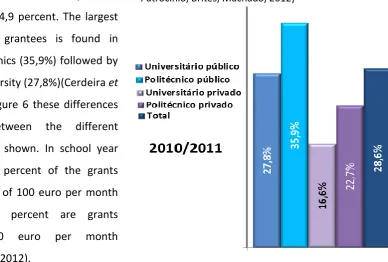
Figure 6: Percentage of grantees 1994/1995, 2004/2005 and 2010/2011 by sub-system (Cerdeira, Cabrito, Patrocinio, Brites, Machado, 2012) ... 25
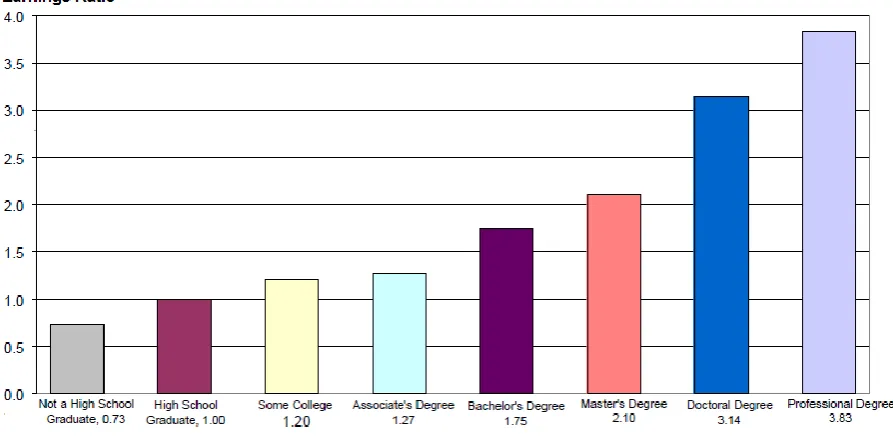
Figure 7: Expected lifetime earnings relative to a High School graduate, by education level (in 1999 dollars) (Gandhi, 2008) ... 32
Figure 8: Overview selected schools in Portuguese map ... 43
List of tables
Table 1: Major concepts and definitions in this study ... 17Table 2: The average total annual costs of higher education students (life, education and total) in euros in the period 2010/2011). (Cerdeira, Cabrito, Patrocinio, Brites, Machado, 2012) ... 23
Table 3: Comparison between the total costs of education (education + life) and Median Household Income in $. (Cerdeira, Cabrito, Patrocínio, Machado & Brites, 2012) ... 24
Table 4: Descriptives SES ... 48
Table 5: Crosstabs highest educational level parents and family household income ... 49
Table 6: general characteristics ... 51
Table 7: Higher education aspirations and expectations ... 52
Table 8: Prospective Portuguese students’ ideas about student financing ... 54
Table 9: Descriptives of the components of the dependent variable debt aversion ... 56
Table 10: Descriptives of the dependent variable the sensitivity to the conditions of student loans.. 58
Table 11: Pearsons Chi-square tests, relation higher education costs expectations and SES ... 61
Table 12: Pearsons Chi-Square tests, relation debt aversion and independent variables ... 63
Table 13: Crosstab; type of school and SES ... 68
10
1.
Introduction
In recent years, higher education has become increasingly important. Stimulating economic
growth is an important issue on the agenda of the European Union. Higher education plays
an important role in stimulating economic growth (Eurydice, 2013). In addition to stimulating
economic growth, higher education has many other benefits, financial and non-financial,
private and social (European Commission, 2007). In most countries, student financing plays
an important role in the funding of higher education, in particular for low income students
(Johnstone, 2006). However governments can no longer pay all costs. In recent years, the
impact of the financial crisis is really noticeable in the area of higher education. Due to
governments’ cutbacks, year after year, students do not have many options besides sharing
the costs of higher education and of its increasing tuition fees with their parents, and by
getting loans and student jobs, instead of grants (Vossensteyn, 2005). In general, according
to studies students are not very price sensitive, except low SES students, but the threshold
to participate in higher education must be reachable enough to ensure everyone’s
accessibility in Higher Education and to stimulate a highly educated population (Johnstone,
2004). The issue that we should deal with is whether the government cuts in Higher
Education funding and increasing emphasis on student loans, the threshold to enter higher
education is not too high to negatively affect the accessibility of higher education.
The main topics of this study are debt aversion among Portuguese prospective students and
the influence of student loans and what conditions can make loans more attractive.
1.1 Developments towards cost-sharing and its potential impact on access to Higher Education
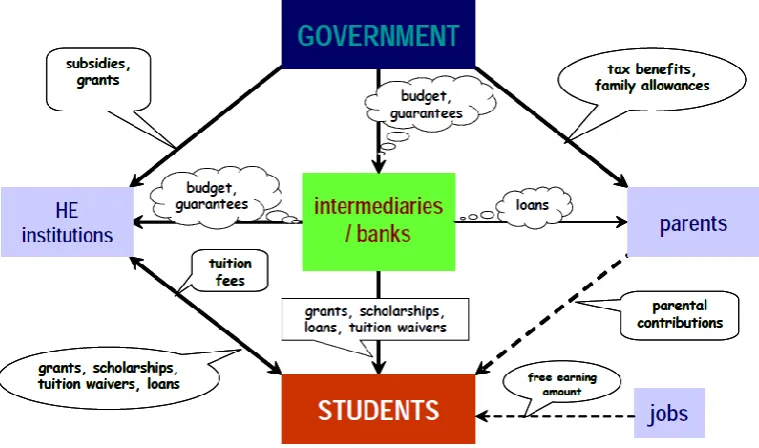
Student financing is very complex; many actors can be involved: governments, parents,
higher education institutions, intermediaries, banks and the students. The figure below
presents how complex student finance is. The figure shows the relation between the
different actors involved in higher education and the different methods of student financing.
Student financing can be provided in different ways, by direct student support like grants
and scholarships (gifts), by indirect student support, such as family support (child support)
and tax benefits (for students and parents), by hidden support, like no interest on loans and
11 Figure 1: The complexity of student financing. Vossensteyn (2012)
Many governments subsidize education at all levels, including Higher Education. These
subsidies can take various forms; like basic funding to universities, grants and guaranteed or
interest-subsidized loans (Eckel et al., 2007). In order to stimulate mass higher education with limited public budgets, governments introduce the principle of cost-sharing. Cost-sharing reflects the public policy change from systems where governments bear most of the
costs, to systems where students and their parents have to share the costs of higher
education by means of higher tuition fees and a growing reliance on loans and students jobs
instead of grants (Johnstone, 2006).
Also, private Higher Education may be a way of cost sharing. Different researchers suggest
that it is fair to ask students and their parents to make a contribution to the costs of higher
education because of the high rates of return to Higher Education. They show rates of return
from 4 percent till 30 percent (Vossensteyn, 2012). Several studies that address the
phenomenon of cost-sharing indicate that it may affect the accessibility to higher education
(Johnstone, 2006). Nevertheless, governments suggest that they support the opportunities
to study by having various student loan schemes. In the dissertation of Vossensteyn (2005)
about the perceptions of student price-responsiveness, he shows that general studies about
student choices indicate that financial incentives, like tuition fees, grants and loans, hardly
have any influence on participation patterns of students. A limited number of studies
12
education, or at least one can speak of debt aversion among students (Vossensteyn, 2005).
Whether debt aversion will in the end lead to reduced accessibility to higher education is not
proven yet(CPB, 2013).
Overall, students in many countries are progressively paying more for higher education. In
figure 1 we see that students can finance their higher education in different methods.
Cost-sharing makes that students increasingly have to rely on the methods of student loans,
self-funding (jobs) or parental contributions. These increasing costs may negatively affect the
accessibility to higher education, if students are not willing to pay the extra costs. Students
may choose not to enroll in higher education or prefer shorter and less expensive programs
and institutions. Governments try to encourage students to take up student loans.
Therefore, it is interesting to know if student loans influence prospective students in their
decision to study in higher education, despite the increasing costs of higher education.
1.2 The Portuguese case of cost sharing
As we mentioned at the beginning of this chapter we see that in many European countries
budgetary restrictions that took place because of the financial crisis, have led to cuts in the
funding of higher education. This is exactly the case in the Portuguese higher education
(Eurydice, 2013). The principle of cost-sharing is also introduced in Portugal. The Portuguese
higher education system forms a very interesting issue. Portuguese students and their
parents pay, for example, much more for studying than students do in most of the other
European countries, in the comparison with their median household income. Furthermore
we see that the differences in student choices between different Portuguese groups are very
big. The introduction of new loan systems should be an answer for these issues in higher
education, but in most of the bibliography it is argued that Portuguese students are debt
averse and that they will not take up a loan to study (Cerdeira, 2009). This is one of the main
reasons why it is interesting to know if loans have an influence on Portuguese student
choices and if Portuguese students actually are debt averse.
So in Portugal without any grants, loans or other financial support, it is very difficult to study
in Higher Education, particularly for lower income students. Portuguese Higher Education
students are in a very unfavorable situation with regard to the degree of accessibility and
13
pay much more for studying then most of the other European countries in the comparison
with their median household income, because family incomes in Portugal are lower than in
the other European countries. On the one hand these high costs for Portuguese students
may negatively affect the accessibility of higher education. Prospective Portuguese students
may choose not to enroll in higher education or prefer shorter and less expensive programs
and institutions. On the other hand student loans can be a good instrument for students in
financial distress; loans can play a role helping prospective students to compensate these
liquidity constraints (Chapman, 2005). Therefore it makes it interesting to know about the
impact of student loans on Portuguese student choices. But, as we mentioned above, in
most of the Portuguese bibliography it is assumed that Portuguese students, particularly
low-income students, are debt averse and that they will not take up a loan to study.
Whether debt aversion in the end will lead to reduced accessibility of higher education is not
proven yet. Hence, with the research of this thesis next to the influence of loans on
prospective Portuguese student choices, we will examine if prospective Portuguese students
are really debt averse and if this differs for prospective students defined in terms of SES,
gender, school type, school location and earning expectations. In the upcoming chapter it
will be explained in more details why Portuguese higher education is an interesting case to
study.
So with this thesis I want to add to literature to see whether prospective students are debt
averse and what conditions can make student loans more attractive.
1.3 Central research question and sub questions
With this thesis we try to find out if student loans for Portuguese prospective students really
influence their decision to study in higher education. We also try to draw conclusions on
whether the expectations about the fact that prospective students are debt averse are right,
and if this differs for students from different backgrounds. The central research question is
therefore:
To what extent are prospective Portuguese students debt averse? And are there differences between students from different groups in terms of social economic background, gender, school type, geographical school location and earning expectations?
14
The first sub-question is: How does higher education in Portugal look like and what student financing arrangements apply to Portuguese students?
Most higher education systems are complex and not transparent. This analysis is envisaged
to provide a clear insight in to the Portuguese higher education system. The accessibility of
Higher Education can be explained by showing how Portuguese Higher education look likes
and how (difficult) students can enroll for higher education.
The second sub-question is: What does economic theory tell us about student choices, student loans and access to higher education and the influence of debt aversion?
With this question the focus will be on the major outcomes of student choice research and
the relation of student choices with loans and debt aversion. By answering the question a
theoretical framework will be given based on a combination of these concepts. Through the
theoretical framework a number of hypotheses will be formulated which can be tested with
the empirical data.
The third sub-question is: Does debt aversion play a role for prospective Portuguese students and does it differ for students from different backgrounds in terms of SES, gender, type of schools, geographical location and earning expectations?
With this third question the empirical part of the research will start. This question provides
insights in how the phenomenon of debt aversion among prospective Portuguese students
really looks like in general and particularly regarding to studying in higher education. There
will be an overview about whether there is debt aversion among upcoming students. Debt
aversion will be measured with different components. With this question we will show how
the different groups of students score on the different aspects of debt aversion.
The fourth sub-question is: Under what conditions do prospective Portuguese students consider loans to be an option for financing their studies?
With this question we want to find out under what conditions loans can be an option in
Portuguese higher education. We will analyze under what conditions Portuguese students
15
The fifth sub-question is: What recommendations can be made for policy making in Portuguese higher education concerning student loans?
With the answers on the other research questions we give some insights in the Portuguese
higher education system, economic theories on student choices, the role of debt aversion for
prospective Portuguese students and the conditions under which student loans are an
option in Portugal. With these analyses that will be made with the collected data, we can do
some recommendations, concerning student loans for Portuguese Higher Education
policymakers.
1.4 Structure of the report
This research will be partly a literature and partly an empirical quantitative study. By using
the literature, we try to find answers to the first two sub-questions. We start the first part of
the study with a description of the Portuguese educational system. This is followed by a
description of the Portuguese student financial support and the tuition fee system.
Thereafter, results from previous Portuguese research on student financing and its impact
on access to higher education will be presented. The second part of the study will be an
overview of different economic theories which may help explain the role of student loans,
debt aversion and differences between particular categories of students in Higher Education.
We also try to show the major outcomes of existing student choice research. With the
quantitative data we will answer the last three sub-questions, by linking the existing
literature to the collected data. Here we also try to find out to what extent there is debt
aversion among students. The quantitative data will be obtained through surveys among
students in the last year of secondary education in Portugal. With the data, we will explain
how prospective Portuguese students think about financial incentives related to studying
and if prospective Portuguese students are debt averse; we will also examine if this differs
among students from different backgrounds. The survey will consist of questions on four
different topics. The survey will start with some questions regarding general characteristics
(questions about behavioral and background variables), followed by questions about
students’ Higher education aspirations and expectations. The surveys will end with questions
about the students’ attitude towards student loans and debt. The survey questions will be
formulated by using the theoretical framework. For answering the research question it is
16
among current university or polytechnic students. In the latter case we would miss the group
of the young people who do not have made the choice to study. Besides, these students
already made the choice to study, which make it difficult to move back to the time they
should choose a study. After the data analysis, this study is finalized with some conclusions
and recommendations about the conditions under which loans can be an option in
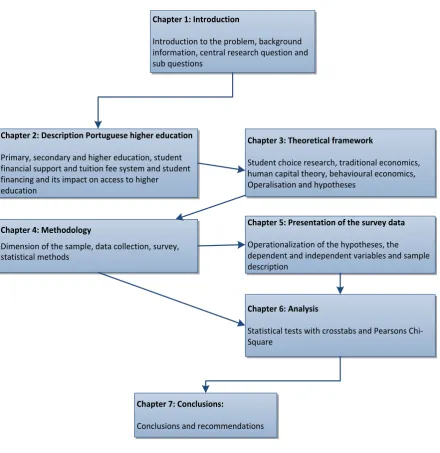
Portuguese Higher Education. In the figure below the content of this research is given in a
[image:17.595.74.515.256.710.2]short overview.
Figure 2: Thesis overview
Chapter 1: Introduction
Introduction to the problem, background information, central research question and sub questions
Chapter 2: Description Portuguese higher education Primary, secondary and higher education, student financial support and tuition fee system and student financing and its impact on access to higher education
Chapter 3: Theoretical framework
Student choice research, traditional economics, human capital theory, behavioural economics, Operalisation and hypotheses
Chapter 4: Methodology
Dimension of the sample, data collection, survey, statistical methods
Chapter 5: Presentation of the survey data Operationalization of the hypotheses, the dependent and independent variables and sample description
Chapter 7: Conclusions:
Conclusions and recommendations
Chapter 6: Analysis
17
1.5 Major concepts and definitions
In this research different concepts will be used. To prevent misinterpretation table 2
presents the major concepts with their definitions used in this study. Most definitions are
[image:18.595.63.534.182.673.2]the most used definitions in student choice literature.
Table 1: Major concepts and definitions in this study
Concepts Definitions
Debt aversion The psychic disutility of borrowing. In this thesis it is measured with students expectations for having a student loan or a student job, students attitude for taking up a loan for a house, car or higher education, the likeliness for taking up a loan in different situations, the maximum debt students are willing to accumulate for completing a higher education degree and students attitude towards different statements about loans in general and loans for studying.
Future earnings The income students expect to earn when they enter the labour market as graduates. These can for example be starting wages of graduates, total lifetime labour income, or the maximum wage at some point in a working career. (Vossensteyn, 2005)
Grants Generic subsidies (gifts) to groups of students that do not have to be repaid. (Vossensteyn, 2005)
Loan
characteristics
Different loan characteristics about interest, repayment conditions and cancellation of debt after some years.
Socio-economic background
Indicators of the social origins of a student, including parental education and parental income. (parents occupational status) (Also used as SES)
Student choice All choices students make related to studying, including whether or not to enroll, what (type of) institution and program to choose, whether to stay in college or to drop out, to live at the parental home or independently, to take up loans, to take a part-time job, etc. (Vossensteyn, 2005)
Study costs All costs for a student related to following a higher education program, including tuition and other fees, study materials, and living costs like nutrition, accommodation, personal care, travelling and leisure, etc. (Vossensteyn, 2005)
Student financial support
Financial assistance to students provided by public authorities or higher education institutions agencies in order to meet the costs of study, including grants, scholarships, loans family allowances and tax incentives. (Vossensteyn, 2005)
Student Loans Money lent to students that must be repaid, typically after the student leaves higher education. Student loans often include favorable repayment conditions.
Tuition fee (price)
18
2.
Description of Portuguese higher education
Like mentioned in the introduction of this thesis most higher education systems are complex
and in transparent. This complexity can affect the accessibility of higher education. Cost
sharing may also affect the accessibility of higher education. The obligation to student loans
may reduce the accessibility, for example. But also many other factors can affect access to
higher education, such as the pathways to higher education, selection, labour market
conditions, etc. For these reasons we give some insights in the Portuguese education system.
For example, we will show what the selection criteria are to continue higher education after
secondary school. In addition, a description of the student financial support and tuition fee
system will be given. Thus, with this chapter, with offering insights in Portuguese higher
education, we can understand better which aspects determine the accessibility to higher
education.
2.1 Portuguese primary and secondary education
Portuguese Basic Education is universal, compulsory and free and it has a duration of nine
years. In Portugal, children aged from six to fifteen are required by law to attend basic
education. They can attend state schools or private schools. The basic education system in
Portugal is divided into three cycles. The first cycle, which has a duration of four years, is
providing a rounded education. The students have every year one single teacher. The second
cycle has a duration of two school years. In the second cycle the learning process is
organized into interdisciplinary areas at a basic level and with one teacher for each area. The
third cycle, last three school years, is organized around a unified curriculum, including a
variety of vocational areas with one teacher for each subject or group of subjects (Ministry
[image:19.595.65.558.624.723.2]of Education, 2006).
19
In this research we will collect our data at secondary schools; this is the reason why we will
describe the Portuguese secondary education more extensively than the Portuguese basic
education. Secondary education courses have a duration of three years and they are open to
students who have obtained the basic education diploma, which they get at the end of
primary education. Attendance is optional and the students are mostly aged between fifteen
and seventeen years. There is a variety of secondary education available to students in
Portugal. If students after secondary education want to directly enter the job market, they
can choose to go to technology courses. Those who are hoping to continue in higher
education are following the general courses. The curriculum is divided into subjects, with
one teacher for each subject (Ministry of Education, 2006). The latest data available about
the enrolled students in Portuguese secondary education are about the school year
2010/2011. At a later time in this thesis we will compare these data with our own data. In
the school year 2010/2011, 440 895 students were enrolled in secondary schools, and of this
group, 116 354 students (+/- 26%) where from the Lisbon area (Ministry of education, 2013).
In 2011, 51% of the secondary students where boys and 49% of the students where girls
(Ministry of education, 2013). Figure 4 shows the differences in percentage between
students enrolled in private and public secondary education. The figure shows that there are
[image:20.595.155.417.518.694.2]many more students enrolled in public schools than in private schools in the whole country.
Figure 4: Students enrolled according to the nature of institution by region, school year 2010/2011 (Ministry of education, 2013)
In Portugal, all secondary schools are ranked from low quality to good quality. Many of the
20
worst ranked secondary schools. The best ranked public and private secondary schools are
those from the biggest cities; Lisbon, Porto and Coimbra. Schools from littoral areas (often
big city areas) are better ranked than schools from rural and less populated regions. This
secondary schools ranking is released every year in Portugal and is based on the student’s
average grades in the national examinations, which are used for higher education selection
(Ministry of Education, 2009). The fact that the best ranked schools are from littoral areas
may have to do with the fact that there are more students from higher SES groups in these
littoral areas than in schools from interior regions (Ministry of Education, 2009). We will also
analyze this information about the differences between the students from the different
areas in a later point in this research.
In the end of the 11th grade of secondary school, students have national exams on the two
specific subjects of their course. In the end of the 12th grade, the students have exams on
Portuguese language and the main subject of the course. The access to higher education is
made through a national process, where the students enter higher education by priority of
their grades. The average of grades obtained in all subjects represents a part of the
application grade to enter college. The other part is based on the grade of the specific exams
that the college requested, which are related with the course the student is applying for. The
average of both averages is the application grade to college. The grade is between zero and
twenty and the higher it is, the better is the chance to enter. In Portugal, the percentage of
secondary students who will not study in higher education is average, compared with other
European countries. In 2009, 31,8% of the female and 43,8% of the male secondary students
did not attend any higher education (Eurydice, 2010) (Unesco, 2014). Many of those
students enter the labour market with the technology courses.
2.2 Portuguese higher education
Higher education in Portugal combines university education and polytechnic education.
Students in Portuguese higher education are mostly between eighteen and twenty five years
old. However, people from twenty five years and older may also apply for a place in higher
education even if they do not possess the necessary secondary education or equivalent
qualification, on condition that they can prove that they have the necessary skills and
knowledge. Both university and polytechnic institutions confer the degree of licenciado
21
bachelor’s degree has a length of 3 to 4 years in universities and in polytechnics and the
masters degree has a length of 1,5 to 2 years both in universities and in polytechnics (ISCEM,
year unknown).
2.3 Portuguese student financial support and tuition fee system
To understand which aspects determine the accessibility to higher education, it is good to
present an overview of what financial arrangements are organized to study in Portuguese
higher education. Portuguese higher education is a successful case in the scope of its
growth, but also in the scope of its diversification and regionalization. Portuguese higher
education was able to change (from 1980/1981 to 2007/2008) from a small system with little
more than 82 thousand students to around 377 thousand students and it changed from a
restricted number of universities to a varied set of institutions, distributed in a national
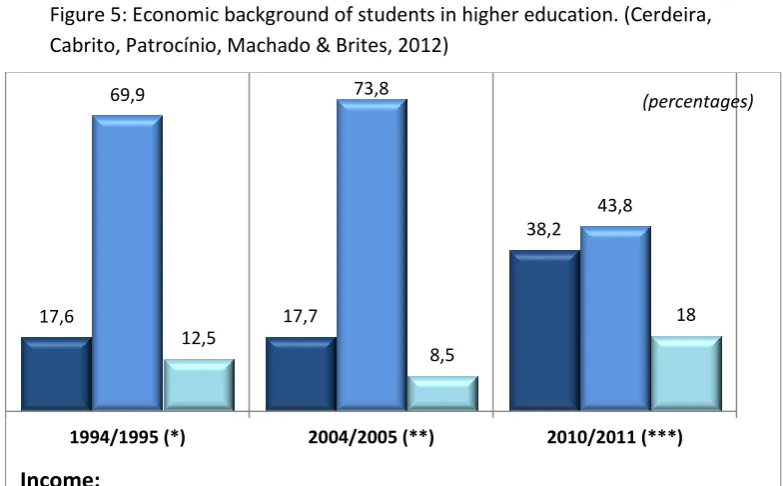
network. In figure 5 we see that the participation of students from the wealthiest strata of
society has more than doubled between 2004/2005 and 2010/2011. At the same time, there
has been a spectacular decline of youth participation coming from middle-income strata in
contrast to richer and poorer students. This could reflect a real increase in participation of
the poorest strata, including a process of democratization of the Portuguese higher
education (Cerdeira, Cabrito, Patrocinio, Machado & Brites, 2012).
17,6 17,7
38,2
69,9 73,8
43,8
12,5
8,5
18
1994/1995 (*) 2004/2005 (**) 2010/2011 (***)
High/medium high >1500€ Medium 870-1500€ Low <870€
(percentages)
[image:22.595.100.492.480.723.2]Income:
22
Introduction of tuition fees in public education did not result in a decrease of academic
attendance (Cerdeira, 2009). In Portugal all Higher Education students pay tuition fees. The
annual tuition fee is fixed by each public higher education institution and ranges from 630,50
euro to 1065,72 euro in the school year 2013/2014. The minimum value of the mentioned
fees is calculated as a 1,3 times the national minimum annual wage. Most of the institutions
apply the maximum value. All international students pay higher fees than national students
(Eurydice, 2013/2014).
Costs of study
Between 2004/2005 and 2010/2011 there was also a significant increase in the costs of
education and life for Portuguese students in higher education, regarding universities and
polytechnic, private and public as well (Cerdeira et al.,2012). The costs of students in Portugal depend on multiple factors, but especially on the type of higher education
institution, the accommodation and the region where the students live (Cerdeira, 2010). The
average total annual costs of higher education students contain therefore large differences
between students from public schools and students from private schools. The big difference
is mainly due to the educational costs. Tuition fees in private universities and polytechnics
are much higher than the tuition fees in public universities and polytechnics (Cerdeira,
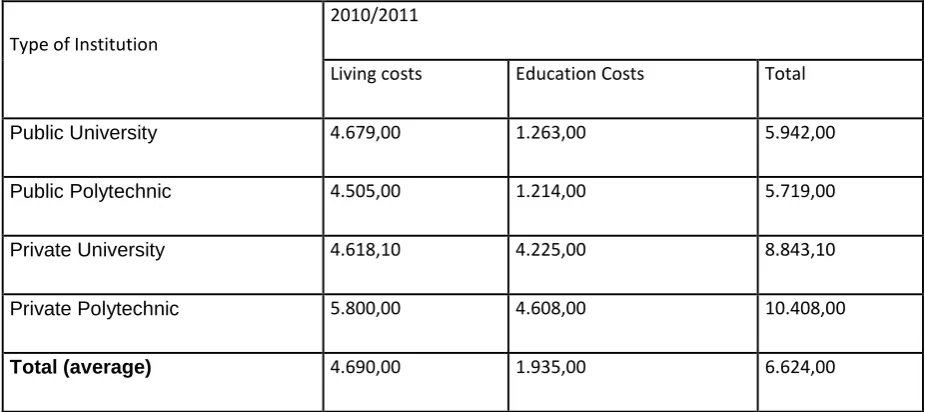
2012). In table 2 the average total annual costs of higher education students is shown (life,
education and total), in euros, in the period 2010/2011. Like we see; the total costs for
private education are much higher, then the cost for public education. It is therefore
explained that students in private education will take up more loans for studies, than
students in public education and that the majority of low SES students goes to public
education schools and thus receive more grants; besides, the total average costs of studying
is also lower in public education. Studying in Portugal is a big expenditure which is difficult
23 Table 2: The average total annual costs of higher education students (life, education and total) in euros in the period 2010/2011). (Cerdeira, Cabrito, Patrocinio, Brites, Machado, 2012)
(The numbers in table 2 and 3 are not similar because table 2 is given in euros and table 3 is given in dollars.)
In comparisons between the costs for Portuguese students in Higher Education with the
results of Higher Education global study cost rankings from the OECD, we see that the
position of Portuguese students is better than in countries as Canada, Australia and the USA
but much worse than in other European countries, in particular when comparing with the
Scandinavian countries (Usher & Medow, 2010). In table 3 we see the comparison between
the total costs of study (study related costs + living expenses) and family household income
in $. Reading the table we see that Portuguese higher education students are in a very
disadvantaged situation in the international context, particularly when compared with their
European colleagues. The total costs compared with their median income are very high
comparing to the other countries. The ranking of Portuguese students, being in twelfth
position, in relation to their ability to pay the costs of higher education is very low. The total
costs of higher education is for Portuguese students 75,1% of median family income. After
receiving grants and tax deductions, students in Portugal pay about 63 percent of their
family income for higher education (Cerdeira et al., 2012).
Type of Institution
2010/2011
Living costs Education Costs Total
Public University 4.679,00 1.263,00 5.942,00
Public Polytechnic 4.505,00 1.214,00 5.719,00
Private University 4.618,10 4.225,00 8.843,10
Private Polytechnic 5.800,00 4.608,00 10.408,00
24 Table 3: Comparison between the total costs of education (education + life) and Median
Household Income in $. (Cerdeira, Cabrito, Patrocínio, Machado & Brites, 2012)
Total costs Median Income % ranking
Germany 6.250 22.020 28,4% 1º
Norway 8.096 26.623 30,4% 2º
Netherlands 10.348 28.032 36,9% 3º
Finland 7.977 21.010 38,0% 4º
France 8.047 20.650 39,0% 5º
Denmark 9.443 22.929 41,2% 6º
Sweden 9.265 20.716 44,7% 7º
Latvia 6.223 13.646 45,6% 8º
Canada 13.007 26.623 48,9% 9º
New Zeeland 10.670 19.265 55,4% 10º
England and Wales 14.844 24.652 60,2% 11º
Portugal 9.761 13.000 75,1% 12º
Australia 19.352 23.017 84,1% 13º
USA 23.615 26.990 87,5% 14º
Japan 24.802 22.790 108,8% 15º
Mexico 8.108 4.615 175,7% 16º
(The numbers in table 2 and 3 are not similar because table 2 is given in euros and table 3 is given in dollars.)
Student support system: grants
In Portugal the main student financial support instruments concern grants for students from
lower-income backgrounds. Most of the Portuguese data suggest a relatively fair
subsidization policy based on which most subsidies go to the poorest students. In Portugal
student grants can be need or merit based. In school year 2012/2013 about 15 percent of
students received a need-based grant. Eligibility for need-based scholarships is determined
by the income of the students and his family. Need-based grants amount vary between
1065,72 and 5677,14 in the school year 2012/2014. Merit based grants are based on
students’ academic, artistic, athletic or other abilities. The most common merit based grants,
awarded by either private organizations or directly by a student’s intended college,
recognizes academic achievement or high scores on standardized tests. Merit-based grants
25
percent of polytechnic students are
grantees, while at university this
percentage is 24,9 percent. The largest
percentage of grantees is found in
public polytechnics (35,9%) followed by
the public university (27,8%)(Cerdeira et al., 2012). In figure 6 these differences in grants between the different
institutions are shown. In school year
2010/2011, 37 percent of the grants
had an amount of 100 euro per month
and only 1,3 percent are grants
exceeding 600 euro per month
(Cerdeira et al., 2012).
Student support system: loans
There are also possibilities to take up a loan to study in Portugal in two different ways. There
is the old loan system, were you can take up a loan at a private bank. And the new loan
program, a type of mortgage loan offered by six private banks and a public bank, with
governmental guarantees and subsidized interest rates, created in 2007. In this new student
loan system these loans are offered by private banks, with the state as liable guarantor,
providing financial guarantees so as to facilitate credit obtaining in proper conditions.
(Cerdeira et al., 2012). In order to establish loan amounts, in the old and new system, banks would have to take into account the students’ economic status, tuition fee value and if the
student is living away from home. Loan amounts can vary from 1000 euro till 5000 euro per
course attendance year, up to 25000 euro maximum (for 5 year courses) (Cerdeira, 2009).
From 2004/2005 to 2010/2011, there was an increase of students (1.6% to 4.9%) who
requested a loan. Students from private polytechnic and private universities contracted
more loans. About 66.7% of loans are "mutual guarantee“, which means that the state is the
liable guarantor. There is also a group of students who take up loans from family and friends
(7.8%). The average total debt after graduation for those who borrow is 9851 Euros. The
older students (>30 years) are the ones with higher percentage of loans (11%). Students
[image:26.595.149.538.106.368.2]from a family household with lower income have a higher percentage of loans (Cerdeira et
26
al., 2012). In school year 2011/2012 only 3,66 percent of all students who were enrolled for higher education took out the loan with the governmental guarantees.
In the dissertation of Cerdeira (2008) we see that loans in Portugal can be a suitable way to
share educational costs and to invest in education for a broader range of students, whose
families can endure their studies at least for a part. Cerdeira (2008) suggests that the new
student loan program with governmental guarantees created in 2007 is regarded as a good
instrument for students in financial distress. The loans help them to meet the financial
conditions required to continue studying (Cerdeira et al., 2012). But this does not apply to all students. The mechanism of a student loan program is regarded not to be applicable to
students from lower-income backgrounds (Cerdeira, 2009), because many authors assume
they are debt averse (Johnstone, 2006). Cerdeira (2008) argues that grants are very
important in Portugal for low-income students to study (Cerdeira et al., 2012). Cerdeira (2009) assumes that due to debt aversion low-income students will not take up a loan. But if
this debt aversion really exists is not proven yet. A study by the OECD (2008) shows that
loans are a good instrument to support tertiary education among middle and upper income
students, but ineffective among lower income students, while the converse is true for
grants. This strongly fits the Portuguese context.
In Portugal there is also indirect support, with tax benefits for parents that are provided
through tax deduction on educational expenses. There is a family allowance in Portugal; this
allowance is granted to families with children enrolled in Higher Education, the children
being less than 24 years old, when the household income does not exceed more then
8803,62 euro per year (in 2013) and when family assets are less than 100612,80 euro in
2013 (Eurydice, 2013/2014).
2.3 Student financing and its impact on access to higher education
Cerdeira (2009) did research on the question to what extend the costs of higher education
students (educational and living costs) could encourage or prevent higher education
accessibility. Cerdeira (2009) argues that in order to prevent cost-sharing policy from raising
equity and accessibility constraints, it is necessary that tuition fee and loan policies are
supplemented by social support policies in the form of grants and subsidies. This way, the
students who wish and have the ability to attend higher education may do so, regardless of
27
support is a cornerstone to provide equity and real higher education accessibility. But this is
not the case in Portugal as one has seen.
In sum, in Portugal without any grants, loans or other financial support, it is very difficult to
study in Higher Education, particularly for lower income students. Portuguese Higher
Education students are in a very unfavorable situation with regard to the degree of
accessibility and affordability compared to other European students. Portuguese students
and their parents pay much more for studying then most of the other European countries in
the comparison with their median household income, because family incomes in Portugal
are lower than in the other European countries. The grant amount (average value) covers
about 25 percent of the total costs of students, thus Portuguese students need also
additional financial support; but still, we see that study grants are the main instruments for
Portuguese students from lower-income backgrounds. Cerdeira (2009) argues that higher
education equity and accessibility should be enhanced by means of a change in the funding
policy of the social support, to overcome the accessibility problems. The new loan program
with governmental guarantees is regarded as a good instrument for students in financial
distress by helping them to have the financial conditions required to continue studying. But
the loan facilities are very limited and a relatively few students make use of this loan system,
which can lead to problems for the accessibility of higher education. It is therefore
interesting to find out in the next chapters if there is potential for further loans and under
28
3. Theoretical framework
The research into the relationship between loans, debt aversion and student choices will be
based on a theoretical framework based on a combination of different theories about these
concepts. This chapter will start with theories and models that are trying to explain student
choice. With the student choice models we will identify background characteristics. Because
the focus in the research questions is on the financial incentive of loans, economic
approaches to explain student choices will be used. We will end this chapter with a number
of hypotheses that can be formulated by the given literature.
3.1 Student choices
Students choice of university career is a complex, long-term, emotive decision, which many
individuals make only once in their lives (Diamand et al., 2012). Vossensteyn (2005) gives a literature review on student choice research in his dissertation. Hossler and Gallagher (1987)
divided the student choice process into three broad stages. The first is predisposition, which
is the attending of higher education or taking up other activities like work. Second is learning
about specific institutions and their characteristics and the last is choosing a particular
higher education program, institution or mode of study and once enrolled choosing whether
or not to persist.
Hossler (1999) distinguished three categories of theoretical models, which are trying to
explain student choices. The first types of models are the status-attainment models. These
are based on the sociological theory that student choose according to what they think it is
expected from them. Students make choices based on a given set of norms and values,
according to the logic of appropriateness. The sociological models use behavioral and
independent background variables to explain student choices. The second models are the
economic models. The economic models have the assumptions that prospective students
are rational actors who make careful cost-benefit analyses. Rational decision makers take
action if the marginal benefit of the action exceeds the marginal costs. Economic models
used explanatory variables as monetary costs, monetary benefits and intervening
non-financial actors. The third model is the information processing model or so called the
combined models; they combine the ideas of the economic and sociological models. In the
information processing models various choice stages and an extensive set of explanatory
29
Vossensteyn (2005), found a host of factors that influence student choice. He argues that the
several variables are dominant in most stages;
Students’ socio-economic background (parental education, family income, ethnicity, encouragement of parents and peers);
Gender: female students make different choices than male students;
Students’ motivation and aspirations;
Students’ academic ability and achievements (Vossensteyn, 2005).
Vossensteyn (2005) also describes in his literature review the role of financial factors like
tuition fees, grants and loans in student choices. In his conclusion we can see that students
in general are not very responsive to price changes. Increasing or reducing tuition fees and
increasing or reducing grants and scholarships hardly affects the number of students. But
what we see is that students from lower socio-economic backgrounds are more sensitive to
differences in tuition fees and grants than middle and higher SES students. It is in the United
States where we mostly see the differences. Lower SES students seek cheaper higher
education opportunities (Gandhi, 2008 & Vossensteyn, 2005). Student loans have a more
ambiguous impact on student choice. They often don’t have a positive impact on access,
because loans provide the opportunity to meet the costs of study and to overcome cash
constraints. Middle and high SES students take up loans more than low SES students. We see
in the literature that students take on part-time work as a substitute to taking up loans.
(Vossensteyn, 2005)
3.2 Traditional economics
This part is about the traditional economic approaches used to analyze student choice
behavior, because in this thesis the focus is on what the influence of loans is; a financial
(economic) instrument, on student choices. Traditional economics has been dominated by
expected utility theory, which is based on the assumptions that decision-makers operate with complete knowledge and with unlimited capacity to evaluate risks and costs (Diamand,
Jones, Vorley and Roberts, 2012). We see that a great part of the early research into student
choice draws heavily on classical economic theory. Classic economic theories assume that
30
theories the individual rationally weighs up the potential costs and benefits of alternative
decisions and chooses the option that will maximize their own long-term utility(Diamand et al., 2012). People will change their behaviour when the costs or benefits change; they will respond to incentives. People try to attain the highest possible utility with the least possible
costs using full information on opportunities and constraints (Vossensteyn, 2005). If we link
the traditional price theory with student choices, prospective students will go to study in
Higher Education if they believe that the benefits outweigh the costs and if they have the
means to pay for all the associated costs. In the general prices theories students will make
other choices if there will be changes in tuition fees and grants. Reducing the price of
education for students by providing more grants should increase the demand for education.
This is also what Cerdeira (2009) concludes in her dissertation and what is already
mentioned in the previous chapter.
The difference between students from poor and wealthier backgrounds is often made in the
traditional economics. Students from families with more financial resources are less sensitive
to tuition and student support changes than poor students. “Poorer students are much more
sensitive to tuition changes than wealthy students” (Vossensteyn, 2005). That also means
that students are more sensitive to the negative impact of tuition fees than to the positive
impact of grants. Vossensteyn (2005) shows that in the general price theories tuition fees
always reduce the consumption of education from poor students even if the extra costs are
fully compensated with grants. In the general price theory one would have to offer grants
that are higher than the tuition increase to overcome the negative impact of the substitution
effects.
The general price theory has a few shortcomings for student choices. In the traditional
economics education, it is assumed as a fully normal economic good, but in the reality this
has to be considered again. The general price theory takes also only a short run perspective,
while the returns and the benefits of education are spread over a very long time. In the long
run, education generates utility through higher lifetime earnings, lower probability of
unemployment and greater job satisfaction. Student choices are also faced with uncertainty.
Individuals do not have full information on all education opportunities, like whether they will
31
case concerning student choices, it is better to go beyond traditional economics, because of
the uncertainty that students face.
3.3 Human Capital Theory
The neo-classical assumption that people are rational utility-maximizers put forth the Human
Capital Hypothesis (Gandhi, 2008). In the Human Capital Theory, education should not be
subsidized because the high returns to education more than compensate for the initial costs.
If students have the choice between higher education and entering the workforce, they
would choose for higher education because the returns result in a higher expected state of
wealth (Gandhi, 2008). In the Human Capital Theory, education is an investment in the
productivity of individuals and their environment (Vossensteyn, 2005). A person who
acquires more education becomes more skillful and productive, which increases earnings in
the labour market later. The costs and benefits of education are like a machine over a
prolonged period of time. Different studies support the Human Capital Hypothesis that
college graduates enjoy high financial returns to their education. We see that the returns to
education are very high. Gandhi (2008) shows that in the United States “College graduates
will earn an average of about 2,6 million, or about 1 million dollars more over their working
lives than high school graduates”. In Figure 7 we see these differences between the rates of
returns by educational level. But not all educational investments lead to high or satisfactory
returns. Some graduates end up unemployed or in low paying jobs. Thus student choice is
32 Figure 7: Expected lifetime earnings relative to a High School graduate, by education level (in 1999 dollars) (Gandhi, 2008)
With the Human capital Theory students have to be rational utility-maximizing investors and
if students are rational utility-maximizing investors, they recognize the returns to education,
they should matriculate even without subsidies (Gandhi, 2008). Gandhi (2008) argues that
under the Human capital theory students without the funds to finance the education will
simply take out loans to front the initial expense because they recognize the future financial
and increased income from a higher education outweigh the current costs. Cost-benefit
analysis is crucial to human capital theory; it leads to the calculation of a rate of return. It is
so that the longer the period of work, the grater the returns to education will be, since the
return accumulates over a longer period of time (Jackson, 2005). In the Human capital
Theory the greater the returns to education, the larger the investment and the lower the net
price of education for students, the larger the return and the greater demand will be. If the
interest rate increases, then the demand for education should drop because the net present
value of the returns is reduced. And if an individual is willing to wait for returns and the
other opportunities are relatively worse than it is more likely that the individual will invest in
education (Vossensteyn, 2005).
Different studies in the United States estimated the private rate of return to college. They
found different rates of returns from 8% till 17 % (Gandhi, 2008). Based on the outcomes of
these studies, higher education is well worth its costs. These rates of return are lower for
33
work part-time than men. The human capital theory suggests that women should have fewer
incentives to invest in education (Gandhi, 2008; Vossenstyn, 2005). Different studies show
that gender is a powerful determinant of investing; women are more risk averse than men
when they invest and they have different attitudes towards money and investing compared
to men (Vossensteyn, 2005).
From the standpoint of Human Capital Theory, students have good reasons to invest in
higher education. Vossensteyn (2005) argues that regardless of students’ socio-economic
status, higher education is a worthwhile investment as discounted future earnings on
average easily outweigh discounted present costs.
Student choice and human capital
A point of critique on the human capital theory is that people sometimes make irrational
choices. Students have to make decisions based on imperfect information, uncertainty and
biased preferences which are bounded rational or subjective rational (Vossensteyn, 2005).
The Human Capital Theory gives the benefits to higher education, but the Human Capital
Theory fails to explain why disparities in enrollment rates between high-income and
low-income students exist (Gandhi, 2008). Like Vossensteyn mentions (2005), Gandhi (2008)
found disparities between different SES groups. Gandhi shows that in the United States,
college enrollment rates show stark disparities by family income level. “In 2001, 80% of
high-income high-school graduates aged 16-23 enrolled in college by October after their
graduation, compared to only 44% of graduates from low-income families. These figures
show that students do not operate within neo-classical paradigms where choices are made
strictly based on financial terms” (Gandhi, 2008). The human capital theory also doesn’t
indicate why monetary incentives appear to have an impact on some but not on others. It is
also difficult to explain the role students loans play in access to higher education. Students in
many countries are reluctant to take up loans or indicate if they are debt averse, in
particular, students from low SES groups. They try to prevent taking up loans by taking
part-time jobs. Favorable repayment conditions and average high rates of return should offset
debt aversion. Loans are expected to improve access, rather than harm it. Under the Human
Capital theory, students without the funds to finance their education will simply take out