Warm Hands Warm Thoughts?
Substitutability of Physical Warmth as a Trigger for
Interpersonal Warmth
Maria Paula Schäper
Master Thesis
May 2017
Supervisors:
Prof. Dr. A. T. H. Pruyn Dr. T. J. L. van Rompay
S1344722 Communication Studies Marketing Communication
Faculty of Behavioral, Management and
Abstract
INTRODUCTION: Experiencing physical warmth in the form of holding a cup of hot coffee for a short
amount of time can favorably alter one’s evaluation of others. This effect seems to be a substitution
of bodily warmth, evoking positive emotions and could therefore improve personality and product
evaluations.
OBJECTIVES: The primary objective of the study at hand is to determine the effects of visual stimuli
over actual physical warmth on the evaluation of persons and products. In order to do this, the
effects of physical warmth are also investigated.
METHOD: The study features a 2 (Temperature) x 2 (Medium of Manipulation) between subjects
factorial design. The temperature was either hot or cold, and the medium was a physical cup of
coffee or the picture of a cup of coffee with visual cues indicating the temperature of the coffee. A
total of 149 experimental subjects were distributed over the four experimental conditions. After
either shortly holding a cup of coffee or looking at a picture of a cup of coffee, experimental subjects
filled in a product rating questionnaire, then read a personality description and filled in a personality
rating questionnaire.
RESULTS: There was no statistically significant effect of Temperature on personality assessment.
There was also no effect found of Medium on the personality rating. While this might suggest that a
trigger, in this case the pictures of a cup of coffee, elicits the same effects as the physical object, cups
of coffee, that cannot be concluded from the experiment because overall no effect was found. Only a
marginal effect was discovered that experimental subjects from both hot conditions had a more
positive attitude towards the product than experimental subjects from both cold conditions. In this
case, it did not matter if the temperature was experienced through physical touch or visual
perception.
CONCLUSION: This experiment suggests that neither physical warmth nor a trigger of physical
warmth can be used to elicit interpersonal warmth, but they might be able to elicit a more favorable
product evaluation. However, more research would be necessary for a definite conclusion. Future
research should focus on factors that might mediate the effect.
Table of Content
1 Introduction ... 1
2 Theoretical Framework ... 3
2.1 Physical Warmth promoting Interpersonal Warmth ... 3
2.2 Physical Warmth promoting Product Evaluation ... 5
2.3 Substitution of Physical Acts ... 5
2.4 Research Hypotheses ... 7
3 Method ... 8
3.1 Research Design ... 8
3.2 Experimental Subjects ... 8
3.3 Procedure ... 10
3.4 Research Instrument ... 11
4 Results ... 13
4.1 Test of homogeneity ... 13
4.2 Univariate Analyses ... 13
4.3 Bivariate Analyses ... 14
Chi-Square Tests ... 14
Regression Analysis ... 15
4.4 Correlation Analyses ... 16
4.5 Analyses of Variance ... 18
MANOVA ... 18
ANOVAs... 18
5 Discussion ... 22
5.1a Conclusion and Limitations Replication ... 22
5.1b Conclusion and Limitations Additional Research ... 23
5.2 Discussion ... 24
5.3 Recommendations ... 26
Implications ... 26
Future Research ... 27
References ... 28
Appendix ... 31
Appendix A – Questionnaire ... 31
Appendix B – Screen Captures ... 35
Appendix C – Trigger Pictures ... 37
Appendix D – Overview Items ... 39
1
1 Introduction
Embodied cognition describes the phenomenon of a person’s bodily responses influencing
their attitudes (Briñol & Petty, 2008). Behavior and posture can affect attitudes and change behavior
(Wells, & Petty, 1980; Cacioppo, Priester, & Berntson, 1993). Vertical head movements, for example,
have a positive connotation and have been found to lead to more favorable attitudes, in contrast
with negatively perceived horizontal head movements. The type of head movement and its positive
or negative connotation get adopted into someone’s attitudes (Wells, & Petty, 1980). Furthermore,
flexing one’s arm leads to more positive attitudes than the movement of arm extension. The action
of extending one’s arm is considered to be avoidance behavior to keep others away, while arm
flexion is perceived as approach behavior and leads to more positive attitudes (Cacioppo, Priester, &
Berntson, 1993). Williams and Bargh (2008) revealed that short exposure to physical warmth by
means of holding a cup of hot coffee elicits more favorable evaluations about another person than
short exposure to iced coffee, concluding that the experience of physical warmth may lead to
interpersonal warmth. They also found that holding a heating pack leads to more prosocial behavior
than holding a cooling pad. This experiment was replicated several times without finding the same
effect (Lynott et al., 2014). Since the replication of Williams and Bargh’s (2008) second experiment
introduced doubt about the concept of physical warmth promoting interpersonal warmth, the
replication of Williams and Bargh’s (2008) first experiment will form the basis of the study at hand.
It might not be necessary to physically experience a trigger to produce an attitude change
and a reminder of said trigger might be enough to evoke a response (Briñol & Petty, 2008). There is a
huge gap in research about embodied persuasion when it comes to the replacement of the trigger of
an embodied reaction. This gives relevance to research about the possibility to replace the physical
act or behavior that triggers embodiment with a reminder of said physical act or behavior. The study
at hand intends to find out if physical warmth can be substituted by images and still evoke
interpersonal warmth without the direct experience of physical warmth.
Generating interpersonal warmth in customers can have positive outcomes for businesses in
terms of generating new customers, long term commitment and brand loyalty (Fiske, Cuddy, & Glick,
2007; Wojciszke, Bazinska, & Jaworski, 1998; Ganesan, 1994). Perceived interpersonal warmth is an
important factor in a person’s decision to approach or avoid (Wojciszke, Bazinska, & Jaworski, 1998).
For businesses it could make a difference in winning more customers by being perceived as more
approachable. Interpersonal warmth refers to personality traits like friendliness, helpfulness and
trustworthiness (Williams & Bargh, 2008) that are important in relationships between customers and
businesses (Fiske, Cuddy, & Glick, 2007). Customers unconsciously use those traits to evaluate the
2 interpersonal warmth would create a positive attitude and trust towards the brand or product and
promote a customer’s long term commitment towards the company (Ganesan, 1994).The concept of
trustworthiness is of special interest for exchanges in an online environment as the acceptance of
online shopping and online money transactions relies on trust (Suh & Han, 2002). The amount of
online transactions rose rapidly in the last few years ("Online Retailing: Britain, Europe, US and
Canada 2017", 2017) and being able to create interpersonal warmth in online transactions could
make online businesses even more successful. Results of this experiment could not only give
implications on how to present products in physical stores, but also on how to design online
environments and portray products in a way to create interpersonal warmth and trust through the
3
2 Theoretical Framework
This chapter first discusses the bidirectional relationship between physical warmth and interpersonal
warmth to explain how physical warmth influences attitudes and behavior and how mediating
factors like context or personality traits might come into play. It is also described how perceived
interpersonal warmth can have an effect on perceived physical temperature, and how this
relationship is bidirectional, as well. The second paragraph illustrates the relationship between
physical warmth and product perception with findings that suggest that warm temperatures are
often associated with a more positive attitude towards products. Subsequently, a substitution of
physical acts is discussed with the conclusion that physical acts may be substituted with triggers. The
last paragraph defines the research hypotheses that resulted from the theoretical framework.
2.1 Physical Warmth promoting Interpersonal Warmth
The connection between physical and interpersonal warmth is an innate instinct and can already be
observed in children. Children experience and act on the connection between physical warmth and
interpersonal warmth by needing physical contact in the form of hugs and being held to feel an
intimate connection to their parent and feel safe (Bowlby, 1958). Children are helpless and rely on
adults for their safety, being held warm in the arms of the mother is directly translated to
interpersonal warmth and well-being. Breast feeding strengthens the bond between mother and
child, it includes physical warmth through skin to skin contact and fosters interpersonal warmth. This
need for warmth, both physical and interpersonal, is necessary for survival. When children start to
cry they can often be calmed by being picked up and feeling the warm embrace of another person.
Including the words warm or cold in personality descriptions has been found to dramatically
alter one’s impression of a person. The word warm elicits a more positive attitude than the word cold
(Asch, 1946). Being described as warm leads to being perceived as more appealing and making more
favorable impressions, than being described as cold (Nisbett & Wilson, 1977).Descriptions of warm
versus cold can also influence behavior. People who have been told that a person is “warm” tend to
interact more with that person while people who have been told that the same person is “cold” tend
to avoid that person (Kelley, 1950).
More recent research discovered that interpersonal warmth is related to perceived intent
and includes personality traits like friendliness, helpfulness, sincerity, trustworthiness and morality
(Fiske et al.,2007). Judging interpersonal warmth and deciding if someone is ‘friend or foe’ happens
automatically and does not need to happen intentionally. The connection between physical and
interpersonal warmth is an innate instinct, ‘having a warm feeling’ about someone is often a positive
4 Experiencing physical warmth has been found to elicit interpersonal warmth. People who
shortly held a cup of hot coffee rated a target person higher on a scale that measures interpersonal
warmth, than people who held iced coffee instead. Also holding a heating pad led to people being
more likely to choose a gift for a friend instead for themselves than holding a cooling pad (Williams &
Bargh, 2008).
Several replications of the experiment claiming that heating packs lead to more prosocial
behavior were not able to replicate the results and concluded that there is no relationship between
experiencing physical warmth by means of touch and interpersonal warmth (Lynott et al., 2014). This
creates doubt about the working of the concept of physical warmth promoting interpersonal
warmth.
Feelings of interpersonal warmth (or coldness) are also theorized to have an influence on the
perception of physical temperature. High scores on chronic loneliness, which can be interpreted as
interpersonal coldness, have been connected to an increased tendency to take warm baths and
showers (Bargh & Shalev, 2012). Thus, feeling interpersonal coldness creates an increased need for
physical warmth. This effect is bidirectional, brief experiences of physical coldness led to
experimental subjects reporting increased feelings of chronic loneliness (interpersonal coldness)
(Bargh & Shalev, 2012). Furthermore, research suggests that interpersonal coldness not only affects
the perception of temperature, but even the actual body temperature. People who were excluded
from a group while playing a computer game in order to experience interpersonal coldness and
subsequently had the temperature of their fingers measured had colder fingers than before being
excluded (IJzerman et al., 2012). This effect can be undone by holding a cup of warm tea, suggesting
that physical warmth can undo social coldness and increase interpersonal warmth. Social exclusion
also leads to perceiving the environmental temperature to be lower and a greater desire for warm
food and drinks (Zhong & Leonardelli, 2008).
Mediating factors have been hypothesized to play a role in the relationship between physical
warmth and interpersonal warmth. If physical warmth is accompanied by a social context, like an
encounter with another person, the context has to be positive in order to elicit interpersonal
warmth. A negative social context, such as an unpleasant encounter with another person leads to
physical warmth promoting interpersonal coldness (Wei, Ma, & Wang, 2015). In addition to social
context, certain personality traits have been found to mediate the effect. Children who relate to their
friends with a secure attachment style experience the effect that physical warmth leads to
interpersonal warmth, whereas this effect cannot be found in children who relate to their friends
with an insecure attachment style (IJzerman, Karremans, Thomsen, & Schubert, 2013). The way a
5 effect of physical warmth on interpersonal warmth introduces the possibility that other personality
traits might influence the effect of physical temperature, as well.
Temperature can influence interpersonal warmth and coldness in different ways and several
factors that are claimed to influence this process have been found. However, temperature does not
only influence interpersonal warmth, other research found relationships between temperature and
product perception.
2.2 Physical Warmth promoting Product Evaluation
The effects of physical warmth have also been studied in the marketing environment. It has been
found that thinking about positively perceived communal brands leads to heightened temperature
estimates of the in-store temperature (IJzerman, Janssen, & Coan, 2015). This effect can be
bidirectional (Bargh & Shalev, 2012), and physical and interpersonal warmth are to some extent
interchangeable as warm temperatures in stores increase product valuation (Zwebner, Lee, &
Goldenberg, 2014), this effect handles a room temperature of 22°C and warm temperature of 26°C.
Customers are hypothesized to translate the warm temperature into a warm feeling towards the
product, which is equal to a more positive attitude. As a consequence, customers estimate the
product to have a higher value, in comparison to people experiencing a lower environmental
temperature. This introduces the possibility that physical warmth can have an influence on the
customer’s perception of products.
Moreover, studies show that temperatures can influence the customer’s processing of a
product (Cheema & Patrick, 2012). Warm temperatures hinder complex thinking and lead to people
making decision on grounds of superficial attributes instead of relevant arguments. Higher in-store
temperatures could hinder the customer’s ability to make a well thought out decision and could
influence them in their purchase decisions. When the ability to process is constrained, people are
more likely to base their decisions on their emotions (Petty & Briñol, 2014).
2.3 Substitution of Physical Acts
The substitution of physical acts can happen in different forms: believing that the act occurred,
reminding one of past experience of the physical act, imaging future experience of the physical act or
observing the physical act in others (Briñol & Petty, 2008). There is a gap of research within the field
of embodied persuasion regarding the substitution of the trigger of embodied persuasion. It is
proposed that a physical act or physical behavior which triggers a certain act of embodiment could
possibly be replaced by a reminder of this physical act or behavior, meaning that an effect could be
6 Even being triggered with words associated with hot temperatures can change a person’s
attitude (Nathan DeWall & Bushman, 2009). Those words can increase aggressive thoughts and
hostile perceptions, literally leading to people being hot-headed. This suggests that the physical
presence of temperature might not be necessary to influence someone, and a trigger of temperature
in the form of words might be enough to elicit a reaction.
A lot of research of this phenomenon has been done with regard to pain. Observing someone
else in pain elicits neural activity in the observer that is similar to experiencing pain (Cheng et al.,
2007). In addition, it was discovered that observing someone else in pain increases the sensitivity to
a current painful stimulation to the body of the observer (Godinho et al., 2011; Höfle, Hauck, Engel,
& Senkowski, 2012).
Even a visual representation of a trigger might be enough to elicit a response. A picture of a
person being touched elicits more favorable evaluations than pictures of the same person without
being touched (Schirmer et al., 2014). Thus suggesting that interpersonal warmth, simulated by the
touching in the picture, can also be conveyed via pictures and direct interpersonal contact may not
be necessary.
To conclude, there is a huge gap in research about embodied persuasion and the substitution
of the trigger of embodied persuasion with regard to physical and interpersonal warmth. Research
shows that the substitution of the trigger works in other areas of study and through visual
representation (Schirmer et al., 2014). This could mean that experiments about substituting physical
warmth with a trigger might have similar results as previous experiments about the relationship
7
2.4 Research Hypotheses
Physical warmth can influence the perception of people and by being translated to interpersonal
warmth, leads to a more positive evaluation of someone’s personality (Williams & Bargh, 2008). As a
starting point, this experiment will try to replicate study 1 of Williams and Bargh (2008) to investigate
the relationship between physical warmth and interpersonal warmth.
H1a: Experiencing physical warmth by means of physical touch promotes interpersonal
warmth.
Interpersonal warmth can influence the perceptions of people (Williams & Bargh, 2008) and
therefore has the potential to be used as a marketing tool. The physical presence of warmth would
mean this marketing tool is restricted to the retail environment. Several researchers suggest that in
some cases only a substitution of a trigger can be enough to provoke a bodily response (Cheng et al.,
2007; Godinho et al., 2011; Höfle et al., 2012) and a visual representation could work (Schirmer et al.,
2014). To investigate if this effect would also be eligible in the online environment, research has to
be done to see if physical warmth can be substituted so that the same effect can also be elicited
without direct physical contact.
H1b: Experiencing physical warmth by means of visual perception promotes interpersonal
warmth.
Additionally, to further investigate the usability of physical warmth, or a trigger of such physical
warmth as a marketing tool, the study will not only investigate the influence of physical warmth on
personality perception, but also on product perception. According to research by Zwebner, Lee and
Goldenberg (2014) people’s perception of certain product qualities, like product valuation, may be
susceptible to temperature influence.
H2a: Experiencing physical warmth by means of physical touch promotes a more positive
evaluation of products.
A physical presence of warmth would mean that warmth as a marketing tool can only be used in
physical stores. To see if temperature manipulation can be used in the online environment it will also
be tested if a substitute of physical warmth influences product evaluation.
H2b: Experiencing physical warmth by means of visual perception promotes a more positive
8
3 Method
3.1 Research Design
The experiment featured a 2 (Temperature) x 2 (Medium of Manipulation) between subjects factorial
design. The first factor is Temperature and was either hot or cold. The second factor was the Medium
the experimental subjects experienced the temperature through. The first medium was a physical
cup of coffee the experimental subjects were asked to hold, and through which subjects were able to
feel the temperature of the coffee inside, hot or cold. The second medium of manipulation was a
picture of a cup of coffee with distinct visual cues that suggested the temperature of the coffee, such
as emerging steam for hot coffee, or floating ice cubes for iced coffee, the pictures were
accompanied by instructions for the experimental subjects to imagine themselves holding the cup.
The effect of the manipulations was measured by asking experimental subjects to fill in a
questionnaire rating a product and another questionnaire to evaluate a person’s personality. This
product evaluation and personality rating are the dependent variables, as it was hypothesized that
manipulation through the hot cup and the picture of the hot cup leads to interpersonal warmth, and
therefore, a more favorable evaluation of the product and the personality. The experimental design
[image:11.595.74.525.439.502.2]can be found in table 1.
Table 1 | Experimental Design and Number of Experimental Subjects
Temperature
Hot Cold
Medium Cup 34 39
Picture 38 38
3.2 Experimental Subjects
To replicate the experiment of Williams and Bargh (2008) as closely as possible the experimental
subjects were chosen to be similar to the original experimental subjects of Williams and Bargh
(2008).
The experimental subjects are male and female students of the University of Twente
between the age of 18 and 28. The limited age range is due to the research population needing to be
as homogeneous as possible because the study does not aim to generalize the results, but rather test
an effect. Furthermore, temperature sensitivity is age-dependent (Meh & Denišlič, 1994). Therefore,
the age range of the research population needed to be small enough to not influence the results,
while still being big enough to be able to acquire enough experimental subjects. The experimental
subjects were quasi-randomly assigned to the experimental conditions and the sampling method
9 Originally, 163 experimental subjects participated in the experiment. After entering the data,
the sets of three subjects had to be eliminated because of non-response to several items. Deleting
the sets was chosen because doing so did not significantly impact the sample size, as the
non-response made up only 1.8% of the sample and therefore, does not warrant other methods, as
enough data was left to execute the analyses (Schafer & Graham, 2002).
Another 11 sets had to be deleted because the answers to the manipulation check suggested
that the manipulation did not work. Experimental subjects were asked to estimate the temperature
of the trigger, either the cup they held or the picture of the cup they looked at. If the answers to this
question did not match the research conditions it was assumed that the manipulation did not work.
This resulted in 149 valid experimental subjects for the experiment. The distribution of the conditions
can be seen in table 1.
The ratio of female students, 64.4% as can be seen in table 2, is almost identical to the ratio in the
experiment of Williams and Bargh (2008) who had 66 % females. Only the age differs from the
original experiment. While Williams and Bargh (2008) had an average age of 18.5, the experiment at
hand has experimental subjects with an average age of 20.95 (SD = 2.26) which is statistically
[image:12.595.71.286.428.492.2]significantly different, t(148) = 13.20, p = .00.
Table 2 | Gender
Frequency Percent
Male 53 35.6
Female 96 64.4
Total 149 100
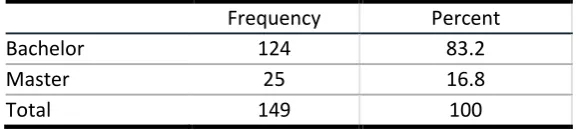
The sample mainly consists of bachelor students. This is due to the fact that the majority of the
experimental subjects was obtained through Sona Systems, the web-based human subject pool
management software of the University of Twente. Mostly bachelor students participated via Sona
Systems and received research credits for their participation. This explains the high number of
bachelor students that participated, as they had a greater incentive to sign up, in comparison to
master students. The distribution of the educational level of the subjects is depicted in table 3.
Table 3 | Educational Level
Frequency Percent
Bachelor 124 83.2
Master 25 16.8
[image:12.595.68.358.656.721.2]10
3.3 Procedure
Experimental subjects were picked up by the researcher at an appointed meeting point and escorted
to the experimental room. In front of the room, the researcher acted as if she had to search for her
keys and asked the experimental subjects to hold either a cup with hot or iced coffee, or an empty
cup in the case of subjects that were later presented with a picture. The iced coffee had an average
temperature of 3.21 degrees Celsius (SD = 1.93) with a range of 7.2 degrees Celsius and the hot
coffee had an average temperature of 68.82 degrees Celsius (SD = 6.25) with a range of 23.1 degrees
Celsius. In the original experiment the researcher was handing the cup to the experimental subjects
under the disguise of having to write down their name on a clipboard (Williams & Bargh, 2008), to
fulfill the ethics code, it was chosen to use a different decoy story so the experimental subjects could
stay anonymous. The purpose of the empty cup was to simulate the act of doing a favor for the
researcher without actually being manipulated by the temperature of the object handed to the
subject. After approximately 20 seconds the door was unlocked and the researcher took the cup
from the experimental subject. The original experiment (Williams & Bargh, 2012) exposed their
subjects to the cups between 10 and 25 seconds, the exposure time in this experiment was within
this range. Subsequently, the experimental subject was asked to sit in front of a computer.
The experimental subjects in the physical temperature conditions immediately started with
the written instructions to the questionnaire. Experimental subjects from the visual temperature
conditions were asked to look at a picture of a cup of either hot or iced coffee (Appendix C) for 30
seconds and instructed to imagine holding the cup in their hands before reading the instructions to
the questionnaire and start filling it in.
The researcher took a passive role inside the experimental room. She silently sat beside the
experimental subject and pretended to be reading while the experimental subject filled in the
questionnaire. This proved to be necessary because several subjects neglected to read the
instructions and intended to fill in the questionnaire without looking at the corresponding part of the
website. In case this happened the experimental subject was again reminded to read the instructions
on the questionnaire carefully.
After finishing filling in the questionnaire, experimental subjects were asked if they suspected
anything and with pointed questions tested if they were aware of the manipulation. Experimental
subjects were also asked if they believed the researcher’s acting in front of the experimental room.
The answers indicated that no experimental subjects suspected that the cup in front of the room was
11
3.4 Research Instrument
The actual questionnaire consisted of two parts. The first part measured the attitude towards
the product and the second part measured the attitude towards the person. Both parts referred to a
website that was created to feature a picture of a sculpture and the fictitious description of a person
in order to give the experiment an authentic context (Appendix B).
The picture of the sculpture (Appendix B, Image 1) was chosen because the sculpture is a
piece of contemporary decoration and, in the context of the website, is presented as a product to be
sold on the website. Experimental subjects were asked to take a good look at the picture and
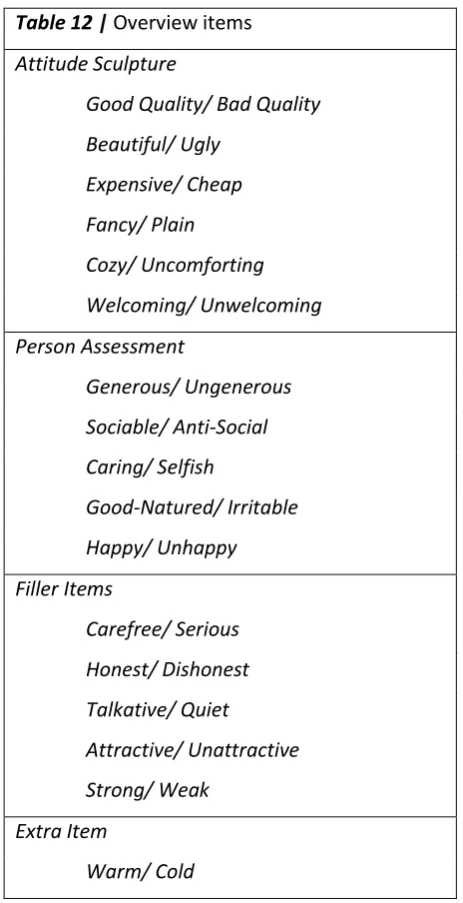
subsequently there were six items to rate the sculpture on, on a 7-point bipolar scale anchored by a
trait and its opposite; Good Quality/ Bad Quality, Beautiful/ Ugly, Expensive/ Cheap, Fancy/ Plain,
Cozy/ Uncomforting, and Welcoming/ Unwelcoming. These items were chosen because they were
suitable to describe the sculpture shown in the picture. Furthermore, although the items do not stem
from a preexisting scale, a sufficient Cronbach’s alpha of .746 suggests that for the purpose of the
experiment, the six items mentioned above could be treated as a construct, AttitudeSculpture. It is
unclear what AttitudeSculpture measures, but for the purpose of further analyses it will be referred
to as measuring a positive/ negative attitude towards the sculpture.
In the second part of the questionnaire experimental subjects were directed to a description
of a person’s personality (Appendix B, Image 2) and then asked to rate the person on 10 items based
on the given description. On the website the person was described as intelligent, skillful, and
industrious. As well as determined, practical, and cautious. The description stems from the original
research of Williams and Bargh (2008). As in their original questionnaire, 5 items related to the
warm-cold distinction: Generous/ Ungenerous, Sociable/ Anti-Social, Caring/ Selfish Good-Natured/
Irritable, and Happy/ Unhappy. These are used as a construct, PersonAssessment, to measure
interpersonal warmth and are suitable to do so with a Cronbach’s alpha of .73. The reliability of
PersonAssessment could be increased by .004 points by deleting item generous/ ungenerous,
however, as the scale already is very small with only five items, and the increase in reliability is small,
it was chosen to keep all items and continue with the same construct Williams and Bargh (2008) used
in the original experiment.
According to the original study, the other five items do not relate to the warm/ cold
dimension: Carefree/ Serious, Honest/ Dishonest, Talkative/ Quiet, Attractive/ Unattractive, and
Strong/ Weak. As a construct, they possess a Cronbach’s alpha of .09. In the original experiment they
were only used as filler items and the low Cronbach’s alpha was therefore to be expected.
12 The second part of the questionnaire also contains one extra item, Warm/Cold. This item was
added as a control factor for Williams and Bargh’s (2008) scale. The item directly asked if the
personality description is perceived as being “warm” or “cold” on the same 7-point scale used for the
rest of the items, Warm/ Cold. In order not to influence the answers to the original items, this item
was placed last on the questionnaire. A scale reliability analysis revealed that including Warm/ Cold
in PersonAssessment increases the Cronbach’s alpha from .73 to .79, therefore it was chosen to
include this item in PersonAssessment for further analysis.
The last part of the questionnaire asked for demographic data like gender, age and current
phase of study. Furthermore, the funnel debriefing technique was used to check for awareness of the
manipulation (Bargh & Chartrand, 2000). First, experimental subjects were asked what they thought
the purpose of the experiment was, then they were asked if they think their answers were influenced
by any surrounding circumstances, and lastly, they were asked if they thought their answers were
influenced by either holding a cup of coffee, or looking at a picture of a cup of coffee before the
experiment. If answers indicated that the experimental subject was aware of the manipulation, their
questionnaire was excluded from the analysis. As an additional manipulation check, experimental
subjects were asked to rate the temperature of the cup they were holding or looking at on a 7-point
scale ranging from cold to hot. Questionnaires indicating a temperature that did not match their
experimental condition were also excluded from the analysis, because it was assumed that the
13
4 Results
This chapter contains the analyses that were executed to answer the research hypotheses and check
for other points of interest.
4.1 Test of homogeneity
To test the homogeneity of the groups a Chi-Square test for the gender of the experimental subjects
was executed. There is no statistically significant association between gender and experimental
condition χ ²(3, N = 149) = 4.33, p = .23.
The assumption of homogeneity of variances between the experimental conditions was
tested with regard to age, and found tenable using Levene’s Test, F(3, 145) = 1.64, p = .18. Therefore,
there is no statistically significant association between age and experimental condition and the
assumption of homogeneity is not violated.
These two tests suggest that the groups are homogeneous with regard to gender and age
and there is no need to include those variables in further statistical analyses.
4.2 Univariate Analyses
Calculating the mean and standard deviation of several items and constructs was done to take a look
at central tendencies and levels of dispersion (Appendix E, Table 13).
Assuming that the middle of a 7-point-scale is 4, the mean of PersonAssessment is close to
being neutral (M = 4.04, SD = .83). Whereas AttitudeSculpture leans towards the more positive side
of the scale (M = 4.87, SD = .78) with 1 signifying a negative attitude towards the sculpture and 7
signifying a positive attitude. Only Warm/ Cold is slightly more towards the lower side of the scale (M
= 3.64, SD = 1.31) with 1 meaning cold and 7 meaning warm.
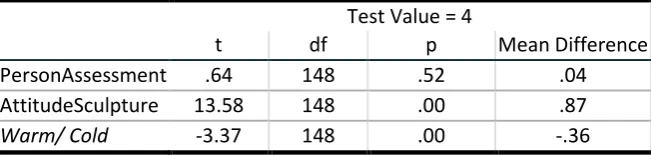
A one sample T-Test confirms these observations. The average rating of PersonAssessment
does not statistically significantly differ from the neutral middle of the scale. The average evaluation
of AttitudeSculpture was statistically significantly higher than the neutral middle, t(148) = 13.58, p =
.00. The average evaluation of Warm/ Cold, on the other hand, was found to be statistically
significantly lower than the neutral middle, t(148) = -3.37, p = .00. A test value of 4 was determined
[image:16.595.71.397.695.773.2]in order to accommodate the used 7-point-scale.
Table 4 | One-Sample T-Test Dependent Variables Test Value = 4
t df p Mean Difference
PersonAssessment .64 148 .52 .04
14
4.3 Bivariate Analyses
Chi-Square Tests
Chi-square tests were performed between experimental condition and the items of
PersonAssessment. This was done to check for the manipulative abilities of the independent
variables on the single items and look for differences between the single items. Separate chi-square
tests between condition and the single items of PersonAssessment revealed that there is no
statistically significant association between experimental condition and Generous/ Ungenerous (χ2
(15) = 21.04, p = .13), Sociable/Anti-Sociable (χ2 (18) = 21, p = .28), Caring/Selfish (χ2 (15) = 16.18, p =
.37), Good-Natured/Irritable (χ2 (15) = 17.29, p = .30), or the item Happy/Unhappy (χ2 (15) = 11.99, p
= .68).
Another crosstabulation with chi-square test between ReportedTemperature and
AssignedTemperature was done as a form of manipulation check. The chi-square test for
AssignedTemperature and ReportedTemperature with χ2 (5) = 149, p = .00 hints that there is a
relationship between those variables and the crosstabulation (table 5) shows that all experimental
subjects reported the temperature according to their condition. Experimental subjects from the hot
conditions reported the temperature with 5, 6, or 7 and experimental subjects from cold conditions
[image:17.595.68.520.450.529.2]reported the temperature with 1, 2, or 3.
Table 5 | Crosstabulation AssignedTemperature * ReportedTemperature ReportedTemperature
Total
1 (Cold) 2 3 4 5 6 7 (Hot)
Assigned Temperature
Hot 0 0 0 0 10 38 24 72
Cold 53 21 3 0 0 0 0 77
Total 53 21 3 0 10 38 24 149
An independent t-test for ReportedTemperature with AssignedTemperature as the grouping variable
confirms the success of the manipulation. The reported temperature of the experimental subjects
that were assigned to the hot conditions (M = 6.19, SD = .66) statistically significantly differs from the
reported temperature of the experimental subjects that were assigned to the cold conditions (M =
15
Regression Analysis
In the original experiment it was assumed that the five items making up PersonAssessment measure
interpersonal warmth towards a person. Statistical analysis was done to check in what way the
individual PersonAssessment items contribute to measuring interpersonal warmth.
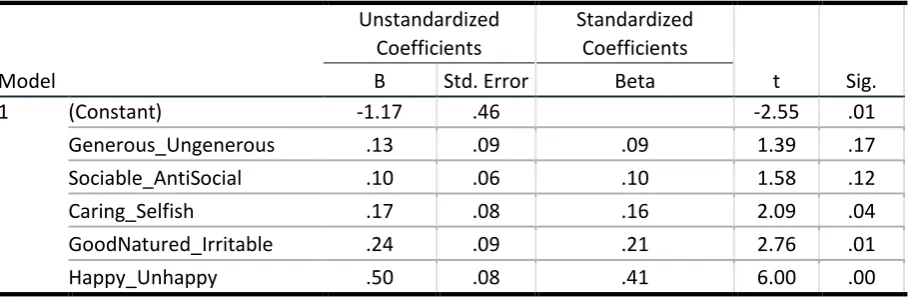
A multiple linear regression was performed to check the predictive ability of the items
Generous/Ungenerous, Sociable/Anti-Social, Caring/Selfish, Good-Natured/Irritable, and
Happy/Unhappy for Warm/ Cold. A statistically significant regression equation was found (F(5,143) =
[image:18.595.72.529.262.411.2]29.13, p < .00), with an R² of .51.
Table 6 | Predictive ability of PersonAssessment Items regarding Warm/ Cold
Model
Unstandardized Coefficients
Standardized Coefficients
t Sig. B Std. Error Beta
1 (Constant) -1.17 .46 -2.55 .01
Generous_Ungenerous .13 .09 .09 1.39 .17
Sociable_AntiSocial .10 .06 .10 1.58 .12
Caring_Selfish .17 .08 .16 2.09 .04
GoodNatured_Irritable .24 .09 .21 2.76 .01
Happy_Unhappy .50 .08 .41 6.00 .00
a. Dependent Variable: Warm/ Cold
The regression analysis indicates that the 5 items explain 51% of the variance of Warm/ Cold. It was
found that three items statistically significantly predict Warm/ Cold; Caring/Selfish (β = .16, p<.04),
Good-Natured/Irritable (β = .21, p<.01), and Happy/Unhappy (β = .41, p<.00). The other two items
were found to be no statistically significant predictors of Warm/ Cold.
As mentioned in the method chapter, Warm/ Cold was included in PersonAssessment, as it increases
16
4.4 Correlation Analyses
A correlation analysis was done in order to check for an influence of physical touch and visual
perception of warmth in a more general context and not only in the context of a warm/ cold scale.
ReportedTemperature can be used as an indicator of AssignedTemperature because of the
high correlation between AssignedTemperature and ReportedTemperature. AssignedTemperature is
not convenient to be used in a correlation analysis because it is a nominal variable and for this
correlation matrix an ordinal variable is more suitable for comparison. The items that make up
PersonAssessment were not included because they were already examined with the help of
Chi-Square tests and will be part of a MANOVA and subsequent ANOVAs. This correlation analysis was
executed in order to look at the data for trends and any other points of interest.
The filler items cannot be treated as a construct because they lack internal consistency and
are therefore looked at as individual items in the correlation analysis (table 7).
There was no statistically significant correlation found between ReportedTemperature and
any other variables, this suggests that the association of perceived temperature and the perception
of people and products could be questionable.
PersonAssessment has a statistically significant positive correlation with Warm/ Cold r(147) =
.80, p < .01, this was to be expected as Warm/ Cold is included in the construct PersonAssessment to
raise the Cronbach’s alpha and both variables are meant to measure interpersonal warmth. This
confirms the functionality of the scale used to measure PersonAssessment.
The items Carefree/ Serious, Honest/ Dishonest, Talkative/ Quiet, Attractive/ Unattractive,
and Strong/ Weak were intended as filler items to disguise the purpose of the scale to the
experimental subjects. These items were included in the correlation analysis to look for interesting
results. Just like PersonAssessment, AttitudeSculpture, and Warm/ Cold, none of the filler items
correlate with ReportedTemperature. What stands out is the fact that while all filler items
statistically significantly correlate with each other, all correlations with the item Carefree/ Serious are
17 Ta b le 7 | C o rrela tio n M atri x Stro n g We ak 1 ** . Co rr el ati o n is s ig n ificant at th
e 0.01 le
ve l ( 2 -tai le d ). *. Co rr el ati o n is s ig n ificant at t h e 0.05 le ve l ( 2 -tai le d ). Attracti ve Un att racti ve 1 .38 ** Talkati ve Qui et 1 .25 ** .30 ** H o n est D ish o n est
1 .26
** .26 ** .38 ** C
arefree Serio
u
s
1 -.45
** -.08 -.26 ** -.41 ** Warm Co ld
1 -.09 .28
** .2 0 * .32 ** .02 Attitud e Scu lp ture
1 -.02 -.07 .24
**
-.05 .07 .08
P ers o n Assess m ent
1 .05 .80
** -.15 * .47 * .37 ** .42 ** .24 ** Repo rt ed Te m p erature
1 .07 .12 -.01 -.04 .09 .01 -.01 -.00
Repo rt ed Te m p erature P ers o n Assess m ent Attitud e Scu lp ture
Warm Cold Carefree Serio
18
4.5 Analyses of Variance
MANOVA
In order to accommodate the research model with 2 independent variables and 2 dependent
variables it was chosen to perform a two-way MANOVA. Before the analysis was performed, several
assumptions had to be tested to check if a MANOVA was applicable. One assumption is to check that
there is no multicollinearity between the two dependent variables. The Pearson Correlation between
the two dependent variables is .09 (Appendix E, Table 14) and therefore, below .9, proving that there
is no multicollinearity. However, the Pearson Correlation indicates another problem. A Pearson
Correlation below .2 suggests that there is no considerable correlation between the two dependent
variables and instead of executing a MANOVA, it is more appropriate to execute two separate
ANOVAs and look at the dependent variables separately.
ANOVAs
Two-way ANOVAs are applicable since the effect of two independent variables on one dependent
variable is tested.
Levene’s test confirms homogeneity of variances for both research models, the effect of
Temperature and Medium on PersonAssessment and their effect on AttitudeSculpture, as can be
seen in Table 8. This meets the assumption necessary to perform ANOVAs.
Table 8 | Levene's Test of Equality of Error Variances Dependent Variable: PersonAssessment
F df1 df2 p
.57 3 145 .63
Dependent Variable: AttitudeSculpture
F df1 df2 p
1.04 3 145 .38
Tests the null hypothesis that the error variance of the dependent variable is equal across groups. a. Design: Intercept + Medium + Temperature + Medium * Temperature
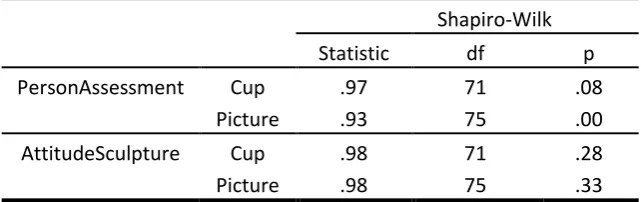
A Shapiro-Wilk Test of normality, shown in table 9 shows that while AttitudeSculpture is
approximately normally distributed, PersonAssessment is not. ANOVAs are robust against violations
against the normal distribution assumption (Schmider, Ziegler, Danay, Beyer, & Bühner, 2010), so
19 Table 9 | Shapiro-Wilk Tests of Normality
Shapiro-Wilk
Statistic df p
PersonAssessment Cup .97 71 .08
Picture .93 75 .00
AttitudeSculpture Cup .98 71 .28
Picture .98 75 .33
a. Lilliefors Significance Correction
Person Assessment
A two-way analysis of variance was conducted to compare the main effects of the independent
variables Medium and Temperature and the interaction effect between Medium and Temperature
on the dependent variable PersonAssessment.
Examining the effect of Medium on PersonAssessment through an ANOVA (table 10) turned
out no statistically significant effect, with F(1, 145) = 1.12, p = .29. This suggests that there is no
statistically significant difference between using a cup (M = 3.94, SD = 0.80) and using a picture (M =
4.12, SD = 0.83). Both groups rated the personality similarly. There was also no statistically significant
main effect for Temperature, with F (1, 145) = 0.30, p = .58. This means that there was no statistically
significant difference between the groups that were exposed to hot temperature (M = 4.08, SD =
0.76) and the groups that were exposed to cold temperature (M = 3.98, SD = 0.87). The interaction
effect between Temperature and Medium on PersonAssessment was not statistically significant, as
well, F(1, 145) = 1.27, p = .26.
Table 10 | ANOVA PersonAssessment
F df1 df2 p Partial η2
Medium 1.12 1 145 .29 .01
Temperature 0.30 1 145 .58 .00
Medium *
Temperature
1.27 1 145 .26 .01
[image:22.595.70.525.516.578.2]20
Attitude Sculpture
Table 11 shows the results of the second ANOVA that investigated the relationship between the two
independent variables Medium and Temperature and the dependent variable AttitudeSculpture.
There was no statistically significant effect of Medium on AttitudeSculpture (F(1,145) = .28, p
= .60), meaning that there was no statistically significant difference between using a cup (M = 4.93,
SD = .76) and using a picture (M = 4.87, SD = .70). Temperature had no statistically significant effect,
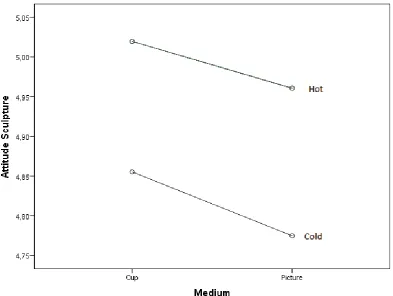
as well (F(1,145) = 3.46, p = .07). This indicates that there was no statistically significant difference
between using the temperature hot (M = 4.99, SD = .72) or the temperature cold (M = 4.82, SD = .74).
Even though the effect of Temperature on AttitudeSculpture is not statistically significant, it is very
close with a p-value of .07, there is a marginal effect of Temperature on attitude towards the
sculpture. Comparing the means of the hot and cold groups reveals that the experimental subjects
from the hot groups evaluated the sculpture slightly more positive than the experimental subjects
from the cold groups. The interaction effect was not statistically significant, F(1, 145) = .00, p = .95.
The combination of both independent variables, Temperature and Medium, had no statistically
significant effect on the attitude towards the sculpture.
Table 11 | ANOVA AttitudeSculpture
F df1 df2 p Partial η2
Medium 0.28 1 145 .60 .00
Temperature 3.46 1 145 .07 .02
Medium *
Temperature
0.00 1 145 .95 .00
a. R Squared = .025 (Adjusted R Squared = .01)
Even though, there is no statistically significant effect, the p-value for the effect of Temperature on
someone’s attitude towards the sculpture, .07, is close to being statistically significant. Figure 1
shows the direction of the marginal effect. Experimental subjects from both hot conditions evaluated
the sculpture more positive than the experimental subjects from both cold conditions. A t-test
confirms that the effect is not statistically significant, there was no statistically significant difference
21
22
5 Discussion
5.1a Conclusion and Limitations Replication
The first hypothesis was the replication of the experiment by Williams and Bargh (2008), H1a:
“Experiencing physical warmth by means of physical touch promotes interpersonal warmth”. The
ANOVA done with regard to Person Assessment shows that there was no statistically significant
effect of the variable Temperature for the Medium cup on PersonAssessment. This means that there
was no difference between experimental subjects that were manipulated by holding cups of iced
coffee and experimental subjects that were manipulated by holding cups of hot coffee with regard to
rating the personality description on a scale for interpersonal warmth. On grounds of these results,
hypothesis H1a was rejected.
This does not comply with the results of the original experiment (Williams & Bargh, 2008).
Differences in the setup of the experiment, like age and language efficiency of the experimental
subjects or location of the experiment could have played a role. But also other factors like
environmental temperature or personality traits of the experimental subjects might have had an
unknown impact on the results.
The age of the experimental subjects of the experiment at hand statistically significantly
differs from the age of the experimental subjects of the original experiment. Even though
temperature sensitivity is age-dependent, the difference of 2.45 years was considered to be small
enough to be neglected (Meh & Denišlič, 1994). The age of the experimental subject could have had
another unknown effect than a difference in temperature sensitivity with regard to the perception of
the statue and the personality description.
The main difference between this experiment and the original experiment by Williams and
Bargh (2008) is the number of native English speakers among the experimental subjects. In the
original experiment all experimental subjects were native speakers, while there was not a single
native speaker that participated in this experiment. The experiment did not take the language
abilities of the experimental subjects into account but relies on subjects being able to correctly
understand the personality description and the scales on the questionnaire. If experimental subjects
did not understand words or interpreted them wrong, it is only logical that the results of both
experiments did not match.
Another unknown variable is if the experimental rooms in the original experiment where
temperature controlled. The original experiment did not mention air conditioned rooms, but those
are much more common in the US than in the Netherlands. This experiment did not use temperature
23 perceived temperature of the pictures and cups. Also, the climate of the city the experiment was
conducted in might have influenced the results. It is imaginable that people who live in hot climate
experience temperatures differently than people who live in cold climate. Warm climate could
possibly elevate the effect of a hot cup of coffee or, in contrary, might even diminish a possible
effect. Future research would need to test the influence of climate. As it is not known at what time of
the year the original experiment was conducted, therefore it cannot be compared to the experiment
at hand.
Another explanation for this rejection could be the influence of personality traits on the
effect of physical warmth on interpersonal warmth (Ijzerman et al., 2013). This group of researchers
only investigated the effect in children under specific circumstances, but introduced the possibility
that certain personality traits might have an impact. This replication of the experiment of Williams
and Bargh (2008) did not take the subjects’ personality traits into account, which the original
experiment did not do, as well. There is a possibility that the experimental subjects of Williams and
Bargh (2008) and the experimental subjects of this experiment were different with regard to
personality traits in ways that altered the results of the experiments and explains the differences in
the results. More research would need to be done to investigate if personality traits could play a role
in this experiment.
5.1b Conclusion and Limitations Additional Research
The second hypothesis is H1b:” Experiencing physical warmth by means of visual perception of a
picture promotes interpersonal warmth”. The ANOVA for PersonAssessment also found no
statistically significant effect of Temperature for the experimental subjects that looked at pictures of
hot or iced coffee. Hypothesis H1b has to be rejected, as well.
For hypotheses H2a: “Experiencing physical warmth by means of physical touch promotes a
more positive evaluation of products”; and H2b: “Experiencing physical warmth by means of visual
perception promotes a more positive evaluation of products” a marginal effect has been found. The
ANOVA for AttitudeSculpture shows a marginal effect for Temperature on the attitude towards the
statue. A comparison of the mean values of the cold conditions (M = 4.82, SD = .74) and the hot
conditions (M = 4.99, SD = .72) reveals that this trend supports the hypotheses. Experiencing physical
warmth by means of physical touch or visual stimulus led to a more positive evaluation of the statue.
A limitation for the comparability of the research conditions using a cup and the conditions
using the picture is the time that subjects were exposed to the stimulus. While experimental subjects
in the physical touch conditions were exposed for a varying time between 10 and 25 seconds, all
24 influence the time of exposure has on this particular effect, therefore, it is possible that the time of
exposure might have mediated the effect in an unknown way.
Past studies that found an effect of temperature on product evaluation used environmental
temperature instead of direct contact with physical objects, a higher environmental temperature led
to a higher product valuation (Zwebner, Lee, & Goldberg, 2014). The results of the experiment at
hand could signify that touching objects of certain temperatures might have a different influence
than environmental temperature, as the experiment at hand only found a marginal effect.
Another reason for the marginal effect could be the subjects’ capacity to process
information. Hot environmental temperatures impair complex thinking (Cheema & Patrick, 2012), if
this is also the case for tactile experience of temperature the differences in answers between the hot
and cold groups could be explained by the experimental subjects’ capacity to process information.
Subjects of the cold conditions were able to thoroughly think about their answers while subjects
from the hot conditions based their answers on easily available information. When the ability to
process is constrained, people are more likely to base their decisions on their emotions (Petty &
Briñol, 2014). In case that the warm cups and the picture of the warm cup did evoke interpersonal
warmth, the effect might have been amplified by the subjects’ constricted processing abilities which
caused them to rely on their emotions while filling in the questionnaire. One argument against this
theory is the fact that the marginal effect was only found for AttitudeSculpture, but not for
PersonAssessment.
5.2 Discussion
The study at hand replicated the original experiment by Williams and Bargh (2008). The research
sample was very similar with regard to gender, and just like in the original experiment, all
experimental subjects were university students. There was a statistically significant difference in age
between the two samples. Similar to the original experiment (Williams & Bargh, 2008), a cover story
was used to hand the cups to the experimental subjects without them suspecting that it was a part of
the experiment. The debriefing questions on the questionnaire confirmed that no subject suspected
that holding the cup was part of the experiment. Furthermore, the exposure time of holding the cups
was within the range of 10 and 25 seconds, like in the experiment of Williams and Bargh (2008).
Even though the personality description and scale were adopted from the original and the
only alteration from the researcher was adding a question at the end of the second scale, the context
in which the description was presented was different. This experiment used a website in order to
present all parts of the experiment in an authentic context. The biggest difference between the
25 Another factor that could not be incorporated in the experiment was environmental temperature.
There was no information available if Williams and Bargh (2008) factored in an influence of
environmental temperature or did anything to actively control the environmental temperature. This
experiment did not control the environmental temperature or include it in any other way. There was
also no information available about the temperature of the cups of coffee Williams and Bargh (2008)
used. The temperature range for the hot coffee used for the experiment at hand is large, but the
manipulation check confirmed that all experimental subjects in the hot conditions experienced the
cup they held as hot.
Environmental temperature can influence the way someone processes information (Cheema
& Patrick, 2012). The experimental room for this experiment was not temperature controlled, so the
environmental temperature might have had an unknown influence on the experimental subjects. The
original experiment was conducted in the United States where air conditioning is more common.,
this makes it reasonable to assume that the original experiment (Williams & Bargh, 2008) was
executed in temperature controlled rooms. Which might have contributed to the difference in
results.
Also, the original experiment did not use a website to present the personality description.
The website was introduced to provide a more authentic context so that experimental subjects
would not be suspicious of the true purpose of the experiment. There is a possibility that this could
have backfired and influenced the subjects in unknown ways. Some elements of the website could
have been distracting, or the fact that experimental subjects actively had to navigate the website
could have influenced their answers.
Lastly, language proficiency might have played a role. Several experimental subjects asked for
translations of words of the personality description or of the questionnaire. This suggests that there
might have been subjects who did not know words but did not ask for the translation, which could
have influenced the results. In contrary to the original experiment, not a single native English speaker
participated. Words play an important role in this experiment, and an exact understanding of the
personality description and the questionnaire is crucial for the success of the experiment. Especially
the five items of the personality impression questionnaire that were used to measure interpersonal
warmth, Generous/ Ungenerous, Sociable/ Anti-Social, Caring/ Selfish, Good-Natured/ Irritable, and
Happy/ Unhappy needed to be understood correctly in order to measure what they were supposed
to measure. If words were not understood or misinterpreted it is likely to have led to inconclusive
26
5.3 Recommendations
Implications
The study revealed no effect of the temperature used on the personality ratings. There has also been
no statistically significant effect found of the Medium used. A marginal effect has been found for
Temperature on product evaluation for both, physical touch and visual perception. This gives
implications for the use of temperature as a marketing tool in retail settings and online. Future
research would need to test if warm objects and images of warm objects could be used to create a
warm feeling towards a certain product and stimulate a more positive attitude.
The trend found in the ANOVA for AttitudeSculpture gives reason to suspect that a visual
trigger could be used to elicit a bodily response in the form of a warm feeling towards a product, and
a the physical presence of a trigger might not be necessary. This would enable online businesses to
use a phenomenon that usually requires direct physical contact. Trust is important to build rapport
with a customer and encourage a long-term commitment. Visual cues on websites that indicate
warm temperature may be used to create a more positive attitude towards products that are offered
on the website. Visual cues that suggest cold temperatures should be avoided.
The results of this study do not agree with the results of the original experiment from
Williams and Bargh (2008). The experiment at hand raises awareness for other factors that would
need to be included in research about the relationship between physical warmth and interpersonal
warmth. It is possible that there are factors that mediate the effect, like context or personality traits.
A future replication of the original experiment of Williams and Bargh (2008) would need to
focus more on details. One factor that is likely to have influenced the results of this study is the
language barrier. Future replications of their study should either be done with native English
speakers or include translations of the personality description and the scales in the mother tongue of
the experimental subject. This would prevent the influence of the subject’s language ability on the
27
Future Research
Future research should be done with regard to factors that possibly mediate the relationship
between physical warmth and interpersonal warmth, like personality traits, environmental
temperature or climate.
A starting point to see if personality traits influence the relationship between physical
warmth and interpersonal warmth could be to conduct an experiment that tests the effect of
physical warmth on interpersonal warmth but include a questionnaire for the big five personality
traits. A big five inventory measures the five most basic human traits (Rammstedt & John, 2007) and
comparison between experimental subjects could give indications if personality traits mediate the
relationship between physical warmth and interpersonal warmth.
Environmental temperature, like a controlled room temperature could have an immediate
effect on a person and possibly elevate or diminish the effect of a trigger. To test this, future
research would need to focus on controlled conditions where the room temperature is manipulated
in addition to the tactile stimulus.
The climate someone lives in would need to be investigated as well. It might have similar
effects like environmental temperature but it is reasonable to assume that being exposed to hot or
cold temperatures for longer than merely the duration of the experiment could have different effects
than the manipulation of the room temperature. An experiment that investigates the relationship
between physical warmth and interpersonal warmth would need to be conducted in different
climate zones.
Further research could also investigate whether the physical touch of temperature controlled
objects could be paired with controlled environmental temperature. Zwebner, Lee and Goldenberg
(2014) found that higher environmental temperatures lead to a higher valuation of products.
Research could test if those two effects might complement each other and lead to an even better
effect, or cancel each other out and make the use of a combination of both types of temperature
control useless.
Furthermore, more research needs to be done about embodied persuasion, as there is a gap
in this field (Briñol & Petty, 2008). This is not limited to research about interpersonal warmth or even
28
References
Asch, S. (1946). Forming Impressions of Personality. The Journal of Abnormal and Social Psychology,
41(3), 258-290. http://dx.doi.org/10.1037/h0055756
Bargh, J. A., & Chartrand, T. L. (2000). Studying the Mind in the Middle: A Practical Guide to Priming
and Automaticity Research In H. Reis & C. Judd (Eds.), Handbook of Research Methods in Social
Psychology (pp. 311-344). New York: NY: Cambridge University Press
Bargh, J., & Shalev, I. (2012). The Substitutability of Physical and Social Warmth in Daily Life. Emotion,
12(1), 154-162. http://dx.doi.org/10.1037/a0023527
Bowlby, J. (1958). The Nature of the Child’s Tie to his Mother. International Journal of
Psycho-Analysis, 39, 350-379
Briñol, P., & Petty, R. E. (2008). Embodied Persuasion: Fundamental Processes by which Bodily
Responses can Impact Attitudes. Embodied Grounding: Social, Cognitive, Affective, and
Neuroscientific Approaches, 184–207. http://doi.org/10.1111/j.1460-2466.2006.00284.x
Cacioppo, J., Priester, J., & Berntson, G. (1993). Rudimentary Determinants of Attitudes: II. Arm
Flexion and Extension have Differential Effects on Attitudes. Journal of Personality and Social
Psychology, 65(1), 5-17. http://dx.doi.org/10.1037/0022-3514.65.1.5
Cheema, A., & Patrick, V. (2012). Influence of Warm versus Cool Temperatures on Consumer Choice:
A Resource Depletion Account. Journal of Marketing Research, 49(6), 984-995.
http://dx.doi.org/10.1509/jmr.08.0205
Cheng, Y., Lin, C., Liu, H., Hsu, Y., Lim, K., Hung, D., & Decety, J. (2007). Expertise Modulates the
Perception of Pain in Others. Current Biology, 17(19), 1708-1713.
http://dx.doi.org/10.1016/j.cub.2007.09.020
Fiske, S., Cuddy, A., & Glick, P. (2007). Universal Dimensions of Social Cognition: Warmth and
Competence. Trends in Cognitive Sciences, 11(2), 77-83.
http://dx.doi.org/10.1016/j.tics.2006.11.005
Ganesan, S. (1994). Determinants of Long-Term Orientation in Buyer-Seller Relationships. Journal of
Marketing, 58(2), 1. http://dx.doi.org/10.2307/1252265
Godinho, F., Faillenot, I., Perchet, C., Frot, M., Magnin, M., & Garcia-Larrea, L. (2011). How the Pain of
Others Enhances our Pain: Searching the Cerebral Correlates of ‘Compassional Hyperalgesia’.
29 Höfle, M., Hauck, M., Engel, A., & Senkowski, D. (2012). Viewing a Needle Pricking a Hand that you
Perceive as yours Enhances Unpleasantness of Pain. Pain, 153(5), 1074-1081.
http://dx.doi.org/10.1016/j.pain.2012.02.010
IJzerman, H., Gallucci, M., Pouw, W., Weibgerber, S., Van Doesum, N., & Williams, K. (2012).
Cold-Blooded Loneliness: Social Exclusion Leads to Lower Skin Temperatures. Acta Psychologica,
140(3), 283-288. http://dx.doi.org/10.1016/j.actpsy.2012.05.002
IJzerman, H., Janssen, J., & Coan, J. (2015). Maintaining Warm, Trusting Relationships with Brands:
Increased Temperature Perceptions after Thinking of Communal Brands. PLOS ONE, 10(4),
e0125194. http://dx.doi.org/10.1371/journal.pone.0125194
IJzerman, H., Karremans, J., Thomsen, L., & Schubert, T. (2013). Caring for Sharing. Social Psychology,
44(2), 160-166. http://dx.doi.org/10.1027/1864-9335/a000142
Kelley, H. (1950). The Warm-Cold Variable in First Impressions of Persons. Journal of Personality,
18(4), 431-439. http://dx.doi.org/10.1111/j.1467-6494.1950.tb01260.x
Lynott, D., Corker, K., Wortman, J., Connell, L., Donnellan, M., Lucas, R., & O’Brien, K. (2014).
Replication of “Experiencing Physical Warmth Promotes Interpersonal Warmth” by Williams
and Bargh (2008). Social Psychology, 45(3), 216-222.
http://dx.doi.org/10.1027/1864-9335/a000187
Meh, D., & Denišlič M. (1994). Quantitative Assessment of Thermal and Pain Sensitivity. Journal of
the Neurological Sciences, 127(2), 164-169. http://dx.doi.org/10.1016/0022-510x(94)90069-8
Nathan DeWall, C., & Bushman, B. (2009). Hot Under the Collar in a Lukewarm Environment: Words
Associated with Hot Temperature Increase Aggressive Thoughts and Hostile Perceptions.
Journal Of Experimental Social Psychology, 45(4), 1045-1047.
http://dx.doi.org/10.1016/j.jesp.2009.05.003
Nisbett, R., & Wilson, T. (1977). The Halo Effect: Evidence for Unconscious Alteration of Judgments.
Journal of Personality and Social Psychology, 35(4), 250-256.
http://dx.doi.org/10.1037//0022-3514.35.4.250
Online Retailing: Britain, Europe, US and Canada 2017. (2017). Retailresearch.org. Retrieved 25 April
2017, from http://www.retailresearch.org/onlineretailing.php
Petty, R., & Briñol, P. (2014). Emotion and Persuasion: Cognitive and Meta-Cognitive Processes
Impact Attitudes. Cognition and Emotion, 29(1), 1-26.