Designing orientation programs: An
exploration of context, content and
social tactics for newly hired managers
Name: Serena Kuiper
Student number: 1751077
Faculty: Behavioral Management Science
Education: Master Educational Science and Technology University: University of Twente
1st Supervisor: A. M. G. M. Hoogeboom
2nd Supervisor: Dr. B. Kollöffel
Organization: DICTU
1 Table of Contents
SUMMARY 2
FOREWORD 3
1.0 INTRODUCTION 4
2.0 THEORETICAL FRAMEWORK 6
2.1ORGANIZATIONALSOCIALIZATION 6
2.2SOCIALIZATION TACTICS 6
2.3SOCIALIZATION TACTICS AND PROXIMAL OUTCOMES 9
2.4SOCIALIZATION TACTICS AND DISTAL OUTCOMES. 10
2.5.ORIENTATION PROGRAMS AND SOCIALIZATION 12
2.6COMPOSITION OF ORIENTATION PROGRAMS 12
2.7ADDITIONAL OUTCOMES OF ORIENTATION PROGRAMS AND TACTICS 13
2.8CURRENT STUDY 13
3. METHOD 15
3.1METHODOLOGY 15
3.2PARTICIPANTS 15
3.3CONSTRUCTS OF THE SEMI-STRUCTURED INTERVIEWS 15
3.4PROCEDURE 17
3.5CODING AND ANALYSIS STRATEGY 17
4. RESULTS 20
4.1CONSTRUCTIONS OF SOCIAL, CONTENT AND CONTEXT TACTICS 20
4.2CONTEXT TACTICS 21
4.3CONTENT TACTICS 25
4.4SOCIAL TACTICS 26
4.5ADDITIONAL ANALYSIS:TYPE OF NEWCOMER 30
5. DISCUSSION 32
5.1REVIEW OF THE STUDY 32
5.2OVERALL DISCUSSION OF RESULTS 32
5.3DISCUSSION OF TACTICS 34
5.4SUMMARY 37
5.5LIMITATIONS AND FUTURE DIRECTIONS 38
5.6PRACTICAL IMPLICATIONS 39
5.7CONCLUSION 40
REFERENCES 40
APPENDIX A – LITERATURE REVIEWS 45
APPENDIX B – INTERVIEW PROTOCOL 49
APPENDIX C – VARIABLES OF INTERVIEW 51
APPENDIX D – CODING BOOK 52
APPENDIX E – RESULTS INTERRATER RELIABILITY 54
APPENDIX F - RESULTS 55
APPENDIX G – RESULTS FOR DISCUSSION 56
2 Summary
The current study explores which socialization tactics are important for newcomers in the early entry period for future orientation programs. I draw upon organizational socialization, literature on newcomers and orientation programs to create a more evidenced based design for orientation programs. In a qualitative study, 13 newcomers indicated which socialization tactics affect learning, information acquisition, relationship building and job performance. The analysis of the semi structured interviews indicated that the context and social tactics are most important during the entry period. The context tactics result in collective or individual activities that include tailored information. The social tactics result in meetings with important organizational members and support from environment. Regarding content tactics, I found that newcomers appreciate the freedom to schedule individual orientation activities. Still, some structure was expected to learn about the organization and tasks. I suggest that future orientation programs combine tactics and include a variation of the activities mentioned by newcomers. Besides that, a supportive environment is important. In concern of the existing categorizing, I suggest replacing content as process tactics because these types of tactics deal with the steps and timing of activities. Future opportunities for research are the examination of an orientation program based upon the suggested to design elements as well for other types of newcomers like interim mangers.
3 Foreword
4 1.0 Introduction
Individuals entering a new organization need to learn several aspects about the job and the new organization. The individuals, so-called newcomers, are expected to transfer from organizational outsiders into organizational insiders, referred to as organizational socialization (Bauer, Bodner, Erdogan, Truxillo, & Tucker, 2007). Organizational socialization is a process wherein newcomers learn about social knowledge, skills and job requirements to become a proficient organizational member (A.M. Saks & Ashforth, 1997; Van Maanen & Schein, 1979). Moreover, both organizational and individual needs to be aligned during the organizational socialization process as newcomers take on an organizational role (Chao, 2012). This is important because organizational socialization results in several outcomes that are valuable for organizations and newcomers. These outcomes are performance, job satisfaction, organizational commitment, intentions to remain and role innovation or replication (Bauer et al., 2007; A.M. Saks, Uggerslev, & Fassina, 2007).
Organizational socialization has been studied much in the last two decades and many scholars have examined the typology of socialization tactics of Van Maanen and Schein (1979) (Ashforth & Saks, 1996; Ashforth, Sluss, & Saks, 2007; Bauer et al., 2007; A.M. Saks & Ashforth, 1997; A.M. Saks et al., 2007). Socialization tactics are the activities that are provided to newcomers (Bauer et al., 2007; Jones, 1986). Consequently, newcomers learn during the socialization process. An understanding of which tactics newcomers apply or value is important because it provides a deeper understanding of effective ways to socialize newcomers. The socialization tactics exist of three themes. These are context, (i.e. tailored activities and information), content (i.e. timing and process of steps newcomers take) and social (i.e. interaction with organizational members and environment) (Cable & Parsons, 2001; Jones, 1986; Van Maanen & Schein, 1979). These tactics resulted in the orientation programs for newcomers.
Orientation programs are formally organized trainings to socialize newcomers during the entry period (Klein & Weaver, 2000). During orientation programs, newcomers learn about the organization and their role (Klein & Weaver, 2000; Waung, 1995; Wesson & Gogus, 2005). Overall, the main focus of these orientation program studies was to find the effects on behavioral outcomes (Cooper-Thomas & Anderson, 2002; Delobbe, Cooper-Thomas, & De Hoe, 2015; Klein & Weaver, 2000; A. M. Saks, 1994; Waung, 1995). No attention is given to the effective use of tactics. Thus, many organizations tend to develop orientation programs based upon their own intuitive insights. However, when combining the knowledge of organizational socialization and socialization tactics, therefore on orientation programs a more evidence based design for orientation programs can be made.
Besides that, current empirical studies on orientation programs are scarce and especially orientation programs for more experienced newcomers (Preston, 2004). Yet, it is very important to socialized more experienced employees like newly hired managers. Still, this group of newcomers might be even more important since an empirical study found that newly hired managers are dismissed after three years because of asymmetry between person and organization (Zhang, 2008). Also, others argued that one out of three managers fails within the first eighteen months of employment (Bradt, Check, & Pedraza, 2011). Thus, orientation programs specifically for newly hired managers is needed because it helps to stimulate positive behavioral outcomes.
5 or missed by newcomers (newly hired managers) during the entry period. A suggestion is then presented on how these tactics can be integrated into an orientation program. The research question of the current study is: “Which context, content and social tactics do newly hired mangers find important for designing future orientation programs that enhance organizational socialization”. Using a qualitative research design methodology, the study examines this research question. A review of organizational socialization, orientation programs and existing effects of tactics are discussed in the following section.
6 2.0 Theoretical framework
The primary goal of the following section is to explain the socialization tactics, outcomes of socialization and empirical examined orientation programs.
2.1 Organizationalsocialization
Individuals that enter a new organization have to learn several aspects of the job and the organization. This process is referred to as organizational socialization. In other words: "process about social knowledge and skills to fulfill an organizational role" (Van Maanen & Schein, 1979). The individual who enters a new organization is a newcomer. To become an organizational member, newcomers learn to adapt towards the organizational role (Chao, 2012). Consequently, taking on the organizational role is possible only when newcomers have gained knowledge about domains like organizational goals, values, power structures and task knowledge (Saks & Ashforth, 1997). So, socialization enables newcomers to become a proficient and comfortable member of the organization (Ashforth et al., 2007). But on the other hand, when newcomers feel uncomfortable in the organization, they intent to leave. Hence, it results in turnover of newcomers (Cable & Parsons, 2001; Hancock, Allen, Bosco, McDaniel, & Pierce, 2013; Wesson & Gogus, 2005). So, a positive first impression during the socialization process is important since newcomers create expectations of their first experiences in an organization that influence future outcomes (J. D. Kammeyer-Mueller & Wanberg, 2003; Korte, 2009).
Socialization is mostly explained by the typology of socialization tactics but other theories that explain the socialization of newcomers exist. The following will briefly mention various theories to provide insights of the different ideas about socialization. To begin with newcomer adaption, which assumes that newcomers need knowledge and motivation to perform a new organizational role (Bauer et al., 2007; Cooper-Thomas & Anderson, 2002; J.D. Kammeyer-Mueller, Wanberg, Rubenstein, & Song, 2013). Another theory is the person-organization fit, this is the alignment between newcomers and the new person-organization (Cable & Parsons, 2001). Yet, another theory builds upon the idea that newcomers are pro-active agents. This means that newcomers influence their performance and remain subject to organizational influence (Delobbe et al., 2015; Ostroff & Kozlowski, 1993). Nevertheless, most important and most cited is the typology of socialization tactics developed by Van Maanen and Schein (1979) (A.M. Saks et al., 2007). This typology implies that socialization is a process wherein newcomers participate in activities during the entry period (Jones, 1986; Van Maanen & Schein, 1979).
2.2 Socialization tactics
Socialization tactics are defined as “a set of interrelated theoretical propositions about the structure and outcomes of organizational socialization processes” (Van Maanen & Schein, 1979, p.214). In other words, socialization tactics shape the context of activities and information newcomers encounter during the socialization process. These theoretical propositions are empirical examined and affect behavioral attitudes of newcomers (Perrot, et al. 2012; Saks & Ashforth, 1997). Originally the socialization theory defined six different tactics that are opposites of one another (Van Maanen & Schein, 1979). Yet, recent studies of socialization tactics refer to the classification scheme of Jones (1986) (Bauer et al., 2007; Cable & Parsons, 2001; Klein & Weaver, 2000; A.M. Saks et al., 2007). Therefore, the classificatory scheme in this study is a combination of Jones (1986) and Van Maanen and Schein (1979), as is discussed in the following pages (see table 1).
7 collective vs individual socialization tactics. With the collective tactic, newcomers undertake a common experience as a group that produces a standard outcome of responses to situations (Jones, 1986; Van Maanen & Schein, 1979). Applying the collective tactic results in a training or other activities that newcomers undertake as a group. On the other hand, the individual tactic emerges in an individual learning process (Van Maanen & Schein, 1979). So, this results in an unique learning experience (Jones, 1986). So, the individual tactic includes tailored activities such as on the job trainings or a specific trainee program (Van Maanen & Schein, 1979). By means, tailored is only in the interest of the individual newcomer and less or not suitable for other newcomers or organizational members. Overall, applying the collective tactic, which are reproduced activities or information, results in a standardized response to the organizational role. The individual tactic, which are tailored activities or information, result in various responses to situations.
The second type of tactics are formal vs. informal and is related to the first because it also deals with the context in which information is presented to newcomers. The formal tactic separates newcomers form other organizational members to learn the responsibilities of the job (Jones, 1986; Van Maanen & Schein, 1979). So, these result in activities or information that is only important and created for newcomers. In contrast, the informal tactic enhances newcomers learning on the job while newcomers interact with other organizational members, nor is there any effort in organizing activities for newcomers (Van Maanen & Schein, 1979). Overall the context tactics distinguishes how newcomers learn about the organizational role.
The second classification of tactics are content tactics. These include two types of tactics that deal with the process of newcomers towards the organizational role. So, third type of tactics, sequential vs. random, deal with the formality of clear stages that newcomers deal with after entry in the organization. The sequential tactic provides information about the steps that lead towards the organizational role (Van Maanen & Schein, 1979). For example, a newcomer who is student medicine knows that several qualifications and competences are required to become a surgeon. In contrast, the random tactic is not revealing which steps newcomers have to take or the steps are constantly changing (Van Maanen & Schein, 1979). For instance, a manager does not exactly know when he is a fully qualified manager and ready a next step.
Fourth type of tactics, fixed vs. variable, provides newcomers with information about the timing of activities that lead towards the organizational role. The fixed tactic deals with the precise knowledge of time to complete something (Van Maanen & Schein, 1979). This results in a timetable that indicates how long each stage takes to complete. The variable tactic provides only a few clues when to expect the next step. So, with the variable tactic newcomers are unsure about the next step that leads towards the organizational role. For example, a senior employee longing to become a managing partner. Still, becoming a managing partner depends on several aspects like economy or place available in the company. So, the classification of content tactics deals with the progress of newcomers towards the organizational role.
8 Last type of tactics, investiture vs. divestiture, issues the degree to which newcomers receive a positive or negative social support from experienced organization members (Jones, 1986). The investiture tactic confirms the identity and characteristics of newcomers. This tactic enhances the existing characteristics of newcomers. Otherwise, the divestiture tactic seeks to deny newcomers and to rebuilding the characteristics of the newcomers. For example, an army recruit has to learn to put aside his personal values of helping others in cases where the environment is too dangerous to help others.
Table 1
Typology of organizational socialization tactics.
Classification Type of tactic Type of tactic
Context Tactics that are organized for newcomers
Collective
"Similar activities or information that produces a standardized response of newcomers” Formal
“Employing activities especially for newcomers”
Individual
“Single person receives a more or less unique activity or information”
Informal
“Not differentiating the newcomer so learning takes place on the job”
Content
Tactics that have a time path or sequence
Sequential
“Follow up of activities for newcomers”
Fixed
“The exact timing of activities or process is known”
Random
“The sequence of activities is unknown”
Variable
“The timing and duration of activities or process is unknown”
Social aspects
tactics that support the learning process through social cues
Serial
“Activities whereby a newcomer involves in activities with a role model”
Investiture
“Affirms the newcomer and personal characteristics”
Disjunctive
“Newcomers do not follow a role model”
Divestiture
“Deny and strip away characteristics of the newcomer”
Note. Combined classification of socialization tactics of Van Maanen and Schein (1976) and categories of Jones (1986).
9 thematic classification of tactics is important because empirical evidence found that the themes are a better predictor of certain outcomes, as is discussed in the following section.
2.3 Socialization tactics and proximal outcomes
Tactics that have a direct effect of the socialization tactics on newcomers are called proximal outcomes. Proximal outcomes of socialization are learning, uncertainty reduction and role clarity (Ashforth & Saks, 1996; Bauer et al., 2007; A.M. Saks et al., 2007). Proximal outcomes mediate between socialization tactics because the tactics have an indirect on behavioral distal outcomes (Allen & Shanock, 2013; Perrot et al., 2012; A.M. Saks & Ashforth, 1997). For instance, a newcomer who learns tasks responsibilities, consequently knows how to perform on the job. Hereby saying, learning is the proximal outcome that affects the distal outcome job performance. So, differentiating between proximal and distal outcomes of socialization is helpful since organizations have the opportunity to foster positive proximal outcomes that have an impact on long term results, or so-called distal outcomes (Saks et al., 2007). The following explains the various outcomes in relation to tactics and provides more detail about the most important relationships in this study.
Learning. Learning is a relatively permanent change in someone’s knowledge, based on the person’s experience (Mayer, 2003). Newcomers have to learn several aspects to become an organizational member. For instance, newcomers have to learn about the organization, job, people, team, procedures, norms and tasks (Haueter, Macan, & Winter, 2003). Socialization tactics can stimulate learning because an organization chooses to provide or withhold information. Subsequently, learning affects distal outcomes like intentions to quit and job satisfaction (Cooper-Thomas, Paterson, Stadler, & Saks, 2014; Haueter et al., 2003; Korte, 2009; Perrot et al., 2012).
Learning is best supported by social tactics (Ashforth et al., 2007). Social tactics, serial vs. disjunctive and investiture vs. divestiture, allow newcomers to learn through interaction with other organizational members often within the organizational context (Cooper Thomas & Anderson, 2005; Korte, 2009; Perrot et al., 2012). For instance, a newcomer who is guided by an experienced organizational member with a similar function learns how the responds towards organizational situations. On the other hand, several studies applied the context tactics, collective and formal, like trainings to simulate newcomers learning (see Appendix A: (Delobbe et al., 2015; Klein & Weaver, 2000; Wesson & Gogus, 2005)). During a training, newcomers receive information or participate in activities that are especially organized for newcomers. However often these trainings exclude newcomers from the organizational context, so learning from experienced organizational members is withheld. Still, other opportunities to enhance learning exists, for example informal learning. Informal learning accounts for 75% of the learning within organizations but are mentioned in studies of organizational socialization (Dochy, Gijbels, Segers, & Van den Bossche, 2012; Klein & Weaver, 2000; Noe, Clarke, & Klein, 2014).
10 Another proximal outcome is Role clarity. Role clarity means that newcomers gain knowledge and understanding about relationships and roles in the organization (Klein & Weaver, 2000; Morrison, 2002; Wesson & Gogus, 2005). In other words, newcomers are able to understand task priorities, time allocation and behavior towards certain tasks (Bauer et al., 2007; Haueter et al., 2003). Social tactics, like serial and investiture, are the best predictor for role clarity because it allows newcomers to interact with other organizational members (A.M. Saks et al., 2007). Still, role clarity is also predicted by context tactics, collective and formal tactics, since these include activities and information that allow newcomers to learn about their role and organization. Besides context and social, content tactics predicts role clarity because newcomers receive information in stages and have knowledge about the timing of activities (Klein, Fan, & Preacher, 2006).
2.4 Socialization tactics and distal outcomes.
As a consequence of tactics and proximal outcomes, distal outcomes emerge. Distal outcomes are indirect outcomes of behavior and are performance, job satisfaction, organizational commitment, intentions to remain and role innovation or replication (Bauer et al., 2007; Cooper-Thomas & Anderson, 2005; Klein, Fan, and Preacher, 2006; Saks et al., 2007).
Job performance. Job performance is the ability of newcomers to apply knowledge, to participate, and to function in the activities required for the organizational role (Haueter et al., 2003). In order to perform an organizational role, newcomers must learn several aspects that will result in organizational behavior. Newcomers are most likely to perform when they have had an opportunity to learn through social tactics (Ashforth et al., 2007; Cable, Gino, & Staats, 2013; Cable & Parsons, 2001; Hart, 2012; A.M. Saks et al., 2007). For example, newcomers who retrieved information from an experienced organizational member, are performing better compared to newcomers who participated in collective activities to learn, hence context tactics (Bauer et al., 2007). On the other hand, context tactics, collective and formal affects job performance (Jones, 1986; Klein & Weaver, 2000; Wesson & Gogus, 2005). For example, newcomers are provided with tailored information about language, performance proficiency, history during a training. So, both context and social tactics allow newcomers to perform.
11 The tactics also result in intentions to remain or quit. Intentions to remain is the willingness of newcomers to stay in an organization. In case newcomers are socialized by organized tactics, collective, formal, sequential, fixed, serial and investiture, it is expected that the intentions to remain increases (Allen & Shanock, 2013; Tabvuma, Georgellis, & Lange, 2015). Yet, most important are the context tactics, for example when newcomers participate in orientation programs (Cooper-Thomas & Anderson, 2002; Payne, Culbertson, Boswell, & Barger, 2008; Waung, 1995).
Last distal outcome is role innovation and role replication.Role innovation is a result of the lack of information and forces to collect information or participate in activities themselves. The individual, informal, random, variable, disjunctive and divestiture tactics force newcomers to shape the context of their role themselves (Jones, 1986; Perrot et al., 2012; Van Maanen & Schein, 1979). On the other hand, role repetition defined as taking over an existing role that does not need to be reinvented. In other words, taking on the status quo. The tactics, collective, formal, sequential, fixed serial and investiture, are related to role replication (Perrot et al., 2012). But most important to role innovation and role replication are content tactics because these provide information about the timing or steps newcomers have to take that lead upon the organizational role (Perrot et al., 2012).
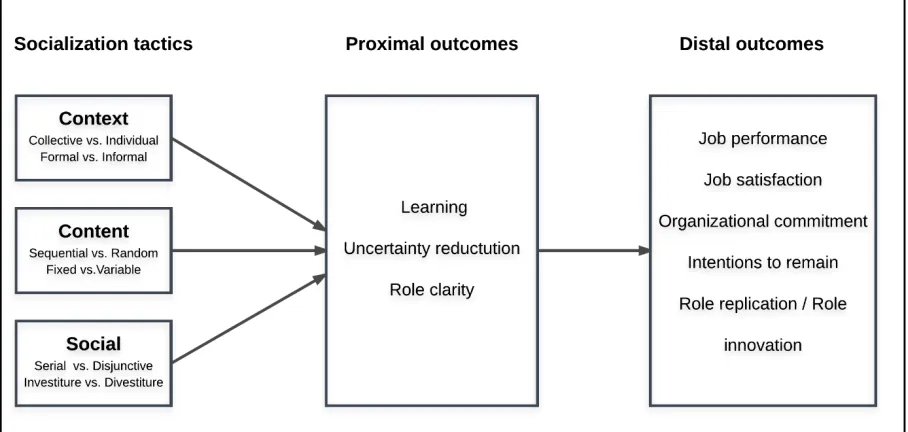
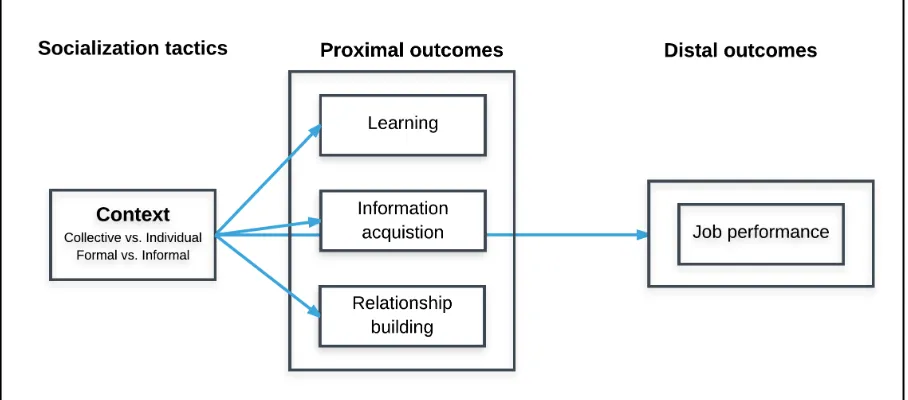
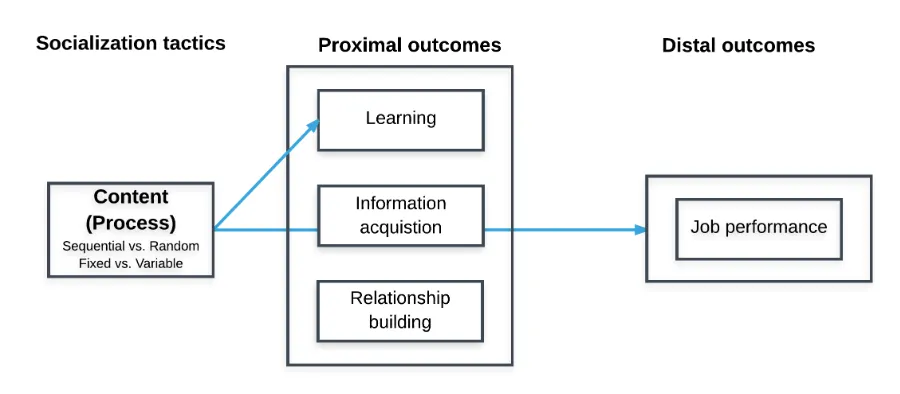
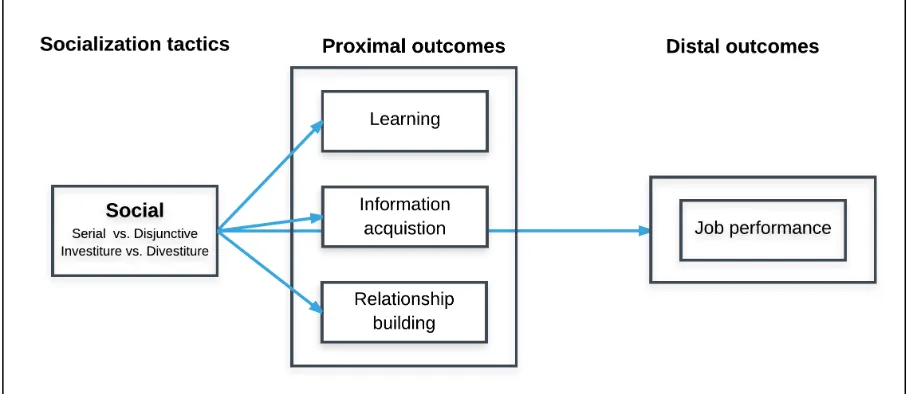
[image:12.595.66.520.470.686.2]In sum, the previous section discusses the most important outcomes of socialization and the contribution context, content of social tactics, see figure 1. Evident is that socialization tactics are important and organizations can utilize socialization tactics to influence newcomer learning (A.M. Saks & Ashforth, 1997). The social tactics and context tactics received most attention in the socialization literature. The social tactics, interactions with organizational members and environment, is proven to be the best predictor for several outcomes (Bauer et al., 2007; A.M. Saks et al., 2007). On the other hand, the context tactics are found to be the weakest predictor when newcomers are separated from the organizational members (A.M. Saks et al., 2007). Still, organizations widely apply context tactics in forms of training and orientation programs. Therefore, the next section will discuss the main aspects of orientation programs that aim to socialize newcomers.
12 2.5. Orientation programs and socialization
Orientation programs are formally organized trainings to socialize newcomers during the early entry period (Klein & Weaver, 2000). The early entry period of newcomers is recognized as the time wherein newcomers are allowed to learn about the organizational role (Ross, Huang, & Jones, 2014). During the early entry period newcomers learn about the organization, tasks and team throughout various activities (Haueter et al., 2003). Various organizations develop orientation programs which are a form of context tactics (Cable et al., 2013; Delobbe et al., 2015). Orientation programs are an important form because it results in a first impression about the organization. Moreover, it is an indication that the organization considers the needs of, and invests in newcomers (Tannenbaum, Mathieu, Salas, & Cannon-Bowers, 1991). Consequently, newcomers judge if the organization suits them or not, this is known as person-organization fit (Cable & Parsons, 2001; Korte, 2009). Since orientation programs are a form of context tactics the following section discusses the variety of orientation programs and learning domains that have been empirically examined.
2.6 Composition of orientation programs
Orientation programs have to deal with various aspects that are important for the compositions of orientation programs. To begin with the occupation of newcomers. For example, an orientation program for military recruits (Cooper-Thomas & Anderson, 2002; Delobbe, Cooper-Thomas & De Hoe, 2015; Payne et al., 2008) is different and longer compared to these from differs from accountancies (Saks, 1994), or ICT employees (Wesson & Gogus, 2005). Secondly, the amount of experience of newcomers matters since newly hired graduates benefit more from orientation programs because they are less experienced compared to more tenured employees (Cable & Parsons, 2001; Fondas & Wiersema, 1997). Third aspect, is the length of orientation programs ranging from three hours (Klein & Weaver, 2000) to eight weeks (Cooper-Thomas & Anderson, 2002; Delobbe et al., 2015; Payne et al., 2008). Another aspect is the time of participation in orientation programs that varies in previous studies between the first week of employment (Cooper-Thomas & Anderson, 2005; Delobbe et al., 2015) or within the first six months of employment (Klein & Weaver, 2000). Another aspect is the effects of traditional classroom programs or computer assisted programs, during orientation programs. The latter is less successful compared to traditional classroom trainings (Wesson & Gogus, 2005).
Learning domains of orientation programs. During orientation programs, newcomers retrieve information that allows them to learn. Current studies rely on the learning domains performance proficiency, people, politics, language, goals and values and history (Chao, O'Leary-Kelly, Wolf, Klein, & Gardner, 1994; Hart, 2012; Klein & Weaver, 2000; Wesson & Gogus, 2005). Performance proficiency concerns the learning of tasks of the job. People concerns the satisfying relationships with others in the organization. Politics concerns the success to gain information about informal and formal relationships and authority in the organization. Language concerns the knowledge about technical jargon in the organization. Goals and values concern the ground rules that foster the integrity of the organization including unwritten rules. The final learning domain is history which concerns the traditions and customs organizations have (Chao et al., 1994). The domains performance proficiency, language, goals, and values are most important for the early entry of newcomers (Hart, 2012).
13 learning (Wesson & Gogus, 2005). So, empirical evidence suggests that newcomers should learn these six learning domains about the organization, team and tasks (Haueter et al., 2003). For instance, newcomers learn about the workgroup and thus learns how the workgroup performs, learns the vocabulary of the workgroup and so on.
2.7 Additional outcomes of orientation programs and tactics
Orientation programs are a form of context tactics which consequently results in proximal and distal outcomes. Yet a literature review found that orientation programs include additional outcomes that are not mentioned in various studies of socialization tactics.
Information acquisition. Information acquisition is the planned proactive strategy of newcomers to learn. Socialization tactics shape the context for information acquisition of newcomers to learn about their role (Cooper-Thomas & Anderson, 2002). For example, newcomers who have a mentor or a recent predecessor retrieve relevant information. So, information acquisition is important because it allows newcomers to become more knowledgeable about their organizational role.
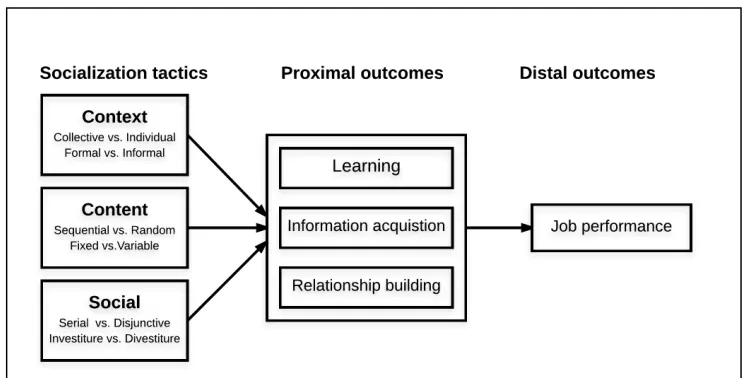
Relationship building. Relationships are the nature and quality of the informal interactions between newcomers and organizational members (Delobbe et al., 2015). Relationships help newcomers to become organizational members because they learn the ropes of the organization from organizational members. Especially important is a good qualitative relationship of newcomers with their supervisor because this results in role clarity (Delobbe et al., 2015). Even more, an empirical study of Morrison (2002) found that the overall structure of newcomers' relationships matters. So, a set of strong relationships is more important than a lot of relationships. The social tactics provide the context for relationship building because newcomers interact with organizational members (Delobbe et al., 2015; Hart, 2012; Tabvuma et al., 2015). Besides that, the social tactics (i.e. interaction with environment) allow to build relationships and help to make sense new experiences in the new organization (Klein et al., 2006). Relationship building is important because it is a predictor of job satisfaction (Tabvuma et al, 2015). In sum, orientation programs that are in the essence a form of context tactics results in two additional outcomes and can also include other tactics like social tactics, see figure 4.
2.8 Current study
Orientation programs are a form to socialize newcomers into the organization. Most important tactics for orientation programs are the formal, collective, sequential, fixed, serial and investiture tactics (Delobbe et al., 2015; Klein & Weaver, 2000). So, the other tactics, individual, informal, random, variable, disjunctive and divestiture, are not present in current orientation programs. But, based upon ideas from previous studies these tactics can also be a valuable contribution for orientation programs (Cable et al., 2013; Klein, Polin, & Leigh Sutton, 2015; Klein & Weaver, 2000). Even more, the orientation programs are a kind of context tactics, because these exists of collective trainings that produces a standardized outcome (Cooper-Thomas & Anderson, 2002; Delobbe et al., 2015; Klein & Weaver, 2000; Wesson & Gogus, 2005). However, various scholars have found that context tactics are a weaker predictor of socialization because it separates newcomers from other organizational members (Bauer et al., 2007; Jones, 1986). Instead, the social tactics are the best predictor of various outcomes (Bauer et al., 2007; A.M. Saks et al., 2007).
14 et al., 2015; Wesson & Gogus, 2005). Therefore, the current study explores which tactics newly hired managers, who did not participate in orientation programs, value for newly designed orientation programs. To guide the research the study proposes the following research question:
“Which context, content and social tactics do newly hired mangers find important for designing future orientation programs that enhance organizational socialization”
To answers the research question, two different sub questions will guide the study.
1a. In which tactics did newcomers participate in the early entry period that resulted in outcomes like learning, relationship building, information acquisition and job performance?
1b. Which tactics are missed in the early entry period by newcomers that could have helped to learn about the organization and tasks?
[image:15.595.73.445.320.509.2]2. How can tactics be included in future orientation programs?
Figure 2. Research model including the tactics and important outcomes for the study.
15 3. Method
The following section explains the research methodology and selection criteria of the participants.
3.1 Methodology
The present study uses a qualitative methodology to explore how newcomers socialized themselves during the early entry period. The strength of a qualitative study is to study an existing phenomenon in close context (Myers, 2009; Onwuegbuzie & Leech, 2007). To accomplish this, a semi structured interview protocol is employed. A semi structured interview allows improvising during the interview as new questions emerge. In addition, there is some consistency among the participants because a semi structured interview will constantly start with the same set of questions (Myers, 2009).
For the selection of the sample, a purposeful sampling strategy is utilized to select newcomers that met the selection criteria to participate. Newcomers in the study are newly hired managers who started working for the organization and did not participate in a formal orientation program. The time-frame on how long managers already worked in the organization was selected upon the ideas of Fondas and Wiersema (1997) and Bradt et al., (2001). They argue that for these high professionals institutionalized socialization, hence the use of formal, collective, sequential, fixed, serial and investiture tactics, is mostly taken for granted. However, a third of newly hired managers fail in their new job within the first 18 months (Bradt et al., 2011). This strengthens the idea that the time-frame for the selection of managers working from 2 to 18 months in the organization with an average of 12 months (SD = 3.36). Evermore, after two months the effects of socialization are present (Cooper-Thomas & Anderson, 2002). However, it can be argued that newcomers present for nearly 18 months can trouble to recall, which is known as retrospective bias because newcomers have to recall a past phenomenon. But, a previous study of socialization applying the same time frame, did not found any hindrance of this time frame (Korte, 2009). Hence, this timeframe is not destructive.
3.2 Participants
Semi structured interviews were conducted with a total of 13 managers at different managerial levels. A 100 % response rate was acquired meaning that all the selected respondents that met the conditions participated (Onwuegbuzie & Leech, 2007). This high response rate was due to the personal relationship with the organization.
The full sample consisted of respondents aged 39 to 59 years, with an average age of 46 years (SD = 5.86). The respondents included 85 % male. The sample included managers who are permanently employed by the organization (N=9) and temporarily hired in the organization (N=4). The respondents carried responsibility for one or multiple teams with different team sizes, the participants are project managers responsible for 12 to 25 people (N=5), team leaders responsible for 26 till 40 people (N=4) or departmental leaders responsible for 65 to 170 people (N=4). It is important to note that this sample consists of experienced full-time managers since the number of prior experiences is significant for the socialization of newcomers because it influences the perspectives of newcomers (Cable & Parsons, 2001; Fondas & Wiersema, 1997; A.M. Saks et al., 2007). On average the respondents had over 15 years of experience in a managerial role (SD = 8.0).
3.3 Constructs of the semi-structured interviews
16 & Anderson, 2002; Delobbe et al., 2015; Wesson & Gogus, 2005). The outcome information acquisition once but based upon the ideas of Perrot et al., (2012) to examine a larger variety of outcomes of socialization, this outcome was included. All the outcomes are proximal outcomes except for job performance. However, this outcome is important since newly hired managers are judged upon job performance (Fondas & Wiersema, 1997) Moreover, newly hired managers tend to fail within the first eighteen months of employment (Bradt et al., 2011; Fondas & Wiersema, 1997). The following explains how these constructs are operationalized in the study.
Descriptive variables. The semi-structured interview included questions about gender, age, tenure in the organization, description of function and experience. These questions are included based upon the ideas of Saks et al. (2007) who found that type of newcomer matters during the socialization. Even more, the amount of experience a newcomer has from prior jobs affects the need they have in the early entry period (Tabvuma et al., 2015). For example, a newcomer who has switched jobs before, like temporarily employees, might need less guidance compared to a newcomer who has little experience with switching jobs.
Socialization tactics. The six different socialization tactics are the antecedents that result in various outcomes. The study applied the definitions mentioned in table 1. To find the important tactics, the interview questions trigger newcomers to recall situations wherein they refer to one or more of the selected outcomes. For example: “What have you done to
familiarize yourself with the tasks and responsibilities?”. This question seeks to find which tactics newcomers have applied to learn about their tasks and in a similar question the respondent is asked which tactics they missed. In another question, the researcher refers to the ideal orientation program, which helps to answer research question 2. An example of this question is: “Which elements would the perfect orientation program have to learn your tasks and the organization?”. The researcher will compare the answers between the applied, missed and desired activities to discover which tactics are important for newcomers.
Learning. Learning is one of the most important aspects of socialization, still it is not clear how newcomers learn to become socialized (Bauer et al., 2007). Therefor the included organizational learning and task learning, because these are learning domains of socialization (Haueter et al., 2003). The study chooses for more than one learning domain to explore if these domains need the same or different tactics. So, the semi-structured interview
specifically refers to learning about the organization or learning about the tasks. An example is: “Are there activities organized in the advance of your entry to learn about the
organization during the first two months?”.
Information acquisition. Information acquisition is important for various reasons. First, newcomers applied a proactive information strategy because they did not participate in an orientation programs. Second, it remains unclear that which tactics affect information acquisition because in the study of Thomas-Cooper and Anderson (2002) did not distinguish between the different classifications of tactics. So, the semi-structured interview included questions that would trigger newcomers to think about personal actions that enabled them retrieve information. For example: “What have you done to familiarize yourself with the tasks and responsibilities?”.
Relationship building. Relationship building is included because previous studies found that these are important and deal with the interaction with other organizational
17 Job performance. Job performance is one the of indicators to evaluate how newcomers participate and function. In order to perform, newcomers can receive information about job performance expectation because they participate in orientation programs (Hart, 2012; Wesson & Gogus, 2005). Yet, the participants in this study do not participate in an orientation programs. But, job performance for newly hired managers is important because one out of three managers fails within the first eighteen months (Bradt et al., 2011; Fondas & Wiersema, 1997). Therefor the current study included questions that relate to missed activities or information that helps newcomers to perform towards the organizational role. These questions enable the study to explore which tactics are needed to stimulate job performance. For example: “Do you have confidence in the tasks and responsibilities you carry out? If yes, which activities were crucial to become confident?”.
3.4 Procedure
The procedure of the research started by contacting the HRM managers of the organization. Subsequently, a list of names of newcomers who entered the organization within the last 18 months was received. Following the researcher contacted, by email, the 13 participants that met the selection criteria to participate in the study. Interviews were scheduled for one hour based upon a comparison of other qualitative studies (Carsten et al., 2010; Korte, 2008)
The interviews ranged from 25 minutes to an hour in length. A semi-structured interview protocol is used and includes 10 core questions (for the full protocol and measures see Appendix B). These questions were designed to explore the socialization of newcomers during the early entry period (two months of employment). During the interviews, respondents were asked to provide detailed information about their experiences. The interview questions referred to learning about the organization and learning about the tasks of newcomers. These subjects are learning domains during the initial period and were the subject in different orientation programs (Saks, 1994; Wesson and Gogus, 2005). Other interview questions were derived from important aspects in relation to orientation outcomes. All interviews were tape recorded and transcribed for coding. The transcribed interview was emailed to the participants so they can confirm the credibility of the information. This is also referred to as member checking (Creswell & Miller, 2000). In case the participants had additional information, the participant informed the researcher.
To ensure the interviews had similar quality and the aim of the study was kept in mind, the researcher prepared every interview thoughtfully. So, prior to every interview, the researcher reads the interview script. During the interviews, the researcher aimed to avoid leading questions and to effectively keep respondents on track. The interviews took place with only one individual at the time at a quiet place in one of the buildings of the organization; three interviews are held with video conferencing. Each interview started with an introduction of the researcher and purpose of the research.
3.5 Coding and analysis strategy
18 units of meaning to the descriptive or inferential information compiled during a study” (Miles & Huberman 1994: p56). These codes are described in the code book that is created based upon the article of ((DeCuir-Gunby, Marshall, & McCulloch, 2010): see Appendix c). This results in a final code book with five categories and a total of 17 first-order summary labels. Developing of the code book occurred in three steps. First, categories for exploring variables of the interview data were generated. The categories enabled the researcher to divide the voluminous data into smaller chunks of information.
The categories include first-order summary labels. These first-order summary labels were obtained to account for themes across the data. Largely all the codes are derived from literature. Second, the code is reviewed and revised in the context when required. For example, the code for divestiture. Divestiture tactic is defined as perceived stage wherein newcomers are denied. In the context of the data, several newcomers explained that co-workers expected them to perform. Co-workers disregard the fact that newcomers are not fully integrated as organizational members. So, the code divestiture was rewritten and defined as a perceived stage wherein newcomers are denied and are expected to have the organizational knowledge to perform. Hence, the code became a combination of theory and context for a better understanding coding. Another example is the code formal. Formal includes activities that are tailored for newcomers (Jones, 1986). But, the data includes examples of tailored formal information for newcomers. So, the code formal was adapted and defined as tailored activities or tailored information for newcomers. In addition to the refinement of the codes, the researcher came up with additional codes that helped the researcher to specify the information. Once first-order labels summary is generated, these labels were used to code all interview data.
In addition to assigning the first order codes, counts (i.e. through colors) for needed (red), missed (blue) and desired (yellow) tactics are addressed given that the newcomers were purposefully asked to provide examples. In doing so, the ratings allow separating needed, missed or desired tactics from the applied tactics during the data analysis.
The final step of the codebook development was the determination of the reliability of the codes. Consequently, the researcher discussed the codes and definitions in the two-hour session with two organizational members who did not participate as respondents in the study. The organizational members have a background in educational science and were updated about the aim of the study. The discussion led to a refinement of some codes. For example, the code information acquisition is similar to tactic context individual and informal. Comparing and discussing several quotations helped to determine a more comprehensive definition of information acquisition.
In sum, the code development is an iterative process and the researcher adapted some codes to make them more comprehensive and suitable in the context (DeCuir-Gunby et al., 2010). The code book comes along with the codes and the definitions (Appendix D). Next, to the codebook, the coding was conducted in Atlas ti.
Analysis strategy. The analysis followed three key stages outlined by Miles and Huberman (1994), (1) data reduction throughout the coding strategy, (2) data display by organizing first order themes and themes of the data, and (3) conclusion (Miles & Huberman, 1994b). The systematic approach of stages is important during qualitative data because the data is voluminous and based the interpretation of the researcher (Anfara et al., 2002; Miles & Huberman, 1994b).
19 the organization. This was labeled with the code “social”. The researcher constantly compares the quotations. By means, the researcher will continuously compare the data and search for contrasts and similarities (Myers, 2009).
The second step is referred to as axial coding and entails re-reading the transcripts to search for quotations that fit into the category. The researcher moved on when there were no more tactics recognized in the data. The third step is inferential coding. The researcher determined how these codes relate to each other help to explain the context of newcomers, and perhaps intervening conditions. For example, the researcher determined if the social tactics led to socialization outcomes like learning, role clarity, information acquisition, relationship building, and job performance. Continuously, the researcher rated the tactics as missed, desired or needed. The fourth step of the coding strategy is selective coding reading through the raw data that illustrate the tactics of newcomers and possible intervening conditions. Coding at the question level of analysis safeguards against over-inflation of code frequencies by ensuring that repeated codes are emerging from the respondents answer to a single question are not coded more than once. To conclude, the coding strategy helps the researcher to systematically interpret the data (Myers, 2013). All the interviews are documented in Atlas.ti.
Next two stages of the analysis, respectively data display and conclusions, follow in the next sections. In addition to the analysis, the researcher explored the type of newcomers. Type of newcomer accounts for a significant variance in the in the socialization outcomes and thus it could be that respondents showed differences in the data. people require different orientation programs (A.M. Saks et al., 2007). Creating groups of documents prior to the analysis helped to separate newcomers into different kinds of groups. This enabled the researcher to find more patterns and themes in data and to distinguish if the type of newcomer affects the use of tactics or need for tactics.
The validity of the coding. The researcher calculated the interrater reliability for the trustworthiness of the coding and interpretations of the researcher. It is suggested to select more than 10% of the data (Hodson, 1999). The size of the reliability sample is two interviews that are randomly selected from the sample. The reliability of the sample, a subset of the full sample, is expected to be equivalent to the full sample because no significant difference between the participants was found. The number of interrater reliability coders is three, including the researcher. Each coder examined the interviews for three different variables, social, content of context variables. The coding occurred at the question level of analysis whereby reliability is calculated for each matching tactic per quotation. The number of training hours was four hours to obtain adequate reliability levels in the pilot test of reliability. Following each coder independently coded two different interviews. The levels of reliability from the pilot test are not included the reliability level. Disagreements in the reliability coding are discussed and resolved in the full sample when all coders agreed.
The interrater reliability is calculated following (Miles & Huberman, 1994b). That is the average number of coding agreements by the number of agreements and disagreements combined among the three coders. For instance, with three coders, 21 text units had been coded with "Social" by at least one of them and coder 2 in 15 of those cases and coder 3 in 13 both had invoked the code on the same text unit, then the averages of 15 and 13 are calculated to determine the level of interrater reliability. For "Social" this is 67 percent (14/22=.67). Respectively the code “Context” had a 75 per cent of agreement. The “Content” was rather small the researcher decided not to calculate the interrater reliability. The results of the interrater reliability rating can be found in Appendix E.
20 4. Results
[image:21.595.73.527.238.500.2]The results describe the constructions of socialization tactics during the early entry period as well the underlying motivation of middle managers, senior managers and temporarily hired managers. These three different groups of managers are all newcomers. The three different socialization tactics are identified in the study throughout various examples from the semi structured interviews. Above that, a distinction between applied and missed tactics is present, see table 2. Besides that, an additional analysis to explore the differences in the use of tactics among the different groups of newcomers is described.
Table 2
Quotations of organizational socialization tactics from participants
Tactics Tactics Tactics
Applied Missed Applied Missed
Context: Involves activities or information to enhance learning of newcomers Collective Formal 7 65 3 32 Individual Informal 75 51 10 0 Content: Involves a time path or sequence for newcomers.
Sequential Fixed
0 2
7 Random
Variable 7 0 0 0 Social: Involves support from organizational members which enables learning process through social cues Serial Investiture 43 17 13 3 Disjunctive Divestiture 15 21 0 3
4.1 Constructions of social, content and context tactics
Newcomers explained that the entry period is important and explain throughout various examples how they have experienced their entry period, as described in the two quotations below.
“The organization really expected me to understand the full package of my responsibilities. But I am still discovering more responsibilities that the organization expects me to do. Unfortunately, this is something you encounter by the occasion." (Middle manager)
21 Different forms of socialization tactics allowed newcomers to learn, to build relationships or to obtain information. These results help to answer research question:
1a. In which tactics did newcomers participate in the early entry period that resulted in outcomes like learning, relationship building, information acquisition and job performance?
1b. Which tactics are missed in the early entry period by newcomers that could have helped to learn about the organization and tasks?
4.2 Context tactics
The context tactics include four different tactics and were all present in the results of the study. The forms are discussed in pairs, collective vs. individual and formal vs. informal. These tactics focus on the activities or tailored information newcomers need in the early entry period. It is different from content tactics because these deal with the timing and planning of activities. As well different from social tactics instead of these issue with the attitude and behavior of other organizational members in the organization. Nevertheless, the activities can include a planning or interactions with other organizational members but the context tactics focus on the kind of activities as well kind of information available and important to newcomers.
4.2.1 Applied forms collective vs. individual tactics
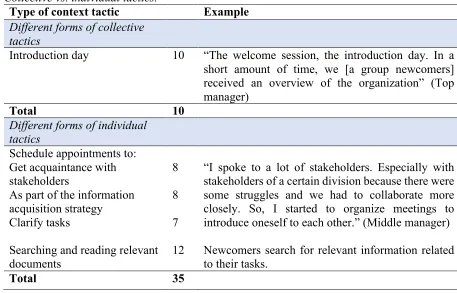
[image:22.595.68.525.472.765.2]Collective and individual tactics include activities that help newcomers to socialize as a group or the contrary, which is throughout individual activities. In the present study, newcomers indicated only one form of collective tactics and several forms of individual tactics, see table 3.
Table 3
Collective vs. individual tactics.
Type of context tactic Example
Different forms of collective tactics
Introduction day 10 “The welcome session, the introduction day. In a short amount of time, we [a group newcomers] received an overview of the organization” (Top manager)
Total 10
Different forms of individual tactics
Schedule appointments to: Get acquaintance with stakeholders
As part of the information acquisition strategy Clarify tasks
8 8 7
“I spoke to a lot of stakeholders. Especially with stakeholders of a certain division because there were some struggles and we had to collaborate more closely. So, I started to organize meetings to introduce oneself to each other.” (Middle manager) Searching and reading relevant
documents 12 Newcomers search for relevant information related to their tasks.
22 Different forms of collective tactics. The introduction day is organized for newcomers to learn about organizational aspects like the organizational structure, norms, and values. The introduction day is valuable because newcomers learn from other organizational members and have the opportunity to interact with other newcomers in the organization. One newcomer indicated that the introduction day could be even more valuable when newcomers are given even more opportunities to interact with other newcomers or senior employees. The introduction day is important to newcomers. So, they suggest that all newcomers should participate in the introduction day during the early entry period. Other suggestions to improve the introduction day is additional information about the building, workspaces, general regularities and instructions about some information systems. Instructions about information systems are urgent as mentioned in the example below which indicates that instructions are not present at the moment.
“Let's put it like this when they [organization] find it important that managers have knowledge about KIS [ICT-system] for instance what to find there and how to use it [ICT-system]. It would be obvious that they would organize something for this, for example like a workshop.” (Middle manager)
Different forms of individual tactics. Individual tactics are self-initiated activities to schedule appointments with others or searching for information and documents. Newcomers scheduled appointments for various reasons that allowed them to learn about the organization, tasks or helped to build relationships. For example, one newcomer indicated that his personal actions to learn and collect information resulted in more self-efficacy, which still helps him nowadays.
Scheduling appointments. Newcomers scheduled appointments in the entry period for
different reasons. One of the reasons was to clarify tasks since a detailed task description is not always present. These appointments are with other organizational members because they can explain how newcomers' tasks relate to the organizational context. Another reason is making acquaintance with stakeholders because newcomers will collaborate with them. Stakeholders are organizational members or clients. Appointments help to understand the nature of the relationship with stakeholders. The last reason for newcomers to schedule appointments is their personal commitment to speak with as many stakeholders as possible. In other words, newcomers emphasize that they voluntarily choose to meet with all team members or clients who are important to their tasks in the organization. Consequently, newcomers indicate that information from different stakeholders helps to make considerate judgments about different aspects of their organizational tasks.
“Tasks, yes there was a task description for which I applied. But the tasks were not unfamiliar, so I understood most things. And there was a document from the management team. But that [task related documents] was about it. So, I arranged some appointments with my supervisor to discuss what the tasks exactly were. For instance, how my tasks were related to other aspects of the organization. Many things that were unclear to me because you can't write them down. These things need a certain interpretation” (Senior manager)
23 helpful during entry and also prior to entry. However, newcomers have to search these documents themselves. For instance, on the intranet that contains a lot of documents. Consequently, the individual exploration for relevant documents of newcomers takes up time and energy, as illustrated in the quotation below.
“Of course, I consulted the intranet and other systems to search for descriptions of management functions or the report OB3.1. What is written in these documents helps to become knowledgeable [about the organization]. All well, you have to find all these kinds of things on your own.” (Middle manager)
4.2.2. Forms of formal vs informal tactics
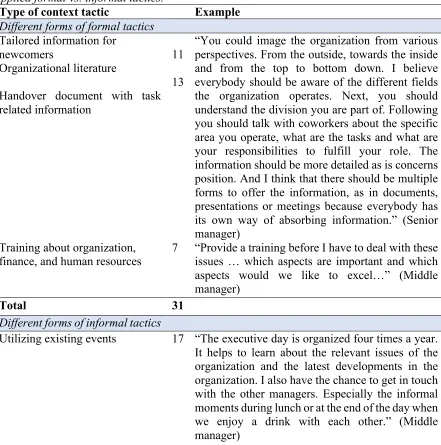
[image:24.595.78.519.318.763.2]The formal vs. informal tactics includes forms that focus on the content of information that is specially tailored or not. So, formal forms of tactics are tailored for newcomers and informal tactics include forms that not distinguish between newcomers and more tenured employees. There are more forms of informal tactics than formal tactics, see table 4.
Table 4
Applied formal vs. informal tactics.
Type of context tactic Example
Different forms of formal tactics Tailored information for
newcomers
Organizational literature
Handover document with task related information
11 13
“You could image the organization from various perspectives. From the outside, towards the inside and from the top to bottom down. I believe everybody should be aware of the different fields the organization operates. Next, you should understand the division you are part of. Following you should talk with coworkers about the specific area you operate, what are the tasks and what are your responsibilities to fulfill your role. The information should be more detailed as is concerns position. And I think that there should be multiple forms to offer the information, as in documents, presentations or meetings because everybody has its own way of absorbing information.” (Senior manager)
Training about organization, finance, and human resources
7 “Provide a training before I have to deal with these issues … which aspects are important and which aspects would we like to excel…” (Middle manager)
Total 31
Different forms of informal tactics
24 Trial & error 5 “At several moments, I learned with falling and
rising. For example, I did not receive an instruction which leaves me with just clicking and trying out different features of the system. This is not a single occasion and costs a lot of time.” (Middle manager)
Total 23
Different forms of formal tactics. The various forms of formal tactics refer to documents that included information that is tailored for newcomers. The reason for different formal tactics is because it allows newcomers to utilize the work environment, to orientate, to learn, clarifying expectations, and to consult information at any time.
Organizational literature & handover document with task related information. The existing book with instructions helps newcomers to set up their accounts. However, newcomers suggest that the information should be accurate and that the book should be provided in the first week of entry. Among the newcomers, this differed. The second important document is a handover document with task related information. Combining these two documents in a kind of a welcome package is helpful because newcomers indicated the information was scattered and it takes up a lot of time to find the right information, as illustrated in the example below. So, providing all necessary documents at one place would save newcomers a lot of time. Consequently, newcomers mention that the handover document was discussed with the predecessor or supervisor. Receiving information in a document allows newcomers to prepare for other activities or allows to have back up information in case other organizational members are not available.
“What I really missed is a clear structure of information. I can deal with ambiguity but people who can't are lost here. At one time, I thought I had the correct document to request some things. Apparently, it was the wrong document so I had to call several times to retrieve the right document. Well, that is not ok and certainly, won't help to start working and be productive.” (Middle manager)
Training about the organization, finance, and human resources. A training would clarify expectations about the performance of managers. Newcomers were not given the opportunity to participate in a training. So, a training was missed as illustrated in the example below.
“Provide a training before I have to deal with these issues. I am not very good with financial numbers. I can foresee the major issues but the organization should have shown me how to do it at an earlier stage. For instance, which financial number matter to indicate my performance, which aspects are important and of which aspects would we like to excel…At the moment, when I come up with something the organization agrees. Which is odd, it shouldn't be like that!” (Middle manager)
25 4.3 Content tactics
Content tactics deal with the timing and sequence of learning activities or the absence of timing. Content tactics are differing from context and social tactics because content tactics issue with the planning of activities. Since there was only a small count for content tactics these are not separated into the different tactics like fixed vs. variable and sequential vs. random. Only the important forms are presented in table 5.
Table 5
Applied forms content tactics.
Type of content tactic Example
Time to learn 7 “Well, what I missed is a week wherein the organization introduces the aim of the organization, the vision, the goals, the strategy and some relevant documents.” (Middle manager)
Lack of timing of introduction day and information
5 “What I found odd, in a later stage, much later, I received an invitation to attain the introduction day. I believe I participated after three or four months of employment, which is a shame.” (Middle manager)
Total 13
Time to learn. Newcomers expected to participate in a period wherein the organization organizes activities or provided information that allowed newcomers to learn, illustrated in the example below. Instead, newcomers become responsible for their tasks immediate after entering the organization. Nevertheless, newcomers suggest that time to learn about their tasks and organization would help them to perform. More specific, a week or more was suggested that allows newcomers to learn and observe to build up knowledge which enhanced their performance.
"I expected information about attendance policies or employee development plan and those related issues. I expected that organization would organize a training on a structural basis in a certain time frame of my entry. But this was not present in the organization." (Middle manager)
Lack of timing of introduction day and information. Newcomers indicated that the timing of activities and retrieval of information is important to them because these activities help to learn about the organization or tasks. The timing of activities and information was not adequate so newcomers would like to see a change, as suggested in one of the examples below. Even more, a newcomer indicated that the late retrieval of information felt unprofessional.
26 4.4 Social tactics
Social tactics become visible in the organization when respondents interact with organizational members or clients to learn, to retrieve information or to build relationships. The social tactics result in forms whereby organizational members become role models and mentors, or the contrary, the absence of role models, hence serial vs. disjunctive tactics. Besides that, social tactics result in forms whereby newcomers noticed that the organizational environment was ready to welcome them or the opposite when organizational members did not recognize or welcomed newcomers. These are labeled as investiture vs. divestiture tactics. 4.4.1 Applied forms of serial vs. disjunctive tactics
Forms of serial tactics include interactions with organizational members who became a role model or a mentor because of their extensive knowledge. Role models and mentors obtain valuable knowledge about organizational and task related aspects and newcomers often organized more than one meeting with them. On the other hand, newcomers did not always have an organizational member who functioned like a role model. This resulted in the negative experience which are forms of disjunctive tactics, see table 6.
Table 6
Applied forms for serial vs. disjunctive tactics.
Type of social tactic Example
Different forms of serial tactics Help from important organizational members:
Role models & Mentor Predecessor
Supervisor
19 10 8
"I noticed that a personal relationship with one or two people in the organization that allows me to ask questions is something I really needed and what actually worked. It is easy when it comes along with a document, but personal relationships are the best way.”
(Middle manager)
Total 37
Different forms of disjunctive tactics Absence of a predecessor and little
organizational help 5 "The person who had to take care of my orientation program, the predecessor, was often not available. Or we scheduled appointments that got canceled by him." (Middle manager)
Total 5
Different forms of serial tactics. Newcomers mentioned various organizational members with whom they arranged appointments that helped them to learn, to ask questions, and to retrieve information.
Help from important organizational members. Organizational members like a role