
Task specific information visualizations using head mounted display technology
31
0
0
Full text
(2) ii.
(3) Master thesis Construction Management & Engineering Faculty of Engineering Technology. TASK SPECIFIC INFORMATION VISUALIZATIONS USING HEAD-MOUNTED DISPLAY TECHNOLOGY. Author:. Berry Busker. Faculty:. Faculty of Engineering Technology. Committee:. Dr. Timo Hartmann Dr. Hans Voordijk Ir. Wilfred van Woudenberg. Date:. April 2016. PO Box 217 7500 AE Enschede the Netherlands +31 534 89 91 11 [email protected] www.utwente.nl. Runnenburg 12 3981 AZ Bunnik the Netherlands +31 30 659 89 33 [email protected] www.bamadvies-engineering.nl iii.
(4) “The time to begin writing an article is when you have finished it to your satisfaction. By that time you begin to clearly and logically perceive what it is you really want to say.” - Mark Twain. iv.
(5) ABSTRACT Various industries (e.g. car assembly, order picking, etc.) adopted a Head-Mounted Display (HMD) as information carrier to enhance the effectiveness of their practitioners using task specific instructions. However, the construction industry has yet adopted this technology. The objective of this research is therefore to determine if construction practitioners can work more effectively using a HMD compared to the traditional paperbased information carrier. The investigated case study is a modular HVAC assembly task at one of the major construction firms in the Netherlands. This research conducted field observations and interviews with assembly experts over a period of six months to determine the information need of the site assemblers. Subsequently a Serious Game was developed using the Unity 3D game engine to simulate the assembly process including the information needs. The game compared the traditional paper-based information carrier to the HMD by simulating two scenarios. Based on the results of the players and the interviews afterwards, this research was able to conclude that site assemblers can be provided with more effective instructions using a HMD as information carrier than the paper-based alternative. The assembly speed increased, and significantly fewer mistakes were made when players used the HMD as information carrier. In addition, this research confirms the results of previous studies that people prefer receiving instructions through a series of information visualizations rather than one instruction (e.g. construction drawing) encompassing all information. Keywords: instructions, context aware, information carrier, HMD, Serious Gaming, modular HVAC elements, assembly crew.. v.
(6) ACKNOWLEDGEMENTS This thesis finalizes my time as a student at the University of Twente. In the following pages I present the results of my final project, but before I do that I want to take a moment and reflect on my time as a student. If I would have to describe my time as a student I’d say it was a rollercoaster ride full of beautiful, unexpected, and life-changing experiences. During this time, I have met the most amazing people, faced many challenges and even learned and something about the engineering discipline. This Master thesis was the latest of my challenges as a student. It has given me the opportunity to test everything I have learned in the real world and more. During this period I learned to work within a professional work environment, and all about the latest technologies such as Augmented Reality and Head-Mounted Display’s that will surely enter our daily households in the near future. I even learned how to develop a game in a VR environment, using software and programming languages I have never used before. Yet, all the things I have learned and the work that lies here has been achieved together with several people who I would like to acknowledge. First of all, I would like to thank Wilfred van Woudenberg, my thesis advisor at BAM. Wilfred, it was truly amazing working with you on this project. At BAM you have the reputation of being a visionary, and I could not agree more. You challenged me in thinking out of the box, and always kept me motivated to improve my work. Although you were always busy with all sorts of things, you always managed to spare some time to help me with my research. Further, I would like to thank my thesis advisors Timo Hartmann and Hans Voordijk from the University of Twente. Hans, I think you are a great motivator, you always replied quickly to my e-mails and questions, and your contributions helped me bring this thesis to a higher level. Timo, I want to thank you in particular. Somehow you always managed to push me to hand in quality work. Regardless if it was for a Bachelor thesis, writing paper reviews for one of your courses, or conducting this awesome research. I am truly grateful for all the things I have learned from you over the last couple of years. I would also like to thank everybody that helped me with my research by playing the game with me. Your input and suggestions for improvement really contributed to the quality of this research. Finally, I want to thank all colleagues at BAM. Your deep interest in my work and compassion kept me motivated and allowed me to enjoy coming to Bunnik every day. In addition to everyone that helped me writing this thesis, I would like to thank my family and friends who were willing to listen to my countless stories about my graduation process and technology stuff such as AR, VR, Serious Gaming, and whatnot. There are too many of you to all mention by name and I think that I should be grateful for that. Finally, I would like to thank my parents for your unconditioned support during my time as a student. Your faith allowed me to enjoy all the facets of life to the fullest even though there have been times that we all doubted if I’d ever graduate.. vi.
(7) TABLE OF CONTENTS ABSTRACT ......................................................................................................................................... V ACKNOWLEDGEMENTS ............................................................................................................... VI 1. INTRODUCTION........................................................................................................................ 1. 2. POINTS OF DEPARTURE ........................................................................................................ 3. 3. RESEARCH APPROACH ........................................................................................................... 6. 3.1 3.2 4 4.1 4.2. CASE STUDY ................................................................................................................................................. 6 SERIOUS GAMING ........................................................................................................................................ 8 FINDINGS ................................................................................................................................. 13 SCENARIO 1: PAPER-BASED INFORMATION CARRIER ...................................................................... 13 SCENARIO 2: HMD INFORMATION CARRIER ..................................................................................... 15. 5. DISCUSSION ............................................................................................................................ 18. 6. CONCLUSION .......................................................................................................................... 21. 7. REFERENCES........................................................................................................................... 22. vii.
(8) 1 INTRODUCTION The current construction market demands innovation, reduction of the integral cost price for construction projects, and improvements with respect to safety requirements. Currently, due to high costs and strict safety requirements, construction practitioners typically lack sufficient information and communication tools (Chi, Kang, & Wang, 2013). Moreover, data-carrying hardware devices, such as paper-based construction drawings, are large in size and contain information that cannot be easily used to compare with the information obtained from real situations. It is up to the practitioners how they assimilate the designer’s ideas into tangible artefacts, even if the instructions provided by a drawing are insufficient or ambiguous. Technological innovations have been developed to improve the effectiveness of the practitioners. Wearable devices containing Augmented Reality and Virtual Reality functionalities to convey instructions using information visualizations are becoming smaller, more sophisticated, and even wearable (Kerr et al., 2011). A future where the construction industry uses wearable AR/VR computing and Head-Mounted Display (HMD) technologies that do not interfere with construction practitioners on site but provide consistent instructions based on their information need seems inevitable. However, the lack of eligible use cases and the limited availability of HMD’s in the construction industry limit the amount of research into this topic, and therefore deter widespread adoption. The objective of this research is to determine if certain tasks within the construction industry can be performed more effectively using HMD technology instead of a paperbased information carrier (e.g. construction drawings, checklists, etc.). To determine this, the effectiveness of the instructions provided by a HMD should be compared to those of paper-based information carrier for the investigated task. It would not make sense to adopt this technology if the provided information is less effective and practitioners would prefer the traditional information carrier anyway. This predicament is the starting point of this research. Therefore, the paper-based information carrier is compared to the HMD for a specific construction task to determine which is most effective and preferred by its end-user. The selected case study is the modular assembly process of Heating Ventilation and AirConditioning (HVAC) elements by the Royal BAM Group N.V. (from now called BAM). This specific task shows similarities to the tasks within different industries that have successfully adopted HMD technologies in their work practice (e.g. order-picking (Groh, 2013), car assembly (Nee, Ong, Chryssolouris, & Mourtzis, 2012)). Similar to these tasks, this construction task contains a structured sequence of process steps and entails unique items that need to be assembled in a unique location. To develop task specific information visualizations on a HMD, the specific information need of the modular assembly crew needs to be determined first. Field observations and semi-structured interviews were conducted to determine the process steps and the task specific information needs of the modular HVAC assembly crew. Based on the identified information need, task specific information visualizations were designed in a Serious Game. To make an appropriate comparison between two information carriers, the process steps that are taken should be similar for both information carriers. The strength of a Serious Game is that it can compare artefacts (e.g. information carriers) relatively easily (Muller, 1999) because it is able to reset the task process, every time it 1.
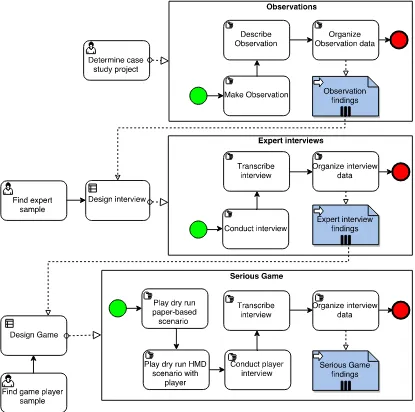
(9) is being played. It basically has similar traits as a laboratory experiment (Lang, Pueschel, & Neumann, 2009). In addition, a Serious Game does not require any commitments since it can be played whenever the player chooses to, and tasks can be simplified so that not only experts are able to play the game (Lang et al., 2009). Besides, it does not require the availability of a real HMD or the readiness of an on-going modular HVAC project. Letting different people play the game as if they would be conducting a modular HVAC assembly task in reality ensured context awareness. Considering the above makes a Serious Game an effective and suitable alternative for a field study comparison. The players played two scenarios. During the first scenario they received information from the paper-based information carrier and some verbal instructions. During the second scenario they only received a HMD as information carrier and no verbal instructions. Ultimately, after the players finished the game possible mistakes they made (e.g. misplacing an element), were transcribed and they were asked about their preferred information carrier during semi-structured interviews afterwards. The outcomes of the experiences from both research approaches resulted in several contributions to the current body of knowledge, practical implications, and recommendations for future research. The main contribution of this research is that for specific use cases in the construction industry a HMD can provide more effective instructions using task specific information visualizations than the traditional paper-based information carriers. It has also shown that people make fewer mistakes while using the HMD. Further, the use case shows similar traits to the cases where HMD technology has successfully been adopted. This could mean that other construction tasks with similar traits (e.g. structured task sequence) could be eligible to adopt HMD technology in their work practices. This thesis is structured as follows. Chapter 2 discusses the theoretical background of this research, and poses a research question. Chapter 3 describes the research approach to provide a structured answer to the research question. Chapter 4 describes the findings regarding the comparison between the information carriers within the Serious Game. The contributions, implications, and recommendations for future research are discussed in Chapter 5. Chapter 6 summarizes the results of this research.. 2.
(10) 2 POINTS OF DEPARTURE A Head-Mounted Display (HMD) is worn on the head or as part of a helmet that has a display optic in front of the users’ face and can provide users with both sentential information (i.e. verbal, written) and diagrammatic information (i.e. illustrations, videos) to one, or both eyes depending on its type (Woods, Fetchenheuer, VargasMartin, & Peli, 2012). This technology can provide dynamic information that can respond to the user’s action. The HMD can provide hands-free information, and is generally operated by users who are walking. This is the major difference with digital handhelds, since further functionalities are similar (e.g. camera, communication, compass, gyroscope, microphone etc.). Most HMD’s can be equipped with Augmented Reality capabilities, which enhance the user’s vision with digital information visualizations (i.e. ‘X-ray vision’). This is particular useful in the manufacturing and construction industries, where people need to be aware of their surroundings but also prefer to work hands-free (Metz, 2014). The first use case where concept of HMD’s including AR have been introduced was in 1990 when Thomas Caudell was figuring out how to help workers assembling long bundles of wires for the new Boeing 777 jetliner. To do the wiring correctly, the assemblers had to continuously look between the instructions sheet and the assembly, which is an inefficient process and prone to mistakes (Metz, 2014). Instead, providing the assemblers a HMD that would show where the wires go, would stop forcing them to look up and down from the construction drawing. Unfortunately, the idea failed to catch on because the computing power of the HMD was not powerful enough. Nowadays the computing power is high enough and some aircraft companies (Metz, 2014), order picking industries (Groh, 2013), and car assembly firms (Nee et al., 2012) actually use HMD’s the way Caudell imagined. In addition to the origins of the HMD, it has specific capabilities that triggered various industries to switch from a paper-based information carrier to the HMD. Probably the biggest asset of a HMD compared to paper, is the parallelization of information gathering with secondary employment and the reduction of time for information search when the data is displayed in the user’s field of view (Reif & Günthner, 2009). In addition, a HMD with AR functionality generally reduces susceptibility to mistakes in interpreting plans or designs. More specifically, it reduces the users cognitive load as it renders a selected portion of a 3D model spatially on the users view (Dunston & Shin, 2009). Further, electronic handover documentation avoids unnecessary visits to the site office (Davies & Harty, 2013), and the AR functionality is able to enhance the context awareness of its user (Shatte, Holdsworth, & Lee, 2014). One might assume that costs of a HMD would exceed the costs of paper-based instructions greatly. However, each paper-based instruction is unique, meaning that it cannot be reused as information carrier for other tasks. The HMD on the other hand is to that account reusable since it uses cloud computing and digital copies (Chi et al., 2013). Lastly, the HMD could be used as navigation tool to determine the location and orientation of its user via its gyroscope, accelerometer and Global Positioning System (GPS). In fact, this technique is already applied in different industries. For example, various museums worldwide use this technique to communicate with passive RFID’s (Radio Frequency Identification) to provide visitors with context aware information about artwork (Chen & Huang, 2012). 3.
(11) Triangulating an RFID tag with a Wireless Local Area Network (WLAN) for instance allows the HMD to determine the location of its user up to 1.2m (Li & Becerik-Gerber, 2011; Razavi & Moselhi, 2012). This could make navigation on a construction site more effective since practitioners would not have to stop and look up and down to a construction drawing anymore. Besides the advantages of a HMD compared to paper, HMD’s also have certain disadvantages that cannot be ignored. First of all, the current HMD’s on the market have limited Field Of View (FOV) and low image resolution (Ateş, Fiannaca, & Folmer, 2015; Hua, Hu, & Gao, 2013). Various industries plea that a ‘good enough’ HMD should have at least have a horizontal FOV of 120 degrees, a vertical FOV of 50 degrees and an image resolution of 1600x1200 pixels if not more (Havig, Goff, McIntire, & Franck, 2009). In contrast, the Google Glass only has a 15 degrees FOV and an image resolution of 640x630 pixels (Hua et al., 2013), and “the Microsoft Hololens only feels natural when you're not handling anything much bigger than a basketball” (Robertson, 2015). Second, the tracking system is one of the most important problems of the HMD with Augmented Reality capabilities. Although it is able to determine its position up to 1.2m, it remains difficult to align objects in the real and the virtual world with respect to each other (Zollmann et al., 2014). Third, the HMD is a relatively fragile device compared to the paper-based information carrier, and given the average cost people may feel reluctant to use such a system for the fear of breaking it. Fourth, a HMD could isolate people from their surroundings although they should be capable of interacting with it. The ‘isolation’ from the real world could also induce nausea to the HMD user (Havig et al., 2009). Fifth, a HMD requires electronics, which means that it must be charged, and thus has a limited battery live. In addition its weight and heat uttering could become disturbing to its user. Lastly, the surrounding view of the user could limit or distract the user due to the information displayed on the HMD (Fiorentino, Uva, Gattullo, Debernardis, & Monno, 2014; Woods et al., 2012). Taking the benefits and the limitations of the HMD into account, one could imagine that for certain construction tasks the HMD might be more effective as information carrier than the paper-based alternative. However, the adoption of this technology in the construction industry evolves slowly (Wang et al., 2013). The question that can be asked is: Why has HMD technology been successfully adopted by other industries, and what makes the construction industry so different? The industries that have picked up this technology have to a certain extent standardized their task processes so that the information need of the users can be addressed accordingly. The general idea within the construction industry is that a construction project is unique, making it difficult to standardize task processes and therefore consistently determine the information needs of the practitioners (Gibb, 2001; Hastak, 1998). This train of thought is debatable since each construction project requires similar materials and equipment (Dubois & Gadde, 2000), and processes (Winch & Carr, 2001) just like any other type of project. In fact, certain tasks have been (partly) standardized such as the modular HVAC assembly task, which has led to great results regarding efficiency, space saving, and waste reduction. This task contains just like any other assembly task in another industry a clear sequence of process steps and consistent information needs. In addition, similar to the order picking industry, it withholds unique items that belong to a unique location in the building. However, it still uses paper-based information carriers (e.g. checklists and 4.
(12) construction drawings) as main source of instruction. This task might therefore be eligible for successful adoption of HMD technology as information carrier to increase the effectiveness of the site assemblers. There has not yet been research conducted to determine if construction tasks can be conducted more effectively using HMD technology as information carrier instead of the current paper-based information carrier(s). This research therefore compares the two alternatives for the modular HVAC assembly task to determine which is more effective and favoured according to the site assemblers. Based on this comparison one could argue whether or not HMD technology should be implemented in the modular HVAC industry based on its strengths and weaknesses compared to the traditional information carrier. The outcome of this research might induce future research within the construction industry to the adoption of HMD technology. In fact, it might induce project engineers to standardise certain task processes of construction projects so that they can become eligible to adopt HMD technology as information carrier. Since the aim of this research is to determine if certain tasks within the construction industry can be conducted more effectively using information visualizations on a HMD, the following research question can be defined: “Is it possible using context aware information visualizations, to provide construction site assemblers with instructions on a HMD that better meet their information needs?” The following chapters in this report are organized in a way to provide a substantiated answer to this research question.. 5.
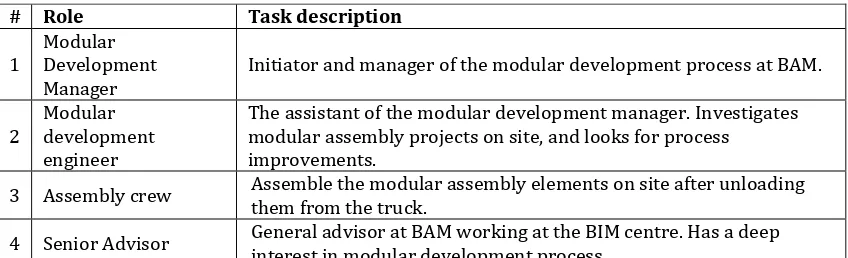
(13) 3 RESEARCH APPROACH For the research approach, field observations were conducted during a case study to determine the information needs of the modular HVAC assembly crew. Subsequently expert interviews are held to triangulate and generalize the case specific findings from the observations. Based on the generalized information needs, this research developed a Serious Game to simulate the modular HVAC assembly task. The game simulated two scenarios to be played using different information carriers (paper-based and HMD). Transcribing their game results (e.g. mistakes, interpretation) and conducting interviews afterwards, allowed this research to present findings regarding the more effective information carrier. Figure 1 visualizes the research approach in a Business Process Model and Notation (BPMN) flowchart.. FIGURE 1: BPNM DIAGRAM RESEARCH APPROACH. 3.1 CASE STUDY The case study that has been selected to conduct this research is the modular HVAC assembly task at the project Zaans-Medisch Centrum (ZMC). This is a novel state-of-theart construction task, which has been developed by BAM Bouw & Techniek. The aim of this assembly technique is standardization following a predetermined sequence of 6.
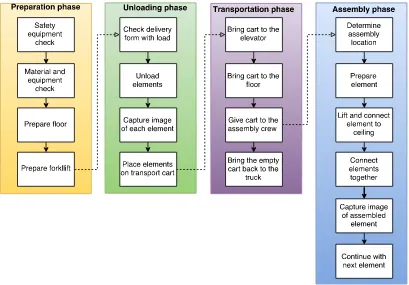
(14) process steps, and increasing the efficiency of the process and the effectiveness of the assemblers. This specific construction task has been selected because it is one of the few construction tasks that follow (to a certain extent) a standardized sequence of process steps. In order to deliver task specific information effectively using a HMD, the information need must be consistent (Chi et al., 2013; Nee et al., 2012). Therefore the process steps must be standardized. The task activities of the modular HVAC assembly crew have been observed over a course of four days to determine their information needs per process step. In order to generalize these observations and to avoid potential bias by the researcher, conducting semi-structured interviews with modular HVAC assembly experts has triangulated the results of the observations. Table 1 summarizes the roles and task descriptions of the modular HVAC assembly experts. TABLE 1: INTERVIEW SAMPLE. # 1 2. Role Modular Development Manager Modular development engineer. 3. Assembly crew. 4. Senior Advisor. Task description Initiator and manager of the modular development process at BAM. The assistant of the modular development manager. Investigates modular assembly projects on site, and looks for process improvements. Assemble the modular assembly elements on site after unloading them from the truck. General advisor at BAM working at the BIM centre. Has a deep interest in modular development process.. The modular HVAC assembly process that has been identified is shown in Figure 2. Four different phases have been distinguished. The phases resemble different site assemblers that conduct these tasks. The process steps including the information needs within these phases have been used as input to design and program the Serious Game.. 7.
(15) FIGURE 2: MODULAR ASSEMBLY PROCESS. 3.2 SERIOUS GAMING A Serious Game is a mental contest which is played in accordance with specific rules to observe a certain result or behaviour (Lang et al., 2009), which is designed to exceed the entertainment aspect (Bellotti, Kapralos, Lee, Moreno-Ger, & Berta, 2013). Figure 3 shows the steps to develop a Serious Game. The sequence is based on Polya’s mathematical problem solving techniques (Polya, 1945). The following paragraphs are organized according to these steps.. FIGURE 3: RESEARCH APPROACH SEQUENCE. The problem that can be identified with respect to the research approach is that real case studies generally lack rigour and objectivity when comparing artefacts (Rowley, 2002). For a proper and unbiased comparison, the assembly process including external factors should be similar for both carriers (Lang et al., 2009). A Serious Game is suited as research approach because it has similar traits as a laboratory experiment and is not bound to the readiness of people, availability of equipment (e.g. HMD), or a construction project that is willing to lay down work until the research finished. In addition, the potential dangers of a construction site are non-existent. The purpose of the Serious Game is to compare the current information carriers to the HMD in an environment that resembles modular assembly project at ZMC as realistically as possible.. 8.
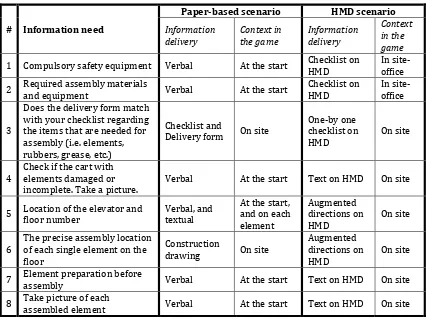
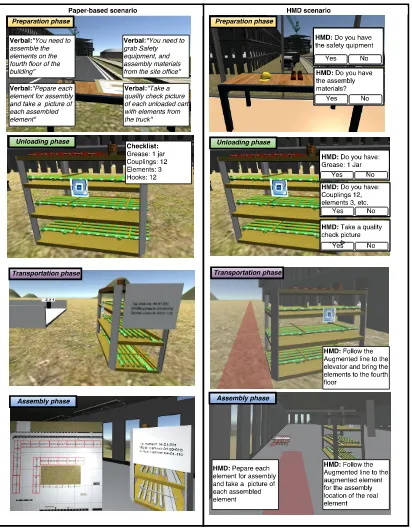
(16) Following Polya’s steps in Figure 3, the next step is to set-up the game (i.e. design the research environment) and defines the rules. The process steps in Figure 2 are used in accordance with the modular HVAC assembly experts to determine the information needs of the assembly crew. The process steps and information needs are subsequently used as a narrative for the game. Two scenarios are designed in the game: the paperbased scenario and the HMD scenario. To make a proper comparison between the information carriers, the delivery of information should be consistent for both alternatives. Table 2 shows how the information need is addressed in the game and what the context is in the game. TABLE 2: ADDRESSING INFORMATION NEEDS. Paper-based scenario. HMD scenario Context Information in the delivery game Checklist on In siteHMD office Checklist on In siteHMD office. #. Information need. Information delivery. Context in the game. 1. Compulsory safety equipment. Verbal. At the start. Verbal. At the start. Checklist and Delivery form. On site. One-by one checklist on HMD. On site. Verbal. At the start. Text on HMD. On site. Verbal, and textual. At the start, and on each element. Construction drawing. On site. Augmented directions on HMD Augmented directions on HMD. Verbal. At the start. Text on HMD. On site. Verbal. At the start. Text on HMD. On site. 2. 3. 4 5 6 7 8. Required assembly materials and equipment Does the delivery form match with your checklist regarding the items that are needed for assembly (i.e. elements, rubbers, grease, etc.) Check if the cart with elements damaged or incomplete. Take a picture. Location of the elevator and floor number The precise assembly location of each single element on the floor Element preparation before assembly Take picture of each assembled element. On site On site. Figure 4 shows how these instructions are visualized in the game for both scenarios over multiple phases. The game follows the process steps of the modular assembly crew in Figure 2.. 9.
(17) FIGURE 4: MULTIPLE PHASE INSTRUCTIONS FOR PAPER-BASED AND HMD SCENARIO. During the paper-based scenario, the players receive all their verbal instructions in the beginning of the game. As long as the game is played they must remember these instructions. During the ‘Unloading phase’ they receive a paper-based delivery form, which they must check with the actual load. During the ‘Assembly phase’ they must match the number on an element with the corresponding number on the map (i.e. construction drawing). They subsequently go to the pointed location on the drawing and assemble the element. This paper-based scenario is similar to a real modular assembly process. For the HMD scenario on the other hand, the players receive all their instructions through the HMD. By clicking either ‘yes’ or ‘no’ to certain instructions, the players receive a next instruction based on their response. As long as the player does not interact with the HMD the instruction remains pending. Each element is provided 10.
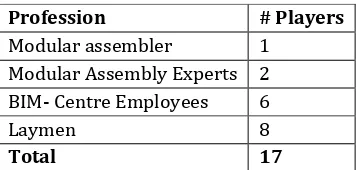
(18) with a unique tag. When the tag is scanned, the HMD provides directions using Augmented Reality to the location of the element in the building. To make the game playable within a minimal amount of time (approximately 10 min), certain simplifications have been designed. These simplifications do not compromise the outcomes of this investigation. For example, the game ignored certain process steps that would not influence the findings regarding the information carriers (e.g. ‘prepare floor’, see Figure 2). In addition, players only had to assemble three elements in total and were able in doing so by pushing a button. Further, players are able to make mistakes within the game similar as how assemblers could make them too in reality. For instance, they could walk to the wrong location and assemble an element incorrectly. Lastly, assuming that game players have a learning curve, the order in which the scenarios are played is randomized, and the location the elements where they are supposed to be assembled differs per scenario. Following steps in Figure 3, the next step is to determine the player types and discuss the dry runs. The type of players that the play game was a combination of construction practitioners, experts and laymen, because these groups can provide different insights regarding the functionality of both information carriers (Witt & Kluge, 2007). Table 3 provides an overview of the players that have played the game. TABLE 3: GAME PLAYERS. Profession Modular assembler Modular Assembly Experts BIM- Centre Employees Laymen Total. # Players 1 2 6 8 17. Specifically these professions have been selected because their work practices are directly involved to the introduction of a new information carrier within the modular HVAC segment. The modular assembly crew is physically working with the information carrier on site. The introduction of a HMD forces them to perform their tasks differently than before. Their input regarding the practical use of the HMD is therefore valuable for this research. The modular assembly experts have designed the modular HVAC assembly process. They have made certain substantiated decisions regarding this process. To ensure that they support the HMD as information carrier within this process, it is crucial that they played and commented on the game. Third, BIM-centre employees have been selected to play the game as well. They develop the digital models of the building. These digital models would have to be extended with additional information, such as the Augmented Reality directions. Therefore, their contributions to this research are valuable. Laymen are in this case people who are not involved with the modular assembly process in any way. The reason that these people have been selected to play the game was because one of the purposes of the task specific instructions is that they are straightforward enabling anyone to conduct the task without making mistakes. Besides, they might provide this research with surprising input. Having determined the player types and selected them, the next step is to conduct the dry runs. At the start of the game, the players were informed about the research objective. They were specifically instructed to play both scenarios to their best interest and were made aware of the potential mistakes they could make. Figure 2 was 11.
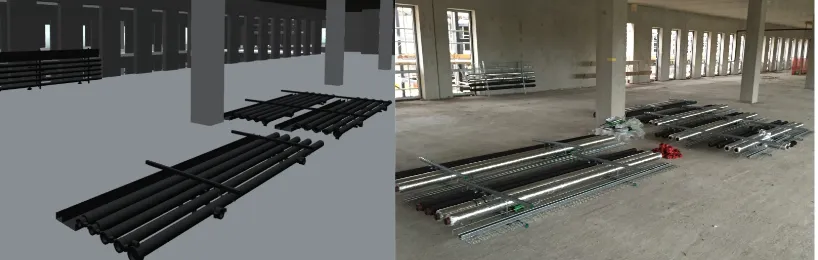
(19) shown to them during these instructions to clarify the steps they were supposed to take. Moreover, they have been instructed to focus on the objective and to determine how the information carrier would influence their effectiveness per phase if they would perform a real modular HVAC assembly task. Before starting a dry run in the game, the players received time to familiarize themselves with the controls (i.e. walk, rotate, pick up items, etc.). It is essential that the presentation of the game is realistic, to ensure context awareness of the players and present meaningful findings. If not, one could argue that certain mistakes might have been caused due to the visual limitations in the game. Figure 5 provides an example of a picture taken at the Zaans Medisch Centrum, and its equivalent in the Serious Game. It shows that the materials including their sizes are similar in the game and in reality. In fact, the building in the game has exactly the same geometry as the real building. The only difference between the game and reality are the limited colours in the game.. FIGURE 5: COMPARISON GAME VS. REALITY (ZMC). After a dry run finished, the researcher analysed the results by determining how the players interpreted the instructions, and if they made any mistakes. Subsequently the mistakes were discussed with the players during semi-structured interviews. Additional comments and suggestions were incorporated in the findings of this research. Due to the diverse type of players, and the limited knowledge of the researcher about the topic, he did not structure the interviews too rigidly in order to avoid missing new perspectives. Based on the interview findings and the game results, this research was able to conclude which information carrier is preferred by the players. It also showed which information carrier is more effective, regarding the amount of mistakes.. 12.
(20) 4 FINDINGS Having identified the modular assembly process and the corresponding information needs, this chapter delivers the information visualizations per information need for two scenarios. The objective of the game is to compare both scenarios and determine how the instructions on both the information carriers influence the effectiveness of the players for the modular HVAC assembly task. The effectiveness is determined based on the amount of mistakes players have made. First the results of the players using the paper-based information carrier (Scenario 1) are described. Second, the results of the players using the HMD information carrier (Scenario 2) are described. In addition, per scenario explanative comments and interview results are included to understand the incentives of the players.. 4.1 SCENARIO 1: PAPER-BASED INFORMATION CARRIER During this scenario, the players received verbal instructions and paper-based information carriers to address their information needs (see Table 2). The players followed the process steps according to Figure 2. The following paragraphs are therefore organized according to the phases that have been distinguished in Figure 2. Preparation Phase It appeared that within the time between the first instruction and the beginning of the game one player forgot to pick up the safety gear from the site office. His comment was: “I simply rushed too quickly into the game, and therefore totally forgot the safety equipment”. The second verbal instruction was to pick up items (i.e. construction equipment) from the site office. Since most of the players were inexperienced assemblers, they were not obliged to precisely remember the type items to bring, but simply not to forget to bring the items to the construction site. However, four players forgot to bring these items. The main reason that they mentioned was that they have forgotten to remember the instruction. Although these instructions have been provided short before the players started playing the game, some of them already forgotten simple instructions. Two of these players stated that the reason was because: “the information was not delivered at the right time”. Unloading Phase During the ‘Unloading Phase’ the first instruction was to check whether the delivery form (i.e. paper-based checklist) corresponded with the actual load. The paper-based checklist forced most the players to look up and down from it and manually search for the matching item on the cart. Although it took them a relatively long time to determine that the load matched the items on the delivery form, none of the players failed this instruction. Compared to the previous tasks where they already made certain mistakes, they conducted this task thorough. During the interviews a BIM-centre employee stated: “I thought that this task was the first test to see if I would make a mistake”. Other players mentioned similar reasons. However, besides the fact that people use their index finger to avoid misreading no tangible differences regarding the effect of the paper-based information carrier compared to the HMD have been identified during this phase-.. 13.
(21) Transportation Phase According to the players, this phase of the modular HVAC assembly process was relatively simple, compared to the other phases. The only instruction that the players needed to remember was to take the cart with elements to the elevator on the other side of the ZMC and bring them to the fourth floor. None of the players forgot the floor number and therefore successfully fulfilled this task. The response of one player to a question of the researcher was particularly interesting. The researcher asked, why he had forgotten to bring the assembly equipment to the construction site but somehow remembered the floor number, which was in fact an instruction further in time. His response was: “I think it is because when I came at the elevator I was forced to think and remember the instructed floor number. Otherwise I could not continue with the task. Regarding the assembly equipment, this was different because I could continue with my task regardless if I had fulfilled this step”. It appeared that other players agreed to this statement after discussing about it during the interviews. Assembly Phase The players generally took longer to fulfil the instructions during this phase than during the other phases combined. The main reason was because of the multiple interactions with the information carrier. First, they needed to determine the assembly location of each of the three elements on the cart (see process step in Figure 2). The design of the game disabled the players to move around while the construction drawing was activated (i.e. visible to them). This forced them to determine their location in the building, while standing still. Most of the players used the location of the elevator as reference point. From there, they identified the unique element number on the cart. They subsequently searched for the matching number on the construction drawing often using their index finger to move over the computer screen. When a match was found, they put away the construction drawing and walked to the location that was pointed out by the drawing. Most of the players were forced to stop and take out the drawing again to re-determine their position. Similar to the real construction site at ZMC, the ceilings in the game contained chains to which the modular elements had to be assembled. Most of the players therefore used these chains as reference points to determine the assembly location. By counting chains per element the players were able to determine the assembly location of the next element. When players had to bring an element somewhere in the middle of the building they sometimes miscalculated, which forced them to start counting again from a reference point. Comments such as: “This is really hard” or “I lost count”, were not uncommon when this happened. The players were forced to concentrate so that they would not make a mistake. Having determined the assembly location, the players had to enter an invisible box collider (i.e. walk to the precise location) and then press a button to assemble the element precisely on that location. By pressing a button, the game activated the (invisible) element within that box and played an animation that assembled the element to the ceiling. Although the players tried to conduct this task thorough, four players failed to correctly assemble one (or more) of the three elements because they entered the incorrect invisible box collider and therefore assembled an incorrect element. The reason that the assembly task took relatively long was due to the amount of interactions between the player and the information carrier. Players had to stop and take out the construction drawing multiple times per modular element before being sure where to go. Finally, after an element was assembled, the players had to remember the instruction given at the 14.
(22) beginning of the game to take a picture as means of a quality check. However, nine players forgot to take this picture. The main reason was again that they had forgotten it because they have not been reminded at the time should have taken the picture.. 4.2 SCENARIO 2: HMD INFORMATION CARRIER During this scenario, the players received (see Table 2) the instructions on the HMD to address their information needs. Each time a player finished a task he either pressed ‘yes’ or ‘no’ on the HMD in the game to receive a new instruction. This means that for each pending task, the instruction that addresses the information is continuously visible to the player. The players followed, similar to Scenario 1, the process steps according to Figure 2. The following paragraphs are therefore organized according to the phases that have been distinguished in Figure 2. Preparation Phase The first instruction the players received was to pick up the safety equipment from the site office. This instruction is similar to the verbal instruction the players receive during Scenario 1. However, the major difference is that during this scenario the players receive the instruction the moment the game begins. In addition, since the instruction was continuously projected on the HMD screen, none of the players forgot to equip themselves with safety equipment during this phase, in this scenario. However, due to inaccurate instructions by the researcher two players thought they were already wearing safety gear because they picked it up during the first scenario. They therefore clicked ‘yes’ to the question if they had the safety equipment with them. Similar actions could also occur in reality. For example, a HMD user that keeps pressing the ‘yes’ button on purpose to ignore instructions, or who mistakenly presses one of the buttons and therefore misses an instruction, seems plausible. After a player equipped himself with the safety equipment the next instruction that appeared on the HMD was to pick up the assembly items. None of the players made a mistake there. However, most of the players questioned the effectiveness of the HMD in this phase. A modular HVAC assembler commented: “I am not allowed to enter the construction site if I am not wearing any safety clothes, and all the assembly equipment I need is in my toolbox. I find it therefore unnecessary to wear a HMD and receive such obvious instructions”. Yet, he did agree that the chance of making a mistake would reduce if a HMD were used, because of its ability to provide context aware instructions. Unloading Phase After the players equipped themselves with the assembly items the next instruction was to follow the Augmented Reality directions to the truck and retrieve the delivery form. Subsequently the players had to compare the delivery form with the cart with elements. Just as in the paper-based scenario no mistakes were made here. The difference between both information carriers was that during this scenario the players had to match the items on the cart with the checklist one at the time. One item appeared on the HMD screen, which was matched with the load and was given a ‘yes’ or a ‘no’ before the next item appeared on the HMD screen. After each item was checked, the players were asked by the HMD to take a picture as means of a quality check that the cart or elements were not damaged. Since this instruction appeared when needed, none of the players forgot to take a quality check picture. Responses such as: “oh, yes that’s right I almost forget to take a quality picture again” during the game were not uncommon. During the 15.
(23) interviews several players mentioned independently that one of the main benefits of the HMD is that it is can deliver context aware information, because it reminds them of instructions that they might have overlooked. Transportation phase During this phase the players were instructed by the HMD to go to the elevator and move to the fourth floor of the building. In order to provide correct directions, the players were instructed to walk past a passive RFID tag, which is automatically scanned by the HMD in the game. This tag is positioned near the ‘truck unloading area’. The tracking features of the HMD in combination with the WLAN on the construction site subsequently determine its location and orientation on the construction site. The specifics of this process are similar as the example described in Chapter 2 regarding the museum visitors. By scanning the RFID of first modular element, its location is determined by the HMD. The information on the tag communicates the directions of its location in the building and the directions to the nearest elevator with respect to the position of the player. After the RFID’s have been scanned, the HMD provided the players with Augmented Reality directions towards the nearest elevator. The information retrieved from the RFID on the element further provided information regarding the floor level of its destination. The players generally found the process where they received directions to the location of the elevator, and the instruction where to bring the elements, convenient. However, several of them questioned the effectiveness of a HMD for this phase because the information need was fairly straight forward, which makes a HMD superfluous according to them. Assembly phase The first instruction during this phase was to go to the RFID tag on the fourth floor near the elevator, which is scanned by the HMD so that the position of the player within the building can be recalibrated. The location of the first element is provided using Augmented Reality directions on the HMD. An augmented image of the modular element is visualized on the precise location on the floor. Further, most of the players mentioned the convenience of this device showing clear directions to the location of the modular elements. Having identified the precise assembly location, the next step was to prepare the modular elements, simply by pressing a button. Next, was to press another button that prepared the element (i.e. greasing, adding couplings, etc.) and activated the animation to assemble the element to the ceiling. None of the players made a mistake in determining the precise assembly location, and assembling the element. Finally, after the element was assembled, the players received an instruction to take a quality check picture of the assembled element. In contrast to the paper-based scenario, again none of the players forgot to take a quality check picture. In fact, the players were positive about the instruction delivered by the HMD during the interviews. Several players commented: “Its gives a very comforting feeling to know that you can rely completely on the information carrier, without having to make uncertain decisions” The modular HVAC assembler reflected on the fact that using a HMD during the assembly phase would certainly benefit his assembly speed. He stated: “Normally we would put a construction drawing on a wall somewhere in the middle of the building floor and walk from and to it with the elements. Sometimes we have to walk back if we become unsure about the assembly location. Using a HMD would certainly increase our speed to find the assembly. 16.
(24) location of the elements”. Several players stated that especially during this phase the HMD would be of great benefit compared to the paper-based information carrier.. 17.
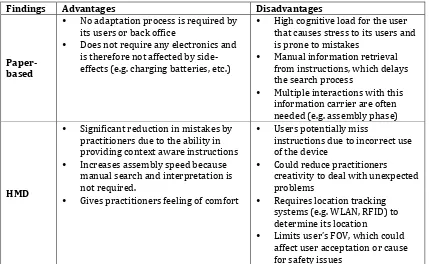
(25) 5 DISCUSSION This section discusses the findings obtained from the previous sections. Table 4 provides a qualitative comparison of the investigated information carriers. Per information carrier various advantages and disadvantages have been identified. The findings presented in Table 4 are discussed throughout this chapter in terms of contributions, implications, and limitations that are recommended for future research. TABLE 4: QUALITATIVE COMPARISON INFORMATION CARRIERS. Findings. Paperbased. Advantages • No adaptation process is required by its users or back office • Does not require any electronics and is therefore not affected by sideeffects (e.g. charging batteries, etc.). •. • HMD. •. Significant reduction in mistakes by practitioners due to the ability in providing context aware instructions Increases assembly speed because manual search and interpretation is not required. Gives practitioners feeling of comfort. Disadvantages • High cognitive load for the user that causes stress to its users and is prone to mistakes • Manual information retrieval from instructions, which delays the search process • Multiple interactions with this information carrier are often needed (e.g. assembly phase) • Users potentially miss instructions due to incorrect use of the device • Could reduce practitioners creativity to deal with unexpected problems • Requires location tracking systems (e.g. WLAN, RFID) to determine its location • Limits user’s FOV, which could affect user acceptation or cause for safety issues. The findings have shown great differences between the information carriers and confirmed multiple claims from researchers regarding this topic. First of all, the amount of mistakes significantly reduced when the players played the HMD scenario compared to the paper-based alternative. The main reason that was brought up was the ability of the HMD to provide context aware instructions using clear and unambiguous information visualizations. In addition, the assembly speed op the players increased greatly using the HMD because they did not have to manually filter instructions from the information carrier into supposedly correct actions. Instead, they received augmented instructions directing them to the assembly location. According to the players this reduced the cognitive load, which is supported by the research of Dunston & Shin (2009) who identified similar results. In fact, it gave them a feeling of comfort, as they trusted the instructions of the HMD to be correct. These advantages of the HMD truly benefit to the general goal of the construction industry, which is to reduce the integral cost price of projects by increasing the effectiveness of practitioners using technological innovations, and by standardization of construction processes (Chi et al., 2013). In addition, the findings in this research confirmed the results of the research by Agrawala et al. (2003) and Novick et al. (2000) showing that people prefer context aware information that present the construction operations across a sequence of instructions rather than a single instruction showing all the operations.. 18.
(26) Furthermore, the concept of Serious Gaming in a virtual environment has been applied to make a proper and unbiased comparison between two information carriers. However, it could be used for numerous other (construction) tasks as well. A Serious Game could be used to show digital designs to clients for instance. Letting clients walk around freely through ‘their’ digital artefact allows them to understand what it will look like when it is actually built. Van den Berg (2014) supports this claim, by stating that the possibility to navigate through a virtual design is an important factor in getting more familiar with a design. This allows for a more transparent discussion between the client and the construction company of how the artefact should be developed. The current techniques used at BAM are less user-friendly according to the BIM engineers at BAM. Views regularly falter (especially, for rendered models), and the walk through functionality is not as user friendly and realistic as it is within a Serious Game. This concept could also be used for train practitioners for fire safety evacuations (Rüppel & Schatz, 2011), to organize site logistics (Nikolic, Lee, Messner, & Anumba, 2010), or to provide machine operators with compaction strategies (Vasenev, Hartmann, & Doree, 2013). Besides the contributions of this research, certain practical implications are identified too. This research identified the workflow of a case study and further standardized this process by delivering consistent information to the practitioners. Standardizing task instructions (e.g. using a HMD) induces further implications for construction tasks. Less specialized personnel is needed on site, which are cheaper and easier to replace because the task specific instructions elaborate step by step what to do. However, this could reduce their capability to solve unexpected problems. Since traditional construction practitioners are generally praised for their decisiveness to cope with these kinds of problems, this could result in adverse implications. Therefore, when changing the information carrier practitioners require a different set of skills. Second, the implementation of HMD technology probably changes the work practices of other construction practitioners, and requires different equipment on site. For example, instead of producing paper-based instructions, clear step-by-step context aware instructions need to be produced and uploaded to a HMD. Further, the back office needs to be organized in a way that it can effectively store the data. Additionally, within the context of this research, WLAN would need to be installed on the construction site, and materials would need to be equipped with RFID tags or other indoor location sensing technology. Based on the contributions and implications of this research several limitations and recommendations for future research should be mentioned. First of all, more case studies should be conducted to compare the HMD and the paper-based information carrier. Such case studies could help to increase the validity of the findings of this research. In addition, future research should incorporate more site assemblers to compare both alternatives, instead of just one as in this research. Although his input was valuable, this limits the generalizability of the research results. Other site assemblers might have provided additional input regarding the game, the instructions, or the information carriers that have not been taken into account now. Second, this research used Augmented Reality and RFID’s to help players navigate over the virtual construction site. In fact, the game provided meticulous directions and smooth augmented transitions to the assembly location of the modular 19.
(27) elements. In reality this functionality is more complicated, less accurate, and possibly prone to malfunctioning. As stated earlier, by triangulating with an RFID tag and WLAN allows a HMD to determine its location of its user up to 1.2m under the most ideal circumstances (Li & Becerik-Gerber, 2011; Razavi & Moselhi, 2012). This deviation has not been taken into account in the game. Moreover, the installation of multiple RFID’s and WLAN to determine the position of the HMD implicates additional effort and costs. In addition, this research used RFID tags solely for location tracking purposes. However the potential of RFID in the construction industry goes beyond of what has been investigated in this research (Costin & Teizer, 2015). Future research into this topic is therefore recommended, especially if it can be combined with the location tracking purposes. Third, the instructions on the HMD force the players to follow a predetermined sequence of process steps. If players click too quickly through the instructions they might accidentally miss specific information, similar as what has happened during two game sessions in this research. Therefore, complete reliance on the HMD could either induce a feeling of comfort, or become a pitfall when users stop thinking for themselves and therefore miss specific instructions. A possible solution to such mistakes could be some sort of visual recognition system within the HMD that disables the button until it has identified the item in play. Similar methods have been applied in the order-picking industry (Funk, Shirazi, Mayer, Lischke, & Schmidt, 2015). However future research is needed to investigate how problems like these can be prevented within the context of the building industry. Fourth, a Serious Game is bound to the design and the resourcefulness of its creator, and since it does not entail real risks it always presents a simplified version of reality (Lang et al., 2009). As risks and unexpected situations occur only on real construction sites, their potential effects have not been considered in this research. In addition, the user experience (e.g. a troubling user interface, a limited battery live, or physical discomfort) of a HMD could not be tested properly in the game and have therefore not been incorporated in this research. If players would have encountered such issues, they might have provided different answers during the interviews. Therefore future research is needed so that the information carriers can be compared on a real construction site. Fifth, the safety regulations in most countries do not describe anything about the use of digital wearables on the construction site, presumably due to its novelty. This does not necessarily mean that the use of wearables should immediately be taken for granted on the construction site. The reduction of sight for instance could cause for dangerous situations. A solution to this issue could be to eradicate the display images while the user is moving. This would benefit both visibility and attention. The technique behind this would function similarly as for a dashboard television within a vehicle. It automatically turns off when the speed of the vehicle exceeds a certain threshold. How such issues and solutions should be addressed requires future research.. 20.
(28) 6 CONCLUSION This research compared HMD technology with the paper-based information carrier for the modular HVAC assembly task at BAM. Zaans-Medisch Centrum has been selected as a case study to determine the information needs of the assembly crew that conduct this task. To determine the specific information needs observations have been conducted and semi-structured interviews have been held with modular assembly experts. Based on the identified assembly process and the task specific information needs, a Serious Game has been developed that functioned as a platform to compare the traditional paper-based information carrier with the HMD alternative. In this game two scenarios have been designed that each represents an information carrier. The game has been designed in a way that allowed players to make mistakes similar as they could make in reality. After the players finished both scenarios, semi-structured interviews have been conducted to determine which information carrier they preferred and which alternative caused for more mistakes. The results pointed unanimously to the HMD as being the more effective information carrier and being preferred by the players of the game. The HMD does not force the players to rely on their cognitive capabilities, and provides context aware instructions, which causes a feeling of comfort according to the interviewees. This research has proven that certain tasks within the construction industry are, just like any other assembly industry, eligible to adopt HMD technology as information carrier. However, future research is necessary that determines how the tasks of the involved practitioners will change after the adoption of HMD technology.. 21.
(29) 7 REFERENCES Ateş, H. Ç., Fiannaca, a, & Folmer, E. (2015). Immersive simulation of visual impairments using a wearable see-through display. TEI 2015 - Proceedings of the 9th International Conference on Tangible, Embedded, and Embodied Interaction, (JANUARY 2015), 225–228. doi:10.1145/2677199.2680551 Bellotti, F., Kapralos, B., Lee, K., Moreno-Ger, P., & Berta, R. (2013). Assessment in and of serious games: An overview. Advances in Human-Computer Interaction, 2013, 1–2. doi:10.1155/2013/136864 Berg, M. van den. (2014). Exploring the Impact of Virtual Reality in Design Review Processes. University of Twente. Chen, C. C., & Huang, T. C. (2012). Learning in a u-Museum: Developing a context-aware ubiquitous learning environment. Computers and Education, 59(3), 873–883. doi:10.1016/j.compedu.2012.04.003 Chi, H. L., Kang, S. C., & Wang, X. (2013). Research trends and opportunities of augmented reality applications in architecture, engineering, and construction. Automation in Construction, 33, 116–122. doi:10.1016/j.autcon.2012.12.017 Costin, A. M., & Teizer, J. (2015). Fusing passive RFID and BIM for increased accuracy in indoor localization. Visualization in Engineering. doi:10.1186/s40327-015-0030-6 Davies, R., & Harty, C. (2013). Implementing “site BIM”: A case study of ICT innovation on a large hospital project. Automation in Construction, 30, 15–24. doi:10.1016/j.autcon.2012.11.024 Dubois, A., & Gadde, L.-E. (2000). Supply strategy and network effects — purchasing behaviour in the construction industry. European Journal of Purchasing & Supply Management, 6(3–4), 207–215. doi:10.1016/s0969-7012(00)00016-2 Dunston, P. S., & Shin, D. H. (2009). Key areas and issues for augmented reality applications on construction sites. Mixed Reality In Architecture, Design And Construction, 157–170. doi:10.1007/978-1-4020-9088-2_10 Fiorentino, M., Uva, A. E., Gattullo, M., Debernardis, S., & Monno, G. (2014). Augmented reality on large screen for interactive maintenance instructions. Computers in Industry, 65(2), 270–278. doi:10.1016/j.compind.2013.11.004 Funk, M., Shirazi, A. S., Mayer, S., Lischke, L., & Schmidt, A. (2015). Pick from Here!: An Interactive Mobile Cart Using In-situ Projection for Order Picking. Proceedings of the 2015 ACM International Joint Conference on Pervasive and Ubiquitous Computing, 601–609. doi:10.1145/2750858.2804268 Gibb, A. G. F. (2001). Standardization and pre-assembly- distinguishing myth from reality using case study research. Construction Management & Economics, 19(3), 307–315. doi:10.1080/01446190010020435 Groh, F. (2013). Research Trends in Media Informatics. Research Trends in Media Informatics, (March), 39–46. Hastak, M. (1998). Advanced automation or conventional construction process? Automation in Construction, 7(4), 299–314. doi:10.1016/S0926-5805(98)00047-8 Havig, P., Goff, C., McIntire, J., & Franck, D. (2009). Helmet-mounted displays: why haven’t they taken off? Proceedings of SPIE, 7326. doi:10.1117/12.820202 Hua, H., Hu, X., & Gao, C. (2013). A high-resolution optical see-through head-mounted display with eyetracking capability. Opt. Express, 21(25), 30993–30998. doi:10.1364/OE.21.030993 Kerr, S. J., Rice, M. D., Teo, Y., Wan, M., Cheong, Yian, L., Ng, J., … Wren, D. (2011). Wearable mobile augmented reality: evaluating outdoor user experience. Proceedings of the 10th International Conference on Virtual Reality Continuum and Its Applications in Industry, 209–216. doi:10.1145/2087756.2087786 Lang, F., Pueschel, T., & Neumann, D. (2009). Serious Gaming for the Evaluation of Market Mechanisms. ICIS 2009 Proceedings, 97. Retrieved from http://aisel.aisnet.org/icis2009/97 22.
(30) Li, N., & Becerik-Gerber, B. (2011). Performance-based evaluation of RFID-based indoor location sensing solutions for the built environment. Advanced Engineering Informatics, 25(3), 535–546. doi:10.1016/j.aei.2011.02.004 Metz, R. (2014). Augmented Reality Gets to Work. Technology Review, 117(3), 13–14. Retrieved from http://0search.proquest.com.pugwash.lib.warwick.ac.uk/docview/1534143417?accountid =14888\nhttp://pugwash.lib.warwick.ac.uk:4550/resserv?genre=article&issn=10 99274X&title=Technology+Review&volume=117&issue=3&date=2014-0501&atitle=Augmented+Reality+Gets+t Muller, R. A. (1999). Experimental Methods for Research into Trading of Greenhouse Gas Emissions, 1–12. Nee, a. Y. C., Ong, S. K., Chryssolouris, G., & Mourtzis, D. (2012). Augmented reality applications in design and manufacturing. CIRP Annals - Manufacturing Technology, 61(2), 657–679. doi:10.1016/j.cirp.2012.05.010 Nikolic, D., Lee, S., Messner, J. I., & Anumba, C. J. (2010). The Virtual Construction Simulator – evaluating an educational simulation application for teaching construction management concepts. Novick, L. R., & Morse, D. L. (2000). Folding a fish, making a mushroom: the role of diagrams in executing assembly procedures. Memory & Cognition, 28(7), 1242– 1256. Polya, G. (1945). How To Solve It. How To Solve It. Princeton University Press. Razavi, S. N., & Moselhi, O. (2012). GPS-less indoor construction location sensing. Automation in Construction, 28, 128–136. doi:10.1016/j.autcon.2012.05.015 Reif, R., & Günthner, W. A. (2009). Pick-by-vision: augmented reality supported order picking. The Visual Computer, 25(5-7), 461–467. doi:10.1007/s00371-009-0348-y Robertson, R. (2015). Microsoft’s HoloLens is new, improved, and still has big problems. The Verge. Rowley, J. (2002). Using Case Studies in Research Hill College of Higher. Management Research News, 25, 16–27. Rüppel, U., & Schatz, K. (2011). Designing a BIM-based serious game for fire safety evacuation simulations. Advanced Engineering Informatics, 25(4), 600–611. doi:10.1016/j.aei.2011.08.001 Shatte, A., Holdsworth, J., & Lee, I. (2014). Mobile augmented reality based contextaware library management system. Expert Systems with Applications, 41(5), 2174– 2185. doi:10.1016/j.eswa.2013.09.016 Vasenev, A., Hartmann, T., & Doree, A. G. (2013). Employing a Virtual Reality Tool to Explicate Tacit Knowledge of Machine Operators. In The 30th International Symposium on Automation and Robotics in Construction and Mining (ISARC). Montreal: University of Twente. doi:10.1017/CBO9781107415324.004 Wang, X., Love, P. E. D., Kim, M. J., Park, C.-S., Sing, C.-P., & Hou, L. (2013). A conceptual framework for integrating building information modeling with augmented reality. Automation in Construction, 34, 37–44. doi:10.1016/j.autcon.2012.10.012 Winch, G. M., & Carr, B. (2001). Processes, maps and protocols: Understanding the shape of the construction process. Construction Management and Economics, 19(5), 519– 531. doi:10.1080/01446193.2001.9709628 Witt, H., & Kluge, E. M. (2007). Domain expert vs. layman: Exploring the effect of subject selection in user studies for industrial wearable computing applications. Mobility Conference 2007 - The 4th Int. Conf. Mobile Technology, Applications and Systems, Mobility 2007, Incorporating the 1st Int. Symp. Computer Human Interaction in Mobile Technology, IS-CHI 2007, 07, 167–174. doi:10.1145/1378063.1378092 Woods, R., Fetchenheuer, I., Vargas-Martin, F., & Peli, E. (2012). The impact of nonimmersive head-mounted displays (HMDs) on the visual field. Journal of the Sociey for Information Display, 11(1), 191–198. doi:10.1889/1.1831704 Zollmann, S., Hoppe, C., Kluckner, S., Poglitsch, C., Bischof, H., & Reitmayr, G. (2014). Augmented reality for construction site monitoring and documentation. 23.
(31) Proceedings of the IEEE, 102(2), 137–154. doi:10.1109/JPROC.2013.2294314. 24.
(32)
Figure
+5
Related documents
The purpose of survival analysis is to model the underlying distribution of the failure time variable and to assess the dependence of the failure time variable on the
Among all programs, the LIHTC program provides the highest number (121) of affordable housing units in DFW and 58% of their supported housing properties are affordable in terms of
With respect to frequency distribution of descending growth curve, the results showed that no descending trend in the children’s growth curve was observed in ages 2, 4, 6 and
The authors have developed a service measure based on space mean speed over the entire facility as a way to define quality of service for freeway facilities. This definition is
emerging market countries, we examine whether the composition of fiscal adjustment matters for the pricing of sovereign risk and whether fiscal variables interact with the
1) To determine the most accurate location for a horse to wear the sensor for determining number of steps and intensity of exercise compared to video recordings. 2) To
OUTLINE Test Chip Test Equipment Resistive Structures Transistors Integrated Circuits Integrated Circuits Ring Oscillator Digital Circuits... THE
At the same time, we see that in those study programs where we have good cooperation with the teachers, we are able to give well integrated lessons, library use an information
