http://wrap.warwick.ac.uk/
Original citation:Wahab, M. (1998) Verification and abstraction of flow-graph programs with pointers and computed jumps. University of Warwick. Department of Computer Science. (Department of Computer Science Research Report). (Unpublished) CS-RR-354
Permanent WRAP url:
http://wrap.warwick.ac.uk/61066
Copyright and reuse:
The Warwick Research Archive Portal (WRAP) makes this work by researchers of the University of Warwick available open access under the following conditions. Copyright © and all moral rights to the version of the paper presented here belong to the individual author(s) and/or other copyright owners. To the extent reasonable and practicable the material made available in WRAP has been checked for eligibility before being made available.
Copies of full items can be used for personal research or study, educational, or not-for-profit purposes without prior permission or charge. Provided that the authors, title and full bibliographic details are credited, a hyperlink and/or URL is given for the original metadata page and the content is not changed in any way.
A note on versions:
Verification and Abstraction
of Flow-Graph Programs
with Pointers and Computed Jumps
M. Wahab
Dept. of Computer Science,University of Warwick [email protected]
November 9, 1998
Abstract
A flow-graph language which includes a simultaneous assignment, pointers and computed jumps is developed. The language is expressive enough that sequential composition can be de-fined as a function on commands, constructing a single command from its arguments. This allows the abstraction of a program to be constructed from the program text. This form of abstraction is the reverse of compilation: the abstraction of a program is also a program. The sequential com-position operator can reduce the number of commands which must be considered when verifying a program. This provides a method for simplifying program verification. Proof rules are defined for reasoning about the liveness properties of flow-graph programs. The language is expressive enough to describe sequential object code programs and a program for the Alpha AXP processor is verified as an example.
1
Introduction
A program is verified to show that it is correct: the result of executing the program on a machine will satisfy its specification. High-level programs are difficult to verify since they are not directly executable but must be translated, by a compiler, to object code. As well as requiring a semantics for the language, which is often hard to obtain, verifying a high-level program requires a proof that that the compiler does not introduce errors into the object code. An object code program is written in a processor language and is executable on a machine. Although processor languages have a formal semantics, object code programs are also difficult to verify since their execution and data models of object code are more flexible than those of the programs which have been considered in verification. Object code also makes acute a general problem in verification: the more commands in the program to be verified, the more difficult it is to verify. Because a typical object code program has a large number of commands, the work required to verify object code is too great to be practical.
A processor language, often called an assembly language or an instruction set, is an instance of a flow-graph language with pointers and computed jumps. This paper describes such a language, called
L, which is expressive enough a processor instruction can be described as a single command ofL.
Formal definitions for the syntax and semantics ofLare given and used to define the proof rules of a
2 Background 2
program logic suitable for verifying the liveness properties of programs (Manna & Pnueli, 1981). The data and execution models of the languageLgeneralise the models of processor languages and any
sequential object code program, which does not modify itself, can be described as program ofL by
replacing each instruction with its equivalentLcommands. Since the size of theLprogram will be
equal to the size of the object code, verifying the program ofLwill be no more difficult than verifying
the object code program.
Verifying a program ofLcan be simplified by constructing an abstraction of the program which
reduces the number of commands to be considered during the course of a proof. The abstraction of a program
p
is a program ofLwhich is correct only ifp
is correct. The method of abstracting programsused here is based on manipulating the commands of a program. Sequential composition is defined, as a function on commands ofL, to construct a single command which is equivalent to its arguments.
An abstraction of a program is obtained by replacing commands of the program with the result of applying sequential composition to program commands. Since this reduce the number of commands to be considered, the resulting program will usually be simpler to verify, at worst no more difficult, than the original program. Both the verification and abstraction of programs are based on the text of a program, which allows the efficient implementation of automated proof tools to abstract from and verify programs.
Notation
The types of Booleans, integers and natural numbers are denoted boolean,ZandN respectively. The
type of functions from
S
toT
are writtenS
!T
, then
th cross-product of typesT
1
:::T
n
is written (T
1
:::
T
n
), a set of elements of typeT
has type Set(T
). Predicates on a typeT
are functionsof type(
T
! boolean). Types and sets are considered equivalent, that an identifierx
has typeT
iswritten
x
:T
orx
2T
. The boolean true, false, conjunction (and), disjunction (or), negation (not),implication (implies) and equivalence (iff) operators are written true, false,^,_,:,)and,. The
universal and existential quantifiers are written8and9respectively. The equality is written=and
the defining equality is def
=. The addition, subtraction, multiplication, division and modulus operators
are written+, , , and mod respectively;
x
y
isx
to the power ofy
. Set membership, union,intersection, subset and proper subset are written2, [, \, andrespectively. The set of items
satisfying a predicate
P
is writtenfx
jP
(x
)g. A set defined in terms of a BNF grammar contains allitems satisfying that grammar. The simultaneous textual substitution of
e
1;::: ;e
n
forv
1;::: ;v
n
ina term
t
is writtent
[e
1
;::: ;e
n
=v
1;::: ;v
n
].2
Background
2 Background 3
to variables. A pointer is an expression which identifies, or refers to, a program variable. Pointers give rise to the aliasing problem: it is not possible to decide whether a pointer refers to an arbitrary variable by considering only the syntax of the expressions.
The aliasing problem affects the interpretation and specification of assignment commands. As-sume that the simultaneous assignment of expressions
e
1;::: ;e
n
to variablesx
1;::: ;x
n
is writtenx
1;::: ;x
n
:=
e
1
;::: ;e
n
. A command assigning different values to the same variable cannot beexecuted since no variable can have more than one value in a state. Without pointers, impossible assignments can be detected by a textual comparison of the variables
x
1;::: ;x
n
. This test fails inthe presence of pointers because of the aliasing problem. An alternative is to interpret a multiple assignment, with pointers, as a sequence of single assignments (Gries, 1981; Cartwright & Oppen, 1981). However, this increases the work needed to verify programs, such as object code, in which the majority of commands make simultaneous assignments. The specification of assignment commands is affected by aliasing since textual substitution is used to model the effect of the assignment on an as-sertion (Hoare, 1969; Dijkstra, 1976). Textual substitution is not adequate when the language include pointers and specialised substitution operators, which take into account the variable referred to by a pointer, must be used instead (Gries, 1981; Manna & Waldinger, 1981b; Francez, 1992). Because all non-trivial programs contain assignment commands, both these problems must be solved if the programs of a language which includes pointers are to be verified.
In a flow-graph language, a program is a set of commands each of which is uniquely labelled (Loeckx & Sieber, 1987) and each state identifies the command selected for execution by its label. In object code, the labels are address in memory and instructions are identified by a register called the program counter (or the instruction pointer), denoted pc. If
l
is a label andc
a commandc
then the labelled commandl
:c
is selected for execution in a states
iff the value of pc ins
isl
, pc =l
. Acommand
c
has control of the machine when it is executed and selects a successorc
0by assigning the label of
c
0to the program counter pc. The flow of control through a program is the order in which the program commands are executed.
Flow-graph programs are often studied by extending a structured language with a jump command, usually called goto. A jump, or computed jump, is a command which does nothing except pass control to a successor, the target. The target of the jump goto
l
is identified by the expressionl
, which can depend on program variables. Clint & Hoare (1972) describe such a language and interpret the goto as a command which passes control to a target but which does not terminates (similar approaches are used by Arbib & Alagi´c, 1970 and de Bruin, 1981). Jifeng He (1983) uses a different approach in which the goto terminates before its target begins but separates the program variables from the flow of control, making it possible for the jump command gotol
to terminate in a state where pc6=l
. Bothinterpretations are false for processor languages, where jump commands terminate and the flow of control is determined by a program variable (the program counter, pc).
The difficulties associated with the jump commands are a consequence of their use in structured languages. In these languages, programs are formed as compound commands using primitive syntactic constructs, such as sequential composition (Hoare, 1969; Loeckx & Sieber, 1987), to determine the order in which commands are executed. Jump commands do not cause difficulties in a flow-graph language which uses a program counter to select commands. A jump is simply an assignment to the program counter: the command goto
l
is the assignment command pc :=l
. More generally, there is2 Background 4
Abstraction
The principal proof methods for verification are the method of inductive assertions Floyd (1967) and the method of intermittent assertions (Manna, 1974; Burstall, 1974). In both, a program is verified by reasoning about the properties established by sequences of program commands. A large part of a verification proof is to show that a property to be established by a sequence is a logical consequence of the properties established by individual commands of the sequence. This can be simplified by con-structing a command
c
which has the same effect on the machine state as the execution of a sequence of commandsc
1;::: ;c
n
. The commandc
will be an abstraction of the sequence, the properties of thecommands
c
1;::: ;c
n
can be deduced by reasoning about the single command.Abstraction is the reverse of refinement (Back & von Wright, 1989). A program
p
1is refined bya program
p
2, writtenp
1 vp
2, iff
p
2 satisfies any specification satisfied byp
1. Programp
1 is anabstraction of
p
2, verifying thatp
1satisfies a specification is enough to show thatp
2also satisfies thatspecification. Verifying program
p
with respect to specificationS
can be simplified by constructing a programp
0such that
p
0satisfies
S
andp
0is an abstraction of
p
,p
0v
p
. Becausep
refinesp
0, this is enough to show that
p
satisfies specificationS
. The abstraction of a program can be constructed from the text of the program: Hoare et al. (1987) describe a set of algebraic rules, for a language without pointers or jumps, which define the relationships between different combinations of commands. If it is know that commandc
1will pass control to commandc
2, then a command can be constructed whichis an abstraction of the sequence
c
1;c
2. However, this is complicated by the presence of computedjumps and pointers. To abstract from commands
c
1 andc
2 it must be known that control will passfrom
c
1 toc
2. Whenc
1 is a computed jump, the target cannot be determined from the syntax ofc
1;whether control will pass from
c
1toc
2is undecidable.Pointers affect the abstraction of assignment commands, which is based on merging the list of vari-ables to which assignments are made and on the substitution of values for varivari-ables. Assume
x;y;z
are variables ande
1;::: ;e
4 are expressions. The abstraction of the two simultaneous assignmentcommands
x;y
:=e
1
;e
2andy;z
:=e
3
;e
4results in the commandx;y;z
:=e
1
;e
3 [e
1
;e
2=x;y
];e
4 [
e
1
;e
2=x;y
]The expressions
e
1 ande
2, assigned to variablesx
andy
by the first command, are substituted forthe variables in the the second command. The variable
y
, which occurs in both lists of assignments, is assignede
3[
e
1
;e
2=x;y
], since the second assignment to
y
supersedes the first. The lists ofassign-ments, to
x;y
and toy;z
andz
are merged to the single listx;y;z
, using syntactic equality to compare the variables. Because of the aliasing problem, it is not possible to merge the lists of variables using syntactic equality nor is it possible to use textual substitution when the assignments are to pointers.Verification and Abstraction in the Language
LThe verification and abstraction of programs in the presence pointer and computed jumps is stud-ied here in the context of the languageL. This is a flow-graph language with three commands: a
simultaneous assignment, a conditional and a labelling command. The expressions of L generalise
syn-3 Expressions ofL 5
tax. The rules for abstracting commands are then defined as a function on pairs of commands, which results in a command equivalent to the sequential composition of its arguments.
The programs ofL are sets of labelled commands. Their semantics provide the basis for a
re-finement relation, which is used to show that a program can be replaced, during verification, with its abstraction. The refinement relation is also used to show that abstracting from the commands of a program results in an abstraction of the program. A program logic for the languageLis justified from
the semantics of the commands and the programs. The proof rules of the logic allow a program, or its abstraction, to be verified using the method of intermittent assertions (Manna, 1974; Burstall, 1974) while the proof rules for the commands are based on the wp predicate transformer (Dijkstra, 1976). As an example of verification and abstraction, a program of the Alpha AXP processor is defined in terms ofLand shown to be correct.
Outline
The remainder of this paper is structured as follows: the definition of the languageLbegins, in Section
3, with the expressions of the language. This includes the models of pointers and the definition of simultaneous substitution, needed for proof rules and to construct abstractions. The syntax and semantics of the commands ofL are described in Section 4 and are followed, in Section 5, by the
syntax and semantics of the programs. The method for constructing abstractions of a program is described in Section 6, beginning with the definition of sequential composition for commands of L.
Section 7 gives an example of the proof rules which can be defined for the language and is followed in Section 8 by the verification of a program for the Alpha AXP processor. The paper ends with the conclusion in Section 9.
3
Expressions of
LCommands of a programming language make changes to the machine state by assignments to vari-ables and the value assigned to each variable is the result of evaluating an expression. In the language
L, the variables to which the assignments are made can also be the result of evaluating expressions.
An expression is a constant, the name of a program variable or the application of a function to one or more expressions. In the language L, constants are values, representing the program data, the
labels of commands and the variable names. The result of a value expression is a value, these expres-sions perform operations such as arithmetic on the program data. Value expresexpres-sions are also used, as Boolean expressions, to perform tests on the program variables. Name expressions generalise the pointers and always evaluate to the name of a variable. Label expressions are used to calculate the la-bel of a command, to identify the target of a jump. To support program verification and abstraction,L
also includes substitution expressions, which are used to describe the changes made by an assignment of values to variables.
3.1
Basic Model
The basic model ofL determines the values, names and labels, and the functions which can occur
3.1 Basic Model 6
group the functions ofL. The functions which result in a name are the basis for the name expressions,
identifying a variable by performing some calculation on program data. The values are any non-empty set representing the program data and the labels are a subset of the values. The names of program variables are distinct from the values and there is a mapping from a subset, Vars, of the values to the names. The variable names include at least the program counter, pc, which identifies the command selected for execution. An interpretation of the values as Booleans allows tests to be made on the values of program variables.
Definition 3.1 Constants
The set of values, Values, is of some type
T
1, Values :Set(T
1
), and Labels is a subset of Values.
LabelsValues
The set of variable names, Names:Set(
T
2)is distinct from the values. There is a subset Vars of the
set of values, VarsValues and a function name:Vars!Names, which constructs variables names
from the elements of Vars. For
x;y
2Vars:Names\Values=fg
x
=y
,name(x
)=name(y
)There is a name pc2Names.
There are at least two values in Values, representing the Boolean true and false and a boolean inter-pretation,B, of type Values!boolean, satisfying:
true
;
false2Values B(true)=true B(false)=false2
All expressions are evaluated in a state, which records the values stored in the program variables. States are modelled as functions from names to values: if
s
is a state andv
the name of a variable thens
(v
)is the value of variablev
ins
.Definition 3.2 States
A state is a total function from the names to the values.
Statedef
=(Names!Values)
2
The functions of L are defined by identifiers, which can occur in the syntax of an expression,
and by an interpretation of these identifiers, which provides the function definitions and is used in the semantics of the expressions. The domain of each function, of arity
n
, is then
th product of the set of values. The functions range over either the set of values, labels or names and a function identifier is either a value function, a name function or a label functions. There is at least one value function, equal, which is interpreted as the equality between values.Definition 3.3 Function identifiers and interpretation
There is a set, F, of function identifiers and a total function, arity, giving the arity of each function
name, arity :F !N. There is an interpretation function,I
f
, on the function identifiers with type:3.1 Basic Model 7
For each of the sets Values, Labels and Names, there is an associated set of function identifiers called the value functions,Fv, the label functions,F
l, and the name functions,Fn such thatFv[Fn[F
l F. For any
f
2F, these sets satisfy:f
2Fv,8(e
1
;::: ;e
m
):I
f
(f
)(e
1
;::: ;e
m
)2Values
f
2Fl,8(
e
1
;::: ;e
m
):I
f
(f
)(e
1
;::: ;e
m
)2Labels
f
2Fn,8(e
1
;::: ;e
m
):I
f
(f
)(e
1
;::: ;e
m
)2Names
where
m
is the arity of the function identifierf
.There is a function identifier equal2 Fv, with arity2, which is interpreted as the equality between
its arguments:
I
f
(equal)(x;y
) def=
true if
x
=y
false otherwise
For any
x;y
, equal(x;y
)will usually be writtenx
=o
y
. 2The interpretation of function identifiers,I
f
, is a total function; a partial function whose identifier isinFv[Fn can be defined using undefined values. These are modelled by application of the Hilbert
choice operator,
, to the empty set.Definition 3.4 Undefined values
Given a set
S
, the result of function undef(S
)is an element ofS
which makes false=true.undef:Set(
T
)!T
undef(
S
) def=
(fx
:S
jfalseg)2
This approach does not allow reasoning about the undefined values (as the approach of Barringer et al., 1984 does) but is sufficient for the expressions ofLwhich will be considered here.
Note that because the labels are a subset of the values, the label functions are also a subset of the value functions,F
l Fv. A typical definition of the setsFn andF
l contains a single identifier, of arity1, whose interpretation results in the name or label identified by the value argument. The result
of applying a name or label function to an argument which does not identify a valid name or location is undefined. Value functions are used to calculate the result of an operation on data. These operations are also used to perform tests on the state of the machine, using the Boolean interpretation, B, of the
values. Since the Boolean constants, true and false are values, the Boolean negation and conjunction are value functions. This provides propositional (quantifier-free) logical formulas, which can be used in the commands and expressions ofL.
Definition 3.5 Boolean operators
The negation and conjunction operators ofLare the value functions not and and.
not2Fv
I
f
(not)(v
) def=
false ifB(
v
)true otherwise
and2Fv
I
f
(and)(v
1;v
2) def
=
true ifB(
v
1
)^B(
v
2)
false otherwise
3.1 Basic Model 8
Valuesdef
=Z Labels def
= f
x
:N jx
2 64g
Varsdef
= N Regs def
= fpc
;
r0;
r1;::: ;
r30g Names=fname(x
)jx
2Varsg[Regsflt
;
plus;
minus;
mult;
div;
mod;
expgFv frefgFn flocgFl
I
f
(plus)(x;y
) def=
x
+y
If
(minus)(x;y
)def =
x y
If
(mult)(x;y
)def
=
x
y
If
(div)(x;y
) def=
x
y
If
(mod)(x;y
)def
=
x
mody
If
(exp)(x;y
) def=
x
y
If
(lt)(x;y
)def =
true if
x < y
false otherwise
I
f
(ref)(x
) def=
name(
x
) ifx
2Varsundef(Names) otherwise
I
f
(loc)(x
) def=
x
ifx
2Labelsundef(Labels) otherwise
Notation: For any
x;y
, lt(x;y
)is writtenx <
o
y
, plus(x;y
)is writtenx
+o
y
, mult(x;y
)iswritten
x
o
y
, div(x;y
)is writtenx
o
y
, minus(x;y
)is writtenx
o
y
, mod(x;y
) [image:9.595.98.475.103.331.2]is written
x
modo
y
and exp(x;y
)is writtenx
y
Figure 1: Basic Model for Alpha AXP
The basic model defines the data items and operations which form the basis for all expressions of the language L. For the data operations of a processor language, the basic model would include the
natural numbers, as values and variables, the arithmetic operations and simple name and label func-tions, to model memory access. A processor language normally imposes restrictions on the data items and operations which are permitted, e.g. limiting values to a fixed set of numbers. Such restrictions are better imposed by suitable definitions of the expressions ofLrather than restricting the constants
and functions on which these expressions are based.
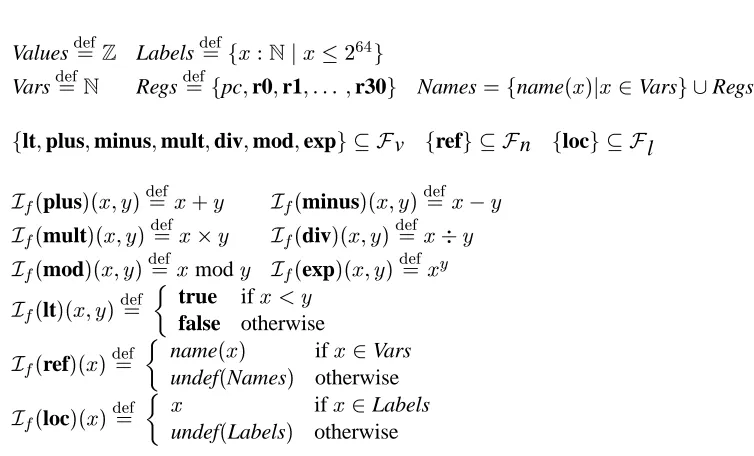
Example 3.1 Alpha AXP processor: Basic model
The Alpha AXP is a64bit processor architecture based on a RISC design (Sites, 1992). A detailed
description which includes the semantics of the processor language, is given in the processor manual (Digital Equipment Corporation, 1996). The Alpha processor has32general purpose registers, which
will be denoted r0 to r31 and the program counter pc is a register. The value stored in register31,
r31, is always0and assignments to register r31 are always ignored.
Data is stored in memory as bit-vectors of size32(called long-words), representing the natural
num-bers0
;::: ;
2 321. Instructions are stored in a single long-word and all memory access is aligned
on a long-word: an address
x
identifies the locationx
(x
mod 4)4and addresses4,5,6and7are all synonyms for address4. This data model, described by Sites (1992), will be used throughout
this paper. The model described in the processor manual (Digital Equipment Corporation, 1996), for a later design of the Alpha AXP, allows byte sized memory access: addresses 4
;
5;
6;
7identify four3.2 Syntax of the Expressions 9
A model of the Alpha AXP data operations as constants and functions ofLis given in Figure (1). The
set of values, Values, on which a program of the Alpha AXP operates is modelled by the set of integers. The names of program variables are the memory locations, modelled by the naturals, together with the processor registers. Both the variables, in Vars, and labels, in Labels, are memory addresses and memory access is modelled in terms of the function identifiers ref, for variables, and loc, for labels. The functions inFv are the basic arithmetic operations from which operations on bit-vectors can be
derived. 2
3.2
Syntax of the Expressions
Expressions ofL are made up of constants and function applications or are a substitution. As with
the constants and functions, the expressions are grouped according to whether an expression results in value, a name or a label. This allows restrictions to be imposed on the occurrence of an expression. For example, assignments can be made only to expressions which result in a name. Substitution is defined as operator which constructs an expression ofL. This allows the syntax of substitution, which
describes the changes to be made to an expression, to be separated from its semantics, which carries out the substitution in a given state.
The syntax of a substitution expression is made up of an expression ofLand an assignment list, a
data structure which associates name and value expressions. The assignment lists and the expressions are mutually dependent. Assignment lists are required for substitution expressions and depend on the value expressions; substitution constructs a value expression, since the result of a substitution is a value, and can occur in an assignment list. For simplicity, the syntax of assignment lists, and their semantic operations, will be generalised over the sets and relations which depend on the expressions ofL.
Assignment Lists
The assignment lists are similar to the association lists used to define textual substitution (Manna & Waldinger, 1981a; Paulson, 1985). However, the syntax of the assignment lists includes an operator, for the combination of lists, to represent the merger of assignment lists, needed for the abstraction of commands. The semantic functions used to interpret substitution expressions take this operator into account when calculating the result of a substitution.
Definition 3.6 Assignment lists
For sets
N
andV
, the set Alist(N;V
)contains all lists of assignments of elements ofV
to elementsof
N
. The set Alist(N;V
)is built up from the empty list, nil and from the operator cons, , and thecombining operator, , and satisfies the grammar:
Alist = nilj(h
N
i;
hV
i)hAlistijhAlistihAlistiThe sub-term relation,between assignment lists has type(AlistAlist)!boolean and definition:
al
nildef
=
al
=nilal
(x;e
)bl
def
=
al
=(x;e
)bl
_x
bl
al
(bl
cl
)def
3.2 Syntax of the Expressions 10
An assignment list
al
is simple if no sub-term ofal
is constructed by the operator.simple?(
al
) def= 8
bl;cl
::(bl
cl
)al
Slist(
N;V
) def= f
al
:Alist(N;V
)jsimple?(al
)g2
The operations required for substitution use the syntax of the assignment lists to find the first value expression associated with some name in a state. The search, for the value associated with name
x
in states
is ordered: if the assignment list is constructed from the addition of a pair (x
1
;e
1 ) to anassignment list
bl
thenx
1is compared (in states
withx
) before searchingbl
. If the assignment list isconstructed from the combination of two assignment lists(
bl
cl
)then the listcl
is searched beforethe list
cl
(the choice is arbitrary).Definition 3.7 Membership and find
For a relation
R
between expressions of En
with typeR
: (En
En
) ! State ! boolean, anassignment list
al
2 Alist and states
, the namex
2s
En
is a member ins
ofal
iff there is a nameexpression
x
0in
al
such thatR
(x;x
0)(
s
).x
2s
nildef = false
x
2s
(x
1
;e
1 )al
def =
R
(x;x
1
)(
s
)_(x
2s
al
)x
2s
(al
bl
)def
=
x
2s
al
_x
2s
bl
Function find has type(E
n
Alist) ! State ! E and searches an assignment list for an expressionassigned to a name.
find(
x;
nil)(s
) def=
x
find(
x;
(x
1;e
1)
al
)(s
) def=
e
1 ifR
(x;x
1 )(
s
)find(
x;al
) otherwisefind(
x;
(al
bl
))(s
) def=
find(
x;bl
)(s
) ifx
2s
bl
find(
x;al
)(s
) otherwise2
Given a name expression
x
, assignment listal
, states
and relationR
, the result of find(x;al
)(s
) isthe value expression associated with name
x
inal
byR
ins
, ifx
is a member ins
ofal
. Ifx
is not a member inx
ofal
, the result is the namex
.Expressions
The expressions ofLare made up of the value, the name and the label expressions. The set of value
expressions is the largest, containing all expressions of the language Land includes the substitution
3.3 Semantics of the Expressions 11
Definition 3.8 Syntax of the expressions
The sets of value expressionsE, name expressionsE
n
and label expressionsEl
satisfy the grammarE
n
= hNamesijhFni(hEi;::: ;
hEi) El
= hLabelsijhFli(hEi
;::: ;
hEi)E = hValuesijhFvi(hEi
;::: ;
hEi)jhEn
ijhEl
ijhEi/
hAlist(En
;
E)iThe set of boolean expressions,E
b
, is the set of value expressions,Eb
=E.The set Alist(E
n
;
E)will be abbreviated Alist. Note that, fore
2Eandal
2 Alist, the substitution ofal
ine
ise / al
. 2Expressions which calculate the result of an operation on data are modelled by the value expres-sions E while the name and label expressions allow restrictions to be imposed on the expressions
which occur in an command. Name expressions calculate the name of a variable from one or more value expressions, restricting the result to valid program variables. Label expressions occur in com-puted jumps and provide a means for ensuring that the target of the jump is the label of a program command.
3.3
Semantics of the Expressions
The evaluation of an expression is by interpretation functions which range over the set of values, names and labels. The value and label expressions share the same interpretation, a label expression is constrained, by its syntax, to result in a label constant (in Labels). The interpretation of a value expression
e
, in a states
results in a value, ife
is a variable name then it is the value of the variable in states
. The interpretation of a name expressionn
as a name is eithern
, if it is a constant name, or is the result of applying a name function to arguments interpreted as values. The difference in the interpretation of value expressions and name expressions corresponds to the difference between r-expressions and l-expressions in code generation techniques (see Aho et al., 1986).The semantics of the expressions are complicated by substitution, which updates the state in which an expression is evaluated: if the substitution expression
e / al
is interpreted in states
thene
is evaluated in a states
0, obtained by updating state
s
with the assignments ofal
. The operations needed to update a state depend on the interpretation of both name and value expressions. These, in turn, depend on the interpretation of substitution since substitution expressions can occur in either a name or a value expression.Definition 3.9 Interpretation of expressions
The interpretation of the expressions are defined in terms of functionsI
e
,In
andIl
on valueexpres-sions, name expressions and label expressions respectively.
I
e
:E !State!Values In
:En
!State!Names Il
:El
!State!LabelsThe equivalence relation between expressions in a state
s
and under an interpretationI2fIe
;
In
;
Il
gis defined:
e
1(I
;s
)e
2def = I(
e
1
)(
s
)=I(e
23.3 Semantics of the Expressions 12
The relation
R
of Definition (3.7) is the equivalence under the interpretation of name expressions,In
:R
(e
1
;e
2)(
s
)=e
1(I
n;s
)e
2.
The state update function, update, is defined:
update:(AlistState)!State
update(
al;s
) def= (
(x
:Names):Ie
(find(x;al
)(s
)))(s
)The interpretation as a value of expression
e
2Ein states
is defined by functionIe
.I
e
(e
)(s
) def= 8 > > < > > :
e
ife
2Valuess
(In
(e
)(s
)) ife
2En
If
(f
)(Ie
(a
1
)(
s
);::: ;
Ie
(a
m
)(s
)) ife
=f
(a
1
;::: ;a
m
) Ie
(e
1
)(update(
al;s
)) ife
=e
1/ al
where
m
=arity(f
)The interpretation as a name of the name expression
e
2En
in states
is defined by functionIn
.I
n
(e
)(s
) def=
e
ife
2NamesI
f
(f
)(Ie
(a
1)(
s
);::: ;
Ie
(a
m
)(s
)) ife
=f
(a
1
;::: ;a
m
)where
m
=arity(f
)The interpretation of the label expressions,I
l
, is the interpretation of the value expressions: Il
def=I
e
.The functionI
b
, of typeE ! State ! boolean is the interpretation of an expression as a boolean,defined: I
b
(e
)(s
) def= B(I
e
(e
)(s
)). 2When the interpretation functionI
e
is applied to an expressione
, in a states
, any name expressionx
occurring ine
is interpreted as a namex
0and replaced with the value
s
(x
0). The application of
the interpretation as a name, I
n
, to the name expressionf
(a
1
;::: ;a
n
), in a state
s
, interprets thearguments
a
1;::: ;a
n
as values, using functionI
e
in states
. The interpretation of name functionf
isapplied to these values to obtain the result of the name expression, a constant name. Applying either interpretation to a constant
e
results in the constant. However, the notion of a constant differs, a namex
2Names is a constant only under the interpretation as a name,In
.Although the constants and functions of the basic model provide simple expressions, these can be used to derive increasingly complex expressions. For example, the Boolean disjunction can be derived from the negation and conjunction functions ofFv.
or :(E
b
Eb
)!Eb
x
ory
def=not(not
x
and noty
)Because the negation and conjunction form expressions ofE, the disjunction of two expressions is
also an expression ofE.
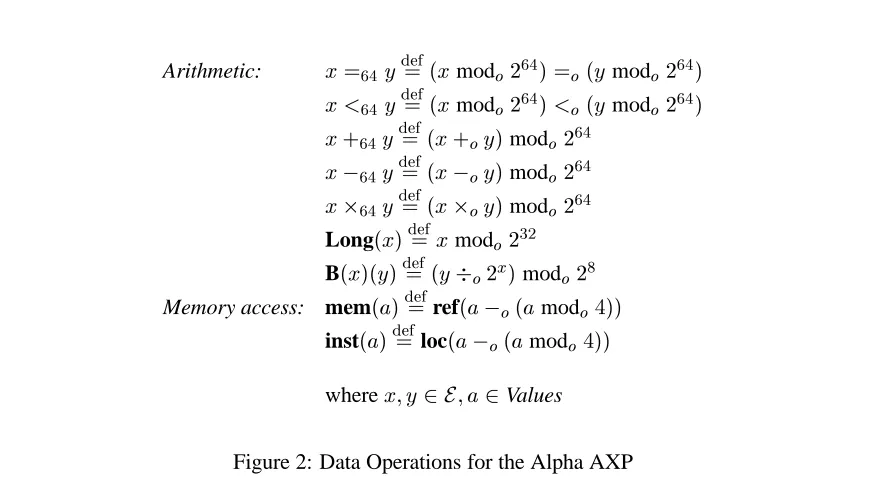
Example 3.2 Alpha AXP: Data operations
The largest number which can be represented on the Alpha AXP is2 64
1and all arithmetic operations
3.3 Semantics of the Expressions 13
Arithmetic:
x
= 64y
def
=(
x
modo
2 64)=
o
(y
modo
2 64)
x <
64y
def
=(
x
modo
2 64)
<
o
(y
modo
2 64)
x
+64
y
def=(
x
+o
y
)modo
2 64x
64y
def
=(
x
o
y
)modo
2 64x
64
y
def=(
x
o
y
)modo
2 64Long(
x
) def=
x
modo
2 32B(
x
)(y
) def= (
y
o
2x
)modo
2 8Memory access: mem(
a
) def= ref(
a
o
(a
modo
4))inst(
a
) def= loc(
a
o
(a
modo
4)) [image:14.595.85.521.94.333.2]where
x;y
2E;a
2ValuesFigure 2: Data Operations for the Alpha AXP
are written in the infix notation and are for bit-vectors of size 64. The function Long is the conversion of an arbitrary value to a bit-vector of size32. The function B is the accessor for bytes: the
n
th byteof an expression
e
2Eis obtained by B(n
)(e
), where B(0)(e
)is the least significant byte ofe
. Notethat the expression Long(
e
)is equivalent to the expression(B(3)(
e
)o
2 3)+
o
(B(2)(e
)o
2 2)+
o
(B(1)(e
)o
2 1)+
o
B(0)(e
))The name function mem in Figure (2) provides access to variables in memory. For
x
2E, the nameresulting from mem(
x
)is aligned at a long-word;x
is assumed to be a multiple of four and roundeddown if not. The label function, inst, applied to expression
x
2 E identifies the command stored atthe address
x
. 23.3.1 Equivalence between Expressions
Expressions can be compared by syntactic equality or by semantic equivalence. Syntactic equality is stronger than equivalence: the expression1+1is not syntactically equal to2, although it is equivalent
in an interpretation which includes integer arithmetic. To manipulate and simplify expressions, it is necessary to determine when expressions are equivalent. The equivalence relation of Definition (3.9), compares two expressions in a given state. A stronger relation, which can be used for rewriting (Duffy, 1991), asserts that two expressions have the same interpretation in any state.
Definition 3.10 Strong Equivalence
Expressions
e
1 ande
2 are strongly equivalent inI, written
e
1I
e
2, if they are equivalent in all
states.
e
1I
e
2def
=8(
s
:State):e
1(I
;s
)e
2
3.4 Derived Substitution Expressions 14
Names which are equivalent under the interpretation I
n
will also be equivalent under the valueinterpretationI
e
and arguments to functions can always by replaced with equivalent expressions.Lemma 3.1 Properties of equivalence relations
Assume
e
1;e
2 2E,n
1
;n
22E
n
,f
2F,I2fIe
;
In
gands
2State.1. Syntactic equality establishes strong equivalence:
e
1 =e
2 )
e
1
I
e
2.2. Equivalent names are equivalent as values:
n
1(I
n;s
)n
2)
n
1(I
e;s
)n
2.
3. Arguments can be replaced with equivalents:
e
1(I
;s
)e
2)
f
(e
1) (I
;s
)f
(
e
2).
Proof. Straightforward from definitions. 2
Because the equivalence of name expressions underI
n
is enough to establish equivalence under Ie
, the interpretation function will not, in general, be given. For expressionse
1
;e
2 ands
2 State,
e
1s
e
2 will be written under the assumption that if both
e
1 ande
2 are name expressions then theequivalence is underI
n
. If either ofe
1 or
e
2 is not a name expression then the equivalence is underthe value interpretationI
e
.Example 3.3 Assume
v
1;v
22 Values,
x
1;x
22 Names. If
v
1=
v
2 then the expressions ref (
v
1 )
and ref(
v
2) are strongly equivalent, ref(
v
1) ref(
v
2). If ref(
v
1)is strongly equivalent to
x
1, thenref(
v
1)+
o
x
2is strongly equivalent to
x
1 +o
x
2and if
x
1 =x
2then
x
1 +o
x
2
2
o
x
1.2
3.4
Derived Substitution Expressions
The substitution operator ofE constructs a value expression and cannot be used where a name
ex-pression is required. Separate substitution operators are needed for the name exex-pressions and for the assignment lists, to apply a substitution to the value expressions which can occur in both. Substitution in name expressions, interpreted as names, is defined on the syntax of name expressions, applying substitution to the value expressions which occur as arguments to a name function.
Definition 3.11 Substitution in name expressions
The substitution of assignment list
al
in the value expressions occurring in name expressionx
2 En
is written
x / al
.x / al
def =
x
ifx
2Namesf
(e
1
/ al;::: ;e
m
/ al
) if
x
=f
(e
1
;::: ;e
m
)where
f
2Fn,m
=arity(f
)ande
1
;::: ;e
m
2E. 2
3.4 Derived Substitution Expressions 15
Lemma 3.2 For name expression
x
2En
, assignment listsal;bl
2Alist and states
,I
n
(x / al
)(s
)=In
(x
)(update(al;s
))Proof. Straightforward, by induction on
x
and from the definitions. 2Substitution in assignment lists applies the substitution operators to each name-value pair in an assignment list.
Definition 3.12 Substitution in assignment lists
The substitution of assignment list
bl
in assignment listal
is writtenal / bl
and definednil
/ bl
def = nil ((x;e
)al
)/ bl
def
= (
x / bl;e / bl
))(al / bl
) (cl
dl
)/ bl
def
= (
cl / bl
)(dl / bl
)2
The effect of substituting assignment list
bl
in assignment listal
and then evaluating an expressione
ofal
in states
is equivalent to evaluatinge
in the states
updated withbl
. Membership of an assignment list is based on the equivalence of name expressions and membership in states
updated with assignment listal
of a name expressionx
is equivalent to membership ins
ofx / al
.Lemma 3.3 For name expression
x
2En
, assignment listsal;bl
2Alist and states
,x
2update(
bl;s
)al
=(
x / bl
)2s
al / bl
Proof. Straightforward, by induction on
al
. 2Substitution and the combination of assignment lists allow the changes made to a state by two assignment commands, executed in sequence, to be described as an assignment list.
Theorem 3.1 For assignment lists
al;bl
and states
,update(
al;
update(bl;s
))=update(bl
(al / bl
);s
)Proof. By induction on
al
and by extensionality withv
2 Names. The property to be proved isupdate(
al;
update(bl;s
))(v
)=update(bl
(al/bl
);s
)(v
). The cases whenal
=nil oral
=al
1al
2are straightforward from the definitions and the inductive hypothesis. Assume
al
= (x;e
)al
1 forx
2En
;e
2Eandal
1
2Alist. Case
x
6update(
bl;s
)v
. It follows that
x/bl
6s
v
, ifx
2update(
bl;s
)al
then it must occur in
al
1 and the proof follows from the inductive hypothesis and Lemma (3.3).Case
x
update(
bl;s
)v
. It follows that
x / bl
s
v
and the result of update(al;
update(bl;s
))(v
)isI
e
(e
)(update(bl;s
)). From the definitions, the result of update(bl
(al / bl
);s
)(v
) isIe
(e / bl
)(s
)4 Commands ofL 16
Theorem (3.1) is the semantic basis for the abstraction of assignment commands. If a command
c
1begins in a states
and has the assignments in listal
, it will end in state update(
al;s
). If a secondcommand
c
2begins in this state and has assignment listbl
, it will end in state update(
bl;
update(al;s
)).From Theorem (3.1), the effect of the two commands on the state
s
is described by the assignment list(
al
(bl/al
)). This assignment list can be constructed from the syntax of the commands and used toconstruct an abstraction of commands
c
1andc
2. The commandc
with assignment list(
al
(bl /al
))beginning in state
s
will produce the same state as the execution ofc
1followed byc
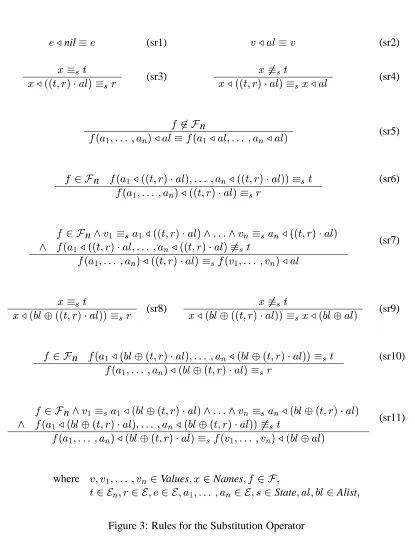
2.Rules for the substitution operator are given in Figure (3), every substitution expression is the substitution of value expressions. Rules (sr1) to (sr5) are the standard rules for substitution. Rules (sr6) and (sr7) describe substitution when the expression is a name function: the substitution is applied to the arguments; the function is evaluated to obtain a name
x
and the assignment list is searched forx
. Ifx
is a member of the list then its associated value is the result, otherwise the result isx
. Rules (sr8) to (sr11) describe substitution and the combination of assignment lists: the substitution is carried out on the arguments to any functions before the expression is reduced to a namex
; the assignment list is then searched for a value associated withx
.4
Commands of
LThe changes made to a state during the execution of a program are determined by the commands of the program. In the language L, the selection of commands for execution is also a function of the
commands. The languageLhas a labelling, a conditional and an assignment command. The labelling
command associates commands with labels; the label assigned to the name pc in a state
s
identifies the command selected for execution ins
. The assignment command describes the changes made to the state in which it begins execution as an assignment list which updates the state. It is also used to select a successor, each command makes at least one assignment to the program counter. The conditional command allows the changes made to a states
to depend on the values of the variables ins
. A Boolean expressionb
is evaluated ins
and depending on the result of the expression, one of two branches is executed.Definition 4.1 Syntax of the commands
The set of all commands ofLis denotedC
0and satisfies the grammar:
com =ifhE
b
ithenhcomielsehcomi j :=(hAlisti;
hEl
i)C 0
=hcomijhLabelsi:hcomi
The setCis the subset ofC
0 containing only labelled commands.
C def
= f
c
:C 0j9
l
0;c
0:
c
=l
0:
c
0g
The successor expression of assignment command:= (
al;l
)isl
(a label expression). The label of alabelled command
l
:c
isl
, label(l
:c
) def=
l
.An assignment command made up of simple list will be written using infix notation. e.g. The com-mand:=((
x
1
;e
1 )(x
2
;e
2)(
x
n
;e
n
)nil;l
)is writtenx
1
;x
1;::: ;x
n
:=e
4 Commands ofL 17
e /
nile
(sr1)v / al
v
(sr2)x
s
t
x /
((t;r
)al
)s
r
(sr3)
x
6s
t
x /
((t;r
)al
)s
x / al
(sr4)
f
62Fnf
(a
1
;::: ;a
n
)
/ al
f
(a
1
/ al;::: ;a
n
/ al
)(sr5)
f
2Fnf
(a
1/
((
t;r
)al
);::: ;a
n
/
((t;r
)al
))s
t
f
(a
1
;::: ;a
n
)
/
((t;r
)al
)s
r
(sr6)
f
2Fn^v
1s
a
1/
((
t;r
)al
)^:::
^v
n
s
a
n
/
((t;r
)al
) ^f
(a
1
/
((
t;r
)al;::: ;a
n
/
((t;r
)al
)6s
t
f
(a
1
;::: ;a
n
)
/
((t;r
)al
)s
f
(v
1
;::: ;v
n
)/ al
(sr7)
x
s
t
x /
(bl
((t;r
)al
))s
r
(sr8)
x
6s
t
x /
(bl
((t;r
)al
))s
x /
(bl
al
)(sr9)
f
2Fnf
(a
1/
(
bl
(t;r
)al
);::: ;a
n
/
(bl
(t;r
)al
))s
t
f
(a
1
;::: ;a
n
)
/
(bl
(t;r
)al
)s
r
(sr10)
f
2Fn^v
1s
a
1/
(
bl
(t;r
)al
)^:::
^v
n
s
a
n
/
(bl
(t;r
)al
) ^f
(a
1
/
(
bl
(t;r
)al
);::: ;a
n
/
(bl
(t;r
)al
))6s
t
f
(a
1
;::: ;a
n
)
/
(bl
(t;r
)al
)s
f
(v
1
;::: ;v
n
)
/
(bl
al
)(sr11)
where
v;v
1;::: ;v
n
2Values
;x
2Names;f
2F;
t
2En
;r
2E;e
2E;a
1
;::: ;a
n
[image:18.595.95.510.136.674.2]2E
;s
2State;al;bl
2Alist;
4.1 Correct Assignment Lists 18
Every assignment command selects a successor by assigning a label expression to the name pc. If an assignment command
c
has assignment listal
and label expressionl
then the assignments ofal
are made simultaneously with the assignment ofl
to the program counter. The full list of assignments made byc
is therefore(pc;l
)al
.4.1
Correct Assignment Lists
The assignment command ofLis a simultaneous assignment and its semantics require a means of
detecting impossible assignments. The assignment command:=(
al;l
)can be executed only if it doesnot assign two different values to the same name. The assignment list of the command,(pc
;l
)al
,is said to be correct iff every name is assigned at most one value. Every name expression in the assignment list of a command is evaluated in the state in which execution of the command begins, and the correctness of the list depends on this state.
An assignment list formed by the combination of lists is correct in state
s
iff each name is asso-ciated ins
with at most one value by each list combined with the operator. The correctness of anassignment list
al
is determined by considering each simple list which occurs inal
. A simple assign-ment listal
is correct in a states
iff every value associated with a namex
is equivalent ins
. Ifal
is a combined assignment list then it is correct iff every simple assignment list occurring inal
is correct ins
.Definition 4.2 Correct assignment lists
For assignment list
al
2Alist and states
, the name-value pair(x;v
) 2(En
E)occurs inal
in states
iff there is a pair(x
1
;v
1)in
al
such thatx
1is equivalent to
x
andv
1is equivalent tov
.occs?((
x;e
);
nil)(s
) def=false
occs?((
x;e
);
(x
1;e
1)
al
)(s
) def=(
x
s
x
1^
e
s
e
1)_occs?((
x;e
);al
)(s
)occs?((
x;e
);
(al
bl
))(s
) def=occs?((
x;e
);al
)(s
)_occs?((x;e
);bl
)(s
)The set of values associated with a name
x
in a states
by an assignment listal
contains all valuese
such that(x;e
)occurs inal
in states
.Assoc(
x;al
)(s
) def=f
e
:Ejoccs?(x;e
)(al
)(s
)gThe initial prefix of an an assignment list is a simple list.
initial(nil) def
= nil
initial((
x;e
)al
) def= (
x;e
)initial(al
)initial(
bl
cl
) def= nil
correct? is a predicate on assignment lists and states with type Alist!State !boolean. An
assign-ment list
al
is correct in a states
iff correct?(al
)(s
). The predicate correct? is defined:1. Simple lists: If
al
is a simple list,al
2 Slist, and every name is associated byal
with at mostone value in a state
s
thenal
is correct.correct?(
al
)(s
),8(
x
:Names): 9(e
:E):8(e
1:E):
e
12Assoc(
z;al
)(s
))e
s
e
14.2 Semantics of the Commands 19
2. Assignment lists: If every simple list in
al
is correct in states
then so isal
.correct?(
al
),correct?(initial(
al
))(s
)^(8
bl;cl
:(bl
cl
)al
)correct?(bl
)(s
)^correct?(cl
)(s
))2
The correctness of an assignment list in an updated state can be be described, syntactically, by updating the assignment list with the newly assigned values.
Theorem 4.1 For assignment lists
al;bl
2Alist and states
,correct?(
al
)(update(bl;s
)),correct?(al / bl
)(s
)Proof. By induction on
al
. The case whenal
= nil oral
=al
1
al
2 is straightforward from the
inductive hypothesis. Assume
al
=(x;e
)al
1forx
2E
n
ande
2E. Ifal
1=nil then the property is
immediate from the definitions, assume
al
1 6=nil.()), the proof for (() is similar: Since
al
1 is correct, from the inductive hypothesis, every
com-bined assignment list
bl
cl
occurring inal
is also correct. The property to be proved is thereforecorrect?(initial(
al
))(update(bl;s
)). Sinceal
is correct in update(bl;s
), there is no namex
1and value
e
1 such that occs?((
x
1;e
1)
;al
)(update(bl;s
)),x
1
update(
bl;s
)x
and
e
1 6update(
bl;s
)e
. Assume that correct?(initial(
al / bl
))(s
) is false then there is a namex
0
2 Names and value
e
02 Values
such that (
x
0;e
0) occurs in
al / bl
,x
0s
x / bl
ande
06
s
e / bl
. It follows from thedefini-tions (and from
x
02 Names
;e
02 Values) that
x
0
update(
bl;s
)x
and
e
0 6update(
bl;s
)e
. From the definition of initial, of substitution in an assignment list (Definition 3.12) and of occs? that occs?((
x
0
;e
0)
;al
)(update(bl;s
)). Sincee
06
update(
bl;s
)e
and from the definition of Assoc, there are two distinct values in Assoc(
x;al
)(update(bl;s
)). From the definition of correct?, the nameex-pression
x
is uniquely associated withe
which is a contradiction. 2The predicate correct? is a precondition which must be satisfied by the state in which an as-signment commands begins execution. For processor languages, the majority of the commands have assignment lists which are correct in any state. For object code verification, this means that the cor-rectness of assignment lists in all states only needs to be established once. It is not necessary to re-establish the correctness of an assignment list during a verification proof.
4.2
Semantics of the Commands
The semantics of the commands are defined as relations between the state in which a command begins execution and the state in which it ends. A command
c
which begins in states
produces a statet
from4.2 Semantics of the Commands 20
Definition 4.3 Semantics of the commands
The interpretation function on commands has definition:
I
c
:C 0!(StateState)!boolean I
c
(l
:c
)(s;t
)def
= I
e
(pc)(s
)=l
^Ic
(c
)(s;t
) Ic
(:=(al;l
))(s;t
)def =
correct?((pc
;l
)al
)(s
) ^t
=update((pc;l
)al;s
) Ic
(ifb
thenc
1else
c
2 )(s;t
)def =
I
c
(c
1
)(
s;t
) ifIb
(b
)(s
) Ic
(c
2
)(
s;t
) if:Ib
(b
)(s
)2
The commands are deterministic: if a command
c
begins in a states
then there is a single state in whichc
can end. Because of this, the relations defining the semantics of the commands can also be considered to be functions transforming states.Lemma 4.1 For command
c
2C0and states
s;t;u
2State,
I
c
(c
)(s;t
)^Ic
(c
)(s;u
))t
=u
Proof. Straightforward, by induction on the command
c
. 2An assignment command:= (
al;l
)updates the program counter with the label expressionl
. If Ic
(:= (al;l
))(s;t
) thent
= update((pc;l
)al;s
) and the value of pc int
is Il
(l
)(s
). Becausethe program counter, pc, acts as a guard on the execution of a labelled command, the assignment commands control the selection of commands for execution.An assignment command of the form
:=(nil
;l
)is a jump command: its only action is to select the command labelledl
and sincel
is a labelexpression, this is a computed jump. Assignment commands also model the commands which cannot be executed. If assignment list
al
is always incorrect then the interpretation of command:=(al;l
)isalways false, the command can never terminate.
Definition 4.4 goto and abort
The computed jump command, goto
l
, is the assignment command with an empty assignment list and successor expressionl
. The command which always fails, abort, has an assignment list which is always incorrect.goto :E
l
!C0
goto
l
def= :=(nil
;l
)abort:C
0
abortdef
= (pc
;
pc:=true;
false;
undef(El
))2
Note that the assignment list of goto
l
is correct in any states
, correct?((pc;l
)nil)(s
), and gotol
can be executed in any state. The command abort can never be executed since both true and false are assigned to the program counter, the assignment list of abort is never correct.
When a command of L is selected in state