warwick.ac.uk/lib-publications
Original citation:
Rajan, A. T. , Narasimham, G. S. V. L. and Jacob, Subhash. (2011) Oscillatory flow and temperature fields in an open tube with temperature difference across the ends. International Journal of Heat and Mass Transfer, 54 (15-16). pp. 3357-3368.
Permanent WRAP URL:
http://wrap.warwick.ac.uk/81412
Copyright and reuse:
The Warwick Research Archive Portal (WRAP) makes this work by researchers of the University of Warwick available open access under the following conditions. Copyright © and all moral rights to the version of the paper presented here belong to the individual author(s) and/or other copyright owners. To the extent reasonable and practicable the material made available in WRAP has been checked for eligibility before being made available.
Copies of full items can be used for personal research or study, educational, or not-for-profit purposes without prior permission or charge. Provided that the authors, title and full
bibliographic details are credited, a hyperlink and/or URL is given for the original metadata page and the content is not changed in any way.
Publisher’s statement:
© 2016. This manuscript version is made available under the CC-BY-NC-ND 4.0 license http://creativecommons.org/licenses/by-nc-nd/4.0/
A note on versions:
The version presented here may differ from the published version or, version of record, if you wish to cite this item you are advised to consult the publisher’s version. Please see the ‘permanent WRAP URL’ above for details on accessing the published version and note that access may require a subscription.
Final version
Oscillatory flow and temperature fields in an open tube with
temperature difference across the ends
T.R. Ashwina, G.S.V.L. Narasimhama,∗, Subhash Jacobb aDepartment of Mechanical Engineering
bCentre for Cryogenic Technology
Indian Institute of Science, Bangalore 560012, India
Abbreviated title: Oscillating flow in a tube
Abstract: The oscillating flow and temperature field in an open tube subjected to cryogenic
temperature at the cold end and ambient temperature at the hot end is studied numerically.
The flow is driven by a time-wise sinusoidally varying pressure at the cold end. The conjugate
problem takes into account the interaction of oscillatory flow with the heat conduction in the
tube wall. The full set of compressible flow equations with axisymmetry assumption are solved
with a pressure correction algorithm. Parametric studies are conducted with frequencies of
5-15 Hz, with one end maintained at 100 K and other end at 300 K. The flow and temperature
distributions and the cooldown characteristics are obtained. The frequency and pressure
amplitude have negligible effect on the time averaged Nusselt number. Pressure amplitude is
an important factor determining the enthalpy flow through the solid wall. The frequency of
operation has considerable effect on penetration of temperature into the tube. The density
variation has strong influence on property profiles during cooldown. The present study is
expected to be of interest in applications such as pulse tube refrigerators and other cryocoolers,
where oscillatory flows occur in open tubes.
Keywords: Pulsating flow, Pulse tube, Heat transfer, Laminar, Circular tube, Conjugate
convection.
∗:Corresponding author. Telephone: +91-80-22932971, Fax: +91-80-23600648
Nomenclature
cp constant pressure specific heat (J kg−1K−1)
D,d diameter (m)
˙
E enthalpy flow (W)
Ec Eckert number, v2
c/cp,cTc dimensionless
f frequency (Hz)
g acceleration due to gravity (m s−2)
H length of tube (m)
h heat transfer coefficient (W m−2K−1)
k thermal conductivity (W m−1K−1)
L length m
˙
M mass flow rate kg s−1
N u Nusselt number,h Ri/k dimensionless
p pressure (Pa)
P r Prandtl number,µ cp/k dimensionless
R radius (m)
Re Reynolds number,ωR2
i ρ/µ dimensionless
T temperature (K)
t time (s)
Greek Symbols
∆Tc characteristic temperature difference K
γ ratio of specific heats dimensionless
overheat ratio dimensionless
µ dynamic viscosity (kg m−1s−1)
ν kinematic viscosity (m2s−1)
ρ density (kg m−3)
ω angular frequency (rad s−1)
Subscripts
a amplitude
av average
c characteristic
e evaporator or cold
f fluid region
h hot or ambient
i inner
o outer, charge pressure
p time period
r radial direction
s solid region
w wall
z axial direction
Superscript
* dimensionless quantity
1
Introduction
Oscillating flow through passages like pipes and conduits is of interest in biological applications
in relation to blood flow, industrial heat exchangers, manifolds, combustion and regenerators
of Stirling and pulse tube cryocoolers. In the studies aimed at determining the heat transfer
and friction between the wall and oscillating flow, the pulsatile flow field is assumed to consist
of a steady Poiseuille flow part and a purely oscillatory part. Such a flow could enhance
heat transfer by breaking down the boundary layer. In other words, the pulsations can have
considerable effect on the rate of heat transfer and thermal resistance due to the alteration
of thickness of the thermal boundary layer [1]. The flow and temperature distributions that
occur in oscillatory flow in a tube with the end portions of the tube maintained at different
temperatures is of interest in pulse tube refrigerators. The present study is motivated by such
an application. Due to the nature of the problem and the large temperature differences that
exist, the problem is analyzed using the full set of compressible flow governing equations with
the assumption of axis symmetry.
Faghri et al. [2] reported a study on the heat transfer from a cylindrical pipe where
periodic flow is superimposed on a fully developed steady laminar flow. It was shown that the
interaction between velocity and temperature pulsations generates an extra diffusivity akin to
eddy diffusivity, contributing to larger heat transfer rates.
There are other numerical investigations such as those of Cho et al. [3] which focused
at-tention on heat transfer characteristics of a pulsating flow in a pipe. Using unsteady
boundary-layer equations, Cho et al. [3] found that the time-mean axial velocity profiles and the Nusselt
number were largely unaffected by the changes in frequency parameter and amplitude of
os-cillation. The skin friction was found to be greater than that of steady flow. The influence of
Amir et al. [4] presented a correlation for the prediction of the heat transfer coefficient in
a heating process for steady and pulsating flow of air through a circular pipe. The pulsating
frequency is between 5 and 60 Hz and a combined dimensionless number composed of the
Reynolds number and a dimensionless flow frequency was used to correlate thermal behavior
with flow parameters. When this number was below 2.1 × 10⁵, there was no significant
improvement in heat transfer. Similar work was reported by Chattopadhyay et al. [5] for
simultaneously developing pulsating incompressible laminar flow in a pipe with constant wall
temperature. The analysis proved that pulsation has a negligible effect on time-averaged heat
transfer. Moschandreou et al. [6] reported that the rate of heat transfer is not significantly
affected when the frequency is very low or very high, while Guo et al. [7] reported that heat
transfer augmentation occurs at large amplitudes of oscillation. For turbulent pulsating flow,
Wang [8] found that there exists an optimum Womersley number at which heat transfer is
enhanced. Heat transfer characteristics of pulsating turbulent air flow in a pipe heated at
uniform heat flux were experimentally investigated [9]. The results show that the Nusselt
number is strongly affected by pulsation frequency, the relative Nusselt number increasing
or decreasing depending on the frequency range. Zhao et al. [10] presented a heat transfer
correlation in terms of the kinetic Reynolds number, dimensionless amplitude of oscillation,
length-to-diameter ratio and the Prandtl number. Khabakhpasheva et al. [11] experimentally
observed considerable phase shift between the velocity and pressure gradient in pulsating flows
of viscoelastic fluids.
Hemida et al. [12] studied the pulsation effect on heat transfer in laminar incompressible
flow in a duct for both thermally fully developed and developing conditions. The results show
that the pulsation has negligible role in fully developed region but it has greater sensitivity
in thermally developing region. For isothermal and isoflux boundary conditions, the effect
of pulsation on the time average heat transfer coefficient tends to be negative, but remains
relatively small. But non-linear boundary conditions (e.g. radiation and natural convection)
combined with pulsation resulted in a noticeable enhancement of the time average Nusselt
number.
Other studies on pulsating turbulent flows include those of Li and Xu [13], Pascale et al.
[14] and He et al. [15].
From the literature, it can be seen that pulsating gas flow in open tubes subjected to
end-to-end temperature difference and its interaction with the tube wall has not received attention.
Such flows find practical application in various cryocoolers and other thermal systems. In an
earlier paper, the present authors reported a numerical simulation for the complete pulse tube
refrigerator operating high frequencies [16]. The present paper is motivated by the need for a
detailed study of the pulse tube for systems in the frequency range 5-15 Hz.
2
Formulation
2.1
Geometry
Fig. 1 shows the physical model and coordinate system. Cylindrical polar coordinate system
is chosen with the assumption of axisymmetric flow and temperature distributions. The model
consists of a cylindrical pipe with finite wall thickness and both the ends open. The flow and
temperature distributions are assumed to be axisymmetric. Ther-axis is perpendicular to the
vertical axis and points outwards in a radial direction. The positive direction of the z-axis
coincides with the vertical axis and points upwards. The gravity vector is parallel to thez-axis
and acts vertically downwards. The portions of the tube beyond the open ends belong to the
entering one of the ends does so at a cryogenic temperatureTe. Similarly the working medium
entering the other end of the tube is at a higher temperature Th. The oscillating flow in the
tube is driven by a sinusoidally varying pressure at the cold end of the tube. Since the so
called DC component is absent, the fluid flow during a cycle takes place partly into and partly
out of the tube at either end. The height of the tube and the inner and outer radii are H,Ri
and Ro, respectively. Clearly the wall thickness δw is Ro−Ri. The oscillating heat transfer
between the wall and the gas is taken into account through the coupling between the fluid
and the solid at the interface. The annular surfaces of the solid at the tube ends are assumed
to be insulated.
2.2
Non-dimensionalisation
The characteristic length Lc is taken as the inner radiusRi of the tube and the characteristic
temperature Tc as the hot heat exchanger temperatureTh, which is the ambient temperature.
The geometrical parameters of the problem are the dimensionless inner radius R∗i of the tube,
dimensionless height H∗ and the dimensionless wall thickness δw∗. The characteristic density
ρc corresponds to the state of helium at the charge pressure po and ambient temperature
Th = Tc. The characteristic thermal conductivity, specific heat and dynamic viscosity of the
working medium, i.e. helium gas, correspond to Tc and are denoted respectively kc, cp,c and
µc. The dimensionless temperature T∗ is (T −Tc)/∆Tc where ∆Tc is Th−Te. The quantity
= ∆Tc/Tc is the overheat ratio. The characteristic pressure is pc is taken asρcvc2 where vc,
the characteristic velocity, is taken as ωLc. The time is non-dimensionalised with the time
period of the oscillation 1/ω. Thus the dimensionless time period t∗p is 2π.
The dimensionless quantities are defined as:
t∗ =tω, r∗ = r Lc
, z∗ = z Lc
, Lc =Ri
v∗r = vr vc
, v∗z = vz vc
, p∗ = p ρcv2c
, vc =ωLc
T∗ = T −Tc ∆Tc
, = ∆Tc Tc
, ∆Tc=Th−Te, Tc =Th
ρ∗ = ρ ρc
, c∗p = cp cp,c
, µ∗ = µ µc
, k∗ = k kc
Re= vcLcρc µc
, P r= µccp,c kc
, Ec = v 2 c cp,cTc
H∗ = H Lc
, δw∗ = δw Lc
The dimensionless outer radius is R∗o = Ro/Lc = 1 + δw∗ and the dimensionless charge
pressure p∗o =po/(ρcv2c). The dimensionless properties should correspond to the fluid or solid
depending upon the region under consideration, i.e. the working medium or wall. Thus the
dimensionless ratios, namely, µ∗f, c∗p,f and kf∗, the subscript ’f’ denoting fluid, are assigned a
value of unity in the fluid domain. In the solid region, the property values should correspond
to those of the solid, namely,ks∗andc∗s =cs/cp,c. In the numerical analysis, the solid is treated
as a fluid of infinite viscosity.
2.3
Dimensionless governing equations
The dimensionless continuity, momentum and energy equations are as follows:
Continuity equation
∂ρ∗ ∂t∗ +
1 r∗
∂ ∂r∗(r
∗
ρ∗vr∗) + ∂ ∂z∗(ρ
∗
v∗z) = 0 (1)
∂ ∂t∗(ρ
∗
v∗r) + 1 r∗
∂ ∂r∗(r
∗
ρ∗vr∗v∗r) + ∂ ∂z(ρ
∗
vz∗vr∗) =−∂p
∗
∂r∗ +
1 Re 1 r∗ ∂ ∂r∗
r∗µ∗∂v
∗ r ∂r∗ + ∂ ∂z∗ µ∗
∂v∗r ∂z∗
+Sr (2)
Momentum equation in axial direction
∂ ∂t∗(ρ
∗
v∗z) + 1 r∗
∂ ∂r∗(r
∗
ρ∗vr∗v∗z) + ∂ ∂z∗(r
∗
ρ∗v∗zvz∗) =−∂p
∗
∂z∗ +
1 Re 1 r∗ ∂ ∂r∗
r∗µ∗∂v
∗ z ∂r∗ + ∂ ∂z∗
µ∗∂v
∗ z ∂z∗
+Sz (3)
Energy equation
∂ ∂t∗(ρ
∗
T∗) + 1 r∗
∂ ∂r∗(ρ
∗
r∗vr∗T∗) + ∂ ∂z∗(ρ
∗
vz∗T∗) = 1 ReP r 1 r∗ ∂ ∂r∗ k∗ c∗ p
r∗∂T
∗ ∂r∗ + ∂ ∂z∗ k∗ c∗ p ∂T∗ ∂z∗ + Ec c∗ p Dp∗
Dt∗ (4)
Equation of state
p∗ = 1 Ecρ
∗ γ−1
γ (T
∗
+ 1) (5)
The momentum source terms are given by:
Sr = 1 Re ∂ ∂z∗
µ∗∂v
∗ z ∂r∗ + 1 r∗ ∂ ∂r∗
r∗µ∗∂v
∗ r ∂r∗
−2µ
∗v∗ r r∗2 −
2 3
∂ ∂r∗(µ
∗
D∗)
(6)
Sz= 1 Re ∂ ∂z∗ µ∗
∂vz∗ ∂z∗ + 1 r∗ ∂ ∂r∗
r∗µ∗∂v
∗ r ∂z∗ − 2 3 ∂ ∂r∗(µ
∗
D∗)
(7)
where the dimensionless divergence is given by:
D∗ = 1 r∗
∂ ∂r∗(r
∗v∗ r) +
∂vz∗ ∂z∗
The substantive derivative Dp∗/Dt∗ is given by:
Dp∗ Dt∗ =
∂p∗ ∂t∗ +v
∗ r
∂p∗ ∂r∗ +v
∗ z
∂p∗ ∂z∗
2.4
Nusselt number and enthalpy flow
The Nusselt number at any axial location on the fluid-solid interface and at any time is defined
as
N uz=
∂T∗ ∂r∗
r∗=R∗ i
(8)
The Nusselt number N uav is the average of N uz over the length of the interface and one
time period.
N uav = 1 H∗t∗
p
Z H∗
0
Z t∗p
0
N uzdz dt (9)
The enthalpy flow through any cross-section is calculated as:
˙ Eav =
1 π R∗2
i
Z R∗i
0
ρ∗vz∗c∗pT∗(2π r∗dr∗) (10)
2.5
Initial and boundary conditions
It is assumed that at the beginning (i.e. t∗ = 0), the geometry is under ambient condition
and the system is filled with helium gas at the charge pressure. These conditions are taken as
300 K and 25 bar.
No-slip and zero mass permeability is assumed on the solid boundary in contact with the
fluid. Oscillating pressure and zero radial velocity are prescribed at the cold end of the tube.
At the hot end of the tube, zero streamwise derivative of the radial velocity is prescribed. The
axial velocities at the inlet and outlet are calculated using the continuity equation. On the
axis of the tube, zero cross-stream derivative of the axial velocity and zero radial velocity are
At the interface between the solid and the fluid, heat flux continuity and no temperature
jump conditions should be satisfied. This is done through the harmonic mean thermal
con-ductivity method [18]. At the cold end, the temperature condition is taken as the cold heat
exchanger temperature when the flow takes place into the tube and as zero axial temperature
gradient when the flow is out of the tube. Similar conditions are also applied at the hot end
of the tube.
The initial and boundary conditions can be expressed as follows in dimensionless form:
At t∗ ≤ 0: v∗r = vz∗ = 0, T∗ = 1 and p∗ = pc/(ρcv2c) (throughout the computational
domain). The quantity vc is given by ωLc.
v∗r(0, z∗, t∗) = 0; v∗r(1, z∗, t∗) = 0; v∗r(r∗,0, t∗) = 0;
∂v∗r ∂z∗(r
∗
, H∗, t∗) = 0; ∂v
∗ z ∂r (0, z
∗
, t∗) = 0 (11)
The last relation states that the radial derivative of axial velocity is zero on the axis in
view of the symmetry.
The boundary conditions for the temperature at the open ends can be expressed as follows:
If vz∗(r∗,0, t∗)≤0 then ∂T
∗
∂z∗(r ∗
,0, t∗) = 0
If vz∗(r∗,0, t∗)>0 then T∗(r∗,0, t∗) = −1.0
If vz∗(r∗, H∗, t∗)>0 then ∂T
∗
∂z∗(r ∗
, H∗, t∗) = 0
If vz∗(r∗, H∗, t∗)≤0 then T∗(r∗, H∗, t∗) = 1.0 (12)
At the interface:
−kf∗∂T
∗ f
∂r∗ =−k ∗ s
∂Ts∗ ∂r∗; T
∗ f =T
∗
s (13)
The pressure oscillation at the inlet of the pipe is:
p∗(t∗) = p∗o+p∗asin(t∗) (14)
where p∗o is the dimensionless charge pressure.
3
Numerical method
The governing equations are discretized on staggered mesh. Fig. 2 shows the nodalized
rep-resentation of the quantities on a staggered mesh [17]. The pressure, density, temperature
and gas properties are defined at the control volume nodes. The radial and axial velocities
are defined at the faces of the control volumes, as shown. Velocities required elsewhere are
obtained by linear interpolation with respect to the grid metrics. The algebraic
transfor-mation of Roberts [22] is used in the radial direction for obtaining finer mesh at the axis
and the solid-fluid interface. The solution is obtained by the SIMPLEC algorithm of Van
Doormal and Raithby [19]. The time derivatives are approximated by backward differences
and the diffusive terms, by central differences. For convective terms, the third-order accurate
HLPA (Hybrid Linear and Parabolic Approximation) scheme is Zhu [20] is employed due to
its good transportive property, upwind bias and lower false diffusion. The discretized
equa-tions in five point stencil form are solved using the Modified Strongly Implicit Procedure of
Schneider and Zedan [21]. This solver, though iterative in nature, achieves a high degree of
implicitness, characteristic of direct methods. The time step depends on the frequency and
pressure amplitude. Typically each time period is divided into 400-800 time steps. The solid
region is considered as a fluid region with infinite viscosity and appropriate density, specific
heat and thermal conductivity. Following startup, the system reaches a periodic state after
a sufficient time has elapsed. The time marching is continued until periodic conditions are
achieved. Sufficient number of global iterations are performed at each time step. During each
global iteration, the velocities, pressure correction, temperature and density are determined
the residuals for continuity and energy are better than 10−3.
Grid dependency of the results is checked by varying the grid size in the axial and radial
directions. The axial divisions are varied from 100 to 200 and the radial divisions in the fluid
from 10-15, with three nodes deployed in the wall region. The area-average velocity is plotted
for two cases at the middle cross-section in Fig. 3. The mesh with 100 axial divisions is found
to perform almost similar to that with 200 divisions. Grid sensitivity tests are also conducted
for various Reynolds numbers and the 15×100 grid is found to be adequate for the geometry
selected.
4
Validation of the computer code
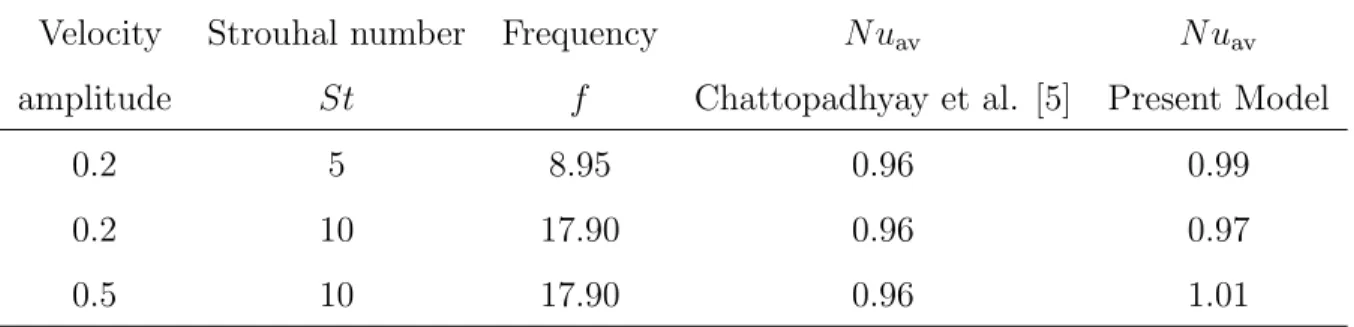
The present code is validated against the simulation of Chattopadhyay et al. [5]. For this
purpose, the present code was modified to incorporate oscillating velocity and isothermal wall
boundary conditions. The validation is conducted for a Reynolds number of 200, for various
velocity amplitudes and for frequencies below 20 Hz. A mesh with 100 control volumes in
the radial direction and 800 control volumes in the axial direction was chosen. The frequency
is adjusted to match the Strouhal number chosen in the original work. The results of the
validation study presented in Table 1 show a favourable agreement between the two studies.
5
Results and discussion
5.1
The effect of pressure amplitude
Figures 4 and 5 show the temperature and velocity distributions inside the tube for pressure
amplitude of 50 Pa and 500 Pa after 66 seconds. At this time the flow reversal is about to take
K, the initialization temperature being 300 K. This shows that the temperature at the cold
end stars penetrating into the tube and a temperature gradient is being setup in the tube.
With open ends, it can be observed that a small pressure oscillation at the inlet results in large
axial velocity gradient. The pressure amplitudes are kept low in order to prevent smearing of
the temperature profiles by the large axial velocities in the tube. Because of the onset of the
flow reversal at this time the velocities in the tube are very small. The flow reversal is mostly
confined to the central part of the tube. The flow pattern suggests that there is a possibility
for the occurrence of eddy formation at the entrance and exit in the central part of the tube.
The axial variation of wall temperature for two pressure amplitudes is presented in Fig.
6 for the middle cross-section of the tube wall at the mid thickness after 167 seconds for a
frequency of 15 Hz after attaining periodic conditions. The attainment of periodic conditions
is ensured by plotting the temperature distribution for two successive time periods and by
observing that there is no change in these profiles. The mid thickness wall temperature at the
tube inlet for the two the cases are different. For the first case with 50 Pa pressure amplitude,
the solid cold end temperature is 183.38 K where as in the second case, the same is 142.37
K at the cold end. The wall to gas temperature difference in these two cases are respectively
83.38 K and 42.37 K. The reason is traced to the fact that higher pressure amplitudes result in
higher velocities and lower thermal boundary layer thickness. It is observed, however that that
the hot end temperature of the tube wall does not change much with pressure amplitudes, the
wall to gas temperature difference at the hot end being very small, typically, 10 K for the first
case and 15 K for the second case. Thus higher pressure amplitude appears to be lowering the
cold end temperature of the wall and maintaining more or less the same hot end temperature.
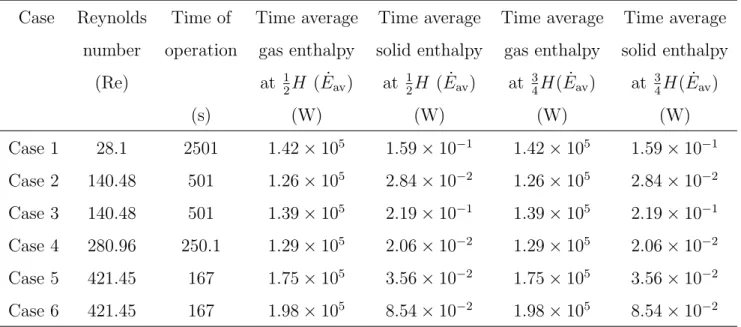
This can also be verified from the Table 2 which shows higher energy flow through the solid
density of the fluid at the cold end and lower density at the hot end. Moving away from the
cold end to the hot end, the disturbances decrease and the rate of temperature change also
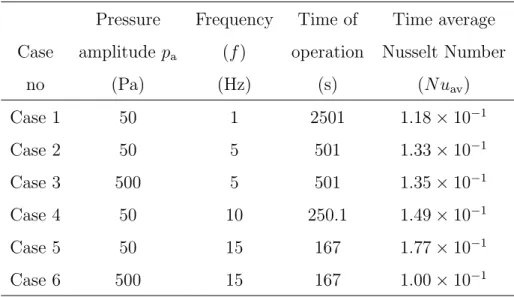
decreases (Fig. 6). From Table 3, it can also be seen that the values of the average Nusselt
number are rather lower compared to incompressible flow [5] and do not change much with
frequency of operation or pressure amplitude. It should be noted that both ends and outer
surface of the tube are insulated and therefore there the only thermal interaction between the
gas and solid is through the interface. This observation is analogous to that of Himadri et
al. [5] for incompressible flow. It may be recalled here that the Nusselt number is based on
the difference between the hot and cold end temperatures rather than the difference of the
time-averaged interface and bulk fluid temperatures.
Fig. 7 shows the variation of space averaged Nusselt number and variation of velocity over
one cycle after 167 seconds of operation from startup. The pressure amplitude is 50 Pa and
the frequency is 15 Hz. The variation in the Nusslet number over a cycle is found to stabilize
after attaining periodic condition. The value of Nusselt number increases and decreases during
a cycle. The variation of the cross-section averaged velocity is also shown in this Figure. The
variation in the Nusselt number follows the same pattern as that of the average velocity over
one cycle.
The radial velocity corresponding to an instant is plotted against the axial velocity at the
same instant in Fig. 8. The location of the monitoring point is at the mid radius and at the
mid length of the tube, the frequency and amplitude being 15 Hz and 50 Pa. Since the curve
closes on itself, it can be concluded that the cooldown phase is passed and the flow field has
become fully periodic.
Fig. 9 shows the area-averaged axial velocity profiles after 6.66 seconds and 167 seconds
of operation at the middle cross section of the tube. The observations are taken for a case
of 500 Pa amplitude and 15 Hz frequency. Though the shorter time and longer time profiles
are similar in shape, the profile is found to shift downwards as the periodic state approaches.
Although not shown here, such a marked shift is not observed between the shorter time and
longer time temperature profiles. This can be due to the strong influence of density variation
in the beginning of the operation. All the cases are initialized with ambient condition at the
startup. The thermal effect of the cold end diffuses into the tube and causes a strong density
variation influencing thereby the velocity profiles inside the tube. This kind of distortion has
earlier been reported by the authors in a previous study on a pulse tube refrigerator at higher
frequencies [16].
Fig. 10 shows the cooldown characteristics for 15 Hz frequency and 500 Pa pressure
amplitude at the middle of the tube. The non dimensional temperature plotted is the area
average over the cross-section. Time advancement is executed until the temperature variation
of two consecutive cycle stabilizes. The best fit for the cooldown characteristic data in terms
of dimensionless temperature and dimensionaless time, is given by:
T∗ = −8.08×10⁻³−9.11×10⁻⁵t∗+ 3.14×10−8t∗2−6.32×10−12t∗3
+6.52×10−16t∗4−3.27×10−20t∗5+ 6.35×10−25t∗6 (15)
The average absolute deviation for the above fit is 0.0072 and the multiple correlation is
0.976. The above equation is valid for the dimensionless time ranges presented in Fig. 10.
5.1.1 Effect of frequency
Fig. 11 shows the variation of temperature at the middle cross section of the tube over one
cycle for frequencies of 10 Hz and 15 Hz. The different temperature scales for the lower and
the frequency increases, the temperature penetration into the tube becomes deeper. The inlet
temperature could cool the gas in the middle section up to an average value of 269 K with
a temperature amplitude of 0.4 K. For frequency of 10 Hz the cross section temperature is
average 295 K with a temperature amplitude of 0.8 K. From this, it can be observed that the
temperature penetration increases with increase in frequency. For a pulse tube refrigerator,
three fluid zones can be identified; a zone near the cold end, a central zone and a zone near
the hot end. The mixing of gases of cold and hot zone will destroy the cooling effect. Higher
frequency pulse tubes are likely to exhibit mixing of gases between the two end zones because
of deeper temperature penetration. Thus the length to diameter ratio should be properly
adjusted to prevent mixing of gases. The frequency of operation is also an important factor
other than length to diameter ratio, in designing the pulse tube refrigerator [16].
Fig. 12 shows the temperature distribution of gas and solid for a particular instant. The
observations are taken for a model working with frequency 10 Hz and 50 Pa amplitude. The
figure shows a large temperature difference, amounting to 151 K, at the inlet of the tube.
Proper meshing is important in this region to capture the large temperature gradient. The
temperature differences decrease to a value of 10−3 at the exit. The energy transfer between
the wall and the gas decreases with axial distance. The temperature difference at the cold end
is the main source of pumping energy to the wall of the tube. Fig. 13 shows the heat transfer
between the working gas and the wall at middle cross section of the tube after cooldown. The
results indicate that the gas-wall heat transfer is higher for higher frequency systems. Detailed
energy balance sheet is given in Table 2. The gas and solid enthalpy flow is calculated at the
middle cross section (i.e. atH/2) and near the exit (4H/3) of the tube. The table shows that
the heat transfer through the solid wall is negligible compared to the enthalpy flow through
the gas. The difference in the cycle average enthalpy flow between the two cross sections is
found to be negligible.
5.2
Phase relationships
Fig. 14 shows the phase relationship between the temperature and mass flow rate at the middle
cross-section of the tube after periodic condition is achieved for frequencies of 10 and 15 Hz.
These are the area-averaged quantities over the cross-section. Such data is very important
for designing devices like pulse tube refrigerator, since the heat released or absorbed directly
depends on the phase relationship between the mass flow and the temperature. Assuming
ideal gas relation, the enthalpy flow over a cycle can be written as:
˙ E = 1
tp
I tp
0 ˙
M cpdt (16)
It can be seen from Fig. 14 that temperature leads the mass flow rate for both the
frequencies. The phase relationship between these quantities depends upon several factors
like geometrical dimensions of the tube, the frequency and the pressure amplitude. Ideally
the temperature should be in phase with the mass flow rate for maximum enthalpy flow rate.
5.3
Conclusions
The problem of oscillating flow inside an open tube with finite wall thickness, ambient to
cryogenic temperature difference at the ends, driven by sinusoidal pressure variation at the
cold end is studied numerically by solving the full set of compressible conservation equations
with axisymmetry. Parametric studies are conducted with different pressure amplitudes and
frequencies. The wall to gas temperature difference is maximum at the cold end and lowest
at the hot end. As the pressure amplitude increases, the temperature difference between the
hot end is less sensitive to the pressure amplitude. The frequency of operation is an important
factor in determining the temperature penetration into the tube. This should be taken into
account for designing devices like pulse tube refrigerators. There is a strong influence of
temperature during cooldown which directly affects the property variations inside the tube.
The pressure amplitude and the frequency have a negligible effect on the time averaged Nusselt
number for the boundary conditions and geometry considered. The result is analogous to the
previous findings for incompressible oscillatory flow. Data on the phase relationship between
the temperature and mass flow rate is useful in designing devices like pulse tube refrigerators.
References
[1] E.G. Richardson, The transverse velocity gradient near the mouths of pipes in which
an alternating or continuous flow of air is established, Proceedings of the Royal Society
London, A42 (1929) 1-15.
[2] M. Faghri, K. Javdani, A. Faghri, Heat transfer with laminar pulsating flow in a pipe,
Letters in Heat and Mass transfer 6 (1979) 259-270.
[3] H.W. Cho, J.M. Hyun, Numerical solutions of pulsating flow and heat transfer
charac-terestics in a pipe, International Journal of Heat and Fluid Flow 11 (1990) 321-330.
[4] A.A. Al-Haddad, N. Al-Binally, Prediction of heat transfer coefficient in pulsating flow,
International Journal of Heat and Fluid Flow 10 (1989) 131-133.
[5] H. Chattopadhyay, F. Durst, S. Ray, Analysis of heat transfer in simultaneously
devel-oping pulsating laminar flow in a pipe with constant wall temperature, International
Communications in Heat and Mass Transfer 33 (2006) 475-481.
[6] T. Moschandreou, M. Zamir,Heat transfer in a tube with pulsating flow and constant
heat flux, International Journal of Heat Mass Transfer, 40 (1997) 2461-2466.
[7] Z. Guo, H.J. Sung, Analysis of the Nusselt number in pulsating pipe flow, International
Journal of Heat and Mass Transfer 40 (1997) 2486-2489.
[8] X. Wang, N. Zhang, Numerical analysis of heat transfer in pulsating turbulent flow in a
[9] A.M.E. Elshafei, M.S. Mohamed, H. Mansour, M. Sakr, Experimental study of heat
transfer in pulsating turbulent flow in a pipe, International Journal of Heat and Fluid
Flow 29 (2008) 1029-1038.
[10] T. Zhao, P. Cheng, A numerical solution of laminar forced convection in a heated pipe
subjected to a reciprocating flow, International Journal of Heat and Mass Transfer 38
(1995) 3011-3022.
[11] E.M. Khabakhpasheva, V.I. Popov, A.N. Kekalov, E.S. Mikhailova, Pulsating flow of
viscoelsatic fluids in tubes, Journal of Non-Newtonian Fluid Mechanics 33 (1989)
289-304
[12] H.N. Hemida, M.N. Sabry, A. Abdel-Rahim, H.Mansour, Theoretical analysis of heat
transfer in laminar pulsating flow, International Journal of Heat and Mass Transfer 45
(2002) 1767-1780.
[13] Z.C. Li, L. Xu, Experimental investigation on the performances of gas flow in
oscillat-ing tube, Proceedoscillat-ings of the Twentieth International Cryogenic Engineeroscillat-ing Conference,
Beijing, China (2004) 257-260.
[14] P. Bouvier, P. Stouffs, J.-P. Bardon, Experimental study of heat transfer in oscillating
flow, International Journal of Heat and Mass Transfer 48 (2005) 2473-2482.
[15] S. He, J.D. Jackson, An experimental study of pulsating turbulent flow in a pipe,
Euro-pean Journal of Mechanics B/Fluids 28 (2009) 309-320.
[16] T.R. Ashwin, G.S.V.L. Narasimham, S. Jacob, CFD analysis of high frequency
minia-ture pulse tube refrigerators for space applications with thermal non-equilibrium model,
[17] F.H. Harlow, J.E. Welch, Numerical calculation of time-dependent viscous incompressible
flow of fluid with free surface, The Physics of Fluids 8 (1965) 2182-2189.
[18] S.V. Patankar, Numerical heat transfer and fluid flow, Series in Computational Methods
in Mechanics and Thermal Sciences, Hemisphere Publishing Corporation (1980)
Wash-ington.
[19] J.P. Van Doormaal, G.D. Raithby, Enhancements of the SIMPLE method for predicting
incompressible fluid flows, Numerical Heat Transfer 7 (1984) 147-163.
[20] J. Zhu, A low-diffusive and oscillation-free convection scheme, Communications in
Ap-plied Numerical Methods 7 (1991) 225-232.
[21] G.E. Schneider, M. Zedan, A modified strongly implicit procedure for the numerical
solution of field problems, Numerical Heat Transfer 4 (1981) 1-19.
[22] G.O. Roberts, Computational meshes for boundary layer problems, Proceedings of the
Second International Conference on Numerical Methods in Fluid Dynamics,
Figure Captions
Fig.1 Physical model and coordinate system.
Fig.2 Location of variables in a staggered mesh.
Fig.3 Results of the grid sensitivity analysis.
Fig.4Temperature and velocity profiles for 15 Hz frequency andpa=50Pa after 66.66 seconds
from startup.
Fig.5Temperature and velocity profiles for 15 Hz frequency andpa=500Pa after 66.66 seconds
from startup.
Fig.6 Wall temperature distribution at two pressure amplitudes.
Fig.7 Variation of the area-averaged velocity at the mid-cross section and that of the wall
Nusselt number over one cycle.
Fig.8 Plot of radial versus axial velocity at mid cross-section and mid radius over a cycle.
Fig.9 Time variation of area-averaged axial velocity at mid cross-section before and after
stabilization.
Fig.10Cooldown characteristics for a frequency of 15 Hz and a pressure amplitude of 500 Pa.
Fig.11 Time variation of area-averaged temperature for frequencies of 10 Hz and 15 Hz.
Fig.12 Axial temperature distribution of gas adjacent to the interface and that of the wall at
mid thickness.
Fig.13 Time variation of the heat transfer between the gas and wall.
Fig.14 Phase relationship between the temperature and the mass flow rate at the middle of
the tube. (a)Frequency 10Hz (b)Frequency 15Hz
List of Tables
Table 1: Results of the validation study
Velocity Strouhal number Frequency N uav N uav
amplitude St f Chattopadhyay et al. [5] Present Model
0.2 5 8.95 0.96 0.99
0.2 10 17.90 0.96 0.97
Table 2: Energy balance for different cases
Case Reynolds Time of Time average Time average Time average Time average
number operation gas enthalpy solid enthalpy gas enthalpy solid enthalpy
(Re) at 12H ( ˙Eav) at 12H ( ˙Eav) at 34H( ˙Eav) at 34H( ˙Eav)
(s) (W) (W) (W) (W)
Case 1 28.1 2501 1.42×10⁵ 1.59×10⁻¹ 1.42×10⁵ 1.59×10⁻¹
Case 2 140.48 501 1.26×10⁵ 2.84×10⁻² 1.26×10⁵ 2.84×10⁻²
Case 3 140.48 501 1.39×10⁵ 2.19×10⁻¹ 1.39×10⁵ 2.19×10⁻¹
Case 4 280.96 250.1 1.29×10⁵ 2.06×10⁻² 1.29×10⁵ 2.06×10⁻²
Case 5 421.45 167 1.75×10⁵ 3.56×10⁻² 1.75×10⁵ 3.56×10⁻²
Case 6 421.45 167 1.98×10⁵ 8.54×10⁻² 1.98×10⁵ 8.54×10⁻²
Table 3: Results of the parametric studies
Pressure Frequency Time of Time average
Case amplitude pa (f) operation Nusselt Number
no (Pa) (Hz) (s) (N uav)
Case 1 50 1 2501 1.18×10⁻¹
Case 2 50 5 501 1.33×10⁻¹
Case 3 500 5 501 1.35×10⁻¹
Case 4 50 10 250.1 1.49×10⁻¹
Case 5 50 15 167 1.77×10⁻¹
Figures
Figure 1:
Figure 3:
(a)
(b)
(a)
(b)
Figure 5:
Figure 7:
Figure 9:
Figure 11:
Figure 13:
(a)