Original citation:
Sitthiworachart, J. and Joy, Mike (2003) Deepening computer programming skills by
using web-based peer assessment. In: 4th Annual Conference of the LTSN Centre for
Information and Computer Sciences, Galway, Eire, 26-28 Aug 2003 pp. 152-157.
Permanent WRAP url:
http://wrap.warwick.ac.uk/61267
Copyright and reuse:
The Warwick Research Archive Portal (WRAP) makes this work by researchers of the
University of Warwick available open access under the following conditions. Copyright ©
and all moral rights to the version of the paper presented here belong to the individual
author(s) and/or other copyright owners. To the extent reasonable and practicable the
material made available in WRAP has been checked for eligibility before being made
available.
Copies of full items can be used for personal research or study, educational, or
not-for-profit purposes without prior permission or charge. Provided that the authors, title and
full bibliographic details are credited, a hyperlink and/or URL is given for the original
metadata page and the content is not changed in any way.
A note on versions:
The version presented in WRAP is the published version or, version of record, and may
be cited as it appears here.For more information, please contact the WRAP Team at:
D
EEPENING
C
OMPUTER
P
ROGRAMMING
S
KILLS BY
U
SING
W
EB
-B
ASED
P
EER
A
SSESSMENT
Jirarat Sitthiworachart
Department of Computer Science University of Warwick Coventry CV4 7AL, UK [email protected]
Mike Joy
Department of Computer Science University of Warwick Coventry CV4 7AL, UK [email protected]
A
BSTRACTPeer assessment is a method of motivating students, involving students marking and providing feedback on other students’ work. This paper reports on the design and implementation of a novel web-based peer assessment system for computer programming courses, and discusses its deployment on a large programming module. The results indicate that this peer assessment system has successfully helped students to develop their understanding of computer programming.
Keywords
Peer assessment, deep learning, web-based assessment, computer programming.
1. I
NTRODUCTIONAssessment is a tool for learning, but traditional assessment methods often encourage surface learning, characterised by memorisation and comprehension of information. Deep learning, such as creating new ideas, and critical judgement of a student’s work, can be encouraged by the use of peer assessment [1,2,10]. When students evaluate each others’ work they think more deeply, see how others tackle problems, learn to criticise constructively, and display important cognitive skills such as critical thinking [3,4]. As part of a study investigating the extent that peer assessment can promote deep learning in a programming course, we have developed a novel web-based peer assessment tool. It has advantages over ordinary peer assessment because students can be more critical (due to anonymity the system provided), the processing of the marks is automated, and the lecturer can easily monitor the marking. We describe the tool
and the peer assessment process it supports, and report on its deployment on a large computer programming course
2. W
HAT ISP
EERA
SSESSMENT?
Falchikov [5] defines peer assessment as “the process whereby groups rate their peers”. Somervell [6] states that peer assessment engages students in making judgements on the other students’ work. In the peer assessment process, students are involved both in the learning and in the assessment process. Peer assessment is primarily a tool for learning rather than for summative assessment [7]. Dochy and McDowell [8] remark that “peer assessment is not only a tool to provide a peer with constructive feedback which is understood by the peer. Above all, peer assessment is a tool for the learner himself.” Receiving many and frequent peer feedbacks can prevent some errors and provide hints for making progress in learning [9]. Thus the peer assessment process provides many benefits to students, including the following:
• encouragement of students’ deep learning skills in programming by making judgements and providing feedback on other student’s work [2,10];
• students have opportunities to compare and discuss about what constituted a good or bad piece of work, which help them to improve their programming style and think more deeply about the quality of work [12];
• when marking, students realise mistakes that they had made in their own answers - the more marking students did, the better their own results became[10];
• development of self-assessment and reflective learning [2,6]; and
• deepening of students’ understanding of the assessment process [7].
Permission to make digital or hard copies of all or part of this work for personal or classroom use is granted without fee provided that copies are not made or distributed for profit or commercial advantage and that copies bear this notice and the full citation on the first page. To copy otherwise, to republish, to post on servers or to redistribute to lists, requires prior specific permission.
4th Annual LTSN-ICS Conference, NUI Galway
3. P
EERA
SSESSMENTE
XERCISEThe peer assessment experiment was performed on 215 first year undergraduate students (189 male and 26 female) of whom 153 students’ first language is English and 62 students who are not native English speakers. The age range of the students was 18-26, with most in the 18-20 band. The UNIX programming module in the Computer Science department at the University of Warwick was chosen for this investigation. This module aims to give students a basic understanding of the UNIX operating system, and competence in programming using a UNIX shell. Students learn how to design and develop programs in the shell, which is a programming language that allows programs to be written in many styles. There are three programming assignments in this module, which students submit via the department’s “BOSS” online submission system [11]. The second of the three assignments was marked using a peer assessment process. The purposes of performing the experiment in peer assessment were:
• to investigate the extent that peer assessment in a programming course promotes deep learning;
• to assess the accuracy of students’ judgements during a peer assessment exercise; and
• to provide evidence that peer assessment in computer programming has a positive pedagogical effect.
3.1 Process
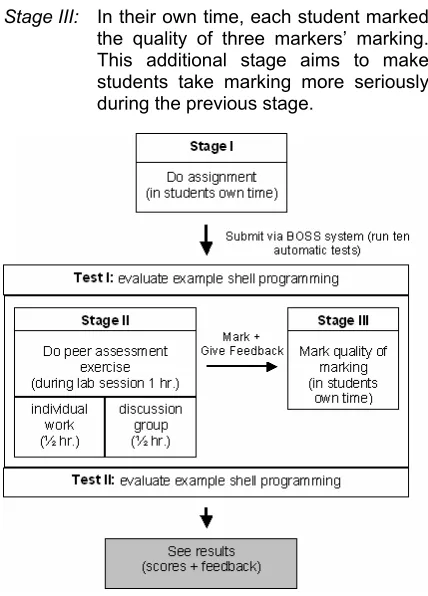
This peer assessment exercise was divided into three separate stages, as shown in Figure 1. Test I and test II were provided in order to measure the students’ evaluation skills, before and after the peer assessment. Students analyse and evaluate short example shell programs in test I and test II, which are similar in content but cosmetically different.
Stage I: Students do the assignment in their own time. Then they submit the assignment via the online submission system. Ten automatic tests are then run on the submitted programs.
Stage II: Students were divided into small groups (three students per group), each group consisting of students with a range of abilities. Each student was assigned three other students’ assignments to mark during the first half hour of a lab session. Then they discussed their marking with the other students in their group, who marked the same assignments.
[image:3.612.321.535.65.363.2]Stage III: In their own time, each student marked the quality of three markers’ marking. This additional stage aims to make students take marking more seriously during the previous stage.
Figure 1 Peer assessment process
3.2
Mark schemeThe marking scheme is illustrated in Figure 2, using the following definitions.
Automatic test: The online submission system tests a student’s assignment against different inputs to check whether it functions correctly. Ten tests are used.
Marker: Student marker marks assignments.
Feedback marker: Student feedback marker reports on the quality of the marking given by the three markers.
Script: Assignment that students submit via the online submission system.
In this peer assessment process, 50% of the marks are awarded by the teacher (automatic tests) and the remaining 50% are awarded by the students (peer assessment):
• Automatic Test 50%
• Peer Assessment
Peer marks are based on three markers; the average of the three marks is calculated. If one of markers does not appear to have marked work seriously (that is, does not appear to have read the program carefully and answer the marking criteria properly), the mark he or she gives will not be
[image:4.612.170.437.144.276.2]included in the average and the other marks will be scaled. The marking of assignments by students is possible since they are given guidance, automatic test scores and results, a marking scheme, and well-explained marking criteria.
Figure 2 Peer assessment mark scheme
4. D
ESIGN OFW
EB-
BASEDP
EER [image:4.612.80.285.299.537.2]A
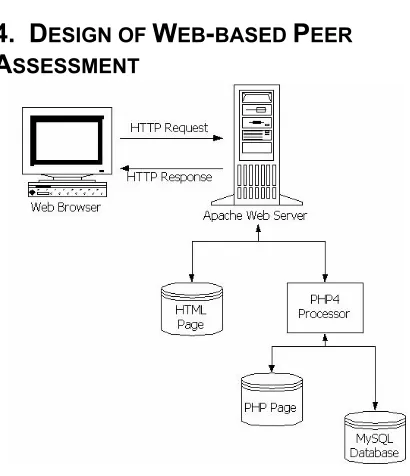
SSESSMENTFigure 3 Architecture of the web-based peer assessment system
The web-based peer assessment software uses the standard combination of Apache web server, the PHP4 programming language, and a MySQL database running on a Linux platform. This architecture is illustrated in Figure 3. Dynamic web pages are written in PHP4 and static web pages are written in HTML.
This web-based peer assessment provides anonymity for all users. Students are allowed to revise the marks they give until the marking deadline is reached. They receive a username and password by email before starting the peer assessment exercise. After students login, the menu page displays three steps for students to
follow (i.e. mark assignment, mark quality of marking, and see mark). They can see the scripts that they have been assigned to mark easily by clicking on the script buttons (Figure 4). They can view the automatic test results by clicking on the link on each script page to open a popup window displaying the results. A “Things to consider” link is provided below containing marking guidance.
Figure 4 Assignment script on Mark web page
4.1
Step I: Mark assignmentIn this visual inspection step, students mark and provide feedback on other students’ assignments by answering nine questions about:
• Readability (comments, indentation, variable names);
[image:4.612.322.536.378.573.2]• Style (easy to follow, well structured, use of appropriate utilities).
These are answered for each script by selecting simple multiple choices, i.e. No, Partial, and Yes. The default answer is set as unmarked. Students give a comment for each group of three questions. An explanation of the marking criteria is provided for each group of questions by clicking on the links on the left.
4.2 Step II: Mark quality of marking
In this step, students mark the quality of marking given by each of the three markers on a particular script. They need to answer three questions about whether the suggestions the markers gave in each section (readability, correctness, and style) are relevant, well explained and useful to students. The marking given by the three markers is displayed at the top of the page and the student enters the feedback marks at the bottom.
4.3 Step III: See mark
In this final step, students can see their mark from both the automatic test and the peer assessment. A Marking calculations link at the bottom of the page provides an explanation of how the overall mark is calculated. If the students do not mark any of three scripts, they may lose some marks. The full mark and comments that the three peer markers gave the student’s assignment are also available. This also includes the full mark that they were given based on the quality of their own marking.
4.4 Monitor marking
The monitor marking web page reports the students’ marks and any absent markers, and is only available for tutors. The highlighted columns show the standard deviation of the three markers for both Step I and Step II in order to know how spread out the marks are. If the standard deviation is less than a preset value, it is acceptable, but if the standard deviation is more than a given upper limit, it means the marks from the three markers have a very wide range, and the tutor may have to reconsider the marks for that student. The tutor can access each script by using the ‘Script ID’ box at the top of the web page.
5. R
ESULTSAt the end of the process, each student was required to fill in a detailed online questionnaire, and the following preliminary observations suggest that the exercise has been beneficial.
• 69% of students realise mistakes that they made in their own answer when marking other students’ work.
• 76% of students discuss with their groups when marking and think this discussion helps them understand more about the assignment. A few students find starting a discussion difficult.
• 58% of students feel comfortable when assigning marks. A few students did not fully understand the marking criteria.
• 65% of students are satisfied with their mark from the peer assessment, and considered that the peer feedback they received was relevant and useful.
• 80% of students agree that seeing good and bad programs help them in learning programming, and marking helps them to think more deeply about their own work.
For most of the questions in the questionnaire, the responses when compared by gender were broadly similar. However, male students appeared to feel significantly more comfortable assigning marks than did the female students. Almost 80% of non-English students would like to recommend the peer assessment to friends as a way of learning more, but only 50% of English students would like to do this, and this may form the basis for further investigation.
[image:5.612.317.533.380.451.2]6. D
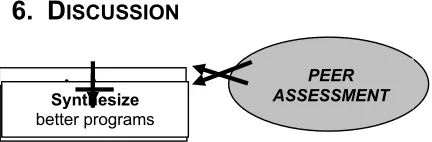
ISCUSSIONFigure 5 Deep learning approach
Peer assessment encourages students to develop higher level cognitive skills in learning computer programming as follows:
• Analyse aspects of programs - peer assessment starts students thinking about what aspects of their programs were wrong and what worked well when they compare their work with other students’ work.
• Evaluate whole programs - making judgement on other students’ work helps student to evaluate their own programs. They can recognise what constitutes good and poor programs.
• Synthesize better programs - students analyse and evaluate the different styles of solving programming problems, which help them to create better programs.
The students’ responses generally appear to support our view that students can learn from each
Analyse
aspects of programsEvaluate
whole programs
Synthesize
better programs
other through this process. Seeing different ways of solving programming problems and marking each other’s works helps students’ self-assessment and writing better programs:
“I got the chance to observe two scripts that used different methods than my own solution to satisfy the specification. In order to be confident in my ability to mark these scripts fairly, I had to spend a long time studying them and hence acquiring an improved knowledge of how shell scripts are composed.”
“Marking others’ work helps me criticise my own work and remind me of my own problems.”
Most students seemed satisfied with their marks, and consider that with adequate guidance the marks from peers could be as reliable as the marks from a tutor. However, some students think the marks awarded by students are graded using different standards to those awarded by tutors. Markers could only base marks on how good the script was compared to their own answers, and some students therefore think no student is really qualified to mark another student’s work, as they are not trained for marking and are not experts:
“I would say peer assessment in a better way to learn how to write a good program. Nevertheless, some markers may not have the skill of marking and understanding of script.” “I think it is hard to mark a student when you’ve never marked assignments before, especially UNIX scripts as I never had any previous experience with it. Additionally, the things I consider good or bad may not be the same for other people.”
It was difficult in the students’ view to avoid friendship marking, resulting in over-marking (they often felt favourable towards their friends) [12]:
“When marking I was inclined to be generous because I expected that everyone else would be to me.”
“Very hard to do when you are marking someone who is technically in the same boat as you.”
7. C
ONCLUSIONSWe have described a peer assessment process, together with supporting web-based software, which we have used to test the effectiveness of peer assessment in learning programming languages. The process we have used is novel, since students are engaged not only in marking each other’s work, but also in evaluating the quality of marking of their peers. Students use deep (analysis, evaluation and synthesis) rather than surface learning strategies in the peer assessment process, contributes to effective learning. Students also realise their own strengths
and weaknesses when marking a good or poor piece of work. Preliminary evaluation of the exercise indicates that it has contributed positively to the students’ learning experience.
8. R
EFERENCES
[1] AAHE Bulletin, “Deep Learning, Surface Learning”, 45(8), 10-13, 1993.
[2] Topping, K., “Peer assessment between students in colleges and universities”, Review of Educational Research,68, 249-276, 1998 [3] Sluijsmans, D., Dochy, F., and Moerkerke, G.,
“Creating a learning environment by using self- peer- and co-assessment”, Learning Environments Research, 1, 293-319, 1999 [4] Tsai, C., Lin, S., and Yuan, S., “Developing
science activities through a net worked peer assessment system”, Computers & Education, 38, 241-252, 2002
[5] Falchikov, N., Learning Together: Peer tutoring in higher education, Routledge Falmer, London, 2001
[6] Somervell, H., “Issues in assessment, enterprise and higher education: the case for self-, peer and collaborative assessment”,
Assessment and Evaluation in Higher Education, 18, 221-233, 1993
[7] Brown, G., Bull, J., and Pendlebury, M., Assessing student learning in higher education, Routledge, London, 170-184, 1997 [8] Dochy, F., McDowell, L., “Assessments as a
tool for learning”, Studies in Educational Evaluation, 23(4), 279-298, 1997
[9] Lin, S., Liu, E., and Yuan, S., “Web-based peer assessment: feedback for students with various thinking-styles”, Journal of Computer Assisted Learning, 17, 420-432, 2001
[10] Bhalerao, A. and Ward, A., “Towards electronically assisted peer assessment: a case study”, Association for Learning Technology journal (ALT-J), 9(1), 26-37, 2001 [11] Joy, M., Luck, M., “The BOSS System for On-line Submission and Assessment”, CTI Computing: Monitor, 10, 1998