WORKING PAPERS SERIES
WP05-08
Performance Measurement with
Loss Aversion
Performance Measurement with Loss Aversion
Gordon Gemmill! Soosung Hwang**
and Mark Salmon!
July 4th, 2005
Abstract
We examine a simple measure of portfolio performance based on prospect theory, which captures not only risk and return but also reflects differential aversion to upside and downside risk. The measure we propose is a ratio of gains to losses, with the gains and losses weighted (if desired) to reflect risk-aversion for gains and risk-seeking for losses. It can also be interpreted as the weighted ratio of the value of a call option to a put option, with the benchmark as the exercise price. When applying the loss-aversion-performance measure to closed-end funds, we find that it gives significantly different rankings from those of conventional measures (such as the Sharpe ratio, Jensen’s alpha, the Sortino ratio, and the Higher Moment measure), and gives the expected signs for the odd and even moments of tracking errors. However, loss-aversion performance is not more closely related to discounts on funds than are the conventional performance measures, so we have not found evidence that loss-aversion attracts investors to particular funds in the short-term.
Keywords: Performance Measurement, Loss Aversion, Prospect Theory, Closed-end-fund Puzzle.
JEL code: G11, G23
! Warwick Business School, University of Warwick, Coventry CV4 7AL
1
Introduction
Measures of portfolio performance, which take account both of risk and return, have evolved over the years in parallel with asset pricing theory, with the main focus on what constitutes risk. The Sharpe ratio (Sharpe, 1966) comes from portfolio theory and uses the variance of returns to measure risk. Treynor (1965) and Treynor and Mazuy (1966) use the CAPM beta as their measure of risk, while Jensen (1968) uses the CAPM alpha. Later measures have been based on the APT (Connor and Korajczyk, 1986 and
Lehmann and Modest, 1987) and the Fama/French model (Carhart, 1997). Other
approaches include the positive period weighting measure (Grinblatt and Titman, 1989) and measures based on the intertemporal marginal rates of substitution (Glosten and Jagannathan, 1994), the law of one price and/or no arbitrage (Chen and Knez, 1996), and the higher moments of the distribution (Hwang and Satchell, 1998).
Most of these measures assume that investors maximise expected utility, but this paradigm may be criticised for being inconsistent with experimental results. In
particular, when taking decisions investors consider individual gains and losses rather than aggregating them into final wealth and the pleasure from a gain is not as great as the regret from a loss of the same size. This led Kahneman and Tversky (1979) to develop prospect theory, according to which investors maximise the weighted sum of a value function, where the ‘value function’ is calculated in terms of gains or losses rather than final wealth and the ‘weights’ are subjective (rather than objective) probabilities. If the gains and losses are measured relative to expectations rather than what happened in the recent past, then loss-aversion has been renamed “disappointment aversion” by Gul (1991) and this has been implemented by Ang, Bekaert and Liu (2004) and Fielding and Stracca (2003), among others.
In this paper we propose a new measure of performance based on prospect theory and compare it, both theoretically and empirically, with other performance measures. The measure, which we denote as loss-aversion performance (LAP), is the ratio of gains to losses, both of which may be weighted by fractional powers. When the reference point is the benchmark portfolio, then gains and losses are ‘tracking errors’ and the measure is the ratio of positive tracking errors to negative tracking errors, each raised to a power. 1 Under the special case that both power terms are set to unity, our measure can be interpreted as the ratio of the price a call option to the price of a put option and is the same as the Omega performance measure of Keating and Shadwick (2002). Omega has been developed as an alternative method of presenting distributions of returns, but has not been related before to prospect theory.
The measurement of gains and losses is critical in implementing prospect theory. An interesting feature of investors is that they tend to take greater risks when they have
experienced recent gains " the so-called ‘house-money effect’ (see, for example, Thaler and Johnson, 1990; Barberis, Huang and Santos, 2001). Because of the house-money effect, it is possible that performance measurement should take account of previous gains and losses as well as current gains and losses. For example, the poor performance of a fund in one period could be compensated to some extent by good performance in a previous period, or be regarded as remaining bad if there had been previous losses. Two of our three measures of loss-aversion performance allow for the house-money effect, as they incorporate lagged performance.
Using 42 UK closed-end funds, we first show some statistical properties of the LAP measure (in three particular specifications) as compared with the Sharpe (1966) ratio, Jensen’s (1968) alpha, the Sortino ratio of Sortino and Van der Meer (1991), and the higher moment (HM) measure of Hwang and Satchell (1998). The new loss-aversion performance measures give different rankings from those of the conventional measures, but we do not find any significant differences between the three LAP variants and so conclude that the house-money effect is not relevant in our sample. Our results support
the use of loss-aversion measures of performance. In particular these measures have highly desirable properties such as a positive relationship with a fund’s tracking error and a negative relationship with its kurtosis. Other standard measures such as Jensen’s alpha, the Sortino ratio, and the HM do not have these properties.
We also examine whether measures of performance can explain the discount on closed-end funds. If a performance measure is capturing what investors want, then it might be expected that the discount would be smaller for funds which “perform” well by that measure. We find that there is no simple relationship between discounts and any of the performance measures (traditional or otherwise) for the funds in our sample, so investor sentiment is not adequately captured in this way.
The paper is written as follows. In section 2 we develop the loss-aversion performance measure which is consistent with prospect theory. We also describe the alternative measures for performance which exist. In section 3 we compare the behaviour of LAP with the other measures empirically, using a set of monthly data on closed-end funds from May 1993 to April 2002. In section 4 we test whether LAP is more consistent with investor preferences than the other measures, assuming that such preferences are reflected in the discount on a particular fund. Section 5 draws together the conclusions of the study.
2 Performance Measures with Loss Aversion
2.1 Prospect Theory and Loss Aversion
According to prospect theory (Kahneman and Tversky, 1979), decisions are based upon relative gains and losses rather than upon the final wealth level (which is the key
objective in conventional expected utility theory). Let !" be the wealth of an investor at
time " and let #" be some appropriate benchmark wealth at time " relative to which an
investor measures gains and losses. Gains are then measured as $", with $"%!""#". The
value function, VS, is defined as
# $ %
& "
"
' (
, 0 if
, ) (
, 0 if
,
2 1
" &
" " &
" '
$ $
$ $
(
) (1)
where the parameters &), &* and ) are assumed positive. The two terms in (1) are respectively: gains raised to the power &); +and losses raised to the power &*+multiplied by a relative loss aversion coefficient ).
Figure 1 plots the value function against losses and gains. Loss-aversion is generated by having )>1, which leads to the kink at the origin of the diagram. Kahneman and
Tversky (1992) and Benartzi and Thaler (1995), use ) = 2.25, while Ang, Bekeart, and
Liu (2004) use a range of ) values which exceed unity and Fishburn and Kochenberger
[image:6.595.88.435.392.738.2](1979) also present some evidence that ) > 1.
Figure 1 The Value Function VS in Prospect Theory (with ) =2.25)
Losses Gains
L
os
s
A
ve
rs
io
n
V
al
ue
When &)%+&*%1, the investor is risk-neutral with respect to gain or losses and this is shown as the dotted line in Figure 1. In the case originally suggested by Kahneman and Tversky (1979), there is risk-aversion in gains (&) <1) and risk-seeking in losses (&* <1), which is shown as the solid line in Figure 1.
2.2 Loss Aversion with a ‘House Money’ Effect
We take account of two (of the many) extensions to prospect theory. First, risk-seeking (convexity, &* <1) over losses is not generally supported; it is observed only when decision makers are asked to choose among prospects that involve only losses or gains, but not both. In other words, it is displayed if the frame of reference is one in which the investor cannot avoid making a loss. Barberis, Huang and Santos (2001) argue that for the choice of prospects that include both gains and losses, a loss aversion coefficient that is larger than one is the most important feature and so they set the two curvature parameters to unity. 2 Levy and Levy (2002), using stochastic dominance theory and experiments, also conclude that investors are not generally risk-loving over losses but are more likely to exhibit risk-aversion in both the gain and loss domains.
Second, investors who are “sitting on” prior gains may exhibit less pain for losses than those who are sitting on prior losses. The ‘house-money effect’ suggests that the value
of ) should be smaller if there have been recent gains, an approach taken by Barberis, Huang and Santos (2001) in their study of the equity risk-premium.
To take account of the house-money effect and possible risk-aversion over losses, we propose two variants of the basic value function. In the first variant, which we call (, (where superscrip H denotes “house-money”), we follow Barberis, Huang and Santos (2001) and make the loss-aversion coefficient ) depend on the previous gains and losses:
# $ %
& "
"
' (
, 0 if
, ) (
, 0 if
,
2 1
" &
" "
" &
" ,
$ $
$ $
(
) (2)
where )" (*0"*1$""1, *0 '0, and *1'0. Therefore with previous losses (i.e.,
0
1+ "
"
$ ) we have )" '*0 and hence the investor is more averse to losses, and vice
versa.
In the second variant, we dispose of the two parameters &) and &* and replace )" by
)
exp(","$" . The revised function is an ‘exponentially weighted loss aversion’
function, (-!, which is defined as
(-! (exp(","$")$", (3)
where ," (-0"-1$""1, -0 '0 and -1'0. In this case there is no longer a sharp kink
at zero in the value function. This is not as radical as it appears, because the “knife-edge” distinction between gains and losses around zero requires all investors to have the same benchmark. In financial markets there are many different choices of market indices for the benchmark. Although these are highly correlated, some small differences are inevitable and a small loss calculated with one index may be a small gain with
Figure 2 Value Functions with Exponential Weights
-0.08 -0.06 -0.04 -0.02 0.00 0.02 0.04 0.06
-0.10 -0.09 -0.08 -0.07 -0.06 -0.05 -0.04 -0.03 -0.02 -0.01 0.00 0.01 0.02
Gains or Losses (rate of returns)
V
al
ue
,(. ,(/0 Loss Aversion Coefficient is 2.25 for Losses and 1 for Gains
2.3 Loss-Aversion Risk Measures
We have already argued that the benchmark will depend on the choice of a particular index. For portfolio managers it is sensible to calculate gains and losses at the present time as wealth in the previous period scaled-up by the rate of return on the risky index. The benchmark wealth for gains and losses is then !"").)/01"2, where !"")is wealth in
the previous period and 01" is the rate of return on the benchmark asset at time ".
Gains or losses from investing in a portfolio can then be expressed relative to the benchmark as:
where 04" is the portfolio return at time ". The prospect-theory value function in (1) can then be re-written using the benchmark as:
1
3
1
2
4
1 23
1
2
4
2,1 1 & 1" 4" & " & 1" 4" & "
' ! 0 0 ! 0 0
( ( " " 5 ") " " " " (4)
where superscripts + and " represent conditional gains and losses respectively. Thus for fund managers, the objective is to maximise the expected value function:
-6( 5 +! 4-6..0 30 2 2 53 ! 4 -6. .0 30 2 2& 5
1" 4" & "3 & 1" 4" & "3
' 1 1 2(1 ) 2
1 1
"
5 " "
( ) , (5)
where 4( 4071(04" "01" 60) and the expectation operator is calculated with subjective
weights rather than with an objective probability density function.3
Viewed in this way, the expected value function in equation (5) is not conceptually very different from that used in traditional risk-return analysis. The first term on the right-hand side is what investors want, while the second term is what they want to avoid. 4
The trade-off between the two is reflected in ) , the loss-aversion coefficient. By comparison, a traditional mean-variance expected utility is:
2 ,
4
0 8( 453 !
-60
-695( )
where )8( is a measure of risk-aversion and !024 is the variance of returns on the
portfolio.
In fact, the expectation on the second component in (5), 4 -6. .0 30 2 2& 5 1
4 2
) 1
( " " " , is a
special case of the risk measure suggested by Fishburn (1977). His measure is
3
, ,4
( 7 " ( ) ,8 " 9 9 9 0 4 4 & 4 4
: 0 & 0 0 0 < 0 ;0
= (6)
3 According to prospect theory, people are observed to over-weight outcomes that are unlikely and under-weight outcomes that are highly likely. However, this subjective under-weighting function is not known and controversial. We do not consider the issue of subjective weights here.
which includes the variance and semi-variance as special cases (in addition to standard deviation and semi-standard deviation). Using the objective probability density function, we can express the second component of (5) as
3
, ,4
. ) ( ) 1 ( 2 2 2 4 1 : 0 4 4 & 4 1 & 1 4 0 & 0 = ;0 0 < 0 0 5 2 2 30 .0 -6. 4 1 ( " ( " "7
8 " " (7)The difference between Fishburn’s measure and our loss-aversion risk measure is that we allow any positive real number for &*. 5
2.4 Loss-Averse Performance Measures
As already noted, the first component in (5) represents what investors want (reward) and the second component is what they wish to avoid (risk). A simple loss-averse
performance measure is then the ratio of the two,
5 2 2 30 .0 -6. 4 5 2 2 30 4-6..0 >?@ & 1 4 & 1 4 ' 2 1 ) 1 ( " 5 " "
( . (10)
Notice that the coefficient ) drops out, just as )8( is not required in the Sharpe ratio,
because it is a constant. An important special case arises when the return on a risky benchmark portfolio is used. When we can define A-:04"01, which is tracking error, and
the simple loss aversion performance can be re-written as:
5 2 A--6. 4 5 2 4-6.A->?@ & & ' 2 1 ) 1 ( " 5 " "
( . (11)
The calculation of -6.A-52&15 and -6. "A-"2&25 as well as 4%4071.A-BC2 requires
an assumption on the probability density function (pdf) of tracking errors. Unfortunately the properties of tracking errors are not known, and even if 04 and 01 are normally
distributed this does not imply that the tracking errors will be Gaussian. In the empirical tests below we use non-parametric methods (i.e. the empirical distributions) to
overcome this difficulty.6
When the house-money effect is taken into account, the loss aversion coefficient )" is a
function of previous performance and does not drop out. The revised performance measure becomes , ) 1 ( 2 1 5 2 A--6. 4 5 2 4-6.A->?@ & " " & " , " 5 " " ( ) (12)
where )" (*0"*1A-""1, *0 '0, and *160. Likewise, the performance measure with
exponential weights can be written as
, ) ( exp( ) 1 ( exp( 5 A-2 A--6 4 5 2 A-4-6 >?@ " " " " " " -! " " 5 5 " " " " ( , , (13)
where ," (-0 "-1A-""1, -0 '0, and -160.
The interpretation of these performance measures with the house-money effect is as follows. When there are losses in the previous period (A-""1+0), the loss aversion
coefficient )" becomes larger and thus LAPH shows worse performance than the
simpler LAPS of (10). Therefore previous losses of a fund affect the current evaluation of the fund in a negative way.
Figure 3 demonstrates the conceptual simplicity of LAPS , with the benchmark return set at B. (Note that for an absolute-return fund, such as a hedge fund, the benchmark might be set at, say, 5% per annum rather than as the return on an index.) LAPS is equal to the probability of gains, 4, times the expected (fractionally powered) gains of XG,
divided by the probability of losses, 1-4, times the expected (fractionally powered) losses of XL.
When &)=&*=1, then LAPS is equivalent to Keating and Shadwick’s (2002) Omega. We
can also note how 4XG is equal in value to an outperformance call option (relative to the
benchmark, exercise price, #) and (1-4)XL is equal in value to an underperformance put
at the same exercise price. If the distribution of excess returns were normal, then the values of these options could be easily computed with the Black/Scholes formula.7
Figure 3 The Distribution of Returns and the Elements of the Simple Loss-Averse Performance Measure, LAPS
Returns
Gain Probability (p)
Loss Probability (1-p)
Expected Losses (XL)=-E(rp-B)v2 Expected Gains (XG)=E(rp-B) v1
B
2.5 Other Performance Measures
Turning to other measures of performance for comparison, the Sharpe (1966) ratio is simply the reward per unit of total variability:
,
4 < 4 !
2 30 +-.0
'=( (8)
where ;4 is the standard deviation of portfolio returns. The measure is easy to
understand and widely used.
1
22
1/2) 1
( 4 -6. A- 2 5 2 30 +-.0
'A 4 <
" " "
( , (9)
where the numerator is the same as that of the Sharpe ratio, but the denominator is replaced with semi-standard-deviation.
Using tracking errors can cause a serious problem for the Sharpe and Sortino ratios when ranking funds.8 This is because if average tracking errors are around zero, these performance measures calculated with tracking errors could be negative for some funds. There is no simple way around this problem and so Sharpe and Sortino ratios are used in this study with a benchmark of the risk-free rate rather than in tracking-error form. 9
Jensen’s (1968) alpha, <4D, measures performance of a portfolio which is not explained
by its CAPM beta:
<D4 (=4 "*4=E, (14)
where
3
4
3
4
,)) ( ( )) ( ))( ( ( ), ( ), ( 2 E E E E 4 4 4 < E E < 4 4 0 -0 -0 -0 0 -0 -0 0 -0 0 -" " " ( " ( " ( * = =
and 04 represents the portfolio's return, 0< is the risk-free rate, 0E is the market
(benchmark) return, *4 denotes the systematic risk of the portfolio. The measure is
based on the assumptions that returns are Gaussian and investors have a quadratic utility function. When these assumptions do not hold Jensen’s alpha is not appropriate.
8 The Sharpe ratio is known as the information ratio when measured as outperformance, see Gupta, Prajobi and Stubbs (1999).
A higher moment (HM) measure has been proposed by Hwang and Satchell (1998), based on an extension of the CAPM to three moments. It is
,8 4 1 E 2( 4 4)
4 = - = - * >
< ( " " " (15)
where , ) 1 ( , ) 1 ( ) 1 ( 2 2 2 2 1 " " ( " " " " ( E E E E E E 4 E 4 E ? > ; > -? > * ? > >
3
3
4
4
,)) ( ( )) ( ))( ( ( 3 2 E E E E 4 4 4 0 -0 -0 -0 0 -0 -" " " ( >
;E (-
3
(0E "0<)24
1/2,
3
34
3 )) ( ( E E E E 0 -0 -;
> ( " , and
3
44
4 )) ( ( E E E E 0 -0 -;
? ( " .
Note that >E and ?E are the skewness and kurtosis of the market return, and *4 and >4 are
beta and coskewness, respectively. If the market returns are normal or investors’ utility
is governed by the mean and variance only, then -)= *4 and -*=0 and thus <,84 is
equivalent to Jensen's Alpha. If this is not the case, the measure reflects both the skewness and kurtosis of the distribution of returns.
There are two other performance measures which we have considered. They are the Treynor and Mazuy (TM) (1966) measure and the positive period weighting (PPW) measure of Grinblatt and Titman (1989). However, we find that these two measures give virtually identical results to Jensen’s alpha and so we do not include them.10 We have also not included the commercial measures of downside risk used by Morningstar and Lipper. Until the middle of 2002 Morningstar had a measure which compared a fund’s average underperformance in months when it underperformed with a similar measure for its category. This measure has been abandoned because many new funds in the late 1990s never underperformed relative to the benchmark. Lipper has a measure for the “preservation of capital” which is just the sum of negative monthly returns over 3, 5 and 10 year periods. A review of these and other industry measures may be found in Amenc and Le Sourd (2005).
3 Empirical Tests
3.1 Objectives and Data
In this section we compare the three LAP measures with the four conventional
performance measures in an empirical context. The aim is to discover whether there is any difference in the rankings of funds when using alternative measures. If there is not, then the simplest possible measure should be adopted and there is no benefit of being concerned with loss aversion.
The analysis is based on two groups of UK closed-end funds which have very clear benchmarks: the first group of 19 funds has a benchmark of the FTSE AllShare index, and the second group of 23 funds has a benchmark of the FTSE SmallCap index. By using two groups, we are able to investigate the properties of the performance measures in different markets and also to cross-compare closed-end funds in different groups. The data are monthly over the period May 1993 to April 2002 and retrieved from
Datastream. The analysis is made on net-asset values (NAVs) rather than prices,
because managers are evaluated on that basis. Tracking errors are calculated by taking the returns of the benchmark from the returns of the individual closed-end funds’ NAVs. Although the total of 42 funds which we use in this study is relatively small, that should not matter for discovering whether measures differ sufficiently to have an empirically recognisable impact.
Table 1 reports the basic statistical properties of the monthly returns for the 42 UK closed-end funds and two benchmark indices over the sample period. For the closed-end funds whose benchmark is the FTSE AllShare index (AllShare group), mean returns range from 0.7% to 1.2% (8.4% to 14.4% in annual terms) with standard deviations between 1.5% and 7.3% (5.2% to 25.3% in annual terms). The SmallCap funds show returns in the 0.2% to 1.6% range per month (2.4% to 19.2% in annual terms) and standard deviations between 3% and 8.6% (10.4% to 29.8% in annual terms).
Table 1 Properties of Net Asset Value Returns and Their Tracking Errors
A. FTSE AllShare Index Funds
NAV Log-returns Tracking Errors
Benchmark Portfolio and Investment Trusts
Mean Dev. Std. Skewness Kurtosis
Normality
(Jarque-Bera)
Autocorrel ation with
Lag 1 Mean
Std.
Dev. Skewness Kurtosis
Normality
(Jarque-Bera)
Autocorrela tion with
Lag 1
Rank Correlations
between NAV log-returns and
Tracking Errors
Disco unts
FTSE AllShare index 0.008 0.038 -0.689 0.515 9.738 * -0.008
Albany 0.009 0.035 -0.542 0.242 5.555 * -0.061 0.001 0.014 0.494 0.095 4.432 * -0.123 -0.034 0.157
Bankers 0.009 0.040 -0.986 2.015 35.792 * -0.052 0.001 0.014 -0.202 0.087 0.767 -0.067 0.260 * 0.059
Capital Gearing 0.009 0.021 -0.425 0.794 6.088 * -0.055 0.001 0.028 0.433 -0.059 3.397 -0.076 -0.131 0.051
City Of London 0.009 0.042 -0.771 1.095 16.094 * -0.038 0.001 0.012 0.173 1.735 14.082 * 0.210 * 0.407 * 0.015
Dres.Rcm Endow 0.007 0.015 1.827 5.270 185.069 * -0.209 * -0.001 0.040 0.582 0.091 6.130 * -0.085 0.129 0.004
Edinburgh 0.007 0.042 -0.715 0.918 12.998 * 0.014 -0.001 0.010 0.404 0.935 6.871 * -0.098 0.492 * 0.121
Edinburgh UK Tracker 0.008 0.038 -0.584 0.283 6.489 * -0.021 0.000 0.006 1.294 1.455 39.676 * -0.268 * 0.035 0.007
F&C Pep 0.008 0.037 -0.967 1.393 25.576 * 0.042 0.000 0.013 0.723 0.083 9.448 * 0.088 0.041 0.067
Finsbury Growth 0.008 0.046 -0.768 0.961 14.787 * -0.039 0.000 0.016 -0.114 0.099 0.277 -0.119 0.597 * 0.103
Fleming Claverhouse 0.009 0.044 -0.667 0.671 10.039 * 0.013 0.001 0.012 -0.413 1.366 11.465 * 0.012 0.650 * -0.010
Glasgow Income 0.011 0.046 -1.182 2.591 55.342 * -0.043 0.003 0.025 0.131 1.090 5.655 * 0.042 0.545 * 0.047
Henderson Elec.&Gen. 0.007 0.052 -0.333 0.944 6.002 * 0.100 -0.001 0.030 0.388 3.574 60.192 * 0.209 * 0.598 * 0.090
Law Debenture 0.010 0.040 -0.976 1.701 30.156 * -0.036 0.002 0.015 0.657 1.131 13.515 * 0.028 0.268 * -0.093
Lowland 0.011 0.049 -1.166 4.011 96.897 * 0.029 0.003 0.031 0.635 6.099 174.644 * 0.092 0.541 * 0.078
Merchants 0.010 0.045 -0.964 1.813 31.521 * -0.074 0.002 0.021 0.231 0.623 2.704 0.078 0.513 * 0.057
Murray Income 0.009 0.040 -0.898 1.624 26.377 * 0.051 0.001 0.017 1.478 5.811 191.276 * 0.370 * 0.239 * 0.074
Securities Tst.Sctl. 0.007 0.041 -0.802 1.186 17.904 * -0.035 -0.001 0.015 0.337 0.056 2.058 -0.114 0.304 * 0.095
Temple Bar 0.010 0.041 -0.599 1.722 19.810 * 0.016 0.002 0.019 1.039 2.158 40.383 * 0.213 * 0.253 * 0.049
B. FTSE Small Cap Index Funds
NAV Log-returns Tracking Errors
Benchmark Portfolio
and Investment Trusts Mean Dev. Std. Skewness Kurtosis Normality
(Jarque-Bera)
Autocorrela tion with
Lag 1 Mean
Std. Dev.
Skewne ss
Kurto sis
Normality
(Jarque-Bera)
Autocorrelat ion with Lag
1
Rank Correlations between NAV
log-returns and Tracking
Errors
Disco unts
FTSE Small Cap 0.007 0.049 -1.148 4.464 113.398 * 0.181
3i Sm.Quoted 0.008 0.056 -1.063 2.650 51.943 * 0.190 0.001 0.020 -0.731 2.499 37.718 * 0.091 0.511 * 0.132
Aberforth 0.013 0.046 -0.688 1.731 21.996 * 0.163 0.006 0.024 0.086 2.163 21.190 * 0.298 * 0.202 * 0.055
Britannic 0.007 0.052 -0.984 3.151 62.083 * 0.204 * 0.000 0.017 -0.480 2.832 40.237 * 0.193 0.236 * 0.136
Candover 0.016 0.038 3.492 17.584 1610.908 * -0.162 0.009 0.061 1.535 4.477 132.583 * 0.003 0.212 * -0.030
Dresdner Rcm 0.008 0.071 -0.112 3.107 43.667 * 0.352 * 0.001 0.038 1.102 8.355 335.979 * 0.443 * 0.634 * 0.172
Dunedin Enterprise 0.011 0.030 0.238 3.485 55.671 * 0.203 * 0.004 0.056 0.237 2.349 25.836 * 0.092 0.324 * 0.164
Dunedin Smaller 0.009 0.055 -1.176 4.312 108.586 * 0.207 * 0.002 0.022 -0.129 0.919 4.101 * 0.109 0.382 * 0.148
Electra 0.010 0.035 -0.339 4.993 114.244 * 0.039 0.003 0.039 0.184 0.690 2.755 -0.058 -0.024 0.151
Fleming Mercantile 0.010 0.047 -0.622 2.747 40.920 * 0.171 0.003 0.020 0.269 0.492 2.386 -0.044 0.152 0.150
Fleming 0.009 0.059 -0.951 3.208 62.599 * 0.243 * 0.002 0.024 -0.014 2.684 32.417 * 0.227 * 0.456 * 0.120
Gartmore 0.006 0.059 -0.618 2.406 32.933 * 0.343 * -0.001 0.031 -0.342 3.287 50.716 * 0.383 * 0.420 * 0.152
Govett Strategic 0.007 0.051 -0.736 1.862 25.354 * 0.086 0.001 0.023 -0.406 1.081 8.230 * -0.014 0.345 * 0.148
Henderson 0.002 0.078 -0.790 2.779 45.979 * 0.215 * -0.005 0.051 -1.040 5.768 169.144 * 0.202 * 0.580 * 0.125
Henderson Strata 0.007 0.072 -0.444 2.521 32.150 * 0.268 * 0.000 0.047 -0.398 4.709 102.622 * 0.248 * 0.516 * 0.047
I&S.UK. 0.009 0.059 -0.530 1.539 15.718 * 0.259 * 0.002 0.030 -0.665 4.856 114.075 * 0.246 * 0.440 * 0.149
Invesco Eng.& Intl. 0.010 0.075 -0.798 3.991 83.154 * 0.239 * 0.004 0.037 0.315 5.661 145.994 * 0.297 * 0.824 * 0.133
Mercury Grosvenor 0.011 0.036 -0.435 5.080 119.553 * 0.015 0.004 0.053 0.305 3.611 60.348 * 0.046 0.262 * 0.178
Northern Investors 0.011 0.037 2.887 18.643 1714.135 * 0.101 0.004 0.051 1.004 2.311 42.177 * 0.092 0.208 * 0.166
Pantheon Intl. 0.011 0.039 2.985 16.356 1364.287 * -0.109 0.004 0.058 1.287 3.353 80.419 * 0.041 0.348 * 0.188
Perpetual UK 0.012 0.049 -1.089 3.961 91.922 * 0.194 0.005 0.017 -0.259 1.627 13.115 * 0.045 0.126 * 0.097
Shires 0.009 0.048 -0.895 2.200 36.204 * 0.128 0.002 0.021 -0.130 1.954 17.493 * -0.082 0.217 * 0.121
Thompson Clive 0.011 0.086 1.679 8.063 343.309 * 0.116 0.004 0.078 1.385 4.947 144.661 * 0.085 0.646 * 0.195
Throgmorton 0.006 0.052 -0.932 2.723 49.004 * 0.149 -0.001 0.018 -0.199 0.595 2.305 0.056 0.356 * 0.146
Most NAV returns (left half of Table 1) are negatively skewed and leptokurtic, leading to significant non-normality according to the Jarque-Bera statistics. In particular, the SmallCap NAV returns are more leptokurtic than those of the AllShare group. The non-normality suggests that performance-measures based on mean and variance may not capture downside risk satisfactorily. Another result in Table 1 is that in several cases high autocorrelation coefficients are found for funds in the SmallCap group, which may be due to the illiquidity of the small stocks which they hold.
The right-hand side of Table 1 reports the statistical properties of the tracking errors. For the AllShare group most of these tracking errors have means which are close to zero, as expected, but for the SmallCap group 20 of the 23 means are positive. By contrast, 16 out of 19 of the AllShare group show positive skewness, whereas only 11 out of 23 of the SmallCap group are positively skewed.
The results in Table 1 suggest that the distributions of the tracking errors are different from those of NAV returns. In particular, they tend to show less skewness and kurtosis than raw returns. Because of the non-normality for almost all distributions, @FG0H7IJH correlation coefficient may not be an appropriate tool to analyse the dependence
relationships. For this reason we prefer to use '4FG0EGIJH+0GIK+70;F0+correlations. The rank correlation coefficients between NAV returns and the tracking errors (penultimate column of Table 1) are positive and significant on average, but the levels are quite varied (ranging from –0.131 to +0.824). More than two thirds of the coefficients are less than 0.5. This suggests that performance based on tracking errors is likely to be quite different from that based on NAV returns.
Table 2 Performance Measures for the UK Investment Trusts A. Performance Measures for the AllShare Group
Sharpe Ratio Jensen's Alpha (Multiplied by 100)
Sortino Ratio Higher Moment (Multiplied by 100)
LAPS (&
)=0.75,
&*=0.95)
Values WG AG Values WG AG Values WG AG Values WG AG Values WG AG Albany 0.134 6 14 0.166 8 21 0.546 6 8 0.167 13 26 2.780 5 9 Bankers 0.109 10 18 0.085 11 28 0.467 9 11 0.306 9 21 2.759 6 10 Capital Gearing 0.230 1 2 0.344 2 11 0.270 15 22 0.451 6 14 2.244 13 26 City Of London 0.109 11 19 0.082 12 29 0.572 3 5 0.172 12 25 2.934 3 6 Dres.Rcm
Endow 0.152 2 8 0.219 6 18 0.085 19 38 0.286 11 24 1.713 18 40 Edinburgh 0.051 18 36 -0.166 19 41 0.298 14 20 -0.105 19 40 1.698 19 41 Edinburgh Uk
Tracker 0.086 15 25 -0.021 15 35 0.927 1 1 -0.048 17 34 2.194 14 28 F&C Pep & Isa 0.102 13 22 0.051 14 32 0.481 8 10 0.300 10 22 2.349 11 23 Finsbury Growth 0.074 16 28 -0.069 16 37 0.299 13 19 0.087 16 31 2.311 12 25 Fleming
Claverhouse 0.108 12 20 0.080 13 30 0.570 4 6 0.146 14 28 3.160 2 4 Glasgow Income 0.135 5 13 0.260 3 14 0.415 10 12 0.672 3 7 2.731 7 12 Henderson
Elec.&Gen. 0.045 19 38 -0.162 18 40 0.113 18 37 -0.093 18 38 1.808 17 39 Law Debenture 0.137 4 12 0.204 7 20 0.656 2 3 0.462 5 13 3.240 1 3 Lowland 0.124 7 15 0.257 4 15 0.321 12 17 0.688 1 5 2.479 10 19 Merchants 0.111 9 17 0.131 9 24 0.370 11 15 0.463 4 12 2.520 9 18 Murray Income 0.115 8 16 0.122 10 25 0.481 7 9 0.405 7 15 2.618 8 15 Securities
B. Performance Measures for the SmallCap Group
Sharpe Ratio Jensen's Alpha (Multiplied by 100)
Sortino Ratio Higher Moment (Multiplied by 100)
LAPS (&
)=0.75,
&*=0.95)
Values WG AG Values WG AG Values WG AG Values WG AG Values WG AG 3i Sm.Quoted 0.059 16 33 0.089 16 26 0.230 9 25 0.154 14 27 2.584 8 16 Aberforth 0.174 4 5 0.612 2 2 0.602 2 4 0.608 6 9 4.125 2 2 Britannic 0.051 19 37 0.039 19 33 0.220 12 29 0.066 16 32 2.479 10 20 Candover 0.292 1 1 1.112 1 1 0.380 4 14 1.248 1 1 2.574 9 17 Dresdner Rcm 0.052 18 35 0.089 17 27 0.158 18 35 -0.063 18 35 2.185 16 30 Dunedin
Enterprise 0.195 2 3 0.582 5 5 0.160 17 34 0.789 3 3 2.153 17 31 Dunedin Smaller 0.070 13 29 0.154 15 23 0.271 7 21 0.323 10 18 2.636 7 14 Electra 0.163 6 7 0.477 8 8 0.230 10 26 0.743 4 4 2.352 12 22 Fleming
Mercantile 0.106 9 21 0.303 10 12 0.406 3 13 0.312 12 20 3.068 3 5 Fleming 0.078 11 26 0.208 13 19 0.300 6 18 0.287 13 23 2.788 4 8 Gartmore 0.029 21 40 -0.062 21 36 0.075 21 40 -0.095 21 39 1.977 19 34 Govett Strategic 0.055 17 34 0.069 18 31 0.170 16 33 0.088 15 30 2.344 13 24 Henderson -0.037 23 42 -0.568 23 42 -0.070 23 42 -0.588 23 42 1.372 23 42 Henderson Strata 0.034 20 39 -0.009 20 34 0.071 22 41 -0.075 20 37 1.955 20 35 I&S.UK. 0.066 15 32 0.155 14 22 0.174 15 32 -0.004 17 33 2.448 11 21 Invesco Eng.&
Intl. 0.077 12 27 0.262 11 13 0.238 8 24 0.316 11 19 2.668 6 13 Mercury
Grosvenor 0.173 5 6 0.583 4 4 0.186 14 31 0.498 8 11 2.237 14 27 Northern
Investors 0.178 3 4 0.604 3 3 0.225 11 28 0.813 2 2 2.193 15 29 Pantheon Intl. 0.152 7 9 0.571 6 6 0.188 13 30 0.651 5 8 2.014 18 32 Perpetual UK 0.148 8 10 0.510 7 7 0.722 1 2 0.599 7 10 4.743 1 1 Shires 0.090 10 24 0.234 12 16 0.322 5 16 0.327 9 17 2.733 5 11 Thompson Clive 0.068 14 30 0.413 9 9 0.129 19 36 -0.071 19 36 1.846 22 38 Throgmorton 0.019 22 41 -0.123 22 39 0.075 20 39 -0.121 22 41 1.906 21 37
3.2 Cross-sectional Properties of Loss Aversion Performance Measures
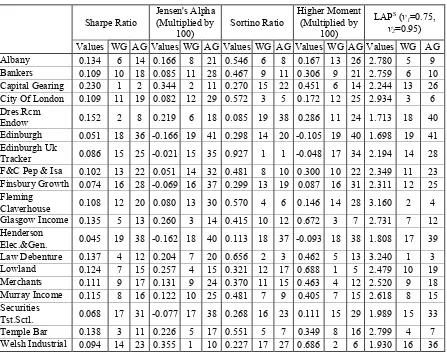
In Table 2 we report the LAPS (with &)=0.75 and &*=0.95) 11 and the four other
performance measures over the 108 monthly returns. There are three columns for each measure: the first, labelled ‘values’, gives the performance for the sample period; the second, labelled ‘WG’, gives the rank of a particular fund “within” its style group; and the third, labelled ‘AG’, gives the rank of a fund across “all” style groups.
Beginning with values, the Sharpe ratios and Sortino ratios are all positive except in one case. This is to be expected as they measure returns in excess of the risk-free rate rather than over the benchmark. The values for Jensen’s alpha and the higher-moment measure are close to zero, as they measure returns relative to the benchmark index. The LAPS values range from 1.4 to 4.7, indicating that the gain component in the numerator of equation (10) exceeds the loss component in the denominator of equation (10) by a relatively large margin for all funds.
Considering the WG (within group) rankings, the Sharpe and Jensen rankings are extremely similar: for the AllShare group, their rankings of funds differ by more than 3 places for only 3 funds out of 19 and for the SmallCap group differ by more than 3 places for only 1 fund out of 23. If we consider the three measures which specifically take account of the downside – the Sortino ratio, higher moment measure (HM) and LAPS – we can also consider which, if any, of these gives a rank which is more than 3 places different from the other two. The result is that the HM differs from the other two measures in its ranking of the AllShare Group by more than 3 places in 11 out of 19 cases and in its ranking of the SmallCap Group by more than 3 places in 10 out of 23 cases. In fact the rankings with the HM measure are closely related to the rankings by the Sharpe and Jensen measures, which is not surprising because the HM is an extension of the CAPM on which the other two measures are based. So our first conclusion is that the Sharpe, Jensen and HM measures behave similarly, and that the Sortino and LAPS measures are also closely related.
If we look at individual funds in the SmallCap group, Candover, Northern Investors, and Pantheon Intl. funds are ranked lower with the LAPS than by the Sharpe ratio, Jensen’s alpha, the Sortino ratio and the HM measure, which is because they are relatively less positively skewed in tracking errors than in returns. On the other hand, funds such as Perpetual UK, whose tracking errors are relatively more positively
skewed and less leptokurtic, are ranked higher with the LAPS than with the conventional measures. This result shows that LAPS is more sensitive to higher moments than the other measures, even when compared with the “higher moment” HM measure.
Although the Sortino ratio shows rankings which are similar to those of the LAPS in the SmallCap group, in the AllShare group its rankings of Glasgow Income, Welsh
Industrial, Lowland, and Edinburgh UK Tracker are quite different from those of LAPS . So the second conclusion is that the two downside measures – Sortino and LAPS – are not empirically equivalent.
3.3 Time-Varying Properties of Loss Aversion Performance Measures
So far we have examined average rankings over all 108 months of data. It would be possible for two performance measures to give the same average rankings but to differ considerably in their time-series behaviour. Therefore we now use twelve individual monthly observations to produce a time-series of annual measures of performance. We also need to use time-series if we are going to compute LAPH and LAPEW, which take account of the previous year’s losses or gains in order to allow for the house-money effect. Using this approach, we obtain a time series for each performance measure for each fund that consists of 9 annual observations from 1994 to 2002. (For the LAPH and
LAPEW, only eight annual measures can be calculated since we require the previous
year’s gains and losses in their computation.) For the LAPH, we set the values of
3
0 (
depending on A-""1.12 For >?-! we choose 10
0 (
- and -1(100, so that the values of
)
exp(","A-""1 range from 1.1 to 4.4 in 95% of cases.13
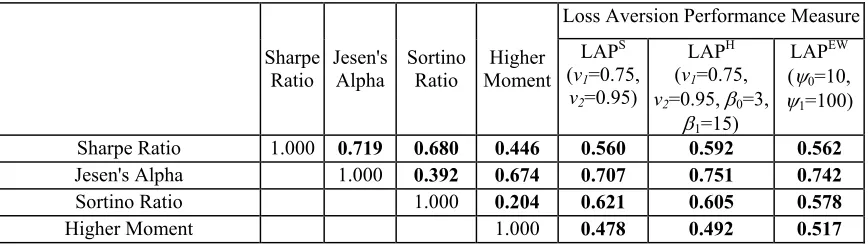
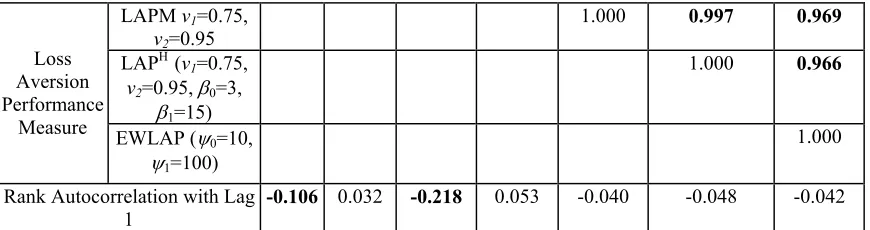
Table 3 reports the average cross-sectional rank-correlation coefficients between the seven performance measures over the nine years, based on the whole sample of 42 funds.14 The first result is that the three LAP measures are very closely related
[image:26.595.85.519.468.591.2](correlations of 0.96 or higher), so that taking account of the house-money effect, which is included within LAPH and LAPEW, does not seem to matter for these funds. The second result is that the LAP measures are related more closely to Jensen’s alpha than to the others – the correlation of the alpha and LAPS is 0.751. This contrasts with a lower correlation of the Sharpe ratio with LAPS, which is 0.591. Jensen’s alpha is also closely related to the HM measure (correlation of 0.674). Although Jensen’s alpha does not take account of asymmetry in the distribution of returns, it is apparent from the table that asymmetry is only of second-order importance in the fund rankings over time. Finally, despite the fact that the Sortino ratio and the LAP measures are concerned with downside risk, the Sortino ratio does not show a stronger relationship with the LAP measures than it does with the three traditional measures.
Table 3 Rank Correlation Coefficients between Performance Measures
Loss Aversion Performance Measure Sharpe
Ratio
Jesen's Alpha
Sortino Ratio
Higher Moment
LAPS (&)=0.75,
&*=0.95)
LAPH (&)=0.75,
&*=0.95, *0=3,
*1=15)
LAPEW (-0=10,
-1=100)
Sharpe Ratio 1.000 0.719 0.680 0.446 0.560 0.592 0.562
Jesen's Alpha 1.000 0.392 0.674 0.707 0.751 0.742
Sortino Ratio 1.000 0.204 0.621 0.605 0.578
Higher Moment 1.000 0.478 0.492 0.517
12 We use 3
0 (
* so that -()")@3 since -(A-""1)@0. We set *1(15 after trying several different values for *1 from 3 to 30. When *1(10 and the standard deviation of A-""1 is 0.05, the values of
1 1A-""
* range from –1.5 to 1.5 in 95% of cases. 13 When 10
0(
- and -1(100, we have -(,")@10 since -(A-""1)@0. In 95% of cases ," belongs to the range between 5 and 15 when the standard deviation of A-" is 0.05. For the >?@, and >?@-! we
have tried several different parameter values, but our results do not show significant differences. For the curvature parameters of the >?@, , we have used &
)=0.75 and &*=0.95 as suggested by Hwang and
Satchell (2005).
LAPM &)=0.75,
&*=0.95
1.000 0.997 0.969
LAPH (&
)=0.75,
&*=0.95, *0=3,
*1=15)
1.000 0.966 Loss
Aversion Performance
Measure EWLAP ( -0=10,
-1=100)
1.000
Rank Autocorrelation with Lag
1 -0.106 0.032 -0.218 0.053 -0.040 -0.048 -0.042
Note: The performance measures are calculated annually using 12 monthly returns. Rank
cross-correlations between measures are then calculated each year using all 42 investment trusts, and then these correlation coefficients have been averaged over the 9 year period. The bold numbers represent
[image:27.595.85.520.84.199.2]significant at the 5% level.
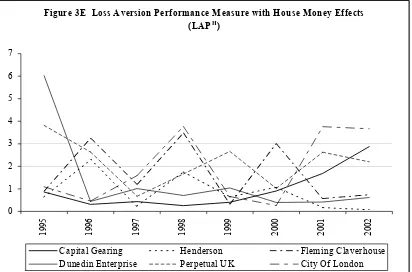
Figure 3 plots each of the performance measures for six of the individual funds over the sample period. There is considerable variation over time with respect to which fund performs best, regardless of which measure of performance is used. Clearly the performance of these particular funds is not persistent and that is also indicated by the low rank-autocorrelations in the final row of Table 3.
Another feature which can be seen in Figure 3 is that the different performance
Figure 3 Performance Measures for Six Representative Funds over Time
Figure 3A Sharpe Ratio
-0.6 -0.4 -0.2 0 0.2 0.4 0.6 0.8 1 1.2 1.4
1994 1995 1996 1997 1998 1999 2000 2001 2002
Capital Gearing Henderson Fleming Claverhouse Dunedin Enterprise Perpetual UK City Of London
[image:28.595.91.501.467.746.2]
Figure 3B Jensen's Alpha (multiplied by 100)
-4 -3 -2 -1 0 1 2 3
1994 1995 1996 1997 1998 1999 2000 2001 2002
Figure 3C Sortino Ratio
-400 -200 0 200 400 600 800 1000 1200
1994 1995 1996 1997 1998 1999 2000 2001 2002
[image:29.595.89.500.89.377.2]Capital Gearing Henderson Fleming Claverhouse Dunedin Enterprise Perpetual UK City Of London
Figure 3D Loss Aversion Performance M easure (LAPS)
0 2 4 6 8 10 12 14 16 18 20
1994 1995 1996 1997 1998 1999 2000 2001 2002
Figure 3E Loss Aversion Performance M easure w ith H ouse M oney Effects (LAPH)
0 1 2 3 4 5 6 7
1995 1996 1997 1998 1999 2000 2001 2002
[image:30.595.90.500.403.697.2]Capital Gearing Henderson Fleming Claverhouse Dunedin Enterprise Perpetual UK City Of London
Figure 3F Exponentially W eighted Loss Aversion Performance M easure (LAPEW)
0 1 2 3 4 5 6 7 8
1995 1996 1997 1998 1999 2000 2001 2002
Finally in relation to Figure 3, the three LAP measures pick out City of London as a good performer in 1998, 2001, and 2002, but not in other periods, while the other conventional measures do not show City of London as a good performer at all. This is an example of how one fund could be preferred to the others if investors are loss-averse.
3.4 Do the Performance Measures Correlate with the Desired Moments of
the Distribution?
From an investor’s viewpoint, “good performance” is related positively to the mean and skewness and negatively related to the variance and kurtosis. Investors like larger first and third moments of the distribution (mean and skewness), while they dislike larger second and fourth moments of the distribution (variance and kurtosis) since these are measures of dispersion (risk). In Table 4 we report rank correlations between the
performance measures and these moments of the distribution, both for NAV returns and for tracking errors.
Starting with the NAV performance in Panel A of Table 4, note first that we only give results for the four traditional measures (Sharpe, Jensen, Sortino, HM) because the LAP measures are only relevant for tracking errors. All four traditional measures are
positively correlated with the mean and negatively correlated with the standard
deviation, with the exception of the Sortino ratio. Jensen’s alpha is the only measure to give a significantly positive correlation with skewness, and no measure gives a negative correlation with kurtosis. In fact the measures are positively related to kurtosis.
negative relationship with the skewness of tracking errors.15 Only the LAP measures give significant negative correlations with kurtosis.
[image:32.595.85.453.317.410.2]The results in Table 4, Panel B, tend to support the loss-aversion (LAP) measures. If tracking errors matter, then one of the LAP measures may be preferred by an investor because they are positively related with the level of tracking errors, and negatively related to volatility and kurtosis of tracking errors.
Table 4 Rank Correlation Coefficients between Performance Measures and NAV Log-returns and Tracking Errors
A. Cross-sectional Rank Correlation Coefficients between Performance Measures and the First Four Moments of NAV log-returns
The First Four Moments of NAV
Log-returns Sharpe Ratio Jesen's Alpha Sortino Ratio
Higher Moment
Mean 0.856 0.649 0.807 0.395
Std. Dev. -0.161 -0.139 0.053 -0.112
Skewness 0.027 0.209 -0.083 -0.199
Kurtosis 0.160 0.164 0.110 0.175
B. Cross-sectional Rank Correlation Coefficients between Performance Measures and the First Four Moments of Tracking Errors
Loss Aversion Performance Measure The First Four
Moments of Tracking Errors
Sharpe Ratio
Jesen's Alpha
Sortino Ratio
Higher
Moment LAP S (&)=0.75,
&*=0.95)
LAPH (&)=0.75,
&*=0.95, *0=3,
*1=15)
LAPEW (-0=10,
-1=100)
Mean 0.626 0.746 0.641 0.484 0.898 0.903 0.879
Std. Dev. 0.111 0.224 -0.038 0.091 -0.128 -0.069 0.017 Skewness -0.054 0.024 0.013 -0.077 -0.061 -0.013 -0.107 Kurtosis -0.089 -0.083 -0.027 -0.058 -0.151 -0.135 -0.146
Notes: All loss aversion performance measures and NAV and TEs statistics are non-normal with Jarque-bera statistics at 5% significance level and thus we calculate correlation coefficients based on ranks of the measures and the first four moments of NAV returns and tracking errors. The results are calculated by averaging 9 years cross-sectional rank correlations between performance measures and the four moments of NAV returns and tracking errors from May 1993 to April 2002 for 42 closed-end funds. The bold numbers represent significance at the 5% level.
4 The Closed-End-Fund Puzzle and Performance Measures
The main puzzle related to closed-end funds is that they trade at a discount to their net-asset values. This has already been noted for our sample in the final column of Table 1. The puzzle has been investigated by many authors and suggested reasons for its
existence include management fees, tax liabilities, illiquid assets, past performance, agency problems, tax inefficiency, and market segmentation.16 The failure of explanations based on efficient markets and rationality has led to a behavioural explanation, that the discount reflects the (irrational) sentiment of investors who are able to move prices within a wide channel because of limited arbitrage.17
Figure 4A plots the average discounts of all UK closed-end funds over our sample period, together with the average discounts for the two sample groups (AllShare and SmallCap). There is an upward trend in the discount over the period, with the SmallCap discount always larger than that for the AllShare group, possibly reflecting the greater costs in replicating a portfolio of small-firm shares.
One way to consider the discount is that it is equal to one minus the familiar book ratio. If investors are happy with a fund’s performance, they raise the market-to-book ratio and, for a closed-end fund, this is reflected in a smaller discount. The
relevance of this to the present study is that “performance is in the eye of the beholder”. If one performance measure is more reflective of investor preferences than another, then funds which perform well according to this measure should also have smaller discounts. That is the hypothesis which we are going to test.
16 See Dimson and Minio-Kozerski (1999) for a literature survey on closed-end funds.
Figure 4 Investment Trusts Discounts and Performance Measures
Figure 4A Investment Trust Discounts
-5% 0% 5% 10% 15% 20% 25%
Apr-93 Apr-94 Apr-95 Apr-96 Apr-97 Apr-98 Apr-99 Apr-00 Apr-01 Apr-02
FTSE All-Share FTSE SmallCap Entire Investment Trusts
Figure 4B Rank Cross-correlation between Discounts and Performance Measures
-0.6 -0.3 0 0.3 0.6
Apr-94 Apr-95 Apr-96 Apr-97 Apr-98 Apr-99 Apr-00 Apr-01 Apr-02
In Panel A of Table 5 we examine whether discounts relate to the moments of the return distributions (either log returns or tracking errors) and in Panel B of Table 5 we
examine whether discounts relate to each of the performance measures. All of the results in the table are based on annual rankings and correlations, so each number in the table is an average for the 9 years of results (or 8 years for LAPH and LAPEW , which require a one-year lag).
In Panel A the cross-sectional rank correlation coefficients between the discounts of the 42 closed-end funds and the first four moments of returns (i.e., mean, standard deviation, skewness and kurtosis) are given. This is done both for NAV returns (upper half of Panel A) and for tracking errors (lower half of Panel A). Few of the correlations are significant at the 5% level. We would expect the discounts to be smaller for funds which have higher NAV returns and this is supported by the negative values in the first row, but these are not statistically significant. Where there are significant correlations in Panel A, they suggest that discounts are larger: (i) for those AllShare funds which have high kurtosis; (ii) for those SmallCap funds which have a large standard deviation for their tracking errors.
Figure 4B plots the rank correlations between the performance measures and discounts year-by-year. A negative correlation would indicate that discounts are smaller when performance is good, but there is no clear “winner” in the contest to see which measure has the highest negative correlation. Measures which are worst in some periods are best in others. Panel B of Table 5 averages the annual data plotted in Figure 4B and
confirms that discounts are not related to any of the performance measures: none of the correlations are significant. We hypothesised that the LAP measures would relate more closely to the discount than would the traditional measures, because investors exhibit loss-aversion, but we are not able to show that. The results do not support arguments that the discount is related to simple measures of past performance. Nevertheless, it remains possible that there is some more complicated relationship between past
Table 5 Cross-sectional Rank Correlation Coefficients between Closed-end Fund Discounts and Various Statistics and Performance Measures
A. Rank Correlation between Discounts and the First Four Moments of NAV Log-returns and Tracking Errors
All 42 Closed-end Funds
19 AllShare Funds
23 SmallCap Funds
NAV Log-returns -0.065 -0.044 -0.049
Standard Deviation
of NAV Log-returns 0.107 0.035 0.006
Skewness of NAV
Log-returns 0.075 -0.082 -0.009
Correlation between Discounts and the First Four Moments of NAV
Log-returns Kurtosis of NAV
Log-returns 0.043 0.188 0.044
Tracking Errors 0.018 -0.044 -0.049
Standard Deviation
of Tracking Errors 0.291 0.070 0.163
Skewness of
Tracking Errors -0.032 0.054 0.008
Correlation between Discounts and the First Four Moments of
Tracking Errors Kurtosis of Tracking
Errors -0.017 -0.001 0.001
B. Rank Correlation between Discounts and Performance Measures
All 42 Closed-end Funds
Sharpe Ratio -0.028
Jesen's Alpha 0.029
Sortino Ratio -0.096
HM Measure -0.029
LAPS, &
)=0.75, &*=0.95 -0.026
LAPH, &
)=0.75, &*=0.95 -0.006
LAPEW 0.035
Notes: The table is calculated with ranks on the NAV log-returns, tracking errors, and discounts for the 42 closed-end funds. Each year we calculate correlation coefficients based on ranks of the discounts and the first four moments of NAV returns and tracking errors. The results are calculated by averaging these 9 years cross-sectional rank correlations. The bold numbers represent significance at the 5% level.
5 Conclusions
loss-aversion-performance measures have great intuitive appeal, since they just compare weighted expected gains relative to weighted expected losses. They can also be
interpreted as the value of an upside call option relative to a downside put option, with the benchmark return as the exercise price.
Performance measures are practical tools for investors. Two questions can be asked in relation to our new measures. The first is whether the new measures attribute different performance to funds than do traditional measures? The second is, even if there is a difference between the new measures and the old measures, do investors care about it? We use a sample of 42 closed-end funds observed monthly over the ten-year period, March 1993 to April 2002, to address these questions.
With respect to the first question, the loss-aversion measures do show different performance, particularly as they are applied to tracking errors and not to portfolio returns. They are positively related in cross-section to (positive) tracking errors, but negatively related to the volatility and kurtosis of such errors. The other measures do not behave in this way and are therefore less appropriate if the user is loss-averse. With respect to the second question, experimental evidence suggests that loss-aversion is important in many situations, but there is no evidence from the behaviour of discounts on the closed-end funds in our sample to suggest that investors bid-up the prices of funds which score well by any performance measure. Either our sample is too small, or loss-aversion does not matter, or investors are not basing their expectations of future performance on the recent past.
References
Amenc, N. and V. Le Sourd, 2005, “Rating the Ratings”, Edhec Risk and Management Centre, Lille.
Ang, A., G. Bekeart, and J. Liu, 2004, "Why Stocks May Disappoint," forthcoming, Journal of Financial Economics.
Artzner, P, 1999, Coherent Measures of Risk, Mathematical Finance 9(3), 203-228.
Barberis, N., M. Huang, and T. Santos, 2001, "Prospect Theory and Asset Prices," Quarterly Journal of Economics, 116(1), 1-53.
Benartzi, S. and R. H. Thaler, 1995, "Myopic Loss Aversion and the Equity Premium Puzzle", Quarterly Journal of Economics, 110(1), 73-92.
Burnes, J., Neilson, W., 2002. A Further Examination of Cumulative Prospect Theory Parameterizations. Journal of Risk and Uncertainty 24, 31-46.
Carhart, Mark M., 1997, "On Persistence In Mutual Fund Performance," Journal of Finance, 52(1), 57-82.
Chay, J. B. and C. Trzcinka, 1999, "Managerial Performance and the Cross-sectional Pricing of Closed-end Funds, Journal of Financial Economics 52, 379-408.
Chen, Z., and P. J. Knez, 1996. Portfolio Performance Measurement: Theory and Applications, Review of Financial Studies 9(2), 511-555.
Clarke, R. G., S. Krase, and M. Statman, 1994, “Tracking Errors, Regret, and Tactical Asset Allocation”, Journal of Portfolio Management, Spring, 16-24.
Connor, G., and R. Korajczyk, 1986. Performance Measurement with the Arbitrage Pricing Theory: A new Framework for Analysis, Journal of Financial Economics 15, 374-394.
Cumby, R., and J. Glen, 1990. Evaluating the performance of international mutual funds, Journal of Finance 45, 497-521.
DeLong, J. B., A. Shleifer, L. H. Summers, and R. J. Waldmann, 1990, "Positive-Feedback Investment Strategies and Destabilizing Rational Speculation," Journal of Finance 45(2), 374-397.
Dimson, E. and C. Minio-Kozerski, 1999, Closed-End-Funds: A Survey, Financial Markets, Institutions and Instruments 8(2), 1-41.
Fielding, David and Livio Stracca, 2003, “Myopic Loss Aversion, Disappointment Aversion, and the Equity Premium Puzzle”, working paper no. 203, European Central Bank, Frankfurt.
Fishburn, Peter C, 1977. "Mean-Risk Analysis with Risk Associated with Below-Target Returns," American Economic Review, Vol. 67 (2) pp. 116-26.
Fishburn, P. C. and G. A. Kochenberger, 1979, "Concepts, Theory, Techniques; Two-piece Von Neumann-Morgenstern Utility Functions," Decision Sciences, 10, 503-518.
Gemmill, G. and Thomas, D., 2002. Noise Trading, Costly Arbitrage and Asset Prices: Evidence from Closed-End Funds, Journal of Finance 57, 2571-2594.
Glosten, L. R. and R. Jagannathan, 1994. A Contingent Claim Approach to Performance Evaluation, Journal of Empirical Finance 1, 133-160.
Grinblatt, M., and S. Titman, 1989. Portfolio Performance Evaluation: Old Issues and New Insights, Review of Financial Studies 2(3), 393-421.
Grinblatt, M., and S. Titman, 1994. A study of Monthly Mutual Fund Returns and Performance Evaluation Techniques, Journal of Financial and Quantitative Analysis 29(3), 419-444.
Gul, Faruk, 1991. "A Theory of Disappointment Aversion," Econometrica, Vol. 59 (3) pp. 667-86.
Gupta, Francis, Robertus Prajogi and Eric Stubbs, 1999. The Information Ratio And Performance, Journal of Portfolio Management, 26(1), 33-39.
Hwang, S. and M. Salmon, 2002, An Analysis of Performance Measures using Copulae, in J. Knight and S. Satchell eds., Performance Measurement in Finance: Firms, Funds and Managers, Butterworth-Heinemann, London."
Hwang, S., and S. Satchell, 1998. Evaluation of Mutual Fund Performance in Emerging Markets, Emerging Markets Quarterly 2(3), 39-50.
Hwang, S., and S. E. Satchell, 2005. The Magnitude of Loss Aversion Parameters in Financial Markets, Unpublished manuscript, Cass Business School.
Jensen, M, 1968. The performance of mutual funds in the period 1945-1964, Journal of Finance 23, 389-416.
Kahneman, D. and A. Tversky, 1979, "Prospect Theory: An Analysis of Decision Under Risk," Econometrica 47, 263-291.
Keating, C. and W. F. Shadwick, 2002. A Universal Performance Measure, Journal of Performance Measurement 6(3), 59–84.
Lee, M. C., A. Shleifer, and R. Thaler, 1991, “Investor Sentiment and the Closed-End Fund Puzzle”, Journal of Finance 46(1), 75-109.
Lehmann, B., and D. Modest, 1987. Mutual fund performance evaluation: A
comparison of benchmarks and benchmark comparisons, Journal of Finance 42, 233-265.
Levy, M., and H. Levy, 2002. Prospect Theory: Much Ado About Nothing?, Management Science 48(10), 1334-1349.
Margrabe, W., 1978, “The Value of an Option to Exchange One Asset for Another”, Journal of Finance 33, 177-86.
Roll, R., 1992, “A Mean/Variance Analysis of Tracking Error,” Journal of Portfolio Management, 13-22.
Pope, P. and P. K. Yadav, 1994, Discovering Error in Tracking Error, Journal of Portfolio Management (Winter 1994), 27-32.
Rudolf, M., H. Wolter, and H. Zimmermann, 1999, “A Linear Model for Tracking Error Minimization,” Journal of Banking and Finance 23, 85-103.
Sharpe, W., 1966. Mutual Fund Performance, Journal of Business 39, 119-138.
Sortino, F. and Van der Meer (1991), Downside risk, Journal of Portfolio Management, 27-31.
Thaler, R. and E. Johnson (1990), "Gambling with the House Money and Trying to Break Even: The Effects of Prior Outcomes on Risky Choice," Management Science 36, 643-660.
Treynor, J., 1965. How to Rate Management of Investment Funds, Harvard Business Review 43, 63-75.
Treynor, J., and K. Mazuy, 1966. Can Mutual Funds Outguess the Market?, Harvard Business Review 44, 131-136.
Tversky, A. and D. Kahneman, 1992, "Advances in Prospect Theory: Cumulative Representation of Uncertainty," Journal of Risk and Uncertainty 5, 297-323.
Wermers, R., 1996, "Momentum Investment Strategies of Mutual Funds, Performance Persistence, and Survivorship Bias. Unpublished working paper, University of Colorado at Boulder.