University of Warwick institutional repository: http://go.warwick.ac.uk/wrap
This paper is made available online in accordance with
publisher policies. Please scroll down to view the document
itself. Please refer to the repository record for this item and our
policy information available from the repository home page for
further information.
To see the final version of this paper please visit the publisher’s website
.
Access to the published version may require a subscription.
Author(s): F Rigat and A Mira
Article Title: Parallel hierarchical sampling: a general-purpose class of
multiple-chains MCMC algorithms
Year of publication: 2009
Link to published article:
http://www2.warwick.ac.uk/fac/sci/statistics/crism/research/2009/paper
09-37
Parallel hierarchical sampling: a general-purpose
class of multiple-chains MCMC algorithms
Fabio Rigat∗
Antonietta Mira†
September 29th, 2009
Abstract
This paper introduces the Parallel Hierarchical Sampler (PHS), a class of Markov chain Monte Carlo algorithms using several interact-ing chains havinteract-ing the same target distribution but different mixinteract-ing properties. Unlike any single-chain MCMC algorithm, upon reaching stationarity one of the PHS chains, which we call the “mother” chain, attains exact Monte Carlo sampling of the target distribution of inter-est. We empirically show that this translates in a dramatic improve-ment in the sampler’s performance with respect to single-chain MCMC algorithms. Convergence of the PHS joint transition kernel is proved and its relationships with single-chain samplers, Parallel Tempering (PT) and variable augmentation algorithms are discussed. We then provide two illustrative examples comparing the accuracy of PHS with
∗Department of Statistics and Centre for analytical Science, University of Warwick,
†Professor of Statistics, Department of Economics, University of Insubria, Italy;
that of various Metropolis-Hastings and PT for sampling multimodal mixtures of multivariate Gaussian densities and for ’banana-shaped’ multivariate distributions with heavy tails. Finally, PHS is applied to approximate inferences for two Bayesian model uncertainty prob-lems, namely selection of main effects for a linear Gaussian multiple regression model and inference for the structure of an exponential treed survival model.
Keywords: Bayesian model selection, classification and regression trees, Gaussian mixtures, heavy tails, linear regression, Metropolis-Hastings algorithm, multimodality, multiple-chains Markov chain Monte Carlo methods, survival analysis.
Introduction
Let θ ∈ Θ be a random variable with cumulative distribution function
F(θ) and probability density or probability mass function f(θ). Also let
Kf(θi, θi+1) be a transition kernel defining the probability that a Markov
chain, having state-space Θ and withf(θ) as its target distribution, jumps from a current state θi to a new state θi+1. Markov chain Monte Carlo
(MCMC) algorithms generate sequences of dependent draws{θi}Ni=1 having
f(θ) as their stationary distribution (Gelfand and Smith [1990], Smith and Roberts [1993], Neal [1993], Gilks et al. [1995b], Gamerman [1997], Robert and Casella [1999] and Liu [2001]). A sufficient set of conditions for conver-gence fulfilled by almost all current MCMC algorithms is that Kf(θi, θi+1)
the-orem hold for any functiong(·)∈L2(F) (Tierney [1994]).
(Hukushima and Nemoto [1996], Hansmann [1997], Rosenthal [2000], Iba [2001], Myers and Laskey [2001], Zheng [2001], Corander et al. [2006], Jasra et al. [2007]), trans-dimensional algorithms (Green [1995], Liu and Sabatti [1998], Stephens [2000], Green and Mira [2001], Brooks et al. [2003], Capp´e et al. [2003], Petris and Tardella [2003], Sission [2005]) and Monte Carlo variance reduction methods (McKeague and Wefelmeyer [2000], Mira and Sargent [2003]). More general approaches to improving mixing of tradi-tional MCMC algorithms have focussed on the optimal scaling of proposal distributions (Roberts et al. [1997], Roberts and Rosenthal [1998a], Roberts and Rosenthal [2001], Neal and Roberts [2006], Neal et al. [2007], B´edard and Rosenthal [2008]) and on the construction of adaptive proposal distri-butions (Tierney and Mira [1991], Gilks and Wild [1992], Gelfand and Sahu [1994], Gilks et al. [1994], Gilks et al. [1995a], Gilks et al. [1998], Liu et al. [1997], Haario et al. [1999], Liu et al. [2001], Haario et al. [2001], Chauveau and Vandekerkhove [2002], Gasemyr [2003], Haario et al. [2005], Atchad´e and Rosenthal [2005], Brockwell and Kadane [2005], Haario et al. [2006], Roberts and Rosenthal [2007], Roberts and Rosenthal [2008], Bai [2009], Bai et al. [2009]). These recent developments have greatly improved the empirical performance of MCMC algorithms, allowing for a substantial ex-pansion of the domain of application of Bayesian methods, mainly by trading the simplicity of samplers for a reduction in Monte Carlo error. Partially as a result of this trend, the popularity of MCMC software such as Win-Bugs (Lunn et al. [2000]) or MrBayes (Huelsenbeck and Ronquist [2005]) has steadily increased.
(PT) and they fully exploit cross-chain swap transitions to maximise mixing of one chain, which we call the “mother” chain. The drawbacks of tempered distributions are overcome by using different proposal distributions for each auxilliary chain rather than different marginal target densities. This strat-egy has two main advanteges. First, it allows mixing simulateneously over many proposal settings, which is an important advantage when analytical results on optimal proposal scaling or proposal adaptation are not easy to derive. A unique optimal proposal scaling might not in fact even exist as different proposal scalings might be optimal within different subsets of the domain unless regularity conditions on the target distribution are met. For instance, a single proposal kernel may not be optimal to explore both very narrow and wide peaks. Second, our multi-chain strategy can incorporate any combination of single-chain MCMC samplers. This is of great practical relevance allowing for fast implementation of our methods using existing computer code, especially in a research environment where distributed com-puting is becoming mainstream (Ren and Orkoulas [2007], Hu and Tsui [2008]).
densities (Haario et al. [1999], Haario et al. [2001]). These examples evaluate the relative accuracy of PHS respectively in case of multimodality and heavy tails. Sections 3 and 4 illustrate two applications of PHS for Bayesian model selection. First, we consider the standard problem of selecting significant main effects for the Gaussian linear regression model. Second, we use PHS to approximate marginal posterior inferences for the high level interactions defining the structure of a treed survival model. Section 5 concludes the paper discussing open problems and research opportunities in the field of multiple chains MCMC samplers.
1
Tempered and untempered multi-chains MCMC
algorithms
In parallel to the development of novel single-chain samplers, the last twenty years have also witnessed the birth of multi-chain MCMC algorithms. The latter have been pioneered in conjunction with the use of tempered distribu-tions by Swedensen and Wang [1987] and Hukushima and Nemoto [1996] in statistical mechanics and by Geyer [1991] in statistics. For each value of a chain indexm∈[1, M] withM <∞fixed, a tempered version of the target posterior distribution is defined by “powering up” its density
fm(θ|X) =
f(θ|X)Tm1
Cm(X)
, (1)
where 1 =T1 ≤ T2 ≤ ...≤ TM < ∞ is a vector of temperature levels and
Cm(X) =
R
Θfm(θ |X)dθ is a positive and finite normalising constant
de-pending on the temperature parameter Tm and on the data X. Here Tm
of interestf1(θ|X). The key advantage of these algorithms is that detailed
balance (DB) is preserved with respect to the marginal target distribution of each chain although different chains interact along the sampling process. Within-chain DB is achieved by coupling anupdatestep with aswapstep us-ing the standard Metropolis rule. Metropolis-coupled MCMC (Geyer [1991], Hukushima and Nemoto [1996]), Parallel Tempering (Geyer and Thomp-son [1995]) and replica Monte Carlo (Swedensen and Wang [1987]) have been found to yield empirically reliable estimates especially when analogies to physical temperatures can be exploited to tune the sampler. In sta-tistical mechanics, temperatures are chosen with reference to the physical properties of the systems being modeled, such as the energy barriers be-tween electron excitation states implied by successive temperature levels. The equilibrium distributions sampled for applications in statistics seldom possess analogous interpretations, making temperature tuning a laborious process (Geyer and Thompson [1995], Neal [1996]). A second limitation to using auxilliary tempered distributions for Bayesian computations is that in general it is difficult to check whether a tempered posterior density is still proper. For instance, a sufficient condition ensuringCm(X)<∞is that the
Kullback-Leibler divergenceKL(f1, fm) = R
Θf1(θ |X) log
f1(θ|X)
fm(θ|X)dθ of the
untempered proper posterior density f1(θ | X) from its tempered version
fm(θ|X) is finite. When this is not the case, the Metropolis rule cannot be
tempered chains are appropriately reweighted.
In what follows we let the indicator si = 0 if each of the M chains is
updated independently at iteration i of the sampler and si = 1 if swap is
chosen instead. The proposal probability q′s(si | si−1) describes how the
two steps are combined along the sampling. For instance, Geyer [1991] adopts the deterministic proposal q′s(si | si−1) = 1{si−1=0}, whereas Liu
[2001] defines an independent PT sampler using qs′(si | si−1) = s where
s ∈ (0,1) is a fixed swap proposal rate. Let the indexes j and k range over the set of chains (1, ..., M) and let θi,j indicate the state of chain j at
iterationi. We denote withq′′s(θi,j, θi,k) the probability that, at iteration i,
a swap is proposed between the current values of the chains with indexes (j, k). In Geyer [1991], Hukushima and Nemoto [1996] and Liu [2001] this proposal is taken to be uniform over all values of the ordered couple (j, k) withk6=j and. A swap is accepted with Metropolis probability
αs([θi,j, θi,k],[θi,k, θi,j]) = 1∧
fj(θi,k|X)fk(θi,j|X)
fj(θi,j|X)fk(θi,k|X), (2)
ensuring the reversibility of the sampler with respect to its joint target density µ(θM |X, T1, ..., TM) = QmM=1fm(θ | X), where θM is the M-fold
product of the random variableθ. When the independent updates of chainm
are carried out using a single Metropolis-Hastings (MH) step with common proposalq(·), the joint transition kernel of the PT sampler is
KP T(θM,i, θM,i+1) = (1−q ′
s(si |si−1)) M Y
m=1
q(θi+1,m|θi,m)αM H(θi,m, θi+1,m) +
+qs′(si|si−1) M X
ji=1
M X
ki=1
ki6=ji
q′′s(θji, θki)αs([θi,j, θi,k],[θi,k, θi,j]), (3)
whereθM,i= [θi1, ..., θiM] represents the joint state of all M chains at
iter-ation i and we assume without loss of generality that R
θi,j)dθ= 1. From (3) it can be seen that, with respect to the standard MH
algorithm, PT can increase mixing for all chains through their successful swaps. Analogously to the MH algorithm, the irreducibility and aperiodic-ity of (3) critically depend on the proposal distributions for within-chains updatesq(·) and on that of the cross-chains swapsqs′′(·). A proof of conver-gence of the PT algorithm is sketched in Hukushima and Nemoto [1996].
1.1 Parallel Hierarchical Sampling
In this paper we consider an alternative class of multiple-chains MCMC samplers which proceed by carrying out both the following two steps at each iteration:
i) draw the index mi ∈ [2, ..., M] from a discrete proposal distribution
qs′′(mi |mi−1) and swap the current value of chainmi with that of the
mother chain;
ii) update independently the remaining M −2 chains each having the same marginal target distributionf(θ|X).
the conditions illustrated in Tierney [1994] so that they are irreducible and aperiodic with respect to their common marginal target distribution f(θ |
X). In addition, we assume that the symmetric proposal distribution q′′s(·) allows for swaps between the mother chain and any of the other chains. Under these conditions the marginal transition kernel for the mother chain of the PHS algorithm is irreducible and aperiodic with respect to its target distribution. If the joint PHS transition kernel is also reversible with respect to the product density µ(θM | X) having all marginals equal to f(θ | X),
thenµ(θM |X) is its unique joint stationary distribution. The reversibility
of the PHS is proved in the following theorem.
Theorem 1 The PHS transition kernel satisfies detailed balance with
re-spect to the joint distribution having product density or probability mass
functionµ(θM |X).
Proof The DB condition for the PHS algorithm is
µ(θM,i)
µ(θM,i+1)
= KP HS(θM,i+1, θM,i)
KP HS(θM,i, θM,i+1)
, (4)
where KP HS(θM,i+1, θM,i) is the PHS joint transition kernel. When the
independent updates of the auxilliary chains are carried out via a MH step, the PHS joint transition kernel is
KP HS(θM,i, θM,i+1) =
M X
mi+1=2
qs′′(mi+1|mi)×
QM
j=2
j6=mi+1
qj(θi+1,j |θi,j)αM H(θi,j, θi+1,j), (5)
where the within-chain proposal probabilities qj(·) and, as a consequence,
the MH acceptance probabilitiesαM H(θi,j, θi+1,j) are now dependent on the
that R
θαM H(θi,j, θ)qj(θ|θi,j)dθ = 1. Each summand in (5) is the product
of the marginal transition kernel for the swap transition and those of the (M −2) independent MH updates for the remaining chains. The former coincides with the proposalqs′′(mi|mi−1) because the PHS swap acceptance
ratio is equal to one. This is a straightforward simplification of (2) when all temperatures are equal to 1. Under (5) the DB condition (4) can be rewritten as
M X
mi=2
qs′′(mi|mi−1)
M Y
j=2
j6=mi
f(θi,j|X)qj(θi+1,j |θi,j)αM H(θi,j, θi+1,j) =
=
M X
mi=2
qs′′(mi−1|mi)
M Y
j=2
j6=mi−1
f(θi+1,j |X)qj(θi,j |θi+1,j)αM H(θi+1,j, θi,j). (6)
For any given value ofmi, by the reversibility of the MH transition kernels
with respect to the marginal density f(θ |X), the M −2 transition prob-abilities on the left-hand side of (6) are equal to their corresponding terms on the right-hand side. By taking qs′′(·) symmetric with respect to mi and
mi−1, for all values of mi each summand on the left-hand side of (6) equals
its corresponding term on the right-hand side, so that the equality (6) holds.
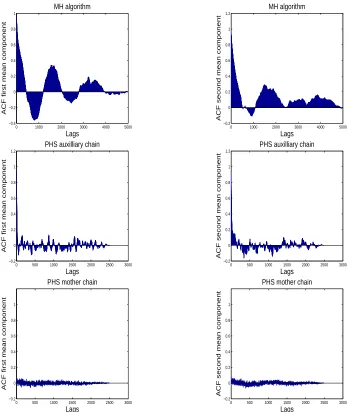
mother chain destroys the autocorrelation structure which is typically im-plied by Metropolis-Hastings type of algorithms. We emphasize this point in the next section by comparing the empirical autocorrelation functions (ACF) and the integrated auto-correlation time (IAT) of the chains generated by the PHS and the MH.
Equation (5) also shows that, as for the MH and PT algorithms, PHS does not require knowledge of the finite normalising constant of its marginal target distributions C(X) =R
Θf(θ |X) and this makes it a suitable
sam-pler for Bayesian applications. Furthermore, in light of the specific form of the joint PHS target density µ(θM | X) the proposal distribution for
within-chains updates in (5) can be generalised to qj(θi+1,j |θi,−j), where
θi,−j = (θi,1, ..., θi,j−1, θi,j+1, ..., θi,M). This allows introducing mutual
repul-sion among the values proposed for the update of different chains along the lines of Green and Han [1991]. For example, when the set of conditional within-chain proposalsqj(·) are Gaussian, they can be constructed so that
the joint proposal for the update for chains (2, ..., M) is multivariate Normal with negative correlations.
Equations (3) and (5) show that the PHS swap proposal has a simpler form than that of PT. This is because at each iteration the PHS transition kernel mixes both update and swap steps whereas in PT they are alternated according to the proposal probability qs′(si | si−1). Thus, unlike PT, the
PHS algorithm does not create unnecessary competition between local and global mixing when the update steps generate local transitions and the swaps produce larger jumps.
shown in the Corollary below.
Corollary 1 Each of the auxilliary chains of the PHS algorithm having
transition kernel (5) is stationary with respect to the distribution f(θ|X).
Proof For any value θ∗ ∈ Θ, the stationarity condition for the auxilliary
chainj= 2, ..., M + 1 is
Z
Θ
f(θ|X)KP HS,j(θ, θ∗)dθ=f(θ∗|X), (7)
where the transition kernel of thej-th chain is
KP HS,j(θ, θ∗) =q ′′
s(j|m)f(θ∗ |X) +
(1−qs′′(j|m))qj(θ∗|θ)αM H(θ, θ∗). (8)
Substituting (8) in (7) and using
Z
Θ
f(θ|X)qj(θ∗|θ)αM H(θ, θ∗)dθ =f(θ∗ |X),
the identity of the left and right terms of equation (7) is verified.
In conjunction with the assumed aperiodicity condition and with the re-versibility of the PHS kernel, this Corollary implies that the distribution of interest, f(θ | X), is the unique stationary distribution of any of the auxilliary PHS chains. Since the mother chain performs exact Monte Carlo sampling drawing from the auxilliary chains, (7) implies that the same target is the unique stationary distribution of the mother chain.
the performance of this PHS algorithm with that of its symmetrised version (sPHS). The latter differs from the above definition of PHS in that at each iteration two chains are chosen uniformly at random and their current states are swapped, whereas all other chains are updated independently. With this symmetrised sampler, the mother chain loses its prominent role as the clear-ing house for swaps between any other pair of chains. Proof of convergence of the sPHS transition kernel can be derived along the lines of Theorem 1 above and it is not reported here.
2
Illustrative examples: multimodality and heavy
tails
In this section we compare the empirical accuracy of single-chain MH ver-sus PHS algorithms for generating samples from multimodal mixtures of Gaussian densities and from the heavy-tailed multivariate distributions of Haario et al. [1999] and Haario et al. [2001]. These two examples have been carefully constructed so as to compare the empirical accuracy of single-chain and multi-chain samplers having fixed their common computational cost.
2.1 MCMC samples from multimodal Gaussian mixtures
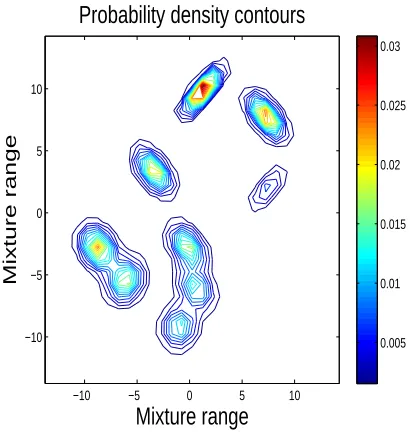
bivariate means µk for k = 1, ...,10 were generated uniformly at random
over the square (−10,10)2 and their variances were all set to 1. The
co-variance between the first and second dimension of each mixture component is Σk(1,2) = Σk(2,1) = Mk+1sign(u ≤ 0.5) where u ∼ U nif orm(0,1) and
k = 1, ...,10, so that the two dimensions of the successive mixture
com-ponents are progressively more correlated, either positively or negatively. The 10 mixture weightswk were generated uniformly at random and then
normalised so as to sum to 1. Figure 1 shows the probability contour of this Gaussian mixture density. As expected, different bivariate modes are separated by throughs where the density is numerically zero.
Mixture range
Mixture range
Probability density contours
−10 −5 0 5 10 −10
−5 0 5 10
[image:16.612.207.412.341.558.2]0.005 0.01 0.015 0.02 0.025 0.03
To generate samples from this Gaussian mixture via MCMC, we first use a standard random walk MH algorithm whith proposal distribution q(θi |δ)
taken to be Normal with mean equal to the current stateθi and varianceδ.
Here we letδ= 3, ensuring an average acceptance rate close to the optimal 0.234 (Roberts and Rosenthal [2001]).
As a first alternative to this vanilla algorithm we consider an other Metropolis-Hastings sampler using a version of the above proposal enriched by a Langenvin term (Roberts and Tweedie [1996a]). At each iterationithis random walk proposal is Normal with meanθi+∇logf(θi|w1:10, µ1:10,Σ1:10)
and variance δ, where logf(θi | w1:10, µ1:10,Σ1:10) is the logarithm of the
probability density for the Gaussian mixture and ∇ stands for the matrix of its partial derivatives with respect to θ. Using the same random walk proposal distribution withδ = 3 we attain an acceptance rate comparable to that of the plain MH sampler.
We compare the accuracy of these two single-chain samplers with that of PHS as described in the previous section and with a symmetrised version of PHS (sPHS). The latter differs from the above definition of PHS in that at each iteration two chains are chosen uniformly at random and their current states are swapped, whereas all other chains are updated independently. With this symmetrised sampler, the mother chain loses its prominent role as the clearing house for swaps between any other pair of chains. For the within-chain updates of both parallel algorithms we use the same type of random walk proposalqm(θi,j |δj) as for the MH algorithm but we let the
varianceδj be chain-specific. In what follows we let δj = j4 for j= 2, ..., M
rates within the range (0.15,0.76).
We calculate Monte Carlo estimates of the two-dimensional Gaussian mixture mean using respectively the samples generated by the MH algo-rithm, the mother chain of the PHS algorithm and the samples generated by all chains of the sPHS algorithm. In a waste-recycle perspective, pooling of the sPHS samples is implemented using two different weighting schemes. In the first scheme we calculate the na¨ıve average of the Monte Carlo esti-mate of each chain
ˆ
θN =
PM
j=1θˆj
M , (9)
where ˆθj is the empirical two-dimensional mean vector calculated from chain
j of the sPHS sampler. In the second scheme, we calculate the weighted Monte carlo estimate
ˆ
θS,i=
M X
j=1
wi,jθˆi,j, (10)
where ˆθi,j is the average of chainj for the mean componenti= 1,2 and the
weight associated to this component of the mean estimate of chain j is
wi,j =
1 IAT(i,j)
PM
j=1 IAT1(i,j)
, (11)
andIAT(i, j) is the integrated auto-correlation time of componentiof chain
j (Sokal [1996]). The latter is estimated using the Gamma method of Wolff [2004]. The pooled estimator ˆθS relatively downweights estimates of the
We compare the empirical accuracy of the three algorithms by repeating these sampling processes for 100 independent runs. In order to make the computational cost for all samplers comparable, each repetition the PHS and sPHS algorithms was run 5000 iterations whereas those of the MH algorithm (random walk and Langevin) were run for 5000×M iterations usingM = 20 auxilliary chains. As a measure of accuracy of a sampler we use its empirical mean square error (MSE) about the mean
MSE =
P100
j=1(θT −Eˆj(θ))(θT −Eˆj(θ))′
100 , (12)
whereθT is the true value of the 2-dimensional Gaussian mixture mean and
ˆ
Ej(θ) is the estimate of θ derived from the jth repetition of the sampling
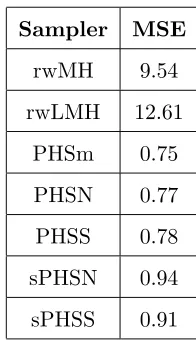
process obtained from thejth repetition of the sampling process using either of the random walk MH algorithm (rwMH), the random walk Langevin MH algorithm (rwLMH), the PHS mother chain (PHSm), the pooled PHS estimators using the the na¨ıve (PHSN) and Sokal (PHSS) weights and the pooled sPHS estimators (sPHSN, sPHSS).
estimators uggests that the PHS mother chain by construction efficiently in-corporates all the information included in all samples of its auxilliary chains. The MSE discrepancies shown in Table 1 are essentially due to the fact that
Sampler MSE
rwMH 9.54 rwLMH 12.61
PHSm 0.75 PHSN 0.77 PHSS 0.78 sPHSN 0.94 sPHSS 0.91
Table 1: empirical mean squared errors of the MCMC estimator for the two-dimensional Gaussian mixture mean. The accuracy of the multiple-chains samplers is found to be superior to that of the estimates obtained by the MH algorithms having fixed a common computational cost.
[image:20.612.254.352.192.363.2]0 1000 2000 3000 4000 5000 −0.4 −0.2 0 0.2 0.4 0.6 0.8 1 Lags
ACF first mean component
MH algorithm
0 1000 2000 3000 4000 5000 −0.2 0 0.2 0.4 0.6 0.8 1 1.2 Lags
ACF second mean component
MH algorithm
0 500 1000 1500 2000 2500 3000 −0.2 0 0.2 0.4 0.6 0.8 1 1.2 Lags
ACF first mean component
PHS auxilliary chain
0 500 1000 1500 2000 2500 3000 −0.2 0 0.2 0.4 0.6 0.8 1 1.2 Lags
ACF second mean component
PHS auxilliary chain
0 500 1000 1500 2000 2500 3000 −0.2 0 0.2 0.4 0.6 0.8 1 Lags
ACF first mean component
PHS mother chain
0 500 1000 1500 2000 2500 3000 −0.2 0 0.2 0.4 0.6 0.8 1 Lags
ACF second mean component
[image:21.612.128.476.128.540.2]PHS mother chain
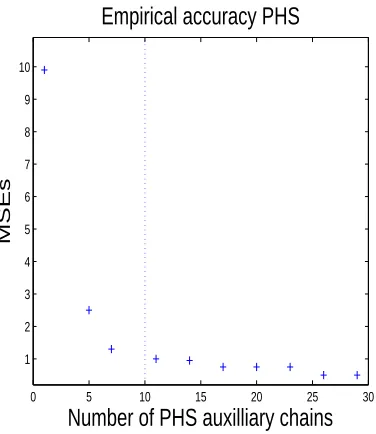
Figure 3 illustrates the empirical relationship between the accuracy of the PHS mother chain estimates and the number of auxilliary chains for this Gaussian mixture example. The MSE of the mean estimator decreases until the number of auxilliary chains reaches the number of Gaussian components in the target density, whereas for M > 10 the sampler achieves almost no further gains in accuracy. These results suggest that, when a target prob-ability density is multimodal, multiple-chain samplers where the number of auxilliary chains roughly matches the number of modes of their target can yield much more accurate Monte Carlo estimates with respect to single-chain samplers having the same computational cost.
2.2 MCMC samples from heavy-tailed Gaussian mixtures
In this section we compare the empirical MSEs (12) for the MH, PHS and sPHS algorithms when their multidimensional target distribution is the non-linear transformation of a Gaussian distribution of Haario et al. [1999]. As opposed to the previous example, here we focus on evaluating the samplers’ accuracy when their target density is heavy-tailed. LetXbe ad-dimensional Gaussian random variable with diagonal covariance matrixChaving all non-zero entries equal to one but for its upper left entry, which is set to 100. The probability density of its non-linear transformation
Y = [X1, X2+b(X12−100), X3, ..., Xd],
0 5 10 15 20 25 30 1
2 3 4 5 6 7 8 9 10
Number of PHS auxilliary chains
MSEs
[image:23.612.213.401.231.448.2]Empirical accuracy PHS
b= 0.03 so that our numerical results can be compared directly with Haario et al. [1999] and Haario et al. [2001].
A comparative evaluation of the empirical precision for MH, PHS and sPHS was carried out by estimating the MSEs of their respective estimators for the 8-dimensional mean, as in section 2.1. Each sampler was run 100 independent times using the same Gaussian proposal distributions and the same number of iterations as in the previous example. The spread of the uni-form random walk proposal distribution for all samplers was set at 1, yielding a MH acceptance ratio of approximately 0.4. The starting point for all sam-plers was set at the origin of the target supportR8. The left panel in Figure
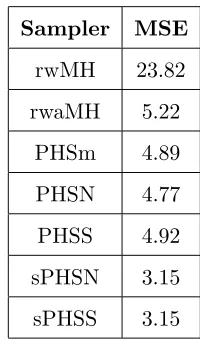
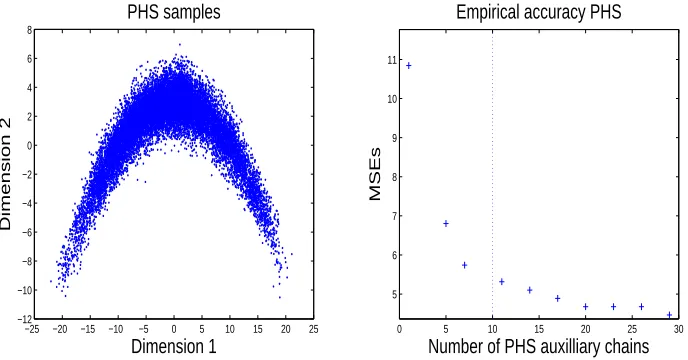
as in Table 1, the MSEs of the weighted estimators PHSN and PHSS are comparable to those derived from the PHs mother chain. The right panel in
Sampler MSE
rwMH 23.82 rwaMH 5.22
[image:25.612.253.353.172.344.2]PHSm 4.89 PHSN 4.77 PHSS 4.92 sPHSN 3.15 sPHSS 3.15
Table 2: empirical mean squared errors of the MCMC estimator for the eight-dimensional banana-shaped distribution. The two versions of the parallel sampler using 20 auxilliary chains yield mean estimators of comparably better precision with respect to those of the random-walk MH algorithm. The precision of the multiple chains samplers is found to be comparable to that of the single-chain adaptive MH sampler.
−25 −20 −15 −10 −5 0 5 10 15 20 25 −12
−10 −8 −6 −4 −2 0 2 4 6 8
Dimension 1
Dimension 2
PHS samples
0 5 10 15 20 25 30 5
6 7 8 9 10 11
Number of PHS auxilliary chains
MSEs
[image:26.612.132.476.241.421.2]Empirical accuracy PHS
3
Application to the selection of covariates for the
Bayesian linear regression model
The selection of main effects for the Bayesian Gaussian linear regression has been addressed using MCMC methods by Mitchell and Beauchamp [1988], Smith and Kohn [1996], George and McCulloch [1993], Carlin and Chib [1995], George and McCulloch [1997], Raftery et al. [1997], Kuo and Mallick [1998], Dellaportas et al. [2002] and Clyde and George [2004] among many others.
Using the same notation as in George and McCulloch [1997], we let the distribution of the n-dimensional random vector Y be multivariate Gaus-sian with mean Xγβγ and covariance matrix σ2In, being (σ, β, γ) a priori
unknown. The p-dimensional model index γ has elements γj taking value
one if the jth covariate is used for the computation of the mean of Y and zero otherwise. The binary vector γ can thus take 2p distinct values. Here
βγ and Xγ include respectively the elements of the p-dimensional column
vector β associated to the statistically significant components of γ and the corresponding columns of X. The latter is a n×p matrix representing p
potential predictors for the mean of Y. Within this framework, the vari-able selection problem is adressed in the current Bayesian literature using the marginal model inclusion probabilities P(γj |Y, X) where j = 1, ..., p.
When the model space is too large for implementing exhaustive search algorithms, model inclusion probabilities can be approximated via MCMC by sampling from the model space. In this section we evaluate the reliability of the MH sampler versus the PHS for generating draws from the marginal posterior probability of the model index,
P(γ |Y, X)∝P(γ)P(Y |γ, X).
Here we adopt the same form of the marginal posterior probability of γ as in Nott and Green [2004], that is
P(γ |Y, X)∝(1 +n)−S(2γ)
Y′Y − n
n+ 1Y
′
Xγ(X
′
γXγ)−1X ′ γY
−n
2
, (13)
whereS(γ) =Pp
j=1γj As noted by George and McCulloch [1997], Denison
et al. [1998] and Nott and Green [2004], efficient MCMC simulation from the above marginal probability mass function is hampered by the sheer di-mension of the model space and by the presence of collinearity among thep
model dimensions (Smith and Kohn [1996]). In particular, when collinear-ity is sufficiently strong or when the sample size is less than the number of covariatesp, the target distribution (13) can be highly multimodal. In this situation the example in section 2 suggests that single-chains samplers can yield unreliable results.
of lactic acid in tissues are well characterised, the correlations between LAT and other metabolites in blood are less understood. The data reports the blood LAT along with the concentrations of 50 relevant metabolites for 171 subjects. The outcome variable LAT and its covariates were log-transformed prior to analysing the data using model (13). As shown in Figure 5, the com-plexity of this data does not arise from a very large number of covariates as in West [2003] but in the collinearity among the predictors, which exhibit correlations ranging from−0.98 up to 0.99.
concentrations of metabolites
concentrations of metabolites
Correlations in LAT data
10 20 30 40 50 5
10
15
20
25
30
35
40
45
50
[image:29.612.212.402.305.522.2]−0.8 −0.6 −0.4 −0.2 0 0.2 0.4 0.6 0.8
Figure 5: empirical correlations among the 50 LAT predictors. The intrinsic bio-logical relationships among many of the metabolites result in a strong collinearity of their measured blood concentrations, ranging from−0.98 up to 0.99.
As illustrated by Geweke [1992], Nott and Green [2004] and by George and McCulloch [1997], the MCSE for the inclusion probability of thejth predic-tor is
M CSE(¯γj) =
v u u t
1
N
X
|h|<N
1−|h|
N
Aj(h),
where ¯γj =PNi=1γji/N,γji is theith MCMC draw for thejth covariate and
Aj(h) is the laghautocovariance of the chain of realisations for{γj}Nj=1. For
ergodic Markov chains, asN → ∞the MCSE converges, up to an additive constant independent of its transition kernel, to the MCMC standard error
σg,K (Mira and Geyer [1999]) where g(γj) =E(γj |Y, X) for this example.
Empirical MCSEs are calculated in this section using the empirical auto-covariances of the chains representing inclusion or exclusion of each LAT covariate.
Independent batches of PHS and MH chains were run to estimate each covariate’s model inclusion frequencies and their empirical MCSE. The for-mer multi-chain sampler was run for twenty thousand iterations using fifty auxilliary chains and the length of the MH algorithm chains was set at one million iterations to match computational costs. Sampling was repeated twice so as to visually compare the consistency of the estimated model in-clusion frequencies for each sampler. The prior inin-clusion probabilities were set at P(γj = 1) = 0.5 for j = 1, ...,50 for both algorithms. The MH
the MH algorithm and of the PHS mother chain. The estimates of perfectly consistent samplers would be aligned exaclty on the 45 degrees dotted line in each plot. The correlation between the estimated inclusion frequencies ob-tained by the two runs of the samplers are respectively 0.27 for MH and 0.93 for the PHS mother chain, suggesting that PHS produces far more reliable inferences for the model inclusion probabilities with respect to MH in pres-ence of strong collinearity. This conclusion is supported by the bottom-left panel in Figure 6, which shows that the ratio of the estimated MCSEs for the PHS and MH algorithms is consistently less than one. The bottom-right panel in Figure 6 represents the PHS estimated model inclusion frequencies for the 50 LAT covariates. Using the predictively optimal threshold of 0.5 inclusion probability (Barbieri and Berger [2004]) only two of the 50 covari-ates, that are the work rate and the respiratory exchange ratio, are found significant.
4
Application to the estimation of the structure
of a survival CART model
in-0 0.2 0.4 0.6 0.8 1 0 0.1 0.2 0.3 0.4 0.5 0.6 0.7 0.8 0.9 1
Inclusion frequency run 2
Inclusion frequency run 1 MH algorithm
0 0.2 0.4 0.6 0.8 1 0 0.1 0.2 0.3 0.4 0.5 0.6 0.7 0.8 0.9 1
Inclusion frequency run 2
Inclusion frequency run 1 PHS algorithm
0 10 20 30 40 50 0 0.1 0.2 0.3 0.4 0.5 0.6 0.7 0.8 0.9 1 MCSE(PHS)/MCSE(MH)
LAT potential predictors
0 10 20 30 40 50 0 0.1 0.2 0.3 0.4 0.5 0.6 0.7 0.8 0.9 1
LAT potential predictors
[image:32.612.127.472.130.477.2]Model inclusion frequency
multi-chain samplers can only improve mixing in tree space with respect to their single-chain analogues. Here we implement a fully Bayesian analysis of the marginal tree posterior distribution using the PHS algorithm under an exponential leaf likelihood. The latter allows a closed-form evaluation of the tree marginal likelihood, which is a key requirement for implementing computationally efficient MCMC model search algorithms.
4.1 Tree structure marginal posterior distribution
Let the survival times {tj}nj=1 be independent random variables
condition-ally on the tree structure and on the exponential leaf parameters. In what follows a tree structure will be represented by the couple (ℓ, ζ) whereℓis the number of tree leaves and ζ = [ζ1, ..., ζℓ] is a collection of disjoint subsets
of the covariate space X corresponding to each of the leaves. Under the exponential likelihood, the joint sampling density of the survival times is
f(t|X, δ, ℓ, ζ, λζ) =
ℓ Y
k=1 n Y
j=1
λδj
ke −λktj
1{Xj∈ζk}
, (14)
whereλζ = [λ1, ..., λℓ] is theℓ-dimensional vector of exponential parameters
for each of the tree leaves andδj takes value 1 for exact observations and 0
for right censored observations. The indicator 1{Xj∈ζk} is 1 if the covariate
profile of thejth subject is included inζk⊆ X and 0 otherwise. Under a
dis-crete uniform prior for the tree structure, the marginal posterior probability
P(ℓ, ζ | t, X, δ) can be obtained, up to a multiplicative constant, by
inte-grating (14) with respect to the conditional prior distribution for the array of leaf parameters λζ. To derive a closed-form expression of the marginal
leaf with probability density
P(λζ |ℓ) =
ℓ Y
k=1
bak
k
Γ(ak)
λak−1
k e−
λkbk.
For this specification of the prior structure, the joint posterior of the tree structure is
P(ℓ, ζ |t, X, δ)∝
ℓ Y
k=1
bak
k
Γ(ak)
Γ(a+Pn
j=1δj1{Xj∈ζk})
(b+Pn
j=1tj1{Xj∈ζk})
a+Pn
j=1δj1{Xj∈ζk}. (15)
A natural extension of model (15) yielding a closed-form likelihood function is to assume Weibull-distributed survival times as in Pittman et al. [2004] but in this case the marginal tree likelihood cannot be derived in closed form as no conjugate prior is available for the Weibull shape parameter. Approx-imate marginal tree likelihoods can be derived in this case using the Laplace or the Schwartz approximations. Here it can be noted that the penalty term of both these approximations increase with the number of tree leaves
ℓ but for any fixed number of leaves the Schwartz approximation favours trees allocating the data more unevenly across leaves whereas the Laplace approximation does not favour unbalanced trees. In light of this difference, when the cluster sizes defined by the number of observations within each tree leaf are of interest, under a Weibull leaf likelihood we find recommendable adopting the Laplace approximation to the marginal posterior in conjunc-tion with a suitable prior on the volume of the tree structure parameters (ζ1, ..., ζℓ).
4.2 Marginal posterior inference for the tree structure
different trees. This general issue has been noted, for instance, by Brooks et al. [2003] in the context of the reversible jump MCMC algorithm (Green [1995]). The within-chain proposal distribution used here generalizes the approaches of Denison et al. [1998] and Chipman et al. [1998] by devising two additional within-chain transitions. For the within-chain updates we propose a transition within the tree space using the following five moves:
1) Insert: sample a leaf at random and insert a new split by randomly selecting a new splitting rule.
2) Delete: sample at random a leaf pair with common parent and at most one child split and delete it.
3) Change: resample at random one splitting rule.
4) Permute: sample a random number of splits and permute at random their splitting rules.
5) Graft: sample at random one of the tree branches and graft it to one of the leaves of a different branch.
the transitions of types 1), 3) and 5), swapping the elements of the tree struc-ture required to perform corresponding pairs of transitions across chains. The second class of cross-chains transitions includes a whole tree swap be-tween chains.
At iteration i, the PHS algorithm for this example proceeds as follows:
i) choose at random one of the auxilliary chainsmi∈[2, M] and propose
at random one of the two cross-chains moves, accepting the swap with probability 1.
ii) update each of the remainingM−2 chains independently using the five types of within-chain transitions and the stndard Metropoilis-Hastings acceptance probability.
4.3 Analysis of a set of cancer survival times
function. Haupt and Mansmann [1995] employed this dataset to illustrate the non-parametric tree fitting techniques for survival data implemented in theS-plusfunctionsurvcart. This Section shows that the estimates of (b, ζ) obtained using the PHS algorithm and the approximate marginal posterior (15) discriminate statistically different survival groups based on differences among their covariate profiles. According to the latest EUROCARE
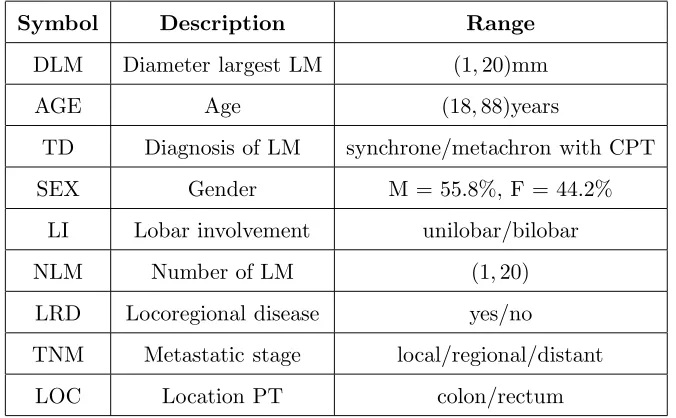
de-Symbol Description Range
DLM Diameter largest LM (1,20)mm
AGE Age (18,88)years
TD Diagnosis of LM synchrone/metachron with CPT SEX Gender M = 55.8%, F = 44.2%
LI Lobar involvement unilobar/bilobar NLM Number of LM (1,20)
LRD Locoregional disease yes/no
[image:38.612.137.475.256.465.2]TNM Metastatic stage local/regional/distant LOC Location PT colon/rectum
Table 3: description of the covariates for the liver dataset. The data include several types of clinical covariates, such as continuous (DLM), discrete (AGE, NLM) and categorical (all others). This analysis aims at discriminating statistically different survival groups based on differences among their covariate profiles.
k = 1, ..., ℓ. Using this informative prior, under the exponential likelihood we obtain a prior predictive median survival time of roughly 60 months, reflecting the descriptive statistic reported by the EUROCARE study.
A PHS using nine auxilliary chains was run for two hundred thousand it-erations, the starting tree for each chain being the root model. The proposal distribution for the cross-chain swaps was uniform over the chain indexes
(2, ...,10) and also uniform over the two implemented swap moves. On the
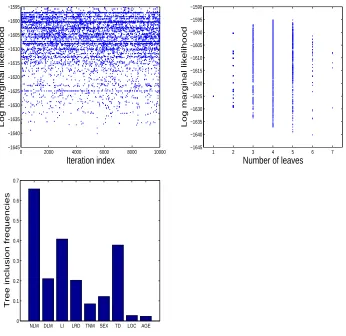
top row, Figure 7 shows the unnormalised log posterior tree probability for the models visited by the mother chain, plotted respectively versus the it-eration index and versus their number of leaves. Posterior sampling moved quickly towards areas of high marginal posterior probability models, which cluster the data over a range of 4 to 6 groups. The bottom plot in Figure 8 shows the estimated marginal inclusion probabilities for the nine covariates. The number of liver metastases, lobar involvement and a synchronous de-tection of the liver metastases along with the primary tumor appear to have prominent prognostic significance with respect to the remaining covariates, suggesting that the main determinant of survival for this sample are the extent of disease at the time of surgery and the accuracy of the diagnosis.
The estimated MAP tree clusters the 622 subjects into ˆℓM AP = 4 groups,
respectively defined by the subsets
ˆ
ζ1 = {N LM >1}
ˆ
ζ2 = {N LM ≤1, DLM >7}
ˆ
ζ3 = {N LM ≤1, DLM ≤7, T D= 0}
ˆ
0 2000 4000 6000 8000 10000 −1645 −1640 −1635 −1630 −1625 −1620 −1615 −1610 −1605 −1600 −1595 Iteration index
Log marginal likelihood
1 2 3 4 5 6 7
−1645 −1640 −1635 −1630 −1625 −1620 −1615 −1610 −1605 −1600 −1595 −1590
Number of leaves
Log marginal likelihood
NLM DLM LI LRD TNM SEX TD LOC AGE 0 0.1 0.2 0.3 0.4 0.5 0.6 0.7
[image:40.612.129.475.136.472.2]Tree inclusion frequencies
Figure 9 shows that the estimated MAP tree separates the short-term sur-vivors in leaf 1, who are characterised by a larger number of liver metastases of large size, from the long-term survivors in leaf 4, who present a few local metastases of small size without further symptoms. Leaves 2 and 3 repre-sent intermediate survival scenarios characterised by either one metastasis of large diameter or by a late diagnosis of an originally limited metastatic process.
0 5 10 15 20 25 30 35 40 45 0
0.1 0.2 0.3 0.4 0.5 0.6 0.7 0.8 0.9 1
Months from diagnosis
KM survival curve
LEAF 1 LEAF 2 LEAF 3
[image:41.612.210.399.296.501.2]LEAF 4
5
Discussion
As noted by Geyer [1991], the attractive feature of multiple-chains MCMC samplers is that their target distribution factors into the product of the marginal distributions for each chain despite the fact that these chains are made dependent by the swap transitions. Under the standard conditions outlined in Section 2 we prove in Theorem 1 that samples generated by the PHS algorithm converge weakly to such product distribution. Furthermore, every time an auxilliary chain swaps with the mother chain its perfomance is improved in the sense of Peskun [1973]. This is reflected in the lower empirical autocorrelation of the auxilliary chain and lower integrated auto-correlation times reported in Figure 2.
In Section 2 we also noted that the joint transition kernels of PT, PHS and sPHS are mixtures where (M −1) out of the M parallel chains are auxilliary to the update of the first chain. The complexity of these tran-sition kernels, has so far hindered a direct analytical comparison of their convergence properties. Establishing orderings between the two kernels us-ing the criteria illustrated in Peskun [1973], Meyn and Tweedie [1994] and Mira [2001] is thus object of ongoing research. Also, in light of the empirical measures of accuracy reported in Table 2 an other very promising topic in this area is the formulation of adaptive multiple-chains sampling strategies (Craiu and Meng [2005], Craiu et al. [2009]).
paths of the first chain of PHS, those of the MH algorithm and those of the cold chain in PT. With respect to the latter, PHS focuses on using si-multaneously many different proposal distributions as opposed to adopting tempered target distributions. This is a key feature for the applicability of parallel samplers for Bayesian inference as one does not need worring about which temperature values correspond to proper tempered target posterior distributions.
The PHS algorithm is also strictly related to at least two other categories of MCMC samplers: those using latent variables and multiple-try propos-als. Parameter augmentation was introduced in the context of single-chain MCMC samplers by Tanner and Wong [1987] and later by Neal [2000] to improve mixing of a chain by expanding its state-space using additional dimensions. Conditionally on these auxilliary variables the posterior distri-bution of the parameters of interest can typically be sampled exactly via a Gibbs step. The PHS algorithm can be seen as a variable augmentation scheme where the auxilliary coefficients areM−1 replicates of the param-eter of interest itself. The main analogy between the algorithm of Liu et al. [2000] and PHS is that many candidates are available at each iteration to update one chain of interest. In Liu et al. [2000], only one of such updates is retained and the Metropolis ratio is modified accordingly. In PHS the proposal mechanism generating all potential updates is not constrained to be the same for all chains and all values not used for swapping with the mother chain are used for updating the other M−1 parallel chains.
References
Y.F. Atchad´e and J.S. Rosenthal. On adaptive Markov chain Monte Carlo algo-rithms. Bernoulli, 11:815–828, 2005.
K.B. Athreya, H. Doss, and J. Sethuraman. On the convergence of the Markov Chain simulation method. The Annals of Statistics, 24:69–100, 1996.
Y. Bai. Simultaneous drift conditions for adaptive Markov chain Monte Carlo algorithms. University of Toronto Preprint, 2009.
Y. Bai, G.O. Roberts, and J.S. Rosenthal. On the containment condition for adap-tive Markov chain Monte Carlo algorithms. University of Toronto Preprint, 2009.
M.M. Barbieri and J.O. Berger. Optimal predictive model selection. The Annals of Statistics, 3:870–897, 2004.
M. B´edard and J.S. Rosenthal. Optimal scaling of Metropolis algorithms: Heading towards general target distributions. The Canadian Journal of Statistics, 36: 483–502, 2008.
F. Berrino, A. Verdecchia, J.M. Lutz, C. Lombardo, A. Micheli, and R. Capocaccia. Comparative cancer survival information in Europe.European Journal of Cancer, 45:901–908, 2009.
L. Breiman. Random forests. Machine Learning, 45:5–32, 2001.
L. Breiman. Population theory for boosting ensembles. The Annals of Statistics, 32:1–11, 2004.
L. Breiman. Bagging predictors. Machine Learning, 24:123–140, 1996.
L. Breiman, J.H. Friedman, R.A. Olshen, and C.J. Stone. Classification and Re-gression Trees. Chapman and Hall, New York, 1984.
S. P. Brooks and G.O. Roberts. Assessing convergence of Markov chain Monte Carlo algorithms. Statistics and Computing, 8:319–335, 1998.
S.P. Brooks. MCMC convergence diagnosis via ultivariate bounds on log-concave densities. The Annals of Statistics, 26:398–433, 1998.
S.P. Brooks, P. Giudici, and G.O. Roberts. Efficient construction of Reversible Jump MCMC proposal distributions. Journal of the Royal Statistical Society B, 65:3–55, 2003.
O. Capp´e and C.P. Robert. Markov chain Monte Carlo: 10 years and still running!
Journal of the American Statistical Association, 95:1282–1286, 2000.
O. Capp´e, G.O. Roberts, and T. Ryden. Reversible jump, birth-and-death and more general continuous time Markov chain Monte Carlo samplers. Journal of the Royal Statistical Society B, 65:679–700, 2003.
B.P. Carlin and S. Chib. Bayesian model choice via Markov chain Monte Carlo methods. Journal of the Royal Statistical Society B, 57, 1995.
G. Celeux, M. Hurn, and C.P. Robert. Computational and inferential difficulties with mixture posterior distributions. Journal of the American Statistical Asso-ciation, 95:957–970, 2000.
D. Chauveau and P. Vandekerkhove. Improving convergence of the Hastings-Metropolis algorithm with a learning proposal. Scandinavian Journal of Statis-tics, 29:13–29, 2002.
Hugh A. Chipman, Edward I. George, and Robert E. McCulloch. Bayesian CART model search. Journal of the American Statistical Society, 93:935–947, 1998.
M. Clyde and E.I. George. Model Uncertainty. Statistical Science, 19:81–94, 2004.
M.K. Cowles and B.P. Carlin. Markov chain Monte Carlo algorithms convergence diagnostics: a comparative reiview. Journal of the American Statistical Associ-ation, 91:883–904, 1996.
R.V. Craiu and X.L. Meng. Multi-process parallel antithetic coupling for forward and backward Markov chain Monte Carlo.The Annals of Statistics, 33:661–697, 2005.
R.V. Craiu, J.S. Rosenthal, and C. Yang. Learn from thy neighbor: Parallel-chain adaptive MCMC. Journal of the American Statistical Association, To Appear, 2009.
R.B. Davis and J.R. Anderson. Exponential survival trees. Statistics in Medicine, 8, 1989.
P. Dellaportas, J.J. Forster, and I. Ntzoufras. On Bayesian model and variable selection using MCMC. Statistics and Computing, 12:27–36, 2002.
D.G.T. Denison, B.K. Mallick, and A.F.M. Smith. A Bayesian CART algorithm.
Biometrika, 85, 1998.
S. Duane, A. D. Kennedy, B. J. Pendleton, and D. Roweth. Hybrid Monte Carlo.
Physics Letters B, 195:216–222, 1987.
J.M Flegal, M. Haran, and J.L. Jones. Markov chain Monte Carlo: can we trust the third significant figure? Statistical Science, 23:250–260, 2008.
D. Gamerman. Markov chain Monte Carlo: Stochastic Simulation for Bayesian Inference. Chapman and Hall, 1997.
J. Gasemyr. On an adaptive version of the Metropolis-Hastings algorithm with independent proposal distribution. Scandinavian Journal of Statistics, 30:159– 173, 2003.
A.E. Gelfand and A. F. M. Smith. Sampling-based approaches to calculating marginal densities.Journal of the American Statistical Society, 85:398–409, 1990.
E.I. George and R.E. McCulloch. Approaches for Bayesian variable selection. Sta-tistica Sinica, 7:339–373, 1997.
E.I. George and R.E. McCulloch. Variable selection via Gibbs sampling. Journal of the American Statistical Association, 88:882–889, 1993.
J. Geweke. Evaluating the accuracy of sampling-based approaches to the calculation of posterior moments. In: Bayesian Statistics 4, J.M. Bernardo, J.O. Berger, A.P. Dawid and A.F.M. Smith editors; Oxford Press, pages 169–194, 1992.
C. J. Geyer and E.A. Thompson. Annealing Markov Chain Monte Carlo with ap-plications to ancestral inference.Journal of the American Statistical Association, 90:909–920, 1995.
C.J. Geyer. Markov chain Monte Carlo maximum likelihood. Computing Science and Statistics: Proceedings on the 23rd Symposium on the Interface, New York, 1991.
W.R. Gilks and P. Wild. Adaptive rejection sampling for Gibbs sampling. Journal of the Royal Statistical Society C, 41:337–348, 1992.
W.R. Gilks, G.O. Roberts, and E.I. George. Adaptive direction sampling. The Statistician, 43:179–189, 1994.
W.R. Gilks, N.G. Best, and K.K.C. Tan. Adaptive rejection Metropolis sampling within Gibbs sampling. Applied Statistics, 44:455–472, 1995a.
W.R. Gilks, S. Richardson, and D. J. Spiegelhalter.Markov chain Monte Carlo in practice. Chapman and Hall, 1995b.
J. Gill and G. Casella. Dynamic tempered transitions for exploring multimodal posterior distributions. Political Analysis, 12:425–443, 2004.
L. Gordon and R.A. Olshen. Tree-structured survival analysis. Cancer Treatment Reports, 69, 1995.
P.H. Green. Reversible Jump Markov chain Monte Carlo computation and Bayesian model determination. Biometrika, 82:711–732, 1995.
P.J. Green and X.L Han. Metropolis methods, Gaussian proposals and antithetic variables. Lecture notes in Statistics, 74:142–164, 1991.
P.J. Green and A. Mira. Delayed rejection in reversible jump Metropolis Hastings.
Biometrika, 88:1035–1053, 2001.
M.P.W. Grocott, D.S. Martin, D.Z.H Levett, H. Montgomery, and M.G. Mythen. Caudwell Xtreme Everest. Anaesthesia and Analegesia, 6:81–84, 2008.
H. Haario, E. Saksman, and J. Tamminen. Adaptive proposal distribution for random walk metropolis algorithm, 1999.
H. Haario, E. Saksman, and J. Tamminen. An adaptive Metropolis algorithm.
Bernoulli, 7:223–242, 2001.
H. Haario, E. Saksman, and J. Tamminen. Component-wise adaptatation for high-dimensional MCMC. Computational Statistics, 20:265–273, 2005.
H. Haario, M Laine, A. Mira, and E. Saksman. DRAM: efficient adaptive MCMC.
Statistics and Computing, 16:339–354, 2006.
U.H.E. Hansmann. Parallel tempering algorithm for conformational studies of bi-ological molecules. Chem. Phys. Lett., 281:140–152, 1997.
P. Hermanek and F.P. Gall. Uicc Studie zur Klassifikation von Lebermetastasen.
Chirurgie der Lebermetastasen und primaren malignen Tumoren, 1990.
T.K. Ho. The random subspace method for constructing decision forests. IEEE Transactions on Pattern Analysis and Machine Intelligence, 20:832 – 844, 1998.
B. Hu and K-W. Tsui. Distributed evolutionary Monte Carlo for Bayesian comput-ing.Computational Statistics and Data Analysis, doi:10.1016/j.csda.2008.10.025, 2008.
J.P. Huelsembeck, B. Larget, R.E. Miller, and F. Ronquist. Potential applications and pitfalls of Bayesian inference of phylogeny. Syst. Biol., 51:673–688, 2002.
J.P. Huelsembeck, B. Larget, and M.E. Alfaro. Bayesian phylogenetic model se-lection using reversible jump Markov chain Monte Carlo. Mol. Biol. Evol., 21: 1123–1133, 2004.
J.P. Huelsenbeck and F. Ronquist. Bayesian analysis of molecular evolution using MrBayes. Statistical methods in molecular evolution, 2:183–226, 2005.
K. Hukushima and K. Nemoto. Exchange Monte Carlo method and application to Spin Glass simulations. Journal of the Physical Society of Japan, 65:1604–1620, 1996.
D. Husmeier and G. McGuire. Detecting recombination in 4-taxa DNA sequence alignments with Bayesian hidden Markov models and Markov chain Monte Carlo.
Mol. Biol. Evol., 20:315–337, 2003.
Y. Iba. Extended ensemble Monte Carlo.International Journal of Modern Physics, 12:623–656, 2001.
S.F. Jarner and G.O. Roberts. Polynomial convergence rates of Markov chains.
The Annals of Applied Probability, 12:224–247, 2002.
A. Kottas. Nonparametric Bayesian survival analysis using mixtures of Weibull distributions. Journal of Statistical Planning and Inference, 136:578–596, 2006.
L. Kuo and B. Mallick. Variable selection for regression models. Sankhya B, 60: 65–81, 1998.
C. Lakner, P. Van der Mark, J.P. Huelsenbeck, B. Larget, and F. Ronquist. Ef-ficiency of Markov chain Monte Carlo tree proposals in Bayesian phylogenetics.
Syst. Biol., 57:86–103, 2008.
M. Li. Bayesian discovery of regulatory motifs using reversible jump Markov chain Monte Carlo. PhD thesis, University of Washington, 2006.
S. Li, D.K. Pearl, and H. Doss. Phylogenetic tree construction using Markov chain Monte Carlo. Journal of the American Statistical Association, 95:493–508, 2000.
F. Liang and W.H. Wong. Real-parameter evolutionary Monte Carlo with applica-tions to Bayesian mixture models. Journal of the American Statistical Associa-tion, 96:653–666, 2001.
C.Y. Lin, C.H. Hu, and U.H.E. Hansmann. Parallel tempering simulations of HP-36. Proteins: Structure, Functions and Genetics, 53:436–445, 2003.
J.S. Liu. Monte Carlo Strategies in Scientific computing. Springer, 2001.
J.S. Liu and C. Sabatti. Simulated sintering: Markov chain Monte Carlo with spaces of varying dimensions. Bayesian Statistics, 6:389–403, 1998.
J.S. Liu, F. Liang, and W.H. Wong. Dynamic weighting in Monte Carlo and opti-mization.Journal of the American Statistical Association, 94:14220–14224, 1997.
J.S. Liu, F. Liang, and W.H. Wong. A theory for dynamic weighting in Monte Carlo computation. Proceedings of the National Academy of Sciences, 96:561– 573, 2001.
D.J. Lunn, A. Thomas, N. Best, and D. Spiegelhalter. WinBUGS - A Bayesian modelling framework: Concepts, structure, and extensibility.Statistics and Com-puting, 10:325–337, 2000.
G. Lunter, I. Miklos, A. Drummond, J.L. Jensen, and J. Hein. Bayesian coesti-mation of phylogeny and sequence alignment. BMC Bioinformatics, 6:83–93, 2005.
B. Mau, M.A. Newton, and B. Larget. Bayesian phylogenetic inference via Markov chain Monte Carlo methods. Biometrics, 55:1–12, 1999.
I.W. McKeague and W. Wefelmeyer. Markov chain Monte Carlo and Rao-Blackwellization.Journal of Statistical Planning and Inference, 85:171–182, 2000.
K.L. Mengersen and R.L. Tweedie. Rates of convergence of the Hastings and Metropolis algorithms. The Annals of Statistics, 24:101–121, 1996.
N. Metropolis and S. Ulam. The Monte Carlo method. Journal of the American Statistical Association, 44:335–341, 1949.
N. Metropolis, A. Rosenbluth, M. Rosenbluth, M. Teller, and E. Teller. Equations of state calculations by fast computing machines.J. Chem. Phys., 21:1087–2092, 1953.
S. Meyn and R.L. Tweedie. State-dependent criteria for convergence of Markov chains. The Annals of Applied Probability, 4:149–168, 1994.
A. Mira. Ordering and improving the performance of Monte Carlo Markov chains.
Statistical Science, 16:340–350, 2001.
A. Mira and D.J. Sargent. A new strategy for speeding Markov chain Monte Carlo algorithms. Statistical Methods and Applications, 12:49–60, 2003.
T.J. Mitchell and J.J. Beauchamp. Bayesian variable selection in linear regression.
Journal of the American Statistical Association, 83:1023–1032, 1988.
M.Leblanch and J.Crowley. Relative risk trees for censored survival data. Biomet-rics, 48, 1992a.
M.Leblanch and J.Crowley. Survival trees by goodness of split. Journal of the American Statistical Association, 88, 1992b.
E. Mossel and E. Vigoda. Phylogenetic MCMC algorithms are misleading on mix-tures of trees. Sience, 309:2207–2209, 2005.
E. Mossel and E. Vigoda. Limitations of Markov chain Monte Carlo algorithms for inference of phylogeny. The Annals of Applied Probability, 16:2215–2234, 2006.
J.W. Myers and K.B. Laskey. Population Markov chain Monte Carlo. Machine Learning, 50:175–196, 2001.
P. Neal and G.O. Roberts. Optimal scaling for partially updating MCMC algo-rithms. The Annals of Applied Probability, 16:475–515, 2006.
P. Neal, G.O. Roberts, and J. Yuen. Optimal scaling of of random walk Metropolis algorithms with discontinous target densities.University of Manchester Technical Report, 1, 2007.
R. Neal. Slice sampling. Technical report No. 2005 - Dept. of Statistics, University of Toronto, 2000.
R.M. Neal. Sampling from multimodal distributions using tempered transitions.
Statistics and Computing, 6:353–366, 1996.
D.J. Nott and P.J. Green. Bayesian veriable selection and the Swendsen-Wang algorithm.Journal of Computational and Graphical Statistics, 13:141–157, 2004.
E. Nummelin. General Irreducible Markov Chains on Non-Negative Operators. Cambridge University Press, 1984.
L.M. Pasetto, E. Rossi, and S. Monfardini. Liver metastases of colorectal cancer: medical treatment. Anticancer, 23:4245–56, 2003.
P.H. Peskun. Optimum Monte Carlo sampling using Markov chain. Biometrika, 60:607–612, 1973.
G. Petris and L. Tardella. A geometric approach to transdimensional Markov chain Monte Carlo. The Canadian Journal of Statistics, 31:469–482, 2003.
J. Pittman, E. Huang, H. Dressman, C.F. Horng, S.H. Cheng, M.H. Tsou, C.M. Chen, A. Bild, E.S. Iversen, A.T. Huang, J.R. Nevins, and M. West. Integrated modeling of clinical and gene expression information for personalized prediction of disease outcomes.Proceedings of the National Academy of Sciences, 101:8431– 8436, 2004.
A. E. Raftery, D. Madigan, and J. A. Hoeting. Bayesian model averaging for linear regression models. Journal of the American Statistical Association, 92:179–191, 1997.
R. Ren and G. Orkoulas. Parallel Markov chain Monte Carlo simulations. Journal of Chemical Physics, doi:10.1063/1.2743003, 2007.
C.P. Robert. Convergence control methods for Markov chain Monte Carlo algo-rithms. Statistical Science, 10:231–253, 1995.
C.P. Robert and G. Casella. Monte Carlo Statistical Methods. Springer, 1999.
G.O. Roberts and J.S. Rosenthal. Coupling and ergodicity of adaptive MCMC.
Journal of Applied Probability, 44:458–475, 2007.
G.O. Roberts and J.S. Rosenthal. Examples of adaptive MCMC. University of Toronto Preprint, 2008.
G.O. Roberts and J.S. Rosenthal. Optimal scaling of discrete approximations to Langevin diffusions. Journal of the Royal Statistical Society B, 60:255–268, 1998a.
G.O. Roberts and J.S. Rosenthal. Markov chain Monte Carlo: some practical implementations of theoretical results. The Canadian Journal of Statistics, 26: 5–20, 1998b.
G.O. Roberts and O. Stramer. Tempered Langevin diffusions and algorithms. Uni-versity of Iowa, Department of Statistics and Actuarial Sciences Technical
Re-port, 314, 2002.
G.O. Roberts and R.L. Tweedie. Exponential convergence of Langevin distributions and their discrete approximations. Bernoulli, 2:341–363, 1996a.
G.O. Roberts and R.L. Tweedie. Geometric convergence and central limit theorems for multidimensional Hastings and Metropolis algorithms.Biometrika, 83:95–110, 1996b.
G.O. Roberts, A. Gelman, and W.R. Gilks. Weak convergence and optimal scaling of random walk Metropolis algorithms. The Annals of Applied Probability, 7: 110–120, 1997.
J.S. Rosenthal. Parallel computing and Monte Carlo algorithms.Far East Journal of Theoretical Statistics, 4:207–236, 2000.
M. Sant, C. Allemani, M. Santaquilani, A. Knijn, F. Marchesi, and Capocaccia R. EUROCARE-4. Survival of cancer patients diagnosed in 1995-1999. Results and commentary. European Journal of Cancer, 45:931–991, 2009.
S.A. Sission. Transdimensional Markov chains. Journal of the American Statistical Association, 100:1077–1089, 2005.
A. F.M. Smith and G.O. Roberts. Bayesian computations via the Gibbs sampler and related Markov chain Monte Carlo methods. Journal of the Royal Statistical Society B, 55:3–23, 1993.
M. Smith and R. Kohn. Nonparametric regression using Bayesian variable selection.
Journal of Econometrics, 75:317–343, 1996.
A.D. Sokal. Monte Carlo methods in Statistical Mechanics: Foundations and new algorithms. Lecture Notes at the Cargese summer school on ”Functional Integra-tion: basis and applications”, 1996.
M. Stephens. Bayesian analysis of mixture models with an unknown number of components - an alternative to reversible jump methods. Annals of Statistics, 28:40–74, 2000.
R.H. Swedensen and J.S. Wang. Nonuniversal critical dynamics in Monte Carlo simulations. Physical Review Letters, 58:86–88, 1987.
M.A. Tanner and W.H. Wong. The calculation of posterior distributions via data augmentation.Journal of the American Statistical Association, 82:528–541, 1987.
L. Tierney. Markov chains for exploring posterior distributions. The Annals of Statistics, 22:1701–1728, 1994.
R. Waagepetersen, N. Ibanez-Escriche, and D. Sorensen. A comparison of strategies for Markov chain Monte Carlo in quantitative genetics. Genet. Set. Evol., 40: 161–176, 2008.
M. West. Bayesian factor regression models in the ”large p, small n” paradigm.
Bayesian Statistics 3, 2003.
U. Wolff. Monte Carlo errors with less errors.Computer Physics Communications, 156:143–153, 2004.
D.B. Woodard, S.C. Schmidler, and Huber M.L. Conditions for rapid mixing of parallel and simulated tempering on multimodal distributions.Annals of Applied Probability, 19:617–640, 2009.
Z. Yang and B. Rannala. Bayesian phylogenetic inference using DNA sequences: a Markov chain Monte Carlo method. Mol. Biol. Evol., 14:717–724, 1997.
T. Yoshida, M. Chida, M. Ichioka, and Y. Suda. Blood lactate parameters related to aerobic capacity and endurance performance. European Journal of Applied Physiology and Occupational Physiology, 56:7–11, 1987.
Z. Zheng. On swapping and simulated tempering algorithms. Stochastic processes and their applications, 104:131–154, 2001.
Acknowledgements
The first author acknowledges the partial support received through a Visiting Fel-low grant of the University of Insubria during the development of this work. A. Mira acknowledges the partial support of the PRIN (Italian National Research Pro-gram) 2007XECZ7L003. The software implementing the models and the MCMC algorithms employed in Sections 3, 4 and 5 can be obtained in the form of MATLAB