Bachelor Thesis
The impact of leader’s expansive body posture and
forward leaning behavior on team performance: A
Mixed-Method study
29.06.2017
Author: Florian Dreisibner
Student number: 1467425
Study program: International Business Administration
Supervisors:
Jacco G.W.L. Smits, MSc
Prof. Dr. C.P.M. Wilderom
Abstract
The purpose of this study was to investigate how the nonverbal behavior of individuals in leadership positions, expressed during regular staff-meetings, relates to team performance. Hypothesized relationships among key variables were based on psychological and management literature and imply that expansive body posture and body leaning postures demonstrated by a leader during regular meetings with staff facilitate followers ‘cognitive and affective trust in the leader, pro-active behavior and team information sharing within their team members. This study combined follower surveys and video-coded leader nonverbal behavior data, sampled from regularly occurring staff-meetings in a large public-sector organization. The data consisted of 20 coded videos which featured 20 leaders and their followers. The findings revealed a significant correlation between follower’s cognitive and affective trust in leadership and the followers information sharing. This may help future researchers to develop new methods to improve team performance by facilitating trust in the leadership.
Keywords
Cognitive trust, Affective trust, pro-active follower behavior, team information sharing, observed leadership behavior, expansive body posture, forward leaning
Permission to make digital or hard copies of all or part of this work for personal or classroom use is granted without fee provided that copies are not made or distributed for profit or commercial advantage and that copies bear this notice and the full citation on the first page. To copy otherwise, or republish, to post on servers or to redistribute to lists, requires prior specific permission and/or a fee.
9th IBA Bachelor Thesis Conference, July 5th, 2017, Enschede, The Netherlands.
1
1. Introduction
We live in a time were the use of teams within organizations has become the standard norm (Hills, 2007). Research has already focused on methodological aspects such as coaching-related activities (Wageman, 2001) to reach a better understanding of effective and successful leadership and which practices a team leaders can use to influence team settings. However, the research that has already been conducted is quite narrow minded in regard of leadership activities as only selected leadership methods were looked into (Morgeson, DeRue, Karam, 2010), leaving the research field relatively incomplete due to its focus on the methodological aspect without considering psychological aspects. This is especially true for the field of the impact and effect of nonverbal behavior in leadership (Morgeson, DeRue, Karam, 2010). Leadership can generally be described as a process initiated by a person with a clear agenda to guide and lead a group of people towards a goal set by the team leader or their organization (Burns 1978 as cited by Northhouse, 2013). Members of a group may have different backgrounds or even different cultures, their believes and values can differ from one another and so can their idea of the goal that the group is supposed to reach.
A leader is tasked with guiding these individuals and provides an environment which allows them to work towards a goal on both individual and group level. Effective leadership emerges from the capability of a leader to focus the team’s resources successfully towards reaching the goal (Goleman, 2013). A project under time pressure may require a more individual focus of single team members with professional skills, while cross-cutting subjects require the group to act as a whole. The team effectiveness is, in these cases, based on how well the team leader can turn the capabilities, knowledge and skills which the team members possess and lead them towards the goal for the sake of the organization. Communication plays a big role when different people are required to work in unity to achieve a goal. The nonverbal part of the communication is often underestimated in management, but has a major impact on how a leaders abilities are perceived.
2. Theory and Hypotheses
One of the first definitions of nonverbal behavior simply stated that every kind of communication that does not make use of words is defined as nonverbal (Knapp, 2011). This definition however evolved during the time and began to cover all communication which is not linguistic (Burgoon, Guerrero, & Manusov, 2011 as cited by Bonaccio et al, 2016), defining sign language as a form of verbal communication in the U.S.A. Sign language is defined as a form of verbal communication and therefore not a behavior of interest to deepen the understanding of nonverbal behavior in relation to various organizational outcomes. The scope of this research rather
defines non verbal behavior as the usage of gestures, postures and mimics to accentuate willingly or unconsciously a message expressed by the team leader to an individual or the whole team.
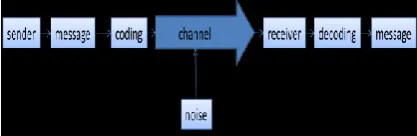
[image:2.595.346.555.299.367.2]The information transfer between individuals or groups can be split into the steps of sender, channel and receiver (Shannon & Weaver, 1949). A message is being coded by the sender and send via the channel to another individual, the receiver, who then decodes the information and interprets it. The channel can be influenced by the environment (noise) and have an impact on the information that is being send. In general, the coding and decoding of the information can and does in most cases, consists of nonverbal aspects. The use of nonverbal behavior by the sender may be in most cases unintentionally and just part of his natural behavior. The receiver however, decodes the nonverbal behavior based on his own knowledge and norms and interprets them to draw out additional information about the message.
Figure 1: Communication model (Shannon & Weaver, 1949)
The use of targeted nonverbal behavior by the sender which is added to a message send to the receiver can allow the receiver to influence the perception of the receiver regarding the message and his environment. This influence shows itself in the form of repetition, substitution, complementation, accent or contradiction as seen in Figure 1. A repetition can be represented by a head shake to demonstrate a disagreement. Substitution of verbal communication can be in the form of pointing your finger in a specific direction to imply where a certain location is. A complementation adds to a verbal message such as raising your shoulders when an answer to a topic is not presentable. Accenting behavior is often done by using hands such as tapping on someone’s shoulder to felicitate him. The contradicting describes opposing nonverbal behavior that counter fights the actual meaning behind a message such as smiling at a horrible joke. This research will focus on the aspect of accentuation and examine communication between team leader and the team by looking at follower’s pro-active behavior, team information sharing and the cognitive and affective trust in leadership.
2
Figure 2: Examples of Haptics, Chronemics,Kinesics and Proxemics (Copyright 2017 by Lucia Dzediţi)
Haptics describe the field of touching in nonverbal communication. Chronemics applies to the interpretation and role of time in once life (e.g. individual importance of punctuality). The overall use of gestures made by the individual such as hand gesture is defined as kinesics. The distance between two individuals during a conversation and more importantly the distance which the individual interprets as personal space falls under the category of proxemics.
2.1 Cognitive and affective trust in
leadership
At this moment of time research on the role of nonverbal leader behavior in team performance is barely touched by researchers and even less often backed up by empirical evidence. One aspect of the nonverbal behavior, namely kinesics, covers the body orientation such as body leaning posture and expansive body posture. Generally, studies have already proven that so called power poses have not only a psychological but also a physical impact (Carney, Cuddy & Yap, 2010). Taking on a power pose causes an increased feeling of power and tolerance to risk due to an increase in testosterone and a decrease in cortisol (Carney, Cuddy & Yap, 2010). This effect adds to the perceived confidence displayed by a leader and influences how the team members interpret the leader’s behavior and leadership capability, resulting in the following hypotheses;
H1a: A more frequent display of expansive body posture by leaders during regular staff meetings positively relates to followers’ cognitive and affective trust in their leader.
H1b: A more frequent display of forward leaning postures expressed by leaders during regular staff meetings, positively relates to followers cognitive and affective trust in their leader.
2.2 Pro-active behavior
Another significant part of nonverbal behavior in communication is the impression that a person gives of when he is listen to someone else. Nonverbal behavior can demonstrate either interest or disinterest in the sender’s message. An attentive listener should lean towards the person he is listening to represent his interest in the topic and the speakers idea (Mehrabian, 1972). An attentive behavior facilitates the interest that the listener has towards the speaker’s message and further strengthens the trust that the speaker has in the listener. Based on these arguments, the following hypotheses are proposed:
H2a: A more frequent display of expansive body posture expressed by leaders during regular staff meetings, positively relates to followers pro-active behavior.
H2b: A more frequent display of forward leaning postures expressed by leaders during regular staff meetings, positively relates to followers pro-active.
2.3 Team information sharing
Employees analyze the behavior of their management on the attempt to gain insight of the possible reaction they might receive in respond to new ideas and risks (Ashford et.al as cited by Morrison and Phelps, 1999). Therefore, it can be argued that the behavior and the resulting impression that leaders have on the employees has an impact on their work behavior in regard of openness, team information sharing and willingness to take risks. Employees are more likely to take on new ideas on the individual level if they have the feeling that their leader represents confidence with his behavior and is more open to new ideas and possible change (Scott & Bruce, 1994). Follower’s perception of a leader can be summarized in the following hypotheses:
H3a: A more frequent display of expansive body posture expressed by leaders during regular staff meetings, positively relates to followers information sharing.
H3b: A more frequent display of forward leaning postures expressed by leaders during regular staff meetings, positively
3
Information sharing is a basic tool used to structure work andfor decision making (Mesmer-Magnus, DeChurch, 2009) and greatly influences the team performance. A higher density of information sharing allows a team to cover more topics and find combine multiple areas of expertise to develop new solutions to problems. Information can generally be classified in the two dimensions of uniqueness and openness (Mesmer-Magnus, DeChurch, 2009). The uniqueness of the information refers to the specific input a team member can offer for a certain topic based on his specialized knowledge and skills. Openness refers to degree to which team members freely share information with each other which forges a stronger trust relationship among the team members and gives rise to new ideas and opportunities (Mesmer-Magnus, DeChurch, 2009). Even more, team information sharing builds the fundamental trust relationship on which proactive behavior is based on. Only with enough information shared, collected and processed, will an employee be able to categorize his leader and anticipate possible behavior when he is confronted with new ideas. The better the employee can understand and trust the leader, the higher the likelihood that the team member speaks his mind more freely (Gong, Cheung & Huang, 2012). This influence of cognitive and affective trust in the leadership on pro-active behavior of followers and team information sharing will be described by an additional hypothesis:
H4: Followers who have more cognitive and affective trust in their leader are expressing a higher level of pro-active behavior and information sharing.
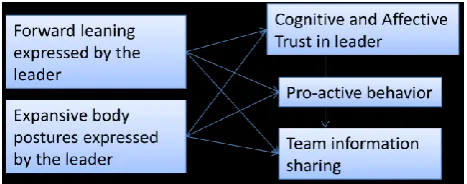
[image:4.595.316.550.71.163.2]A leader that is perceived as more trustworthy causes employees to be more outspoken about their ideas and share more information, while a leader who is perceived less trustworthy causes employees to bottle up their thoughts (see figure2). It is also expected that a leader who is perceived as more engaging in a conversation by demonstrating an open and expansive body posture will impinge his followers to a higher degree of pro-active behavior. Cognitive and affective trust in the leader is also strengthened by the leader’s demonstration of expansive and forward leaning behavior. A leader who demonstrates attentiveness by leaning forward to listen and directly engage in a conversation with his followers is expected to receive a higher amount of cognitive and affective trust than a leader who demonstrates less attention to his team. Taking on an expansive body posture demonstrates confidence and further facilitates the follower’s cognitive and affective trust in their leader. The above mentioned hypotheses, H1a, H1b, H2a, H2b, H3a and H3b are summarized and visualized in figure 2. All relationships between the independent variables of a leaders expansive body posture and forward leaning position and the dependent variables of cognitive and affective trust in the leader, pro-active behavior of the followers and team information sharing are assumed to be positive.
Figure 2: Expected impact of a leader’s nonverbal behavior on team members
3. Method
3.1 Design
The data collection for this research was gathered from multiple sources. First source was the coding of the nonverbal behavior of team leaders during regularly held meetings. The other sources were surveys, which were filled out right after the meeting by the team leader himself and his or her followers who evaluated the organizations behavior and life based on certain criteria’s such as cognitive and affective trust in leadership, pro-active follower behavior and team information sharing between employees. Each perceived quality organization and its management, based on those dependent variables, was in the next step, assigned to the coded nonverbal behavior of forward leaning movements and constricted vs. expansive body posture, representing the independent variable, to determine a possible relationship.
3.2 Sample
4
3.3 Measures
Real life observation and real time coding of human nonverbal behavior is too fast paced to accurately code all the behaviors correctly. Videos however, give the coder the ability to not only slow down and/or rewind parts of the video, but also allow other coders to compare the coded behavior to the specific scene and moments in the video for discussions The measured variables were the perceived cognitive and affective trust in leadership (McAllister, 1995) which the leaders followers put in him, pro-active follower behavior (Morrison & Phelps, 1999) and team information sharing (Bunderson & Boumgarden, 2007) which were determined by the surveys filled out by the team leaders and their followers. Question following a based on Likert scales (Likert, 1932) are designed to represent the leaders and the followers perceived value of the above stated variables. The scale ranged from 1=completely disagree to 7=completely agree. Six questions on the survey were focused on the cognitive trust in leadership. The cognitive subscale consisted of t items (α = .922). An example item from the survey regarding the follower’s cognitive trust in their leader was the level to which the followers think that the leader approaches his work with professionalism and dedication (McAllister, 1995). The affective trust which followers have in their leader was measured by a subscale of five items (α = .872) in the survey and determines the degree to which the follower can freely share ideas, feelings and expectations (McAllister, 1995). The pro-active behavior subscales consisted of five items (α = .893) with questions regarding the level of adaptability to improved procedures and how often a follower makes a constructive suggestion which will benefit the organizations operations (Morrison & Phelps, 1999). The degree of team information sharing subscale consisted of four items (α = .089). Some example items of the survey measure the team information sharing with questions regarding the level of ease with which information is being shared among team members and how quickly new information is shared with others (Bunderson & Boumgarden, 20010) on a Likert scale. The nonverbal behavior consisting of expansive vs. constricted body posture and leaning postures was measured through the coding of the videos. Both aspects, the constricted vs. expansive body posture as well as the leaning postures were defined and agreed upon by both of the coders before the coding started. It was defined that the leaders posture has to be coded as mutual exclusive as either constricted or expansive at all times. The leaning posture consisted of three mutual exclusive states of leaning forward, leaning backwards or no leaning. The later state of no leaning allowed the coding scheme to define a position that was not unambiguously definable. All combination between these two variables of constricted vs. expansive and leaning postures were not mutual exclusive, consequently it was possible to code a constricted body posture at the same time as a leaning backwards.
Constricted Body Posture
The leader was be coded as a having taken up a constricted body posture when his upper and lower arms are touching his
body without a gap and/or the lower arms are resting on top of each other.
Expansive body posture
An expansive body posture was coded when at least one arm is placed away from his body, leaving a visual gap between the upper arm and the torso.
Leaning forward
The posture of forward leaning was coded when the leader showed clear indication that he was shifting his weight in front of his body. Indicators for this were a forward leaning torso, a tilted shoulder position and a visible shift of the weight of his upper body onto his arms when they were resting on the table and he was leaning onto them.
Leaning backwards
A backwards leaning position was coded when the upper body was leaning onto the back of the chair and his weight is clearly shifted backwards.
No leaning
The position of no leaning served as a form of a neutral position when the leader was neither clearly leaning forwards nor leaning backwards or the exact leaning position was not determinable due to the lack of additional video angles. Exceptions
One extra case was developed for forward leaning and crossed arm where the hands of one arm are located on the elbow of the other arm. Even though a gap is visible between both upper arms and the torso, this posture was coded as being constricted due to the lower arms touching each other.
3.4 Video Observation Method
5
resulted in an average agreement of 92.03% and an averagekappa of .92. Discussion sessions of both coders and their supervisor were used to solve all remaining disagreements and create the “golden tape” which was used for further discussions. The higher agreement build through discussions of multiple coders raised the reliability of the coding and offered a more accurate coding of the leaders nonverbal behavior.
3.5 Data analysis
Exporting the files from the Noldus observer XT software into SPSS files made it possible to test the hypotheses. A correlation analysis in SPSS was used to determine possible relation between all variables. All hypotheses expected some form of linear relation between the nonverbal behavior of the leaders and the influence of said behavior on the followers; hence the decision was made to use a linear regression to test the hypotheses. The relationship between the independent variables of constricted vs. expansive body posture, leaning postures and dependent variables of cognitive and affective trust in leadership, pro-active behavior and team information sharing was based on the correlation of percentile duration of the expressed nonverbal behavior and the perceived impression that it leaves within the followers. The dependent variables were based on the feedback from the surveys that were filled out by the followers. The analytical procedure of
linear regression was used to test for positive correlations between expansive body posture (H1a, H2a, H3b) and forward leaning positions (H1b, H2b, H3b) with the dependent variables of cognitive and affective trust in leadership, pro-active follower behavior and team information sharing.
4. Results
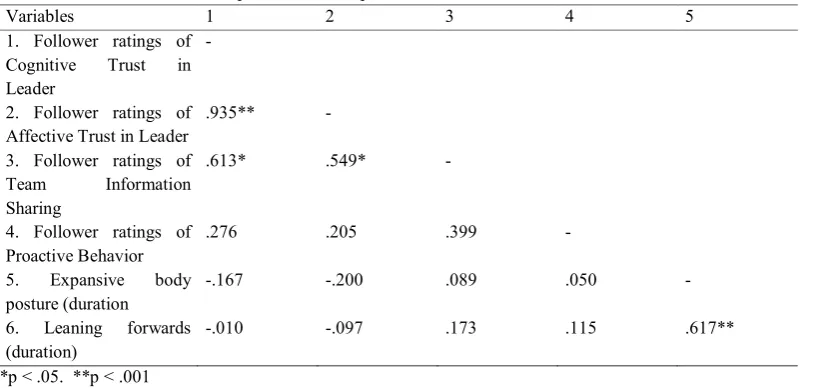
[image:6.595.54.469.407.601.2]The 20 leaders expressed on average an expansive behavior for 60.11% or 360.66 minutes of the total coded time of 600 minutes while a constricted body posture is only taken on for 39.89% or 239.34 minutes of the time. Expansive body postures were coded in total 196 times, and constricted body posture was coded in total 194 times. Leaders leaned, on average, as much backwards with 31.14% as they did not show any leaning at all with 31.35%. The position of forward leaning was expressed slightly longer with 37.51% compared to forward and backward leaning positions. The no leaning behavior was coded with a frequency with 218, forward leaning with 240 and backwards leaning 164 times. Table 1 shows the correlations between dependent and independent variables. The independent variables of cognitive and affective trust in leader ship showed the strongest significant correlation, r=.935, P<.001. Expansive body posture and forward leaning showed the second strongest correlation, r=.617, P<.05. Table 2 and 3 show the results of the linear regression which was used to test the hypotheses.
Table 1: Correlations between dependent and independent variables
Variables 1 2 3 4 5
1. Follower ratings of Cognitive Trust in Leader
-
2. Follower ratings of Affective Trust in Leader
.935** -
3. Follower ratings of
Team Information
Sharing
.613* .549* -
4. Follower ratings of Proactive Behavior
.276 .205 .399 -
5. Expansive body posture (duration
-.167 -.200 .089 .050 -
6. Leaning forwards (duration)
-.010 -.097 .173 .115 .617**
*p < .05. **p < .001
Table 2: Regression analysis that tested the hypotheses H1a, H2a, H3a
Cognitive Trust Affective Trust Pro-active behavior
Team information
sharing
Variable B
SE
B β Sig. B SE B β Sig. B SE B β Sig. B
SE
B β Sig.
Expansive
body posture 5728 .340 -.167 .482 5884 0.259 -.200 .398 5.884 .259 .050 .834 5.189 .280 .089 .709
[image:6.595.52.545.630.740.2]R² .028 .040 .002 .008
Table 3: Regression analysis that tested the hypotheses H1b, H2b, H3b
6
sharingVariable B SE B β Sig. SE B β Sig. B
SE
B β Sig. B
SE
B β Sig.
Forward leaning 5.515 .264 -.010 .966 5.750 .201 -.097 .683 5.363 .196 .115 .630 5.152 .212 .173 .466
R² .000 .009 .013 .030
Table4: Regression analysis between cognitive trust in leadership and team information sharing
Team information sharing
Variable B SE B β Sig.
Cognitive trust .250 .842 .613 .004
[image:7.595.55.545.76.147.2]R² .125
Table 5: Regression analysis between affective trust in leadership and team information sharing
Team information sharing
Variable B SE B β Sig.
Affective trust .20 .209 .549 .012
R² .262
Cognitive and affective trust in leadership (expansive body posture)
Linear regression analysis was used to test if the expansive body posture of a leader significantly affects the cognitive and affective trust that followers have in their leaders. The results of the regression pointed out that 2.8% of the variance could be explained by the two predictors (R² = .028, F(18) = .482) for cognitive trust and 4% of the variance for the affective trust (R² = .040, F(18) = -.200). H1a proposed that leader’s expansive body posture is positively related to follower's level of cognitive and affective trust in their leader. Table 2 shows that this hypothesis could not be supported for cognitive trust (β = -.167, p= 482 > .05) and affective trust (β = -.200, p = .398 > .05) and had to be rejected.
Cognitive and affective trust in leadership (leaning forward)
The result of the linear regression for cognitive and affective trust in leadership and a leaders forward leaning behavior indicated that less than 0.01% of the variance could be explained by the predictors for cognitive trust (R < .000, F(18) = .966) and 0.9% for affective trust (R² = .009, F(18) = .683). A positive relation of the leaders forward leaning and his followers cognitive and affective trust in leadership is proposed as H1b. H1b could not be supported by the data from table 3 for neither cognitive trust (β = -.010, p = 966 > .05) or affective trust (β = -.097, p = .683 > .05) and had to be rejected.
Pro-active behavior (expansive body posture)
The linear regression for the expansive body posture of leaders and the pro-active behavior of followers showed an explained variance of 0.2% (R² = 0.002, F(18) = .834). Table 2indicates that the result of the analysis did not support H2a, meaning that the leaders expansive body posture has no
relation with his followers pro-active behavior (β=.050, p = .834 > .05).
Pro-active behavior (leaning forward)
The two predictors of expressed forward leaning by the leader and his the follower’s pro-active behavior demonstrated an explained variance of 1.3% (R²=.013,F(18)=.630). H2b could not be supported by the data seen in table 3, meaning that a leaders forward leaning has virtually no relation with the degree of his followers pro-active behavior (β=.490, p = .630 > .05).
Team information sharing (expansive body posture) The result of the linear regression for a leaders expressed expansive body posture and his team information sharing showed an explained variance of 0.8% between the predictors (R²=.008, F(18) = .709).H3a proposed a positive relation of a leader’s expansive body posture and his followers information sharing. This hypothesis could not be supported by table 2 (β=.379, p = .709 > .05) and had to be rejected.
Team information sharing (forward leaning)
7
Cognitive and affective trust on team information sharingThe linear regression for cognitive and affective trust in leadership and team information sharing revealed a explained variance of 12.5% for cognitive trust (R² = .125, F(18) = .004) and a explained variance of 26.2% for the affective trust (R² = .262, F(18) = .012). H4 proposed that the level of trust that the followers have in the leader influences followers information sharing. This hypothesis could be supported by the data from table 4 for cognitive trust (β = -.613, p = .004 < .05) and by table 5 for affective trust in leadership (β = -.549, p = .012 < .05).
5. Discussion
Two different research methods were used in this study, the observational method and data collection from surveys. The usage of an observational study is still new in the area of leadership studies, especially the method of collecting data directly from videos of regularly held stuff meetings.
The linear regression for the relation between cognitive and affective trust in leadership and expansive body posture showed a non-significant negative relation, unlike expected in H1a. It indicates that a more frequent expression of expansive body posture would have a negative impact on the cognitive trust that followers put into their leaders. The same unexpected negative non-significant relation can be seen in the relation between cognitive and affective trust and a leaders forward leaning behavior. A possible reason for this unexpected relation could hide in the psychological aspect of power distance (Hofstede, 1984) of the human behavior. A superior might be seen on a higher level of the hierarchy which puts a gap between the leader and the follower, resulting in a less personal and trusting relationship and more in a professional work relationship. All other hypotheses did show the expected direction in their relation, but were proved to be non-significant. The results from the linear regression indicate that there is no clear relation between a leader’s nonverbal behavior of expansive body posture and forward leaning and his follower’s pro-active behavior and team information sharing. The influence of a trust worthy leader on the follower’s degree of information sharing showed a positive and significant correlation. It can be argued that it is indeed the case that a leader who is perceived as cognitively and affectively trustworthy can positively influence his followers to share information more freely and increase the team’s information flow.
All correlation between dependent and independent variables are on the weak side. Far more impressive are the relations among the dependent variables. The relation between cognitive and affective trust is statistically significant (β=.935, P<.05) and showed the strongest correlation in this research. Both variables, cognitive and affective trust seem to measure the same relation. Apparently, followers not distinguish between the professional skills of a leader and his abilities to manage emotion but a rather perceived as a common factor in regard of the leaders trust worthiness.
5.1 Practical implications
This study can offer advisable insight for organizations future management training programs. The observation of the leader’s nonverbal behavior during regularly held staff meetings can determine which behaviors have positive effect on the followers and which have a negative effect on them. Forming and building the leaders awareness for these behaviors will allow him to actively and positively influence his followers, helping him in strengthening the team work and increasing team efficiency. This study contributes that the cognitive and affective trust which followers have in their leader affects their degree of information sharing. In other words, a team leader that can gain his followers trust by showing his professional skills and demonstrate the ability to manage his emotion and those of his followers can achieve a higher degree of shared information and communication within his team. The ability to influence and manage once own emotions and relate to others is widely known as emotional intelligence (Goleman, 2010) and is a skill that can be acquired and nurtured through training.
5.2 Strengths, Limitations, and Future
research
8
5.3 Conclusion
Especially literature from the psychological area of expertise presents that nonverbal behavior has an enormous influence on how people see each other, interpret and classify their behavior. However, it was not possible to define a significant relation between a leader’s nonverbal behavior and his perceived capabilities. Even though the results of table 1 show an unexpected negative relation between a leader´s expressed expansive body posture and forward leaning, there was no statistical evidence to call this relationship significant. Neither have the relations between the leader’s use of expansive body posture and forward leaning shown any significant influence on his follower’s pro-active behavior and
9
Refrences:
Birdwhistell, R. L. (1952). Introduction to Kinesics: An Annotation System for Analysis of Body Motion and Gesture. Washington, DC: Department of State, Foreign Service Institute.
Bonaccio, S., O’Reilly, J., O’Sullivan, S., Chiochio, F. (2016). Nonverbal Behavior and Communication in the Workplace: A Review and an Agenda for Research. Journal of Management.
Bunderson, J. S., & Boumgarden, P. (2010). Structure and Learning in Self-Managed Teams: Why “Bureaucratic” Teams Can Be Better Learners. Organization Science.
Burgoon, J. K., Guerrero, L. K., & Manusov, V. (2011). Nonverbal signals. In M. L. Knapp & J. Daly (Eds.), Handbook of interpersonal communication: 239-280. Thousand Oaks, CA: Sage.
Cicchetti, D. V. (1994). Guidelines, criteria, and rules of thumb for evaluating normed and standardized assessment instruments in psychology. Psychological Assessment,6(4), 284-290. doi:10.1037/1040-3590.6.4.284.
Dana R. Carney, Amy J.C. Cuddy & Andy J. Yap (2010). Power Posing: Brief Nonverbal Displays Affect
Neuroendocrine Levels and Risk Tolerance. Beverly Hills CA: SAGE Publications.
Goleman, D. (2010). Emotional intelligence: why it can matter more than IQ. London: Bloomsbury.
Goleman, D., Hallowell, E., & Daniel Goleman, Richard E. Boyatzis, and Annie McKee. (2016). The Focused Leader. Retrieved April 12, 2017, from https://hbr.org/2013/12/the-focused-leader.
Gong, Y., Cheung, S., Wang, M., & Huang, J. (2012). Unfolding the Proactive Process for Creativity. Journal of Management, 38(5).
Hayes, A. F., & Krippendorff, K. (2007). Answering the call for a standard reliability measure for coding data. Communication Methods and Measures, 1, 77-89.
Hills, H. 2007. Team-based learning. Burlington, VT: Gower.
Knapp, M. L. (2011). An historical overview of nonverbal research. In V. Manusov & M. L. Patterson (Eds.), The Sage handbook of nonverbal communication: 3-19. Thousand Oaks
Hofstede, Geert (1984). Culture's Consequences: International Differences in Work-Related Values. Beverly Hills CA: SAGE Publications.
Likert, R. (1932). A Technique for the Measurement of Attitudes. Archives of Psychology, 140, 1–55.
Mcallister, D. J. (1995). Affect- And Cognition-Based Trust As Foundations For Interpersonal Cooperation In Organizations. Academy of Management Journal, 38(1), 24-59. doi:10.2307/256727.
Mehrabian, A. (1972). Nonverbal communication. Chicago: Aldin-Atherton.
Mesmer-Magnus, J.R., & DeChurch, L.A. (2009). Information Sharing and Team Performance: A Meta-analysis. Journal of Applied Psychology, 94(2), 535-546.
Morgeson, F. P., Derue, D. S., & Karam, E. P. (2010). Leadership in Teams: A Functional Approach to Understanding Leadership Structures and Processes. Journal of Management, 36(1).
Morrison, E. W., & Phelps, C. C. (1998). Taking Charge At Work: Understanding Voluntary Change Initiative. Academy of Management Proceedings, 1998(1).
Morrison, E. W., & Phelps, C. C. (1999). Taking Charge At Work: Extra role Efforts To Initiate Workplace Change. Academy of Management Journal, 42(4), 403-419. doi:10.2307/257011
Noldus, L. P., Trienes, R. J., Hendriksen, A. H., Jansen, H., & Jansen, R. G. (n.d.). (2000) Behavior Research Methods,
Instruments, and Computers, 32, 197–206.
https://doi.org/10.3758/BF03200802.
Northouse, P. G. (2015). Leadership: theory and practice. Los Angeles (California): Sage.
Remland, M.S. & Jones, T.S. (1995). "Interpersonal distance, body orientation, and touch: The effect of culture, gender and age". Journal of Social Psychology
Scott S.G. and Bruce R.A. (1994).Determinants of innovative behavior: a path model of individual innovation in the workplace. Academy of Management Journal, 37 (3), 580-607.
Shannon, C. E., & Weaver, W. (1949). The mathematical theory of communication. Urbana, Illinois: University of Illinois Press.