Published by Canadian Center of Science and Education
87
Towards a More Nuanced Theory of Elite Capture in Development
Projects. The Importance of Context and Theories of Power
Michael K. Musgrave1 & Sam Wong2
1 School of International Relations, University of St Andrews, Arts Building, The Scores, United Kingdom 2 Social Sciences Department, University College Roosevelt, Middelburg, the Netherlands
Correspondence: Michael K. Musgrave, Department of Geography, Geology and Environment, William Smith Building, Keele University, Keele, Staffordshire, ST5 5BG, United Kingdom. E-mail: [email protected]
Received: February 17, 2016 Accepted: March 10, 2016 Online Published: May 30, 2016 doi:10.5539/jsd.v9n3p87 URL: http://dx.doi.org/10.5539/jsd.v9n3p87
Abstract
Elite capture in development projects is problematic across a wide range of cultures, governance contexts and geographical locations. The dominant development discourse suggests that elite capture can be addressed using principles of good governance and participatory democracy. We critique the notion that this is sufficient to challenge practices of elite domination that detrimentally affect the outcome of development projects. Using a Foucauldian notion of power we suggest that power relationships are more complex than current conceptualisations of elite capture allow. We offer some definitions and suggest a common conceptual framework to unify the concept of elite capture across cultures. This conceptual framework is used to analyse data from 2 case studies in south western Zambia. We conclude that the dominant discourse ignores complex power relationships and uses a simplistic notion of political legitimacy that may enhance elite capture rather than prevent it. The concept of political legitimacy needs to be expanded to include traditional institutions that are not elected, while still applying principles of participation and accountability to the design of institutions.
Keywords: corruption, Africa, development, democracy, governance, legitimacy, political, rural, traditional
1. Introduction
88
The literature on governance and political economy has a long history of developing theory which suggests that capture of democratic processes, (and by extension, money and power) by local elites is associated with devolution and is detrimental to minority groups and the poor (Jay et al., 2003). Nevertheless, there are cases where elites play a leadership role in delivering benefits to the poor, and elites are not unambiguously associated with appropriation of resources to the disadvantage of ordinary people (Alatas et al., 2013; Beath et al., 2011). While participation has become a central tenet of development theory (Arnstein, 1969; Maveneke, 1998; Lyons
et al., 2001; Nelson and Agrawal, 2008), the implications that emerge from the process of devolution with the aim of increasing participation has lacked a nuanced approach that accounts for local context, the role of traditional leaders and the effectiveness of the state in structuring devolved institutions (Crook, 2003). This has the potential to influence the success of global development objectives. For example, the UN-REDD programme designed to address the role of forests in ameliorating climate change (United Nations, 2011), advocates an important role for community participation in forest management, without addressing the role of elites. Karsenty and Ongolo (2012) highlight the requirement for the marginal economic theory that supports market related interventions in forest management to be applied at the correct scale so that the proposed economic benefits accrue to those communities who are expected to forego the economic opportunities of forest conversion However, the role of elites in the REDD mechanism is not addressed by Karsenty and Ongolo (2012), despite their grounding of economic theory at a scale at which elites have an influence over economic rewards of forest conservation. Devolution and democratic participation in local governance of natural resources is generally poor and forest governance is particularly problematic, with potential for elite capture at local level and higher levels of government (Ribot et al., 2006; Ribot, 2006).
In this paper we propose definitions that are intended to bring some consistency to the description of the roles elites play in development projects. We also suggest a wider approach to the contested concept of political legitimacy that is currently dominated by the democratic justification for governance to the exclusion of different forms of local governance, some of which can be more effective than the weak states under which they exist. We use the general theories of power and society proposed by Foucault (Foucault, 1977) to attempt a more holistic assessment of the role of power relations in both democratic and traditional governance structures.
The paper is divided into four sections: In Section 1 we review the background to development theory around devolution and participation and the perceptions that have led to elite capture being associated with development intended to reduce poverty. In Section 2 we introduce some definitions in an attempt to bring some rigour to the description of the role of elites in development projects. In section three we present the results of our case study in the form of an institutional analysis of two neighbouring chieftainships around the tourist centre of Livingstone, the Victoria Falls and the upper Zambezi River in Zambia. In Section 4 we challenge some of the assumptions about the role of elites as well as the solutions designed to reduce the possibility of elite capture by examining the question of political legitimacy around traditional governance systems, particularly in Africa. Using Foucault's theories of power we emphasise the complexity and subtlety of power relations and suggest approaches that may restructure these relations where they are not conducive to forming institutions that deliver benefits to their communities. Throughout the paper we draw on examples from the case study where tourist development has led to local demands from traditional leaders for a greater share of the revenue. The associated structures and controls that have emerged from this process present a challenge to some of the assumptions around democratic participation as a panacea for controlling elite capture. The role of elites becomes more difficult to question when justifications of political legitimacy are broadened to include governance systems that are not representative in the Western democratic sense but nevertheless include checks and balances designed to prevent the abuse of power.
1.1 Devolution, Participation and Corruption
89
idea that local measures to establish community accountability will ensure funds flow to those whom the project is intended to benefit, principally the poor and vulnerable in society. The focus on participation has also been important for the development of research methodology (Chambers, 1994). The family of techniques known as Participatory Rural Appraisal (PRA) has led to the development of new techniques of data collection that involve local people sharing and analysing the knowledge they have of their livelihoods and the circumstances under which they live so that plans for development are suited to local conditions and a sense of ownership of the program is created through participation in planning data collection (Chambers, 1983; Nemarundwe and Richards, 2002).
This shift of power from the centre to the periphery is premised on the belief that popular local democratic institutions are the key to people being able to govern themselves in peace and dignity (Hatchard et al., 2004). However, the possibility of elites capturing resources and the democratic process has long been a concern in democratic theory. In a series of essays (now known as the Federalist papers) written between 1787 and 1788 to provide background and justification for the adoption of the United States Constitution (Jay et al., 2003), James Madison highlights the tendency for local elites to act in their own interests. He suggests that 'The regulation of these various and interfering interests forms the principle task of modern legislation' (Jay et al., 2003; Federalist No. 10, p77). Current political theory, as well as attitudes and presumptions within the donor community assume that elite capture and other misuse of funds is able to be countered by democratising the space in which funds are dispersed (Fritzen, 2007). However, if this is the solution to eliminating the tendency of elites to act in their own interests, why is it not universally successful? Several authors point to institutional inadequacies that have allowed local elites to capture the benefits of development (Finsterbusch and van Wicklin, 1989; Agrawal and Ribot, 1999; Larson and Ribot, 2004; Ribot, 2006; Ribot et al., 2006; Larson and Soto, 2008; Persha and Andersson, 2014). There is merit in the critique of how central governments have failed to adequately empower local institutions both financially and authoritatively, especially in Africa (Crook, 2003) and the creation of opportunities for elite capture that this provides. However, this argument is open to the possibility that there is a discrepancy between theory and the practical reality of structuring institutions in a particular contextual landscape of power, culture and social relations. The problem of development practitioners constructing their own reality with respect to the economic and social interventions required for addressing poverty and the claim to a monopoly on reality that does not correspond to the reality of the development environment, leads to unrealistic expectations around how devolution and subsequent participation and local governance can be achieved (Chambers, 1997; Bardhan, 2002). We argue that there are fundamental problems with the theory of power relations within communities, as well as problems with defining elite capture in terms that distinguish between different kinds of elites, different types of elite participation in society and, more fundamentally, problems with the moral and philosophical justification for different kinds of governance traditions, particularly with traditional governance structures that do not comply with Western democratic norms. In the absence of clear definitions and gaps in theory this tendency is hardly surprising. It is common practice to ignore the knowledge and institutions that non-literate local people have developed over many years in preference for modern representative democratic institutions, many of which are imposed on communities that are culturally, educationally and socially ill-adapted to deal with the mechanisms required for the institutions to function correctly (Groenfeldt, 2003; Isa, 2014). If devolution and democratisation were the panacea they are deemed to be, the problem of elite capture would not present itself on the scale at which it currently constitutes a real problem for development.
Our attempt at providing definitions for the role of elites in development projects emerges from other critiques of methodology and theory used in researching elites (Pollis, 1996; Schuurman, 2000). It has been 18 years since Woods (1998) argued that 'the resurgence of empirical work and consideration of the methodological issues involved in researching elites, has not been accompanied by a renewed theorisation of the concept of elites'. He also suggests that the term elite is merely 'a short-hand term for those actors who are in some way perceived to be more powerful or privileged than some undefined group' and we find little evidence in the literature since then that this issue has been addressed (Smith, 2006). The vague definition of elites provided by (Mills, 1958) as individuals 'so placed within the structure that by their decisions they modify the milieu of many other men' is still current despite its dated phraseology (p132).
90
elite capture. For example, Kundu (2011) uses the term 'elite capture' when comparing the actions and performance of community institutions comprising middle and upper middle class residents with similar institutions in poor or low-income neighbourhoods in cities in India. We do not dispute the findings by Kundu (2011) that wealthier and better educated communities who act to prevent encroachment by the poor or to sanitise their communities reinforces disparities in urban areas, but to describe this as elite capture expands the concept to a scale at which it is seldom applied. The decentralisation measures that led to the establishment of these local institutions resulted from the 74th Constitutional Amendment Act of the Indian constitution (Kundu, 2011). They may represent a failure of the state to provide support for the establishment of functioning institutions in areas where capacity or social capital is low, but they do not describe elite capture in a normative sense. The problem is one of large scale social inequality that manifests in the actions and functioning of local institutions.
As outlined below, we restrict our definition of elite capture to describe the actions of individuals or at most, groups of individuals, within the same institutional setting. We do not support the expansion of the definition to describe different institutions across the geographical space of a city or rural area. In providing the following definitions we draw from the literature on the role of elites and attempt to synthesise the meanings that have been used in different contexts, as well as providing some new terms that expand the conceptualisation of the role that elites play.
1.2 Elites
Elites are seldom a homogenous group and making a distinction between different elites serves a useful purpose in identifying a unit of analysis that may share characteristics across boundaries of culture and national origin. The role of traditional leaders, for example, may differ from that of a social or economic elite who have less long term interests when it comes to proper implementation of development projects and therefore may be more prone to capturing a portion of the funding intended for the project. It is possible than an individual will occupy more than one category of elite, but making a distinction between these elite categories allows for a clear description of the individuals role. Where individuals occupy more than one category the analysis of their role may be more complex but does not obviate the need for making these categories explicit. We define three categories of elites as follows, with a few examples:
1.2.1 Social Elite
We include among the definition of a social elite the best educated individuals, those individuals who are respected within the community but have no clear political or leadership role or position of wealth that would clearly place them in another elite category. The social elite may acquire their status through kinship links with other elites or enjoy close affiliation with religious figures. Retired government employees, police or military personnel may enjoy enhanced status in rural communities because of their experience of the world outside rural village life. Those who are deemed to be members of a social elite may have higher levels of material wealth than the non-elite, but this is not necessarily always the case and is not a criteria for membership of a social elite. In many traditional societies social status may arise from factors other than material wealth. The power that a social elite may wield varies from substantial to very little and may vary in a hierarchical manner according to the degree of relative social status that an individual enjoys. To the outside researcher it may be very difficult to ascertain the degree of power a member of the social elite is able to command in a particular social and cultural setting.
1.2.2 Economic Elite
These include the wealthiest individuals, often with extensive land holdings and/or business interests. The economic elite may have strong links with the political and social elite and wield power in their society by virtue of their ability to provide local employment to both the non-elite and the social elite who are also poor. It is through their ability to exercise power using money directly (through the provision of loans or credit), business dealings, employment (or denial of employment) and the award of sub-contracts and tenders that the economic elite are most clearly identified.
1.2.3 Political Elite
91
Defining these different elites separately does not imply that their role in power relations within the society is solely defined by the position they occupy. The role that these different elites play is flexible and permeable and our emphasis on a contextual approach is intended to allow for the complexity and fluidity of power relations to be described.
1.2.4 Non-elites and Power
The non-elite are people who development projects are aimed at benefitting and who comprise a majority of those living in the area where development projects are underway. We choose not to redefine this definition, but to add a cautionary note regarding how the non-elite are conceptualised with respect to power relations. The non-elite are frequently conceptualised as homogenous and treated as such in theoretical accounts of power and elites. For example the non-elite are mostly deemed to be the poorest, and women may all be deemed to be members of the non-elite in those societies where gender discrimination is problematic. In practice it would be unusual if women did not exert some influence and power even in the most traditional societies (Abu-Lughod, 2002). In those societies where democratic participation and representation form part of the structure and functioning of institutions, the non-elite have power through voting, access to a free press, or attending village or council meetings. The degree of power will vary according to the extent which these tenets of good governance are implemented, but it would be incorrect to assign no power at all to the non-elite who, at the very lowest level, always posses the power of greater numbers and the threat that this implies to the elites who are in more discernible positions of power. Our discussion of power in Section 4 gives some examples and a more detailed discussion around theories of power.
We do not find the distinction between formal and informal elites (Alatas et al., 2013) useful because it imposes a model of elite representation on a society. It may not be representative of how people in that society view their traditional leaders, headmen or indeed female leaders who would more properly represent a political elite according to the definition above, regardless of an imposed formal/informal status. In addition, there is an inherent hierarchy imposed by distinguishing between formal and informal elites which both bestows and assumes a power relation that may not be acceptable or shared by those who are involved in a development project and it is very much the view of the outsider as to who is an informal or formal elite.
1.3 Power
Central to this paper is a theory of power that does not consider a sovereign model of power and a uni-directional exercise of power by the sovereign (or state or social, economic or political elite) over their subjects as the only role in power relations within a society. Foucault (1977) claimed that most contemporary analyses of power portray power as negative, repressive and uni-directional. Foucault stressed that power is a productive force in society, and that the character of relations of force and power in society is diverse and operates at even the most micro levels of social relations (McHoul and Grace, 1993). He states that 'We must cease once and for all to describe the effects of power in negative terms: it “excludes”, it “represses”, it “censors”, it “abstracts”, it “masks”, it “conceals”. In fact, power produces reality; it produces domains of objects and rituals of truth' (Foucault, 1977). We explore Foucault's ideas later, but suggest that a definition of power must at least include a rejection of the sovereign model of power relations. Although power is a complex phenomenon in society, acceptance of its importance implies the definition of at least two groups with respect to power relations and elite capture:
1.3.1 Power of Elites
The power of different elites is derived from their social, economic and political standing and is outlined in the above definitions.
1.3.2 Power of Non-Elites
The power of non-elites is derived from their social capital, capacity for resistance and social pressure as well as other diverse and polymorphous power relations, at multiple scales, extant in society. The power of women in particular, who are frequently regarded as non-elites, requires a more nuanced assessment where their power is exercised in ways that are less visible than the more easily identifiable elites.
92
'Relations of power are not in a position of exteriority with respect to other types of relationships (economic processes, knowledge relationships, sexual relations), but are immanent in the latter; they are the immediate effects of the divisions, inequalities, and the disequilibriums which occur in the latter, and conversely they are the internal conditions of these differentiations; relations of power are not in superstructural positions with merely a role of prohibition or accompaniment; they have a directly productive role, wherever they come into effect'.
A comprehensive definition of power relations is not possible since these will vary widely between different cultures and different societies, but the establishment of power for non-elites is important in redefining the system of power relations with respect to elite capture in general. Our suggestion is that elites do not exclusively occupy the position of sovereign in the relations of power that determine their participation in development, and that their role should be assessed with these power relations in mind.
1.4 Capture, Control and Reinforcement
The role of elites in development projects is not universally associated with outcomes that make ordinary villagers worse off (Beath et al., 2011; Dasgupta and Beard, 2007; Mansuri and Rao, 2004). It therefore follows that a distinction must be made between elite capture and elite control. Elites are often better educated or hold moral or spiritual authority and the population expects them to be in charge in many cases where development programmes are being implemented. Indeed, good leadership can be the key to successful implementation and the importance of distinguishing between control and capture becomes important in this context. We offer the following definitions:
1.4.1 Elite Control
The control of the distribution of resources, project implementation and decision making which does not negatively impact non-elites or the target population should be defined as elite control and not elite capture. The lack of project management capacity in rural communities, the difficulty of operating in remote rural locations, the problems associated with navigating local bureaucracy and the poorly structured banking and financial services sector makes development project implementation a challenging exercise in many areas. Where there is an elite, whether they be social, economic or political who can facilitate the implementation of a project, it is a mistake to assume that they will always be capturing a disproportionate share of the benefits. While it is always prudent to exercise caution, in some areas the cooperation of a local elite makes the difference between being able to implement a project or having to abandon the project altogether. The question of community involvement and ownership of a project may sometimes depend on the authority and legitimacy that the involvement of a local elite gives to the project. It is the interplay of power, tradition, legitimacy and ultimately delivery of at least some of the projects intended benefits to the non-elite that should be combined in assessments of the role of the elite and not a simplistic accounting exercise which adds up the costs and benefits and looks for discrepancies in order to apportion blame for elite capture.
1.4.2 Elite Capture
We define elite capture as the capture of the distribution of resources, project implementation and decision making which negatively impacts non-elites or the target population or is deemed to be corrupt under the law. Financial capture or embezzlement is relatively easy to conceptualise and condemn. Unfortunately these incidents do take place and there should be no hesitation in identifying them as such and taking appropriate action to remedy the circumstance under which these thefts occur. This may involve a review of institutional structure that can facilitate elite capture under a process of devolution as much as it can result in more effective delivery of benefits to the poor (Finsterbusch and van Wicklin, 1989; Larson et al., 2005; Persha & Andersson, 2014).
1.4.3 Elite Reinforcement
93
It is impossible to completely define what elite reinforcement is in each development project scenario, but a less idealistic approach to project implementation and an acceptance of what is possible and what would be acceptable in terms of benefits that a particular individual could be expected to accrue seems to be a reasonable approach to avoid accusations of elite capture. Despite the altruistic motivation which employees of international development agencies may subscribe to, they do not work for free; it is unreasonable to expect members of the community to do so when they play a constructive role in project implementation. This is particularly true of economic and social elites and perhaps less true of political elites who may be expected to facilitate project implementation as part of their job description. A holistic assessment of the role of the individual concerned - the use of earlier definitions to identify which kind of elite he or she represents - and the assessment of their role in this context is required to make a distinction between elite capture and elite reinforcement.
Applying these definitions and assessing the relationships of power that are extant in a particular situation takes experience and judgement. A clear assessment of institutional structure is required to make power relationships explicit so that the role of elites becomes clear. In the next section we examine a case study from Southern Province, Zambia and apply some of the definitions and analysis of power relations to make an assessment of the role of individuals and institutions that has the potential for accusations of elite capture.
2. Methodology
2.1 Case Studies: The Munokalya Mukuni Chiefdom versus the Sekuti Chiefdom
Our research in southern Zambia examined the potential for developing theory that extended the boundaries of conventional theories around democratic governance, power relations and elite capture. The area around the city of Livingstone has a high concentration of tourist businesses, many of whom have relationships with local communities. These businesses pay revenue to the communities for a range of activities including usage of the Zambezi river for whitewater rafting and canoeing, land rental and traversing rights for adventure tourism activities and in some cases there are outright business partnerships where the community holds a shareholding in the business. We conducted 67 semi-structured interviews with a wide range of community members including, traditional leaders, members of development organisations, NGOs, private tourism operators and ordinary villagers between February and April 2015. The questions were formulated around discovering institutional structure, procedures of payment and accountability, avenues for dispute resolution and relationships of power between the different elites, the institutions and the community. We also looked for evidence that the use of funds received had resulted in tangible benefits to the poor or non-elite. In some cases we had to avoid probing too closely into these issues, which was indicative itself of a particular relationship. The overall aim was to establish the governance structures around traditional authorities and democratically elected structures that interface between development agencies and businesses on the one hand and the people of the region on the other. In one case we were actively prevented from visiting an area where a prominent regional NGO, The Peace Parks Foundation (PPF) has a close relationship and partnership with Chief Inyambo Yeta in the Western Province of Zambia. Cramer et al. (2015) have suggested that the details of these sorts of threats and obstructions to access have practical value for research and should be treated as forms of evidence and insight rather than failures to implement the research methodology. We follow the advice of Cramer et al. (2015) and draw insight from our experience.
3. Results
3.1 The Case Studies
3.1.1 The Munokalya Mukuni Chiefdom
94
The Sekuti Chiefdom, which we use a our second case study area, is the immediate neighbouring chiefdom to the west of the MMC and encompasses the area above the Victoria Falls along the Zambezi river to Mambova and extends inland to its border with other chiefdoms to the north. There are a number of tourist lodges along the Zambezi river in Chief Sekuti's area, all of which falls under the same local government administrative area of KDC as the Munokalya Mukuni Chiefdom. The Sekuti Chiefdom has not established any community development trust or other similar body that deals with investors in the area and all dealings are directly with Chief Sekuti and his group of indunas or advisors. In some cases individual lodges run community projects to benefit the community nearest their lodge and in this case all dealings are between the lodge and the local village elite and do not involve Chief Sekuti.
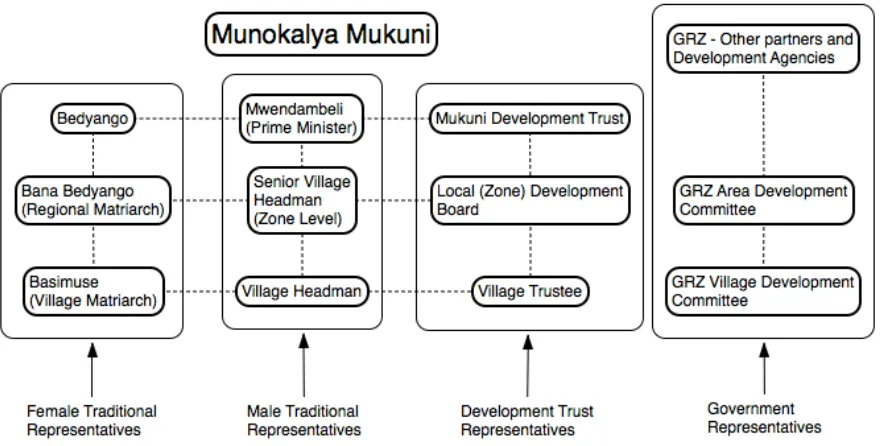
[image:8.595.79.519.335.558.2]The MMC has a well structured, hierarchical governance structure which provides an interface between the traditional leaders and the MDT. The official title of the Chief is Munokalya Mukuni and he is the ritual and political head of the MMRE. He is served by a Mwendambeli, or Prime Minister-like figure, with equivalent administrative representatives below him at Zone level (a zone is a group of villages) and village level. The Bedyango (or Matriarch) is a female member of the MMRE who exerts a powerful control over the male members of the governance structure. Her role is to criticise and publicly cajole, if necessary, the male members of the different levels of administration if the people of the chiefdom have a grievance concerning governance issues. The Bedyango, in partnership with the Mwendambeli, have the power to remove the Munokalya Mukuni should it be deemed necessary in extreme circumstances where he is widely unpopular in the chiefdom. Equivalent administrative links between the elected Government of Zambia (GRZ) structures exist as shown in Figure 1.
Figure 1. Structure of the Munokalya Mukuni governance and management structure (Munokalya, 2013b)
95
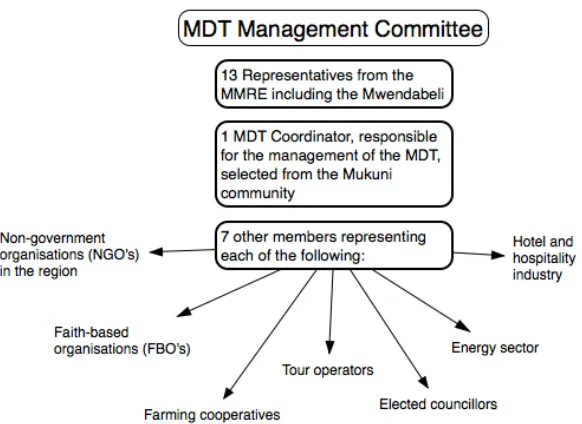
Figure 2. Structure of the Mukuni Development Trust Management Committee (Munokalya, 2013b)
3.1.2 The Sekuti Chiefdom
The Sekuti Chiefdom lacks the organisational structure shown in the MMC. Although traditional structures are in place in terms of there being a group of headmen who act as advisors to Chief Sekuti, there is no other organisation that conducts business on behalf of the people of the chiefdom, or in which people from the community are able to participate. Our interviews with potential investors, current tourist lodge owners and forestry businesses indicate that all business negotiations are conducted on an informal basis with the Chief and his advisors. In some cases, especially in more remote regions of the Chiefdom, dealings with the local community are ad hoc and are sometimes directly with local headmen or other community leaders without any participation of the Chief. There is a marked contrast to the way business is conducted in the MMC and Sekuti Chiefdom. In most cases a meeting fee of around USD1000 is demanded before any meeting can take place with the Chief. Even when this money is paid meetings are often delayed for days at a time. Several potential investors have indicated that demands are made for vehicles to be provided or money to be paid before any agreements are made. The agreements which are made lack structure or in many cases any basis in law and most frequently take the form of verbal promises on the part of the investor and large gifts to the Chief with no receipt provided and no attempt at accounting for money paid. Some projects that benefit the local people have gone ahead (clinic, schools) but these are all individual projects of the tourist lodge nearest to a local village. Tourist lodges have initiated this community interaction out of a combination of goodwill, charitable feeling and a need for having a clear corporate social responsibility profile. There is no coordinated strategy from the Chief and the Sekuti Royal Establishment to spend benefits throughout the community. On the contrary there is evidence that the elite are capturing everything they can when it comes to development in the region, except in those cases where project administration is tightly controlled by the tourist lodge which funds the project and works directly with the local community.
3.1.3 Analysis
96
structure of the committee was laid out in consultations between the leadership and the donor community who provided assistance with institutional design. Since these comprise 30% of the 21 member management committee they provide a degree of oversight of the management committee which is independent of the traditional governance structures. Chief Mukuni himself has no official involvement in the MDT management committee, although one may suppose that his status within the Chiefdom would enable him to exert an influence on the decisions of the committee. We did not find any evidence of this influence being exerted. Chief Mukuni himself makes a clear attempt to separate himself from the business of the MDT and refers all potential investment or business partnership queries that are made to him personally, to the MDT.
Nevertheless, Chief Mukuni makes it quite clear that he has used his status and his influence to expedite license applications or other local government permissions for his own businesses and that of the MDT. He expresses as much frustration with Zambian bureaucracy as many other businessmen in Zambia. We would argue that there is evidence of elite reinforcement on the part of Chief Mukuni and perhaps some of the other senior figures in the MMRE, but there is no evidence of elite capture according to our definition. The MDT has built a secondary school and runs a taxi service that is exclusively for transporting elderly or sick members of the community to Livingstone hospital. A small fund is dedicated to caring for older people who have no relatives or other source of income. It was difficult to get exact figures for the income of the MDT, but a mean figure of around USD10,000 p.a. was calculated from the estimates given by 9 interviewees who were prepared to offer an estimate. Given this quite low level of income it appears that the MDT delivers a comparable level of benefits to the community.
Most tourism operators and business owners expressed frustration with the MDT because they perceived it to be a corrupt organisation. However, some of the examples they cited were simply factually incorrect (they were not aware that the MDT runs a bank account and keep accounts) and there was often complete ignorance about the achievements of the MDT and the composition of the board. However, a group of interviewees who were more sympathetic to what was being attempted by the MDT indicated that the board lacked experience and made bad decisions. They denied that any form of elite capture was a problem, but that business was conducted in a naive and inexperienced way which sometimes lead to projects failing to be implemented or money being wasted. Although there was frustration about the competence of the management of the MDT, all interviewees expressed the need for the trust management committee to learn from mistakes and not to have management decisions imposed on them.
By contrast the Sekuti Chiefdom has a limited capacity for management of funds received by investors or development agencies. The Chief does all negotiations on an ad hoc basis and no attempt is made to secure funding for development. The Chief makes demands for payment at every stage of the negotiations and money paid is not accounted for. The lack of any equivalent management structure or community development trust to allow tourist lodges who want to make a contribution to the Chiefdom, has led to individual, ad hoc
arrangements between local communities and different lodges which depend entirely on the goodwill of the two parties to determine the success of the project and the avoidance of elite capture of the funding which is supplied.
4. Discussion
4.1 A Nuanced Approach to Elite Capture
4.1.1 Democratic Governance as a Solution to Elite Capture?
97
through their links to the MMRE and the religious and spiritual authority which they embody. The MMRE have made these governance structures explicit and establish their legitimacy through publication of historiographical accounts that outline their moral and political justification for the traditional authority (Munokalya, 2013a). A Strategic Development Plan for the chiefdom has been facilitated by international donors (including USAID) and the document is a progressive and well presented statement of how the community wishes to develop over the next decade (Munokalya, 2013b). The organisational reach of the MDT far exceeds that of the elected KDC in this remote region with poor infrastructure. Although there are elected local councillors for the region, it would be difficult for local government to implement any development plan without a major investment by central government in improving the reach, capacity and organisational maturity of the local authority. However this still begs the question about political legitimacy and especially relative political legitimacy of the two institutions in a region where traditional beliefs are still strong. We address the contested concept of democratic and political legitimacy in the next section and also examine the issue of cultural relativism and power which arise from taking a more nuanced and contextual view of the role of elites in development projects.
Despite clear evidence of elite capture in the Sekuti Chiefdom, we reach similar conclusions about the probably effectiveness of democratising the space in which development takes place. The Sekuti Chiefdom already falls within the local government jurisdiction of KDC which is poorly funded and has limited reach and capacity in terms of implementing development programs. The assumption that strengthening this institution will solve problems of elite capture ignores the reality that claims to power and legitimacy by the chiefs are recognised by government and the civil servants who work for KDC. There are already elected councillors in the area, as there are in the MMC, but the claims of the Sekuti Royal Establishment over land and natural resources (which are similar to those of many Chiefdoms in Zambia) means that any development in the region must be negotiated with the Chief before it can proceed. Although applications for development must be passed by the KDC, they require the assent of the Chief before the council will agree to them. The question of legitimacy of any governance regime is as important in the Sekuti Chiefdom as it is in the Mukuni Chiefdom, despite the fact that elite capture means that few projects benefit the poor in the community through money paid to the Sekuti Royal Establishment. The creation of a community development trust and a more detailed analysis of decision making powers within the chiefdom would go a long way towards regularising the arrangements between investors, development agencies, the Sekuti Royal Establishment and the community. There is an obvious temptation to duplicate the model used by the MDT. However the traditions and historiography that legitimise the governance of the MDT are tightly linked to the MMC and these cannot be reproduced in exactly the same way in different communities. We were not able to conduct historical research around the establishment of the Sekuti Chiefdom but suggest that the establishment of a historiographical justification for the existence of the traditional elite would be an important first step in reproducing the governance arrangements of the MMC and MDT. There is little evidence that a democratisation of the structure along conventional democratic principles would be possible or would provide a solution to the problem of elite capture in the Sekuti Royal Establishment.
4.1.2 Relationships in the Shadows
98
Ramutsindela, 2016). There would naturally be strong motivation to keep the relationship between PPF and authorities in Zambia within the expectations of these donors. Officially, relationships for implementation of the Kavango-Zambezi Trans-Frontier Conservation Area (KAZA TFCA) are between PPF and participating government departments, but the reality in Zambia is that traditional authorities hold real power with respect to local implementation and a partnership with the BRE is essential for project delivery. Indeed, one could argue that it is the insistence on the part of Western development discourse that elected local government is the only legitimate authority which forces other potentially more effective partnerships into the shadows thereby restricting transparency and facilitating elite capture. Since we were not able to conduct research in the area we can present no evidence for or against the propriety of the relationship between PPF and the BRE and our exclusion from the area does not provide any insight into this relationship. However PPF have a track record of using their access to powerful and influential figures in business and politics to suppress media exposure of unethical practices (Büscher and Ramutsindela, 2016) and our exclusion from the area appears to mirror a previous reluctance to have their relationships investigated in a transparent and independent manner. In the next section we discuss the concept of political legitimacy and how expanding the concept of political legitimacy may benefit partnerships with traditional authorities and prevent incidents of elite capture via increased transparency of these relationships.
4.2 Political Legitimacy
Political legitimacy is a contested concept, and although John Locke's writings on democratic legitimacy and his social contract theory underpin much of modern democratic thought (Locke, 1988), there is no a priori moral or philosophical criterion for political legitimacy. James Madison's assertions about the role of central government in controlling the tendency of local elites to act in their own interests (Jay et al., 2003) are not applicable to traditional governance arrangements that exist alongside a modern democratic state. This is partly because the abstraction of the individual from society, which underpins Locke's ‘natural state of humanity’ and allows for the erection of the individual as political actor, is in conflict with the views of the individual in African society and in many other societies around the world (Cobbah, 1987; Pollis, 1996). The simplest explanation for an African philosophy of individual existence is summed up in the Zulu saying ‘umuntu ngumuntu ngabantu’ (A person is a person through other people or, I am what I am because of who we all are). By citing this alternative communitarian world view we are drawn into the dichotomy between cultural relativism on the one hand, which can be used to justify and rationalise repression to hold on to political power, and universalism which advocates democratising the development space as the only solution to avoid elite capture and to ensure legitimacy of the governance system. This polarisation is common in human rights discourse (Cobbah, 1987; Donnelly, 2007) but has strong relevance to development studies because 'Scholars . . . have not developed a conceptual framework within which to analyze whether state's claims of cultural distinctiveness are consistent with that cultures conceptions of rights, dignity and justice, or whether it is a wanton exercise of power by the elite' (Pollis, 1996). It seems the furthest the analytical methodology of development discourse has progressed is a loose set of partly descriptive, partly heuristic notions like civil society, social capital, diversity and risk' (Schuurman, 2000, p7). To this list we would add the notions of good governance and participation. Despite the lack of clear analytical frameworks it is important that in allowing for different forms of political legitimacy, we do not adopt the cultural relativists static conception of culture or justification for injustice, but that we view culture as an ongoing institutional and historic process which changes over time (Zechenter, 1997).
None of the members of the MMC community that we interviewed expressed a desire for democratically elected governing body to run the affairs of the MDT. There was unanimous agreement that the management of the MDT should be rooted in their traditions. There is a strong sense of ownership derived from this institutional structure that we interpret as a reflection of the communitarian worldview that defines the individual in relation to his community and its institutions. This is because the traditional authority and the community subscribe to a source of legitimacy that is based on the spiritual, religious and cultural significance of their position. Although there is a role for government in regulating the extent of this authority (for example Chiefs were recently prevented from granting title for parcels of land) the legitimacy of the traditional authority of Chief Mukuni emerges from the link between people and their traditional beliefs. In some African countries traditional leaders have de jure status in the constitution thus providing a level of legitimacy that is additional to other claims (Ray, 2003). Democratising this space may not prevent elite capture as the newly elected authorities may fail to gain the respect and credibility of the people because legitimacy does not emerge from popularity in an election, but from being embedded in their traditions.
99
significant role in community cohesion. It is these leaders who represent a political elite which may come to dominate project implementation and decision making, simply because that is the role they have always played. Context specific assessments of the role which elites play, the degree of community participation in decision making (which is not only via conventional democratic structures) and the degree of transparency are all contextual factors which make the difference between elite control, elite reinforcement and elite capture.
4.3 Power
In political philosophical discourse, analyses of power have followed two approaches. The first equated power with the law, and conceived of its exercise as a contract between two consenting parties: the sovereign on the one hand and people on the other. The second, inspired mostly by Marx, have conceived of power in the ideological representations of the state, with power being exercised through discursive mechanisms. In both cases the state is in the position of the sovereign and power is conceptualised as being unidirectional (McHoul and Grace, 1993). Woods (1998) advocates a post-structuralist, relational approach to elites that is sensitive to the processes and discourses that legitimate their power. There is little indication that this challenge has been taken up in the development literature despite it being one of the most contentious topics in social science (Few, 2002). Despite this criticism, the lack of a methodological and conceptual framework for analysing power makes it difficult to turn complex theories on social power into research methodology. We support Foucault's conception of power, as it provides a broad conceptual approach to the analysis of power that has previously been inadequate (Sharp et al., 2002). Critics of Foucault, such as Giddens (1984) and Layder (1997), have added to the subtlety and complexity of theories of power in society by including the role of socialisation and social practices in governing the control of power and the role of interpersonal power dynamics which are ubiquitous in everyday life (Wong, 2003). It is difficult to be conclusive about whether the exercise of power in this complex and multidimensional interplay of domains of authority between the Bene Mukuni (people of Mukuni) is able to prevent elite capture of resources. However, the theoretical advantages of a broadly Foucauldian approach to analysing power allows a more nuanced, relational approach in assessing the potential for elite capture. The idea of the Chief as sovereign who rules over his people, with power directed only at suppression, domination and control, is a fanciful notion, more typical of fictional kings and queens rather than a description of the realities of power of the traditional authority. The idea that a devolved democratic structure will always functionally and adequately represents the demands and aspirations of the people and allow for participation of the community to the extent that elite capture becomes difficult or impossible, is equally fanciful in a region which is remote, with poor roads and communications and where the capacity to govern effectively is low. In the case of the MMC the position of the Matriarch which is mirrored at every level of administration, and her role as critic, guide and ultimately arbiter of the Chieftainship together with the Mwendabeli, places powerful controls on the rule of the Chief, Zonal headmen and village headmen. Within every level of Bene Mukuni society, from the village to the Chiefs palace, power is exercised as a productive force which both produces reality and its 'rituals of truth' (Foucault, 1977). Although the Sekuti Royal Establishment does not have an articulated historiography of power relations, the power relations are more complex than a simple sovereign model of power. The position of the advisors or induna's, all of whom are drawn from headmen in the community provides a flow of power relations which is unlikely to be unidirectional. There are problems with the structure of the institution of the Sekuti Royal Establishment which is allowing for elite capture of funds, but there is potential to manage power relations in the community by detailed anthropological study of traditions and production of historiography that make explicit the values which would contribute to an institutional structure that is of benefit to the community. It is difficult to see how the introduction of Western democratic governance structures would make any contribution to eliminating elite capture when the basic relations of power between the Sekuti Royal Establishment and the community are problematic.
5. Conclusion
100
the traditional authority are closely linked to a detailed historiography that links this legitimacy to stories of culture and tradition. This legitimacy is underpinned by religious and spiritual links between the political elite and the people. Although it is important to avoid the trap of cultural relativism (Zechenter, 1997), some principles of development theory (participation, transparency,) which evidence shows are important for avoiding elite capture can be applied to the institutional analysis of the traditional authority to ensure elite capture is avoided. We advocate a role for a complex, multidimensional notion of power in, and provide the moral and philosophical justification for, placing democratisation as one of several approaches to the prevention of elite capture.
Acknowledgements
MM would like to acknowledge the support of Dr Hazel Cameron from the School of International Relations, University of St Andrews in guiding the conceptual development of this research and for ongoing support. The research was supported by a grant from the Gerda Henkel Foundation and the University of Liverpool. Publication was supported by a grant from the University of St Andrews Open Access Support programme.
References
Abu-Lughod, L. (2002). Do Muslim Women Really Need Saving? Anthropological Reflections on Cultural Relativism and its Others. American Anthropologist, 104(3), 783–790. http://dx.doi.org/10.1525/aa.2002.104.3.783
Agrawal, A., & Ribot, J. (1999). Accountability in Decentralization: A Framework with South Asian and West African Cases. The Journal of Developing Areas, 33, 473–502.
Alatas, V., Banerjee, A., Hanna, R., Olken, B. A., Purnamasari, R., & Wai-Poi, M. (2013). Does Elite Capture Matter? Local Elites and Targeted Welfare Programs in Indonesia. NBER Working Paper No. 18798. National Bureau of Economic Research, 1050 Massachusetts Ave, Cambridge, MA. http://dx.doi.org/10.2139/ssrn.2326703
Arcand, J., & Wagner, N. (2012). Elite Capture Revisited: Does Community Driven Development Improve Inclusiveness? Evidence from Senegal. Geneva: Graduate Institute of International and Development Studies.
Arnstein, S. R. (1969). A Ladder of Citizen Participation. Journal of the American Institute of Planners, 35(4), 216–224. http://dx.doi.org/10.1080/01944366908977225
Bardhan, P. (2002). Decentralization of Governance and Development. Journal of Economic Perspectives, 16(4), 185–205. http://dx.doi.org/10.1257/089533002320951037
Bardhan, P., & Mookherjee, D. (2006a). The Rise of Local Governments: An Overview. In Bardhan P., & Mookherjee D. (Eds.), Decentralization and Local Governance in Developing Countries: A Comparative Perspective. The MIT Press.
Bardhan, P., & Mookherjee, D. (2006b). Decentralisation and Accountability in Infrastructure Delivery in
Developing Countries. The Economic Journal, 116(508), 101–127.
http://dx.doi.org/10.1111/j.1468-0297.2006.01049.x
Beath, A., Christia, F., & Enikolopov, R. (2011). Elite Capture of Local Institutions: Evidence from a Field Experiment in Afghanistan. Unpublished manuscript.
Chambers, R. (1983). Rural Development: Putting the Last First. Pearson Education Limited.
Chambers, R. (1994). The Origins and Practice of Participatory Rural Appraisal. World Development, 22(7), 953–969.http://dx.doi.org/10.1016/0305-750X(94)90141-4
Chambers, R. (1997). Whose Reality Counts? Putting the First Last. Intermediate Technology Publications Ltd, London.http://dx.doi.org/10.3362/9781780440453
Cobbah, J. A. (1987). African Values and the Human Rights Debate: An African Perspective. Human Rights Quarterly, 9(3), 309–331.http://dx.doi.org/10.2307/761878
Cramer, C., Johnstone, D., Oya, C., & Sender, J. (2015). Mistakes, crises, and research independence: The perils of fieldwork as a form of evidence. African Affairs, 115(458), 145–160. http://dx.doi.org/10.1093/afraf/adv067
Crook, R. C. (2003). Decentralisation and Poverty Reduction in Africa: The Politics of Local--Central Relations.
101
Dasgupta, A., & Beard, V. A. (2007). Community Driven Development, Collective Action and Elite Capture in Indonesia. Development and Change, 38(2), 229–249.http://dx.doi.org/10.1111/j.1467-7660.2007.00410.x Donnelly, J. (2007). The Relative Universality of Human Rights. Human Rights Quarterly, 29(2), 281–306.
http://dx.doi.org/10.1353/hrq.2007.0016
Few, R. (2002). Researching Actor Power: Analyzing Mechanisms of Interaction in Negotiations over Space.
Area, 34(1), 29–38.http://dx.doi.org/10.1111/1475-4762.00054
Finsterbusch, K., & Van Wicklin, W. A. (1989). Beneficiary Participation in Development Projects: Empirical Tests of Popular Theories. Economic Development and Cultural Change, 37(3), 573–593. http://dx.doi.org/10.1086/451743
Foucault, M. (1977). Discipline and Punish: The Birth of the Prison. Allen Lane, London.
Foucault, M. (1978). The History of Sexuality (Vol. 1: An introduction. Trans. Robert Hurley). New York: Pantheon.
Fritzen, S. A. (2007). Can the Design of Community-driven Development Reduce the Risk of Elite Capture? Evidence from Indonesia. World Development, 35(8), 1359–1375. http://dx.doi.org/10.1016/j.worlddev.2007.05.001
Giddens, A. (1984). The Constitution of Society: Outline of the Theory of Structuration. University of California Press.
Groenfeldt, D. (2003). The Future of Indigenous Values: Cultural Relativism in the Face of Economic Development. Futures, 35(9), 917–929.http://dx.doi.org/10.1016/S0016-3287(03)00049-1
Hatchard, J., Ndulo, M., & Slinn, P. (2004). The Devolution of Power to Local Communities. In Hatchard, J., Ndulo, M., & Slinn, P. (Eds.), Comparative Constitutionalism and Good Governance in the Commonwealth
(pp. 184-207). Cambridge University Press.http://dx.doi.org/10.1017/cbo9780511494314.014
Isa, F. G. (2014). Cultural Diversity, Legal Pluralism, and Human Rights from an Indigenous Perspective: The Approach by the Colombian Constitutional Court and the Inter-American Court of Human Rights. Human Rights Quarterly, 36(4), 722–755.http://dx.doi.org/10.1353/hrq.2014.0056
Jay, J., Hamilton, A., & Madison, J. (2003). The Federalist Papers. Random House Publishing Group.
Karsenty, A., & Ongolo, S. (2012). Can Fragile States Decide to Reduce their Deforestation? The Inappropriate Use of the Theory of Incentives with Respect to the REDD Mechanism. Forest Policy and Economics, 18,
38–45.http://dx.doi.org/10.1016/j.forpol.2011.05.006
Kettl, D. F. (2000). The Transformation of Governance: Globalization, Devolution, and the Role of Government.
Public Administration Review, 60(6), 488–497.http://dx.doi.org/10.1111/0033-3352.00112
Kundu, D. (2011). Elite Capture in Participatory Urban Governance. Economic and Political Weekly, 46(10), 23–25.
Larson, A. (2005). Democratic Decentralization in the Forestry Sector: Lessons Learned from Africa, Asia and Latin America. In Colfer, C. P., & Capistrano, D. (Eds.), The Politics of Decentralisation: Forests, Power and People (pp. 32–62). London: Earthscan.
Larson, A. M., & Soto, F. (2008). Decentralization of Natural Resource Governance Regimes. Annual Review of Environment and Resources, 33(1), 213-239.http://dx.doi.org/10.1146/annurev.environ.33.020607.095522 Larson, A., & Ribot, J. (2004). Democratic Decentralisation through a Natural Resource Lens: An Introduction.
The European Journal of Development Research, 16(1), 1–25.
http://dx.doi.org/10.1080/09578810410001688707
Layder, D. (1997). Modern Social Theory: Key Debates and New Directions. Psychology Press.
Locke, J. (1988). Locke: Two Treatises of Government Student Edition. Cambridge University Press. http://dx.doi.org/10.1017/CBO9780511810268
Lockwood, M. (2010). Good Governance for Terrestrial Protected Areas: A Framework, Principles and Performance Outcomes. Journal of Environmental Management, 91(3), 754-766. http://dx.doi.org/10.1016/j.jenvman.2009.10.005
102
Lyons, M., Smuts, C., & Stephens, A. (2001). Participation, Empowerment and Sustainability: (How) do the Links Work? Urban Studies, 38(8), 1233–1251.http://dx.doi.org/10.1080/00420980125039
Mansuri, G., & Rao, V. (2004). Community-based and -driven Development: A Critical Review. The World Bank Research Observer, 19(1), 1–39.http://dx.doi.org/10.1093/wbro/lkh012
Maveneke, T. N. (1998). Local Participation as an Instrument for Natural Resources Management under the Communal Areas Management Programme for Indigenous Resources (CAMPFIRE) in Zimbabwe. In: Proceedings of an International Workshop on Community-Based Natural Resource Management (CBNRM), Washington, DC 10–14.
McHoul, A., & Grace, W. (1993). A Foucault Primer. Discourse Power and the Subject. Melbourne University Press.
Mills, C. W. (1958). The Structure of Power in American Society. British Journal of Sociology, 9(1), 29–41. http://dx.doi.org/10.2307/587620
Munokalya, M. (2013a). The Mukuni Royal Dynasty's Short History and the Munokalya Mukuni Royal Establishment's Ritual and Political Sovereignty. Munokalya Mupotola IV Siloka III Mukuni XIX.
Munokalya, M. (2013b). Munokalya Mukuni Chiefdom Stategic Development Plan 2013-2017. Technical Report. Funded by USAID, PEPFAR, SHARe II.
Nelson, F., & Agrawal, A. (2008). Patronage or Participation? Community-based Natural Resource Management Reform in Sub-Saharan Africa. Development and Change, 39(4), 557–585. http://dx.doi.org/10.1111/j.1467-7660.2008.00496.x
Nemarundwe, N., & Richards, M. (2002). Participatory Methods for Exploring Livelihood Values Derived from Forests: Potential and Limitations. People and Plants Conservation Series. In Luckert, M. K., & Campbell, B. M. (Eds.), Uncovering the Hidden Harvest: Valuation Methods for Woodlands and Forest Resources (pp. 168-197). London: UK, Earthscan.
Persha, L., & Andersson, K. (2014). Elite Capture Risk and Mitigation in Decentralized Forest Governance Regimes. Global Environmental Change, 24, 265–276.http://dx.doi.org/10.1016/j.gloenvcha.2013.12.005 Platteau, J. P. (2004). Monitoring Elite Capture in Community-Driven Development. Development and Change,
35(2), 223–246.http://dx.doi.org/10.1111/j.1467-7660.2004.00350.x
Platteau, J. P. (2009) Information Distortion, Elite Capture and Task Complexity in Decentralised Development. In Ahmed, E., & Brosio, G. (Eds.), Does Decentralization Enhance Service Delivery and Poverty Reduction
(pp. 23–72). Northampton, MA: Edward Elgar.http://dx.doi.org/10.4337/9781849801850.00008
Pollis, A. (1996). Cultural Relativism Revisited: Through a State Prism. Human Rights Quarterly, 18(2), 316–344.http://dx.doi.org/10.1353/hrq.1996.0021
Pretty, J. (2003). Social Capital and the Collective Management of Resources. Science, 302(5652), 1912–1914. http://dx.doi.org/10.1126/science.1090847
Ray, D. I. (2003). Chiefs in their Millennium Sandals: Traditional Authority in Ghana - Relevance, Challenges and Prospects. In Tettey, W. J., Puplampu, K. P., & Berman, B. T. (Eds.), Critical Perspectives in Political and Socioeconomic Development in Ghana (pp. 241–271; African Social Studies Series, Vol. 6). Leiden: Boston Brill.
Ribot, J. C. (2006). Choose Democracy: Environmentalists Socio-political Responsibility. Global Environmental Change, 16(2), 115–119.http://dx.doi.org/10.1016/j.gloenvcha.2006.01.004
Ribot, J. C., Agrawal, A., & Larson, A. M. (2006). Recentralizing While Decentralizing: How National Governments Reappropriate Forest Resources. World Development, 34(11), 1864–1886. http://dx.doi.org/10.1016/j.worlddev.2005.11.020
Rodiguez-Pose, A., & Gill, N. (2003). The Global Trend towards Devolution and its Implications. Environment and Planning C: Government and Policy, 21(3), 333–351.http://dx.doi.org/10.1068/c0235
Schuurman, F. J. (2000). Paradigms Lost, Paradigms Regained? Development Studies in the Twenty-first Century. Third World Quarterly, 21(1), 7–20.http://dx.doi.org/10.1080/01436590013198
103
Smith, K. E. (2006). Problematising Power Relations in `Elite' Interviews’. Geoforum, 37(4), 643-653. http://dx.doi.org/10.1016/j.geoforum.2005.11.002
United Nations. (2011). The UN-REDD Programme Strategy. Technical Report. United Nations Development Programme, UNDP.
Wong, K. F. (2003). Empowerment as a Panacea for Poverty - Old Wine in New Bottles? Reflections on the World Bank’s Conception of Power. Progress in Development Studies, 3(4), 307–322. http://dx.doi.org/10.1191/1464993403ps067oa
Woods, M. (1998). Rethinking Elites: Networks, Space, and Local Politics. Environment and Planning A, 30(12), 2101–2119. http://dx.doi.org/10.1068/a302101
World Bank. (2004). World Development Report 2004: Making Services Work for Poor People. Washington D.C.: World Bank.
Zambia Wildlife Authority. (2008). Integrated Development Plan. Zambia Component of the KAZA TFCA. Technical report, Peace Parks Foundation.
Zechenter, E. M. (1997). In the Name of Culture: Cultural Relativism and the Abuse of the Individual. Journal of Anthropological Research, 53(3), 319–347.http://dx.doi.org/10.1086/jar.53.3.3630957
Copyrights
Copyright for this article is retained by the author(s), with first publication rights granted to the journal.