doi:10.4236/am.2011.25085 Published Online May 2011 (http://www.SciRP.org/journal/am)
Numerical Solution of a Class of Nonlinear Optimal
Control Problems Using Linearization and Discretization
Mohammad Hadi Noori Skandari, Emran Tohidi
Department of Applied Mathematics, School of Mathematical Sciences, Ferdowsi University of Mashhad, Mashhad, Iran
E-mail:etohidi110}@yahoo.com
Received March 13, 2011; revised March 30, 2011; accepted April 4, 2011
Abstract
In this paper, a new approach using linear combination property of intervals and discretization is proposed to solve a class of nonlinear optimal control problems, containing a nonlinear system and linear functional, in three phases. In the first phase, using linear combination property of intervals, changes nonlinear system to an equivalent linear system, in the second phase, using discretization method, the attained problem is con-verted to a linear programming problem, and in the third phase, the latter problem will be solved by linear programming methods. In addition, efficiency of our approach is confirmed by some numerical examples.
Keywords:Linear and Nonlinear Optimal Control, Linear Combination Property of Intervals, Linear Programming, Discretization, Dynamical Control Systems.
1. Introduction
Control problems for systems governed by ordinary (or partial) differential equations arise in many applications, e.g., in astronautics, aeronautics, robotics, and economics. Experimental studies of such problems go back recent years and computational approaches have been applied since the advent of computer age. Most of the efforts in the latter direction have employed elementary strategies, but more recently, there has been considerable practical and theoretical interest in the application of sophisticated optimal control strategies, e.g., multiple shooting me-thods [1-4], collocation meme-thods [5,6], measure theoreti-cal approaches [7-10], discretization methods [11,12], numerical methods and approximation theory techniques [13-16], neural networks methods [17-19], etc.
The optimal control problems we consider consist of 1) State variables, i.e., variables that describe the sys-tem being modeled;
2) Control variables, i.e., variables at our disposal that can be used to affect the state variables;
3) A state system, i.e., ordinary differential equations relating the state and control variables;
4) A functional of the state variables whose minimiza-tion is the goal.
Then, the problems we consider consist of finding state and control variables that minimize the given
func-tional subject to the state system being satisfied. Here, we restrict attention to nonlinear state systems and to li-near functionals.
The approach we have described for finding approx-imate solutions of optimal control problems for ordinary diffrential equations is of the linearize-then-discretize- then-optimize type.
Now, consider the following subclass of nonlinear op-timal control problems:
( ) ( )
0min tf d
t c t x t t
∫
(1)( )
( ) ( )
(
( )
)
( )
( )
( )
0
0
subject to , ,
, ,
, ,
f
f
x t A t x t h t u t
u t U t t t
x t α x t η
= +
∈ ∈
= =
(2)
where A
( )
. ∈n n× , c( )
. , α and η∈n are known,( )
. nx ∈ and u
( )
. ∈m are the state and control va-riables respectively. It is assumed that U is a compactand connected subset of mand h
( )
.,. ∈nis a smooth or non-smooth continuous function on t t0, f × U. More-over, there exists a pair of state and control variables( ) ( )
(
x . ,u .)
such that satisfies (2) and boundary conditions( )
0dy-namical control system (2) to the equivalent linear sys-tem. The new optimal control problem with this linear dynamical control system is transformed to a discrete- time problem that could be solved by linear program-ming methods (e.g. simplex method).
There exist some systems containing non-smooth func-tion h
( )
.,. with regard to control variables. In such sys-tems, multiple shooting methods [1-4] do not dealing with the problem in a correct way. Because, in these me-thods needing to computation of gradients and hessians of function h( )
.,. is necessary. However, considering of non-smoothness of function h( )
.,. could not make any difficulty in our approach. Moreover, in another appro- aches (see [11,12] ), which discretization methods are the major basis of them, if a complicated function h( )
.,. is chosen, obtaining an optimal solution seems to be diffi-cult. Here, we show that our strategy acquire better solu-tions, that attained in fewer time, than one of the above- mentioned methods through several simplistic examples, which comparison of the solutions is included in each example.This paper is organized as follows. Section 2, trans-forms the nonlinear h
( )
.,. to a corresponding function That is linear with respect to a new control variable. In Section 3, the new problem is converted to a discrete- time problem via discretization. In Section 4, numerical examples are presented to illustrate the effectiveness of this proposed method. Finally conclusions are given in Section 5.2. Linearization
In this section, problems (1)-(2) is transformed to an equi- valent linear problem. First, we state and prove the fol-lowing two theorems:
Theorem 2.1: Let hi:t t0, f × → U fori=1, 2,,n
be a continuous function where U is a compact and connected subset of m
, then for any arbitrary (but fixed) t∈ t0,tf the set
{
h t ui( )
, :u∈U}
is a closed interval in.Proof: Assume that t∈ t t0, f be given. Let φi
( )
u( )
,i
h t u
= for i=1, 2,,n. Obviously φi
( )
. is a conti-nuous function on U. Since continuous functions pre-serve compactness and connectedness properties,( )
{
φi u :u∈U}
is compact and connected in.There-fore
{
h t ui( )
, :u∈U}
is a closed interval in. Now, for any t∈ t t0, f, suppose that the lower and upper bounds of the closed interval{
h t ui( )
, :u∈U}
areg ti
( )
and w ti( )
respectively. Thus fori=1, 2,,n:( )
( )
,( )
,(
0,)
i i i f
g t ≤h t u ≤w t t∈ t t (3)
In other words
( )
min{
( )
, :}
, 0,i i f
u
g t = h t u u∈U t∈ t t (4)
( )
max{
( )
, :}
, 0,i i f
u
w t = h t u u∈U t∈ t t (5) Theorem 2.2: Let functions gi
( )
. and wi( )
. for1, 2, ,
i= n be defined by relations (4) and (5). Then they are uniformly continuous on t t0, f.
Proof: We will show that gi
( )
. for i=1, 2,,n is uniformly continuous. It is sufficient to show that for any given ε >0, there existsδ >0such that if s1∈Nδ( )
s2then g si
( )
1 −g si( )
2 <εwhere Nδ( )
z is a δ−neigh-borhood of z. Since any continuous function on a com- pact set is uniformly continuous, the function hi
( )
.,. on the compact set t t0, f × U is uniformly continuous, i.e. for any ε >0 there exists δ >0, such that if( )
s u1,(
2,)
Nδ s u
∈ thenh s ui
(
1,)
−h s ui(
2,)
<ε.Thus h s ui(
1,)
(
2,)
ih s u ε
< + . In addition, by (4), g si
( )
1 ≤h s ui(
1,)
and so g si
( )
1 ≤h s ui(
2,)
+ε. Now, by taking infimumon the right hand side of the latter inequalityg si
( )
1 ≤( )
2i
g s +ε. By a similar argument we have alsog si
( )
2( )
1i
g s ε
− ≤ . Thus g si
( )
1 −g si( )
2 ≤ε. The proof ofuniformly continuity of wi
( )
. for i=1, 2,,n is simi-lar.By linear combination property of intervals and rela-tion (4), for any t∈ t t0, f:
( )
(
,)
( ) ( )
( )
,( )
[ ]
0,1i i i i i
h t u t =β t λ t +g t λ t ∈ (6) where βi
( )
t =w ti( )
−g ti( )
for i=1, 2,,n . Thus, we transform problems (1)-(2) by relations (4), (5) and (6) to the following problem:( ) ( )
( )
( ) ( )
( ) ( )
( )
( )
( )
0
1
0 0
min
subject to ,
0 ( ) 1, , , 1, 2, ,
,
f
t t
n
k kr r k k k r
k f
f
c t x t dt
x t a t x t t t g t
t t t t k n
x t x t
β λ
λ
α η
=
= + +
≤ ≤ ∈ =
= =
∫
∑
(7) where akr
( )
. is the kth row and rth column compo-nent of matrix A( )
. . Note that on the problem (7), which is a linear optimal control problem, λ( )
. =(
λ1( ) ( )
. ,λ2 . ,( )
)
,λn .
is the new control variable.
Next section, converts the latter problem to the cor-responding discrete-time problem.
optimal solution of problem (7). Then, there exists u∗
( )
. such that the pair of(
x∗( ) ( )
. ,u∗ .)
is the optimal solution of problems (1)-(2).Proof:Let u∗
( )
. satisfies system of (6), whereλ∗( )
. is replaced byλ( )
. . Thus, the pair of(
x∗( ) ( )
. ,u∗ .)
satis-fies constraints of problems (1)-(2). Since the objective function of problems (1)-(2) is the same of problem (7), the pair of(
x∗( ) ( )
. ,u∗ .)
is the optimal solution of (1)-(2) evidently.3. Discrete-Time Problem
Now, discretization method enables us transforming con-tinuous problem (7) to the corresponding discrete form. Consider equidistance pointst0=s0< <s1 s2< <sN
f
t
= on t t0, fwhich defined assj = +t0 δj for all
0,1, ,
j= N with length step tf t0
N
δ = − where N
is a given large number. We use the trapezoidal approx-imation in numerical integration and the following ap-proximations to change problem (7) to the corresponding discrete form:
( )
( ) ( )
1( )
( )
(
1)
, ,
1, 2, , 1, 2, , 1.
k j k j k N k N
k j k N
x s x s x s x s
x s x s
k n j N
δ δ + − − − ≈ ≈ = = −
Thus we have the following discrete-time problem with unknown variables xkj and λkj for k=1, 2,,n and
0,1, 2, ,
j= N :
(
)
(
)
(
)
1
0 0
1 1 1
, 1 1 , 1 1 min 2 subject to 1 ,
0,1, , 1, 1, 2, ,
1 ,
1, 2, , 0 1 , 0,1, , , 1,
n n N
k k kN kN kj kj
k k j
n
k j kkj kj krj rj kj kj kj r
r k
n
kkN kN k N krN rN kN kN kN r
r k
kj
c x c x c x
x a x a x g
j N k n
a x x a x g
k n j N
k
δ δ
δ δ δβ λ δ
δ δ δβ λ δ
λ − = = = + = ≠ − = ≠ + + − + − − = = − = − − − − = = ≤ ≤ = =
∑
∑ ∑
∑
∑
02,,n xk =αk, xkN =ηk, k=1, 2,,n (8) where
( )
( )
( )
( )
( )
( )
, , , , , ,kj k j kj k j krj kr j
kj k j kj k j kj k j
x x s c c s a a s
s g g s s
λ λ β β
= = =
= = =
for all k=1, 2,,n and j=0,1,,N . By solving problem (8), which is a linear programming problem, we are able to obtain optimal solutions λkj
∗
and xkj
∗
for all
1, 2, ,
j= N and k=1, 2,,n. Note that, for evaluat-ing the control function u∗
( )
. , we must use the follow-ing system:( )
(
,)
( ) ( )
( )
h t u∗ t =β t λ∗ t +g t (9) Remark 3.1: The most important reason of LCPI (li-near combination property of intervals) consideration is that problem (8) is an (finite-dimensional) LP problem and has at least a global optimal solution (by the assump-tions of the problems (1)-(2)). However, if problems (1)- (2) be discretized directly then, we reach to an NLP problem which its optimal solution may be a local solu-tion.
Remark 3.2: In Equation (8) if h
( )
.,. is a well-define function with respect to control u( )
. we can obtain op-timal control u∗( )
. directly. Otherwise, one has to apply numerical technique such as Newton and fixed-point me- thods for approximating u∗( )
. after obtaining λ∗( )
. .4. Numerical Examples
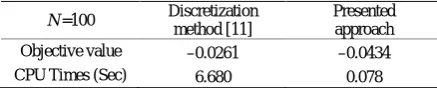
Here, we use our approach to obtain approximate optimal solutions of the following three nonlinear optimal control problems by solving linear programming (LP) problem (8), via simplex method [20]. All the problems are pro-grammed in MATLAB and run on a PC with 1.8 GHz and 1GB RAM. Moreover, comparisons of our solutions with the method that argued in [11] are included in Tables 1, 2 and 3 respectively for each example.
Example 4.1: Consider the following nonlinear op-timal control problem:
( ) ( )
( )
( ) ( )
( )
( )
[ ]
( )
( )
1 0 3min sin 3 d
subject to cos 2 tan ,
8
0 1, 0,1
0 1, 1 0.
t x t t
x t t x t u t t
u t t
x x
π
π
= π − +
≤ ≤ ∈ = =
∫
(10)Here,
( )
3( )
( )
, tan , sin 3
8
h t u = − πu +t c t = πt
and
( )
A t =cos 2
( )
πt for( )
t u, ∈[ ] [ ]
0,1× 0,1 . Thus by (4) and (5) for all t∈[ ]
0,1( )
3[0,1]
min tan tan ,
8 8
u
g t u t t
∈
π π
= − + = − +
( )
3( )
[0,1]
max tan tan .
8 u
w t u t t
∈
π
= − + = −
Hence
( )
( )
( )
tan( )
tan . 8t w t g t t t
β = − = − + +π
Let N=100. Then δ =0.01 and
100
j
j s = for 0,1, 2, ,100.
j= The optimal solutions x∗j and λ∗j, 0,1, 2, ,100.
j= Of problem (10) is obtained by solving problem (8) which is illustrated in Figures 1 and 2 re-spectively. Here, the value of optimal solution of objec-tive function is 0.0977. In addition, the corresponding Equation (9) of this example is
( )
( )
3
tan 0,1, 2, ,100
8uj sj β sj λj g sj j
∗ ∗
π
− + = + =
Therefore for j=0,1, 2,,100
( )
( )
(
)
(
)
1/31
8
tan ,
j j j j j
u∗= − −β s λ∗−g s −s
π
The optimal control u*j, j=0,1, 2,,100 of
prob-lem (10) is showed in Figure 3.
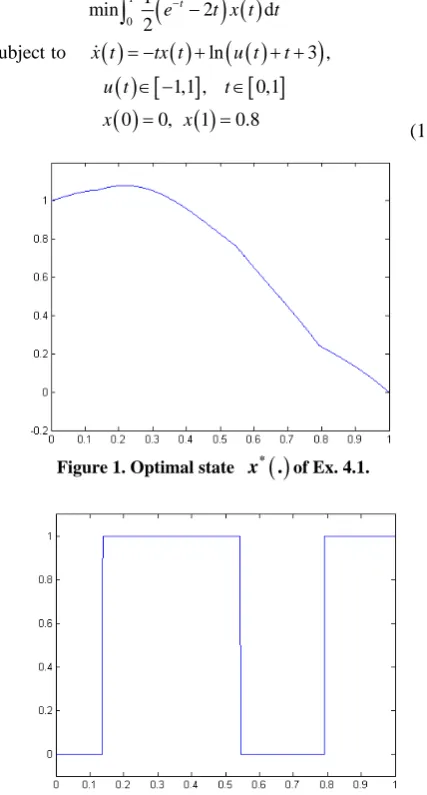
Example 4.2: Consider the following nonlinear op-timal control problem:
(
)
( )
( )
( )
(
( )
)
( )
[
]
[ ]
( )
( )
1 0
1
min 2 d
2
subject to ln 3 ,
1,1 , 0,1
0 0, 1 0.8
t
e t x t t
x t tx t u t t
u t t
x x
− −
= − + + +
∈ − ∈
= =
∫
[image:4.595.68.475.68.698.2](11)
Figure 1. Optimal state x*
( )
. of Ex. 4.1. [image:4.595.65.279.306.704.2]Figure 2. Corresponding optimal control λ*
( )
. of Ex. 4.1.Figure 3. Optimal control u*
( )
. of Ex. 4.1.By relations (4) and (5) for t∈
[ ]
0,1( )
{
(
)
}
(
)
[ 1,1]
min ln 3 ln 2 ,
u
g t u t t
∈ −
= + + = +
( )
{
(
)
}
(
)
[ 1,1]
max ln 3 ln 4 .
u
w t u t t
∈ −
= + + = +
Hence
( )
t w t( )
g t( )
ln(
t 4)
ln(
t 2)
β = − = + − +
Let N =100. Then δ =0.01 and
100
j
j
s = for all 0,
j= 1, 2,,100. We obtain the optimal solutions xj
∗
and λj
∗
, j=0,1, 2,,100 of this problem by solving corresponding problem (8) which is illustrated in Fig-ures 4 and 5 respectively. In addition, by relation (9) the corresponding u∗
( )
. of this example is( ) ( )
3, 0,1, 2, ,100
j j j
s g s
j j
u∗=eβ λ∗+ − −s j=
The optimal controls *
j
u , j=0,1, 2,,100 of prob-lem (11) is shown in Figure 6. Here, The value of op-timal solution of objective function is –0.1829.
Example 4.3: Consider the following nonlinear op-timal control problem:
( )
(
)
( )
( )
(
)
( )
( )
[
]
[ ]
( )
( )
1 0
3
5 2 sin(2 )
min sin 2 d
subject to ( ) e ,
1,1 , 0,1 0 0.9, 1 0.4
t
t
t e x t t
x t t t t x t u t
u t t
x x
−
π
π −
= − + −
∈ − ∈
= =
∫
(12)
Since
( )
( )
3 sin(2π), e t
h t u = −u t is a non-smooth func-tion, the methods that discussed in [2,6] cannot solve the problem (14) correctly. However, by relations (4) and (5), we have for all t∈
[ ]
0,1 :( )
{
( )
3 sin(2 )}
sin(2 )[ 1,1]
min e t e t ,
u
g t u t π π
∈ −
Figure 4. Optimal state x*
( )
. of Ex. 4.2. [image:5.595.72.276.77.411.2]Figure 5. Corresponding optimal control λ*
( )
. of Ex. 4.2.Figure 6. Optimal control u*
( )
. of Ex. 4.2.( )
{
( )
3 sin(2 )}
[ 1,1]
max e t 0,
u
w t u t π
∈ −
= − =
thus
( )
( ) ( )
sin(2 )e t.
t w t g t
β = − = π
Let N=100. Then δ =0.01 and
100
j
j
s = for all
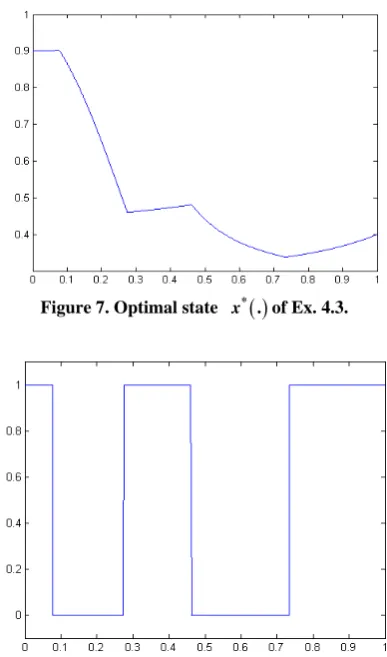
Figure 7. Optimal state x*
( )
. of Ex. 4.3. [image:5.595.324.526.438.604.2]Figure 8. Corresponding optimal control λ*
( )
. of Ex. 4.3.Figure 9. Optimal control u*
( )
. of Ex. 4.3.0,1, 2, ,100
j= . We obtain the optimal solutions xj
∗
and λj,
∗
0,1, 2, ,100
j= of this problem by solving corresponding problem (8), which is illustrated in Fig- ures 7 and 8 respectively. In addition, by relation (9) the corresponding u∗
( )
. of this example is( )
( )
(
)
(
)
13
sin(2 )
e sj , 0,1, 2, ,100
j j j j
[image:5.595.77.274.445.602.2]Table1. Solutions comparison of the Ex. 10.
N =100 Discretization
method [11]
Presented approach
Objective value 0.1180 0.0980
CPU Times (Sec) 5.281 0.047
Table2. Solutions comparison of the Ex. 11.
N =100 Discretization
method [11]
Presented approach
Objective value –0.1808 –0.1830
CPU Times (Sec) 95.734 0.125
Table3. Solutions comparison of the Ex. 12.
N =100 Discretizationmethod [11] Presentedapproach
Objective value –0.0261 –0.0434
CPU Times (Sec) 6.680 0.078
The optimal controls *
j
u , j=0,1, 2,,100 of problem (12) is shown in Figure 9. Here, the value of optimal solution of objective function is –0.0435.
5. Conclusions
In this paper, we proposed a different approach for solv-ing a class of nonlinear optimal control problems which have a linear functional and nonlinear dynamical control system. In our approach, the linear combination property of intervals is used to obtain the new correspondingpro- blem which is a linear optimal control problem. The new problem can be converted to an LP problem by discrete-zation method. Finally, we obtain an approximate solu-tion for the main problem. By the approach of this paper we may solve a wide class of nonlinear optimal control problems.
6. References
[1] M. Diehl, H. G. Bock and J. P. Schloder, “A Real-Time Iteration Scheme for Nonlinear Optimization in Optimal Feedback Control,” Siam Journal on Control and Opti-mization, Vol. 43, No. 5, 2005, pp.1714-1736.
doi:10.1137/S0363012902400713
[2] M. Diehl, H. G. Bock, J. P. Schloder, R. Findeisen, Z. Nagyc and F. Allgower, “Real-Time Optimization and Nonlinear Model Predictive Control of Processes Go-verned by Differential-Algebraic Equations,” Journal of Process Control, Vol. 12, No. 4, 2002, pp. 577-585. [3] M. Gerdts and H. J. Pesch, “Direct Shooting Method for
the Numerical Solution of Higher-Index DAE Optimal Control Problems,” Journal of Optimization Theory and Applications, Vol. 117, No. 2, 2003, pp. 267-294. doi:10.1023/A:1023679622905
[4] H. J. Pesch, “A Practical Guide to the Solution of Real- Life Optimal Control Problems,” 1994.
http://citeseerx.ist.psu.edu/viewdoc/download?doi=10.1.1 .53.5766&rep=rep1&type=pdf
[5] J. A. Pietz, “Pseudospectral Collocation Methods for the Direct Transcription of Optimal Control Problems,” Master Thesis, Rice University, Houston, 2003.
[6] O. V. Stryk, “Numerical Solution of Optimal Control Problems by Direct Collocation,” International Series of Numerical Mathematics, Vol. 111, No. 1, 1993, pp. 129- 143.
[7] A. H. Borzabadi, A. V. Kamyad, M. H. Farahi and H. H. Mehne, “Solving Some Optimal Path Planning Problems Using an Approach Based on Measure Theory,” Applied Mathematics and Computation, Vol. 170, No. 2, 2005, pp. 1418-1435.
[8] M. Gachpazan, A. H. Borzabadi and A. V. Kamyad, “A Measure-Theoretical Approach for Solving Discrete Optimal Control Problems,” Applied Mathematics and Computation, Vol. 173, No. 2, 2006, pp. 736-752. [9] A.V. Kamyad, M. Keyanpour and M. H. Farahi, “A New
Approach for Solving of Optimal Nonlinear Control Problems,” Applied Mathematics and Computation, Vol. 187, No. 2, 2007, pp. 1461-1471.
[10] A. V. Kamyad, H. H. Mehne and A. H. Borzabadi, “The Best Linear Approximation for Nonlinear Systems,” Ap-plied Mathematics and Computation, Vol. 167, No. 2, 2005, pp. 1041-1061.
[11] K. P. Badakhshan and A. V. Kamyad, “Numerical Solu-tion of Nonlinear Optimal Control Problems Using Non-linear Programming,” Applied Mathematics and Compu-tation, Vol. 187, No. 2, 2007, pp. 1511-1519.
[12] K. P. Badakhshan, A. V. Kamyad and A. Azemi, “Using AVK Method to Solve Nonlinear Problems with Uncer-tain Parameters,” Applied Mathematics and Computation, Vol. 189, No. 1, 2007, pp. 27-34.
[13] W. Alt, “Approximation of Optimal Control Problems with Bound Constraints by Control Parameterization,” Control and Cybernetics, Vol. 32, No. 3, 2003, pp. 451- 472.
[14] T. M. Gindy, H. M. El-Hawary, M. S. Salim and M. El-Kady, “A Chebyshev Approximation for Solving Op-timal Control Problems,” Computers & Mathematics with Applications, Vol 29, No. 6, 1995, pp 35-45.
doi:10.1016/0898-1221(95)00005-J
[15] H. Jaddu, “Direct Solution of Nonlinear Optimal Control Using Quasilinearization and Chebyshev Polynomials Problems,” Journal of the Franklin Institute, Vol. 339, No. 4-5, 2002, pp. 479-498.
[16] G. N. Saridis, C. S. G. Lee, “An Approximation Theory of Optimal Control for Trainable Manipulators,” IEEE Transations on Systems, Vol. 9, No. 3, 1979, pp. 152-159. [17] P. Balasubramaniam, J. A. Samath and N. Kumaresan,
“Optimal Control for Nonlinear Singular Systems with Quadratic Performance Using Neural Networks,” Applied Mathematics and Computation, Vol. 187, No. 2, 2007, pp. 1535-1543.
[image:6.595.61.280.233.277.2]Nonlinear Systems,” Automatica, Vol. 43, No. 3, 2007, pp. 482-490.
[19] P. V. Medagam and F. Pourboghrat, “Optimal Control of Nonlinear Systems Using RBF Neural Network and Adaptive Extended Kalman Filter,” Proceedings of
American Control Conference Hyatt Regency Riverfront, St. Louis, 10-12 June 2009, pp. 355-360.